
A New Method of 3-D Motion Analysis Using a Concept of Projective Geometry
Proceedings of the Ninth International Joint Conference on Artificial Intelligence. Perception. Pages 902-903.
© 1985 International Joint Conferences on Artificial Intelligence
Abstract
This paper describe s a method of interpreting three dimensional motion of an object by making use of rigidity assurnption and orientation of its edge . We employ a vanishing point to determine the o rient a tion. We propese a new idea of using cross ratio, i.e . one of the mo st fundament a l concepts in pr o jective ge o metry to find a vanish ing point of a line. This a ll ows t o calculate the l oca ti o n of a van i s hing point with a known seq uence of p o int s on it withovc another parallel line required by the conventional meth od .
- Ullman, s . The Interpretation of Visual Motion, MIT Press , 1979
- Horn, B. K. P., et al., "Determining optical flow" , Artif. Intell. , 17 1981
- Prazdny , K. "Egomotion and relative depth map from optical flow " , Biol. Cybern. 36 1980 {3)
- Kender, J. R. "Shape from texture " , DARPA , Image Understanding Workshop , 1979
- Huang , T. s . Ed . , Image Sequence Analysis, Springer-verlag, 1981
References were extracted automatically from the PDF and may contain errors.
Full text extracted automatically from the PDF; figures, tables and equations may differ. The PDF is the version of record.
Introduction
These years a nurnber, of researchers working on the computer vision com~ t o be interest8d in the analysis of three dimentional motions of an object f vr the application t o improving industrial r obots and some intelligent systems. Three major approa ches have been taken for this problem, optical flow ana l ysi s , algebraic geometry and projective geometry . These methods have their own advantages.
Some robots, for exarnple mobile r obot s, r equire visual systems providing a standard (not long focus) lens for getting a rather wide scope . Perspective distortions appear in the image, since projection through such a lens yields an image of central projection. Perspective geometry is useful to deal wi th the image. The most advantageaus point of it is that it enables t o calculate rela tive distance between the camer a and arbitary points on a line could be calcula ted by a simple ratio of the one (or two) dimensional distances between the images of the points and the vanishing point of the line. The difficulty in the procedure is t o find the vanishing point by means of image proces sing . Hence it has been given a priori in most o f the scene analysis us ing vanishing points. In case of utilizing image processing it has been determined an intersection o f several edges in an image asswned to be parallel in the orginal space . However we often encounter the cases to analyze irnages which invo l ve no parallel edges or lines.
In this paper we prope se a method which does not require the existence o f parallel lines f or finding the vanishing point of a line. It i s expected t o extend application areas of projective geometry in the field of computer vision and scene analysis . We describe an application t o interpreting the 3-D motion of an object moving freely in space.
A New Method of 3-D Motion Analysis Using A Concept of Projective Geometry
Tadahiro Kitahashi
Dept. of Infor. & Comp. Seiences Toyohashi Univ. of Technology Toyohashi, 440, JAPAN
Hiroyuki Endo
Fujitsu Ltd.
Kawasaki, 210 , JAPAN
2. Preliminary
In this paper the vanishing point is used t o know the orientati on of an object and the rigidity assurnption i s also used to calculate position of the object at each instance o f the motion. Below will be presented several fundament al properties of a lgebraic geometry which are necessary to the discussion.
2 .1 Coordinates and Central projection
Cartesian coordinates to express three dimensional location o f an object are fixed t o a carnera. The origin is set on the eyepoint, i.e.the center of the lens and the z-axis is aligned to the optical axis. A focal distance is denoted by f.
An image plane with coordinates ( ~ , Z ) i s defined by an equation z=f, that is, t o be parallel to the xy plane at a distance f in front of the eyepoint s uch tha t the z-axis pierces the coordinate axes origin . As illustrated in Fig .l, ~ and ~ axes on the image plane are defined to be parallel to the x and y axes , respectively. Since a point P(x ,y,z) is pro jected to a point p(s, 1-) on
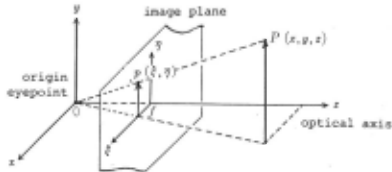
the image plane by the central following equations hold. pro jection, the
When a line with a directional cosine (n 1 ,n2 ,n3 ) is projected onto the image plane, the coordina tes ( §.,. , Zoo ) of i t s vanishing point is represented by the following equations.
Inversely, a line with the vanishing point (§.,2H) on the image plane is pointing in the direction (n 1 , n 2 ,n3 ) in the 3-D space, where
2.2 Rigidity-assumption and central projection
Let r denote the distance between two points P 1 (x 1 ,y 1 , z 1 ) and P 2 (x 2 ,y 2 , z 2 ) on an object and (n 1 ,n2 ,n3 ) denote the orientation of the line P,~ running on these points. We get the following relations.
If these points change the position to P 1 ' (x: ,y,' , z; ) and P; (x~ , y;, z;) after a motion of the object, the distance between them is invariant from the rigidity-assumption of the object. Thus the similar relations to eq. (4) hold as follows.
where (n; ,n; ,nl) also represents the orientation of the line P 1 ' P;.
On the other hand, suppose that these points P, ,P 2 ,P,' and P; are projected to the points P, (s 1 , r,), P,(s,,z,), p:(s;,2,') and p:(s~·'l;l on the image plane, respectively. Then, the following equations are derived from the equations (1), (4) and (5).
When the value of z is given, the Coordinates of P; can be calculated with eq.'s (6) and (1) and those of P; as well. In this process it is assumed that the orientations of the lines P 1 P 1 and P 1 ' P; are also given. In the next section we propose a new approach to know the vanishing point of a line from its image.
3. Projective Geometry
Equations (3) shows that a vanishing point is a key to know the orientation of a line from its image. Conventional methods to find vanishing points have utilized parallelpiped structures of objects. However, there are not always parallels in the scene and moreover even if there are any, we do not have means how to verify them now. This is the greatest problern in employing vanishing points to recover 3-D structures. Consequently if we could point of to it, method as well obtain an algorithm to find the vanishing a line without using other lines parallel we could extend applicable fields of the using vanishing points to much more scenes as reduce the l oad of image processing.
3.1 Cross ratio of a range of points
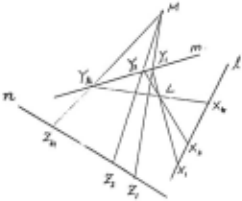
We have solved this problern by introducing the cross ratio, t o calculate the position of the vanishing point of a line with the locations of a sequence of points.
We describe several definitions and properties about the concept of the cross ratio below.
( Def. l ) The cross ratio RABc.t> of the ordered four point:: A,B,C and D on a line is defined by the following equation.
where XY denotes the line segment directing from X to Y.
[ Prop.l] The cross ratio is invariant through projective transformation of a range of points.
[ Prop. 2 l If a point A in a range of points A,B,C and D locates at the infinite (~) and the others do not, the following equation holds.
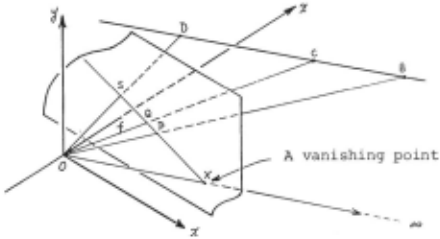
By the central projection, a point located at the infinite in the 3-D world is projected to a vanishing point on an image plane. Suppose that a range of pointsoo,B,C and D in the 3-D world is projected to a range of points X,P,Q and S on an image plane, and that their cross ratios are denoted by R008c Dand R~r<a:s , respecti vely.
Then from ( Prop .1 J and l Prop. 2 l we can readily obtain the following relation.
The relatioto (9) is immediately interpreted as a relation among the coordinates of the points in the 3-D world as follows.
This is the relation that we have pursued for the purpose of calculating the l ocation of a van ishing point without the assumption of an exis tence of parallel edges and detection of them.
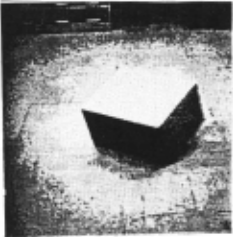
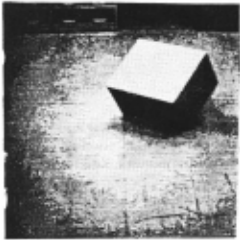
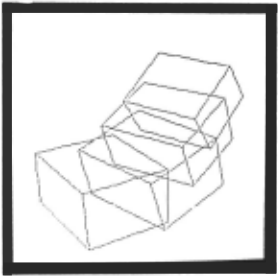
4. Experiment
The concept of the cross ratio enables us to calculate a location of a vanishing point with a simple formula by imposing rather easy restrictions satisfied in most of the applications as described in the previous section. Thus tagether with the discussion in chapter 2 now we have a new method for the analysis of free 3-D motion of an object .
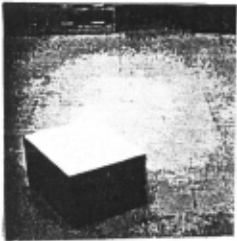
We have experimentally applied this method to an analysis of a motion of a simple shaped object, i.e. a carton . We move it 4 feet from 7 feet in front of a fixed camera tilting gradually to rea lize taken, although pictures in Fig.3 are dis played 128xl28 in size and 8 levels in intensity for convenience .
The requirement of the proposed method i s satisfied by three points on a diagonal of the t op-surface of the box, that is both end-points of the diagonal and the intersection of diagonals. Since a pair of facing edges of the top-surface could be assumed parallel, the intersection is the middle point of each diagonal. In this case and the cross ratio becomes as simple as equal to -1.
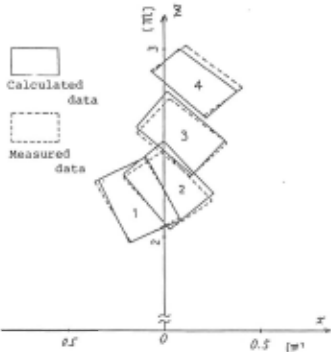
Fig. 6 Results of Experiment compared with Measured Data
The computed results of the experiment are shown in Fig.6 and the measured data are added for comparison. The relative errors in the position are lower than 2%. This is well acceptable to most of the actual applications .
5. Conclusion
In this paper, we have proposed a new method to analyze non-restricted 3-D motions by introducing a simple but fundamental concept useful to deal with actual problems. Results of the experiments proved its validity for a variety of applications . Our method is also relevent t o the recovery of three dimensional structures of static scenes although it may fail to analyze structures of small objects . The accuracy for the estimation should be well considered in such applications.
Acknowlegement
We thank Dr. K. Murase for his suggesting improvements in presentation.
@inproceedings{ijcai1985p181,
  title     = {A New Method of 3-D Motion Analysis Using a Concept of Projective Geometry},
  author    = {Kitahashi, Tadahiro and Endo, Hiroyuki},
  booktitle = {Proceedings of the Ninth International Joint Conference on
               Artificial Intelligence, {IJCAI-85}},
  publisher = {International Joint Conferences on Artificial Intelligence},
  editor    = {Aravind Joshi},
  pages     = {902--903},
  year      = {1985},
  note      = {Perception},
  url       = {https://ijcai.org/proceedings/1985/181},
}
TY - CPAPER TI - A New Method of 3-D Motion Analysis Using a Concept of Projective Geometry AU - Kitahashi, Tadahiro AU - Endo, Hiroyuki T2 - Proceedings of the Ninth International Joint Conference on Artificial Intelligence, IJCAI-85 PB - International Joint Conferences on Artificial Intelligence PY - 1985 SP - 902 EP - 903 UR - https://ijcai.org/proceedings/1985/181 ER -Copied
Machine-readable versions of this paper, for tools and AI agents:





