
Multi-Objective Learning via Genetic Algorithms
Proceedings of the Ninth International Joint Conference on Artificial Intelligence. Learning and Acquisition. Pages 593-594.
© 1985 International Joint Conferences on Artificial Intelligence
Abstract
Genetic algorithms (GAs) are powerful, general purpose adaptive search techniques which have been used successfully in a variety of learning systems. In the standard formulation, GAs maintain a set of alternative knowledge structures for the task to be learned, and improved knowledge structures are formed through a combination of competition and knowledge sharing among the alternative knowledge structures. In this paper, we extend the GA paradigm by allowing multidimensional feedback concerning the performance of the alternative structures. The modified GA is shown to solve a multiclass pattern discrimination task which could not be solved by the unmodified GA.
- A. B. Bekey, C. Chang, J. Perry, and M. M. Hoffer, "Pattern recognition of multiple EMG signals applied to the description of human gait," Proc. IEEE Vol. 65(5) (May 1977).
- A. D. Bethke, Genetic algorithms as function optimizers, Ph. D. Thesis, Dept. Computer and Communication Sciences, Univ. of Michigan ( 1981).
- K. A. DeJong, "Adaptive system design: a genetic approach," IEEE Trans. Syst., Man, and Cyber. Vol. SMC-10(9) ,---pp-.566-574 -(sept:" 1980).
- J. M. Fitzpatrick, J. J. Grefenstette, and D. Van-Gucht, "Image registration by genetic search," Proceedings of IEEE Southeastcon '84, pp.460-464 (April 1984T.-- 5. D. Goldberg, Computer aided gas pipeline operation using genetic--algorithms and rule learning, P~ Thesis, Dept. Civi-l--Eng., Univ. of Michigan (1983).
- J. H. Holland, Adaptation in Natural and Artificial Systems, Univ. Michigan Press, Ann Arbor (1975).
- M. L. Mauldin, "Maintaining diversity in genetic search," Proc. National Conf. on AI, AAAI 84, pp.247-250 (Aug. 1984).
- T. M. Mitchell, "Generalization as Search," Artificial Intelligence Vol. 18 (1982).
- J.D. Schaffer, Some experiments in machine learning using vector evaluated genetic algo- rithms, Ph-:-o;-Thesis, Dept. of Electrical Engineering, Vanderbilt University (Dec. 1984).
- J.D. Schaffer, "Multiple objective optimiza- tion with vector-evaluated genetic algorithms," submitted to Int'l Conf. on Genetic Algorithms and their Applications, Carnegie-Mellon Univ., Pittsburgh (July 1985).
- S. F. Smith, A learning system based on genetic adaptive algorithms, Ph. D. Thesis, Dept. Computer Science, Univ. of Pittsburgh ( 1980).
- S. F. Smith, "Flexible learning of problem solving heuristics through adaptive search," Proc. of 8th IJCAI (Aug. 1983). IJCAI
References were extracted automatically from the PDF and may contain errors.
Full text extracted automatically from the PDF; figures, tables and equations may differ. The PDF is the version of record.
1. Introduction
Pattern classification is a central task in flexible systems which incorporate an arsenal of problem solving techniques. For example, a given problem instance may need to be classified in order to decide which problem solving method should be applied. This paper concerns the task of multi class pattern discrimination in a learning system. As in Mitchell [8], we view learning as a search process. But rather than searching a space of con cepts, we consider a learning system which searches a space of production system programs for programs which adequately accomplish the desired pattern classification. The search is accomplished by means of a genetic algorithm (GA). GAs are power ful adaptive search techniques which have been used successfully in a variety of learning systems [3,4,5,12]. In this paper, GAs are extended in order to perform multi-objective learning in a pat tern classification domain.
2. Learning via Genetic Search.
This section contains a brief description of GAs . More detailed descriptions are available in the literature [3,6,7,12]. Briefly, GAs may be viewed as adaptive generate-and-test procedures. GAs are adaptive in the sense that the candidate solutions generated reflect and exploit information obtained by earlier tests. A GA maintains a popu lation of knowledge structures (e.g. alternative sets of production rules for a given task) and repeatedly (1) selects structures on the basis of observed performance, and (2) applies idealized genetic operators to the selected structures to
MULTI-OBJECTIVE LEARNING VIA GENETIC ALGORITHMS
J. David Schaffer Department of Electrical Engineering
John J. Grefenstette Department of Computer Science Vanderbilt University Nashville, TN 37235
construct new structures. For example, one impor tant genetic operator is crossover, by which sub sets of rules may be exchanged between two alterna tive knowledge structures. This results in a sophisticated search in which subsets of rules which contribute to good performance are propagated through the population. Other genetic operators are described in Smith [12]. In this paper, we concentrate on the influence of the performance feedback on step (1) above, the selection of knowledge structures for reproduction.
The characterization of the power and limita tions of GAs is an active research area, but prel iminary theoretical results are available. For example, the number of structures in the population which contain a given subset of rules can be expected to increase or decrease over time at a rate proportional to the average observed perfor mance of all knowledge structures which contain that set of rules [11]. Thus, all subsets of rules appearing in the population of knowledge structures are explored simultaneously in a near-optimal fashion, a phenomenon which is called implicit parallelism by Holland[7]. Bethke[2] describes some properties of search spaces which may be espe cially hard for GAs.
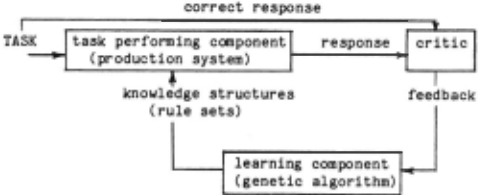
Smith[12] implemented a GA-based machine learning system called LS-1. In LS-1, each struc ture maintained by the GA represents a production system (PS) program. Each PS program is evaluated on the learning task by a critic which assigns a numerical measure of fitness to the evaluated pro gram. When all of the PS programs in the current population have been evaluated, the GA is invoked to construct a new population of PS programs, and the cycle is repeated. (See Figure 1.) LS-1 suc cessfully learned PS programs for maze tasks and for draw poker. Our work extends the LS-1 system in order to achieve multi-objective learning.
Multi-class pattern discrimination was selected as a representative multi-objective learn ing task. The specific task under investigation was to classify muscle activity patterns for five human gait classes, representing one normal and four abnormal gait types. A training set of 11 test cases was obtained from the literature [1], each training case consisting of a 12-bit string derived from EMG signals from leg muscles while walking. As in LS-1, we used a GA to search a space of knowledge structures (i.e., rule sets). The goal of the learning system was to find a knowledge structure which correctly classifies the 11 training cases. The performance of the learning system was measured by the number of knowledge structures tested before obtaining a solution. By choosing subsets of the training cases, we derived 2-class, 3-class, 4-class, and 5-class discrimina tion problems. Each experiment was started with an initial population of randomly generated knowledge structures, in order to test the power of the GA with no initial knowledge. (Our implementation system[9] does allow the incorporation of heuristic knowledge into the initial population o·f knowledge structures.)
4. The Need for Multidimensional Feedback
A series of experiments was performed in which a GA using a scalar critic was applied to multi class discrimination problems. Although the GA could solve 2-class problems, it could not solve the full five-class problem. An analysis of the individual PS programs generated by the GA at vari ous times during search revealed a common pattern. Knowledge of how to recognize a particular class was frequently absent from later PS programs, even when such knowledge was present in earlier pro grams. The problem is that structures which con tain complementary knowledge are forced to compete by a GA using a scalar critic. Consider this sim ple example: Suppose that the critic measures the fitness of each structure by counting the number of training cases which were correctly classified. Suppose program P1 contains rules which correctly classify classes A and B, and program P2 correctly classifies only instances in class c. If all classes are equally represented in the training set, then program P1 appears to be twice as "fit" as program P2. Since the GA selects programs for reproduction on the basis of the fitness assigned by the critic, P1 will tend to contribute rule sub sets to twice as many new programs in the next population as will P2. As the number of classes increases, specialized knowledge (like that in P2) may tend to suffer extinction, finally resulting in suboptimal performance for the learning system as a whole.
Our solution was to modify the critic so that a vector of performance measures was computed for each structure, with one slot in the fitness vector for each class represented in the training set. We then modified the GA so that complementary knowledge structures would share knowledge (through the genetic operators) rather than compete directly.
An interesting question emerges at this point which was never an issue with scalar critics. Where should any punishment for incorrect behavior be applied? Consider a knowledge structure which incorrectly classifies a class A case as class B. By applying the penalty to the A slot of .the reward vector, we are punishing the failure to do the right thing. By applying it to the B slot, we are punishing doing the wrong thing. The former stra tegy was adopted for all subsequent experiments, arguing that class X training cases should contri bute, positively or negatively, only to the X slot of the reward vector.
The modification to the basic GA is as fol lows: instead of selecting structures for reproduc tion on the basis of a single fitness measure, a portion of each new population is selected on the basis of each slot in the fitness vector. Note that if a structure scores well on several meas ures, then it will tend to be chosen in several selection phases. However, structures which per form well on even one measure will be given the opportunity to pass along their specialized knowledge. After the selection phases, structures are combined via genetic operator just as in LS-1. As a result, our modified GA performs multi objective optimization in the space of knowledge structures [10].
One important property of the critic in a GA based system is that the fitness reported by the critic must reflect more than just success or failure on the task. Otherwise, the GA is unable to identify promising programs in the early stages when successes are rare, and cannot discriminate the better programs in the later stages when they are plentiful. One source of information of this type is the amount of uncertainty exhibited by a PS program while attempting the task, where uncer tainty is defined as the extent to which conflict resolution is required in the decision process. A good critic should not discourage this uncertainty in the early stages but should discourage it in the later stages. Some experiments with different cri tics of this sort revealed something of the power of the GA to exploit subtle features in the critic. For example, a critic which applied a desirable uncertainty correction , but only rewarded success, was found to yield populations rich in programs we called specialists. A specialist was a program which achieved a maximum score in one slot of the fitness vector, but zero in all others. It appeared to "know" only one aspect of the task. Unfortunately, these specialists were actually PS programs which were wildly guessing in the sense that they contained an overly general rule which suggested the same classification for every train ing case. A modified critic, designed to punish this indiscriminate guessing, was found to be too strict. By making risk-taking behavior too dangerous, it led the GA to evolve programs which produced no classification. This strategy at least scores zero, which is better than being excessively punished. Finally, a judicious balance of reward and punishment was achieved by incorporating in the critic a scoring scheme inspired by the Scholastic Aptitude Test (SAT scoring). This scheme led the GA to consistent success on problems involving 2, 3, 4 and 5 classes.
6. Results
The results of the experiments with 2, 3, 4 and 5-class discrimination learning are summarized in table 1. The figures reported for number-of evaluations-to-solution are averages from several trials.
By successfully learning to solve the 5-class problem, the value of the vector-valued feedback to the learning component was demonstrated. It may be of interest that the only attempt to solve this problem by hand required a non-trivial effort and produced a solution program containing 16 rules. Although all solutions evolved by the GA used the full allotment of 11 rules, in all cases many of these rules were not used in the solution of the learning task. (They never fired.) They represented a kind of unexpressed genetic material. The aver age number of functional rules in the solutions to the 5-class task was 7.5.
| Number of classes to discriminate | Number of evaluations· to learn solution | Maximum number of rules | Length of knowledge structures (bits) |
|---|---|---|---|
| 2 3 4 5 | 1440 5647 15938 44309 | 4 6 8 11 I I | 136 228 328 462 |
l· Conclusions
The use of a scalar critic limits the useful ness of GAs for multi-objective learning. The scalar critic forces competition between knowledge structures which contain rules for complementary aspects of the learning task. We have shown that GAs can be extended to perform multicriteria learn ing through the use of a multidimensional feedback mechanism from the critic and a modification of the GA selection procedure. A series of experiments with an implemented system show that GAs are oppor tunistic learning algorithms, requ1r1ng careful design of the critic. In fact, the GA responded in a reasonable manner to the various critics. When the critic is too lax, only rewarding successes, the GA evolves programs which guess wildly to max imize the possibility of success. When the critic is too strict, the GA quickly learns than doing nothing is a good strategy. Only judicious balanc ing of reward and punishment leads to effective learning.
@inproceedings{ijcai1985p113,
  title     = {Multi-Objective Learning via Genetic Algorithms},
  author    = {Schaffer, J. David and Grefenstette, John J.},
  booktitle = {Proceedings of the Ninth International Joint Conference on
               Artificial Intelligence, {IJCAI-85}},
  publisher = {International Joint Conferences on Artificial Intelligence},
  editor    = {Aravind Joshi},
  pages     = {593--594},
  year      = {1985},
  note      = {Learning and Acquisition},
  url       = {https://ijcai.org/proceedings/1985/113},
}
TY - CPAPER TI - Multi-Objective Learning via Genetic Algorithms AU - Schaffer, J. David AU - Grefenstette, John J. T2 - Proceedings of the Ninth International Joint Conference on Artificial Intelligence, IJCAI-85 PB - International Joint Conferences on Artificial Intelligence PY - 1985 SP - 593 EP - 594 UR - https://ijcai.org/proceedings/1985/113 ER -Copied
Machine-readable versions of this paper, for tools and AI agents:





