
Flexible Learning of Problem Solving Heuristics Through Adaptive Search
Proceedings of the Eighth International Joint Conference on Artificial Intelligence. Learning and Knowledge Acquisition. Pages 422-424.
© 1983 International Joint Conferences on Artificial Intelligence
Abstract
Noting th at th e methods employed by ex istin g learnin g sys tems are often bound to th r: intended task domain and have little applicabi lity outside that do main, tli is paper co nsiders an :.\lterna ti ve learning sys tem design th at offers g reater fl ex ibility with o ut sacrifi c ing performance. An operational prototype, co nstru cted around a powerful adap tive searc h technique, is presented and appli ed to th e problem of acquiring problem so lving heuristics through experi ence. S om e performance results obt ai ned with th e system in a poker betting do main are reported and compared with th ose of a pr ev iously in vesti ga ted learning sys tem in th e same domain . It is seen th at comp arable levels of performance are achieved by th e two system s. despite the latter 's dependence on a considerable a mount of domain specific knowl edge for effective operation.
- uchanon , B. and T.M Mitchell , " Moclei•Direc ted Learning of Prod uc tion Rul es", in Pattern -Oirec ted Inference Systems, Waterman and Hayes-Roth , Eel ., Academic Press, 1978.
- Carbonell , J.G ., " Experi enlial Learning in An alogical Problem Solving" , Proc. AAA /-82, Au g ust. 1982.
- DeJong,K .A ., "Adapti ve System Design: A Genetic Approach" , IEEE Trans . on Ma n, Sys tems, an d Cyberne tics 10, 9 (September, 1980) .
- DeJo nD , K.A. and T. Smith , !'Geneti c Al gorithms Appli ed to Inform ati on Dri ven Models of US Mi g ration Pattern s " , • 12th Annu al Pit tsbu rgh Co nt. on Modeling and Simulation , April , 1981 .
- Fogel, L.J ., A.J . Owe ns and M.J. Walsh, 1\rtificia ll ntellig ence Th rough Sim ula ted Evolution, Wiley, New York, 1966.
- Hed ri ck , C. L., " Learnin g Prod uction Sys tems from Exa mples" . Art ificial Intell ige nce 7 (1976).
- S. Smith 425
- Holland , J.H ., Aclap tatio n in Natural ancl Artific ial System s, Uni v. of Mic higan Press, 1975.
- Holl and , J.H. and J. Reitman, "Cognitive Systems Based on Adapti ve Algo rithms " , in Pa ttern-Direc ted In fe rence Systems, Waterm an ancl Hayes -Roth, Ed ., Academi c Press, 1Q78.
- Holl and . J.H., "Ad aptive Algorithms for Discovering and Using General Pattern s in Growing Knowledye Bases" , Int.
- Jo urn al on Po lic y Analysis and Informatio n Systems 4, 2 (1980).
- Mitchell , T.M., "Generalization as Search" , Artific ial Intellige nce 18 (1 982) .
- Mitchell , T.M. , P.E. Utgoff and R.B. Banerji, "Learning Problem Solving Heuristics by Experimentation" , in Ma c hine Learning, Michalski , Carbonell , and Mitchell , Ed ., Tioga Press, 1983.
- Smith , S. F., A Learning System Based on Genetic Adaptive Mgorithms, Ph.D . Th ., Univ . of Pittsburg h, December, 1980.
- Stolf o, S. J. and M.C. Harrison , " Automati c Discovery of Heu•dics for Nondetermini sti c Programs", Proc. /JCA I-79, 1979.
- Waterm an, O.A., "Generalization Learnin g Techniques for Aut u~ol ati n g th e Learn ing of Heuristics" , 1\ rtificia l Intellige nce 1 (1 970).
References were extracted automatically from the PDF and may contain errors.
Full text extracted automatically from the PDF; figures, tables and equations may differ. The PDF is the version of record.
ABSTRACT
Noting that the methods employed by ex isting learning systems are often bound to thr: intended task domain and have little applicabi lity outside that domain, tli is paper considers an :.\lternati ve learning system design that offers greater flex ibility without sacrifi cing performance. An operational prototype, constructed around a powerful adaptive search technique, is presented and applied to the problem of acquiring problem solving heuristics through experience. Some performance results obtained with the system in a poker betting domain are reported and compared with those of a previously investigated learning system in the same domain. It is seen that comparable levels of performance are achieved by the two systems. despite the latter's dependence on a considerable amount of domain specific knowledge for effective operation.
I INTRODUCTION
The design of problem solving systems capable of improving their performance autonomously through the accumulation of experience in a specific task domain has received much attention within !\ I [1 , 2, 6, 11 , 13, 14] . Such learning systems have appeared in many problem solving contexts and several have been quite successful. Yet, the underlying methods by which pmblem solving heuristics are acquired in these systems are often bound to the intended domain, relying on considerable amounts of information specific to the domain for effective operation . As such, these methods are inflex ible and have little applicabi lity outside the intended domain. This paper considers an alternative learning system design that offers greater flexibility without sacrificing performance. The design is operationalized in a program called L.S-1 that learns a set of heuristics, represented as a production system {PS) program, to govern the application of a set of operators in performing a particular problem solving task.
II LEARNING AS ADAPTIVE SEARCH
As in [1 0], learning is viewed as a searching problem in the system's representation sp<1ce. The core of the system is an adaptive search technique called a genetic algorithm {GA) . GAs are powerful procedures, motivated by standard models of heredity and evolution but applicable for searching any suitably represented domain of structures. Empirical studies have demonstrated their capabilities in the areas of function optimization [3], model -fitting [4] , learning [8], and discovery [9]. Despite these results, GAs have been largely ignored by the AI community.·
This may be due, in part, to a mistaken nssociation with early evolutionary se~uch models (e.g. [5]) that embodied a form of random search.
FLEXIBLE LEARNING OF PROBLEM SOLVING HEURISTICS THROUGH ADAPTIVE SEARCH
Stephen F. Smith
The Robotics Institute
Carnegie-Mellon University
Pittsburgh, Pennsylvania 15213 USA
Briefly, a GA mainlains a know l ~d9e base uf structures {e.g. alternative sets of problem solving hr.:uristics for a given domain) and proceeds by repeatedly 1) selecting structures on til e basis of observed performance, and 2) applying ideal ized genet ic operators to the structures selected to construct new structures. This results in a search wherein subsets of structure components found to contribute to good performance in the domain are prorauated through the structures in the knowledge base, forming the basis for subsequent exploitation of larger and larger such subsets of components. Intuitively, selecti on according to performance focuses attention on til e most promising subsets and application of the operators serves to expl ore the utility of these subsets in new contexts.
Structures are represented as sequences of their constituent components and manipulated as such by the genetic operators. The variants employed in L.S-1 operate at various levels of granularity, manipulating sequences of productions at the highest level; sequences of symbols at the lowest level. The first operator, crossover, takes two structures, selects a breakpoint on each structure at a particular level of granularity, and exchanges the sequences of components to the right of til e breakpoints. For example, if two structures consist ing of the componeni !Wquences c 1 ,c 2 1c 3 .c 4 ,c 5 and -:: 1 ',c 2 '1c 3 ',c 4 ',c 5 ' are crossed at the designated breakpoints, the structures generated are c 1 ,c 2 ,c 3 ',c 4 ',c 5 ' and c 1 ',c 2 ',c 3 ,c 4 ,c 5 . This operator tends to preserve subsets of components in relatively close physical proximity to one anot11er in the input structures. A complementary operator called inversion alters the sequence of components representing a structure, thereby reducing the susceptibility of particular subsets of components to disruption by subsequent crossovers. In this case, two breakpoints are selected on a single structure, and the sequence of components delineated by the breakpoints is inverted. For example, an inversion of the structure c 1 1c 2 ,c 3 ,c 4 1c 5 at the designated brea~. points yields c 1 ,c 4 ,c 3 ,c 2 ,c 5 . Application of this operator is constrained to levels where interpretation of the components is independent of their positions in the sequence {e.g . at the production level) . A final operator is mutation, which arbitrarily alters individual components of a structure. It functions as a background operator {i.e. its ,probability of application is very low), its presence insuring the reachability of all points in the search space.
As alluded to above, the power of the algorithm lies not in the testing of individual structures but in the efficient exploitation of the wealth of information concerning the components comprising the structures. Consider the sequence of components c 1 ,c 2 , . .. ,cn that comprises a single structure S in the knowledge base. An evaluation of S {e.g. an assessment of the relative worth of S as a solution structur€) actually provides information as to the worth of each of the different subs~ts of components that are present inS, sinc8 it is these components that interact to produce the observed performance of S. If S has n components, ti1cn information is pro·>ided about 2 11 ·1 di stinct subsets. The theory underlying the aloori thms, established in [7 j and extended to encompass L.S-1 's op·~rator set in [ 12], states that the number of structures in the knowledye base possessing a given subset of components can be expec ted to increase or decrease over time at a rate directly prt·portional to the observed performance of t11e subset. Thus, all subsets of components appearing in the structures in the knowledye base are simultaneously pursued in a near- optimal fashion, a phenomenon referred to as implicit parailelism. The reader is referred to [3, 7] for a more detailed discussion of the algori thms and their properties.
The remainder of the paper is organized as follows. A brief ovsrview of the LS-1 system is presented in Section Ill (a complete description may be found in [12)). In Section IV, some experimtmtal results obtained with LS-1 in the poker betting task domain investigated in [14] are reported and a comparison is drawn. In Section V, some concluding remarks are made.
Ill SYSTEM OVERVIEW
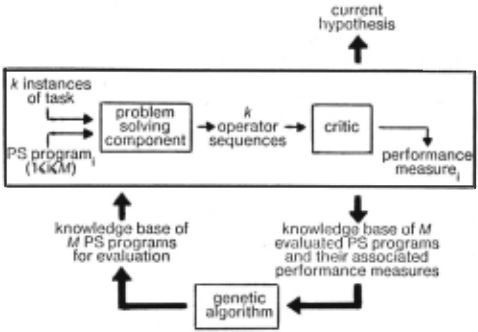
The LS-1 learning paradigm is depicted schematically in Figure 1. The system maintains a knowledge base of M structures, each a cand idate set of productions (or PS program) for solving the task at hand. On a given cycle through the learning loop, each PS program is applied by the problem solving component to k instances of the task. The critic analyzes the I< operator se(]uences generated by the problem solver in this proficiency test as well as characteristics of the PS program under evaluation, and assigns a performance measure indicative of the relative worth of the PS program as a potential solution to the task at hand. Once all structures in the knowledge base have been evaluated in this manner, the GA is invoked to construct a new knowledge base of structures for testing and the cycle is repeated. The knowledge base of PS programs, together with the associated performance m8asures, is viewed as LS-1 's internal memory, representing the sum of the system's experience in the task domain at any point in time. Externally, LS-1 's current hypothesis as to a solution to the tasl~ is the PS program that has been highest r::1ted by the critic thus far in the search. LS-1 's progress is monitored by considering the sequence of hypotheses generated over time.
A. THE PROBLEM SOLVING COMPONENT
The PS architecture serving as LS-1 's problem solving ccmponent is organized as a domain independent framework into which task specific primitives must be injected for operation within a given task domain. More specifically, LS-1 is instantiated in a particular problem solving domain by supplying an appropriate set of state variables and operators. The state variables provide the problem solver with a characterization of the domain and the operators form the problem solver's repertoire of alternatives in reacting to the current state. When enabled, the productions invoke operators and enter signals into working memory (WM) in response to perceived state variable and WM configurations.
The productions,which collectively constitute a single structure in LS-1 's internal memory, are homogeneous and simplistic in nature. Each antecedent contains a fixed number of elementary patterns, one sensitive to each of the domain's state variables and a given number attending to the signals resident in WM. Each consequent contains a signal, to be placed in WM if the production is activated, and, optionally, the designation of an operator to be applied to the current state. If no operator is desinnated, the production is intended for internal communication purposes only.
This simple structure, necessary in providing a knowledge representation amenable to manipulation by a GA, imposes limits on the recognizing capabilities of individual productions. These deficiencies are balanced, however, by a PS control scheme that activates all instantiations found during the recognition phase of a given cycle. This allows distinct productions to cooperate in the recognition of more complex aspects of the current state. A default resolution mechanism coordinates external activity if more than one operator is designated by instantiated productions on the same cycle.
B. THE CRITIC
The LS-1 critic, in assessing the performance of the PS programs constructed by the GA, provides the GA woth a global focus in the subsequent construction of PS programs. Accordingly, the critic is equipped with a means for analyzing the correc tness of the k operator sequences produced by a given PS program during its proficiency test, and measures based on this analysis play a major role in the derivation of the overall performance rating. However, the critic also considers general characteristics of the PS program under evaluation that appear relevant to good performance regardless of the specific task domain. Structural properties of the productions (e.g. potential for communication in the WM patterns and signals, level of generality in the productions' conditions). dynamic properties of the execution history (e.g. percentage of productions activated, amount of dependence on the default resolution mechanism), and efficiency (e.g. number of productions) are all assessed to provide a finer level of discrimination between candidate structures.
IV SOME EXPERIM6.NTAL RESUlTS
To provide a basis for comparison with previous work, LS-1 was tested in the poker betting domain first considered by Waterman [·14]. Briefly, the system engages in a game of draw poker with the goal of making bet decisions that maximize profits. Each time it is the system's turn to bet, it must therefore infer the most appropriate bet decision to make, given the. current state of the poker game. For purposes of evaluation in the experiments described below, the objective was to generate the correct bet decisions in each of 10 consecutive rounds of play.
Remaining faithful to Waterman 's paradigm, the LS-1 problem solving component was presented with 7 state variables upon
·,.- l,icil to base its bet decisions: the value of the problem solver's hand, the amount of money in the pot. the amount of money fast vet, tile ratin of the amour1t of money in tile pot to the amount of 111oney last vet, the number of cards replaced by the opponent, a measure of the probability t/Jill tile opponent can be bluffed, and a measure ·J f the conservativeness of the opponent. 4 bet decisions were provided as operators: calf, drop, bet tow, and bet high. Within U1e critic, Waterman 's deductive procedure for determining the correctness or incorrectness of a given bet decision, based on an i.IYiomatization of the game of po~<er, was implemented and a measure indicating the percentage of agreement with the axioms in the bet decisions genera ted was incorporated in the evaluation function. A second measure relating to performance, the number of successfully completed rounds of play, was also utilized to insure that premature drop decisions (i .e. drops issued before c.'ards have been replaced) would not be assessed as appropriate by the critic.
LS-1 was pitted against P[built-in], a poker betting program hand crafted by Waterman and judged to perform at roughly the sam<~ levt.:l ~s an experienced humiln pok·~ r pi :J.ynr [1 ·lj. An int·) rnal knowledqe base of 50 PS proorams was maintained by the system, ye11eratecl at tile outset by r:.Hldomly <.c:·.xtiny conditions and operators fur t11e individual productions of c':ch structure.' · flunning for 2 DEC1 0 cpu hours, LS-1 's operation verse:> P[built· in] was observed ov.~r an interval of 4,200 PS ev~ luation:; [approximately 85 cycles through the learning loop) . As indicated by the performance results depicted in table 1, LS-1 achieved the performanr;e objective within this time fmrne. A PS program was constructed that successfully completed 10 consecutive rounds of plc,y in which there was total agreement with the poker axioms as to the bet decisions generated.···
| number of evaluations performed | 500 | 1,000 | 2,000 | 3,000 | 4,200 |
|---|---|---|---|---|---|
| performance rating of current -~pothes1s (scale. .0 · 1.0) | 0.461 | 0.490 | 0.562 | 0.748 | 0893 |
| percentage of agreement with the poker axioms | 71.4 | 80 | 76.1 | 85.7 | 100 |
| numbe1 of successfully completed rounds | 3 | 4 | 7 | 8 | 10 |
In attempting to understand these performance resuits it was discovered that the heuristics used by P[built-in], while appropriate within Waterman's paradigm, were not designed for such an extended game of poker (i .e. 42,000 rounds of play) . Generally speaking. P[built-in] incorrectly judged L.S-1 to be an extremely conservative player over time, and, with this misconception, was easily bluffed into dropping. LS-1 responded to its opponent in precisely the right manner, constructing PS programs that exhibited an overriding tendency to bet.
The decision to start LS·1 from scratch in these experiments was entirely motivated by a desire to provide a direct comparison with Waterman's results and is not due in any way to properties of the model. We could have initialized LS-1 at any level of expertise.
Since a GA is inherently a stochastic process, successful performance in a single run might be misleading (e.g. a consequence of the random number seed). The results presented here actually represent averages taken over several distinct runs of LS-1.
To test LS-1 against a more formidetble opponent, adjustments 'Nere made to P[built-in I to eliminate tile above misconception and a second experiment was conducted. Tile results obtained in this case are presented in Table 2. We once again observe a steady and significant improvement in the hypotheses generated by L.S-1 as the poker game progressed. Within 4,000 evaluations, a PS program w<1s constructed that successfully completed 9 of 10 rounds of play while generatin9 bet decisions that agreed with those deduced by tile cr itic 82% of tile time.
| number of evaluations performed | 500 | 1,000 | 2,000 | 3,000 | 4,000 |
|---|---|---|---|---|---|
| performance rating of current hJpothes1s (scale. .0 . 1.0) | 0.414 | 0.483 | 0.619 | 0.689 | 0.740 |
| percentage of agreement wi th tile poker ax ioms | 58.75 | 73.03 | 89.9 | 75.1 | 81.93 |
| number of successfully completed rounds | 3 | 4 | 6 | 8 | 9 |
The relative success of LS-1 in the poker betting domain can be gauged by comparing these results to those obtained with Waterman 's system. Waterman subjected his trained learning system to a proficiency test consisting of 50 rounds of poker against a human opponent, also measuring performance in terms of the percentage of ag reement with the axioms in the bet decisions generated. 86% agreement was achieved by his system in this test [14] . Thus, while LS-1 PS programs were subjected to a shorter proficiency test (i.e. 10 rounds). the levels of performance achieved by the two systems are comparable. This becomes particularly significant when we examine tile methods employed by Waterman 's system in manipulating its PS program. Speci fi cally, the creation of new productions was guided by an a priori supplied decision matrix, specifying for each possible bet decision, tile reason why each state variable is relevant to that decision if, in fact, the variables are relevant. This information was used directly in building tile predicates of new productions' antecedents.
V CONCLUDING REMARKS
Tile intent of the LS-1 design was to provide a flexible yet effective means of acquiring problem solving knowledge in a learning system. The experimental results presented above clearly illustrate the viability of the approach. Moreover, tile method of learning employed by LS-1 embodies a general technique whose effectiveness in a given problem solving domain depends primarily on tile qual ity of the evaluation function realized by the critic (LS-1 has, in fact , yielded similar performance results in another, unrelated domain [ 12], although space limitations prohibit their discussion here). Clearly, domain knowledge must enter into the derivation of the performance measure. However, it is felt that this shift in perspective with respect to the role of domain knowledge fundamentally enhances the general <·pplicability of a learning system. The speci fication of domain specific measures to judae the external performance of hypotheses appears a far less imposin9 problem than the construction of learning methods based on domain speci fic assumptions.
ACKNOWLEDGMENTS
This wot11 was conducted while the author was in the Computer Science Department at the Universi ty of Pittsburgh. The author would like to thank Ken DeJong for his guidance and encouragement throughout the course of the project.
llEFERENCES
- [1) 8uchanon , B. and T.M Mitchell , "Moclei·Directed Learning of Production Rules", in Pattern -Oirec ted Inference Systems, Waterman and Hayes-Roth , Eel ., Academic Press, 1978.
- [2) Carbonell , J.G., "Experienlial Learning in Analogical Problem Solving" , Proc. AAA /-82, August. 1982.
- DeJong,K.A., "Adapti ve System Design: A Genetic Approach" , IEEE Trans. on Man, Systems, and Cybernetics 10, 9 (September, 1980) .
- (4] DeJonD, K.A. and T. Smith , !'Genetic Algorithms Applied to Informati on Dri ven Models of US Migration Patterns" , ·12th Annual Pit tsburgh Cont. on Modeling and Simulation , April , 1981 .
- [5) Fogel, L.J ., A.J. Owens and M.J. Walsh, 1\rtificiallntelligence Th rough Simulated Evolution, Wiley, New York, 1966.
- (6] Hedrick, C. L., "Learning Production Systems from Examples" . Art ificial Intell igence 7 (1976).
- (7] Holland , J.H., Aclaptation in Natural ancl Artificial Systems, Univ. of Michigan Press, 1975.
- [8) Holland , J.H. and J. Reitman, "Cognitive Systems Based on Adaptive Algorithms" , in Pattern-Direc ted Infe rence Systems, Waterman ancl Hayes-Roth, Ed., Academic Press, 1Q78.
- Holland. J.H., "Adaptive Algorithms for Discovering and Using General Patterns in Growing Knowledye Bases" , Int. Journal on Po l ic y Analysis and Information Systems 4, 2 (1980).
- [10) Mitchell , T.M., "Generalization as Search" , Artificial Intelligence 18 (1 982) .
- Mitchell , T.M. , P.E. Utgoff and R.B. Banerji, "Learning Problem Solving Heuristics by Experimentation" , in Machine Learning, Michalski , Carbonell , and Mitchell , Ed., Tioga Press, 1983.
- [12) Smith, S. F., A Learning System Based on Genetic Adaptive Mgorithms, Ph.D. Th., Univ. of Pittsburgh, December, 1980.
- [1 3] Stolfo, S. J. and M.C. Harrison, "Automatic Discovery of Heu·dics for Nondeterministic Programs", Proc. /JCAI-79, 1979.
- [1 '1] Waterman, O.A., "Generalization Learning Techniques for Autu~ol ating the Learning of Heuristics" , 1\ rtificia l Intelligence 1 (1 970).
@inproceedings{ijcai1983p102,
  title     = {Flexible Learning of Problem Solving Heuristics Through Adaptive Search},
  author    = {Smith, Stephen F.},
  booktitle = {Proceedings of the Eighth International Joint Conference on
               Artificial Intelligence, {IJCAI-83}},
  publisher = {International Joint Conferences on Artificial Intelligence},
  editor    = {Alan Bundy},
  pages     = {422--424},
  year      = {1983},
  note      = {Learning and Knowledge Acquisition},
  url       = {https://ijcai.org/proceedings/1983/102},
}
TY - CPAPER TI - Flexible Learning of Problem Solving Heuristics Through Adaptive Search AU - Smith, Stephen F. T2 - Proceedings of the Eighth International Joint Conference on Artificial Intelligence, IJCAI-83 PB - International Joint Conferences on Artificial Intelligence PY - 1983 SP - 422 EP - 424 UR - https://ijcai.org/proceedings/1983/102 ER -Copied
Machine-readable versions of this paper, for tools and AI agents:





