
The Geometry Tutor
Proceedings of the Ninth International Joint Conference on Artificial Intelligence. AI and Education. Pages 1-6.
© 1985 International Joint Conferences on Artificial Intelligence
Abstract
The tutor for doin[l proof s in high s ch o ol geometry c on si:.t s of '-' set of ic! e; JI a nd bu nnY rul es (IBn). a tutor, n ne! an int ( rl: 1cr;. Th e IBR i ~: rr.:;por 1s iblc fo r eli ic i cn ll y COlllfluting lll<Jlcll c:s to all the corr uc t ::md in c oncct rul e~<. Tlo r: int erf:.lce is ff;~;p or::;ib l c for int e r e~cl in g with thr! s tud e nt ;i ;-.rl uraphically re po esf: roting th e p roof. Th e tutor is nJspon,~ib l e for directinu the I OF: an d int e rface to achiev e a c urr e nt tutori al s trategy. The s tr atqw w e emp loy involvec. traci ng th e stud e nt':; be havior in te rm s of what rul es in the IBR it instantiates, correcting the s tud e nt wh e n l)eh:l'l inr deviat es be low a minimum tiH'e shold, and helpiro(J til e stud e nt o•Jer hmdle s. WhilE: incomplc•te, curre nt e•Ji d en ce indic ates ttHJ oe om e try tutor is quit e eff ec tive. Tho Aclvance c! Computer - Tut.:rin~J Proj t'ct r.as bef'n working on t:1 t: r! (' vdopmc nt of int c lli <Je llt corr.p \ ol ~ r - h a ,>e d t11t ors rvr no ;! lll ernatic;, and sc i ence ~; uiJj e cts in li :'-' ranq e of se ni or higtlsc l wo l to juni c r college . Thrs pap e r d csc rih e>s tilE, uen et al fram ew ork ll1at we hav e cJ c v l' lop ::c! :.1nd il ~' in s tantiation in th e CJ:;c ol a ttlior for gr'n c rat inq pr oo!s in W!Uillctry. First, w e will d esc ribe till-: gr::·neral pililo :> c' phy of our l•.:t lx ing effort s. Sec ond, we will d esc 1ibt ~ t11 e ba sic s tructure of lh· ~ g eo metry tutor tll at we have built. 1 hi re!, we will d P.s cr'be th e ong o inu effort s to e v;.~luate the tutor.
- Anderson, J. R. Tunmg of search of the problem space for geometry proofs. Proceedinas of IJCAI -81 , 1981, pages 165• 170.
- Anderson . J.R. The Archttecture of Cognition . Harvard University Press, Cambridge, MA, 1983.
- J . Anderson et al. 7
- Bloom, B.S. The 2 Sigma Problem: The search for methods of group instruction as effective as one-to-one tutoring. Educational Researcher J..>l:3-16, 1984.
- Boyle, C. F. & Anderson . J.R. Acquisition and automated instruction of geometry proof skills. Paper presented at the 1984 AERA meetings, 1984.
- Brown , J.S. & Burton . R.R. Diagnostic models for procedural bugs in basic mathematical skills. Cognitive Science 2: 155• 192, 1978.
- Forgy, C. L. OPS5 Manual. Carnegie-Mellon University, Computer Science Department, 1981 .
- Forgy, C.L. Rete: A fast algorithm for the many pattern / many object pattern match problem . Artificial Intelligence 19:17-37, 1982.
- Gelernter. H. Realization of a geometry theorem -proving machine. Intelligent Tutoring Systems. McGraw-Hill , New York, 1963.
- Hoffer. A. Geometry is more than proof. Mathematics Teacher :t 1-t8, January, 1981.
- Nevins. A. J. Plane geometry theorem proving using forward chaining. AI Memo 303, Cambridge, MA: MIT AI Laboratory, 1974.
References were extracted automatically from the PDF and may contain errors.
Full text extracted automatically from the PDF; figures, tables and equations may differ. The PDF is the version of record.
Abstract
The tutor for doin[l proofs in high school geometry consi:.ts of '-' set of ic!e;JI and bunnY rules (IBn). a tutor, nne! an int( rl:1cr;. The IBR i ~: rr.:;por 1s iblc for eli ic icn ll y COlllfluting lll<Jlcllc:s to all the corruc t ::md inconcct rul e~<. Tlor: interf:.lce is ff;~;p or::;ib lc for intere~cl in g with thr! student ;i ;-.rl uraphically repoesf:roting the proof. The tutor is nJspon,~ib le for directinu the IOF: and interface to achieve a current tutorial strategy. The stratqw we employ involvec. tracing the student':; behavior in terms of what rules in the IBR it instantiates, correcting the student when l)eh:l'linr deviates below a minimum tiH'eshold, and helpiro(J til e student o·Jer hmdles. WhilE: incomplc·te, current e·Jidence indicates ttHJ oeometry tutor is quite effective.
THE GEOMETRY TUTOR
John R. Anderson, C. Fr;wlllin Boyle, GrerJg Yost
Advanced Computer Tutorin~l Project Carneuie-Mellon University Pittsburgh , PA 15213
they learn in the standard cl<:ssroom situation, where students solve problems on their own, getting feedb3ck by handinq in exercises to be graded or comparing t11eir solutions witli example solutions. In our work comparing these \wo modes of study, we have found !11 9 students wi th priv,lte tutoring ,·each thf) same achievement level as much as four times more rapidly <han the classroom students. Bloom (1984) has compared private tutoring with classroom instruction for two school topics: cartography and probabilrty. In his research , students spent the same amount of time learning, and he looked for differences in achievement levels. He found that 88 percent of the students ·Nith the private tutors performed better than the ave· ''~;e classroom-student. lt1terestin,; ly, he also fcuncl that the str ongest benelit was for the poorest students. There was little c!iffl:rence betwoen the achi everner.t levels of the best students in tile two co!lcli tions.
Tho Aclvancec! Computer - Tut.:rin~J Proj t'ct r.as bef'n working on t:1t: r!('vdopmcnt of intc lli<Jellt corr.p \ ol~r - ha,>ed t11tors rvr no;! lllernatic;, and science ~;uiJjects in li :'-' ranqe of senior higtl sclwol to juni cr college. Thrs paper dcscrihe>s tilE, uenet al framework ll1at we have cJcvl'lop::c! :.1nd il ~' instantiation in the CJ:;c ol a ttlior for gr'ncrat inq proo!s in W!Uillctry. First, we will describe till-: gr::·neral pililo:>c'phy of our l·.:t lxing effort s. Second, we will desc1ibt~ t11e basic structure of lh·~ geometry tutor tllat we have built. 1 hi re!, we will dP.scr'be the ongoinu efforts to ev;.~luate the tutor.
General Philosophy
Our arproach to tutoriny :o<ems :rom two observations abou t the nature of learning in domains like high -school geometry. First, the major learning hurdle is acquirin ~J domain spec ific problem-solving skills (e.g., generating proofs in geometry), and the way they are learned is by practicing the problem-solving sl<ill. Wc have intensively observed numerous students going through the first half of hi (th school geometry (Anderson , 1!181 ). We nave not yet sE-en a case where a studen t was <>ble to c;bsorb abstract instruction (from the text or the teacher) and go off and use that knowledge effectively in problem-solving. Students on ly acquirecl effective use of problem-solving knowledge by struogli;Jg with its application through a series of problems.
The second observation is that ~ tudents learn these problcrn -:;oiving sk ills much more effecti vely if they lt'!arn with a full-time, private, human tutor wl10 knows the domain well than if
1 th:' l t: ar~ a IIUilllh.: r of n ;CJsCH1S fc1 r the ~:,cc ~:.::~J uf ille Pri'Ji! (· · i·,d!r>an Iuter. VC!ry impo·! :l!1t 1:; tire: con:;tLlnt ntoll itoring anc~ :.: 1 · ur turmg of the; stucleni's prot: lf!PI ·solvmo <.~tt.,rnpt.; . The tt ttc,r c,t;l di <i~jno~:c what contu~; 1 o P~ tha: par !ICular student has. ciet·" 111in ~· wl1at n·,e stud·~nl nC·i..'cls to knC\w, <.~nc l provide instrucilr,n specific 1o these rh::C->ds. The 1c.Jcher can com ·· ·u nic;ll t~ iloe over;dl goal struc!urt> that cott !rols 1!1>! P·oblem solvu1~l · somethinu that is di fltct tlt to do oub<lo ol tl lf: problem con t (~x \ and wh tch is seldom al ten<p!ed in c lassroo111 mstruction. P: il'ale tutors are V(~ry good at m:.~rFI<Jinu student errors . They provide trn·nediate or near immediate f e·~dback on these errors. They can point t11e ·ctudent back to the right track ar·d prevent the student !rom getting lost. In this way students can p::~rtiall y solve problem:.; tl1at they would normally give up on and so can learn from tlw ir solution attempts.
The ability to be an effectrve tutor requires that the tutor have an internal rnodel of how the ski ll should be performed and be able to access t11is model for purposes of instruction. Such a model we call an jp_eal model. The tutor needs to be able to supplement this ideal model with various errors that a student makes tn deviating from the model. We call this the buggy model after Brown and Burton (1978).
One of the major commitments in our tutoring efforts has been to instantiate the ideal model and the buggy model as production systems. This follows from our psychological analysis of such sktlls in terms of the ACT' production system (Anderson ,
1983). There are two major consequences of this commitment. First, ACT' production systems have well ·defined goal structures which we try to communicate to the student. Second, these production systems imply a commitment to a grain size of instruction. Essentially, every production in the system encodes a meaningful step of cognition. Therefore, we monitor the student's problem·solving production step by production step and after each step determine which production (from the ideal or buggy model) that step instantiates.
This leads to what we have called the model -tracing paradigm for instruction. Essentially, the tutor traces the student 's behavior through its ideal and buggy model. At any point in time there are a number of productions in the tutor that rlli ~t l rt ~rpp l y. Tlw tutor infe r ~ wl1icil rule tire student executed I.Jy uei . ·ll llill in\t wiJ iciJ one 111atched tile strrclent's output. If it is a correc t pr ocl uc.t run. tire tut or stJys quiet ;rnd continues to trace ti re st udelll·~; prol rt.:, rn solving. If an irrcorrcct production has I.Jc:;on ;rppiicd. ti re tutor interrupts with appropriate rernm1ial instnrction l he fir ral possitJrli tics are t t ~<r t the student does not r.now wlut to do nex t or thdt ti lt; ~tudenL; behavior matches no l;rodir!: tron. correc t or incorrect. Usu:r lly. this occurs when the st11de11t rs (JI>Jd liy con fu:;ccl . We !rave lound tirat tile best th inu to do ir, :;ucil :;it11:: tions is to tell tir8 student tile next stop to take. If t' ris is e~piJ ined proper ly, the student is often able to get back on a ri y lit track.
The set of ideal and buggy rules (henceforth called IBRs) are based on considerable theoretical analysis of the char<Jctenstics of the problem domain and on a great deal of ernpirical observation of student behavior. Therefore , it is reason3ble to suppose that they are more sophisticated than those possessed by most private tutors. Also, we have greater access to the knowledge encoded in these rules than do typical private tutors for whom the ideal model is often tacit and incapable of being directly described to students. We think it is possible to outperform human tutors in our use of these rules, which is not to deny that our computer tutors will be outperformed by human tutors on other dimensions such as natural language analysis.
The Architecture of the Geometry Tutor
In trying to achieve our tutoring paradigm, we have realized the need to separate out three components in a tutor. These are the IBR, the tutor, and the interface. These three components are clearly separated in the current version of the geometry tutor, although they were not so clearly separated in earlier versions (Boyle & Anderson, 1984). There are a number of advantages that come from clearly seperating the components. First, from a software engineering point of view it becomes possible to develop and test each component independently. Second, the components can be optimized for their distinct characteristics. Third this is a step towards one of the ultimate goals of the Advanced Tutoring Project .. which is to develop a domain-free theory of instruction. While our current tutor is not entirely domain-free it represents a strong step in that direction. The IBR and the interface are the components in which most of tl w clornain sp()cifics arc rcprc:;,;nted.
The cr'ntr,tl co111porH: nt in thi:; tri.1d is tir ·: tut ::~r . It def irks our curr e11t tutoring c< lr;ik<Jy. In uur cu rrent system the tutor rs implemented as a production !;yt;ter.1 in the OPS5 langll;l<JC (For\JY, t 'l8 1). It uses intorm:rtioro both tr .::Jfll the lrlfl amj lrom ti re student (vra the interf ace) to e<Hltr ol the tutor ial interac tion. It ccu r prcc;ent information to the student and ; cquest infon11ation from the student by invok inu the interf ace. It has two means of interaction with the IBR:
(a) It can look at whicil idea l and bu9gy rules are cmren tiy instantiated in the IBH and use these to interpret the student's behavior. It allows the IBR to trace the student's solution by selecting in conflict resolution one of the IBR production rules. It then receives an update of the instantiated rules in the IBR after firing this rule.
(b) It can request of the ideal model whether a statement can be proven, subject to certain constraints. This will cause the IBR to attempt a proof and report back information such as whether such a proof exists, how long it is, how optimal it is, what rules it involves, etc.
We will return to a further description of the tutor after describing the IBR and the interface.
TheiBR
There were two major goals in our design of the IBR. The first was to have the ideal model generate proofs in what we felt was a natural, human·like way .. in contrast to some methods of proof. The bugs are hung off the structure generated by the ideal model so it is doubly important that it generate human·like proofs, both in order to instruct students about what is right and to interpret their errors. The second goal was to make the IBR efficient. It is an important constraint on tutoring that the IBR perform its computations rapidly so that feedback to the student be rapid. Most of the computation in the geometry tutor is done in the IBR. As we will see, both of these goals posed interesting challenges in the case of geometry.
Figure 1 illustrates a geometry proof problem that is considered relatively complex for high-school students. The import ant feature to note is that at any point in trnw th .::rr~ are a laru;;, number of iiiiCrr:llces that can be ' ~::~le. For rnstance, fr orn the Y'""" fact that M is the n11dpornt of /\13, it is possible to infer til ed /\1,1 ;;o 1,1£3. Elut this is just onr! ol the many inferences that are possr llle. For instance. it is also possible to infer that !AMF ;:; .C:BivtE: because of the vertical ;rngle configuration formed by -- -- segrnents /\MB and FME. Moreover. th·o.·se pos!, ible i11 f<~rences can be ordered in a continuum according to aptness, wilere the first is very apt and the second is very inapt.
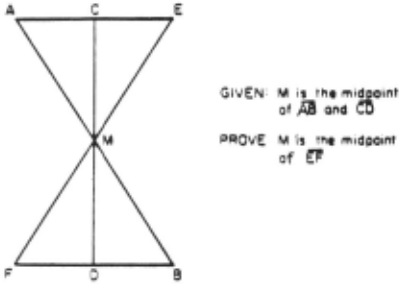
There is another kind of deductive reasoning that students engage in when faced with such problems. This is reasoning backwards from statements to be proven to statements that will prove them. Thus, a student can reason backwards from th~oal of proving M is the midpoint of EF to the subgoal of proving ME = MF. This involves the definition of midpoint. It is possible to reason backwards from this goal again. For instance, one might reason backwards from the goal of proving ME = MF to the subgoal of proving ll.AMC = ll.BMD. This would involve the use of the corresponding parts rule for congruent triangles. On the other hand, one might reason back from the goal of proving ME ::; MF to the subgoals of proving ME = AM and AM = MF. This would involve using the transitive property of congruence. Again, these backward inferences can be ordered as to their aptness with the first two inferences being quite apt but not the third .
The important observation is that the aptness of an inference is not an absolute property of the rule of geometry that authorizes it, but rather a function of the context in which it occurs. For instance, it does not seem appropriate to make the vertical-angle forward -inference that LAMF = LBME. However, another vertical -angle inference, LAMC = LBMD is quite apt, particularly after we establish that AM = BM and MC = MD. Then we can use these two side congruences and the angle congruence to show that ll.AMC = ll.BMD by the side-angle-side postulate.
We have created an ideal model for generating proofs in geometry that involves forward and backward inference rules with contextual restrictions. It takes the form of a production system th~t enables us to model the flexible alternation between lJ:.1chw;ud ;uu l lorw:rrd n·asoning that we oh:.;crve in human ,~yp,;r t s. t.vcry :.i\l' lil.cant contextualizcd rule of inf ,~ renr.e is a :.: t-:p;;1 ;rk p1 nd!ic:.l;"n 1 ule. Our IIStc ot a producltutl :;y:;h~m en ;~l> l c:; 1,:; lu ac lll·cvc the <ksned tlcxiiJility and to have the individual pt uductions u:>ecl os objects of in~truction . Compared to ll lh·; r lllCOICIII ptovc" s for 90omctry such as Nevtns (Hl"/1\) our :oystc1n is distlll'JUi :;lwd by the flex ibility of its cont10l struc ture 'Hid ns d·.·cntnrositton of dom;1 in knowh;dge into relatively modul i.l r rules.
As an exa:nple of a forward inference rule, the following "Enqlisllttied" production ~!Cnerates a vertical angle inference when that will enable a side-angle-side inference.
IF XY ::; UY and YZ = YW and there are triangles 6XYZ and 6 UYW and XYW and UYZ are colinear
THEN infer L XYZ::; LUYW by vertical angles.
As an instance of a contextually bound backward rule, consider t
IF the goal is to prove two lines parallel and there is a transversal
THEN set as a subgoal to prove the alternate
interior angles are congruent.
We have developed 300 such rules and have ordered them according to aptness. The ideal model applies the best inference rule that is satisfied in a situation, whether that is a backward or a forward rule. This system can prove all the problems in the high school material we have been working with. It also generates human-like proofs. Not all the inferences it makes are part of the final proof, but when it deviates from the final proof, it deviates in the way we have observed in human subjects.
Geometry poses an interesting challenge for efficient production-system implementation because of all of the symmetries that exist in geometry. Consider matching the rule t11 ~1 t s<Jys if u,erc tS a goal to prove two .lii<J ies COII\Jruent and they are p;Hls of co>IIJSJlOIHiinq tri<ll1cJI·)S. ~;e t <1 :.;uli<_toal to prove the two tri ;;nyl.::.; con,;ruetll. Dduw is tli8 l'ncoclinv that is c l o~''" to wllot we actually use for this rule:
IF goal : Lobe= Ldef
tests:
there is 6 nbc
there is 6 def
THEN goal : 6 abc :::= 6def
Figure 2 illustrates a situation where tl1i :> rule should match with two distinct bindings of variables (a = 0. b = P, c = S, d = U, e = T, f = W) ::tnd (a = 0 , b = P, c = S, d = W. e = T. f = U) . However, as the astute reader no doubt discerns, there is potential for a great many other bindings and the trick is to filter them out as unnecessary. Consider, for instance, the brnding of a. Because of the symmetry of congruence and the symmetry of the end points of an angle. it can bind to any of P, R, S, M, U, V, w, or N. Having settled on this binding, there can still be two bindings for c, four for d, and two lor f. (These four bindings completely constrain b and e.) Altogether there are 8 x 2 x 4 x 2 = 128 possible bindings to be considered, of which only eight correspond to distinct hypotheses about triangle congruence. Six of these distinct hypotheses (e.g., 6.PRM ;;:: 6. TVN) can be rejected as implausible given the physical diagram--this plausibility check is the same idea used by Gelernter (1963). The only two plausible hypotheses about triangle congruence are 6.0PS;;:: 6.UTW and 6.0PS;;:: 6.WTU.
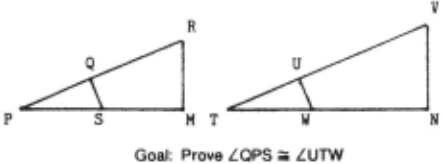
An immediate reaction to this problem is to try to canonical ize the angles, segments, and triangles in the diagram and have a unique name for each such object. The problem with such attempts is that they fail to uncover all the possible matches to geometry rules that exist. These can only be uncovered by considering the actual ordering of points as significant. For instance, most canonicalizations of this problem would fail to be able to retrieve the eight distinct hypotheses about triangle congruence in Figure 2. They would have particular difficulty with representing the distinction between the two plausible hypotheses above which only differ in terms of the correspondence between the points of the triangles. It is no accident lhGt traditionGI geometry uses a point representation and not a canonicali zed object repr esenlation .
Part of our solution is to encode into our statements of the rules the symmetries and have our pattern matcher take advantage of this. So for the rule above we inform the pattern nratcher that it need not consider both angle onl'"rings in the congruence. Ther010re it can assume l i\BC will match to LOPS and not worry about the potential match to LUTW. It also need not consider both orders of tl1e ray points (A. C) in the first angle. Tt1erefore it can assume A will match to 0 . This reduces by a factor of four the amount of pattern matching that must be done. Secondly, we have a special coding for the points on a ray such that we do not have to consider each combination separately. For instance in Figure 2, two ray points can match to each of points A, C, D, and F in the pattern. However, we do not have to consider the 2 4 = 16 combinations. So, rather than having 128 instantiations of the pattern L.ABC ;;:: LDEF, we have 128/(4 x 16) = 2 instantiations. As most of the computation in the IBR is spent in pattern matching, this is a very significant savings. These two instantiations are expanded to eight when we consider the various triangles that can be formed, but six of these are filtered out on the basis of plausibility.
These patterns are organized on a modified Rete net to obtain much of the efficiency of the OPS family of production systems (Forgy, 1982). We estimate that we are able to obtain a couple orders of magnitude of efficiency over any previous production-rule-based geometry theorem prover. For instance, it is able to produce the prototypical expert solution to the problem in Figure 1 in eight seconds of CPU time on a Xerox Dandelion. Table 1 summarizes the sequence of inferences that it makes. It makes three inferences that are not part of the final proof, but these are inferences experts frequently make, and these inferences actually lead to a slightly longer proof. The important fact to note is that eight seconds is much less than human performance (usually a minute) and so is definitely within the bounds for acceptable tutoring.
| Backward Goal or Forward Inference | Statement | Rule | Time |
|---|---|---|---|
| Goal | Del-Midpoint -Backwards | .17 sec. | |
| Inference | Del-Midpoint-Forward | .17 sec. | |
| Inference | 3.AM ;;;;Me | Del-Midpoint-Forward | .22 sec. |
| Inference | 4. LBMO;;;; LAMC | Vertical -Angles-in· Triangles-Forward | .37 sec. |
| Inference | 5. LI.CMA;;;; LI.DMB | Side-Angle-Side· Forward | .15sec |
| Inference | 6. LBMF;;;; LAME | Vertical -Angles· Known-Side-Forward | .38 sec. |
| Inference | 7. LDMF ;;;; LCME | Vertical -Angles- Known-Side-Forward | .53 sec. |
| Goal | 8. LI.EMC;;;; LI.MFO | Corresponding-Parts· Segment-Backward | .38 sec |
| Goal | 9. LI.EMA;;;; LI.FMO | Corresponding-Parts· Segment -Backward | .63 sec |
| Goal | 10. LMEA;;;; LMBF | Ang le-Angle-Side-Backward | .so sec |
| Goal | 11 . LMAE;;;; LMFB | Ang le-Angle-Side-Backward | .35 sec |
| Inference | 12. LMAE;;;; L MFB | Corresponding -Parts· Angle-ForNard | 4 27 sec |
The Interface
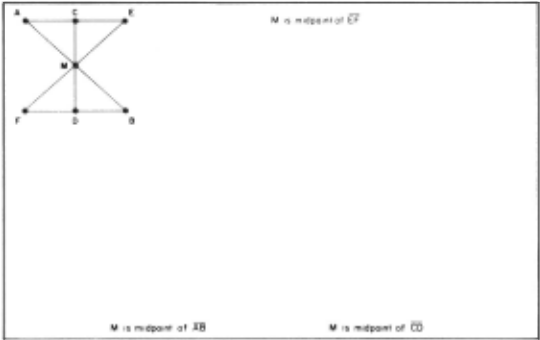
A m<.~jor effort in the desivn of \I re inlerface has tJ,;c!n to cornnnrnic<.~te to \11e student t11e logical ~truc t u r e of a proof and the structure of the problem-solving process by which a proof is genera ted. Figures 3·5 illuslrale the proof uraph that we have duveluped for t11is purposE: . Tl1ere we l1ave a representation of the graph at the beuinnin(J of a geometry proof, in the rnrddle of the proof. and at the end of the proof . Fi<Jure 3 illustr ates the initial problem-state. The stateme:nt to be proven is at the top of the screen , the givens at the bottom, ancl the diagram in the upper lefthand corner. The student can reason forward from the givens and backward from the statement to be proven . The student grows the graph by a combination of pointing to statements on the screen and typing in information. Each step of inference involves a set of premises, a reason , and a conclusion. Reasoning forward , the student points to the premises, types in the reason, and points to the conclusion or types it in. Reasoning backwards, the student points to the conclusion, types in the reason , and then provides the premises.
Figures 4 and 5 show some of the possible states in proof development. The student is finished when there is a set of logical inferences connecting the givens to the statements to be proven. Figure 4 illustrates how inferences can be grown from the top and the bottom to meet in the middle. Figure 5 shows the screen when a student achieves a final proof. Note that the student has made some inferences which were not part of the final proof.
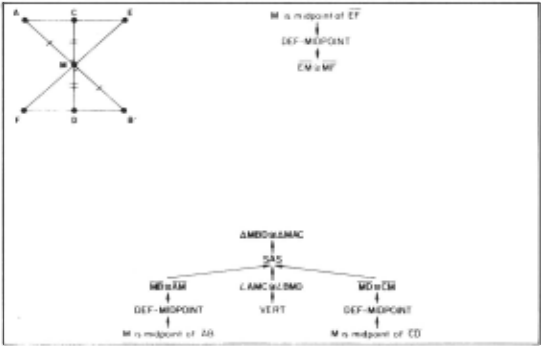
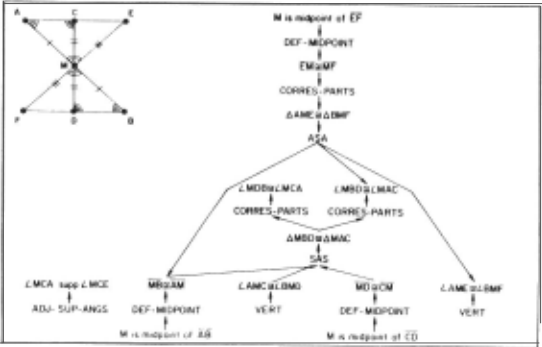
One function of this formalism is to graphically illustrate the structure of a complete proof. High school students typically do not appreciate how the steps of a proof fit together and find this structure to be particularly enlightening. Second, the proof graph concretely illustrates critical features of the problem space--that inferences can be grown in forward and backward mode, that choice points exist where the student must choose among multiple inference rules, that the ultimate goal is to complete a well-formed logical structure.
There are a number of other features available in the rnk rl ace which the student find~; uselul. The system aut<Hn<Jtrcally does spelling <.~nd synt<.J~ checking and so protects thu ~,. tudent lrom the misundurstand·n:Js that can result from mrstyping. NUinerous help windows can lJe brouyt1t up. The two help windows that students find rn a~; t useful are a window providing the currently applic:.~ble rules of inference and a window giving the statement of any particular postul <.~te , theorem, or· definition.
The Tutor
The tutorial component can be described at two levels. First. there is the mlD.l!.nal tutor that we tuve actually implemented and tested with students, and then there are the various embellishments that we are in the process of implementing and testing. The minimal tutor can be described with respect to three steps a student must go through to complete an inference: selecting a set of statements from which to make an inference, specifying the rule of inference that will apply to these statements, and then specifying the statements that result from applying this rule of inference.
In the selection step the student can either select a set of statements from which to apply an inference rule or ask for help. If the student asks for help, the tutor picks the statement set of the most highly rated rule in the conflict set of the IBR, subject to the constraint that the inference produced by that rule is actually part of a proof. It provides the student with the statements (backward or forward) that are part of this rule. If the student selects a set of statements and they represent the instantiation of any legal rule, the system accepts it even if it is poorly rated and even if it is not part of the proof. If the student selects a statement set that is not part of any rule, the tutor tells the student so, and the student gets to select again. If the student chooses a wrong set again, the tutor presents the student with the same statement set that it would if the student had asked for help. This "two strikes and you're out" principle was instituted to prevent the student from looping with guess after guess.
The tutor treats the rule-selection step similarly. If the student asks for help, it provides the highest-rated rule involving the statements chosen in the previous step. It will accept any legal rule that applies to those statements. If the student twice provides illegal rules, it will give the highest-rated legal rule. The analogous thing is ag<.~ in done in specifyinq statements tl1<.1t Li re the result of applying the rule.
This minimal tutor is one that tries to guide the student to a solution with minimal intervention . It accepts any l e~J<I I inlerence that the student wants to rnake. We have found that students can get lost in a maze of leual but ust, less ir. ferences. Therefore. one thing we want to do is to prevent students from making low-rated inferences thL! t are not part of any reasonable proof . The minimal feedback we can provide would be something like " It is legal to do that , but it won·! get you anywhere." However, we would like to build into the tutor recognizers for particular false paths as well as unnecessarily long-winded paths that students go down. As an example of the latter. students often prove theorems as part of a larger proof when they could apply that theorem directly.
Implied in this capacity is the ability of the tutor to query the IBR as to whether an unanticipated inference is part of a reasonable proof. In reasoning backwards this amounts to judging if each of the premises can be proven and how quickly. In reasoning forward this amounts to judging whether the conclusion of a forward inference figures in a reasonable proof.
With these facilities in place we can begin to explore the issue of how directive to be in our feedback. We can allow students to go a fixed number of steps off the path , to override the tutor's advice, etc. Given our commitment to immediate feedback and reducing working-memory load, we would expect that the more structured environment would be better, but there is sufficient controversy on this topic to merit empirical exploration.
Another feature we would like to augment the tutor with is the ability to recognize student confusions and instruct on these confusions. For instance, many students do not realize that in the side-angle-side postulate the angle must be included by the two sides. This requires that there be a buggy rule in the IBR to match this pattern and that the tutor know of this bug and have an explanation associated with it.
A related feature is the ability to give the student strategic advice in addition to simply telling the student that an inference is inadvisable. For instance, if the student starts out in Figure 1 with the inferr-mce I IIMF ;:= I: OME. we would like to l1e able to say sonrt~ tl1 i11y ol tlw order "No. it is not usr, tul to m<1k0 th:.Jt vertic:ll <11191·= inferer1ce liere. It is useful to r11ake the VterliC<II an~l k~ inkrence when the <lnyles are corr esponding parts ol trianvi·:'S you want to prove conarucnt In thrs problem why don't you try to make :.111 inference involving the tact tt1at M is the midpoint of liB."
Yet anott1er feature we wou ld like to provide the tutor with is the ability to generate remedial problems tailored to student weaknesses. This requires keeping an assessment of how well the student knows t11e various rul es in the ideal model. If there is a weak rule, the tutor can generate a problem involvtng this rule and tutor the student on the rule.
Evaluation
Beginning in the fall of 1985 we intend to have a classroom of 10 Xerox Dandetigers in one of the Pittsburgh Public High Schools, and to teach four or five geometry classes of ten students each based on these tutors. The tutor will be devoted to the proof generation portion of high-school geometry, which is slightly more than half of a standard curriculum. This part of the course will be taught on a self-paced basis. The other part of the course (involving ruler and compass construction and coord inate geometry) will be taught in the conventional way. There will be many issues concerned with coordinating such a class which we have yet to work out. However, the outcome of this project will be a fairly systematic evaluation of the tutor and variations on it.
In absence of that we have only our pilot work with the geometry tutor to report. We have run three students through the minimal tutor in various stages of development. One student was of above-average ability, one of average ability, and one of below· average ability (as defined by their math grades) . The below average student came to us for remedial purposes, having failed 10th grade geometry. The other two were eighth graders with no formal geometry training. All learned geometry quite successfully and reached the point where they were solving problems more complex than are assigned in the Pittsburgh Public Schools. After it was over, all claimed to like geometry, which is encouraging given that classroom geometry is usually rated as the least liked of all school subjects (Hoffer, 1981).
Assumi t tCJ that we can establish e:quillly positive results on a l ; tr~wr scale. the nex t quustion cuncer11s how we can rt:·procluce tilts tutor on a more economical scale. It is uur belief that the generatton of personal computers slated for the late 1980s will be Sttffictently powerful to deliver th1s instw c tion . For instance. the IBM machine being developed on the CMU campus is projected to be sufficiently powerful. Moreover. there are optimizotions in the clirection of compiling the real time computations made by the IBR and the tutor that might reduce computational time by a factor of ten.
@inproceedings{ijcai1985p1,
  title     = {The Geometry Tutor},
  author    = {Anderson, John R. and Boyle, C. Franklin and Yost, Gregg},
  booktitle = {Proceedings of the Ninth International Joint Conference on
               Artificial Intelligence, {IJCAI-85}},
  publisher = {International Joint Conferences on Artificial Intelligence},
  editor    = {Aravind Joshi},
  pages     = {1--6},
  year      = {1985},
  note      = {AI and Education},
  url       = {https://ijcai.org/proceedings/1985/1},
}
TY - CPAPER TI - The Geometry Tutor AU - Anderson, John R. AU - Boyle, C. Franklin AU - Yost, Gregg T2 - Proceedings of the Ninth International Joint Conference on Artificial Intelligence, IJCAI-85 PB - International Joint Conferences on Artificial Intelligence PY - 1985 SP - 1 EP - 6 UR - https://ijcai.org/proceedings/1985/1 ER -Copied
Machine-readable versions of this paper, for tools and AI agents:
 Welcome
 Future Conferences
 AI Journal Division
 IJCAI Proceedings
 About IJCAI
 IJCAI Awards