
Demand and Requirements for Natural Language Systems - Results of an Inquiry
Proceedings of the Eighth International Joint Conference on Artificial Intelligence. Natural Language. Pages 647-648.
© 1983 International Joint Conferences on Artificial Intelligence
Abstract
This paper presents the results of a market inquiry on German natural language systems (NLS), which may provide a basis for discussions about applications of AI systems. Features of applicationareas in wh i ch NLS are desired are analyzed and requirements for capabilities of NLS are determined.
- Bobrow, D. G., R. M. Kaplan, M. Kay, D. A. Norman, H. Thompson, and T. Winograd, "GUS: A Frame-Driven Dialog System." Artificial Intelligence 4:2 (1977) 155-173 .
- Codd, E. F. and C. J . Date, "Interactive Sup- port for Non-Programmers: The Relational and the Network Approaches." Report RJ1400, IBM, San Jose 1974.
- McCarty, L. T., N. S. Sridharan, and B. C. Sangster, "The Implementation of TAXMAN I I: An Experiment in Artificial Intelligence and Le- gal Reasoning." Report LRP-TR-2, Rutgers Univ. 1979.
- Mylopoulos, J, P. A. Bernstein, and H. K. Wong, ''A Language Fac i 1 i ty for the Design of Interactive Database Intensive Applications", ACM Transactions on Database Systems, 5:2 ( 1980)' 185-202 0
- Salveter, S. C. and D. Maier, "Natural Lan- guage Database Updates", In Proc. 20th Annual Meeting of ACL, Toronto, Canada, 1982, pp. 67-73.
- Tennant, H. "Experience with the Evaluation of Natural Language Question Answers", In Proc. IJCAI-79, Tokyo, Japan, 1979, pp. 874-876.
References were extracted automatically from the PDF and may contain errors.
Full text extracted automatically from the PDF; figures, tables and equations may differ. The PDF is the version of record.
1. Cost-Benefit-Analysis
In order to determine the demand for NLS we asked about their supposed benefits, costs, and the relation between them. We also took into ac count the believed effects on the user, because this may have influenced the assessment made by potential customers. 88.6% of the interviewees, in dependent of their position, feel that a NLS would be put to good use at their working place. The most frequently indicated benefits of NLS were better substantiated decision-making (65.4%) and planning (61 .4%). That more people have access to computers is viewed as beneficial by 57.2%. That the user is more in control interacting with a NLS (72.0%) and system's performance will be more transparent (65.2%) are consipered advantageous effects on the user. We may infer from this the importance of an explanation component.
As disadvantage for the user the increase of workload because of using NLS is noted by only
16.3% of the interviewees. 43.7% believe that con tentment of employees does not increase with the introduction of NLS, but the opposite is asserted by 33.2%. Other changes in the users' work routines were denied by the majority.
A NLS is expected to be expensive- like any other computer syste~. 86.8% of the interviewees reported from experience that computers are expen sive, 72.2% supposed NLS to be expensive and 16.3% didn't know. 52.0% placed the maximal price. for a NLS alone between 50 000 and 200 000 Deutschmark. Although 69.9% believe that the costs of a NLS would be greater than the benefits in the short run, 70.8% would invest, if NLS were now available! This 'act disposition' does not depend on the trade or the position of the interviewee. So, there seems to be a great demand for and positive attitude to wards NLS.
2. Setting and Tasks
The desired application areas for NLS will now be investigated, showing their implications in terms of NLS capabilities. A simple model of a NLS setting was presented to the interviewee:
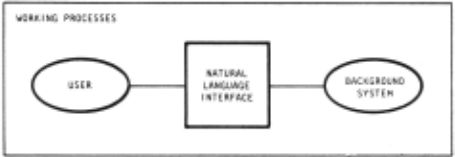
A NLS was judged a useful support for flexible (indicated by 62.2% of the interviewees) and time sensitive working processes (71.4%). It is expec ted that the information gets into the information seeker's hands sooner with the help of NLS. Because decision processes are often time sensitive it is not surprising that decision support is the most demanded function of the overall system for the working process. 44.2% of the interviewees marked decision support as the prime task for a natural language interfaced system. But also information supply (32.7%) and administrative support (23. 1%) were named. Decision support is primarily needed by experts who are not programmers, e.g. managers from all trades, doctors, chemists, etc. But also at lower levels in a firm's hierarchy decision support is desired. Clerks may use a system not only supporting their administrative work but also aiding in well-substantiated decision-making, e.g. to decide which offer can be made with respect to resources and follow-up charts. This example, stemming from the personal inquiries, shows the close relationship between decision and planning. Viewing GUS, for example, as a decision-supporting system, we are familiar with the degree of planning capabilities expected by the user (Bobrow et al.77).
The most frequently named user type of NLS is the parametric user type (37%). We defined the par ametric user (diverging from the definition of Codd, Date 74) as a permanent user whose interac tions with the system are part of his/her job, re gardless of whether the job is routine or not. Ex pert users (here: occasional and professionally mo tivated use of the system) were indicated as typi cal NLS users by 28.4%, casual users (here: occa sional use that does not belong to the job) by 33.2%. As expected, there was a strong correlation between the indication of information supply as system's function and that of casual user as typi cal NLS user type. And most people who chose 'ex pert user' marked decision support as the most sen sible system function .
The choices for background system were: data base system, expert system, and planning system. Information Retrieval Systems were excluded because their domain is typically too extensive for a knowledge-based NLS to handle. While image inter pretation (2.9%) and planning systems (7.2%) were rarely named, expert systems have 23 . 2% of the votes. Yet, the most often chosen background system for a NLS was a data base system (66.2%). But we suspect that it is not understood as a technically strict term, oriented toward the data base systems now available. All people who wanted direct access via natural language to mass data (52.2%) checked data base system, but nearly a third of the 39.6% who desired access to expert knowledge did so too. Expert knowledge was defined as rule-based knowl edge of experience in a limited domain. In which respect could this kind of knowledge appear in a data base context? From the personal interviews it became clear that inferential knowledge about the discourse domain and meta-knowledge about the data base is expected to be attached to the data base system . This may be taken as evidence for the the sis of Tennant (79) that the ease of man-machine interaction requires the extension of conceptual coverage beyond the 1 imits of data base contents.
Two other capabilities of natural language in terfaced systems suggest new directions for re search . The system should not only supply informa tion but do something according to the dialog. That data may be changed of brought in in a natural lan guage dialog was declared to be decisive by 58.9% of the interviewees, in the hope that the bottle neck of data input may thus be overcome. As we know from the work of Salveter, Maier (82) and Mylopoulos et al. (80), natural language update im plicitly demands meta-knowledge about changes in the world and meta-knowledge about data base trans actions. The task, simple in the eyes of the users, turns out to be difficult for those developing the systems. Another requirement for NLS concerns ap plication programs. 40.7% judge as decisive and 52.6% as useful that application programs may be started via natural language. If an advising dialog leads to a decision by the user, the system is ex pected to fulfill the corresponding tasks. A tax advising expert system 1 ike TAXMAN I I (McCarty et al.79), for example, should fill in the correspond ing tax form. A hotel advising system should not only inform the user about advantages of the hotel but also book a room and do all of the related bookkeeping, if it is ordered by the user. From the point of view of the customers it seems quite natu ral that the tasks resulting from a decision sup porting dialog with a computer are performed by the same system. , Aside from ad hoc solutions for a spe cial application, the realization of this demand requires:
- interprocess communication (in a mast P. r-slave
transmitting specifications of the user, which were gathered during the dialog as parameters to the application program
transmitting requests for missing specifications to the NLS, triggering the generation of queries
- mode with the NLS in control) for further information;
- representation of provisional results during the dialog;
- abstract representation of the program's actions;
- representation of real world actions in relation to the implications of verbs (e.g. what does it imply to 'book' a room?)
- understanding of the speech acts 'order' and 'command'
Coming back to the debate mentioned above, the conclusion is quite balanced: there is a great de mand for NLS but there is also a lot of work to meet these requirements.
@inproceedings{ijcai1983p154,
  title     = {Demand and Requirements for Natural Language Systems - Results of an Inquiry},
  author    = {Morik, Katharina},
  booktitle = {Proceedings of the Eighth International Joint Conference on
               Artificial Intelligence, {IJCAI-83}},
  publisher = {International Joint Conferences on Artificial Intelligence},
  editor    = {Alan Bundy},
  pages     = {647--648},
  year      = {1983},
  note      = {Natural Language},
  url       = {https://ijcai.org/proceedings/1983/154},
}
TY - CPAPER TI - Demand and Requirements for Natural Language Systems - Results of an Inquiry AU - Morik, Katharina T2 - Proceedings of the Eighth International Joint Conference on Artificial Intelligence, IJCAI-83 PB - International Joint Conferences on Artificial Intelligence PY - 1983 SP - 647 EP - 648 UR - https://ijcai.org/proceedings/1983/154 ER -Copied
Machine-readable versions of this paper, for tools and AI agents:





