
GLP: A General Linguistic Processor
Proceedings of the Seventh International Joint Conference on Artificial Intelligence. Natural Language Applications. Pages 429-430.
© 1981 International Joint Conferences on Artificial Intelligence
Abstract
GLP is a general linguistic processor for the analysis and generation of natural language. It is part of a speech understanding system currently under development at the 'omputer Science Department of our university (2).
- References Bobrow R. "The RUS System". BBN-Report No.3878, Cambridge, MA, 1978, 28-58
- Hein H.-w. "Automatic Understanding of Continuous German Speech" . In
- Niemann H. (Ed.), Work on Pattern Recogni- tion at Lehrstuhl f. Informatik 5 -Muster- erkennung. Arbeitsberichte d. Instituts f. Mathema- tische Maschinen und Datenverarbeitung (Informatik), Erlangen 1981
- Kay M. "Syntactic Processing and the Functional Sentence Perspective". Proc . TINLAP-1, Cambridge, MA, 1975, 6-9
- Kay M. "Syntactic Processing". Proc. 17th Ann. Meeting ACL, La Jolla, 1979, 1-2
- Miller P. "An Adaptive Natural Language System that Listens, Asks and Learns" . , Proc. TJCAI-75, Tbilissi, 1975, 406-413 IJCAI
- Roberts R.B., Goldstein J.P. "The FRL Manual". MIT-AI-Memo 409, Cambridge, MA, 1977
References were extracted automatically from the PDF and may contain errors.
Full text extracted automatically from the PDF; figures, tables and equations may differ. The PDF is the version of record.
1. The Structure of GLP
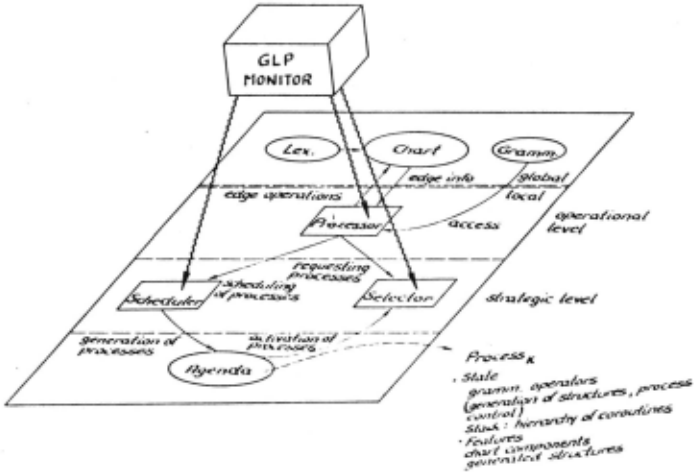
GLP is based on a second generation version of the ~eferal Syntactic Processor GSP of Kaplan and Kay l3 . Its architecture is shown in fig. 1.
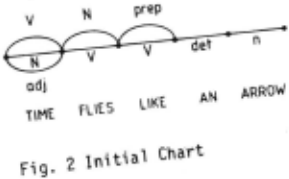
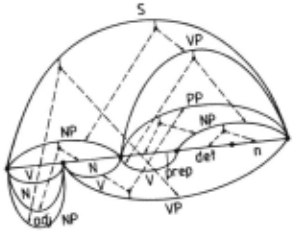
GLP uses two central data structures, chart and agenda. The chart is a directed graph vJhlCflrepre sents the utterance being analysed (or generated) together with all its component structures for any point of time of the processor's operation. For the sake of simplicity our illustration of the chart's usage is limited to the simpler case of text proc essing. In this case the chart is initialized by a sequence of vertices which mark the start and the end of the sentence and the boundaries between words. The vertices are connected by edgds which are la belled by the words themselves an lexical informa tion (see fig. 2.). During processing GLP introduces more and more edges into the chart representing con stituents, partial derivations, etc. Processing is finished when at least one spanning edge from the first to the last vertex is · found which represents a comple tely specified interpretation of the sen tence (see fig. 3). All edges along one path through the chart belong to the same decomposition of the sentence . Besides these inactive edges during proc essing there are also active ones which represent only a part of a phrase, together with an indication which kind of information would be necessary to com plete it, i.e. to make an inactive edge out of it.
The agehda is a list of tasks to be carried out over the c art. Each task is-Ine procedural incar nation of a· rule of the grammar, or a part of it. As GLP realizes a multiprocess1ng scheme all tasks can be executed independently of one another as asynchronous parallel processes .
The underlyin~ rannna1· is a procedural one sim ilar to an Augmente ransition Network (ATN) . Its rules contain linguistically defined operators , a mong which are opera tors for the formation of struc tures , selectors for accessing structures , predi-
GLP: A GENERAL LINGUISTIC PROCESSOR G. Goerz
Univ . Erlangen-Nuernberg, RRZE, Martensstr. 1 D-8520 Erlangen, W. Germany
cates for testing the applicability of a rule or of parts of it, operators to cause side effects and to affect the flow of control The formalism used is similar to that of Kay's(31 reversible grammar sys tem in which the rules are treated as coroutines.
The whole processing is controlled by a monitor which is responsible for the initialization of the system and the generation and management of proc esses . It is the monitor which creates new tasks, splits complex tasks into potentially parallel ex ecutable subtasks, and maintains process and state information. The tasks themselves are executed by an interpreter (or processor) whose instruction set is the set of grammatical operators. Whenever a task sends an interrupt the monitor has to update the chart with the information sent along with it and to look at inactive edges whether there are suspended processes which would need exactly thi s information to be resumed. The monitor causes the selection of tasks from the agenda by means of a selector in an order determined by strategical reasons which are based on linguistic theory. The parsing strategy is realized by a scheduler which gives priorities to tasks and so f1xes their order of execution. Thus the strategy may be flexible over the whole parsing process; top-down or bottom up processing are not characteristic for the proc essing as a whole but only for parts of it.
Clearly the structure of GLP does not limit its ability to perform syntactic analysis; with a suit able linguistic data base (lexicon and grammar) it can be npplied from phonological/morphological to semantic processing. The desire to break down the traditional borders between morphological, syntactic and semantic processing was not the least reason to choose this kind of systems architecture. Parti cularly in systems for processing continuous speech, because of uncertain data, progress in one level of analysis can only be achieved by confirmations from different levels so that a common data structure for all levels so that a con1mon data structure for all levels of processing and a unique control struc ture allowing a flexible strategy become essential [4J.
2. Special Features of GLP
Besides an improved set of grammatical operators, GLP is able
- to perform direction-independent island par sing,
- to deal with gaps in the input utterance and to handle quality scores for word and phrase hypotheses, and
- to tie syntactic and semantic analysis close ly together.
In order to process input data containing gaps and errors as is the case in speech understanding, GLP is able to start its operation at any point with in the chart at a word hypothesis with a high qual ity score and continues by trying to expand this is land on both sides by making predictions on word __ s __ ana-word categories according to the grammar. Pre dictions are based on the entire context of the is land as well as on its internal syntactic structure. If there is more than one island GLP tries to find appropriate syntactic hypotheses in order to merge the islands. This is achieved automatically by proc essing the tasks which seek to complete inactive edges in the chart. To perform these steps effi ciently, the grammar has been preprocessed in a sim ple way to provide information about the word cate gories of potential predecessors or successors of the already recognized islands. Parsing from right to left is performed by a new class of tasks, the so called scantasks, which look for a grammatically fitting expans1on of the island determined by the information about it represented in the chart. To be precise, a scan-task tries to identify a start ing node for a fitting category left of the island which is then verified by the corresponding syntax task.
The chart is initialized in such a way that it contains about ten (eventually overlapping) robust word hypotheses. The gaas between them are closed by specially labelled e ges. If a GAP-edge is found while attempting to expand an island, GLP starts processes which try a match with a set of permissi ble sequences of word categories of the word edges at its left and right end which are accessible through the preprocessed grammar. If the match is successful, a task is generated automatically which requests word hypotheses with the desired features.
Word hypotheses carry quality scores from which priority scores are derived which 1n turn influence the scoring of the constituents containing them. The scoring methods we are currently experimenting with are essentially Woods' [7] shortfall and density scoring . In this fashion the scores determine the priorities of the tasks which shall work on these edges which in turn are subject to the parsing strategy obeying a "best-first" discipline.
To achieve an overall adaptive behavior leading to an acceptable recognition rate it is necessary to tie syntactic and semantic analysis closely to gether. Similar to the fpproaches by Miller [5}, R. Bobrow [1] and Woods [7 in our system we provide the following processing stages: First the utter ance is analyzed bottom-up in order to expand is lands to local constituents. At this stage, the phase of semantic clustering is started by generat ing semantics-tasks which use semantic relationships in the form of case-/valence-frames from the lexicon, in which the semantic and pragmatic knowledge resides, mainly associated with the head word of a phrase. These tasks apply semantic interpretation rules from the grammar to generate semantic hypo theses at the phrase level. These are represented by edges to which instantiated case-frames are attached. In a third stage these hypotheses are evaluated syntactically in a top-down fashion which may cause the generation of new syntactic hypotheses by means of corresponding tasks or may give new scores to syntax-tasks which have been suspended in the appropriate portion of the chart. From the strategic point of view this means assigning new priorities to the newly generated or still present but not yet finished tasks. In this way constituents are interpreted as soon as they are parsed, and the structure of the semantic interpretations thus pro duced is checked when filling the case-/valence frames. This organization permits the semantic and pragmatic knowledge to control the syntactic anal ysis tightly, while at the same time syntactic and semantic processing are cleanly separated.
GLP tries to clarify remaining areas of uncer tainty, which can only be resolved by means of contextual inference, e.g. by resolving references, by generating pragmatics-tasks which trigger the inference-processor. For this we chose the FRL-sys tern l6], which offers a unique and - for our purpose sufficient knowledge representation formalism and reasoning framework.
3. References
- Bobrow R. "The RUS System". BBN-Report No.3878, Cambridge, MA, 1978, 28-58
- Hein H.-w. "Automatic Understanding of Continuous German Speech" . In Niemann H. (Ed.), Work on Pattern Recogni tion at Lehrstuhl f. Informatik 5 -Muster erkennung. Arbeitsberichte d. Instituts f. Mathema tische Maschinen und Datenverarbeitung (Informatik), Erlangen 1981
- Kay M. "Syntactic Processing and the Functional Sentence Perspective". Proc . TINLAP-1, Cambridge, MA, 1975, 6-9
- Kay M. "Syntactic Processing". Proc. 17th Ann. Meeting ACL, La Jolla, 1979, 1-2
- Miller P. "An Adaptive Natural Language System that Listens, Asks and Learns" . , Proc. TJCAI-75, Tbilissi, 1975, 406-413
- Roberts R.B., Goldstein J.P. "The FRL Manual". MIT-AI-Memo 409, Cambridge, MA, 1977
@inproceedings{ijcai1981p83,
  title     = {GLP: A General Linguistic Processor},
  author    = {Goerx, G.},
  booktitle = {Proceedings of the Seventh International Joint Conference on
               Artificial Intelligence, {IJCAI-81}},
  publisher = {International Joint Conferences on Artificial Intelligence},
  editor    = {Patrick J. Hayes},
  pages     = {429--430},
  year      = {1981},
  month     = {8},
  note      = {Natural Language Applications},
  url       = {https://ijcai.org/proceedings/1981/83},
}
TY - CPAPER TI - GLP: A General Linguistic Processor AU - Goerx, G. T2 - Proceedings of the Seventh International Joint Conference on Artificial Intelligence, IJCAI-81 PB - International Joint Conferences on Artificial Intelligence PY - 1981 SP - 429 EP - 430 UR - https://ijcai.org/proceedings/1981/83 ER -Copied
Machine-readable versions of this paper, for tools and AI agents:





