
Building the Inference Component of an Historical Information Retrieval System
Proceedings of the Seventh International Joint Conference on Artificial Intelligence. INFERENCE and REASONING. Pages 401-407.
© 1981 International Joint Conferences on Artificial Intelligence
Abstract
The principal characteristic of the RESEDA system is being able to question an historicaldatabase about the causal relationships which may exist between different attested !acts in the database, but which are not explicitly recorded . In order to do this the designers of RESEDA have created from scratch a methodology for the formalization and generalization of the reasoning used by historians in concrete situations. The description of the present state of this methodology is the object of this paper.
- Hewitt, C. Description and Theoretical Ana- lysis (Using Schemata) of PLANNER : A La~ge for Proving Theorems and Manipulating Models in a Robot (AI Memo n• 251). Cambridge (Mass.): MIT Project MAC, 1972.
- Shortliffe, E.H. Computer-based medical Consultation : MYCIN. New York: American Elsevier, 1976.
- Duda, R., Gaschnig, J. and Hart, P. "Model Design in the Prospector Consultant System for Mineral Exploration". In Expert Systems in Microelectronic Age, Michie, D., ed. Edinburgh: University Press, 1979, 153-167.
- King, Margaret, Ornate, Monique, Zarri, G.P., Zarri-Baldi, Lucia, Zwiebel, Anne. "Ghosts in the machine : An AI treatment in mediaeval history". In Proceedings of the 5th Interna- tional Joint Conference on Artificial Intel- ligence-IJCAI/77 (Cambridge 1979). Pittsburgh: carnegie Mellon University Press, 1977,873-879.
- Abelson, R.P. "Differences Between Belief and Knowledge Systems". Cognitive Science, III (1979) 355-366.
- Carbonell, J.G. Jr. "POLITICS : Automated Ideological Reasoning." Cognitive Science, II (1978) 27-51.
- Carbonell, J.G. Jr. "Toward a Process Model of Human Personality Traits." Artificial In- telligence, XV (1980) 49-74.
- Kolodner, Janet L. Retrieval and Organization- al Strategies in Conceptual Memory : A Compu- ter Model (Research Report n• 187). New Haveru Yale University Computer Science Department, 1980.
- Zarri, G.P. "What can artificial intelligence offer to computational Linguistics ? The ex- perience of the RESEDA project." In Advances in Computer-Aided Literary and Linguistic Research, Ager, D.E., et al. eds., Birmingham: The University of Aston, 1979 , 229-243.
- Zarri, G.P. "From History to Computer Science: A Formalization of the Inferential Processes of an Historian." In Proceedings of the 6th International Joint Conference on Artificial Intelligence-IJCAI/79 (Tokyo 1979). IJCAI
- Hayes, P. The Naive Physic Manifesto (ISSCO Working Paper n• 34). Geneve: Fondazione Daile Molle, 1979.
- Bruce, B. "Case Systems for Natural Language." Artificial Intelligence, VI (1975) 327-360.
- Rosner, M., Somers, H.L. Case in Linguistics and Cognitive Science (Working Paper n• 40). Geneve: Fondazione Dalle Molle, 1980.
- Zarri, G.P., Ornate, Monique, Lee, G., Lelouche, R., Meissonnier, V., Insole, Angela. Projet RESEDA/1 : Rapport sur les recherches effeetu- ees du ler mai 1979 au 1er octobre 1979 (Rapp. LISH/150). Paris: Laboratoire d'Informatique pour les Sciences de l'Homme, 1979 • [ 16]
- Zarri, G.P., Ornato, Monique, Lee, G., Lelouche, R., Meissonnier, V., De Vries, P., Roccati, M. Projet RESEDA/! : Rapport sur les recherches effectuees du ler octobre 1979 au ler juillet 1980 _(Rapp. LISH/187). Paris: Laboratoire d'Informatique pour les Sciences de l'Homme, 1980.
- Blanche, R. Le raisonnement. Paris: Presses Universitaires de France, 1973.
- Demurger, A. "Guerre civile et changements du personnel administratif dans le Royaume de France de 1400 a 1418 : l'exemple des baillis et senechaux." Francia, VI (1978) 151-298.
- Davis, R. "Generalized Procedure Calling and Content-Directed Invocation." In Pro- ceedings of the Symposium on Artificial In- telligence and Programming Languages - Special Issue of the ACM SIGART Newsletter, N° 64, 1977, 45-54.
- Davis, R. Control." 179-222. "Meta-Rules : Reasoning about Artificial Intelligence, XV (1980)
- Zarri, G.P., Ornato, Monique, Lee, G., Meissonnier, V., Cridford, Lesley, Nedelec, Y., Zarri-Baldi, Lucia. Projet RESEDA/! : Rapport s ur les recherches effectuees du ler octobre 19 78 au ler avril 1979 (Rapp. LISH/129). Paris: Laboratoire d'Informati- que pour les Sciences de l'Homme, 1979 .
References were extracted automatically from the PDF and may contain errors.
Full text extracted automatically from the PDF; figures, tables and equations may differ. The PDF is the version of record.
Gian Piero ZARRI
Centre National de la Recherche Scientifique Laboratoire d'Informatique pour les Sciences de l'Homrne 54, Boulevard Raspail - 75270 PARIS CEDEX 06 FRANCE
ABSTRACT
The principal characteristic of the RESEDA system is being able to question an historicaldata base about the causal relationships which may exist between different attested !acts in the database, but which are not explicitly recorded . In order to do this the designers of RESEDA have created from scratch a methodology for the formalization and generalization of the reasoning used by historians in concrete situations. The description of the present state of this methodology is the object of this paper.
I INTRODUCTION
* The aim of the RESEDA project is the construction and practical exploitation of a database of biographical information dealing with the lives of a certain number of important people in France during the late Middle Ages. The principal charac teristic from an AI point of view is being able to ques t ion the system about causal relationships, which ~ exist between different attested facts in the database, but which are not explicitly recorde~ If the replies are considered plausible by the user historian, then the new causal relationships can be permanently recorded in the base. Thus the system may be progressively improved by use.
To carry out these inference operations, RESEDA uses two additional ·sets o! data besides the biographical information proper. These two sets of data constitute the system's "general knowledge" of its particular field. The first gives the his t orical background for the period; for example, i nformation on the social, economic and bureaucrat i c etc. structures of late French mediaeval society, i nformation about important events (e.g. the "hundred years war'~, ideological trends etc. The second set consists of "common sense" rules, which form the backup for the inference .procedures. These permit, for example, top-level changes in the State administration to be explained in terms of changes in political power.
* The RESEDA project is financed by grants from the "D·Hegation Generale a la Recherche Scientifique et Technique" (RESEDA/0, CNRS- DGRST Contract n· 75.7, 0456), from the "Institut de Recherche d'Informa tique et d'Automatique" (RESEDA/1, CNRS-IRIA Contract n· 78.206), and from the "Centre National de la Recherche Scientifique" within the framework of the "Action Thematique Programmee Intelligence Artificielle" .
Therefore RESEDA utilises knowledge inherent to a well-defined subject area to achieve the concrete objective o! simulating an expert's behav iour within this field; hence it may, in some respects, be compared to systems designed on the principles of "knowledge engineering" [1]. This coherence of purpose is also reflected on a more technical level : for example, the format and method of activating the inference rules used by RESEDA conforms to the general theoretical framework de fined by the "consequent theorems" of PLANNER [2] as do rules of the "situation ,..action" type used by most expert systems .
However, RESEDA has certain special charac teristics which are unusual in most expert systems, such as MYCIN [3], PROSPECTOR [4], etc.
- The specialized knowledge which must be introduced into the system is characterized by the total absence of any systematization or formal ization - who indeed may claim to know the laws of history ?
b. The information that RESEDA is required to process refers mainly to "abstract notions", such as the political and religious attitudes, beliefs and ideology of the people concerned [5], rather than "concrete objects" like bacteroides, igneous rocks or nuclear submarines. Therefore RESEDA has some characteristics in couunon with the "belief systems", as defined by Abelson [6] in opposition to "knowledge systems". Abelson emphasizes that "belie! systems have not been very popular objects of study in AI" [6:360]; indeed, it would be diffi cult to cite many projects which share a substan tial numbers of RESEDA's objectives, even taking into consideration, for example, the studies of
Carbonell [7 ; 8] and Kolodner [9].
These characteristics do not make it easy to identify the knowledge necessary to construct the system, particularly in the case of the common sense rules. To avoid falling into the trap of constructing these rules a priori from an abstract point of view, which could only lead to a danger ous hypersimplification - see the famous example of the "Berlin Wall" [7:27] - the designers of RESEDA
have decided to emphasize the principle that all information to be introduced into an expert system must be obtained by reproducing the actual behav iour of specialists within the given field. This means that any inference rule used in RESEDA is only a formalization and a generalization of the reason ing, or a part of it, effectively used by an his torian in a concrete situation [10;11]. The RESEDA team has created an entire methodology from sc~ch for representing historical reasoning, which has been progressively refined throughout the course of the project. It is the description of its present s tate which is the object of this paper.
I I FUNDAMENTAL CONCEPTS OF THE RESEDA SYSTEM.
The biographical information which constitutes the system's database is organized in the form of units called "coded episodes" or "planes'~ There are several different types of plane; the "predicative plane", the mcst important, corresponds to a "flash" which illustrates a particular moment in the "life story" of one or more persons. A predicative plane is made up of one of five possible "predicates" (BE-Al'Ya:TED -BY, BEHAVe, BE-PRESENT, MOVE, PRODUCE), to which one or more "modulators" may be attached. The modu lators' function is to specify and delimit the sem antic role of the predicate. Of course, the "mean ing" of the modulator plus predicate is "defined" - as for all elements of the RESEDA data definition language ("metalanguage") - by the general behavirur of the system rather than by the usual function of these codes in natural language - see also Hayes [12:11-12]. The predicate of the plane is accom panied by "case slots" [13;14] which introduce the predicate arguments.
Dating and space location information is also given with a predicative plane, as is the bibli ographic authority for the statement. Predicative planes may be linked either through the label of one plane being the value of an argument slot (the slot OBJ) in another, or through explicit links "and", "or", "cause", "finality .. etc.
The extremely simple example fiven in figure should provide a clearer idea of what I have just explained; it is the representation of "Robert de Bonnay was named bailli of Mlicon on 27th September 1413 by the King's Council" (bibliographical autho:t' ity : Demurger ; the "bailli" was an officer who dispensed justice, administered finances, etc., for a particular area, "bailliage", in the name of a king or lord) ·
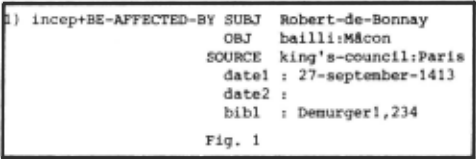
The codes given in capital letters indicate the predicate and the cases associated with it. For each predicative plane there is a pair of temporal markers, "datel- date2", which give the duration of the episode (the predicates are, therefore, "state" predicates). In the above example, which concerns only the beginning of a state (modulator "incep"), "date2"is obviously empty. "Robert de Bonnay" i~ a "vedette",i.e. one of the historical persons whose "life story" is recorded in the system ; "bailli" (meaning the "post of· bailli '') and "king's-council" are entries in RESEDA's lexicon. The classifications associated with the lexical terms provide essential information for the system as regards the historical background of the period. "Miicon" and "Paris" are obviously the "object loca tion" and the "source location" respectively. If the historical documents g i ve us explicitly the pre cise causes of this nomination, then the corre sponding planes would be introduced into the data base and the "nomination" plane would be associated with them by an explicit link of the "CAUSED-BY" type.
When the system is considered from the point of view of its utilization, the fundamental concept which must be introduced is that of the "search model".
A "search model" gives the essential elements, expressed in terms of the RESEDA metalanguage, of a coded episode which it is necessary to search for in the database. A search model may originate from outside the system, if it is the direct translation of a query posed by a user. On the other hand, it may be automatically generated by the system. This happens during a search for "causes" when one tries to retrieve the planes which supply the presuppo sitions of a certain known episode. A search model may, independent of its origin, be "transformed" into a semantically "equivalent" model if an im passe is reached while trying to match the model with data in the base.
Let us suppose, then, that the user questions RESEDA on the subject of the progression of Robert de Bonnay's career, asking, for example, "Did Robert de Bonnay exercise the power of a bailli during the first quarter of the 15th century". In this case the user himself creates the searchmodel given in figure 2, with aid of a prompting program.
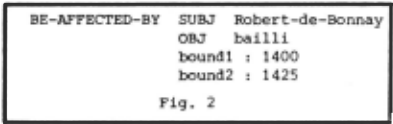
The only notable difference between this for malism and that required for representation of the episodes in the database is that of the presence of a "search interval", "boundl - bound2", which is used to define the temporal limits of the search. Therefore, the search interval has the function of limiting the planes to be examined, and has only a n indirect relationship with the temporal information of the "date" type which is associated to each of the episodes recorded in the base.
I do not intend, here, to go into the detail s of the procedure adopted to test the match of a search model with data in the base ; instead, for details of this, see Zarri et al. [15;16]. It is, for example, obvious that the model in figure 2
may be directly matched with the plane in figure 1; this of course is the exception rather than the rule
In the case of a dead end, a first class of inference rules may be applied to the model, that is the "transformations". To keep to an extremely simple example, the search model :
(for+ BEHAVE SUBJ ~ OBJ 1_) =
"to be favourable towards ··· " could be substituted by the model :
(against+BEHAVE SUBJ X OBJ 1_) given that information regarding the unfavourable attitude of person ~ toward person 1. is at the same time a response to any query about the possi bility of a favourable attitude. Note the exist ence of an underlying common sense rule even in such a simple transformation.
A second example of a transformation is that qiven in fiqure 3. The underlying common sense rule is : "if a person x has a university degree w, then this person has followed some course v"-(one or several persons 1. have "produced" the course ~ with the intention of x). In figure 3, I have only partially detailed the-"restrictions" associated with the "variables" ~· 1.· ~and ~;
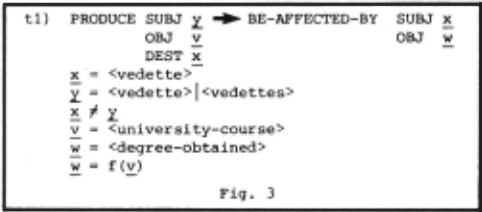
the use of variables allows maximum generality in the formulation of the common sense law underlying the transformation. The values which replace the variables in the retrieved plane (or planes) using the transformed model must obviously respect these restrictions ; for example, the particular type of "degree" which will have been substituted for ~ must be compatible with the value of v in the orig inal model, which I have indicated fo; simplicity as w = f(~).
Unlike the transformation "for/against" given earlier, the transformation in figure 3 is "on&-way'~ that is, it is possible to transform the model from left to right, but not the inverse.
Very often the passage of one model to another is subject to certain conditions ; it is only poss ible to substitute one model for the other if a particular condition has been satisfied. This is verified by checking the existence of episodes wit~ in the base which are able to guarantee the appro priate context.
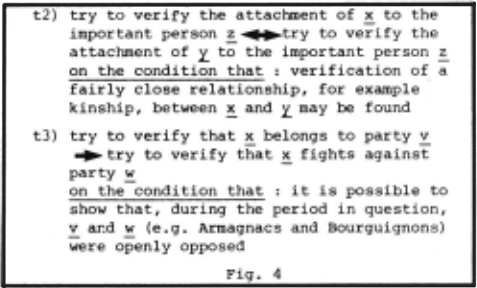
Figure 4 shows the formulation in natural lan guage of two fairly simple conditional transform ations. It is clear that, in the cases of "condi tional" transformations, the "semantic distance" between the information found using the transformed model and that sought at the outset may be quite large. In the most general case, therefore, the information retrieved by means of the transformed model is desiqned to suggest possible new semantic associations rather than a real reply to the search procedure originally instigated.
Even taking into consideration this first cat egory of inference rules, the behaviour of the system such as it has been described up to now is entirely classic in type. RESEDA has, however, a second, more original method of research : it is possible to search for the "causes" of an attested fact in the base. For example, if the user, in sub mitting the query in figure 2, obtained in reply the plane in figure 1, he would be able to continue his enquiry into the career of Robert de Bonnay by asking the system if it knows the reasons for his nomination as "bailli" of MAcon. If the "causes" are not explicitly registered in the system, the function of replying to this type of query is the domain of a second category of inference rules, the "hypotheses".
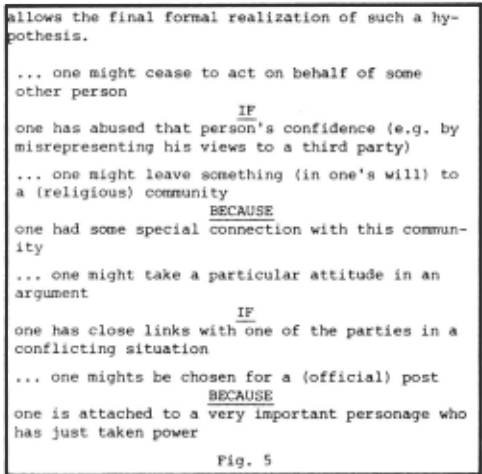
In order to give some idea of the functioning of the hypotheses on an intuitive level, figure 5 shows the formulation in natural language of four of the hypotheses which are at present in the sys tem.
The first part of each of these rules corre sponds to a particular class of confirmed facts (planes) for which one asks the causes. For example, the plane in figure 1 is clearly an exemplification of the first part of the fourth hypothesis in fig ure 5. In RESEDA's terminoloqy, the formal red action of this first part is called a "premiss". The second part (the "condition") gives instruc tions for searching the database for information which would be able to justify the fact which has been matched with the premiss. That is, if planes matching the particular search models which can be obtained from the "condition" part of the hypoth esis can be found in the database, it is considered that the facts represented by these planes could constitute the justification for the plan-premiss and are then returned as the response to the user's query.
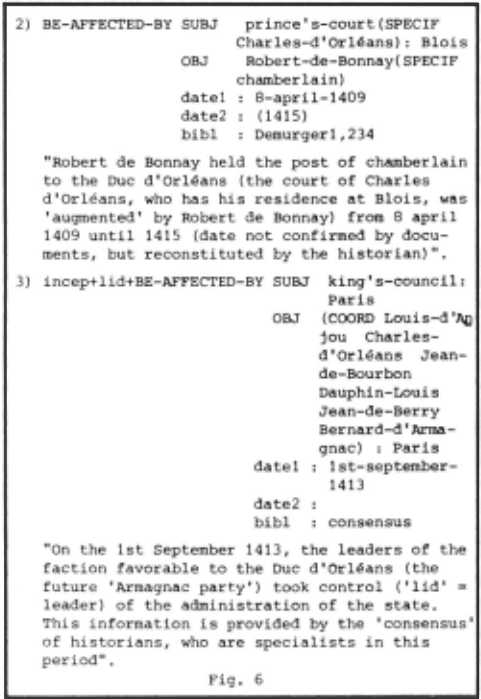
Figure 6 gives the planes obtained by means of the condition part of the fourth hypothesis in fig ure 5 in the case of the query about Robert de Bon nay's nomination. The following chapter will be devoted to the steps which, by generalizing and formalizing the observations of the historian,
III THE FORMALIZATION OF HISTORICAL REASONING
I will restate here the general principles of the methodology which were adopted from .the begin ning of the project with the aim of providing RESEDA with inductive inference rules of the "hy pothesis" type [ 10). There are three well-defined stages :
a) the identification of a possible user question of the type "cause" which cannot be sat isfactorily answered either by direct matching with the data present in memory or by an inference procedure already contained in the system, but where the specialists in mediaeval history are capable of picking out planes from RESEDA's data base containing data which may indirectly provide the information needed for the reply.
b) On the basis of this information and the logical relationships among the planes found, the analyst tries to produce a formal "condition", or sequence of theoretical schemata of planes ("con dition schemata"), which correspond to the par ticular planes pointed out by the historian and all other planes which could provide an answer in analogous situations. The condition must be able to explain all the specific realizations of the "premiss", that is, of the general scheme under lying the coded episode whose causes were orig inally requested. The "premiss", the "condition", and their "variables" and "restrictions on the variables" together make up the formal "hypoth esis".
c) Once this classic line of inductive reason ing [17) has been worked out, then the semantic type of the empirically discovered hypothesis is determined and a "name" is then given to the hy pothesis (for example, for the fourth hypothesis given in figure 5, we have "the hypothesis of nomi nation following a change of goverrunent").
If this methodology is applied strictly, it gives rise to at least two types of major incon venience.
- From the general point of view, the growth of the corpus of hypotheses is purely random and cumulative : each hypothesis is constructed as a single unit, totally independent of other inference rules in the system. Thus, a posteriori, many par tial overlaps can be discovered (several inference rules have indeed recourse in an independent way to some general principles, such as that of "con tradiction"), as are redundancies on the condition schemata level of the same hypothesis (several schemata express the same concept with slight sem antic nuances, for example, see the "hypothesis of the donation" in Zarri [11)).
- On the strictly practical plane, the sys tematic insertion at the condition level of all data discovered by the historian, rapidly leads to an important complication on the formal plane. The exponential growth of possible relationships be tween different e lements of the hypothesis in effect forces the introduction of innwnerable vari ables and very complicated restrictions, see for example, the "hypothesis of coherence of role" [10:237-240). This can only imply considerable uelays on the level of the effective execution of
t he procedures.
In order to illustrate how it is possible to use pr inciples a) b) and c) in the most flexible and productive way, I will now give a detailed example. While examining a recent work by Alain Demurger [18] on the civil war in France and the changes of administrative personnel in the kingdom dur i ng the period 1400 to 1418, the two historia~ Monique Ornato and Joanna Pomian, who are both working on the RESEDA project, encountered the quo t ation reproduced in figure 7, extracted from a l etter from King Charles VI appointing Regnault d 'Azincourt as "bailli" of Gisors [18:168]. This letter alludes to one of many episodes of the civil war , the purging of the central administration, which took place between September 1411 and January 1412, by the Due de Bourgogne, who at that time was secure ly in power.
"Et nous avons es t e et soyons souffi samment in forme que Robert Le Mai s tre qui de ti en t et occu pe l 'off i cede baillyde Gi sor s , a tenu e t tienle parti desdits de Berry, d 'Orlean s e t de l eurs aleez et en l eur s mauvai s et dampnabl e propos l es a consei lle z , portez, sous t enu z et favor isez par quoy il sest entre autres c hoses r endu in digne de t enir e t exe r cer l e d i t offi ce de bailli ne aucun autre office que l conques . Et pour ce l'en avons prive , deboute e t decha rge , privons, deboutons e t de schargeon· de tou t par ces presente s . . . "
"We have been informed and are now acquai nt ed with t he fac t t hat Rober t Le Ma i s tre , who lulds the office of bailli of Gisors , ha s s upported and "'ill continue t o s upport the Dukes o f Berry and Or l eans , and t he ir all ies ; he has advi sed, encouraged , supported and favoured them in everyt hing concerning their mal evolent and con demnabl e i nt entions . For these r ea sons he ha s become , among o ther things, unworthy t o occu py and exer c i se his functions as baill i or any other publ ic f unction. We have , the r e f or e , deprived , r e j ect ed and discharged him f rom his dut i es and now, by t his ac t , we deprive h im o f everything .. . "
F'iq 7
The information given in figure 7 corresponds to a situation where all the data related to a "cau se" search already exists in the base, explicit ~ linked together ; therefore, a query relating to the nomination of Regnault d'Azincourt might receive a reply by direct match. On the basis of thi s model, our historians have thus been able to establish that, within the context of coherence of local power with the governmental power during an unse ttled 'period, all information concerning the fol l owing should be retained a s interesting
- the acces sion to power (in the case of the pr eceding example, the Due de Bourgogne) or the loss o f power (the Dues de Berry, Orleans, etc.) ;
- the accession t o (Regnault d'Azincourt) or the l oss o f (Robert Le Maistre) power on a local leve l ;
- the existing relationships between the peopl e thus brought into play .
We can, now, return to the query on the sub ject of the reasons for the nomination (Fig. 1) of Robert de Bonnay as bailli of Macon. Documents of the period, and this is confirmed by Demurger [18: 234-235] do not mention these reasons ; therefore, we find ourselves in the situation foreseen by a) above. Our historians have thus tried to isolate information in RESEDA's database allowing an in direct reply to the query ; in our case, this information is going to conform to suggestions f) , g) and h) obtained by means of the prototype situ ation. In figure 8, I have given the list of natur al language formulations corresponding to the ~es thus obtained ; I must point out that for the sake of simplicity, I have not indicated all the inform ation of type "h" that it is possible to extract about reciprocal relationships between the people involved. The planes corresponding to the inform ation of the type "f" obviously pertain to this part of the database which supplies the general historical background of the period.
- fl) The influence of Due Jean de Bourgogne on the King's Council ended on 23rd August 1413 , thanks to the energetic efforts of the Dauphin Louis.
- f2) The leaders of the Orleans-Armagnac faction took complete control of the King's Council 1st September 1413 (see the coding of plane3 in the preceding chapter) .
- gl) On 17th September 1413, the King's Council removed Philibert de St Leger from his post as bailli of Macon.
- h1) It has been established that, in March 1414, Philibert de St Leger was in command of the garrison which the Due de Bourgogne had left at Compiegne.
- h2) From 1406 to 1411, the Due de Bourgogne paid Philibert de St Leger an allowance.
- h3) During the same period, Philibert de St Leger was counsellor and "maitre d'hOtel" of the Due de Bourgogne.
- h4) Robert de Bonnay held the post of chamberlain of the Due d'Orleans from 8th April 1409 until 1415 (see plane 2).
- h5) On 9th October 1411, Robert de Bonnay signed the proclamation of the captains of the Orleans party.
Fig. 8
According to the criteria given in point b) at the beginning of this chapter, the general schemata obtained by abstraction from the planes correspond ing to the information in figure 8, should together now constitute the condition part of a new hypoth esis, whose "premiss schema" is derived from plan 1 in figure 1. First of all, our historians tried to see if it was possible to simplify the information in figure 8, eliminating by transformation the "duplicated" information. This allowed the elimin ation of hl) and h2), to leave h3), and hS), to leave h4) ; they have, therefore, retained inform ation which is not cluttered with useless details, and which constitutes the "archetype" of the con cept of "attachment to an important person". It should be noted that the expression "eliminated" is not strictly correct ; if the transformation allow ing the execution of this type of simplification do not yet exist in the system, they are now created and added to the general corpus of transformations. All that remains now is to organize the logical relations between the premiss and the information contained in figure 8. A "natural" way of regroup ing the remaining planes in figure 8 is now given in figure 9. The logical operators "A" and "v" hive the usual meaning "and" and "or". On the one hand,
(f2 A h4) V (f1 A g1 A h)) Fig. 9
the attestation of the accession to power of the princes of the Orleans party (f2) must be related t o the adherence of Robert de Bonnay to this party (h4), while on the other, we must relate the at testation of the removal of Jean de Bourgogne's influence over the Royal Council (f1), to the dis missal (g1) of his agent (h3) Philibert de St Leger. To confirm the formula given in figure 9 in a more analytical manner, we can try to interpret the re lationships between the information in figure 1 and figure 8, not from the standpoint of "causality", but from the point of view of the "transformations'~ It is now easy to see that we can establish the equivalences provided by the two transformations (expressed in figure 10) between the general under lying schema of the plane in figure 1 (which corre sponds to the "premiss schema" of the hypothesis) and the underlying schemata of the planes in figure 8 (condition schemata).
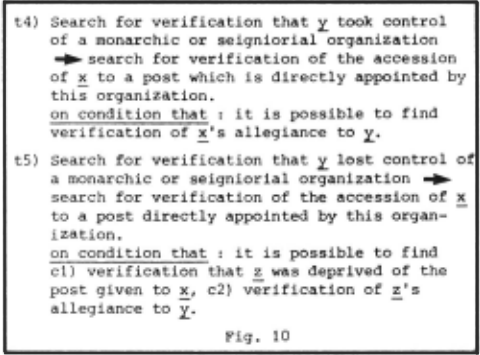
In the se transformations, the search model on the right always corresponds to the plane 1 in figure ("premiss"), while in t4), the model on the left and the data to be checked correspond to planes f2) and h4) in figure 8, and in t5), to planes fl), g1) and h3). The intuitive division into two blocs (see figure 9) of the planes in figure 8 is thus verifi ed : it is now possible to affirm that, from a set of plane schemata which may, a priori, constitute t he condition part of a hypothesis, we can construc t a s many separate hypotheses as there are schemata blocs defined. These blocs have to be interpret ed as the (possibly conditional) transformations, bringing into play these schemata and the "premiss" (which will obviously be the same for the different hypotheses) .
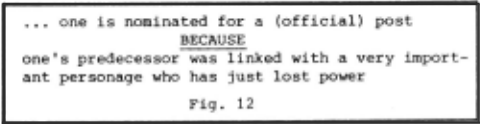
Therefore, finally, we have two hypotheses which are able to reply to the question on Robert de Bonnay's nomination. The first, derived from the transformation t4) and formally expressed in figure 11, corresponds in effect to the fourth hypothesis in figure 5 of the preceding chapter ; it is easy to verify that the two planes in figure 6 satisfy this hypothesis.
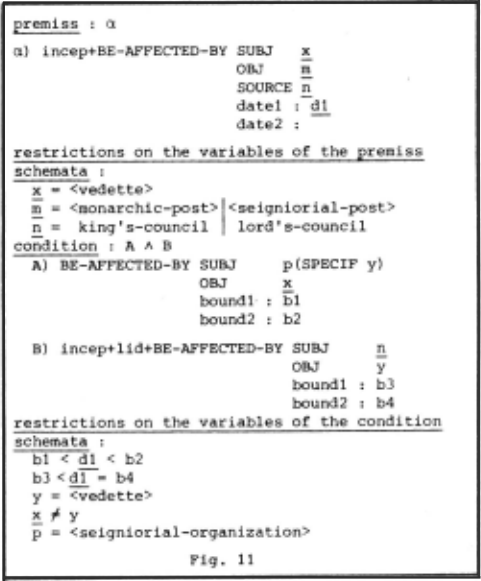
rhe second, derived from t5), can be formulated in natural language, as shown in figure 12.
The two transformations t4) and tS) will now, of course, become part of the general corpus of transformations.
Conforming to the notion of maximum exploit ation of the historical documents which make up the RESEDA database, Monique Ornate and Joanna Pomian have, by using again the data in figures 1 and 8 and procedure that I have just illustrated, tried to construct rules for replying to the question "Why did Philibert de st Leger lose his post as bailli of MAcon." It is easy to see how they arrived at the two hypotheses in figure 13, which are symmetrical with those previously discovered.
This may be extended further by using inform ation not given in figure 8 on the circumstances of the nomination of Philibert de St Leger as bailli of Macon (who was in power at that time, etc).
One might lose one's (official) post
BECAUSE (1)
one was connected with a very important person who has just lost power.
BECAUSE ill_
one's successor is linked to a very important person who has just taken power.
Fig. 13
IV CONCLUSION
No doubt everything that I have just set forth will seem rather ad hoc, and this impression will be even stronger due to the rhetorical artifice that I have, for reasons of clarity, adopted in my text, that is using the same data, both in the con struction and exemplification phases. In reality, this extremely analytic construction procedure ma~s it possible for the system of hypotheses and trans- formations to attain a degree of complexity and subtlety which is sufficient to cover a very large number of possible inferences.
I will now add two observations. The first, which is implicit in everything that I have written (see for example the interpretation in "hypothesis mode" of the transformations in figure 10), concems the fundamental identity of the hypotheses and transformations. Although used in two a priori very different func:tions, thev have basically an analogous function, that of suggesting uses of new search models which may lead to in~ormation having an interesting logical relationship with those orig inally sought ; that is, to suggest intelligent "connections".
The second is that the analytic phase of con struction described in this paper, must obviously be followed by a phase of synthesis which allows the regrouping of the inference rules by means of most general "abstraction levels". Here I will limit myself to stating that we have turned to a "metarule" type methodology, see Davis [19;20], in order to resolve these problems ; some details on our approach may be found in [16].
I will conclude by recalling that, even if cer tain elementary modules have been in use since 1976, the construction of the system in its complexity (noting that, unlike most other expert systems, RESEDA must maintain a real, permanent database) only began with the phase RESEDA/1 in 1978. Cons~ able work from the computational point of view has thus been accomplished in these last few years, on both the analytic and programming levels, see once again [15;16;21]. We expect the completion of a prototype system to arrive in the autumn of 1981.
V REFERENCES
- [ 1] Feigenbaum, E.A. "The Art of Artificial Intel ligence : Themes and Case Studies of Knowledge Engineering". In Proceedings of the 5th Inter national Joint Conference on Artificial Intel gence - !JCAI/77 (Cambridge 1979). Pittsburgh: Carnegie Mellon University Press, 1977, 10141029.
- Hewitt, C. Description and Theoretical Ana lysis (Using Schemata) of PLANNER : A La~ge for Proving Theorems and Manipulating Models in a Robot (AI Memo n· 251). Cambridge (Mass.): MIT Project MAC, 1972.
- Shortliffe, E.H. Computer-based medical Consultation : MYCIN. New York: American Elsevier, 1976.
- Duda, R., Gaschnig, J. and Hart, P. "Model Design in the Prospector Consultant System for Mineral Exploration". In Expert Systems in Microelectronic Age, Michie, D., ed. Edinburgh: University Press, 1979, 153-167.
- King, Margaret, Ornate, Monique, Zarri, G.P., Zarri-Baldi, Lucia, Zwiebel, Anne. "Ghosts in the machine : An AI treatment in mediaeval history". In Proceedings of the 5th Interna tional Joint Conference on Artificial Intel ligence- IJCAI/77 (Cambridge 1979). Pittsburgh: carnegie Mellon University Press, 1977,873-879.
- Abelson, R.P. "Differences Between Belief and Knowledge Systems". Cognitive Science, III (1979) 355-366.
- Carbonell, J.G. Jr. "POLITICS : Automated Ideological Reasoning." Cognitive Science, II (1978) 27-51.
- Carbonell, J.G. Jr. "Toward a Process Model of Human Personality Traits." Artificial In telligence, XV (1980) 49-74.
- Kolodner, Janet L. Retrieval and Organization al Strategies in Conceptual Memory : A Compu ter Model (Research Report n· 187). New Haveru Yale University Computer Science Department, 1980.
- Zarri, G.P. "What can artificial intelligence offer to computational Linguistics ? The ex perience of the RESEDA project." In Advances in Computer-Aided Literary and Linguistic Research, Ager, D.E., et al. eds., Birmingham: The University of Aston, 1979 , 229-243.
- Zarri, G.P. "From History to Computer Science: A Formalization of the Inferential Processes of an Historian." In Proceedings of the 6th International Joint Conference on Artificial Intelligence- IJCAI/79 (Tokyo 1979). Stanford (Cal.): Stanford University Computer Science Dept., 1979 , 1011-1013.
- Hayes, P. The Naive Physic Manifesto (ISSCO Working Paper n· 34). Geneve: Fondazione Daile Molle, 1979.
- Bruce, B. "Case Systems for Natural Language." Artificial Intelligence, VI (1975) 327-360.
- Rosner, M., Somers, H.L. Case in Linguistics and Cognitive Science (Working Paper n· 40). Geneve: Fondazione Dalle Molle, 1980.
- Zarri, G.P., Ornate, Monique, Lee, G., Lelouche, R., Meissonnier, V., Insole, Angela. Projet RESEDA/1 : Rapport sur les recherches effeetu ees du ler mai 1979 au 1er octobre 1979 (Rapp. LISH/150). Paris: Laboratoire d'Informatique pour les Sciences de l'Homme, 1979 ·
- [ 16] Zarri, G.P., Ornato, Monique, Lee, G., Lelouche, R., Meissonnier, V., De Vries, P., Roccati, M. Projet RESEDA/! : Rapport sur les recherches effectuees du ler octobre 1979 au ler juillet 1980 _(Rapp. LISH/187). Paris: Laboratoire d'Informatique pour les Sciences de l'Homme, 1980.
- Blanche, R. Le raisonnement. Paris: Presses Universitaires de France, 1973.
- [ 18] Demurger, A. "Guerre civile et changements du personnel administratif dans le Royaume de France de 1400 a 1418 : l'exemple des baillis et senechaux." Francia, VI (1978) 151-298.
- Davis, R. "Generalized Procedure Calling and Content-Directed Invocation." In Pro ceedings of the Symposium on Artificial In telligence and Programming Languages - Special Issue of the ACM SIGART Newsletter, N° 64, 1977, 45-54.
- Davis, R. Control." 179-222. "Meta-Rules : Reasoning about Artificial Intelligence, XV (1980)
- Zarri, G.P., Ornato, Monique, Lee, G., Meissonnier, V., Cridford, Lesley, Nedelec, Y., Zarri-Baldi, Lucia. Projet RESEDA/! : Rapport sur les recherches effectuees du ler octobre 1978 au ler avril 1979 (Rapp. LISH/129). Paris: Laboratoire d'Informati que pour les Sciences de l'Homme, 1979 .
@inproceedings{ijcai1981p78,
  title     = {Building the Inference Component of an Historical Information Retrieval System},
  author    = {Zarri, Gian Piero},
  booktitle = {Proceedings of the Seventh International Joint Conference on
               Artificial Intelligence, {IJCAI-81}},
  publisher = {International Joint Conferences on Artificial Intelligence},
  editor    = {Patrick J. Hayes},
  pages     = {401--407},
  year      = {1981},
  month     = {8},
  note      = {INFERENCE and REASONING},
  url       = {https://ijcai.org/proceedings/1981/78},
}
TY - CPAPER TI - Building the Inference Component of an Historical Information Retrieval System AU - Zarri, Gian Piero T2 - Proceedings of the Seventh International Joint Conference on Artificial Intelligence, IJCAI-81 PB - International Joint Conferences on Artificial Intelligence PY - 1981 SP - 401 EP - 407 UR - https://ijcai.org/proceedings/1981/78 ER -Copied
Machine-readable versions of this paper, for tools and AI agents:





