
From History to Computer Science: A Formalization of the Inferential Processes of an Historian
Proceedings of the Sixth International Joint Conference on Artificial Intelligence. .
© 1979 International Joint Conferences on Artificial Intelligence
Abstract
The object of the present paper is to discus s the results of the work carried out to define as strictly as possible the formal system of representation of the inferenc e procedures ("hypotheses") characteristic of the RESEDA project. RESEDA is a question-answering system which operates on a data base containing biographical information concerning c haract ers involved in the medieval history of France.
- J Bobrow, D.G., Winograd, T. "An Overview of KRL, a Knowledge Representation Language." Cognitive Science. 1:1 (1977) 3-36.
- Hedrick, C.L. "Learning Production Systems from Examples." Artificial Intelligence. 7:1 (1976) 21-49.
- King, M., Ornate, M., Zarri, G.P., Zarri- Baldi, L. , Zwiebel, A. "Ghosts in the Machine : An AI Treatment of Medieval History." In Proc. IJCAI-77. MIT, Cambridge, Mass., August, 1977, pp. 873-879. IJCAI
- Quillian, M.R. "Semantic Memory." In Semantic Information Processing, Minsky, M. ed. Cambridge Hass. :The MIT Press, 1968, pp. 216-270.
- J Smith, B. "How i s a Knowledge Representation System like a Piano?" Artificial Intelligence Lab- oratory. AI memo 497, MIT, Cambridge, Mass., 1978.
- J Zarri, G.P. "Sur le traitement automatique de donnees biographiques medievales : le projet RESEDA." In Computing in the Humanities, Lusignan, S. , North, J. S. eds. Waterloo, Ontario: University Press, 1977, pp. 151-161.
- Zarri, G.P., Ornate, M., King, M., Zwiebel, A., Zarri-Baldi, L. "Projet RESEDA/0: Rapport final." Equipe Recherche Humanisme Fran<;ais. CNRS, Paris, December, 1977.
References were extracted automatically from the PDF and may contain errors.
Full text extracted automatically from the PDF; figures, tables and equations may differ. The PDF is the version of record.
1 · INTRODUCTION
- The RESEDA project aims to set up an ad vanced question-answering system operating upon a biographical data base. The information housed within this base concerns characters involved in the medieval history of France and their socio historical background. Strictly formulated ques tions are presented to the system; responses, given in the same format, are obtained by direct s earch through the data base or by infe rence p rocedures. The obj~ctives of the first RESEDA/0 step of the project were to construct a general framework for the system and to verify the ad equacy of descriptive metalanguage chosen for dealing with this special sort of data. A new phase RESEDA/1 has just recently commenced. It strives towards two goals : a) making the system fully operational, in pr.ogressing beyond the phase of demonstration tests to approximate a routine practical use of the data; b) examining in theoretical and practical detail the possi bility of a partially automated construction of the inductive "hypotheses" which support the system's inference operations.
- In preparing for the latter, the RESEDA team has had to restudy in depth the work already ac complished on hypotheses in the first phase of the project. It was in effect necessary to es tablish on a more strictly defined basis, the formal conventions under which the hypotheses are drawn up, and to define these conventions down to the smallest detail. This paper relates
* RESEDA/0 was supported by a grant from the "Delegation Generale a la Recherche Scienti fique et Technique" (CNRS-DGRST Contract n° 75. 7.0456); the new RESEDA/1 phase is financed by the "Institut de Recherche d'Informatique et d'Automatique" (CNRS-IRIA Contract n° 78.206).
to the results of this thorough work. With regard to the metalanguage used to represent biographi cal data, discussed in the IJCAI/77 report [3], I will give no more information than is strictly necessary for the full understanding of my talk; the interested reader is referred to recent pa per s on this subject [3,6,7].
2. AN EXAMPLE OF AN HYPOTHESIS
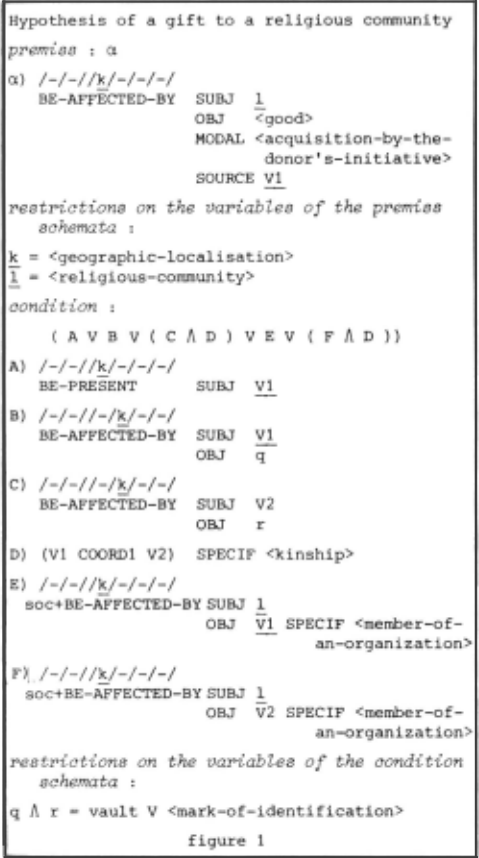
- Fig. 1 shows the formal representation of one of the most simple hypotheses in the RESEDA s ys tem, the "hypothesis of a gift to a religious community".
- Every hypothesis -inference procedure which can be interpreted in KRL "servant-triggers" terms, see [1]- consists of two separate parts, the "premiss" and the "condition".
- The premiss provides the general frame work capable of being adapted to the formal r e presentation of any question, the answer to which can be found in the hypothesis under examination. If we use the distinction introduced by Smith [5] between "abstraction" and "generalization", we could say that the formal expression of the prem iss is obtained by the abstraction of specific formulations, in RESEDA's metalanguage, of dif ferent questions which can be associated with the hypothesis.
- The condition is formed of a sequence of theoretical schemata ("condition schemata") of "planes", linked by "and", "or", "not". The term "plane" [4] is reserved for expressing the repre sentation in the data base, in terms of the meta language, of each elementary "episode", each "fact" -expressed in natural language- which make up the fundamental stages for a biography. For an example, refer to the episode from Pierre l'Orfevre biography further below: "It is known
that around 1360 Pierre l'Orfevre was a member of the chapter of Senlis cathedral, as their dean", which will give rise to the plane 3 in fig. 3. Translation from episode to plane is done by separating out spatio-temporal data plus bibliographic references (the "thematic") from the description proper of the episode. In the "description part" of plane 3, BE-AFFECTED-BY is the "predicate" used in the translation of the episode; SUBJ, OBJ, are the "main cases" while SPECIF simply introduces a degree of precision with respect to the argument JEAN-L 'ORFEVRE which fills the slotOBJ. "soc" is a "modulator" which enables us to specify the fact that the "state" defined by the predicate is inserted into a socio-professional context; "const" carries the meaning of "verified fact".
Returning now to the condition, the information which it enables us to find in the system's data base provides a possible interpretation of the fact (episode) represented by the specificplane to which the question has been reduced. The for mal expression of the condition is obtained, by abstraction, from the coding relating to the planes which are shown to be capable of fulfilling an a ~o~ undefined number of specificactual izations of the premiss.
2. 1 . 2 With regards now to the formal details of the representation of fig. 1, let me take the premiss first. The symbols k, l and VI which appear in the "scheme of premiss", a :-are "vari ables of the premiss schemata". In order to be bound, theses variables must satisfy the "re strictions" connected with them (the restriction on VI is shown implicitly: variables of the type Vn can only be satisfied by the name of one of the personages recognized by the system) .
Going on to the condition : the symbol "1\" which joins the two "condition schemata" C, D (F, D) has its usual meaning of "C and D" ( "F and D" ); "A V B" has the meaning of "A or B" . The condi tion must therefore be interpreted in this way : an explanation of the episode represented by the premiss filled with elements drawn fromthe question, can be given by the planes of the data base which can be adapted to the "condition scheme" A, or to scheme B, or to two schemata C and D -which must in this case be satisfied together- or to scheme E, or to two schemata F and D.
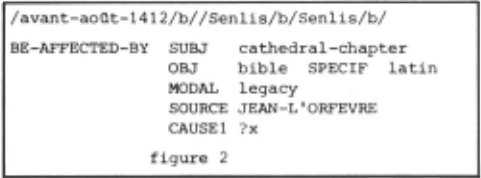
2 .2 Imagine now a question like "Why did Jean l'Orfevre at some unspecified time, but cer tainly before August 1412, the time of his death, give a latin bible by legacy to the Chapter of Sen lis cathedral? "; the question would be coded as in fig. 2. A reply obtained by direct-match would show that it is possible to retrace in the data base a plane -containing at least all the information distinctly specified in the question- which should already be explicitly connected by a "pointer-correlator" [7: 16-17 ] of the type CAUSE to a second plane, or a succession of planes, which would so match with the variable x.
Let us now imagine that this explicit linkdoes not exist; RESEDA will have to resort to the system of hypotheses to reply to the question
asked.
The predicate present in the question (in our case BE-AFFECTED-BY) identifies the set of infer ence procedures which must be examined in order to see if there exists at least one hypothesis whose premiss can a p~o~ match the type of question proposed. When this test has been passed, a real match between the question and the premiss is required. In our case, and referring back to fig. 1 and 2, the result obtained will be that from this point onwards the variables k, l and V1 will be connected to "Senlis" (the place - associated with the "subject" of the attribution in the question thematic) , to "cathedral-chapter", and to "Jean l'Orfevre".
Research on the data base of planes which can satisfy the six condition schemata begins with an examination of the "volume" associated with "Jean l'Orfevre" (volumes are permanent files -a file for each personage recognized by the system- containing "labels" identifying the planes in which the personage in question appears) , in order to see if it is possible to retrace the planes of the form A, B, D and E -the condition schemata in which the (bound) variable V1 is present. In our case, it can be assumed that the searchwill first retrace the plane 1 in fig. 3 : "Jean l' Or fevre lived in Senlis (location of the subject) for a period of which the starting date (code "-") is not known but which ended in August 1412".
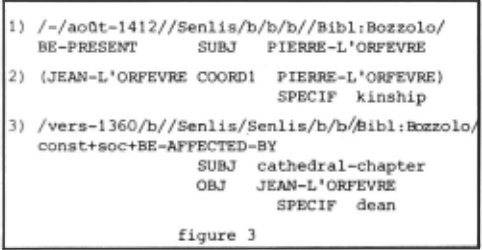
Secondly, we will have a series of "relation plct1es" (special planes without thematics) of the formD, which provide the personages V2 who are relatives of Jean l'Orfevre. A couple of planes which satisfy (F 1\ D) are planes 2 and 3 of fig. 3 : "Around 1360 Pierre l;Orfevre, who is some non-specified rela tive to Jean l'Orfevre, V1, was dean (specific term of the lexical tree <member ... >) of the chapter of Sen lis cathedral". The planes 1 , 2 and 3 together form the reply to the question in fig. 2; the possible reasons for the gift to Senlis cathedral are therefore that Jean l'Or fevre was an inhabitant of this town and that his family had special relations with the cathe dral, given that one of his relatives had held an important position within the chapter.
3. CONCLUSION
Detailed analysis of the hypothesis "gift", proves clearly the ad hoc. nature of RESEDA's inference corpus. However, this ad hoc.ness does not consti tute a limit on the practical utility of the sy!t:en. The degree of complexity and subtlety which can be reached by the inference procedures is sufficient to cover a very large number of possible deduc tions. However, it cannot be denied that, at the present, RESEDA is a system containing a limited number of non-evolving structures (hypotheses), whose capacity to enrich the system by finding new relations between characters or the situations in which these characters are involveq, is restrX:ted to a closed set of pre-determined contexts.
Thus the new phase RESEDA/1 of the project intends to use a semi-automatic technique for the formation of the hypotheses. Such a mechanism should help to alleviate the handicap mentioned above, at least in the sense of facilitating a rapid and continual development of the inference corpus, if onlyat the quantitative level. The procedureinvolved should be the classical one of learning by ex amples, see [2] . The intended mechanismshould be capable of utilizing the syntactic-semantic properties of RESEDA's formal system, in order to create the framework enabling the association of the two poles, question and answer, of the new hypothesis which is to be constructed.
@inproceedings{ijcai1979p221,
  title     = {From History to Computer Science: A Formalization of the Inferential Processes of an Historian},
  author    = {Zarri, Gian Piero},
  booktitle = {Proceedings of the Sixth International Joint Conference on
               Artificial Intelligence, {IJCAI-79}},
  publisher = {International Joint Conferences on Artificial Intelligence},
  editor    = {Bruce G. Buchanan},
  year      = {1979},
  month     = {8},
  url       = {https://ijcai.org/proceedings/1979/221},
}
TY - CPAPER TI - From History to Computer Science: A Formalization of the Inferential Processes of an Historian AU - Zarri, Gian Piero T2 - Proceedings of the Sixth International Joint Conference on Artificial Intelligence, IJCAI-79 PB - International Joint Conferences on Artificial Intelligence PY - 1979 UR - https://ijcai.org/proceedings/1979/221 ER -Copied
Machine-readable versions of this paper, for tools and AI agents:





