
The Representation of an Evolving System of Legal Concepts: II. Prototypes and Deformations
Proceedings of the Seventh International Joint Conference on Artificial Intelligence. Nowledge Representation. Pages 246-252.
© 1981 International Joint Conferences on Artificial Intelligence
Abstract
One of the principal goals of the TAXMAN project is to develop a theory about the structure and dynamics of legal concepts . using corporate tax law as an experimental pr oblem domain. In this paper we describe the " prototypeplus - deformation" model of legal conceptual structure : a concept is represented here by a prototypical description plus a sequence of deformations of the prototype. where the deformations are selected from among the possible "mapptngs" of one concrete description into another. The paper focuses on the set of mappings. which is the most important component of the model because it makes manifest the basic coherence of the conceptual space. The syntax and semantics of the mapptngs are described . and thet r role in the process of legal argument is suggested. The formal model is then illustrated by examples drawn from Eisner v. Macomber . an early stock dividend case.
- McCarty, L.T, and Sridharan, N.S. "The Representation of an Evolving System of Legal Concepts I. Logical Templates." In Proceedings of the Third Biennial Conference of the Canadian Society for Computational Studies of Intelligence.
- V1ctoria, Brit1sh Columbia, 1980, 304-311 .
- McCarty, LT. "Reflections on TAXMAN: An Experiment in Artificial Intelligence and Legal Reasoning." Harvard Law Review. 90 I 1977) 837- 93.
- Sridharan, N.S. "AIMDS User Manual, Version 2", Techn1cal report CBM-TR-89, Department of Computer Science, Rutgers University, 1978, 252
- Schmidt, C.F., Sridhar an, N.S, and Goodson, JL "Plan Recognition: An Intersection of Artificial Intelligence and Psychology." Artificial Intelligence. 9 (1978) 45-83
- McCarty, L.T., and Sridharan. N.S. "The Representation of Conceptual Structures in TAX MAN II. Part One: Logical Templates", Technical report LRP-TR-4, Laboratory for Computer Science Research, Rutgers University, 1980.
- McCarty, L.T "Some Requirements for a Computer- Based Legal Consultant" In Proceedings of the First Annual National Conference on Artificial Intelligence. Stanford University, August, 1980, 298-300.
- Hart HLA. The Concept of Law. Clarendon Press. 196
- Oxford Dworkin, R. "Hard Cases." Harvard Law Review. 88 11975) 1057-1109.
- McCarty, LT. "The TAXMAN Project Towards a Cognitive Theory of Legal Argument," in Computer Science and Law: An Advanced Course, B. Niblett ed .. Cambridge University Press, 1980. 23-43.
- Wittgenstein, L. Philosophical Investigations. Macmillan. 1953.
- Kuhn. T The Structure of Scientifi c Revolutions. University of Chicago Press, 1970.
- Kuhn, T., "Second Thoughts on Parad1 gms." in The Structure of Scientific Theories, F Suppe, ed . University of Illinois Press. 197
- Schwartz, S.P. Naming, Necessity and Natural Kinds. Cornell University Press, 1977.
- Rosch, E , "Classification of Real-World Objects Origins and Representations in Cognition," in Thinking: Readings 1n Cognitive Science, PN
- Rosch, E . and Categorization. 1978.
- Lloyd. Lawrence B.B. Cognition and Erlbaum Associates .
- Minsky, M., A Framework for Representing Knowledge, McGraw-Hill, 1975, 211-77.
- Winston, PH "Learning by Creating and Justify ing Transfer Frames." Artificial Intelligence. 10.2 11978) 147-172.
- Winston, PH "Learning and Reason1ng by Analog y " Communications of the ACM. 23. 12 I 19801 689 - 703.
- W1nograd. Semantic Workshop Language T "On Primitives, Prototypes, and Other Anomalies " In Proceedings, Second on Theoretical Issues in Natural Processing. University of Illinois, 197 8 . 25-32.
- Moore, J., and Newell. A.. "How Can MERLIN Understand?," in Knowledge and Cognition, L Gregg. ed .. Lawrence Erlbaum Associates. 1974. 201.
- Mitchell. T.M. Version Spaces: An Approach to
- Concept Learning, PhD dissertation. Stanford University. 1978.
- Sridhar an. Structures: TAXMAN Laboratory University.
- N.S. "Transformations on Description Syntax. Semantics. and Examples from II", Technical report LRP-TR-12. for Computer Science Research. Rutgers 198 1. (forthcoming).
- McCarty. LT. "A Computational Theory of Eisner v. Macomber." In Proceedings of the International Study Congress on Logic, Informatics, and Law. Florence. Italy. April, 1981 , 553-95.
- Brody. DA "The Post-Macomber Cases in a TAXMAN II Framework: A Preliminary Analysis", Technical report LRP-TR-5. Laboratory for Computer Science Research. Rutgers University. 1980.
References were extracted automatically from the PDF and may contain errors.
Full text extracted automatically from the PDF; figures, tables and equations may differ. The PDF is the version of record.
THE REPRESENTATION OF AN EVOLVING
SYSTEM OF LEGAL CONCEPTS
II. PROTOTYPES ANO OEFORMA TIONS
L. Thorne McCarty Faculty of Law and Jurisprudence State University of New York at Buffalo
N. S. Sridharan Department of Computer Science Rutgers University
"open-textured" (see [7]. pp. 12 1 -50): their structure is never logical and precise. but amorphous and poorly defined. Second. legal concepts are not static structures. but dynamic ones (see [8]): they are typically constructed and reconstructed as they are applied to a particular set of facts. In this paper we will describe a representation of a system of legal concepts which attempts to capture some of these characteristics. In place of the logical template model. we will represent an abstract concept by a prototype and a sequence of deformations of the prototype the prototype is a relatively concrete description selected from the lower-level factual network itself. and the deformations are selected from among the possible mappings of one concrete description into another. We have suggested in our earlier papers that these "prototype plus-deformation" structures play a crucial role in the process of legal argument. and that they contribute a degree of stability and flexibility to an emerging system o f concepts that would not exist with the logical template structures alone [9] [ 1] .
ABSTRACT
One of the principal goals of the TAXMAN project is to develop a theory about the structure and dynamics of legal concepts. using corporate tax law as an experimental problem domain. In this paper we describe the "prototype plus- deformation" model of legal conceptual structure: a concept is represented here by a prototypical description plus a sequence of deformations of the prototype. where the deformations are selected from among the possible "mapptngs" of one concrete description into another. The paper focuses on the set of mappings. which is the most important component of the model because it makes manifest the basic coherence of the conceptual space. The syntax and semantics of the mapptngs are described. and thetr role in the process of legal argument is suggested. The formal model is then illustrated by examples drawn
from Eisner v. Macomber. an early stock dividend case.
I INTRODUCTION
In an earlier paper on the TAX MAN project [ 1] . we outlined our basic representation of the corporate tax domain [2] . using a frame-based language [3] with extended facilities for the description of states. events. act·ons and expectations [4] A principal feature of this representation is its abstraction/expansion hierarchy: a relatively "abstract" conceptual structure is given an "expanded" representation in terms of an assemblage of more concrete conceptual structures. and a recursive pattern-matching procedure is used to "generate" the expanstons when given the abstractions. and to "recognize" the abstractions when given the expansions. We have referred to this model of a conceptual hierarchy as a logi cal template model. and we have demonstrated that it is adequate for representing the facts of an actual corporate tax case. such as United States v. Phellis. 257 U.S 156 ( 192 1). and adequate also for representing the statutory rules and concepts which classify such cases as tax- free reorganizations under Sections 368(a)(1)(8). (C) and (0) of the Internal Revenue Code [2] [ 1] [5] . In addition. we have concluded that the model is adequate for certain practtcal applications in the legal field. as long as the domain of application is carefully chosen [6]
Lawyers would object. however. that the logical template model is theoretically inadequate as a representation of a system of legal concepts. First. a lawyer might say. the most important legal concepts are The idea of representing an abstract concept by a prototype and a sequence of deformations of the prototype has numerous antecedents in the literature In the philosophical literature. the idea is suggested in the "family resemblances" of Wittgenstein [ 1 O] . the "paradigms" of Kuhn [ 1 1] [ 1 2l and the recent work by several authors on the logic of "natural kinds" [ 13] . In cognitive psychology. the idea has emerged recently tn the experimental work of Rosch and other~ [ 1 4] [ 1 5] on the coding of natural categories There nave been several attempts to formalize these notions in the artificial intelligence literature: for example. the suggestion by Minsky [ 16] that a collection of "frames" could be connected by pairwise "difference descriptions" into a "similarity network"; or the work of Winston on the construction of "transfer frames" [ 17] and the understanding of analogies [ 1 8] . However. since the notion of a "prototype" has generated a great deal of controversy and confusion in the recent literature (see. e.g.. [ 19] ). it would appear that the prototype- plus-deformation model. taken as a whole. is not yet fully understood.
In this paper we will focus our attention on the mappings in the space of descriptions. since this is the element of the prototype-plus-deformation model which gives the conceptual representation its coherence. In Section II. we will outline the basic formalism and introduce two important devices: the MAP. which expresses a relationship between two concrete descriptions; and the XDN, which defines a general transformation on the space of concrete descriptions. In Section Ill, we will illustrate these formalisms with some examples drawn from an early corporate tax case. and we will suggest the ways in which the MAPs and the XDNs play a role in the process of legal argument
II THE MODEL: A STRUCTURED SPACE OF DESCRIPTIONS
We have described the basic representational mechanisms of the TAX MAN II system in our previous papers ( 1] (5] , but it may be helpful to review the essential points here. To set up a domain of discourse in T AXMAN II (see generally [3] ), we first construct a system of templates to describe the classes of objects in the domain. and a system of relations to express the possible relationships between these objects. To describe the facts of a particular case, we generate instances of the templates and their associated relations in a particular context. The main work of the TAXMAN II system is then performed by a collection of pattern-matching procedures which operate on descriptions. or, as they are frequently called, DONs. A DON has three components: a template list. a constraint-list and a bindings-list, where
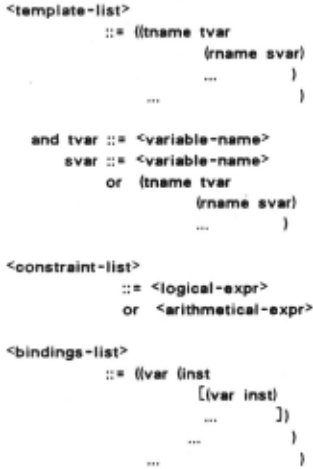
For example, the following DON would represent the ownership of more than 80 percent of the common stock of a corporation, with the corporation in question bound either to "DuPont" or to "StandardOil":
(DON: D-80PerCentOwnership ((OWN 01 (OWNER A 1) (OWNED (SHARE PI (QUANT I TY N 1) (SHARE OF (STOCK S 1 ))))) (QUANT I TY N2) (COMMON YES) (VOTING YES) (ISSUER C 1)) ((GREATERP Nl (TIMES 0.80 N2))) ( (C 1 (DuPont) (StandardO i I))))In this example, we have assumed that the domain already contains a definition of the template OWN, with relations "owner" and "owned"; the template SHARE, with relations "quantity" and "shareof"; and the template STOCK. with the relations as indicated.
Now suppose we wished to use the preceding DON, but minus the bindings for the CORPORATION C 1, as a representation of the expansion of the concept of "corporate control", as defined in Section 368(c) of the Internal Revenue Code. We would do this by defining a new template called CONTROL. with relations "controller" and "controlled":
(TON : ((CONTROL RE L)
((CONTROLLER FN) ACTOR)
((CONTROLLED FN) CORPORATION)))
and then linking up the "80PerCentOwnership" description with the following abstraction:
((CONTROL CON 1
(CONTROLLER AI)
(CONTROLLED Cl)))
In other words, "A 1 controls C 1" if "A 1 owns more than 80 percent of the common stock of C 1 ". The example is a simple one. but for a discussion of several more complicated forms of the abstraction/expansion hierarchy, and an analysis of the procedures RMA TCH and GMAKE which operate upon them. see ( 1] and [5] . As an indication of the level of complexity that we can presently handle, consider the following definition of a "8Reorganization" in Section 368(a)( 1 )(8) of the Internal Revenue Code:
the acquisition by one corporat ion, in exchange solely for all or a part of its voting stock lor in exchange solely for all or a part of the voting stock of a corporation which is in control of the acquiring corporation). of stock of another corporation if, immediately after the acquisition, the acquiring corporation has control of such other corporation !whether or not such acquiring corporation had control immediately before the acquisition).
This example, and others like it, are discussed in detail in (2]
Even with a substantial elaboration of the abstraction/expansion pairs, of course. the preceding formalism captures only the "logical template" version of a conceptual hierarchy. To generalize this representation to a system of "prototypes' and "deformations", we will replace the single DON expression in the abstraction/expansion hierarchy with a structured space of DON expressions. The expansion will thus have three components: ( 1.) an "invariant" component. consisting of a single DON, to handle the case of a concept. like CONTROL, which can be represented with a simple logical template expansion; (2.) a set of "exemplars', each of which is a DON, to handle the case of a concept which cannot be represented with a simple logical template expansion; and (3) a set of 'transformations", each of which is a MAP. to tie the set of exemplars together into a coherent whole. The set of exemplars by itself provides only a disjunctive specification of a conceptual expansion, without giving any indication of how the various exemplars are related to one another. but the set of transformations is intended to supplement this disjunctive specification by expressing certain relationships among the exemplars, and thus imposing an order and a structure on the conceptual space. In this way we hope to capture one of the more important characteristics of the prototype-plus-deformation model: the fact that we can des1gnate one or more of the exemplars as the prototype. and then arrange the remaining exemplars in the order of their prototypicality.
Obviously, the critical component of this definition is the MAP structure, which was discussed informally in [9] . As a first approximation, a MAP has the following form:
(MAP <name>
<structureP :: = DON
<structure2> ::= DON
<invariant> :: = DON
<transformation> :: = MAP)
and it expresses the fact that the DON in the structure1 slot can be mapped into the DON in the structure2 slot, with a specified DON as the invariant and a specified MAP as the residual transformation. For simplicity, we will assume that the MAP operates only on the template-list component of the DON, leaving the constraint-list and the bindings -list unchanged. With this simplification, then. we could write out a sample mapping as follows:
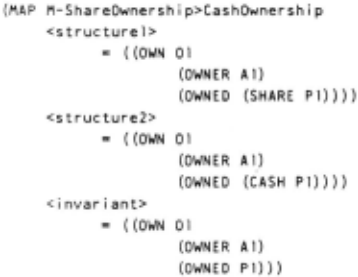
<transformation> · (MAP M-Share>Cash ((SHARE PI)) ((CASH P 1))))
which expresses the fairly obvious fact that the "Ownership-of-a-SHARE" can be mapped into the "Ownership-of-a- CASH", by simply mapping SHARE to CASH. For an extensive discussion of mappings of this
sort, see [20].
Notice, however, that the MAP formalism. as described so far , adds nothing of substance to the domain: it merely restates the relationships that exist implicitly by virtue of the structure of the DON space and the definition of the pattern-matcher. We often refer to the relationship between the invariant slot and the two structure slots here as an imp! i cit vertical mapping. since it corresponds to the "vertical" generalization-specialization hierarchy in the space of DON expressions. (Compare here the "version spaces" of Mitchell [21]). Analogously, we often refer to the relationship in the transformation slot as an implicit horizontal mapping. In the preceding example. the horizontal mapping from SHARE to CASH reveals no structure of any importance. but there are numerous mappings in the corporate tax domain which· depend on a continuous parameter (e.g., the quantity of stock outstand1ng: the proportionality of a stockholder's ownership interest; the risk or the liquidity of an investment). and these other horizontal mappings impose a partial order on the DON space which is orthogonal to the partial order of the generalization/specialization hierarchy. It turns out that the implicit mappings of the DON space can all be defined in terms of a small set of primitive syntactic operations -- operations which add and delete templates and relations; operations which move up and down the AKO hierarchies; operations which mark variables as identical or distinct; etc -- and these operations can be arranged in a preference ordering which preserves several important aspects of the simplicity and the compactness of the DON expressions. For details, see [22l
However. these implicit MAPs are not enough In order to construct a useful system of prototypes and deformations, it is necessary to have available a set of explicit mappings of the DON space. ie . a set of mappings between DON structures which are not mappable by virtue of their syntactic structure alone. What does th1s mean7 As a first approximat ion, we could simply stipulate that a certain MAP, such as the "Share>Cash" mapping illustrated above. had been previously defined in our domain and was therefore available whenever it turned out to be useful. But we can often say more than this. Frequently, we can explain a mapping between two dissimilar DON structures by pointing to a related mapping with a known invariant and a known transformation in a different "dimension" of the DON space. For example, we might be able to describe the relationship between two events by describing the relationship between the two corresponding sequences of state descriptions. Or we might be able to describe the relationship between a "Share" and a "Cash' by describing the relationship between the rights and the obligations associated with each. Sometimes these new mappings will be used to construct invariant relationships in the DON space, in which case we will call them expl ici t vertical mappings, and sometimes they will be used to construct ordered transformations in the DON space, in which case we will call them explicit horizontal mappings, by analogy to the implicit mappings discussed previously. The important point, though, is that these new mappings are not just syntactic mappings. Instead they impose an explicit semantic structure on the space of DON expressions.
To carry out these constructions, it is clear that we need a general facility for defining new MAPs in terms of old ones, and with the appropriate expressive power. These considerations lead us to the following definitional form:
(XDN: <name>
(arg1 arg2)
(SCOPE <DON-pattern> arg1)
(SCOPE <DON-pattern> arg2)
<body> ::= <elementary-transform>
or <(XDNAPPL Y
<xdn>
<structureP
<structure2>)
>)
As suggested, the XDN is a defined transformation which takes two arguments, arg1 and arg2, and expresses the mapping between them in terms of the complex of related transformations listed in its body Because the arguments are usually complex DON expressions, the SCOPE specification is provided to decompose them into their component parts: the given DON-patterns are matched to the arguments, first to determine the potential applicability of the transformation itself, but also to bind the internal variables of the XDN to the components of the DON expressions, in whatever detail is needed. The body of the XDN can then take several forms. There would be certain elementary transformations to provide the building blocks for the entire system: for example. one important elementary transformation would represent the implicit syntactic mapping described earlier, in which the invariant is a matching DON expression and the transformation is a residual MAP; another set of elementary transformations would represent the arithmetical relationships in the domain. and so on. The compound transformations would then be written as the result of applying an XDN to the components of argl and arg2 in this case. structural and structure2 refer to the sub-structures of the DON· patterns. as extracted by means of the SCOPE specification A number of variations of XDNAPPL Y are possible. but the most important variant for our present purposes is the transformation defined in a related "dimension" of the DON space. We represent this transformation by filling in the structure slots with an expression of the form
(PROJECTION <Projected-Dimension Of DON-Space>
arg)
which, by assumption. produces the projection of the arguments in the specified DON space. In this case, the XDN expresses the following fact: arg1 and arg2 can be mapped together because the projections of argl and arg2
in the specified DON space can be mapped together under the application of a known xdn.
We will provide illustrations of these constructions in the following section of this paper. At the same time. we will suggest how the XDN formalism and the MAP formalism play a role in the construction and modification of legal concepts. Since the XDN is basically a lambda expression, and since the MAP expresses the result of applying an XDN to a particular pair of DON expressions. we can explain some of the procedures for conceptual construction in the prototype-plus-deformation model in terms of a directed interaction between lambda-abstraction and lambda-application. We will not develop this point in the present paper. but there will be hints of it in the discussion of the corporate tax case which follows.
Ill ILLUSTRATIONS: THE MAPPINGS OF EISNER V. MACOMBER
We will draw our illustrations from Eisner v. Macomber. 252 U.S 189 ( 1920). one of the landmark decisions of the early corporate tax code. The case involved the distribution of a 50 percent stock dividend Myrtle H. Macomber. who originally owned 2200 shares of the common stock of Standard Oil, received a d1vidend consisting of 1100 additional shares of the same stock .. and the Collector of Internal Revenue, as required by the Revenue Act of 1916. imposed a tax on the distribution. The Supreme Court, however, in an opinion by Justice Pitney. held that a stock dividend of this sort was not "income" within the meaning of the Sixteenth Amendment to the Constitution, and thus the tax could not constitutionally be imposed Justice Brandeis, in an elaborate opinion, dissented. Several other cases were discussed as precedents in the course of the argument The distribution of a corporation's cash, as in Lynch v. Hornby, 24 7 US 339 ( 1 918). and the distribution of the stock of an unrelated corporation, as in Peabody v. Eisner, 24 7 U.S. 34 7 ( 1918). were situations that all parties agreed should be taxable. On the other hand, the appreciation in the value of a stock without the actual transfer of stock certificates. a purely hypothetical case. was a situation that all parties agreed should be nontaxable. The task for Justice Pitney and Justice Brandeis, then. as outlined in [9] , was to construct a concept of taxable income consistent with these agreed precedents. and in such a way that the Macomber case itself would be classified as nontaxable (Pitney) or taxable (Brandeis)
We have discussed the details of the Macomber arguments in an earlier paper [23] , and we will not repeat them here. However, an important step in the analysis. for both parties. was the construction of a sequence of mappings between the decided and the undecided cases. and these mappings prov1de an interesting illustration of the formalisms set forth in the previous section of this paper. For example. one of the more important points in Justice Pitney's argument was the construction of a mapp1ng between the Macomber case and the unrealized appreciat1on case: the taxpayer in Macomber now owns 3300 shares of common stock out of 75.000.000 outstanding. the argument goes. but that's the same as owning 2200 shares out of 50.000,000 outstanding. which is the situation that would have existed had there been no actual transfer of stock certificates. As Just1ce Pitney puts it in his opinion, 252 U.S 189. 211 119201. the stock dividend "does not alter the pre-existing proportionate interest of any stockholder" The point is a simple one. but how would we formalize itJ
First. let us assume that there exists the following XDN in our domain:
(XDN: X-EndStateMapping (d 1 d2) (SCOPE ((STATE TA varA) (STATE TB varB)) dl) (SCOPE ((STATE TX var X) <segment> (STATE TY varY)) d2) (BODY (XDNAPPLY xdnl varA varX) (XDNAPPLY xdn2 varB varY)))which expresses the fact that an ordered pair of state descriptions can be mapped into an indefinite sequence of state descriptions if the initial state descriptions, verA and varX. can be mapped together by some known mapping xdn1. and the final state descriptions. verB and verY. can be mapped together by some known mapping xdn2. Although this mapping might not be considered an invariant mapping in all contexts. in the corporate tax domain there are strong reasons for treating it as such: two sequences of transactions which reach the same end result ought not to be treated differently just because one of them follows a different path. Let us therefore attempt to apply the "EndStateMapping" to our problem, binding a description of the unrealized appreciation case to d1 and a description of the Macomber case to d2. Because of the definition of the unrealized appreciation case. the pattern-match inside the fir st SCOPE specification will bind the identical state description to varA and varB: 2200 shares out of 50.000.000 However. the pattern-match of the Macomber case. expanded backwards in time to a point just before the issuance of the new stock. will bind this same state description to varX. and a different state description to varY: 3300 shares out of 75.000.000. It follows. then. that the "EndStateMapping" can be fully applied if xdn1 is the identity transformation. and if xdn2 is a transformation of the following sort
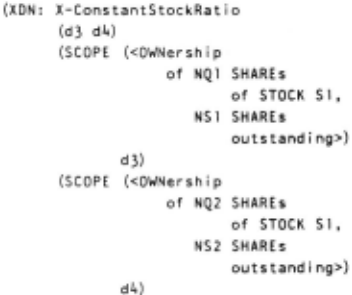
(BODY (EQUAL (QUOTIENT NQ 1 NS 1) (QUOTIENT NQ2 NS2)) ))Now it is conceivable that the "ConstantStockRatio" mapping has already been defined in our domain. since it is an invariant transformation of broad applicability. and if this is the case then our analysis is done
However. the force of this mapping can be strengthened substantially if we project it onto a more detailed representation of the space of security interests The ownership of common stock carries with it cer tain rights to the "earnings". the "assets" and the "control" of a corporation. and these rights can be represented by a system of permission and obi igation schemata [9] For simplicity. let us focus our attention on the right to earnings: we represent this w ith a pair of descriptions expressing the fact that when a certain situation is satisf ied the corporation is permitted to carry out the action of distributing earnings prorata to the common stockholder s. Suppose we now ask what earnings would be distributed to the owners of the shares in the structure1 and the structure2 slots of the "ConstantStockRatio" mapping above It is not too difficult to construct a procedure which gives us the answer: we trace along the path from the permission structure. to the embedded distribution. and then to the expansion of the distr ibution in terms of a sequence of transfers to each stockholder The result. simpl if ied slightly, is:
(DON: D-PermittedTransferOfEarn ings ((TRANS TRl (AGENT (CDRPORAT I ON C 1)) (OBJECT (CASH P2 )) (QUANT I TY (TIMES <fract i on> <ea r n i ngs>)) (OLDOWNER (CDRPDRAT I ON C 1)) (NEWOWNER Al)) (OWN 01 (OWNER A 1) (OWNED (SHARE Pl (QUANT I TY NQ 1) (SHARE OF (STOCK S 1 (QUANT I TY NS 1) (COMMON YES) ( ISSUER C 1)) ))))) ((EQUAL <fraction> (QUOT I ENT NQl NS l ))) NIL)which gives us the "projection" of the or iginal· description onto the space of "permitted transfers of earn1ngs". But notice now that this projection is identical f or both the structure1 and the structure2 slots of the "ConstantStockRatio" mapping. and thus the mapping has been shown to preserve an invariant in the secur ity interest space. Furthermore. the invariant works only f or common stock. not for pref erred stock. since the distribution to preferred stockholders is normally stated in terms of the number of shares owned. instead of the fraction of ownership. Having discovered this invariant mapping. of course. we can now use it to construct an explicit invariant XDN in our domain. following the notation in the previous section of this paper.
A more difficult mapping to represent is the one constructed by Justice Brandeis to demonstrate that it is impossible to draw a coherent line of distinction between the stock distribution of Eisner v. Macomber and the cash distribution of Lynch v. Hornby. In his argument Justice Brandeis posits a sequence of hypothetical cases: first the distribution of common stock, then preferred stock. then bonds; then the distribution of long-term notes. then short term notes; and finally the distribution of cash. This is basically an elaboration of the "Share>Cash" mapping introduced in the previous section of this paper. but for the mapping to have any force it must be projected onto a detailed representation of the security interest space. For simplicity. let us concentrate on a portion of the mapping: from common stock. to preferred stock. to bonds. A direct projection of these securities onto the space of permissions and obligations. which worked well in our previous example, fails to give us the result we want in this case. since the permission and obligation structures are not directly mappable. The common stockholders receive a permitted distribution of residual earnings. but conditional on a prior permitted distribution to the preferred stockholders. while the bondholders receive an obligatory distribution of a fixed amount. and there appears to be no way to compare these various structures except by listing all of their pairwise differences.· However. a further projection. onto a space of expectations. reveals both a common pattern and a systematic difference.
To see this. let us analyze how the corporation is expected to behave. given a capital structure with common stock. preferred stock and bonds outstanding. The basic behavioral assumption is that the corporation seeks to maximize the benefits to its common stockholders. since the common stockholders hold the ultimate voting power over the corporation's affairs. In the case of the distribution of earnings. however. there are. by virtue of the system of permission and obligation schemata. two groups of claimants standing ahead of the common stockholders the bondholders and the preferred stockholders. A relatively straightforward exercise in plan generation (see, e.g.. [4]) will therefore demonstrate that the expected cash dividend for each class of securityholders depends on the earnings available for distribution: unless the corporation is near bankruptcy. the bondholders will receive a fixed amount; beyond that. if the available earnings exceed the bond obligation. then the preferred stockholders will receive a dividend. but only up to the limit of the preferred stock obligation; and beyond that, if earnings are still available. then the common stockholder·s will receive the rest. We can summarize this analysis with the following expectation structure:
(DON: 0-ExpectedOistributionOfEarnings ( (0 I STR I BUTE 0 1 (AGENT (CORPORATION C1)) (OBJECT (CASH P1 )) (QUANTITY (<function> <earnings>)) (OLDOWNER (CORPORATION C1)) (RECIPIENT (SECURITY 51)))) NIL N ll)in which the function applied to the earnings depends in a systematic way on the identity of the "recipient security" But now. if we work with this projection of a security interest onto the space of expectation schemata. instead of the projection onto the space of permission and obligation schemata. we can define a mapping of the followtng sort
(XON: X-Equity>Debt (d1 d2) (SCOPE ((STOCK S 1 (COMMON YES))) d1) (SCOPE ((STOCK S 1 d2) (BODY (XONAPPL Y <xdn> (PREFERRED YES))) (PROJECTION <Expected Distribution Of Earnings> dl) (PROJECTION <Expected Distribution Of Earnings> d2))))where the xdn embedded inside the BODY is an elementary syntactic transformation with the DISTRIBUTION of CASH as the invariant and the mapping from (<function:COMMON> <earnings>) to (<function:PREFERRED> <earnings>) as the residual transformation. The "Equity>Debt" mapping thus expresses the fact that the only difference between common stock and preferred stock in the space of expectation structures is the difference between the two functions which translate earnings into expected quantities of CASH. Another mapping is possible if we assume a reasonable probability distribution on the space of future earnings The quantities of CASH would then inhent a probability distribution. too. and it would be apparent that the common stock has a high expected return and a high risk. while the preferred stock has a lower expected return and a lower risk. This is the traditional way of describtng the mapping between "Equity" and "Debt". For a discusston of the importance of this mapping in the arguments of Eisner v. Macomber. and its importance in the later corporate tax cases. see (9] and [23] .
IV CONCLUSION
Although this paper has emphasized the differences between the "logical template" model of conceptual structure and the "prototype-plus-deformation" model, it is clear that both representations coexist in the corporate tax domain The patterns of reasoning observed in Eisner v. Macomber pers1st throughout the later cases lsee [24]1 There are strong pressures to formulate legal concepts as log,cal templates, if possible, but there are also strong countervailing tendencies to construct mappings from prototypes. and the tension between these two modes of representation provides the foundation for some of the maJOr strategies of legal argument. We believe that the key to understanding this process is a further exploration of the structure of MAPs and XDNs, as set forth in the present paper.
Our implementation of the TAX MAN II theory has proceeded in several stages. In the first stage, we developed the logical template representations and the associated pattern-matching procedures. described in [ 1] and [5] As a step toward the implementation of the prototype-plus-deformation representation, we have extended the pattern-matching procedures to deal with partial matches, and we have added several heuristics to produce a plausible version of a "best match" result We are now working on an implementation of the XDN formalism: an interpreter for the elementary transformations has been written I see [22] L and an initial implementation of XDNAPPL Y has been tested out on the examples in the text The major work left to be done. then, is to define a search procedure in the space of MAPs which matches the observed procedures of Justice Pitney and Justice Brandeis 1n E1sner v. Macomber. Once this step is completed, we should be able to model the major components of legal reasoning in the corporate tax doma1n We expect our results to be of interest to workers in several areas of art1f1C1al intelligence research, and of general utility 1n vanous areas of application.
Acknowledgments: This research has been supported by the National Science Foundation under Grant SOC-78-11408 11978-79) and Grant MCS-79-21471 11979-81) The authors are grateful to John Bresina, Richie Cantone, Donna Nagel and Julian Padget for their assistance in the implementation of the current system.
@inproceedings{ijcai1981p51,
  title     = {The Representation of an Evolving System of Legal Concepts: II. Prototypes and Deformations},
  author    = {McCarty, L. Thorne and Sridharan, N. S.},
  booktitle = {Proceedings of the Seventh International Joint Conference on
               Artificial Intelligence, {IJCAI-81}},
  publisher = {International Joint Conferences on Artificial Intelligence},
  editor    = {Patrick J. Hayes},
  pages     = {246--252},
  year      = {1981},
  month     = {8},
  note      = {Nowledge Representation},
  url       = {https://ijcai.org/proceedings/1981/51},
}
TY - CPAPER TI - The Representation of an Evolving System of Legal Concepts: II. Prototypes and Deformations AU - McCarty, L. Thorne AU - Sridharan, N. S. T2 - Proceedings of the Seventh International Joint Conference on Artificial Intelligence, IJCAI-81 PB - International Joint Conferences on Artificial Intelligence PY - 1981 SP - 246 EP - 252 UR - https://ijcai.org/proceedings/1981/51 ER -Copied
Machine-readable versions of this paper, for tools and AI agents:
 Welcome
 Future Conferences
 AI Journal Division
 IJCAI Proceedings
 About IJCAI
 IJCAI Awards