
RESTAURANT Revisited or "Lunch with BORIS"
Proceedings of the Seventh International Joint Conference on Artificial Intelligence. Nowledge Representation. Pages 234-235.
© 1981 International Joint Conferences on Artificial Intelligence
Abstract
- Special thanks go to Tom Wolf, Pete Johnson, Mark Burstein and Marty Kotsin for their conceptual• and practical contributions to the BORIS project. REFUEIICES Ill Cullingford, R. E. "Script Application : Computer Understanding of Newspaper Stories." Tech. Rep. 116, Yale University. Comput er Science Dept. 1978.
- DeJong. II, Gerald F. "SkiDDIIing Stories 1n Real Time: An Experiment in Integrated Understanding." Tech. Rep. 158, Yale University. Computer Science Dept. 1979.
- Dyer, Michael G. and Wendy G. Lehnert. "Organization and Search Process. es for Narratives." Tech. Rep. 175, Yale Univ. Computer Science Dept. April 1980.
- Dyer, Michael G. In-Depth Understanding: A Computer Model of Memory for Narrativ e Comprehension.. PhD Thesis, Computer Scienc e Dept. Yale University, (Forthcoming).
- Lehnert, Wendy G, Dyer, Michael G., Johnson, Peter N., Yang, C. J,, and Steve Harley. "BORIS An Experiment in In-Depth Understanding of Narratives." Tech. Rep. 188, Yale Univ. Computer Science Dept. , Dec. 1980 .
- Lehnert, Wendy G. The Proceaa Anavering. Lawrence Er1baum, NJ. of Question 197 8.
- Schank, Roger and Abelson, Robert. Plana, Goala, and Underatanding. Earlbaum, Hillsdale, NJ. 1977.
- Scripta, Lawrence Schank, Roger C. "Reminding and Memory Organization: An Introduction to MOPs." In Strategiea for Natural Language Proceaaing.
- W. Lehnert and M. Ringle, editors, Lawrence Er1baum, NJ (in press), 1981.
- Wilensky, Robert. "Understanding Goal-Based Storie•." TP.ch. II••~• 140, y,],. IJr.ivrr~Jty. Computer Science Dept. 1978.
References were extracted automatically from the PDF and may contain errors.
Full text extracted automatically from the PDF; figures, tables and equations may differ. The PDF is the version of record.
1. Introduction
Several natural language understanding systems, such as SAM [1] and FRUMP [2], use the notion of a acript [ 7], a knowledge structure containing a atereotypic sequence of actions. Scripts are intended to capture situations in which the behavior is so stylized that the need for complex plan or goal analysis rarely arises. A prototypic& 1 example of a script is $RESTAURANT "' ENTER + BE-SEATED + WAITRESS-COMES + ORDER-FOOD + FOOD-BROUGHT + EAT-FOOD + RECEIVE-CHECK + LEAVE-TIP + PAY-BILL + LEAVE.
Scripta are useful in supplying expectations during processing. These expectations represent an active context and help in such tasks as:
- Pronoun Resolution In a $RESTAURANT context, tip." waiter. clearly the "he" in: "He left him a big is the customer while "him" must be a
- Word Sense Disambiguation -- The expressions "ordered" and "to go" have very different meanings in a restaurant ("John ordered a pizza to go.") than in the military ("The general ordered a private to go.").
- Supplying Inferences -- Once a script is chosen, processing can proceed very efficiently, since missing information is automatically provided by the script. For example:
John ordered a lobster. John paid and left.
Q: What did John eat?
A: Lobster.
Scripts also contain one or more patha [1], each supplying a possible alternative sequence of actions to ghoat [6] (or default) path. An alternative path in $RESTAURANT includes leaving without paying because the food was improperly cooked. This path information is used to answer questions, such as:
Q: Why didn't John eat the hamburger?
In this case, the search heuristic starts with the 'ghost path' in which the food would have been eaten. The retrieval heuristic backs up along this
1 This work supported in part by Advanced Research Projects Agency contract N0014-75-C-lll and National Science Foundation contract IST7918463.
$RESTAURANT REVISITED OR
'LUNCH WITH BORIS'
Michael G. Dyer
Computer Science Department Yale University
New Haven, CT 06520
path until a branch point is found. Here resides the reason:
A: The hamburger was burnt.
that an alternate path was taken.
2. Probleaa with $RESTAUIAIT
However, representing what people know about restaurants only in terms of a $RESTAURANT script ' is inadequate, for three reasons:
- Scripts were conceived as self-contained 'chunks' of knowledge. As a result, it is' difficult to share knowledge across scripts. For example, a restaurant serves meals, but people also eat meals in non-restaurant situations (home, picnics). This meal knowledge should be shared with restaurant knowledge, even though the meal-server in a restaurant differs from the meal-server at home.
- Because scripts are self-contained, experiences occurring within one script cannot be generalized to other relevant situations. For example, if we refuse to pay for burnt food in a restaurant, somehow the knowledge derived from this experience should be available later in an $AUTO-REPAIR context, when the mechanic fails to fix the engine properly. .
- Scripts lack intentionality. From a scriptal point of view, each event occurs next simply because it is the next event in the script. Although script-based programs know that characters, initiate $RESTAURANT to satisfy hunger, they do not know why any specific event within $RESTAURANT occurs. This is analogous to answering:
- Q: Why does the diner tip the waitress?
- A: I don't know. That's just what he does in a restaurant after he's eaten.
Lack of intentionality has both advantages and disadvantages. It is certainly more efficient, since goals and plans do not have to be processed in order to predict what a character will do next. However, it is difficult to handle novel situations, where a character's reaction might be explainable if the underlying goals and motivations (for the expected event) were known [9].
For instance, a friend admitted to me that, ss a child, she enjoyed pocketing the coins people left on restaurant tables. One day she was caught by her parents. who informed her that these coins were to reward the waitress for her service. Until' this moment, in which my friend grasped the intentional significance of tipping, it had just been a "scripta! action" for her.
3. MOPe
In BORIS, an in-depth understander of narratives [3] [5], scripts have been augmented by a class of knowledge structures called MOPe (Memory Oq1.nni7.nt ion l'llckr·tN) (II).
L·k~ ticriptti, HOPs encode expectations, but unlike scripts, HOPs are not isolated chunks of knowledge. Instead, each HOP in BORIS has etrande which indicate how the HOP has been constructed from other knowledge sources. Each strand connects an event in one MOP to some event in another MOP. In this way, MOPs are overlaid with each other. Consider diagram-1:
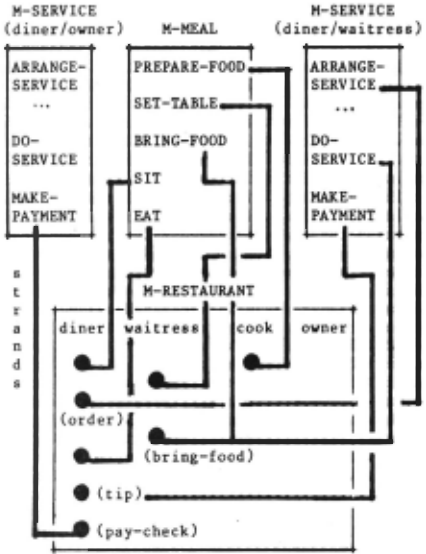
Events in M-RESTAURANT are overlaid with their corresponding events in M-MEAL and M-SERVICE. In this way, M-RESTAURANT can be viewed from different perepectivea. From the perspective of M-MEAL, a restaurant is simply a setting in which people have meals. From the perspective of M-SERVICE, the diner ~n M-RESTAURANT is engaged in a service contract with the restaurant owner. The restaurant must serve food to the diner and, in return, the diner is expected to pay for this service.
As stated earlier, script-based systems represent scripta! deviation in terms of alternate 'paths'. Thus, the restaurant script contains a BURNT-FOOD --> LEAVE-WITHOUT-PAYING path. But this approach causes a proliferation of paths, for two reasons: First, every possible deviation has to be anticipated and 'canned' into the script; otherwise the script would not be able to handle the deviation. Second, each service-related script ends up copying the same path. For example, in $AUTO-REPAIR there has to be a BAD-REPAIR ---> LEAVE-WITHOUT-PAYING path. By overlaying these scripts with M-SERVICE, a single deviation path: POOR-SERVICE ---> REFUSE-TO-PAY in M-SERVICE can represent deviation knowledge at a more general level. Likewise, 'payment for service' occurs in many situations, not just in $RESTAURANT. Therefore, tipping should be understood at a mon: general level than $RESTAURANT.
4. Handling Deviations
When stereotypic situations are first encountered, people let their scripta! knowledge handle the situation until a violation occurs. At this point they become aware of other perspectives associated with the script, each potentially useful in understanding the violation.
For instance, we rarely think about the contractual aspects of restaurants when eating in one. Restaurants are usually "taken for granted" as a place where one can have a meal and socialize. Only when something goes wrong do we think of the contract we're implicitly engaged in. Jf the service is bad, then we reconsider the amount of the tip and what it's for.
More importantly, a deviation which has never before been encountered may be handled, as long as some strand exists from the script to a knowledge structure with information about this type of deviation. For instance, if $MOVIE has strands to M-SERVICE then the very first time the movie projector breaks we can use our deviation path in M-SERVICE to demand a refund, even if the projector breaking is a novel experience.
Consider how BORIS processes fragment of DIVORCE-2, a complicated concerning marital infidelity: the following narrative (4]
George was having lunch when the waitress accidentally knocked a glass of coke on him. George was very annoyed and left refusing to pay the check ···
Briefly, an analysis of "having lunch" activates M-MEAL. When "waitress" occurs, the MOPs associated with this role are examined. If a MOP being examined has a strand to an active MOP, then it is also activated. Since there are strands from M-RESTAURANT to M-MEAL, and since H-MEAL is already active, K-RESTAURANT is activated also.
An interpretation of "accidentally" indicates that a violation may follow. This heuristic is based upon the assumption that unintended actions usually violate scripta! expectations.
"Knocked a glass of coke on him" is analyzed in terms of the Conceptual Dependency [7] primitive PROPEL (Object · Liquid). Given this event, BORIS tries to match it against the events expected in H-RESTAURANT. This match would normally fail, since H-RESTAURANT does not expect waitresses to PROPEL food-stuffs. However, "accidentally" has warned BORIS of a possible violation, so a violation match is attempted and succeeds. At this point ;JORIS realizes that the PROPEL event is a violation of the event BRING-FOOD in M-RESTAURANT, rather than some event totally unrelated to M-RESTAURANT.
Now what is BORIS to do? In previous systems, there would be a path in the script for such a deviation. However, this is not the case here. When BORIS encounters a deviation, it searches the strands connected to the event where the deviation occurred. This leads to DO-SERVICE in M-SERVICE (see diagram-1).
Associated with M-SERVICE is general knowledge about how things may "go wrong" for each event in M-SERVICE. There are several events, such as: ARRANGE-SERVICE, DO-SERVICE, INFORM-BILL, MAKE-PAYMENT, etc. For example, the sentence:
The waitress overcharged George.
constitutes a violation of INFORM-BILL.
In addition, there is knowledge about violations may be related to each other. knowledge is represented by rules, such as: how This
If SERVER has done SERVICE badly (or not at all), Then SERVER should either not BILL CONTRACTOR or BILL for amount < NORM.
If SERVER has done SERVICE badly or BILLs CONTRACTOR for amount > NORM,
Then CONTRACTOR may REFUSE PAYMENT.
BORIS uses this knowledge connection between the waitress George's refusal to pay a check. to recognize the PROPEL LIQUID and
Left to consider is how BORIS realizes that the violation of BRING-FOOD actually constitutes POOR-SERVICE. This is accomplished by tracking the goals of the characters. The PROPEL LIQUID on George is understood to cause a PRESERVE-COMFORT goal for George. This goal is examined by M-SERVICE, which applies the following heuristic:
If SERVER causes a PRESERVATION GOAL for CONTRACTOR while performing SERVICE, Then it is probably POOR-SERVICE.
Thus, BORIS uses several sources of knowledge to understand what has happened. H-RESTAURANT supplies expectations for what the waitress should have done. Knowledge about PROPEL and LIQUIDs supplies goal information, while H-SERVICE (between waitress and diner) provides very general knowledge
about how contractors will respond to poor service.
5. Concluaiona
Early script-based systems operated within restricted knowledge source domains. For instance, although FRUMP had many available scripts to choose from, once a single script had been selected, the rest of the story was processed within the context of that script alone. As a result, many problems
involving scripta! interactions never arose.
In this paper I have discussed various problems with scripts, and suggested memory 'overlays' as an in it ia 1 solution. This overlay scheme has sever a 1
advantages:
Each knowledge structure need know only what is directly relevant to it. For example, what a waitress does in captured in M-RESTAURANT, while her reasons for doing her job are represented at the M-SERVICE level which will handle any type of service. H-SERVICE need not be repeated for janitors, salesgirls, etc. This supports economy of storage, but more importantly, it means that any augmentation of the knowledge in M-SERVICE will automatically improve the processing ability of any
MOP with strands to it.
Related knowledge sources need not be activated unless something goes wrong during processing. For instance, people do not normally think . of the contract between themselves and the restaurant manager unless they are having trouble with the
service.
Finally, a given event can be understood from several perspectives. For example, a "business lunch" involves M-MEAL, M-SERVICE, M-RESTAURANT, and M-BUSINESS-DEAL simultaneously.
AClROWLEDG!MIIITS
Special thanks go to Tom Wolf, Pete Johnson, Mark Burstein and Marty Kotsin for their conceptual· and practical contributions to the BORIS project.
REFUEIICES
- Ill Cullingford, R. E. "Script Application : Computer Understanding of Newspaper Stories." Tech. Rep. 116, Yale University. Comput er Science Dept. 1978.
- DeJong. II, Gerald F. "SkiDDIIing Stories 1n Real Time: An Experiment in Integrated Understanding." Tech. Rep. 158, Yale University. Computer Science Dept. 1979.
- (3] Dyer, Michael G. and Wendy G. Lehnert. "Organization and Search Process.es for Narratives." Tech. Rep. 175, Yale Univ. Computer Science Dept. April 1980.
- Dyer, Michael G. In-Depth Understanding: A Computer Model of Memory for Narrative Comprehension.. PhD Thesis, Computer Scienc e Dept. Yale University, (Forthcoming).
- Lehnert, Wendy G, Dyer, Michael G., Johnson, Peter N., Yang, C. J,, and Steve Harley. "BORIS An Experiment in In-Depth Understanding of Narratives." Tech. Rep. 188, Yale Univ. Computer Science Dept. , Dec. 1980 .
- (6] Lehnert, Wendy G. The Proceaa of Question
- Anavering. Lawrence Er1baum, NJ. 197 8.
- Schank, Roger and Abelson, Robert. Plana, Goala, and Underatanding. Earlbaum, Hillsdale, NJ. 1977. Scripta, Lawrence
- [ 8] Schank, Roger C. "Reminding and Memory Organization: An Introduction to MOPs." In Strategiea for Natural Language Proceaaing. W. Lehnert and M. Ringle, editors, Lawrence Er1baum, NJ (in press), 1981.
- [ 9] Wilensky, Robert. "Understanding Goal-Based Storie·." TP.ch. II··~· 140, y,],. IJr.ivrr~Jty.
- Computer Science Dept. 1978.
@inproceedings{ijcai1981p48,
  title     = {RESTAURANT Revisited or "Lunch with BORIS"},
  author    = {Dyer, Michael C.},
  booktitle = {Proceedings of the Seventh International Joint Conference on
               Artificial Intelligence, {IJCAI-81}},
  publisher = {International Joint Conferences on Artificial Intelligence},
  editor    = {Patrick J. Hayes},
  pages     = {234--235},
  year      = {1981},
  month     = {8},
  note      = {Nowledge Representation},
  url       = {https://ijcai.org/proceedings/1981/48},
}
TY - CPAPER TI - RESTAURANT Revisited or "Lunch with BORIS" AU - Dyer, Michael C. T2 - Proceedings of the Seventh International Joint Conference on Artificial Intelligence, IJCAI-81 PB - International Joint Conferences on Artificial Intelligence PY - 1981 SP - 234 EP - 235 UR - https://ijcai.org/proceedings/1981/48 ER -Copied
Machine-readable versions of this paper, for tools and AI agents:





