
Six Topics in Search of a Parser: An Overview of AI Language Research
Proceedings of the Seventh International Joint Conference on Artificial Intelligence. Invited Talk. Pages 1079-1086.
© 1981 International Joint Conferences on Artificial Intelligence
Abstract
- Daniel G. Bobrow and Terry Winograd, "An overview of KRL, a knowledge representation language," Cog- nitive Science 1( 1) pp. 3-46 ( 1977).
- Robert J. Bobrow and Bonnie L. Webber, "Knowledge repr e sentation for syntactic /semantic processing," Proceedings of the First Annual Na- tional Conference on Artificial Intelligence ( 1900) .
- Ronald J. Brachman, " On the epistemologic a l status of semantic networks ," pp . 3-f>O in Associa.- tive Networks : NP.prP.senta.tion a.nd U. o;e of KnowledgP. by Computers, ed . N.Y. Findler, Academ - ic Pres s. New York ( 1979} .
- Eugene Chdrnia k, "Toward a model of ehlldrens story unders tanding ," TR-266 M.I.T. Artificial Intelli- gence Laboratory ( 1 972} .
- Eugene Charniak , "A framed PAINTING : The representation of a common sense knowledge frag- ment," Cogn'i.t'ive Sciencr. 1(1) pp . 355-391 (1977) .
- l:ugcnc Charniak, "A parser with something for everyone," TH 70 Department of Computer Science, Brown University ( 1981).
- Eugene Charniak, "A common representation for problem solving and language comprehension infor- mation," Art'ificial Intelligence, (forthcoming) .
- B) Eugene Charniak, "The case-slot identity theory," Cognit'i.ve Sc'i.ence, (forthcoming) .
- Richard E. Cullingford, "Script application : Computer understanding of news- paper stories," Report 116 Yale Depari.ment of Computer Science ( 1978) .
- David R. Dowty, Robert E. Wall , and Stanley Peters , Introduction to Montague Semantics, D. Reidel Publishing Company, Dordrecht, Holland ( 1981).
- Lee D. Erman, Frederick Hayes-Roth, Victor R. Lesser, and D. Raj Reddy, "The Hearsay-11 speech- understanding system: integrating knowledge lo resolve uncertainty," Computing Surveys 12(2) pp . 213-253 (1980) .
- Scott E . Fahlman, NETL : A system for Representin.g and Using Real-World Knowledge , MIT Press , Cam- bridge, Mass . (1979) .
- Charles J . Fillmore. "The case for case," pp . 1-88 in Universals in. Lin.guistic Theo1-y, ed. E. Bach and R.T. Harmes, Holt, Rinehart. and Winston, New York (1966) .
- Joyce Friedman and David S. Warren, "A parsing method for Montague grammars," Linguistics and Philosophy 2 pp . 34 7-372 ( 1978) .
- Philip J. Hayes , "On semantic nels, frames and as- sociations ," pp . 99-107 in Proceedin.gs of the F'i.fth International Joint Conference on Artificial Intelli- gence, ( 1977).
- Philip J. Hayes, "Mapping input onto schemas," TR 29 Department of Computer Science University of Rochester (1978) .
- Jerry R. Hobbs and Stanley J . Rosenschein, "Making compulalional sense of Montague ' s intensional log- ic," Courant Computer Science Report #11 New York University ( 1977).
- Mitchell P . Marcus , A Theory of Syntactic Recogni- tion for Natural Language, M.I.T . Press, Cam- bridge, Mass. (1980) .
- Bonny Nash-Webber and Raymond Reiter, "Ana- phora and Logical Form: On Jo'ormal Meaning Representations for Natural Language," pp. 121- 131 tn Proceedings of the F'i.fth International Joint Conferrmr:e on Artificiallntr!lligrmce, ( 1977) .
- Chuck R1cgcr, "Conceptual mf'mory ," in Conceptu- al Information Processing, ed . H. C. Schank, North-llolland Press, Amsterdam ( 1975).
- Chuck Rieger and Steve Small, "Word expert pars- ing ." pp . 723-728 in Proceedings of the Sixth Inter- national Joint Conference on Artificial lntelli- geme, ( 1979) .
- Christopher K. Ric sbeck and Roger C. Schank, "Compr•chension by compulcr: F.xpeclalion-based a nalys is of sentences in conlext," Research Report 1/?B Yale University Department of Computer Sci .. "ne e• ( 19'76) . 10 87
- Roger Schank and Lawrence Birnbaum, "Memory, meaning, and syntax," Yale Department of Comput- er !:icience (1960) .
- Roger C. Schank and Robert P . Abelson, Scripts, Plans, Goals, and Understanding, Lawrence Jo:rl- baum Associates, Hillsdale , New Jersey (1977).
- Candace L. Sidner, "Towards a Computational Theory of Definite Anaphora Comprehension in En- glish Discourse," AI-TR 537 Massachusetts Institute of Technology Artificial Intelligence Laboratory ( 1979).
- Yorick Wilks, "An intelligent analyzer and under- slander of English," Communications of the ACM 18(5) pp . 264-274 (1975) .
- Yorick Wilks, "Philosophy of language," pp . 205-233 in Cotnputational Setnantics: An Introduction to Artificial Intelligence and Natural Langua9e Comprehension, ed . E. Charniak and Y. Wilks, (1976) .
- Terry Winograd , Understanding NaturaL Language, Academic Press, New York ( 1972).
- Patrick H. Winston, Artificial Intelligence , Addison Wesley, Reading. Massachusetts (1977) .
- Douglas Wong, "Language Comprehension in a Problem Solver," in Proceedings of the Seventh International Joint Conference on Artificial Intelli- gence, (1981). IJCAI
- William A. Woods, "Procedural semantics for a question-answering machine," Proceedings of the FalL Joint Computer Conference, pp. 457-471 (1968).
- William A. Woods, "An experimental parsing system for transition network grammars," pp . 113-154 in Natural Language Processing, ed. R. Rustin. Algo- rithmics Press, New York ( 1972).
References were extracted automatically from the PDF and may contain errors.
Full text extracted automatically from the PDF; figures, tables and equations may differ. The PDF is the version of record.
I Introduction
My purpose in this paper is to give an overview of natural fanguage understanding work within artificial intelligence (AI) . I will concentrate on the problem of parsing - going from natural language input to a seman tic representation. Naturally, the form of semantic representation is a factor in such discussions, so it will receive some attention as well . Furthermore, I doubt that parsing can be completely isolated from text pro cessing issues, and hence I will touch upon such seem ingly non-parsing issues as script application. Neverthe less, the topic is parsing.
Un,fortunately, to present AI parsing work with any sort of historical accuracy would be to produce a bewild ering forest of names (both of people and programs) Rather, I will rather try to extract from the historical record a group of ideas which I believe can be molded into a coherent framework. Naturally, even within these limitations my remarks will be sketchy - this is an arti cle, not a book.
n Syntax
Parsing takes us from natural language(in this paper English) to a semantic representation. While we will discuss semantic representation later, for the moment we need simply note that whatever form this representation takes , it must at the very least clearly and unambiguously indicate the logical relations in the sentence . That is , in a sentence like "Jack pushed the button." it must clearly distinguish the pusher from the pushee . In English this is typically indicated by word order, but other factors can enter in, as in the case of the passive sentence "The button was pushed by Jack." I bring this up, of course, · because it is typically our knowledge of the syntax of English which gives us a first cut at this information.
A Rules of Syntax
Given that we need to use syntax, the next thing we must decide is if we are to have explicit rules of syntax. Actually, if interpreted in the narrowest possible fashion, there is a general consensus on this point. After all, if we do not have such explicit rules , then the only alternative is to have the rules implicitly buried in the code of the program (or possibly buried in rules for other things) . Given the general popularity of "rule based systems" these days , it seems reasonable to assume that we will make our knowledge of syntax "rule based" as well.
·Many of the opinions express ed in this pape r we re forged dur ing conversations with Graeme Hir st and the selection of topics would huvc been r ad ically different we r e i t not ror his input. This research was supported in part by the Office of Naval Hescar c h unde r contrac t N00011-79-C-0592 , a nd in part by the National Sc ie nce Founda tion unde r contra ct IST-8013689. apo logi es t o l'irunde llo.
However, semantics could presumably note that "about the plot" does not make much sense as a modifier of "the boy" . (The only possible hold out here might be Woods . In [32] he points out that the lime needed to do semantic processing in his system is longer than that needed to follow alternative syntactic parses. He may have changed his view on this, but I have not seen it in print. However, few people have been convinced by this argument, since most assume that it says more about our lack of knowledge about semantics than anything else.)
But relegating semantics to a subroutine of syntax (let us call this the "semantic subroutine" position) is quite controversial. Schank and his students [22, 23) have a,rgued for a much tighter connection - one in which there is but a single system with both syntactic and semantic rules. We will call this the "combined seman tics" position. While there have been a variety of argu ments for such a position, ranging from psychological experiments to etnciency considerations, to me the most cogent is that people understand ungrammatical sen tences . The argument goes like this : if we had a syntac tic parser in charge of everything then it would be responsible for calling the semantic routines. So, in a sentence like "The boys is hungry." the syntax would have failed to parse it, hence producing nothing which could be handed otf to semantics, and hence no under standing .
While I know of no written response to this argu ment, several alternatives seem to come up in discus sions . One is to use a "blackboard" model as in HEAR SAY [ 11). In this scheme the syntax and semantic com ponents work in parallel. leaving their conclusions on a common "blackboard" . The idea is that even if the syn tactic component fails , the semantic component will still succeed, at least if the sentence is comprehensible.
That there are troubles with this model is suggested by the fact that HEARSAY itself did not really use it. While technically the two systems worked in parallel. in actual design the semantics would only work on the out put of the syntactic component, making the model iso morphic to the semantic subroutine model proposed earlier. Nor is it hard to see why this should be the case . As we have already noted, syntax is the most obvious way to get a first cut at the logical structure of the sentence . In a real blackboard model the semantics would be forced to do without the logical structure established by the syntactic component. This would mean that it would have to re-establish the same information by other means . If it could do this, then why bother with syntax at all'? In other words, a blackboard model will ulti mately degenerate into either a "no syntax" model, or a combined semantics model.
The other alternative to the combined semantics model is one in which we have a syntactic parser, but the grammar it uses is not the "correct" grammar for English, but rather a much more permissive grammar. The idea is to make the permissive grammar such that if a sentence is ungrammatical according to these permis sive standards. then it will be incomprehensible as well. But there are still problems here . We have already noted that people understand sentences in which subject verb agreement is not obeyed, e .g . "Jack have the ball .". Yet some sentences can only be completely understood if we use this rule . For example:
The fish is hungry. The fish are hungry.
If our permissive syntax does not check for agreement then we will not have extracted the lull measure of meaning from such examples.
Perhaps one final point here. We have become so accustomed to the fact that we are concerned with the extraction of meaning from sentences, and not account ing for grammaticality judgements, that it is, at times, remarkably easy to forget the fact that people d.o have grammaticality judgements. If we are at all interested in psychologically plausible models of language comprehen sion then we must account for this fact . Permissive syn tax simply will not do this for us. short of including two sets of rules, one permissive, one strict - a rather ad hoc solution at best.
The way out of this bind is to take a slighlly different approach. Rather than assuming that the grammar of the language should account for our ability to under stand ungrammatical sentences, it seems more plausible to me to assume that one has a standard "correct" grammar for the language, and one tries to apply it to the sentence . If the sentence is ungrammatical. then somehow it should be the parsing mechanism itself which allows for the ungrammaticality. That is , it should note the ungrammaticality, but go on anyway, dolng the best it cr.n.
However, the most popular of the syntactic parsers, the "augmented transition network" parser (ATN) (32) cannot do this. The need to reject ungrammatical sen tences is built deep into the workings of ATNs . Ulti mately we can trace the problem back to the method ATNs use for handling situations where there is more than one possible interpretation for the next sentence constituent. For example:
Jack gave the ball to the boy. Jack gave the boy the ball.
After parsing the "gave", the next noun phrase may be either the direct object "the ball" (in the first sentence) , or the indirect object "the boy" (in the second sen tence) . Suppose for the first of the above cases it guesses that the noun phrase is the indirect object. After parsing the noun phrase it will then be immediately expecting a second noun phrase, the direct object. as in the second sentence. Of course, it will not be there, a prepositional phrase is there instead. The point is that upon finding that there is no way to proceed, an ATN can not assume the sentence is ungrammatical at that point and try to fix things up. In the case at hand the sen tence is not ungrammatical. Rather , the inability to proceed stems from an incorrect gues"s made at an ear lier point . Hence the ATN will backtrack to the last deci sion point and try an alternate guess.
C. Parsifal and Paragram
The solution to this problem is deterministic pars ing . If we have a parser which need not backtrack then failure at a given point in the sentence will indicate ungrammaticality, and hence we have the possibility or dealing with the ungrammatical sentence . Mlircus' Par sifal ( 10) is such a parser, although it does not handle ungrammatical sentences .
The basic idea behind .Parsifal is that we have a buffer which allows us to have a limited look-ahead in the sentence. In Parsifal the butler is or size three, so at any point we may have three constituents (such as individual words , but they may be larger units as well) which have yet to be attached to the overall syntactic tree . Once we have decided how a constituent is to be attached, how ever, we cannot change it . So, ror example, the Parsiral rule ror equi np insertion would look something like this:
(rule cqui-np-mscruon ; We g'i.ve thP. rule the name equi-np-insertion [=to][= verb tnsless] [the higher verb is +equi] - > ;Th:i.o; is the test portion of the rule , we witt ;explain it below. Insert a copy of the subject of the next higher sentence into the bufler before the 'to'. ;This is thP. action. It does the insertion of the ;understood noun phrase .In a sentence like "Jack wants to go home." equi-np inscrtion applies after we have parsed the "wants" . The test portion of the rule checks that the next thing to come is the word "to", and that it is followed by a "tenseless" verb. That is , by a verb which has the infinitive form, as, in this case, "to go" . Finally it checks that the higher verb, in this case "wants" allows equi np insertion to take place.
Now, as we already noted, Parsifal will not parse an ungrammatical sentence. For example, if we gave it
Jack wants go to the store.
the above rule of equi-np-i.nserlion would not apply because the " to" is missing. However, I have written a parser, Paragram, which will handle at least some ungrammatical sentences (6]. While Paragram differs from Parsifal in several ways, the point which is impor tant here is that rather than have all or nothing tests as in Parsifal. (that is , the test is either true or false) Paragram's tests produce a " goodness of fit" rating . Thus, in the case of an ungrammatical sentence, when we reach the point of ungrammaticality, all of the tests will have bad fits , yet , baring lies, there will still be one rule which looks marginally better than the others. In the case of the above sentence with the missing "to" , equi np-i.nscrlion is the best of a bad lot for Paragram, and hence Paragram will "hallucinate" a "to" in the right spot, and proceed to apply equi-np-i.nsertion anyway, thus successfully parsing the sentence.
Ill Semantics
Given a possible solution to the problem of ungram matical sentences, we have cleared the way for a resumption of the semantic subroutine. model of parsing . Thus we are adopting a model in which the syntactic parser produces some portion of a syntactic tree, and, at predetermined times hands this otl to semantics. Semantics then helps guide the parse , resolve ambiguity, and builds the final semantic representation.
A. Woods Procedural Semantics
A while ago, when I was trying to figure out what to teach my students in my undergraduate AI course, I became rather dissatisfied with the state of semantics in Al . ldealy what I wanted was some rule based system for turning the output of syntax into a semantic representa t ion. The trouble is, that none of the recent work in semantics is sufficiently formalized to allow for this . I found mvse lf forced to turn back the clock about ten years and return to Woods procedural semantics [31] .
Wood 's system was a classic rule based system, as we can see by examining one of his rules. First, we have several gene ral patterns lor syntacti c trees Now consider a rule which will handle a sentence like this :
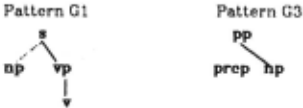
AA-57 departs from Boston. The rule Is: TEST: In Gl : np is a flight and v = leave or depart In G3: prep = in or at and np is a place OUTPUT: (depart Gl-np G3-np)The output is a pattern in which we substitute the objects found in the input. So Gl-np would be the np found in pattern G 1. e .g., AA-57.
Now this is nice because it is fairly easy to give a student this type of work and have him understand it. The situation action type rules are easy to understand, so the student is, with one exception, pretty much able to determine the behavior of the system from an exami nation of the rules .
The exception, the only part which is not reasonably clear given just the rules, deals with quantification. In order to handle sentences like
Every plane tlys to Boston
Woods must engage in some slight bit of complicated machinery. The rule for handling "every" translates it into the following :
Roughly speaking what will happen is l!l.at the translation for "plane", (plane X)" , will be substituted in for V , and the translation for " flies to Boston", (arrive X Boston)" will be substituted in for 6 . The result will be:
(for every X (plane X) (arrive X Boston))
There is a bit more complexity, to insure that the same variable (in this case X) is used in each subformula.
While this is not too bad, it is nevertheless a part of the system which is not adequately rule based, since, as we did here, one must abandon the rules and give a rather lengthly explanation in English. We shall return to this point in a moment.
B. Montague Grammar
One possible source for formalizing ideas would be linguistics. Upon turing in that direction however, we find that the major trend in linguistic semantics over the last few years has been Montague grammar, which, as we shall see, is a rather odd companion for AI language work.
Montague grammar is exceedingly complex, and there is no hope that I could explain it here. For the reader who wants to learn more about Montague gram mar, the most accessible introduction is the textbook by Dowty et al. [ 10]. As in transformational grammar, a set of grammatical rules analyze the structure of a sen tence . As opposed to transformational grammar, how ever, each syntactic rule is associated with a semantic rule which turns the sentence into a formula of a rather complicated formal logic . (The combination of syntactic rule plus translation into logic is essentially just another tesllaclion rule .) The logical formula , in turn, is assi«ned a meaning according to certain rules which define the semantics of the logic . Again, . the details here need not concern us. All we really need note is that the logic deals with so called "possible worlds" , and many of the expressions in the logic have , as their meanings , quantifications over all possible worlds . So a certain expression would be true if in all possible worlds in which X is true, Y is true as well, or some such.
Now from an A1 point of view there are a lot of prob lems with Montague grammar . The actual syntax Mon tague used was rather trivial, but this is being attacked by the linguists attracted to the framework . More trou blesome are the issues we run into if we try to take seri ously the idea of using the semantics of the formal logic as a way of inferring facts about the world . Quantifying over all possible worlds is, to quote Wilks [27] "no joke" For this and other reasons Wilks rejects Montague gram mar as relevant to AI.
By and large, Wilks' view has been the majority one . Thus, while Friedman [ 14] has implemented a Montague grammar parser, it was clearly intended as a toy system, suitable only tor leatning about Montague grammar. It does not seem intended as a useful AI system. Hobbs [ 17] has also considered the use of Montague grammar, but never implemented a program. It would seem that he too had trouble making quantification over possible worlds compatible withAl .
While I basically agree with the above criticism, I have recently become more sympathetic to Montague grammar, due to two rather nice features . The first is the way in which Montague grammar handles quantification. At first glance, quantification in Montague grammar looks a mess . So rather than tackle it directly, let us start with a simpler example :
Bill sleeps.
"Sleeps" is easily enough. It is translated into some predicate sleepe. However "Bill" has a rather bizarre translation. It becomes
Here I am using the normal lambda calculus, although expressing it in LISP formalism. In this formula, Bill is the symbol for t.he individual referred to by the English word "Bill". Now while this looks pretty odd, note that combining subject and predicate in Montague grammar is now a very simply operation - that of functional appli cation. That is
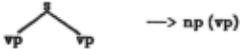
That is, we apply the function represented by the noun phrase to the verb phrase . In the case at hand this gives us :
((lambda (P) (P Bill)) sleep)
This still looks pretty odd, but as we all know from nor mal LISP, this can be simplified because P will now become bound to sleep and we can replace it throughout by its value, giving us
(sleep Bill)
Now this looks like a rather complicated way to pro duce the obvious . But note what happens when we have quantification. So consider a sentence like :
Every dog sleeps
This will have the following representation (I am chang ing the Montague formalism a bit here, for reasons which should become obvious) :

Now we add a rule for combining "every" with "dog" :

With these rules the noun phrase "every dog" will be analyzed as follows :
Every dog---> ((lambda (N)
(lambda (P)
(for every (X) (N X) (P X))))
dog)
---> (lambda (P)
(for every (X) (dog X) (P X)))
by lambda substitution
When we then combined this with the verb "sleeps", we get:
Every dog sleeps ---> ((lambda (P)
(for every (X) (dog X) (P X)))
sleep}
---> (for every (X) (dog X) (sleep X))
Now the point of this exercise is that this last formula is exactly what Woods would have come up with for this sen tence . Once we see this , we can then see that the rather complicated expression Montague uses for "every" is really just the same as what Wood's had. The only difference is that while Woods had to depart from his rule based system in order to state in English what his sys tem did with all of this, Montague, through the usc of the lambda calculus, is able to express everything within his rule formalism. In other words, for this example , any way, the Montague formalism is the better one if one wants a truly rule based system.
There are other nice features of Montague as well . One is his handling of the verb "to be" . Typically AI sys tems handle "to be" as ambiguous between ''is of iden tity" and the " is of predication" . We have identity in:
Mark Twain is Sam Clemens.
This is normally represented by something like :
(=mark-twain sam-clemens)
The "is of predications" is seen in:
Mark Train is a man.
This gets a representation like :
(man' mark-twain)
Montague is able to have a single sense Cor the verb "to be" yet end up with the two distinct representations shown above . The differences stem from the differences between his representations for "a man" and "Sam Cle mens" . This is not, in itself, an earth shaking develop ment, but it is a nice touch.
Because of lhesc nice touchs , I have become interested in Montague grammar as a useful tool for AI Neverthel ess, l should it make it clear that 1n mos t respects my earlier opmions have not changed . lt is s till the case that quanlifica twn ove r possibl e worlds is out of the qucstwn. For th1s an other reasons, the actual semantics of Montague grammar docs not inte r es t nw. Nevertheless, Montague's method of deve lopmg the semantic representation using only the lambda calculus and functional application looks very cute to me, and I would like to sec if it can be adopted to more reasonable AI systems . The example from Woods suggests that this 1s not an idle possibility.
C. Word Sense Ambiguity
But for all of my recent infatuation with Montague grammar , it should be clear that the Linguists are not really going to help us very much. The major problem in semantics is not, as discussed above , how to combine predicates into the semantics representation, but rather the disambiguation of predicates ("river bank" vs . "commercial bank") and the detcrmmation of noun phrase referents ("Jack put the money in the jar and then put it on the self" .) Since virtually all linguists ignore these problems we arc on our own.
Needless to say, AI has not been standing still since Wood's paper ten years ago. Howeve r , the work has not been easily systcmatizable. To give you some feel for the sorts of things which have been done, and the problems which remain if we arc to incorporate them into some easily comprehensible rule based system , let us just look al some of the work which has been done on word sense ambiguity.
Probably the most direct attack on word sense disambiguation is that of Rieger and Small [21] . Rieger and Small are particularly interested in cases where a single word has a rather large number of uses. So, to lake a reasonably typical case, the word "call" can, to give just a few, be used in the following ways :
[1] Jack picked up the phone and called Fred .
[2] Jack called to Fred to come upstairs .
[:1] Jack called Fred a dirty name.
[ 4] Fred raised fifty cents and Jack called him.
[b] Jack called for an investigation .
[6] Jack called the meeting for lOam.
Nor is this complete by any means .
Confronted with such examples we have two basic problems , the more difficult is deciding upon the factors which are relevant to distinguishing between the senses . So, we might note that some of the uses in the above examples take a direct object (call F'rrui on the phone) , where othe rs usc a prepositional phrase (called to Fred to come upstairs) . We can and should use such informa tion, but we must be very careful. So, we can also say:
Jack called F'red to come upstairs .
Furthermore, in some cases the local information within the sentence is not sufficient. So, "Jack called Fred" could be phoning, shouting, or poker, to name just a few.
But even having decided upon the factors which enter into the decision, we have yet another problem. How and when do we apply these facts . F'or example, if, for any given word we have a small number of sense , say. 5 or 10, then it would seems reasonable to just go through each possibility in turn, and perform the various tests which would rule the possibility in or out. However, for words such as "call" the number is certainly larger than 10.
[7] Jack called the deba te a draw.
[B) The banker ca lled the loan .
! 9] Jack called the dance .
- [ 1 O]The game was called due to r a in .
Rieger and Smull suggcsl thai. we usc a d1scnminalion nel for such cases. ll1 scnmination ne ts a n , a good can did a t e becau se 1f designed prope rly they reduce the tlm<' for a <.l e c iswn from linear in the numbe r of items.
to the log of the number of item!: , although whether this can be done for a particular nel depends on the kinds of tests available . A net for our example might start out:
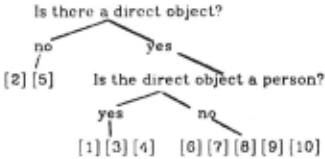
From the viewpoint o( rule based systems , there arc several problems with this . rirslly, given we have not specified what sorts of tests appear at the nodes, there are no real constraints on such networks . Secondly, in such a system we cannot extend our knowledge by sim ply adding another rule . A child (or a programmer) who wanted to add a few new senses (or a word would have Lo modify a rather complicated discrimination net. On lhe other hand, it may well be feasible Lo automate tile con struction of such nels , given basic knowledge of how indi vidual senses are used, in which case the forr.c of such objections would be substantially diminished .
This is, by no means, the only suggestion which has been made concerning word sense disambiguation in the lasl several years . The other idea which I want to dis cuss, however, is based upon the script idea of story comprehension, so we must break for a discussion of knowledge representation and text comprehension.
IV Knowledge Representation Issues
The last several years have seen a fair amount of work on various knowledge representations . Roughly speaking we can distinguish two trends. On one hand there have been various predicate calculus based representations, while on the other we have the script/frame based systems .
In fact, I believe that these Lwo traditions can (and should) be merged, and my Cllrrent knowledge represen tation language, FRAIL [ 7], uses both the predicate cal culus and frames. However, since most of the AI work related to parsing has assume one or another of the frame / script approaches , I shall concentrate on this for malism here .
A. Comprehension Based Reprcscntati6ns
Even within the frame/script approaches one can distinguish two trends . On one hand we have those sys tems which take as their starting point the need to pro vide a knowledge representation to underlie the comprehension of text. Certainly the Yale script representations [24, 9] fall in Lhis category, as docs my penultimate frame representation [5]. A typical exam ple of such a representation might go as follows :
(frame: ci&arette-lighting ;The name of thefram.e is cigarette-lighting slots: (a&ent (a human)) (patient (a cigarette)) (instrument (a match)) ;There are three objects which pla:y roles in ;this a.ctivity, an agent who does it, the ;thing which is lit (patient), and an ;instrument used during the process. script: (?agent lights ?instrument) ;The sequence of activities, which I witl call ;a. script, consists of lighting the instrument ;and bringing it in contact with the cigarette. (?agent brings-into-contact ?instrument ?patient)I assume that with the English glosses, the above should be reasonably self explanatory. Basically, a frame such as this is said to be "active" if the activity it describes comes up in a text. At that point the program will try matching further actions against those predicted by the IICript section of the frame. If it succeeds, it has under stood the action in terms of a higher level goal.
B. General Frame Representation
The other major trend in frame representations have been those which are less directly tied to language comprehension, and have some pretensions to general ity. Under this heading I would fit KRL (1], NETL [12), KL-ONE (3], and FRAIL (7]. By and large these languages are characterized by
- More attention to the "semantics" of the represen tation.
- Greater use of the isa hierarchy to effect a reduc tion of space by placing required knowledge at the greatest possible level of generality.
- Lack of any explicit script section to the frame, as seen above, with most of the descriptive burden fal ling on the slot section of the frame .
Again, the details need not concern us . What is of concern is the degree to which the two frame groups have gone ort in incompatible directions. Fortunately this seems to be minor . Of the above ditl~rences, the only important one is the third. However, this can be circumvented by the simple expedient of making the events which are part of the script secion of the frame into slots themselves. Thus, in such a scheme our cigarette-lighting frame would become:
(frame: cigarette-lighting isa: intentional-action ; I have added an is a. section. slots: (agent (a human)) (patient (a cigarette)) (instrument (a match)} ;The three previo1L.'1 slots (light-step (?agent lights ?instrument)) ;The sequence of activities, have now become ;a sequence of slots in the frame . (contact-step (?agent brings-into-contact ?instrument ?patient)Furthermore, if you do not like the formal imposed in which s lots and actions arc intermixed, it is ccrlamly possible to introduce some syntacti.c sugar to make the representation look more like the script formal shown earlier . FRAIL (7, 30] does exactly this.
V Interactions between Parsing and Everything Else
With the discussion of text comprehension out of the way, we can now look at approaches to parsing issues which are dependent on either the form of the represen tation, the use to which it is made during comprehen sion, or both.
A. Contextual Disambiguation
Rieger and Small's discrimination nets attacked the problem of word sense disambiguation in a brute force way. A rather different approach to the problem depends heavily on the use of scripts during language comprehension , In this approach rather than listing all possible senses in a large dictionary (or IP.xicon) we would have a "default" lexicon which would give only the most standard definitions . For "call" it might just be restricted to shouting and telephoning . However, we would then have associated with each script/frame a lex icon, which gives for each notion used in the script the word associated with it and vice versa [16, 9]. Thus, in the poker script we would have an entry for "call" point ing directly into the part of the script which deals with "calling a bet" .
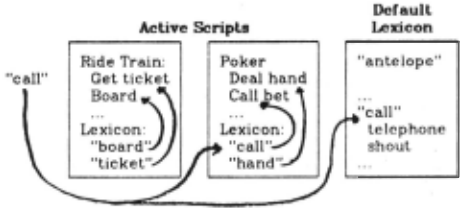
Thus, in looking for a word sense, we would first look to see if the word appeared in the lexicon of an active script, in which case we would automatically usc the con textually suggested meaning.
The advantage of such an approach is that it sug gests a way to avoid the problem encountered earlier in organizing large numbers of senses for a particular word . In the script/frame approach we will only have a few to consider. and we would naturally consider lhc contextu ally relevant ones first. On the other hand, this places some rather sever constraints on our scripts/frames . If there is only a small number of such frames active then this is fine, but if, as I tend to believe, the number might be quite large (they were playing poker with porno graphic playing cards on the train on the way to a birth day party while one player was eating a hamburger and another was talking about yesterdays baseball game} then we have simply replaced a long search through word senses by a long search through scripta! lexicons .
Because of such problems l have grave doubts about this approach . On the other hand. I have some doubts about the discrimination ncl approach as well. and it IS fair to say that l know of no approach to word sense disambiguation which I find cncouragmg, much less satisfactory. I suppose that my objections to the discrimination net approach arc less severe , but it is a rather dull approach . The scripta! lexicon approach cer tainly has more fla1r .
B. Jorames and Case
One area which seems particularly interesting to me, and which seems comparatively unexplored is the interaction between the processes of language comprehension and the form of semantic representation we usc . To some degree the scripta! lexicon idea has this flavor, but more interesting to me are examples where properties of language interact with features of the representation which are needed for independent rea sons. Let me give one such example, concerning case theory in linguistics [ 13).
For those unfamiliar with case theory, the basic idea is that there are certain cases associated with each verb. These cases relate the arguments of the verb to the verb itself, and do so in a meaningful manner . For example :
AA-57 flies to Chicago.In this sentence the noun phrase "Chicago" is said to be in the goal , or destination case of the verb "fiies". There are many reasons which have been put forward for want ing such cases . One such is the tendency for noun phrases in the same case to take the same prepositions. So the verbs "travel", "go", "walk", "fly", etc., all take "to" with their destinations .
Several people have noticed the similarity between such cases and the slots of frames in AI frame represen tations . This has lead some, for example Winston [29] to assert that cases of a verb are in fact the same thing as slots on a frame . While this comparison seems reason able, it has not aroused much interest, presumably beca:.~se nothing seems to follow from it. So what if slots and cases are the same?
Interestingly enough, there are some consequences . To take but one (sec [B] for others), if slots and cases are the same, then if two things can fill the same case, it would seem to imply that they fill the same slot. How ever, this can get us into trouble . For example:
Jack painted the wall with the brush. Jack painted the wall with the yellow paint.Here both "the brush" and "the yellow paint" are in the instrument case, yet we would normally assume that they should fill two different slots in the painting frame, one for the tool used, and one for the liquid used. How ever, one of the aforementioned frame representations, KL-ONE, has a feature built into it which will handle this problem.
In KL-ONE, not only is there an isa hierarchy of frames, but there is also a hierarchy of slots. In particu lar, one can speak of one slot differentiating another slot . So, if we had a mammal which had a head-of slot, then it would be likely that head-of would differentiate the part-or slot in the phys-obj (physical object) frame . Naturally , this is useful because we would automatically know that whatever is true of parts of objects is true of heads of mammals. Now, returning to the example at hand, we m ight have the following representation for painting .
(frame: deliberate-action isa: action slots: (ins trument) (frame : painting isa: deliberate-action slots: (tool differentiates instrument) (liquid ditrercntiates instrument)Here the painling frame has two slots, tool and liquid so there 1s no problem in distinguishmg what goes on the wall. and what 1s used to put it there . At lhe same time, since both are differentiations of the instrument slot, we still have the normal case relations .
C. Frame Specific Slot Filling
In the examples we looked at in the last section we were able to fill certain slots because of syntactic clues in the input sentence . In many cases, however, this is not possible. Typically in such examples the slot to be filled is quite specific to the frame at hand, so it would be unreasonable to expect the English language to make allowances for it in the syntax. For example, Schank and Birnbaum [23] discuss the problem proposed by exam ples like:
A plane carrying 150 people ...
Presumably in reading this sentence we establish some sort of air-travel frame/script. This frame will have several slots which may be filled, one of which is the passenger slot. The problem here is to realize that "150 people" fills that slot, given that there is nothing directly in the sentence, at least when read literally, which sug gests this.
After rejecting several alternatives, Schank and Birnbaum decide upon the following. Within the air travel frame, (or perhaps within some frame higher on the isa hierarchy, such as machine-aided-travel. or some such) we will note that the purpose of this activity is to move passengers (and cargo) to some location. That is, we will have something like :
(move ?passengers ?destination)We then further assume that part of the meaning of "to carry" is that the direct object (in case theory this is often called the patient case) of the carry is moved. Hence we have:
(move ?patient ?destination)
In this example this becomes:
(move 150-people ?destination)
If we then do a match between this line and the corresponding line in the air-travel frame, we get as a side result that 150-people should be In the passenger slot.
What is really nice about this is that it does not require any additional machinery beyond what we have already hypothesized for text comprehension. While Schank and Birnbaum do not comment on this fact, the mechanism proposed here is our good old script applica tion mechanism. That is, the fact that the passengers o( an air-travel are moved from place to place will be part of the script describing the actions taken during air travel. If we do normal script application we will find the match described above, and in the course of this match we will be required to fill the passenger slot as indicated.
A similar proposal is put forward by Hayes [15]. Hayes is concerned with examples like:
Jack got in the car and touched the steering wheel.
The problem here is to recognize that the referent of "the steering wheel" refers to the steering wheRL of the car just mentioned. Or, to put this somewhat differently, assuming that we have some sort of automobile frame, the referent of "the steering wheel" will fill a certain slot in the instance of the automobile frame which we created to account for the automobile mentioned earlier in the sentence. Presumably, the automobile frame will look something like:
(frame: automobile isa : traveling-instrument slots: (door-of (a door)) (wheel-of (a steering-wheel))In the example of an airplane carrying people, we made the connection based upon the actions which lake place iuring airplane-travel. In this last example there is no action, rather we want to make the connection on the basis of the match between the description of the newly mentioned object, namely steering-wheel, and the res triction on the wheel-of slot in the automobile frame , namely that it be a steering-wheel.
While it is not unreasonable to assume that we have two slightly ditterent mechanisms, one for making such associations on the basis of scripta! actions, and one on the basis of slot restrictions , there are reasons to assume that these are really the same thing . In particu lar, when I talked about how FRAIL negotiates the differences between script based and general purpose frame representations, I noted that in FRAIL a scripta! action was simply a slot on the frame . That is, what typi cally is represented as
(frame: airplane-travel isa: machine-aided-travel slots: (passengers (a person)) script: (move ?passengers ?destination)" .) would, In FRAIL be expressed exactly the same way, but would, internally be translated into: (frame: airplane-travel isa: machine-aided-travel slots: (passengers-of (a person)) (move-step (move ?passengers-of ?destination)
Thus, in both cases, filling a. slot in a.fra.me is the result of a. match betwun the incoming statement a.nd the res triction on a. slot in a.n active fra.me . While there are a lot of problems with the details of all of this , I find it encouraging that various strands of work are slowing comming together.
VI Conclusion
I have presented a medley of topics and ideas here. and to conclude let me try to draw them together and sketch what an overall parsing mechanism which included them might look like .
Roughly speaking, the parser would come in three parts . The first part would be a reasonably standard syn tactic parser . The only change discussed here from those parsers already on the market is that I would like to see the parser press ahead in the face of ungrammati cality. Syntax would, from time to time, hand ofT its results to the second part of the parser, the semantics . At the moment it seems reasonable to me that this would occur at those points in the syntactic parsing process when we wish to attach a new constituent to the syntac tic tree.
One advantage to calling semantics when we are about to attach a constituent to the tree is that this fils nicely with the idea that semantics should be responsible Cor guiding the path of the syntactic parser . Hence one possible action that semantics could lake is the rejection of the proposed attachment . However , the reader should note that I have ass d 1 ! 'lUsly avoided the issur of how this judgemental aspect fits in with the other processing semantics is doing . There is an interesting system by Bobrow and Webber [2] which has some ideas on this problem. but as yet I am not happy with any of the pro posals I have seen. This is an area which requires a lot of work.
Besides deciding on the acceptability of the attach ment, semantics must do two other things, translate the English words into semantic symbols, and arrange these symbols into the proper format. One part of the transla tion process is the disambiguation of 1word senses . Presumably we will use one or more of the methods men tioned earlier. If we go With the discrimination net approach, which seems the safest, I assume that the nets Will be "compiled" from a more declarative format.
The other part of the translation process requires doing something about referent determination, another topic which I have left out from this paper. There has been a good deal of work on referent determination. [ 4, 20, 25, 19, 26] but how (or even if) this work is to be naturally integrated into the framework I am proposing is still an open question.
Lastly, semantics will take the translated symbols, and . using the clues provided by the s:.~ntax , establish the functional structure for the constituent , and indicate this structure by putting . the symbols together in the appropriate semantic format . For this process. the use of the lambda calculus ala Montague grammar looks rea sonable .
However, the output of semantics is not really the end of the parsing process. We might call the output a "surface semantics" in so far as it will get some of the slot assignments, but by no means all . As we have already noted, many of the assignments of slots in frames are best done by processes which most naturally fall under the heading of text comprehension. Thus , the last part of the parsing process will be coextensive with the various recognition processes which go under the heading of text processing . It is here that we will decide that the people in the airplane fill the passenger slot . It may also be at this point that much of the referent determination takes place. We should also note that given our decision to have semantics be a subroutine of syntax, it is an interesting question whether we should have semantics immediately call our text processing component . That is, do we wait until the end of the sen tence (or at least the end of an s node) before doing text processing. or, is this too intermixed with everything else . My guess is the latter , but this question is yet another to be added to the list of problems which still require solutions .
@inproceedings{ijcai1981p216,
  title     = {Six Topics in Search of a Parser: An Overview of AI Language Research},
  author    = {Charniak, Eugene},
  booktitle = {Proceedings of the Seventh International Joint Conference on
               Artificial Intelligence, {IJCAI-81}},
  publisher = {International Joint Conferences on Artificial Intelligence},
  editor    = {Patrick J. Hayes},
  pages     = {1079--1086},
  year      = {1981},
  month     = {8},
  note      = {Invited Talk},
  url       = {https://ijcai.org/proceedings/1981/216},
}
TY - CPAPER TI - Six Topics in Search of a Parser: An Overview of AI Language Research AU - Charniak, Eugene T2 - Proceedings of the Seventh International Joint Conference on Artificial Intelligence, IJCAI-81 PB - International Joint Conferences on Artificial Intelligence PY - 1981 SP - 1079 EP - 1086 UR - https://ijcai.org/proceedings/1981/216 ER -Copied
Machine-readable versions of this paper, for tools and AI agents:





