
Algorithms of the Complex Tactile Information Processing
Proceedings of the Seventh International Joint Conference on Artificial Intelligence. Robotics. Pages 773-773.
© 1981 International Joint Conferences on Artificial Intelligence
Abstract
- Chalupa, v., Marik, v. "Object Recognition by Means of Artificial Hand", Automatizace 19:2 (1976) 34-37.(in Czech)
- Kirchmann, B,, Kopecicf, P., and Zdr&hal, z. "GOALEM from Prague", In Proc. IJCAI-77. Cambridge, MA 1 htgust, 1977, 771 •
- Volf, J, "Obtaining and Processing of Tactile Information from Tactile Sensors", in Proc . of Int,Conf, on AI and Inform.- -Control Systems of Robots, Smolenice, Czechoslovakia, June, 1980, 234-237.
- Eccles, M,,J,, McQueen, M,, P., c.,and Rosen, D, "Analysis of the Digitized Boundaries of Planar Objects " ~ Recognition 9:1 (1977) 31-41.
- Marik, V, "Linguistic Approach to the Object Recognition by Grasping" 1Z2s;_, YIII.IFAQ Congress, Kyoto , Japan, August, 1981 •
- Okada, T,, and Tsuchiya, S, "Object Recognition by Grasping" Pattern necognition 9:3 (1977) 111-119.
- Kinoshita, G,, Aida, s., and Mor1 1 U. "Pattern Recognition by an Artificial Tactile Sense" Proc. IJCAI-71 , London, u. K., 1971, 376-383,
References were extracted automatically from the PDF and may contain errors.
Full text extracted automatically from the PDF; figures, tables and equations may differ. The PDF is the version of record.
Vladimir Maf:Lk
Czech Technical University, Faculty of E.E., Karlovo nam.1J, 121 35 Prague 2, Czechoslovakia
I INTRODUCTION
The tactile information plays an important role for an intelligent robot activity. The main advantage of the tactile information over the optical one lies in its J-d character. The tactile information can be used both for a finer positioning before gripping the object and for the shape and dimension recognition by a simultaneous handling the object.
', Let s solve the latter problem. 3-d objects are gripped by an antropomorphic five-finger hand. The hand consists of a palm to which the object is pressed by multijointed fingers. The artificial hand model has been designed by Chalupa and Ma.fik (1] [5] under the GOALEII project [2]. The complex tactile information is obtained both from the tactile (contact) sensing elements situated on the palm surface and from the position sensing element set (PSES) on the finger joints. The regular rectangular net of the on-off tactile elements is called a tactile sensing unit (TSU). The TSU matrix consists of 16 lines per 32 elements in one line and 7 lines per 21 elements the distance between the centers of neighbouring ones being 3.2 mm and the radius of the elements being 1 mm. For details see [3].
II ~ RECOGNITION ,!!X MEANS QE TSU
The TSU "print" of the J-d object is a 2-d pattern, i.e. a matrix of o's and 1 's. The preprocessing and recognition of this pattern consists of the following steps:
1) The pattern boundary detection.
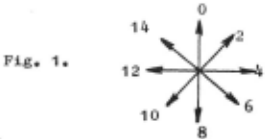
- 'l'he munerical symbol ai of the modified Freeman code (Fig.2.) corresponds to the i-th boundary point and the boundary curve is descri.bed by a string A = a 1 ,. ··· ,a where n is the munber of the boundary points. n
3) The string A is transformed to the string B by a digital filter: For simplicity we have considered the distance between two adjacent boundary points being h (even if it is V2 .h for the directions 45° + k.90o). In principle the response of the filter is expressed as a convolution B · f !II A modulo 16 where f is the impulse response. Having done a lot of expert.ents we have arrived at conclusions that for the string lengths n = 20-70 the transfer function

is suitable for the shape recognition. Our experience is in concordance with the theoretical conclusions of [4].
- Each munber in the string B is considered as a primitive of the structural (linguistic) description. To each primitive the terminal symbol ciE VT is assigned. Each TSU pattern is described by a sentence C · c ·· c 1' ' n·
- For the s~tactical analysis of C tree grammars G1 and G are employed. G1 and G2 are the grammars for angular and oval patterns respectively. The shape of the pattern (angular or oval) is roughly determined by the grammar by means of which the parsi!!f is su~cessfully accomplished. The grammars G and G have been derived from the descriptions of the typical patterns.
- At the semantical analysis stage the right interpretation of the chain A is looked for. For example corner positions, edge lengths and the angle of edges are computed for the angular patterns, centers and symetry axis lengths are evaluated for oval ones. Then we refine the shape classification inside the basic two classes (rectangle, square, triangle, ····· circular line, ellipse, ··· ). The semantical analysis can be expressed in terms of a special grammar for semantical analysis GSA [5].
III .I!m PROCESSING QE § ~ INFORMATION
The position information has obviously the
3-d character, Each finger is a k-linked plane mechanism, The finger planes are planparallel, equidistant and perpendicular with respect to the palm, The fingers approximate the surface of the object by piecewise linear curves, The approximation depends on the control principles of the gripping activity which have been similar to those of Okada and Tsuchiya (6] : The gripping action is always carried out only for one joint all the joints being successively changed starting from the nearest one, The action of the given joint is finished when the rest of the finger contacts the object or when the joint angle reaches the maximum value.
If the kinematio-geometrical analysis for the 3-linked mechanism is employed, the 6 types of approximations can be distinguished [5] , These approximations are taken as the description primitives, Let's label them qj, j · 1,,,,,,6, Q a{qj)' The algorithm for the processing of the PSES information (the 4 fingerE without the thumb are considered) is expressed in the following way :
- For x-th finger , x = 1,2,3 1 4 the description primitive is determined by means of Bayesian adaptive classifiers,
- To each primitive qj E Q the terminal symbol Cl( j £ VT is assigned and thus the information provided by PSES is described as a string of the length m · 4.
- The s~1tactica1 analysis of the string is executed with respect to the grammar which was inferred from a large set of syntactically correct words, The correction of the description from the syntactical point of view may be carried out if necessary,
- The semantical analysis by means of the due GSA is done, In the course of this analysis the contextual verification of the description is carried out and some parameters for the 2nd level are evaluated,
IV I0& 2nd PROCESSING ~
The 2nd processing level uses the descriptions and other results of the both 1st level algorithms described above, The processing on the 2ful level consists of three hierarchical
- the generating of the description,
stages: b) its syntactical analysis,
- its semantioal analysis,
The 2nd level serves to synthetise the 1st level results and to refine the total recognition results.
V EXPERIMENTAL R!§ULTS A:iU CONCWSION§
In the case of the first algorithm (Chap.II)
the correctness of the classification into 12 shape classes (including convex shapes) was nearly 100%. The IUliDerical errors in the dimension recognition were smaller than the distance betw·en two adjacent tactile elements,
The descriptions produced by the second algorithm (Chap,III) were correct in 96% oases for 5 types of objects.
The shape recognition of prisms, cones, pyramides, cylinders and spheres in all types of the grips as well as the recognition of their orientation with respect to the hand was successtull in 97% making use of the both levels. The fundamental dimensions and/or the numerical parameters were obtained with numerical errors not exceeding ~. The processing time on our slow M 6000 computer was always less than 6 seo, but in the most cases even less than 1 sec. The worst results were achieved for prismatic objects.
Using the complex tactile information (TSU and PSF.S data) and the special grammars very good classification results are obtained. The only restriction are the object dinensions which have to be suitable for gripping, The results achieved by the formal grammar approach are much better than those of feature methods [1J (7].
@inproceedings{ijcai1981p148,
  title     = {Algorithms of the Complex Tactile Information Processing},
  author    = {Marík, Vladimír},
  booktitle = {Proceedings of the Seventh International Joint Conference on
               Artificial Intelligence, {IJCAI-81}},
  publisher = {International Joint Conferences on Artificial Intelligence},
  editor    = {Patrick J. Hayes},
  pages     = {773--773},
  year      = {1981},
  month     = {8},
  note      = {Robotics},
  url       = {https://ijcai.org/proceedings/1981/148},
}
TY - CPAPER TI - Algorithms of the Complex Tactile Information Processing AU - Marík, Vladimír T2 - Proceedings of the Seventh International Joint Conference on Artificial Intelligence, IJCAI-81 PB - International Joint Conferences on Artificial Intelligence PY - 1981 SP - 773 EP - 773 UR - https://ijcai.org/proceedings/1981/148 ER -Copied
Machine-readable versions of this paper, for tools and AI agents:
 Welcome
 Future Conferences
 AI Journal Division
 IJCAI Proceedings
 About IJCAI
 IJCAI Awards