
Structure from Motion of Rigid and Jointed Objects
Proceedings of the Seventh International Joint Conference on Artificial Intelligence. Vision: Motion. Pages 686-690.
© 1981 International Joint Conferences on Artificial Intelligence
Abstract
A method for structure from motion is presented. The method makes a motion assumption about the objects baing viewed. The motion assumption ia that all motion consists or translations and rotationa about a fixed axia. Parallel projection ia al110 assumed. This makes it possible to interpret the motion of aa rev as two rigidly connected pointe. The method works for both rigid and jointed objects. Results or a teat or thie method on Johansson's data are presented.
- Borjesson, and C. Von Hofsten, Spatial deter- minants of depth perception in two-dot motion patterns, Perception ~ Psychophysics ..!..L (1972) 263-268.
- Braunstein, Depth Perception rhrough 112ll2!!• Academic Press, New York, 1971.
- Clockein, W. F., Inference of structural descriptions from visual examples of motions: preliminary results. DAI Working Paper 21, Department of Aritificial Intelligence, Univ. of Edinburgh, May, 1977.
- Cutting, J. E., A biomechanical invariant for gait perception, _l. !!£• Psych 1_, 357-372, 1978.
- Green, B. F., Jr., Figure coherence in the kinetic depth effect, _l. !!£• Psych. ~ (1961) 272-282.
- Hoffman, D. D. and Flinchbaugh, B. F., The interpretation of biological motion, MIT AI Memo 608, December, 1900.
- Houghton-Mifflin, 2-Dimeneional Motion Per- ception, 1971.
- Johansson, G., Visual perception of biologi- cal motion and a model for its analysis, Per- ception ~ PsychopYeice.!.! (1973) 201-21-1-.-
- Johansson, G., Spatia-temporal differentia- tion and integration in visual motion percep- tion, Psych. Research 38 (1976) 379-383.
- Johansson, G., Visual motion perception, Scientific American (November, 1976) 76-88.
- Johansson, G., Visual perception of rotary motions as transformations of conic sections, P sychologia .11.. 226-237, 1974.
- Johansson, G. and Jansson, G., rotary motion from changes in line, Perception~ Psychophysics 165-170.
- Perceived a straight ! (1968)
- Messier, S., Webb, J. A., and Aggarwal, J. K., A single camera intterpretation of three-dimensional motion as an alternative to multi-camera analysis. Proc. Panamerican congress of sports medicine and exercises, May, 1981. •
- 'Rourke, J. and Badler, N., Model-baaed image analysis of human motion using con- straint propagation, IEEE PA~II ~-~ (November, 1900) 522-536.
- -- Rashid, R. F., Towards a eye tem for the interpretation of moving light displays, IEEE PAM! PAMI-~ (November, 1900) 574-581.
- -- Roach, J. W., and Aggarwal, J. K., Determin- ing the movement of objects from a sequence of images, IEEE PAM! PAMI-2 (November, 1900) 554-562.
- ------- Ullman, S., The interpretation of visual motion, Ph. D. thesis, Department of Electri- cal Engineering and Computer Science, Mass. Inat. Tech. (May, 1977).
- Ullman, S. , The Interpretation of V iaual The MIT Preas, Cambridge, ~. Massachusetts (1979).
- Wallach, H. and O'Connell, D. N., The kinetic depth effect, _l. !!£• Psych. 45 (1953) 205- 217.
- Webb, J. A. and Aggarwal, J. K., Visual interpretation of the motion of objects in space, IEEE Conf. on Pattern Recognition and Image Processing, Dallas, Texas, August 1981.
- Webb, J. A. and Aggarwal, J. K., Visually interpreting the motion of objects in space, IEEE Computer, to appear.
References were extracted automatically from the PDF and may contain errors.
Full text extracted automatically from the PDF; figures, tables and equations may differ. The PDF is the version of record.
1. INTRODUCTION
Human beings have many sources or information on depth that do not depend on stereo vision. These include motion parallax, shape from shading, and textural information. These sources of depth information are particularly interesting for com puter applications because they require the uae or only one camera. Moreover, there are many situa tions where stereo algorithms are difficult to use, eo that the availability or other sources or depth information is helpful. The present investigation is also motivated for psychological reasons. Aa computational methode are proposed for solving problema that huaan vision also solves these methode can be compared with human methode, hope fully leading to insights in human visual processes.
This paper addressee a method for recovering structure (i.e., depth information) by observing the motion or objects in the image plane. The method aaaumea that the objects are reasonably dis tant fr0111 the obaerver, ao that perspective affects are amall and the objects can be treated aa if they ware seen in parallel projection. This procaaa ia called structure .f!:2! ~. after Ullman [ 18,19 ].
Previous work in this area kinde: psychological studies ability in this process, has bean or two investigating human and computational connected points. The fixed axis assumption also gives a criterion which can be used to decide whether tvo points are connected, so that both the connectedness structure and the three-dimensional structure of Johansson-type figures can be recovered.
· This research supported by the Air Force Office of Scientific Research under grant number AFOSR
77-3190.
The algorithm for the recovery of the struc ture of rigid and jointed objects is developed in the next section. An experiment testing perfor mance on Johansson's data is presented in section 3. Psychological implications are discussed in section 4.
2. RIGID AND JOINTED OBJECTS
An algorithm for recovering the structure of rigid and jointed objects is developed in this sec tion. First the fixed axis assumption is justified on the basis of everyday observations of movement. Then it is proved that the fixed axis assumption makes possible the recovery of the structure of any group of rigidly connected points. The algorithm for the recovery of structure is developed at the same time. The algorithm is then extended to jointed objects. The development for jointed objects is brief because a more complete develop ment is available in [21 ].
Many natural and man-1118de objects move in vays that tend to satisfy the fixed axis assumption. Objects that move vith a fixed orientation to a plane must satisfy the assumption, because only planar rotations are possible, so that the axis must point out from the plane." The bodies of auto mobiles are an example of this. Objects that move through the air, such as frisbees and maple seeds, tend to satisfy the fixed axis assumption because they rotate rapidly around a fixed axis to maintain stability.
Jointed objects also often satisfy this assumption. Many animal locomotive systems use fixed axis movements extensively. For example, the walking motion of humans involves rotations about a line roughly perpend i cular to the line of travel and parallel to the plane the human walks on. At the same time, the person's arms rotate about an axis parallel to this line. !'.any gymnastics move ments consist of rotations about a fixed axis. For reasons of simplicity, much machine design is based on planar translations and rotations. For example, the wheels on a car rotate rapidly about a fixed axis.
Using the fixed axis assumption, it is shown that any rigid object satisfying it has the follow ing property: fixing any point on the object causes the other points to trace out circles in planes normal to a fixed axis. Under parallel projection, these circles project onto ellipses in the i.lllage plane. .The orientation of each circle, and hence the structure of the rigid object, can be recovered to within a reflection by finding the equations describing the ellipses.
First it is shown that fixing any point on the rigid object in space reduces the motion of any other point to a circle in a plane nomal to a fixed axis. Let T be a rif}.d object rotating about an axis vith direction v, 1vi·t (i.e., vis a unit vector), paesing through a point 0 in T. !!_et_R and P be any two feature points in T, and let R, P, and 0 be the positions of R, P, and 0 in some ftame. The motion . of. P relativs to R, which vill be called the reference point, will be shown to be a circle J:.n_a .J!l.!ne noma.!,_!o the axis of rotation. Let P..R·av+a, where v·a-o, and let R-O·liV+e.J.. where v·a-o. This breaks the position Of P-R and R-0 into two components: one along the axis of rotation and _t.he _o_!her per.J!!..!ldicular to it. Similarly, let_P-Q.·.£V-t-r, where v y-o. Then define the function f(x)·x-R, which fixes Rat the origin. The effect of the function f on the pointe in T is to be determined. Let T move ~ a translation and a rotation about v. Let P'' R', and o' be the new positions of R, P, and 0. Since T_, i.!., r_2t.!,ting .!.bO.J!.t :!._it must b.!, the _£aee that P -o_:..s:v.:~_and R'-o'·bv+e:, for some 6 and e: such that 6 v· e:v-o. That is, the positions of P and R along the axis of rotation are not affected, although the positions normal to the axie of rotation may be changed. The distances from the axis of rotation are fixed, how ever. Then
'P' -i'. w· -o· >- <i' -o· > ·(c-b)v. C6-&> a.tt y -i · av+; · (P-o}- (i-0) ·(c-b)v. <Y-a> Taking the dot product vith v, (av·a>·v·(c-b)v·v · <Y-F>·v a·c-b
Hence P'-R'·av+w, for some w such that w·v-o. This shove that P lies in a plane normal to the axis of rotation, passing through the axis of rotation at av. To complete the proof, it must be shown that 1;1-1;1, since this shove that P stays a fixed dis tance from the axis of rotation and therefore traces out a circle around it. Nov 1;1-IY-81, but 1~1-li:I.J. IE"i·IFI, and 6·&·r·s by rigidity. Hence I wl-16-e:l· r~l' shoving that fixing R reduces the motion of P 1o a circle about an axis through R with direction v ·
Nov it is shown that the image produced by fixing R then projecting T is the Ame as the image produced by projecting T and then subtracting the projected position of R. The projection pr(Q) using parallel projection along _!he_z_ axis (i.e., in direction k) of a point Q is kx(Qxk), so that
This shove that the image shoving R fixed can be produced froa the image which is available, which shove R moving, simply by subtracting the projected nosi tion of R.
The n.rst step in the algorithm subtracts the ,bserved position of any feature point, called the reference point, from the observed posi tiona of all other feature points. Under the fixed uis assUIIIp tion, this reduces the obaerved motion to a rota tion about a fixed axis through the origin. The rest of this section assUIIIes this process has been applied to th.!, image. Let P be a point on the object and let v be a unit vector in the direction of t~e axis. The goal is to find P, the actual position of P in threedimensional apace, given pr(P), the observed posi tion.
It is nov shown that the circle traced out by the positions of any feature point relative to the .,tef.!.r.!.nce point _p.,tojecta onto_ an ellipse. Let P·cv+w, where v'wo<> and let lwl·r. The radius of the circle traced out by P is r, and the plane this circle lies in cute the uis of rotation at cv. Asswae Vik, since if v·k the structure cannot be recovered since each image is an illage plane rota tion of any other image (p· traces out a circle in the image plane).
Chooae a, a, and y such that
Such a, a , and y can always be found three vectors on the right-hand linearly independent set, as shown Then because the aide form a in figure 3.
But v'l\v#lx[vx.ivx~>ll~. since vfk, so that y ·0. Hence "'"avxk + llvx( vxk), so that
&t
Nov consider a new coordinate system (p,q) defined by the orthonormal vectors vxlC ll!ld I ¥WI
ix(vxiC)
.
Changing the coordinate
lvxiCI aystea in this way does not affect geometric properties. Equations (1) and (2) show !hat in this coordinate system, the projection of w satis fies: (p,q) can be on the projection of some w only if or so that the projections of w trace out an ellipse in the image plane. The major axis of this ell~pse has length r, and the minor axis has length -----, so that the ratio of the lengths of the axes~""i~~is the z-coord inate of the axis of rotation (to vi thin a sign) ·
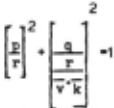
Moreover, the direction of the minor axis is (0,1) in this coordinate system, which may be exp,ressed as kx(vxk) in vector notation. Since pr(P)· ckx(vxk)+iCx(-:xiC), and since v is coll.!ta~t.L P projects onto an ellipse with center at ckx(vxk). Thus the minor axis of the ellipse and a line from the origin to J,ta center are collinear, and the projection of v can be recovered from either param eter, or the two can be combined to constrain the search space. Since the z-coordinate of v is known from the ratio of the lengths of the axes of t_he ellipse, this makes is · possible to recover v. Finally, w can be found since v'"W-o and lwl·r.
The equa tiona given above could be used to solve for the structure of the rigid object by fit ting a non-linear equation. It is more convenient to develop the equations in a different way, so as to simplify the equation fitting process.
Let (xi ,yif) be the observed several fea{ure points, 1 <i<k, in 1 <f<F. If the - ciiita rotated counter-clockwise through the transformation coordinates of several frames, is the angle e by
the ellipses will be rotated so all centers are on the u-uis. This class of ellipses is described by the equation
Here C is a constant for all ellipses (c is related to the depth coordinate of the direction of the axis of rotation), and Di and F i may be different for each ellipse.
Note that given C and e one can find Di and F using least squares, so that equations (3) and (4~ describe a non-linear system in two variables. In fitting the equations, it is more convenient for both non-linear variables to be of the same type, so that the equation fitting is actually done using C and tan e as the non-linear variables. This method has been used to program the three dimensional reconstruction phase of the algorithm, using Fletcher-Powell minimization as described by Acton [1 ).
This technique works vall enough when there are only two feature points on the rigid object.
However, performance does not improve significantly when there are several points on the rigid object; the equations developed do not take advantage of useful constraints on the relative motions of the points in space. Equations (3) and (4) do not require the object to be truly rigid; each point can move independently of the others, though each must trace out a circle in a plane normal to the axis of rotation.
Nov the algorithm for jointed objects will be developed. The first step in the algorithm applies the rigid pert algorithm to the image, testing every point as a reference point. This divides the im88e into rigid parts, and determines the three dimensional structure of each part. Next the jointed objects have to be built up out of these parts.
Joints that are seen (i.e., joints vith feature points) are identifiable as joints because the feature points corresponding to them belong to more than one rigid part. Once a seen joint is found, the structure of the two rigid parts it con nects must be found. The rigid part algorithm finds two reflections of each rigid part. Each reflection makes a different prediction about the position of the joint. When the two rigid parts are put together, the predicted positions must be consistent, so that each reflection of a rigid part is consistent with only one reflection of the other rigid part. This means that_ when the two rigid parts are put together there are only two valid reflections of the two rigid parts together. For example, in a side view of a walking human each of the four limbs consists of two rigid parts. Each rigid part has two interpretations as given by the rigid part algorithm, so that there would be 256 interpretations of the limbs of the body. However, when the predicted po si tiona of the joints are resolved, the 256 interpretations would be reduced to 16, since each limb has two interpretations.
The jointed object can still be assembled if the joints are not seen. Once the rigid part algo ri thm has analyzed the structure of the rigid parts, the relative positions of the points and the direction of the axis of rotation are known. The position of the joint (if it exists) can then be expressed relative to the reference point as a linear combination of a vee tor from the reference point to any other point, a vector in the direction of the axis of rotation, and the cross product of these two vee tors. These posi tiona can be resolved for any two rigid parts using least- squares minimi zation of a linear form, and then the residual error can be examined to see if it is reasonable to suppose that a joint exists between the rigid parts.
The algorithm for recovering structure of rigid and jointed objects begins by analyzing the structure of all rigid parts in the ecenes. Then the jointed objects are assembled, in two different ways depending on whether the joints are seen or unseen. The result is that the scene is analyzed as a collection of rigid and jointed objects, with the structure of each being known to within a scal ing factor and a number of reflections.
3. EXPERI~~NTAL RESULTS
The structure from motion method developed in this paper has been implemented and run on Johansson's [9-13] data. These data vera obtained from a commercial film made for educational pur poses [a]. The data were encoded by hand using a Numonics Graphics Data Calculator. No three dimensional infonaation was available for this data. Two sets of data vi th three-dimensional information were tested in [21 ).
The data is shown in figure 1 · Six points were available: shoulder, elbow, wrist, hip, knee, and ankle. Twenty-one frames were analyzed: since the film speed twenty-four frames per second the time interval was just under one second.
The connectedness structure found by thres holding the residual errors in the fits of the ellipses is shown in figure 2. The proposed struc ture seems perfectly reasonable, since the shoulder and hip are not a single rigid part. (Including the shoulder -- hip connection would have forced the shoulder -- wrist and hip -- ankle connec tions).
The rigid part lengths proposed by the algo rithm are shown in Table I. These rigid part lengths were calculated by assuming the maximal shoulder -- ankle extension (as measured from the im88e plane view) vas 4.5 feet. ~oat of these lengths seem reasonable; clear exceptions are the shoulder -- elbow and knee -- ankle lengths. The algorithm seems to be recovering part of the struc ture of the object, but . the results are not good enough to be used for three-dimensional structure analysis.
This section has reported the results of an experiment testing the behavior of the algorithm on Johansson's data. The connectedness structure recovered is reasonable. The rigid part lengths inferred seem less so.
4. PSYCHOLOGICAL IMPLICATIONS
The previous sections have developed an algo rithm that can recover structure from motion in many situations. In this section the capacity of the algorithm to explain some aspects of human motion vision is examined.
The perception of depth by humans is a compli cated process involving many independent sources of information, including stereo vision, perception of slant and tilt, and motion parallax [3 ]. The present research addresses the perception of struc ture from motion of rigid and jointed structures under conditions where parallel projection is a reasonable approximation of the camera conditions.
The perception of structure from motion under various kinds of translation and rotation has been a popular topic of psychological research in vision. Johansson [12] clearly suggests the role projective geometry and rotation may play in this process. The first major study of this phenomenon was by Wallach and 0 'Connell [20 ), who demonstrated what they called the "kinetic depth effect" by showing subjects the shadow of a rotating wire fig ure. Later White and Mueaer [23) demonstrated that subjects could under aome conditions recover three-dimensional structure accurately.
The present algorithm will recover the correct three-dimensional structure when the objects observed do not translata in depth and rotate about a fixed axis. This is consistent with human behavior as observed by several researchers and summarized by Braunstein [3, page 107). If there is no rotation or the axis of rotation is perpen dicular to the image plane, the algorithm cannot determine structure. This is consistent with human motion vision, which sees planar motion in the second case, as observed by Borjeaaon and Von Hofa ten [2 ).
Rigidity-baaed algorithms, like those of Ull man [18,19) and Roach and Aggarwal [17), predict slightly different behavior: when there are only two points visible, or in some cases where the points observed are coplanar, the correct structure cannot be determined. Human motion vision does not have this restriction, as noted in Johannaaon'a experiments [9-13, eap. 13) and by Borjesson and Von Hofaten [2 ).
In aome cases the algorithm predicts failure in grouping into rigid parts. For example, in the case of tumbling motion the algorithm may not succeed in finding the correct grouping, so that objects that are actually rigid would appear to be non-ri~id. Tumbling motion haa been studied by Green L6 ), vho found that rigidity is leas pro nounced with tumbling than with simple rotation. Evidence on this point is still unclear; several factors seam to influence the perception of rigi dity, and tumbling motion has apparently been investigated only by Green. This result might be explained by a rigidity-based algorithm if the implementation of the algorithm made fixed ax~s motion easier to interpret, such as in Ullman s ([ 18), pp. 237-238) proposed implementation of his rigidity-baaed algorithm by an expert system in which each expert interprets motion about a single axis. Further experiments would aid understanding of human motion vision under these conditions.
The experimental results reported in the last section suggest that the proposed algorithm can account for some aspects of human behavior in interpreting Johansson-type figures. It seems likely that some high-level knowledge is used by humans in interpreting these images. One vay of using this knowledge has been investigated by 0 'Rourke and Badler [ 15 ). Another kind of high level knowledge has been investigated by Cutting [5 ). This research attempted to explain human ability in determining gender from impoverished Johansson-type figures (for example, subjects could determine gender with better than chance accuracy even when only the ankles vera seen). It may be that the fixed axis assumption can be incorporated in a useful vay with high-level type knowledge to aid interpretation of human movement. This syn thesis could be useful not only for understanding human visual processes, but also for aiding in the interpretation of athletic movement from monocular images [ 14 ).
One kind of motion that the present algorithm cannot account for is motion involving a large depth component. Its behavior in the presence of objects moving in depth will depend on the relative amounts of motion in depth and rotation. With a large rotation component and a fast camera, the algorithm will perform correctly. If the rotation component is small, the algorithm will still group the points correctly, but the structure will not be recovered. The structure the algorithm assigns has the the other pgints swinging about the reference point. Ullman [19) observed this interpretation in an experiment involving the motion of a cylinder in depth. If the rotation and depth motion components are similar, the algorithm will fail, which is inconsistent with human behavior as noted by Borjesson and Von Hofsten [2 ).
This section has summarized the psychological implications of the present approach to motion vision. The present approach can account for several aspects of human behavior in motion vision. In addition, the present theory predicts interest ing things in human ability, such as the difficulty in interpreting tumbling motion. The algorithm cannot account for the correct perception of simul taneous rotation and translation in depth.
5. SUMMARY
A method for structure from motion of rigid and jointed objects has been presented. The method relies upon a motion assumption. The mathematical basis of this method has been developed. Tests done with Johansson's data have been presented. Psychological implications of this method have been discussed.
ACKNO WLEDG r-1ENTS
The authors are indebted to several persons who made contributions to this paper; in particular ve would like to acknowledge many helpful discus sions with Larry Davis and Worthy Martin, both of the UT Department of Computer Sciences. The com ments and proofs of Mike Brady, of the MIT AI Lab, greatly aided the mathematical analysis in this paper. The authors also gratefully acknowledge the comments of the reviewers. Linda Melnick did the typing of early drafts.
BIBLIOGRAPHY
- [ 1 ) Acton, F. s. , Numerical Methods !.!!.!! .!2.!:!· Harper and Row, Nev York, 1970.
- [2) Borjesson, and C. Von Hofsten, Spatial deter minants of depth perception in two-dot motion patterns, Perception ~ Psychophysics ..!..L (1972) 263-268.
- [3) Braunstein, Depth Perception rhrough 112ll2!!· Academic Press, New York, 1971.
- [4) Clockein, W. F., Inference of structural descriptions from visual examples of motions: preliminary results. DAI Working Paper 21, Department of Aritificial Intelligence, Univ. of Edinburgh, May, 1977.
- [5) Cutting, J. E., A biomechanical invariant for gait perception, _l. !!£· Psych 1_, 357-372, 1978.
- Green, B. F., Jr., Figure coherence in the kinetic depth effect, _l. !!£· Psych. ~ (1961) 272-282.
- [7) Hoffman, D. D. and Flinchbaugh, B. F., The interpretation of biological motion, MIT AI Memo 608, December, 1900.
- Houghton-Mifflin, 2-Dimeneional Motion Per ception, 1971.
- [ 9] Johansson, G., Visual perception of biologi cal motion and a model for its analysis, Per ception ~ PsychopYeice.!.! (1973) 201-21-1-.-
- [10) Johansson, G., Spatia-temporal differentia tion and integration in visual motion percep tion, Psych. Research 38 (1976) 379-383.
- [ 11 ] Johansson, G., Visual motion perception, Scientific American (November, 1976) 76-88.
- [ 12] Johansson, G., Visual perception of rotary motions as transformations of conic sections, P sychologia .11.. 226-237, 1974.
- [ 13] Johansson, G. and Jansson, G., rotary motion from changes in line, Perception~ Psychophysics 165-170. Perceived a straight ! (1968)
- Messier, S., Webb, J. A., and Aggarwal, J. K., A single camera intterpretation of three-dimensional motion as an alternative to multi-camera analysis. Proc. Panamerican congress of sports medicine and exercises, May, 1981. ·
- 0 'Rourke, J. and Badler, N., Model-baaed image analysis of human motion using con straint propagation, IEEE PA~II ~-~ (November, 1900) 522-536.--
- [ 16] Rashid, R. F., Towards a eye tem for the interpretation of moving light displays, IEEE PAM! PAMI-~ (November, 1900) 574-581. --
- Roach, J. W., and Aggarwal, J. K., Determin ing the movement of objects from a sequence of images, IEEE PAM! PAMI-2 (November, 1900) 554-562. ------ -
- [ 18] Ullman, S., The interpretation of visual motion, Ph. D. thesis, Department of Electri cal Engineering and Computer Science, Mass. Inat. Tech. (May, 1977).
- Ullman, S. , The Interpretation of V iaual The MIT Preas, Cambridge, ~.
Massachusetts (1979).
- Wallach, H. and O'Connell, D. N., The kinetic depth effect, _l. !!£· Psych. 45 (1953) 205217.
- Webb, J. A. and Aggarwal, J. K., Visual interpretation of the motion of objects in space, IEEE Conf. on Pattern Recognition and Image Processing, Dallas, Texas, August 1981.
- Webb, J. A. and Aggarwal, J. K., Visually interpreting the motion of objects in space, IEEE Computer, to appear.
- White, B. W., and Musser, G. E., Accuracy in reconstructing the arrangement of elements generating kinetic depth displays, J. !!£· Psych. 60 (July, 1960) 1 -11. -
| From | To | Est. Length (F'eet) |
|---|---|---|
| Shoulder | Elbow | 4.2 |
| Elbow | Wrist | 0.94 |
| Shoulder | Hip | 1.5 |
| Hip | Knee | 1.7 |
| Knee | Ankle | 2.4 |
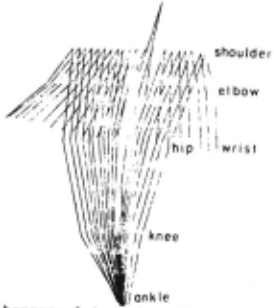
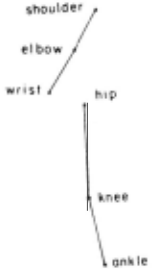
Figure 2. Connectedness structure for Johansson "ata.
@inproceedings{ijcai1981p130,
  title     = {Structure from Motion of Rigid and Jointed Objects},
  author    = {Webb, Jon A. and Aggarwal, Jake K.},
  booktitle = {Proceedings of the Seventh International Joint Conference on
               Artificial Intelligence, {IJCAI-81}},
  publisher = {International Joint Conferences on Artificial Intelligence},
  editor    = {Patrick J. Hayes},
  pages     = {686--690},
  year      = {1981},
  month     = {8},
  note      = {Vision: Motion},
  url       = {https://ijcai.org/proceedings/1981/130},
}
TY - CPAPER TI - Structure from Motion of Rigid and Jointed Objects AU - Webb, Jon A. AU - Aggarwal, Jake K. T2 - Proceedings of the Seventh International Joint Conference on Artificial Intelligence, IJCAI-81 PB - International Joint Conferences on Artificial Intelligence PY - 1981 SP - 686 EP - 690 UR - https://ijcai.org/proceedings/1981/130 ER -Copied
Machine-readable versions of this paper, for tools and AI agents:





