
Opportunistic Processing in Arguments
Proceedings of the Seventh International Joint Conference on Artificial Intelligence. Natural Language. Pages 58-59.
© 1981 International Joint Conferences on Artificial Intelligence
Abstract
In two previous papers. we have proposed a part of a computational theory of argumentation, including representations for argument structure and rules for using those representations in understanding and in rebutting (Birnbaum et a/. (1980) and Flowers et a/. (I 98 I); related work includes Cohen (I 980)) . One property of the model which we emphasized is the way in which argument mechanisms and inferential memory can each help to direct the proce ss ing of the other. In particular, we presented examples in which inferential memory can uncover good rebuttals to an input as a side-effect of the processing that naturally goes on in trying to understand that input. When such opportunities for rebuttal are noticed during understanding, they render unnecessary the use of argument rules to find a response. since one has already been di scove red.
- Birnbaum. L.. Flowers, M ., and McGuire. R. 1980. Towards an AI model of argumentation. In Proceedings of the First A AA I Conference, Stanford. CA. pp. 313-315.
- Cohen. R. 1980. Understanding arguments . In Proceedings of the Third CSCSI/ SCE/0 Conference.
- Victoria. BC.
- Flowers. M .. McGuire. R .. and Birnbaum. L. 1981. Adversary arguments and the logic of personal attacks .
- In W. Lehnert and M . Ringle. eds .. Strategies for Natural Language Processing.
- Hayes-Roth, B .. and Hayes-Roth, F. 1979. A cognitive model of planning. In Cognitive Science, vol. 3. pp. 275-310.
- Hobbs . J . 1979. Conversation as planned behavior. In Proceedings of the Sixth /JCAI, Tokyo. Japan. pp . 390-396. IJCAI
- Schank. R. 1980. Language and memory. In Cognitive Science. vol. 4. pp . 243-284.
- Schank. R . 1981. Dynamic Memory: A Theory <1{ Learning in Computers and People. (Forthcoming) .
References were extracted automatically from the PDF and may contain errors.
Full text extracted automatically from the PDF; figures, tables and equations may differ. The PDF is the version of record.
Opportunistic Processing in Arguments
Rod McGuire, Lawrence Birnbaum, and Margot Flowers
Yale University Department of Computer Science New Haven, Connecticut
In two previous papers. we have proposed a part of a computational theory of argumentation, including representations for argument structure and rules for using those representations in understanding and in rebutting (Birnbaum et a/. (1980) and Flowers et a/. (I 98 I); related work includes Cohen (I 980)) . One property of the model which we emphasized is the way in which argument mechanisms and inferential memory can each help to direct the processing of the other. In particular, we presented examples in which inferential memory can uncover good rebuttals to an input as a side-effect of the processing that naturally goes on in trying to understand that input. When such opportunities for rebuttal are noticed during understanding, they render unnecessary the use of argument rules to find a response. since one has already been di scovered .
For example, consider the following exchange in a mock argument between an Arab and an Israeli over Middle East affairs:
- [I] Arab: Israel is trying to take over the Middle East.
- Israeli : If that were our goal, we wouldn 't have given back Sinai to the Egyptians.
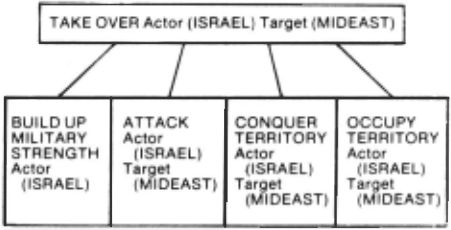
The Israeli's understanding of the Arab's claim [I] involves instantiating a knowledge structure representing imperialism. with Israel as the actor and the Middle East as the target, and recognizing that this is intended as an accusation. This knowledge structure (let's call it TAKE OVER) has several component substructures. roughly as shown in figure I.
We propose that in trying to understand input [I]. the Israeli must relate this entire structure to his long-term memory. In so doing, he will discover. among other things.
This work was supported in part by the Defense Advanced Rcsear<:h Projects Agency. monitored by the Office of Naval Research under contract NOOOI4-75-C-1111. and in part by the National Science Foundation under grant IST7918463.
(MIDEAST) -
that Israel has indeed engaged in building up its military strength (although in his memory that fa ct would he explained by the goal of self-defense). More importantly for this example. 1n the course of relating the OCCUPY TERRITORY substructure to memory. he will find a counterexample-- an instanCl' of Israe l relinquishing occupied territory (the Sinai).
This fact. which contradicts the original allegation of imperialism. forms the basis of the Israeli's rebuttal [2]. There remains the problem of distinguishing this fact. which is extremely relevant from the point of view of producing a rebuttal. from other facts brought to light while relating the input to memory. Inferential memory must be informed enough about the goals of the arguer to realize that any evidence it uncovers which contradicts the allegation of Israeli imperialism will be useful. and should therefore be saved. This entire process is an instance of the more general phenomenon of reminding (Schank ( 19!!0) and ( 1981 )) .
As another example of this kind of processing. consider the following continuation of the previous exchange :
- [J] Arab: But then why haven't you given back the West Bank to the Palestinians?
Both the Israeli utterance [2) and the Arab response [J] refer to Arab territory occupied by the Israelis. It seems entirely reasonable to suppose that this topic is sufficiently important to an informed supporter of the Arab position to warrant the existence in his memory of some knowledge structures which organize information relevant to it. In particular, these knowledge structures would point to instances of OCCUPY TERRITORY which have Israel as the actor and former Arab lands as the target. Further, these would be the exact structures which we would logically expect to play a role in the inferential memory processing needed to understand utterance [2). Thus. in the course of trying to understand the utterance. the Arab would naturally be reminded of instances of continued Israeli occupation of Arab territory. One of these instances (the West Bank) forms the basis of the Arab response [3). Further examples of this sort can be found in Birnbaum er a/. ( 1980) and Flowers era/. ( 1981 ).
In many cases, of course, no rebuttal will be uncovered by inferential memory during the understanding phase. It then becomes necessary to utilize argument rules and structures in order to select a point to attack or defend . For example. consider the following argument fragment:
- Israeli: The Arabs started the 1967 War, by blockading the Straits of Tiran.
- [5) Arab: But Israel attacked first.
- [6) Israeli : According to international law. blockades arc acts of war.
- Arab: Were we supposed to let you import American arms through the Straits'?
By our analysis, the Arab's use of inferential memory during the course of understanding the Israeli's claim [6] does not yield a possible rebuttal as a side-effect. Hence, the derivation of his response [7) must result from the explicit application of argument rules based on larger structural features of the entire fragment [4) through [6).
In our model. the structure of an argument ts represented by an argument graph in which the individual propositions of the argument are related by support and auack links . For example. the argument graph representation that we propose for the above text fragment is shown in figure 2. Many of the propositions in this gra ph . for example [4a) and [5a]. are not explicit in the utt erances given. and must be inferred . The motivation for thei r presence. and mechanisms for producing them. arc discussed in Flowers t'f a/. ( 19K I).
The argument graph shown in figure 2 is an instance of a conrrasrive posiriom· srrucfllrt·, an argument form which is generally characterized by a mutual attack n:lation between two central propositions (in this cast: [4a) and [5a]) to which furtht:r supporting and attacking propositions are attacht:d . Rules associated with argument structurt:s of this sort art: used to constrain possible response choices . The rules for a contrastive positions structure suggest two rebuttal options : the Arab may offer additional support for his own claim
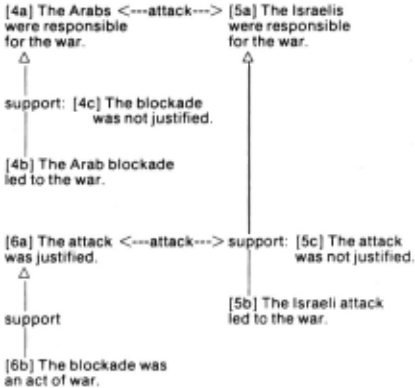
[5a]. that the Israelis were responsible for the war. or he can attack the Israeli claim [4a). that the Arabs were. This latter possibility is realized in the Arab's response [7] . which attt:mpts to justify the blockade. and thus attacks the support relation between [4a) and [4b). Although inferential memory is of necessity involved in producing thi s justification. in this case it plays a secondary role. directed by the argument rules .
These examples illustrate that rebuttals can be produced in two very different ways. either as a side-effect of inferential memory processing performed at understanding time, or as a result of explicit use of argument structures and rules . An important corollary of this processing distinction is that if a direct attack (i .e .. a contradiction) is made on an input , it was discovered at understanding time. The argument is as follows . The same inferential memory apparatus, with the same knowledge base. is used both in understanding and in rebutting. Hence. if inferential memory processing does not uncover any contradictory evidence at the time an input is understood . none will be uncovered a few steps later during response formation at the behest of some argument rule . since exactly the same processing. leading to the same outcome. would occur then . So there is no point in having an argument rule which advises trying to find a direct attack on the input : by the time any such rule were invoked. either the basis for a rebuttal would already be in hand . or no d irect attack on the input would be possible.
This point has implications for the role of argument rules in our theory. If direct attacks are only discovered by inferential memory during understanding. then a key function of the argument rules must be to focus attention on other points of possible contention in the argument when no direct attack on the input is possible. That is. they must primarily be concerned with identifying which previous points are worth going back to. or which new points are worth raising.
This distinction also has broader implications for computational models of argumentation. and more generally. conversation. Hobbs ( 1979). among others. has argued that conversation is best viewed as planned behavior. in which utterances are produced by some kind of planning mechanism which is trying to achieve the conversational goals of the participants. Our notion of rebuttals produced as a side-effect of understanding an input implies that any such planning mechanism must be opportunistic, in a sense akin to that of Hayes-Roth and Hayes-Roth ( 1979). That is. it must be able to utilize opportunities for rebuttal which are discovered by inferential memory when performing another task (understanding) . It seems possible that a theory of conversation (or more specifically of argumentation) based on this kind of opportunistic processing can reconcile our C\·eryday perceptions of conversations (or arguments) as being. on the one hand. planful. and on the other. wandering and disorganized.
@inproceedings{ijcai1981p13,
  title     = {Opportunistic Processing in Arguments},
  author    = {McGuire, Rod and Birnbaum, Lawrence and Flowers, Margot},
  booktitle = {Proceedings of the Seventh International Joint Conference on
               Artificial Intelligence, {IJCAI-81}},
  publisher = {International Joint Conferences on Artificial Intelligence},
  editor    = {Patrick J. Hayes},
  pages     = {58--59},
  year      = {1981},
  month     = {8},
  note      = {Natural Language},
  url       = {https://ijcai.org/proceedings/1981/13},
}
TY - CPAPER TI - Opportunistic Processing in Arguments AU - McGuire, Rod AU - Birnbaum, Lawrence AU - Flowers, Margot T2 - Proceedings of the Seventh International Joint Conference on Artificial Intelligence, IJCAI-81 PB - International Joint Conferences on Artificial Intelligence PY - 1981 SP - 58 EP - 59 UR - https://ijcai.org/proceedings/1981/13 ER -Copied
Machine-readable versions of this paper, for tools and AI agents:
 Welcome
 Future Conferences
 AI Journal Division
 IJCAI Proceedings
 About IJCAI
 IJCAI Awards