
A Model of Dialog Based on Fuzzy Set Concept
Proceedings of the Sixth International Joint Conference on Artificial Intelligence. .
© 1979 International Joint Conferences on Artificial Intelligence
Abstract
Dialog is considered as the exchange of information between two persons who speak natural language to und e rstand each other. However natural language is so ambiguous both in expression an d logi c that for understanding it is very important to supplement the information through so me r e as o ning or imagination. In this paper, we analyze this thinking process using fuzzy se ts theory and approach a modelling of dialog. The dialog in the model is characterized by the set o f objects talked about, the set of their attributes, etc. There are two important fa c tor s in th e p ro ce ss of dialog: fuzzy information on the objects given by one person and the o ther person's fuzzy knowledge on the o bjects. Both fuzzy information and knowledge are expresse d by fuzzy se ts. The main problem in the paper is to compare these two fuzzy sets with each o th e r. For this p urpose the concept of truth qualification in fuzzy logic is useful. The authors propose a generalized truth value instead of an ordinary one which appears in Zadeh's truth qualification rule. Then one of the two persons, say a listener in the dialog, can unders t ano by r e f e rring the generalized truth value what the other wants to communicate.
- L. A. Zadeh, "Fuzzy Logic and Approximate Reasoning", Syntheses 30 (1975) 407-428.
- M. Mizumoto and K. Tanaka, "Some Properties of Fuzzy Sets of Type 2", Inform. & Control, 31 (1976) 312-340.
References were extracted automatically from the PDF and may contain errors.
Full text extracted automatically from the PDF; figures, tables and equations may differ. The PDF is the version of record.
1. INTRODUCTION
In r eal dialog the roles of a speaker and a listener changes alternate ly but in our model those arc fixed for s implic ity. Le t us suppose the following si tuation. The listener acquires a sequence o f information from the speaker by r epeating indirect questions and guesses what the speaker is thinking. In orde r to supple ment the obtained information by r easoning or imagination, the lis t ener has a priori knowledge on objects which they talk about. Then listene r eva lua t es thi s information by comparing it with his knowl edge and r epeats this process untill he is convinced that he has understood what the speaker wanted to communicate. Both the informat i on and the knowledge arc so ambiguous that fuzzy se t concept is suitable for the ir mathe matical expr ession.
2. PROCESS OF DIALOG
We first describe the situation o f dialog be tween a ·sp.,uker and a listene r by X: a set of objects , A: a se t of a ttributes , AV: sets of values o f each attribute. For exampl e X=(Yama quchi , Yoshi naga , Ken, ... }; names of Japanese f cmal<~ singers, A=t Age , Appearance , He ight, .. } AV(Agc)={ Young, Middle , Old, ... }, AV(Appear ance)={Beautiful, Normal, ... }, etc . llere it i s assumed that both the speaker and the listene r know the sets X and A. Let x . be the i-th c l ement of X, a. the j-th element 1 of A und avk(aj) the k-th c lc~ent of the se t AV(aj)
which is the set of values of the attribute a . . Then dialog proceeds as follows. J
The speaker chooses x . out of the objects.
The listener: How abo~t the Age of x?
The speaker: She is young.
The listener: ............ .
Here the listener is forbidden to directly ask the name of x. and the speaker is allowed to answer only ifi the form "She is avk(a . )". Generally avk(a.) in the form "She isJavk(a . )" is a fuzzy infotmation on the attribute a . . J Let us assume that this fuzzy informationJis expressed by a fuzzy set. We further assume that the listener has a priori knowledge on the attributes of the objects, e.g., "She, an ob ject x, is about 20 years old". This type of fuzzy knowledge can be also expressed by a fuzzy set.
3. EVALUATION AND UNDERSTANDING
Le t F be a fuzzy set associated with a member ship function ~ which implies a fuzzy infor mation given byFthe speaker as stated in the pr evious section. Further let G. be also a fuzzy set expressing the listenef's fuzzy know l edge on an attribute of an object x . . Now we discuss the process of reasoning in which the listener finds, by using a given in formation F and a priori knowledges G., what the speaker has chosen out of the objects; where F and G. are of course assumed to have the same unive?se of discourse concerned with an attribute.
In order to s e lect x. out of the objects by comparing F with �.,~we can use truth qualifi cation given by zaaeh [1).
where T. : [0, 1) + [0, 1) is a linguistic truth vilue. For example "x . is young (F) is more or less true (T . )" tran~lates into "x . is about 20 years old (~ . )". If T. is false,~then the listener can conclude that ihe speaker is not thinking about the object x. as far as the attribute under consideration i~ concerned. Thus the truth value of "x. is F" with respect to "x. is G. " can be used is a criterion for selecting x~.
According t6 truth qualification rule as is shown in Fig.l, we have
where u denotes a variable in the universe of discourse of F and G . . ~
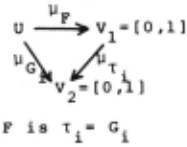
If llF is one to one mapping, then 11 is given by Ti
where v denotes a variable in the unit interval [0, 1]. In the case that 11 does not have the inverse, llT can be obtainea, for example, as i follows:
That is, T. . ~ mapp~ng ll · termined.F 11 (G . ), the image of G. through In FgeReral T. is not uniquely de ~
In this paper the authors define instead of llF(Gi) the following relation RF(Gi) on [0, 1] x [0, 1].
The relation R (G.) is considered as a generali zation ofT . . FFi§.2 shows the difference be tween 11 (G.t and R (G.). It is easily seen that F ~ F 1 the graph of the membership function of a fuzzy set llF(Gi) is a subset of RF(Gi).
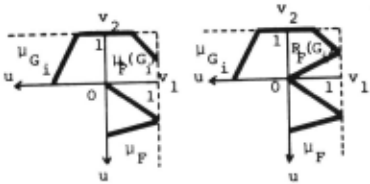
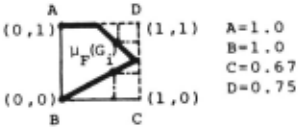
Fig. 2 Difference between IJF (Gi)and RF (Gi) Now our problem is how to evaluate RF(Gi) in comparison of F and G.. To this end l et us de fine the following values A, B, C and D with respect to RF(Gi).
where A implies the distance in the sense of max-min from a point (0, 1) to its nearest point in RF(Gi) and B, C, Dare those from (0, 0), (1, 0), (1, 1) respectively as is shown in Fig.3.
Next we introduce a kind of order to the class of R (G.) 's by a function transforming RF(G.) F ~ ~ to a r eal numbe r such that
where A' = 1 -A, C' = 1 - C and a, B, y, o are constants.
We have to take into account that this order preserves the partial order concerned with T. since R (G . ) includes T. in its special case: -y ~ ~
The partial order~ of the class ofT . is de fined by T n T 1 = T and T U T 1 T 0 * 1 T 6 T', whe re n is meet* ope ration and U is join* ope ration [2].
where t\ stands for min, V for max and l: for union.
Let us take two fuzzy sets F 1 and F 2 and con sider the special case where R (G . J and R (G.) Fl ~ F2 ~
are reduced to ordinary functions, more pre cisely the graphs of membership functions such as 1J in Eq. ( 2) . T.
Here eonsider the following two equations.
What we should do is to determine a, S, y and 6 in Eq. (6) so that Eq. (7) leads to Eq. (8). The operation in Eq. (7) illustrated in Fig.4 with the values A', B, c' and D.
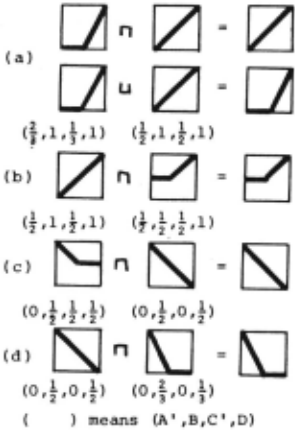
From the above condition we have a ~ y according t o Fig. 4 (a). From Fig. 4 (b), (c) and (d) follow S ~ 0, y ~ 0 and 6 > a. Finally we have the inequalite s
Conve r se ly, 8q. (8) is obtained from Eq.(7) using Eq. (9).
Now we can introduce an orde r to the c lass of RF(G) 's as follows:
Let us next consider the general case that the information in the attributes of the object x is sequencially obtained. Let F . be the infor mation on the j-th attribute andJG .. be a priori knowledge on the j-th attribute of~the objext x .. Let us define ~
Here h(x . ) can be interpreted as the degree of the list~ner's confidence that the speaker is talking about the object x . . Thus the listener can find, according to the~value of h(x.), an x which the speaker might choose out of tfie objects.
4. CONCLUSION
A dialog spoken in natural language is the ex change of ambiguous information in many cases. In this paper we develope a mathematical model of a dialog in which one person understands what the partner wants to communicate through ambig uous information and knowledge. In our model of dialog, the behaviour of the listener plays the most important role. If this role is played by computer, then in a restricted sence a man can talk with computer in natural language. The key point of this paper is how to evaluate the given fuzzy information though a priori know ledge. We have presented a generalized truth value and introduced an order into its class for the evaluation.
@inproceedings{ijcai1979p91,
  title     = {A Model of Dialog Based on Fuzzy Set Concept},
  author    = {Imaoka, Haruki and Sugeno, Michio},
  booktitle = {Proceedings of the Sixth International Joint Conference on
               Artificial Intelligence, {IJCAI-79}},
  publisher = {International Joint Conferences on Artificial Intelligence},
  editor    = {Bruce G. Buchanan},
  year      = {1979},
  month     = {8},
  url       = {https://ijcai.org/proceedings/1979/91},
}
TY - CPAPER TI - A Model of Dialog Based on Fuzzy Set Concept AU - Imaoka, Haruki AU - Sugeno, Michio T2 - Proceedings of the Sixth International Joint Conference on Artificial Intelligence, IJCAI-79 PB - International Joint Conferences on Artificial Intelligence PY - 1979 UR - https://ijcai.org/proceedings/1979/91 ER -Copied
Machine-readable versions of this paper, for tools and AI agents:





