
CONTROLLING KNOWLEDGE DEDUCTION IN A DECLARATIVE APPROACH
Proceedings of the Sixth International Joint Conference on Artificial Intelligence. .
© 1979 International Joint Conferences on Artificial Intelligence
Abstract
This paper*is concerned with the problem of introducing user-defined heuristic control over the deduction process in a knowledge based system. Control information is seen as being just another piece of data, separated from the knowledge base the use of which it controls and from the theorem prover. A declarative approach to control expression was retained. Control information is embedded in user's metarul e s taken from the metalanguage presented in this paper. This metalanguage and a theorem prover interpreting it have been implemented. Examples of its use are given and discussed.
- REFERENC~:s
- I Chang, C.L. and Lee, R. "Symbolic Logic and Mechanical Theorem Proving" Academic Press, 1973 S-6
- Davis, R. "Generalized Procedure Calling and Content Directed Invocation." In Proc. Symposium on AI and Programming Languages, Rochester, Au- gust 1977, p 45-54
- Davis, R. and Buchanan, B.G. "Metalevel know- ledge Overview and Applications." In Proc. IJCAI- 2I• MIT, Mass., August 1977, pp 920-927.
- Friedman, D. and Wise, D. "Unbounded Computa- tional Structures." Software, Practice and Expe- rience. Vol. 8, pp 407-416 (1978).
- Hayes, P. "In Defence of Logic." In Proc. IJCAI-77, pp 559-565.
- Hill, R. "Lush Resolution and its Complete-: ness." DCL-Memo 78, University of Edinburgh, Aug. 1974.
- Kowalski, R. "Algorithm = Logic + Control." Depart. of Computing and Control. Imperial Colle- ge, London, 1976.
- Kowalski, R. "Logic for Problem Solving" DCL- memo 75, University of Edinburgh, 1974.
- Lasserre, C. "Apport de la logique mathemati- que dans les systemes de decision en robotique." These Universite Paul Sabatier, Toulouse, 1978.
- Latombe, J.C. (Ed.) "Artificial Intelligence and Pattern Recognition in Computer Aided Design." North Holland, 1978.
- Me Cabe, F.G. "Programmer's Guide to IC- PROLOG 0.7." Department of Computing and Control. Imperial College, London, 1979.
- Nicolas, J.M. and Gallaire, H. "Data Base- Theory vs Interpretation." In Logic and Data Bases, Plenum Pub. Co, 1978.
- Roussel, Ph. "PROLOG : Manuel de Reference et d 'utilisation." Groupe d' Intelligence Artifi- cielle. UER de Marseille-Luminy.
- Sussman, G. and Me Dermott, D. "From Planner to Conniver." In Proc. FJCC 1972, pp I 171-1179.
- Winograd, T. "FrameRepresentations and the declarative procedural controversy'' In Represen- tation and Understanding. Academic Press, 1975.
- Colmerauer, A. Personal Communication.
References were extracted automatically from the PDF and may contain errors.
Full text extracted automatically from the PDF; figures, tables and equations may differ. The PDF is the version of record.
CONTROLLING KNOWLEDGE DEDUCTION IN A DECLARATIVE APPROACH
Herve Gallaire ENSAE - CERT 2, Avenue Edouard Belin 310SS Toulouse Cedex France Claudine Lasserre ENSAE 10, Avenue Edouard Belin 310SS Toulouse Cedex France
This paper*is concerned with the problem of introducing user-defined heuristic control over the deduction process in a knowledge based system. Control information is seen as being just another piece of data, separated from the knowledge base the use of which it controls and from the theorem prover. A declarative approach to control expression was retained. Control information is embedded in user's metarul es taken from the metalanguage presented in this paper. This metalanguage and a theorem prover interpreting it have been implemented. Examples of its use are given and discussed.
I . INTRODUCTION
The process of deducing information from a know ledge base and from deduction rules is central to many fields : proof theory, problem solvers, expe rt systems in many areas. Whatever the approach followed, be it more declarative or more procedural, the major problem encountered is that of guiding the deduction process, namely the control problem.
Exp r essing control over the deduction process is but one aspect of metaknowledge, as shown in [ 3) ; we give here an application-independent formalism for expressing application-dependent con trol, which is a way of .heuristically guiding a general process. The metarules presented here f or that purpose have been developed in a dec larative context and as such come close to ideas from [2) ; we were influenced by [S) and
[8] too.
The paper is organized as follows. Section 2 presents the framework of this study and the PROLOG system we use for knowledge and metaknow ledge expression. Section 3 gives an overview . of the possible levels and means for metaknow l edge expression while section 4 presents the meta language we have defined and examples of its use.
-------------------------- * Study sponsored in part by CNRS and DGRST.
2. THE DERIVATION PROCESS
2.1. ~point of view for deduction control
Reasoning strategies have been of main concern in many fields of A.I investigated at CERT [9], [12]. For instance Data Base systems need to be enhanced with deduction of implicit information from the explicit one or with checking of integrity constraints to be satisfied by the stored data ; CAD systems need problem solving techniques for exhibiting some kind of intelli gence in the design process [10], etc.
Most of the systems built at CERT rely on a declarative approach [IS]. But we do not deny the practical interest of more procedural approaches [IS]. In these studies the choice was guided by the interest in separating knowledge expression from the expression of algorithmic information on how to use it, and in studying this relationship ; a declarative approach, toge ther with the use of logic as a formalism,proved to provide a very interesting basis for that. Its benefits in knowledge representation - ease of specification, clarity, adaptability, ease of modification of the knowledge base, power of the deductive or proof mechanism- are well known. Besides, we don't believe the proofmecha nism to be more complex, although it is more powerful, than dynamic pattern-directed invoca tion; it is reasonably efficient -....hen improvements are made in specific areas such as clause inde xing and retrieval.
As the declarative approach makes it necessary to t·xpn·ss "how to use what we know" ie meta know! edgl', it gives a good framework for experi ml'nting not only the diffC'rent possible l evels of mc·taknowll'dge t·xpression but its different efft·cts on the sam(' data too. Here stands the basic point of this paper, namely that metarul es - il' rult·s on how to usP tlw knowledge base [21can ;Jt·tually be c·xprl'ssed in a de c larative man IH'I' st·p;~r;~tely from thl' knowledgt' till' ust· of whit·! ,-[~---;;-;ntrol. It i s important to nott· that till ' Ill'<'<·ssity of t·xp r<·ss ing control is not an addit i<>Ilal work which could bt· viewed as a de fault of till· declar;~tivl' approach : as argued in LSI, the possibility fur the user to mix control to hi s program in the procedural approach will raisl' a problem of interpreter control instead of " program control problem.
This study clll control ,,[ the deduction me cha nism I'c·s ls upon till' illgic;~l system PROLOG as a form;II ism ;~nd inft'l'l'IH'<' mt>chanism both for rules ;~nd llll' tarul <'s. lt\t>;Js d<'V<' lopc·d he· re cuu I d as Wt' I I lw , ., 11·ril'd OV<'I- to olh<·r systt·ms, such as rull' bast·d systl'ms, prodiil'tion systrms, provided they off,·r ft·alurvs simi Jar lll tht· st·cunJ-ordt·r logic lllll's that· l'\WLOG gi Vt'S.
2.2. Not:Jliuns and intt·rprt>tations
We shall ust' the First order predicate calculus (FOPC) under clausal form, restricted to Horn clauses LBI and ;Jssumt' the reader to be fami li;Jr with thetHem proving (1]. We use the follo wing notation :
- (I) +A -BI .. -Bn stands for (BIA .. ABn)-A
- +A stands f o r A
- (:3) -BJ .. -Bn stands for 1 (B I A .. ABn)
Litl'rals an· PithPr positive (eg +A)or negative (t·g-Bi). A is thl' lwad of the clausE' the rest of it is its body. -- '
These Horn clauses can be interpreted in many different ways. Their standard interpretation is : if x,y ·. are all variables in the clause, then (I) asserts that for all x,y ·· A if Bl and ·.· and Bn ; (2) asserts that for all x,y .. A ; and (3) asserts that for no x,y.. Bl and. ·.· Bn (i.e. ·l3x3y .. BIA ·· ABn). Other interpre tations are possible, in terms of problem sol ving ((I) being an operator, (2) an assertion, (3) a problem), or of programming languages, ( (I) and (2) being procedures, (3) a procedure call). We shall stick to the logic language as much as possible in the sequel.
As f,>r till' pruuf pr<><'<'dlll'<' wt· shall only consi dt·r dl'riv:~tion <>r rl'futatiun procedures, bast·d "n ,.,,s,>lul iun, n·stri,·tt·d to I inc·ar stratC'gil's starting from purely negativl' c lauses. At l'ach step i of tht· derivation wt· arc given the first (negative) parent claust· Ci (FPCL) ; we have to choose the lite ral -Cij in Ci---a5thP literal to be r eso lve d upon at this step (Cij is called SEL) ; we also have to choosP among all clauses those whosl' head unifit·s with Cij (making the UNIFCJ.SET); finally Wt' havp to clloost· in UNJFCJ.SET the st>cond pan·nt c laust· (SELCL) rl·solution yil'lds rt·solvpnl C' i ; Ci~said to bt· till' pan·nt of the I i lrra Is in till' body of SELCL. 1\TltTte abovl' clloict·s will IH' guidl'd hy a strategy.
2.3. Background on PROLOG
PROLOG [131 is a theorem prove r which takes as input a set of Horn clauses of type (I) and (2) ahovl' and a theorem to ht· proved, or actually its nl'gation of typt· _('l). It uses a staticstra t<'gy compl<·tt· for Horn claus<·s, namt·ly LUSH r e solution [hi; it is "top-down", starting from the purl'ly nPgativl' claust· it is givC'n ; it chooses as SEL the leflmosl I i tcral in FPCL, work i ne, "dt·pth-f irs t", and choost's c 1 aust's from UNIFCLSET in tht· exact ordt·r tllC'y wl're input to the theorem pruvt·r by the ust·r. Furthe r, the proc e ss is controlll'd by an automatic backtra ckine mechanism activated in c ase of incorrect clause c hoice and in order to find all proofs of the all<·g<·tl theorem. Vt·ry important to our work is that, d11e to LUSH resolution results, any other SEJ. sdection strategy would preserve compl e teness.
We must note that PROLOG implementation is not complete, clue to the unbound depth-first mecha nism and to the Jac k of loop c hecks. But PROLOG exhibits great advantages for metaknowledge ex pression: it allows using clauses and predicates as t e rms, i .c as areuments of other predicates ; through built-in predicates it offers access to input-oHtput, to the proof trel' (ETAT prl'dicate) and to tilt· various parts of clausPs anti tt·rms (VAR, UNIV pn·di ca tt·s) ; oiH' can also alter tht· set of axioms (ADD anti SUPP predicatt·s) ; it is also possible to alter the stantlard backtrack step by eliminating rc·turn points : any selec tion of the '/' predi cate in a SELCL will sup press all remaining choices for all the already solved literals in SEI.CL and for the ir parE'nt.
Example : the following is a set of axioms for proving that Z is an element of list L satisfy ing pre dicat e P. The '.' is the concatenati on symbol and NIL is the t>mpty list.
( I ) +ELEri(X. Y ,X) -P (X)- +El.EM(X.Y,Z) -ELEM(Y,Z)
Wh en used t o prove 3z ELEM(L,Z) axiom (I) will un i fy Z and the first clement of the given list L ; then if Z sa t isfies P, the theorem will have been proved (the value of Z be ing the answer of PIWLOG). Due to PROI.Ol. strategy for choos ing SEI.CL , axiom (2) is used in case axiom (I) doe s not yield the empty c l11usc , i . e when P(X) cannot be proved ; in that case a new theorem is to be proved, namely 3z ELEM(Y ,Z), where Y is the rest of the list. If +P(b), +P( c ) are axioms and the theorem to prove is 3z ELEM( a .b. c .NIL,Z), the de r i va t ion tree will be :
----------------
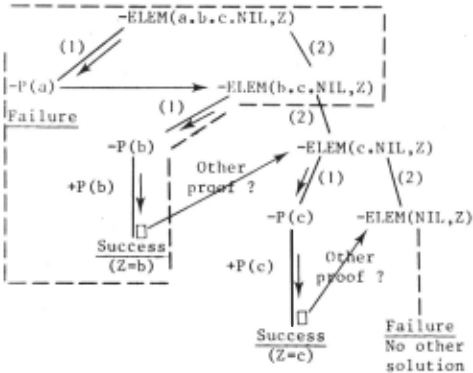
Reca ll that PROLOG gives all possibl e proofs ; hence when succes s is reco rded an alte rna tive is l ooked for. In this trc·e the arrows indi ca t e the order i n whi eh the nodt-s of the tree arE' built. If one wanted only one proof of that theorem, it would be simple to modify "(I) and to write it +ELEM(X. Y ,X) - P(X) -/ In that case we would ge t a tree limited to the one enclosed in the box above.
3. PARAMETERS OF THE DERIVATION PROCESS
A choice strategy rests upon a selection func tion. Such a function may or may not depend on the object on which it bears ; for instance it may depend on the specific c lause from whi ch to extrac t SEL, or it may not depend on the speci fi c UNIFCLSET from whi ch to extract SELCL. Simi l a rly it may or may not depend on the context of the objec t on which it bears ; by context we mean the derivation tree or part of it .
The information needed by the selection function may be either impli c it or exp licitly specified by the user. Autonomous selec tion func tions use implici t information (which may even be void,eg the leftmost- literal-firs t rul e seen in PROLOG) as in the lite ral-with-the-least-number-of-ins t antiated-variables-first rule, or in thE' shor test-clause-first rul e , e tc. Such func tions will not he discussed in this paper, although an inte rac tive choice of such strategies is offered t o the user in some syst ems .
This paper is precise ly conc erned with the expre ssion of information to be used by selection functions ; we shall only deal with the means of exp r ession, not with designing specific criteria. Important t o this work is the not i on of context ; to express context information, the use r must choose be tween a loc a l contt·xt (part of tht· pro of tree , eg the parent of a literal, its para~v.· ters , its descendants) and a more global one (ancestors of a litera l, the whole proof tree itself). Although the declarative approach that we follow, especially the logic one, set'ms to be we 11 sui ted to that latte r choice through tlw no tion of proof, we have not investigated it, thus restricting ourselves to local context ex pression. Neither shall we discuss the pragmatic control expression that c lause writing always conveys [7].
There are two basi c ways for expressing contro l of the deduction process.
- As is typi cal of the procedural approach, con tro 1 information can be mixed with the know l edge base, ie with the application data (clau ses) used in the derivation process. For instan ce the user can modi fy his set of c lauses so that the order of his original clauses in the UNIFCLSET they belong to becomes dependent on SEL. We do not rej ect such an approach ; its systematic use is repo rted in [9].
- More coherently with the declarative appro ach, one can separate control information from the knowledge base ; at the user level thisbeco me s another piece of data, ie a set of clauses expressing a heuristi c control. This is the choi ce that was made here .
We shall now present our me talanguage for sta ting the metarules expressing this heuristic control. It uses content-directed invocation [2] heavily- and we feel we have the correct tools for it. Our metalanguage is coherent with the base language [5].
4. A PROPOSAL FOR A METALANGUAGE
There are two types of metarules in this lal'@la ge, expressing control either over the choiceof SEL or ove r the choice of SELCL ; for the user writing them, such metarules are true assertions, in the logical sense, about priorities and orde rings as explained below ; they will be used as axioms by the theorem prover.
4.1. Ordering of UNIFCLSET
The METAL metarules to be described here have as primary purpose the expression of assertions on priorities of individual clauses in UNIFCLSET, SELCL being the clause of higher priority. Then let P, R be terms or variables, let L be a term Ll,L2 ·.· Lr.NIL or a variable (see 2.3 for the ',' notation and for NIL) ; let Cl, ... Cn be posi tive literals ; then Metarule
+ METAL(P,L,R,K) -Cl ... -Cn
asserts that any user's clause matching (unify ing) with clause +P-L 1- .· -Lr has priority K in the UNIFCLSET it belongs to, provided R matches the parent of SEL and the existential closure of CIA .·· ACn can be proved; in the sequel we talk more simply of the proof of CIA ... ACn. We must remark that :
- Li,R,P are terms in METAL but literals inuser's clauses (second order feature~
- -when any of P, L is a variable, the process of matching will instantiate it ; similarly when R is a variable it is instantiated to the value of SEL ; this feature allows to have metarules ap plying to many user's clauses, the target clau ses, thus avoiding much redundancy, and making it easier to write metarules by specifying just wh.at is necessary to match the target clause(s).
- the matching process is constrained not to ins tantiate any uninstantiated variable of thernrget clauses or of the parent of SEL at the time mat ching takes place ; this restriction, enforced by the theorem prover means that a metarule shouldn't be used when it aims at a special case of a target clause. This restric tion implies mat during the proof of CIA ... ACn no variable in P, L,R is instantiated.
- there is a default metarule asserting priority value for clauses which aren't of any metarule : +METAL(P,L,R,MEAN) L,R are variables. a MEAN target where P,
- the set of metarules may be conflicting ie a clause might be the target of two metarules ; as no meta-metarule has been introduced yet, wecm not handle it differently from PROLOG, ie the first metarule that is proved is retained.
- the Ci predicates can be defined by any valid
PROLOG set of axioms.
Example
+METAL(P(X,a),L,R(X,Y),O) -PREDI(X,a) -PRED2(Y)
-PRED3(L,F)
This metarule asserts that priority 0 is the prio rity of any rule the head of which unifies with P(X,a), the parent of SEL unifying with R(X,Y), provided the conditions PRED are provable. The matching process must comply with the above r es trictions - eg as 'a' is constant, X vari able , this is not allowed to match P(T,U) wher e T,U are variables, but P(b,a) would pass the t es t ; during a proof of PREDI(X,a) it is no t allowed to instantiate X more than it is already.
4.2. Choice of SEL
We are to introduce local context evaluation for SEL selection ; there· are two selection fac tors :
- backtracking blocking corresponding to a dyna mic '/' introduction
- literal freezing preventing the theorem prover from choosing as SEL a frozen literal ; th is fea ture, the most interesting of all featur es we present, allows for very dynamic control regimes.
Let P,L,Cl, .. ,Cn be as described for METAL me ta rules ; let I and F be terms to be described be low ; then
+METAX(P,L,I,F) -Cl ... -Cn
asserts that if +P -Ll- .· -Lr matches the candi date SELCL, and if CIA ... ACn is provable, then:
- -if I is the term INH(Il ·..· Im.NIL) where each Ij matches some Lh, any backtracking on Lh and on its parent will be blocked ; INH (NIL) blocks P only ; if I is NIL no blocking occurs.
- -ifF is the term FRZ(Fl,Vl) ·...· FRZ(Fs,Vs ). NIL where each Fj matches some Lh , then Lh will be frozen as long as none of its arguments appea ring in list Vj is instantiated (ie anything bu t a pure variable) ; if F is NIL no literal i s to be frozen.
We must remark that much of what was noted f or METAL metarules applies to METAX ones and is not repeated here, especially for instantiation. Also, there might be cases where all literals are frozen ; we unblock the situation by choosing the leftmost one (default rule). We are now to see examples and to examine more deeply the free zing capability, already investigated but solved differently by Colmerauer [16].
Examples on freezing literals
The following set of PROLOG clauses can be used to prove that two trees X,Y have identical lists of leaves when traversed from left to right :
+IDLF(X,Y)-LF(X,S)-LF(Y,S) +LF(X,X.NIL) - ATOM(X) +LF(U,V,Z) -LF(U,X) -LF(V,Y) -CONC(X,Y,Z) +CONC(NIL,Y,Y)- +CONC (A.Z,Y,A.V) -CONC(Z,Y,V)
If it has been given clauses ATOM(a), ATOH(b), ATOM( c) and if IDLF((a.b).c, a.(b.c)) is a theorem to be proved, PROLOG will succeed ;howe ver the control regime of this proof is quite unsatisfactory for, if it were to fail, much useless work might have been carried out before checking anything. This is a classical example for coroutine need, as a coroutine would allow checking each leaf as soon as it is uncovered in Xor Y. The following metarules, together with the default rule, will do :
+METAX(P,L,NIL,FRZ(LF(X,S),S.NIL),NIL) +METAX(P,L,NIL,FRZ(CONC(U,V,Z),U.Z.NIL).NIL)
The first metarule will prevent the theorem pro ver from choosing LF(X,S) as SEL as long as S is not instantiated ; the second one will do slml larly for CONC(U,V,Z) whenever both U and Z are unins tantiated.
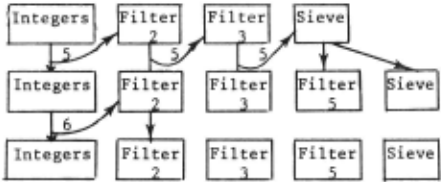
A different and even more interesting example is the classical Sieve of Eratosthenes problem. The followi ng is the list of PROLOG clauses that might be necessary to prove Primes(X) where X is the list of prime numbers
+Primes (2.X) -Integers(2.Y) -Sieve(2.Y,X) +Integers(P.(Q.R)) -Succ(P,Q) -Integers(Q.R) +Sieve (P.IN,P.PR)-Filter(P,IN,NEW)-Sieve(NEW,PR) +Filter (P,Q.IN,OUT)-Mult(P,Q)-Filter(P,IN,OUT) +Filter(P,Q.IN,Q.OUT)-Filter(P,IN,OUT)
The Succ(P,Q) predicate is satisfied iff the va lue of Q is the value of P plus I ; the Mult(P ,Q) predicate is satisfied iff Q is a multiple of P (definitions not given here for lack of space). As argued in [II] where it is presented, due to PROLOG selection rule this neat example will not work as it is. However it is quite easy to fix with the following :
+ME TAX (X, L ,NIL, FRZ (Integers (S. T) , T. NIL) . NIL) +METAX(X ,L,NIL,FRZ(Sieve(U,V),U.NIL).NIL) +METAX(X,L ,NIL,FRZ(Filter(M,N,K),N.NIL).NIL)
Snapshots will explain how the proof proceeds
4.3 - Implementation principles
There is no major problem in such an implementa tion, although particular attention is to be paid to allow correct backtracking, 'fair selec tion of frozen literals. The theorem prover has been coded in PROLOG mainly for ease of modifica tion and for its unification algorithm. As we piled up levels of interpretation the result is rather inefficient, but our goal is attained. We emphasize how useful both the non first-order features of PROLOG and the possibility to exami ne its own data structures, i.e. terms and clau ses, are. Due to the very simple access to those structures (UNIV, VAR, ·.· ) it is possible to build powerful mechanisms.
Of course this theorem prover is not a major in novation in the field ; one can argue that it behaves with respect to PROLOG in a manner quite similar to CONNIVER's behaviour with respect to MICROPLANNER. This is basically true from the viewpoint of the theorem prover ; what we gave back to the user is some control over lists of possibilities, over backtrack, over the context mechanism [14]. This similarity is only superfi cial. We give more to the user because what he can examine in our case is not just a list of possibilities, but it is a list of methods in the CONNIVER sense ; the method body can be scru tinized, modified, reordered whereas it cannot happen with CONNIVER ; this is due to the con tent-directed invocation feature that we men tioned earlier and of which we saw some impor tant effects in 4.2. We recognize that out con text handling mechanisms, which are roughly the SUPP and ADD predicates of PROLOG, are not as powerful as CONNIVER's. Our goal was different and this remains a possible extension for this work.
5. DISCUSSION
The points we want to stress are the following
a. User responsibility- Metarules give the user much freedom ; a correct use of metarules goes through an understanding of how the deriva tion process should go ; then the user will be tempted to use this knowledge and modify his own
- algorithm so as to take advantage of this under standing directly. This is the reason why we did not give real examples for METAL metarules nor for backtracking use of METAX metarules ; simple examples can easily be fixed without metarules, although this usually introduces much redundancy and awkwardness in the set of axioms. From our studies in plan generation, we are aware of ca ses where a'/' could be dynamically introduced with much benefit.
- Extensions- Any time a language is defined, one may propose extensions to it. Among all the extensions we have been thinking of, one is to allow user-defined FRZ predicates ; such a need has been found in another plan generation program where redundant tests could be avoided by properly defined freezing conditions ; such an extension is quite simple to incorporate to our theorem prover.
- Related topics - Much of the interest of me tarules comes from the dynamic ordering of lite rals (4.2) ; clearly this is related to the many producer-consumer discussions, to the call by op portunity or call by necessity choice ; the Pri mes problem is discussed in [II] and in a diffe rent framework in [4] ; we believe the simple tools given here compare favorably with those given there. We use a data flow mechanism (ins tantiation) ; more explicit control mechanisms such as message passing have not been looked for. Note that it is possible to define and implement a theorem prover which could take advantage of the connections between variables to select lite rals ; for instance, in the Prime example the instantiation of a variable unfreezes just one literal, and usually a theorem prover can watch such instantiations. Expressing specific proper ties of predicates, e.g. that they are true func tions, is not covered here although it is an im portant domain to be investigated. We believe "intelligent" backtracking to be an important to pic deserving more attention ; we only note that to be intelligent it must be prepared during the derivation process ; the tools we give are but one step in that direction. Finally interactive control expression has not been covered at all.
ACKNOWLEDGMENTS
We would like to thank A. FAHMY for the many dis cussions we had with him on this topic and on I'ROLOC use. 1'. HAYES conunents on this paper are grat~fully acknowledged.
REFERENC~:s
ll I Chang, C.L. and Lee, R. "Symbolic Logic and Mechanical Theorem Proving" Academic Press, 1973
- Davis, R. "Generalized Procedure Calling and Content Directed Invocation." In Proc. Symposium on AI and Programming Languages, Rochester, Au gust 1977, p 45-54
- Davis, R. and Buchanan, B.G. "Metalevel know ledge Overview and Applications." In Proc. IJCAI2I· MIT, Mass., August 1977, pp 920-927.
- Friedman, D. and Wise, D. "Unbounded Computa tional Structures." Software, Practice and Expe rience. Vol. 8, pp 407-416 (1978).
- Hayes, P. "In Defence of Logic." In Proc. IJCAI-77, pp 559-565.
- Hill, R. "Lush Resolution and its Complete-: ness." DCL-Memo 78, University of Edinburgh, Aug. 1974.
- Kowalski, R. "Algorithm = Logic + Control." Depart. of Computing and Control. Imperial Colle ge, London, 1976.
- Kowalski, R. "Logic for Problem Solving" DCL memo 75, University of Edinburgh, 1974.
- Lasserre, C. "Apport de la logique mathemati que dans les systemes de decision en robotique." These Universite Paul Sabatier, Toulouse, 1978.
- Latombe, J.C. (Ed.) "Artificial Intelligence and Pattern Recognition in Computer Aided Design." North Holland, 1978.
- [II] Me Cabe, F.G. "Programmer's Guide to IC PROLOG 0.7." Department of Computing and Control. Imperial College, London, 1979.
- Nicolas, J.M. and Gallaire, H. "Data Base Theory vs Interpretation." In Logic and Data Bases, Plenum Pub. Co, 1978.
- Roussel, Ph. "PROLOG : Manuel de Reference et d 'utilisation." Groupe d' Intelligence Artifi cielle. UER de Marseille-Luminy.
- Sussman, G. and Me Dermott, D. "From Planner to Conniver." In Proc. FJCC 1972, pp I 171-1179.
- [IS] Winograd, T. "FrameRepresentations and the declarative procedural controversy'' In Represen tation and Understanding. Academic Press, 1975.
- Colmerauer, A. Personal Communication.
@inproceedings{ijcai1979p236,
  title     = {CONTROLLING KNOWLEDGE DEDUCTION IN A DECLARATIVE APPROACH},
  author    = {Gallaire, Hervé and Lasserre, Claudine},
  booktitle = {Proceedings of the Sixth International Joint Conference on
               Artificial Intelligence, {IJCAI-79}},
  publisher = {International Joint Conferences on Artificial Intelligence},
  editor    = {Bruce G. Buchanan},
  year      = {1979},
  month     = {8},
  url       = {https://ijcai.org/proceedings/1979/236},
}
TY - CPAPER TI - CONTROLLING KNOWLEDGE DEDUCTION IN A DECLARATIVE APPROACH AU - Gallaire, Hervé AU - Lasserre, Claudine T2 - Proceedings of the Sixth International Joint Conference on Artificial Intelligence, IJCAI-79 PB - International Joint Conferences on Artificial Intelligence PY - 1979 UR - https://ijcai.org/proceedings/1979/236 ER -Copied
Machine-readable versions of this paper, for tools and AI agents:





