
A Facsimile Based Text Editor Using Handwritten Mark Recognition
Proceedings of the Sixth International Joint Conference on Artificial Intelligence. .
© 1979 International Joint Conferences on Artificial Intelligence
Abstract
A fundamental study on a facsimile based text editor using handwritten mark recognition is described with some experimental results. Every information for editting is given to the computer via facsimile. First, texts (handwritten, typed or printed) and five kinds of handwritten marks are input to the computer as binary pictures. Second, the marks are recognized to make the picture allocation list. Third, the fair copy of the text is constructed by rearranging the binary picture according to the list, and is output to the facsimile receiver. Manuscripts using almost any kinds of languages including English, Chinese, Japanese etc. are editted by this system. Moreover, the method described here can be combined with usual text editors or word processors, in order to reduce the keyboard based man machine interaction. Experiments based on a minicomputer controlled facsimile produced unexpectedly good results, and the report(l] was actually made using this method, with less than a half of efforts required in the usual way of Japanese manuscript writing with black ink, scissors and paste.
- Y.Suenaga, "Automatic text editting using handwritten mark recognition", Proc. of The 9th Conference on Image Science and Engineering, No.3-l,pp63-66, Dec.l978(in Japanese)
References were extracted automatically from the PDF and may contain errors.
Full text extracted automatically from the PDF; figures, tables and equations may differ. The PDF is the version of record.
1. Introduction
It is usually a hard work to prepare documents, especially in Japan, where more than 2,000
kinds of kanji characters are commonly used.
Kanji text editors are available, however, the inconvenience of Kanji input operation is yet
essentially unsolved.
documents and the Kanji Consequently, the greater part of used in Japan is still handwritten, development of text editors free from
input operation is expected.
This paper describes a fundamental study on a text editor using only facsimiles as input and output devices. The method described here is not based on character recognition, but on mark recognition.
2. Assumption
The following conditions are assumed, in order
to make the practical consideration.
- (a) Characters must be handwritten, typed or printed with the color easily detected by the facsimile transmitter(e.g. black).
- (b) The ruled lines of the should be printed with the detected by the facsimile light blue or green). manuscript paper color which is not transmitter( e.g.
- (c) Characters must be placed according to the
- ruled lines.
- (d) Marks are drawn by one of the following two methods:
- (d-1) drawing marks directly on the manuscript
- paper together with characters,
- (d-2) drawing marks on the other papers.
In case of (d-1), the overlapping of marks with characters or with other marks should be avoided except for the delete or space marks stated later, while the method (d-2) do not
suffer from this limitation.
Fig.l shows an example of the manuscript paper format and five kinds of marks employed here.
(1) Position mark:
The position mark is defined as a set of short lines drawn according to the ruled lines of manuscripts. The format and block size of
manuscripts are estimated from this mark.
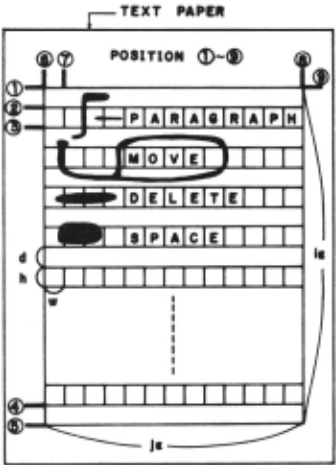
(2) Delete mark:
The delete mark is defined as a mass figure drawn on the character string within the blocks. The characters covered with this mark are deleted.
( 3) Space mark:
The space mark is defined as a mass figure drawn on the character string, which is similar to, but wider than the delete mark. The characters covered with the space mark are replaced by the equal numbers of spaces.
(4) Paragraph mark:
The paragraph mark is defined as a hook shaped line figure which crosses the blocks vertically. This mark indicates the beginning of the new paragraph.
(5) Move mark:
The move mark is defined as a line figure which consists of an arm and a loop. The character string within the loop is extracted and inser ted to the position indicated by the arm.
3. Procedure
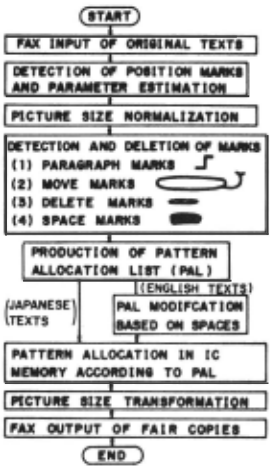
Referring t o Fig.2, the procedure of text editting is described below.
3.1 Input of texts
Original manuscripts and handwritten marks are input to the minicomputer from the facsimile transmitter. At this time, the position mark is detected, and the parameters on the text size and format are calculated.
3.2 Detection of marks for text modification
At first, the paragraph marks and the move marks are detected by searching along the center line of the space between lines.
Then the delete marks and the space marks are detected by testing the inside of blocks. In case of method (d-1) stated in 2, detected marks are completely removed from the binary picture of the manuscript.
3.3 Generation of the picture allocation list
The picture allocation list (PAL) is generated according to the detected marks. PAL consists of block numbers and addresses indicating the order. Character strings of the manuscript are virtually deleted, moved and combined in PAL .
3.4 Reconstruction of the binary image
Finally, the fair copy of the manuscript is made by rearranging the binary picture according to PAL, and output to the facsimile receiver. Put line procedures for Japanese and English are different from each other.
FACSIMILE BASED rEXT EDITOR BY HANOWRITTEN MARK RECO~NITION
A~ -{Vr.4;t} ~- ~ ~~~ ?rt.~ v,.., -r:k. ~Vn.J. 1:v;a a,..lt...('... ~~11(,_ ~ ,_.~ ~ i_wt.
T ~) d..e 1--tJA, tJ.,_ ~ i4 '1/tlt.dA. .IU...~,.~, ol.;t p~ -th. .1~. -th ~t M a..~~
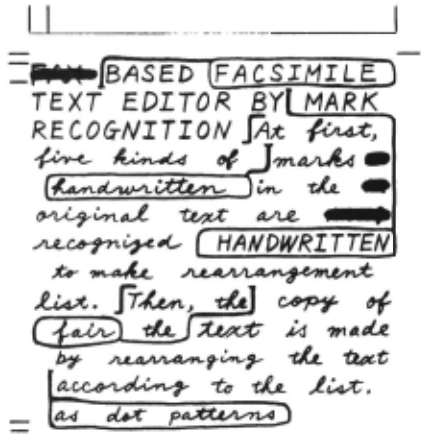
Fig.3(b) Resultant binary pattern of the manuscript made from Fig.3(a).
4. Experimental results
Fig.3(a) and (b) show an example of text editting by the system stated above. One page of the manuscript is handled as a 512 x 512 dot binary picture.
Most programs of the experimental system are made using FORTRAN-IV, and only some special input or output routines are written with an assembly language.
The total processing time is about three minutes per one page of the manuscript: one minute for facsimile input, one minute for mark recognition and the rearrangement of binary picture, and, one minute for facsimile output.
5. Conclusion
The fundamental experiments of text editting by the system described here produced unexpectedly good results. Actually, the report[l] was made by using the system, with less than a half of efforts required for ordinary way of manuscript writing with black ink, erasers, scissors and paste.
The notion and techniques stated here will be very useful for the the modification of various kinds of texts written in almost any kinds of languages.
Moreover, the method employed here can be used in combination with usual text editors, or, in future, with some Kanji OCR's, to reduce the keyboard based man machine interaction.
ACKNOWLEDGEMENTS
The author thank Dr. Junji Yamato, the chief of Yamato Research Section, Yokosuka Electrical Communication Laboratory, and the members of the same Research Section, for their invaluable advices.
REFERENCE
[1] Y.Suenaga, "Automatic text editting using handwritten mark recognition", Proc. of The 9th Conference on Image Science and Engineering, No.3-l,pp63-66, Dec.l978(in Japanese)
@inproceedings{ijcai1979p187,
  title     = {A Facsimile Based Text Editor Using Handwritten Mark Recognition},
  author    = {Suenaga, Yasuhito},
  booktitle = {Proceedings of the Sixth International Joint Conference on
               Artificial Intelligence, {IJCAI-79}},
  publisher = {International Joint Conferences on Artificial Intelligence},
  editor    = {Bruce G. Buchanan},
  year      = {1979},
  month     = {8},
  url       = {https://ijcai.org/proceedings/1979/187},
}
TY - CPAPER TI - A Facsimile Based Text Editor Using Handwritten Mark Recognition AU - Suenaga, Yasuhito T2 - Proceedings of the Sixth International Joint Conference on Artificial Intelligence, IJCAI-79 PB - International Joint Conferences on Artificial Intelligence PY - 1979 UR - https://ijcai.org/proceedings/1979/187 ER -Copied
Machine-readable versions of this paper, for tools and AI agents:





