
Music Information Processing System and Its Applications to Comparative Musicology
Proceedings of the Sixth International Joint Conference on Artificial Intelligence. .
© 1979 International Joint Conferences on Artificial Intelligence
Abstract
In the application of digital data processing techniques to comparative musicology, it is an interesting subject to determine the type of scale in folk musi c and to compare the similarities in melody and rhythm between different musics. This paper describes two subjects: data entry technique for the realization of a music database and its application to comparative musicology. The former deals with dictation of melody sound. The latter concerns a method to find what scale is included in the melody, using knowledge in the modern ethno-musicology, and describes a certain measure of similarity of music.
- W.H. Davidow Ed. "Music by Computer", from 1966-FJCC.
- H.B. Lincoln Ed. "The Computer and Music", Cornell University Press, 1970.
- H.C. Longuet Higgins, "On Interpreting Bach" Ma c hine Intelligence 6, Edinburgh, 1971.
- F. Koizumi, "Research on Japanese Tradi- tional Music", Ongaku-no-Tomo Sha,(in Japanese)
References were extracted automatically from the PDF and may contain errors.
Full text extracted automatically from the PDF; figures, tables and equations may differ. The PDF is the version of record.
1. INTRODUCTION
Digital data processing techniques gave the ethno-musicologists a large capacity of data processing ability never before obtainable [1]. This paper deals with data entry method for realization of a music database and its appli cations to comparative musicology.
It is difficult to compare the music informa tion by listening to the melody or by watching the note. It is troublesome, still more, to search what scale is included in the melody and to detect the similarity between two different melodies.
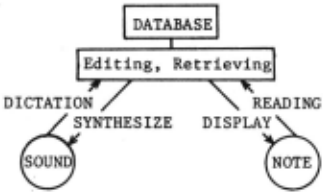
Figure 1 shows the music information processing system which has been developed for this re seach. Musical information is expressed by two types of pattern: one is audible pattern -sound - and another is visible pattern -music note-. Though it has analogy with the language, which has speech pattern and character, it is diffi cult to dictate the sound of melody and to read the music note. This system has two data entry functions: dictation of melody and recognition of music note. A synthesizer and a display are used for monitoring the music.
2. DATA ENTRY AND DATABASE
2.1 Melody Analyser
In the early period, punched card or tape was used for comparative musicology [1]. In Japan there are a large number of folk musics which have never been collected before. So we have developed a melody analyser, which detects the pitch and the length of tone, for dictating folk music.
Pitch interval can be identified by detecting the fundamental frequency of sound. But the frequency difference ratio between the adjacent tones (semi-tone) is very small (21/12=0.059) and the duration of one tone may be very short, which requires that the measurement of the fundamental frequency should be done accurately during a short period [2].
As it is only fundamental frequency to be detected for pitch identification, a band-pass filter of Butterworth type ranging from 131 Hz (name of pitch: C2) to 1047 Hz( Cs ) is used. Sound signal is sampled with the relatively low sampling rate (6kHz).
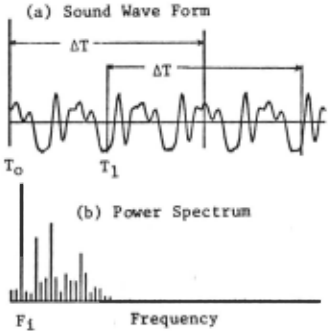
For the identification of pitch, we transform the sound signal (a) in Fig.2 from T 0 to T0+6T into the power spectrum (b) using the FFT algo rithm. In the discrete frequency analysis, the frequency difference 6F between adjacent spectra, which is the inverse of data length 6T , is too large. In order to obtain the accurate frequen cy Fp, we compensate spectral peak frequency Fi with the phase change as follows:
where 81 and 80 are phases of Fi in the interval [T1,T1+6T] and [T 0 ,T0+6T], respectively. Pitch P is expressed as follows:
where Fr is reference frequency.
The pitch obtained above has unstable frequency at the transition of tone. As the pitch of melody changes stepwise, a median filter gives good results rather than a moving averaging filter.
In case of vocal sound, FP may vary over the range of semi-tone during the same tone because of the vibirato and the pitch scale may shift little by little for lack of absolute pitch. For the correction of them, the thresholding with hysteresis is carried out and the pitch is identified as the accumulation of the quantized pitch difference between the adjacent tones.
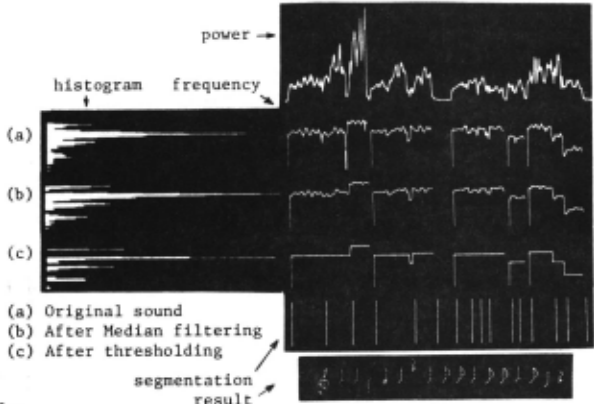
The segmentation is done at the time when one of the following conditions is satisfied: (1) Pitch changes stepwise, (2) Correlation of spectra between adjacent intervals becomes smaller than the predetermined value and (3) Power increases abruptly. Segmented length is quantized by using result its histogram partition. Figure 3 shows an ex ample of dictation of a Japanese nursery song.
Fig.) Dictation of Melody sound
2.2 Music Database
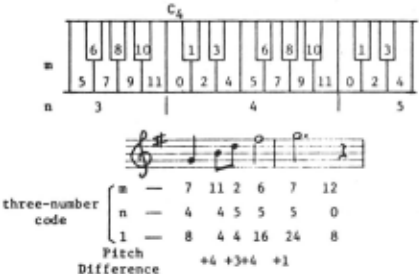
Music data are encoded into a three-number code as shown in Fig.4. Them, n and 1 represent pitch name in octave, octave position and note length, respectively. The m and n are obtained as:
Notation of the music note is not unique but the pitch code in database described above is unique [3].
Music data can be en tered into the database not only by the melody analyser but 3lso by an optical note reader or a data tablet.
3. APPLICATIONS TO COMPARATIVE MUSICOLOGY
3.1 petermination ~Scale~
In the past, the scale of Japanese folk music was classified into Ritsu, Ryo, Yo and In scales, as the European music is classified into major scale and minor one. These scales, named after their origin, were partially illogical. In the modern Japanese ethno-musicology, Koizumi[4] claims that Japanese folk music s hould be cate gorized into Minyo, Miyakobushi, Ritsu and Ryukyu scales as shown in Fig.S, where they are shown in the form of pitch difference sequence. And he also proposed that the type of scale should be determined by the type of tetrachord included in melody and the position of nuclear notes.
| (1) Minyo scale | +3 +2 +2 +3 +2 |
| (2) Miyakobushi scale | +1 +4 +2 +1 +4 |
| (3) Ritsu scale | +2 +3 +2 +2 +3 |
| (4) Ryukyu scale | +4 +1 +2 +4 +1 |
Fig.S Scale Type of Japanese Folk Music (Underlines indicate Tetrachord)
Tetrachords are the fundamental units to compose a scale and a melody, as structured with two Tetrachords conjuncted.
Nuclear notes , which mean the important notes of melody, have the following features: (i) Basic note of tctrachord, (ii) Median note of three adjacent notes, (iii) Very often final tone of melody and (iv) Upper note in two-tone melody.
This knowledge makes it possible to categorize the type of scale by Ill Finding tetrachord and making its histogram and [2] Finding nuclear note and scoring it.
3.2 Similarity of Melody
Tile melody may be considered as a finit e Markov chain process, in wllich the state ki is the pitch m>te in scale. The pit ch transition probability Pij, the conditional probability that the pit ch ki is followed by kj, has the feature of the melody.
The weight of pitch note in scale can be ex pressed by its steady state probability W, which can be solved by the following equations.
The weight of pitch is effective to express the similarity between different melodies belonging to the same scale class.
3.3 Complexity £f. Rhythm and Melody
Let's assume the rhythm ratio Ri as:
Its standard deviation OR indicates the complex
ity of rhythm. ~
The root mean square of pitch difference in melody can indicate the complexity of melody:
where Pi is the pitch of note (m + nxl2).
On (oR, dm) plane, horizontal and vertical axes indicate the complexity of rhythm and melody, respectively.
4. CONCLUSION
A method for dictating music sound was proposed for the realization of a music database. Regarding the applications of a Japanese folk music database, this paper described an algorithm for determining the type of scale using the knowledge about the modern ethno musicology. And some measures of similarity in melody and rhythm were proposed for the compar ison of folk music.
@inproceedings{ijcai1979p138,
  title     = {Music Information Processing System and Its Applications to Comparative Musicology},
  author    = {Nakamura, Yasuaki and Inokuchi, Seiji},
  booktitle = {Proceedings of the Sixth International Joint Conference on
               Artificial Intelligence, {IJCAI-79}},
  publisher = {International Joint Conferences on Artificial Intelligence},
  editor    = {Bruce G. Buchanan},
  year      = {1979},
  month     = {8},
  url       = {https://ijcai.org/proceedings/1979/138},
}
TY - CPAPER TI - Music Information Processing System and Its Applications to Comparative Musicology AU - Nakamura, Yasuaki AU - Inokuchi, Seiji T2 - Proceedings of the Sixth International Joint Conference on Artificial Intelligence, IJCAI-79 PB - International Joint Conferences on Artificial Intelligence PY - 1979 UR - https://ijcai.org/proceedings/1979/138 ER -Copied
Machine-readable versions of this paper, for tools and AI agents:





