
The Execution of Plans in an Independent Dynamic Microworld
Proceedings of the Sixth International Joint Conference on Artificial Intelligence. .
© 1979 International Joint Conferences on Artificial Intelligence
Abstract
The problem of executing plans in an independent dynamic microworld is discussed. The microworld is a simulated city that not only contains permanent features (e.g. streets) but also transient features (e.g. other cars). A simulated taxi driver (ELMER) must plan and execute routes through this city. Among the interesting features of ELMER are the use of hierarchical rather than linear plans; the representation of knowledge by routes (similar to and possibly built from plans); and planning by splicing together these routes.
- Hayes, P. J. "A Representation for Robot Plans", ~ IJCAI-75. IJCAI
- Tbilisi, U.S.S.R., 1975, pp. 181-188.
- Chien, R. T. and S. Weissman. and Execution in Incompletely Environments", ~ IJCAI-75.
- U.S.S.R., August, 1975, pp. 169-174.
- "Planning Specified Tbiliai, (3
- Hendrix, G. G. "Modeling Simultaneous Actions and Continuous Processes." ~ Intell. 4 (1973) 145-180.
- Hiller, G. A., E. Galanter, and K. H. Pribaum. llan4 ~ ~ Strycture ~ Behayioyr. New York, N.Y.: Holt, Rinehart & Winston, 1960.
- Sussman, G. J. "A Computational Model of Skill Acquisition." AI Lab. AI-TR-297, MIT, Cambridge, Mass., 1973.
- Fikes, R. E. and N. J. Nilsson. "STRIPS: A New Approach to the Application of Theorem Proving."~ Intell. 2 (1971) 189-208.
- Kuipers, B. J. "Representing Knowledse of Large Scale Space." AI Lab. AI-TR--1H, MIT, Cambridge, Mass., 1977.
- McCalla, G. I., P. Schneider, R. Cohen, and H. Levesque. "Investigations into Plannins and Executing in an Independent and Continuously Changing Microworld." Dept. of Comp. Sci. AI Memo 78-2, U. of Toronto, Toronto, Ont., 1978.
- Sacerdoti, E. A Stryctuce ~ ll&n4 ~ Behayioyr. New York, N.Y.: Elsevier, 1977.
References were extracted automatically from the PDF and may contain errors.
Full text extracted automatically from the PDF; figures, tables and equations may differ. The PDF is the version of record.
1 INTRODUCTION
One of the more productive areas of AI research has been the study of producing plans to solve problems in a microworld. Usually such worlds (e.g. the blocks world) are static. We are interested in planning for microworlds which can change continuously and independently of the planning agent. Such microworlds have received some attention [1] [2).
The microworld here is an abstraction of the environment a taxi driver might encounter. The microworld and the taxi driver. (ELMER) are simulated as asynchronous processes where ELMER informs the microworld of speed and direction changes and the microworld provides ELMER with a "window" of what he can "see" at any given instant. The three central components of ELMER are the Planner that creates a travel plan from a customer's request; the Executor that carries out the plan; and the ~ that maintains ELMER's developing knowledge of the city.
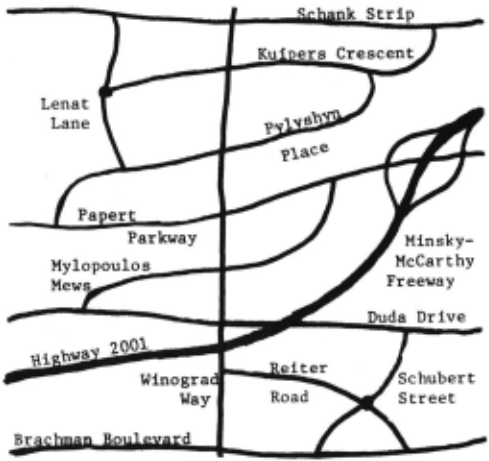
ELMER exists in Simon City (Figure 1). The microworld component of the system must simulate this city, including not only the permanent street arrangement, but also transient features such as traffic lights or other cars. It must also maintain the window and keep track of ELMER. The microworld is not yet implemented, but an implementation strategy based on something like Hendrix's scenarios [3] may be appropriate.
2 .I!iE. EXECUTOR
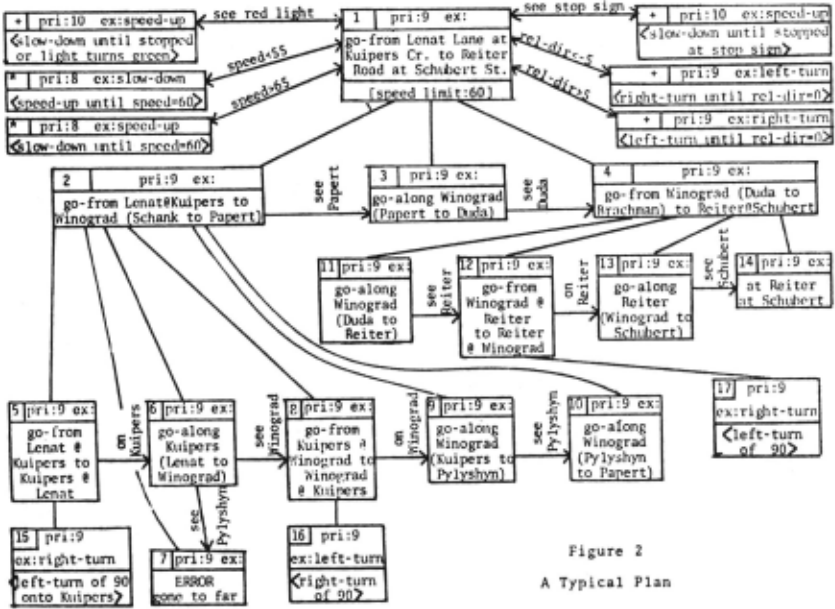
The Executor undertakes plans produced by the Planner. Plans are represented as hierarchies of ever more detailed sub-plans similar to the plans of Hiller ~Al [4], but in contrast to the usual linear sequences of actions (e.g. HACKER [5] or STRIPS [6]). Figure 2 shows a plan for going from Lenat Lane at Kuipers Crescent to Reiter Road at Schubert Street in Simon City. The numbered "boxes" are the ~ of the plan; the other boxes are demon-like secondary plans controlling ELMER's speed and direction and looking out for obstructions such as red lights. In the core each box represents a plan connected to more detailed sub-plans below and more general super-plans above, and connected by arrows to subsequent brother plans at the same level of detail. Plans have a ~. indicated by the first word in the plan box (e.g. 16 has type "right-turn"). Angle brackets contain commands to be sent directly to the microworld (e.g. 15).
When the Executor executes a plan, it executes the top plan (e.g. 1) and all its left-most descendants (e.g. 2, 5, 15) . Such plans are then ~ and remain so until they are either suspended or de-actiyated by an absolute transition into another plan along an arrow leaving the plan. Such a transition occurs when information labellinc the arrow corresponds to inforaation in the window. For exampie, when the window indicates that "on Kuipers" is true, a transition is made from 5 to 6 (if 5 is active). We don't currently see a need to allow labels that would require complex inferences before matching the window information, thus ensuring fairly rapid computations when deciding on transitions. Once a transition is made, the old plan and all its active descendants are de-activated, and the new plan and all its left-most descendants are activated. Note the similarity of a plan to a TOTE (Test-Operate-Test-Exit) [4] and to a DOWHEN, DOWHAT, DOUNTIL triple [3] . Of course, the labels and actions here are more limited than the arbitrary procedural capabilities of these other approaches.
Attached to the Planner-generated core at a level of detail appropriate to their action are Executor-generated secondary plans . These fall into two categories: (i) plans (indicated by + in Fig. 2) to handle normal driving perils such as stop signs and (ii) plans (indicated by · ) to handle Planner suggestions on speed limits , etc. A secondary plan is activated in the same way as a core plan, except the transition is parallel in that the old plan continues to execute. Parallel transitions allow ELMER to do several things at once (e.g . slow for a stop sign and continue undertaking the core plan). During parallel execution, one plan can suggest an action which contradicts the action of another plan (e.g. both maintaining speed and stopping at a stop sign). To overcome such conflicts, a priority and an exclusion ~ are associated with each plan. The exclusion list indicates other plan types which cannot be executed in parallel with the plan; the priority determines whether another plan has the authority to exclude the plan (it does if it has higher priority). In the example, the stop sign would exclude speed maintenance. When a plan is excluded by another plan, it and all of its active descendants are susoended until the excluding plan is de-activated or is itself suspended. A suspended plan can send no commands to the microworld, but transitions from it will still be made (allowing a "you-are-here" pointer (a la Kuipers [7]) to be kept even if some parallel action has suspended active processing of the core).
Suspension can be tricky since the suspension of a plan which is itself suspending other plans may allow the re-activation of some of these plans. A susoension ~is given in McCalla ~ Al (8] that guarantees a unique set of suspensions providing a plan has priority no greater than the priorities of its ancestors. Since most plans having ancestors are core plans which usually don't exclude one another, this isn't a serious restriction.
4 IHl MAl ANR IHl PLANNER
The Map contains ELMER's knowledge of the city represented mostly as ~ (unlike the multiple representations of [7]). Such routes are similar in structure to plans, differing mainly in that associated with each route is the ~ ELMER would travel if he traversed the route. The containment relations of such regions are integrated into a ~ hierarchy. We feel that "instantiated" old plans will provide the main source of new Map routes. This would correspond nicely with Miller ~ al's intuition that . "probably the major source of new plans is old plans".· [4, p. 177].
The Planner uses Map routes to produce a plan to solve a particular problem. If the problem is to go from region b to region d, the Planner essentially reasons as follows: if there is a Map route which connects super-region B ~ b (in the region hierarchy) to super-region D ~ d, use this route as the skeleton for the desired plan; else look for a route connecting B to some region C and another route connecting C to D and ~plice them together to form the skeleton; else give up. Converting a skeletal plan into an actual plan may involve the further elaboration of parts of the skeleton (as well as adding recommendations for Executor ·-type plans). Such elaboration is done on the earliest portions of the plan first so that ELMER can start executing the plan as quickly as possible (contrast this to Sacerdoti's [9) planner which produces the whole plan before any execution is considered). More details or the Map and Planner can be found in [8].
5 CONCLUSION
The two main contributions of this research are the ability to handle a dynamic world (via secondary plans attached to the core plan) and the uniformity of representation of plans and routes which not only allows a route splicing planning methodology but may also allow ELMER to add new routes built from old plans. This latter aspect is currently under investigation as are problems of error recovery and the need to discover the limits of this approach.
ACKNOWLEDGEMENTS
We would like to thank Robin Cohen and Hector Levesque for their contributions to this research. The support of the Natural Sciences and Engineering Research Council of Canada through grant A3323 is also acknowledged.
@inproceedings{ijcai1979p122,
  title     = {The Execution of Plans in an Independent Dynamic Microworld},
  author    = {McCalla, Gordon I. and Schneider, Peter F.},
  booktitle = {Proceedings of the Sixth International Joint Conference on
               Artificial Intelligence, {IJCAI-79}},
  publisher = {International Joint Conferences on Artificial Intelligence},
  editor    = {Bruce G. Buchanan},
  year      = {1979},
  month     = {8},
  url       = {https://ijcai.org/proceedings/1979/122},
}
TY - CPAPER TI - The Execution of Plans in an Independent Dynamic Microworld AU - McCalla, Gordon I. AU - Schneider, Peter F. T2 - Proceedings of the Sixth International Joint Conference on Artificial Intelligence, IJCAI-79 PB - International Joint Conferences on Artificial Intelligence PY - 1979 UR - https://ijcai.org/proceedings/1979/122 ER -Copied
Machine-readable versions of this paper, for tools and AI agents:





