
Interfacing a Semantic Net with an Augmented Transition Network
Proceedings of the Sixth International Joint Conference on Artificial Intelligence. .
© 1979 International Joint Conferences on Artificial Intelligence
Abstract
The main advantages of semantic A'l!f-gl'8111118ra ars efficient execution and easy implementation in small discourse domains. 'lbe drawback lies in the growth of the semantic grammar if the domain of discourse is to be extended. The thesis of this paper is that a higher level of modularity for granmar rules can be attained by making semantic ATNs sharable t?rough schemata (:alled "c~:mcepts") of the knowledge base. A workspace of activatable subATNs gu~des the parser m choos~ng among competing PUSH arcs. Expected subATNs are entered into this workspace either indirectly from ~he schemata through a filtering mechanism, or directly as a side effect of acti~ on arcs wh~ch instantiate a concept.
- Blrth, K. "fur Implemmtierung eines I.alrsystems fuer LlSP." Diplanarb. 62, IFI-UNI Stuttgart, 1gn.
- Bmcbnan, R.J. "A Structural Paradign for Repre- senting Kmwledge." 1m Rep. r«>. Yff>, CBnbridge, 1978.
- lbbrow, D.G. & Winograd, T. "An overview of KRL, a krowl~ representatim langtEge... Qwd.tiwa an...... 1 :1 (1CJ77) }-46.
- Brown, J.S., :atrton, R.R. & 1211, A.G. "SJME -a &>Jiristicated Instructional Ehvircnnent for teaching elec- tronic trouble-shooting." IBN Rep. ZNJ, Cambridge, 1974.
- lbrtcn, R.R. "Semantic Granmar: An engineering 1Bclni.que for oonstructing mtural l.anguage Ulllerstaming sys1Bie." liN Rep. 3453, CBnbridge, 1g?6.
- G:>ldberg, A. & Kay, A. (El:ls.) "~ILTAIK-72 Instructional Manual." XEroX, PARC, Palo Alto, 1'1?6.
- Hlnlrix, G., S!r::erdoti, E.D., 9lgalowitz, D. & Slocun, J. "!Sveloping a natural langtEge interface to oonplex data ... JIJI ~ ca J)d a ~. 3:2 ( 1978) 1()5-147.
- Kam, K.M. "DIREL"rx:R Guide." MIT-AI liBno 48?, Cambridge, 1978.
- I.aubsch, J.H. "OBmi.K -eine auf semantischen Netzm basiererrle Spm::he zur I'arstell~ vm Wi.ssal". •J+!K ftmx> 12, IFI-UNI Stuttgart, 1979.
- It:>berts, R.B. & G:>ldstein, I.P. "'!he FRL Mmual." MIT-AI J1Bno 403, CBnbridge, 1 gn.
- Sclairer, M. "IBrstell~ des 2lJIII Verstehen einfacher LlSP ~:ra~~~~e beooet:i8ten Wissem in FRL." Diplanarbei t # 76, IFI-UNI Stuttgart, 1978.
- Waltz, D.L. "An Ehglish lBnguage ~estion Answer~ Sysm for a large Relational JBtabase." CMJL 21:7 (1978) 526-539•
- Woods, W.A., Kaplan, R.M. & Nash-Webber, B. "'!he llJNAR sciences natural language infonnatim systEm." lEN Rep. r«>. 2378, Qunbridge, 1972.
References were extracted automatically from the PDF and may contain errors.
Full text extracted automatically from the PDF; figures, tables and equations may differ. The PDF is the version of record.
INTERFACING A SEMAN'l'IC NET WITH AN AOOMmrED TRANSITION NEn'WORK
Joachim H. Laubach Insti tut f\Jer Informatik Universitaet Stuttgart West-Germany
The main advantages of semantic A'l!f-gl'8111118ra ars efficient execution and easy implementation in small discourse domains. 'lbe drawback lies in the growth of the semantic grammar if the domain of discourse is to be extended. The thesis of this paper is that a higher level of modularity for granmar rules can be attained by making semantic ATNs sharable t?rough schemata (:alled "c~:mcepts") of the knowledge base. A workspace of activatable subATNs gu~des the parser m choos~ng among competing PUSH arcs. Expected subATNs are entered into this workspace either indirectly from ~he schemata through a filtering mechanism, or directly as a side effect of acti~ on arcs wh~ch instantiate a concept.
1- :r.troiJact:lml
Question-anweri~ systems such as WNAR [ 13], OOPHIE (4], PLANE) (12j, am various applications of LIFER [7] contributed valuable methodological tools for the developnent of a natural language user interface. Of these, semantic ATN-granmars and semantic nets have been successfully used in our group in several snall projects [ 1 , 11 ] · 'lbe drawback of semantic gl'811111ars lies in the growth of the ATN if the discourse domain is enlarged. We discuss an approach to rsduce the taak-specifity of semantic ATNs by interfacing them with an inheritance network which performa many of the tasks usually embedded in t~sts am actions of a semantic graumar.
An object-oriented representation language - called OBJTAIK [9] - will be used to illustrate the interface between ATN and semantic net. OBJTAIK was inspired by SMALL TALK [ 6], FRL [ 10] , KRL ( 3], KI.ONE [2], and DIRECTOR [8].
The basic ideas of object-oriented knowledge representation are:
- ( 1 ) objects are active data structures vi th
- behavioral traits, such as
- slot a filler - pairs (where the filler may be defaulted, restricted etc) and
- methods consisting of a pittern to receive a message and a body describing what is to be done.
- behavioral traits are inherited in a p11Bft).1aatba ~(or network). An object is either a c:a- or an ~laia». Each object has one or several superclasses from which it inherits
- behavioral traits recursively up to a ~node.
- An object will exhibit behavior if it is sent a
- message.
2. Pl!ih I nw] atby I t ~ Blla tD
CUDCI&pbi iD - iDher.i.tlmce aet
In order to achieve semantic-driven parsing, a semantic SubATN should be activated whenever a particular __. or cwpt is found . The basic mechanisn is to attach ~ to a schema that state which words or concepts p.1t some named subATNs in a preferred activatable state. Once activated, a subATN may access the slots of the schema in tests or actions, and/or pop a structure used to fill slots of that schema. The inheritance structure between concepts is defined such that semantic subATNs are sharable among many concepts.
A concept definition in OBJTALK has the form:
( 0 ;t <concept-name> ( l:llll:l:riduatea <name of a super-concept> .·· ) (~ <Slot>: <Filler description> ... ) (~<Trigger-keys> ; attached ATN [<subATN-node> <production>] ..· ))The Trigger-atn form is a special case of pattern-directed message receipt by an object. The Trigger-keys serve as activation keys for a ~up instantiation of the current concept through words or other concepts. The form of ~ is :
(Ouac&pt& <concept name> ..· ))) If ( 1 ) a concept has been pm"t:ial4 instantiated (an( ~: I (Vcmla <lexical entry> ... ) Jinstance of this concept or one lower in the hierarchy was made, but not all obligatory slots are given values yet) , or
- one of the CCIIDtpta mentioned in trigger-keys has been instantiated, or
- one of the wolda mentioned in trigger keys was entered into the chart during a lexical prepass,
then the concept's Trigger-atn form is evaluated. This has the effect that all subATN-nodes named in it are given a preferred activation status (leading the parser to try PUSHes to those subATNs first). The slots in the concept can be accessed from the ATN analogous to registers. The register eelf' contains the name of the activating concept.
The <production> describes what will be done with the result of the activated subATN in case it was left by a rop arc. Its form is:
[(<Filter> ··· ) <action> ··· ]The convention is that the value returned by a roP is a nested · a-list. The filters match such an a-list, thereby birxling filter variables. A (sequence of) J:8 th-ind icator( s) [$!<symbol> ... ] is used to find the embedded value in an a-list.
The form of the <Filter> is ($!<symbol> !$!<symbol> · ·· 1 <list of constants, variables and slot-values>)All filters have to match successfully. A fail action in <action> will try alternative matches if possible or finally fail back to the ATN. A success deactivates the current <subATN node>.
We are using an ATN compiler developed by BURTON [5], modified to our MacLISP. The depth-first control structure of this J:erser leads to a large mnber of back-UJ:S because, from a single node, many PUSH arcs are possible. We want to reduce the m.unber of failing PUSHes arxl roPs by entering those subATNs occuring in evaluated Trigger-atn forms into a workspace of activatable aubnets (VAS).
A~ pi&p&MB extracts wordclass, features etc aoo puts them into the c:llart. At this point, trigger-atn procedures associated as the words-part of trigger-keys may enter WAS. If the ATN machine reaches a node, containing PUSH arcs, a check is made to see whether any of them is among the expected subATNs in WAS. In case of a word-triggered subATN an additional test ensures that the triggering word has almost been reached by the scanner. This is psychologically motivated, since we think of parsing as basically a serial process with only a small look-ahead (of 2 - 4 words).
New trigger-atn procedures may be added to 'WAS in basically two ways:
- ( 1 ) ~ by processes in the inheritance network: A triggered subATN returna as the form of its rop arc an a-list which (J:Srtially) instantiatiates a concept. If instantiation is partial, the other subATNs stay activatable, else all are deactivated. Those attached subATNs where a concepts-part of trigger-keys contains an instantiated concept enter WAS. Also actions of productions may instantiate new concepts whose attached subATNs will become activatable.
- ~ qy the ATN as a side-effect of evaluating an action on an arc, if the action instantiates a new concept.
1D11iract iDatlmtiatica of concepts via a-lists allows a high generslizability of subnets - in the extreme to p.~rely syntactic ATNs. On the other hand, ~~beet ~ presupposes that at the level of the ATN enough task-specific knowledge was coded to instantiate a concept, which in the extreme would result in a p.~rely semantic granmar. The granmar progranmer may chose between both alternatives. The ATN-progranming style may change towards greater modularity, since FUSHes can be used more extensively.
Example 1: It shows :iD1.i.nct u.t.lt:latica of concepts via a trigger-atn procedure attached to a particular attribute. The concept 'consumption' is defined as follows:
(Oaacept consumption (IDii~ Quant/attr/prod) an attribute (~ of/product: (claaa PRODUKT) consumed/quantity: (claaa QUANTITY) ··· ) (~ta ( ~: (...._ verbrauch- hoch Hoehe ··· ) ) [Q/PROP/OBJ ; wbATN for query of object's property (($!0BJ1 (PROP: $?PROP)) I ($!0BJ2 (PROD/CODE: $?PROD))) I filter (Alit PRODUKT ..at: P 1ri.11l: $-, OBJ1 ) ; make an exemplar of a prod/code product actUa (Alit ..U ..t: of/product: $-<P) ; retain it in my of/product slot (.1111: P prop: $?PROP) ; ask it how much it consumes on that ; attribute ;]))Q/PRP/0 J can be shared by different attributes and products.
Example 2: This example illustrates how a subATN cl1rectl7 u.t.lt:latee a concept which in turn makes further subATNs activatable. Consider sentences like:
» Klaus faehrt mit dem Zug urn 17:35 (Klaus goes qy train at 17:35)- >> Klaus fliegt mit Gerhard von Stuttgart nach Berlin (Klaus flies with Gerhard from Stuttgart to Berlin)
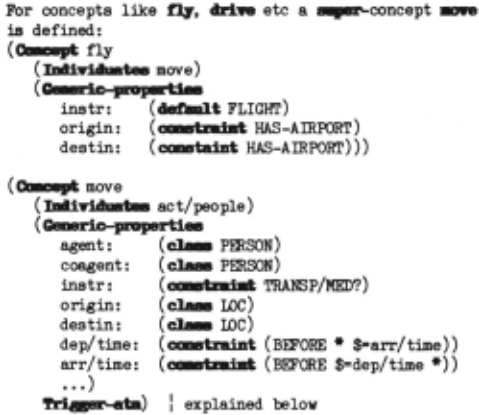
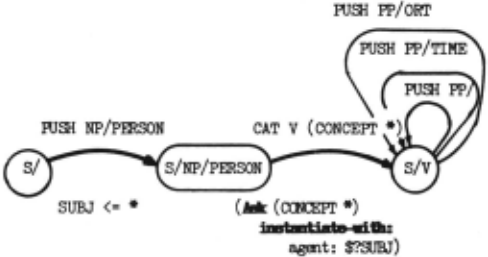
Parsing leads to instantiation of a concept (like ~ or dri.-.e) as a side-effect of an arc action. 'Ibis concept is a key in .,.. am activates the subATNs contained in it:
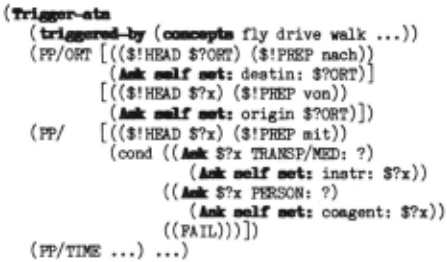
Among the many ruSH arcs from S/V (see Fig. 1 ) the subset !PP/ORT PP/TIME PP/) is preferred, expressing the expectation to associate only a restricted subset of cases, each signalled by particular syntactic constructions.
The proposed ATN-semantic net interface allows higher generality am extensibility of the semantic gralllllar because we may use ruSH arcs more freely. · 'lbere is increased work in the filtering phase ( reducable by p!ttern-compilation). 'lbe interface has been tested in a semantic gralllllar for the micro-world of soccer. In our current research we concentrate on observing the gralllllar prograllllling process in order to establish guidelines for semantic ATN design.
@inproceedings{ijcai1979p115,
  title     = {Interfacing a Semantic Net with an Augmented Transition Network},
  author    = {Laubsch, Joachim H.},
  booktitle = {Proceedings of the Sixth International Joint Conference on
               Artificial Intelligence, {IJCAI-79}},
  publisher = {International Joint Conferences on Artificial Intelligence},
  editor    = {Bruce G. Buchanan},
  year      = {1979},
  month     = {8},
  url       = {https://ijcai.org/proceedings/1979/115},
}
TY - CPAPER TI - Interfacing a Semantic Net with an Augmented Transition Network AU - Laubsch, Joachim H. T2 - Proceedings of the Sixth International Joint Conference on Artificial Intelligence, IJCAI-79 PB - International Joint Conferences on Artificial Intelligence PY - 1979 UR - https://ijcai.org/proceedings/1979/115 ER -Copied
Machine-readable versions of this paper, for tools and AI agents:
 Welcome
 Future Conferences
 AI Journal Division
 IJCAI Proceedings
 About IJCAI
 IJCAI Awards