
Deductive Methods for Large Data Bases
Proceedings of the Fifth International Joint Conference on Artificial Intelligence. Representation of Knowledge. Pages 203-208.
© 1977 International Joint Conferences on Artificial Intelligence
Abstract
The design and prototype implementation of a deductive processor for efficient extraction of implicit information from explicit data stored within a relational data-base system is described. General statements (premises or inference rules) as well as queries are expressed in a canonical form as implications. From user queries, the system constructs skeletal derivations (proof plans) through the use of a predicate connection graph, a pre-computed net structure representing possible deductive interactions among the general statements. The system incorporates techniques for rapid selection of small sets of relevant premises (by proof planning); development and elaboration of proof plans; proof plan verification; use of proof plans as a basis for determining data-base access strategies; and instantiation of plans (i.e., turning proof plans into proofs) with retrieved data-base values. Examples of the current capability of the system are illustrated.
- Davis, R., Buchanan, B. , and Shortliffe, E~ Production rules as a representation for a knowledge-based consultation program. Artificial Intelligence,~. 1977, 15-45. 2. 3. 4. 5. 6. 7. 8. 9.
- Green, C. C. Theorem Proving by resolution as a basis for question-answering systems. In Machine Intelligence 4, Meltzer, B. and Michie, D. (Eds.), Edinburgh University Press, Edinburgh, 1969, 183-205.
- Kellogg, C. H., Burger, J., Diller, T., and Fogt, K. The CONVERSE natural language data management system: current status and plans. Proceedings of the Symposium on Information Storage and Retrieval, ACM, New York, 1971, 33-46.
- Kellogg, C., Klahr, P., and Travis, L. A deductive capability for data management. In Systems for Large Data Bases, Lockemann, P. C. and Neuhold, E. J . (Eds.), North Holland, Amsterdam, 1976, 181-196.
- Klahr, P. The Deductive Pathfinder: creating derivation plans for inferential question- answering. Ph.D. Dissertation, Computer Science Department, University of Wisconsin, Madison, December 1975.
- Klahr, ~ Planning techniques for rule selec- tion in deductive question-answering. In Pattern-Directed Inference Systems, Waterman, D. and Hayes-Roth, F. (Eds.), Academic Press, New York, 1977.
- Kowalski, R. tion graphs. 572-595.
- A proof procedure using connec- Journal of the ACM, 22, 1975,
- McSkimin, J. R. The use of semantic informa- tion in deductive question-answering systems. TR-465, University of Maryland, College Park, 1976.
- Minker, J., Fishman, D. H., and McSkimin, J. R. The Q* Algorithm--a search strategy for a deductive question-answering system. Artifi- cial Intellioence, i. 1973, 225-243. IJCAI
- ------- Robinson, J. A. A machine-oriented logic based on the resolution principle. Journal of the ACM, ~. 1965, 23-41. Knowlerl~e Repr.-1: Kello~g
- Schwarcz, R. M., Burger, J. F., and Simmons, R. F. A deductive question-answerer for natural language inference, Communications of the ACM, }l, 1970, 167-183 .
- Shostak, R. F. Refutation Graphs. Artificial Intelligence,], 1976, 51-64.
- Sickel, S. A search technique for clause interconnectivity graphs. IEEE Transaction on Computers, C-25, 1976, 823-835.
- Simmons, R. F. Answering English questions by computer: a survey. Communications of the ACM, ~. 1965, 53-69.
- Simmons, R. F. Natural language question- answering systems: 1969 . Communications of the ACM, }l, 1970, 15-30.
- Shortliffe, E. H. Computer-Based Medical Con- sultations: MYCIN. American Elsevier, New York, 1976
- Travis, L., Kellogg, C., and Klahr, P., Inferential question-answering: extending CONVERSE. SP-3679, System Development Corporation, Santa Monica, Calif., 1973.
- Winograd, T. Understanding Natural Language. Academic Press, New York, 1972.
- Zadeh, L. A. Fuzzy sets. Information and Control,~. 1965, 338-353.
References were extracted automatically from the PDF and may contain errors.
Full text extracted automatically from the PDF; figures, tables and equations may differ. The PDF is the version of record.
DEDUCTIVE METHODS FOR LARGE DATA BASES
Charles Kellogg, System Development Corporation, Santa f1oni ca, Ca 1 if. Philip Klahr, System Development Corporation, Santa Monica, Calif. Larry Travis, University of Wisconsin, fladison, Wisconsin
ABSTRACT
The design and prototype implementation of a deductive processor for efficient extraction of implicit information from explicit data stored within a relational data-base system is described. General statements (premises or inference rules) as well as queries are expressed in a canonical form as implications. From user queries, the system constructs skeletal derivations (proof plans) through the use of a predicate connection graph, a pre-computed net structure representing possible deductive interactions among the general statements. The system incorporates techniques for rapid selection of small sets of relevant premises (by proof planning); development and elaboration of proof plans; proof plan verifica tion; use of proof plans as a basis for deter mining data-base access strategies; and instantia tion of plans (i.e., turning proof plans into proofs) with retrieved data-base values. Examples of the current capability of the system are illustrated.
INTRODUCTION
The deductive processor (DP) described in this paper has been designed to interface with existing and emerging relational data management systems (RDMSs). Given this orientation, we have made a sharp distinction between specific facts (n-tuples) which reside in an ROMS data base and general statements (rule-based knowledge or premises) that are directly accessible to the DP. Sine~ the number of general · statements that may be requ1red for a practical application is likely to be large (perhaps hundreds to thousands of premises), particular attention has been paid to the development of techniques for the rapid selection of relatively small sets of premises relevant to answering a user's specific request. Premise-selection techniques are automatically invoked when deductive support is necessary to respond to a user's request; otherwise, queries
"fall through" the DP and directly drive the ROMS.
This "deductive inference by exception" principle suggests that the DP be viewed as an add on or enhancement to existing data-base searching capabilities4. Such an enhancement can result in a major increase in the power of a data manage ment system by providing a means for extracting and deriving implicit information from data bases of explicit facts. Further, as we shall see, the DP can aid a user in evaluating the utility and/or plausib.il ity of an inferentially obtained answer by displaying the evidence on which the answer is based.
We briefly review some of the relevant workin the field of deductive question answering, outline our approach, describe the several components of our prototype DP, and illustrate by means of two examples the current operation of the system.
APPROACH
Previous approaches to adding deductive capa bilities to data management have occurred primarily in the develQpment of question-answering systems (Simmons14,lo reviews many of these). The primary deductive methods that have been used are set inclusion logic, e.a., CONVERSE3 and SYNTHExll . technique~ based on ~ ~he "resolution" principleiO, e:g., QA3 and MRP~~; procedural-oriented deduc tlon, e.g., SHRDLU ; and goal-oriented backward chaining, e.g., MYCIN16.
The primary difference between these systems and our DP is in our use of planning. Our system creates deduction plans to guide the generation of full deductions. We believe such planning to be essential for cutting through the massive number of dead ends and irrelevant inferences which have impaired the performance of earlier systems. Planning becomes even more important for systems involving large numbers of premises. Selection of a manageably small set of possibly relevant premises can be based on such planning.
To this end we have designed and implemented a deductive processor that first builds deriva tion skeletons which represent possible deduction plans. Once such plans are generated, the system will attempt to instantiate and verify the plans (examine substitutions for variables in premises). We have thus separated the premise-selection process from the process of verifying the consis tency of variable substitutions.
The generation of derivation (proof) plans is centered around middle-term chaining6. This process finds implication chains from assumptions to goals through the premises. Middle-term chaining combines the processes of forward chaining from the assump tions in a query and backward chaining from the goals in a query. (In the case of no query assumptions, middle-term chaining defaults to back ward chaining.) As chaining proceeds in the two directions, intersections are performed on the derived sets. When a non-empty intersection occurs, the system has found an implication chain from an assumption to a goal. The resulting chain is passed on to the proof plan generator, which extracts the premises whose occurrences are involved in the chain. Subproblems may result, requiring further deduction or data-base search. The examples presented below will illustrate these
processes.
The chaining process does not operate on the premises themselves but on a net structure called the predicate connection graph (PCG). This graph is abstracted from the premises. When a premise is introduced into the system, the implication connections existing among the predicate occur rences in the premise are encoded into the PCG. Further, the deductive interactions (i.e., unifica tionslO) between predicate occurrences in the new premise and predicate occurrences in existing premises are pre-computed and encoded into the PCG. The variable substitutions required to effect the unifications are stored elsewhere, for latter use by the proof plan verifier. Thus, the PCG contains information on the implications within premises and the deductive interactions among the premises. During the generation of middle-term chains and proof plans, the system is aware of the existence of unifications among the premises, but it does not need to generate the unifications nor does it need to examine and combine the variable substitu tions associated with the interacting unifications. The former is done by a pre-processor, while the latter is done by the verifier after proof plan ning.
Although some connection graphs used in theorem-proving systems also contain information on the unifications among general assertions (resolution clauses in these systems), they are not used as a planning tool as is the PCG. The PCG most resembles Sickel's clause interconnec tivity graphl3 in that both graphs represent the initi al deductive search space and are not changed in the course of constructing deductions. Other graph procedures7,12involve adding nodes to graphs as deductions are formed. More detail on the PCG is given in Klahr5.
REPRESENTATION OF INFORMATION
The basic representation for general asser tions (premises) is the primitive conditionall7. This form is a normalized first-order predicate calculus implication statement. The antecedent of the implication contains the assumptions (con ditions) of the assertion; the consequent contains the goals of the assertion. Conjunctions, dis junctions, and negations can occur on either side of the implication. Each assumption and goal is a predicate occurrence consisting of a predicate (relation) and its argument terms (i.e., variables, constants, or functions) .
The primitive conditional was chosen because general assertions are usually formulated in the form of "if ... ,then ... " implications. Users can easily express and understand general assertions in this form and can easily control and understand proofs involving them. Further, this form facilitates system discovery of deductive implica tion chains.
Variables and constants occurring in premises and queries may be categorized into specific domain classes. For example, a variable "x" might be specified as being a LABORATORY and the constant "Joe" as being a SCIENTIST. In attempting to match argument strings involving these terms, the system will not allow the substitution of Joe for x because they belong to different domains . . The use of such semantic information eliminates cer tain deductive interactions among the premises and thus reduce§ ghe search space of possible deductions · .
Semantic information in the form of user supplied advice can also be given to the system. Advice most typically involves recommendations on the use of particular premises or predicates in finding deductions. For advised premises, the . system will try using them whenever possible in the course of constructing a proof. For advised predicates, the system will try chaining through occurrences of them (in premises). In the case of negative advice, specified premises and predicates are avoided in proofs.
Advice may be given for a particular input query or stored in a permanent advice file which the system accesses for each query. Advice state ments are in the form of condition-recommendafion rules similar to the meta-rules used in MYCIN . The conditions contain information about predicates, constants, and domain classes that may occur in query assumptions and goals. The conditions are matched against the input query and, if they are satisfied, the associated recommendations about the use of certain premises and predicates are activated. Internally, advice is transformed into premise and predicate alert lists (as well as negative alert lists for negative advice), which are accessed in the chaining and proof-planning processes.
In addition to the information used by the deductive processor, there is also a file of specific facts used by a data management system. This latter system searches for and retrieves specific facts needed to resolve subproblems result ing from premises. For our experiments with the prototype deductive processor, we have written a small LISP relational data-base management system. Facts are stored relationally as n-tuples associa ted with a predicate (relation) name. When a particular predicate occurrence becomes a sub problem, the system has three alternative methods for resolving it; the decision is based on how the user defined the various predicates known to the system. If a predicate is defined computationally by a procedure, the procedure is executed to determine the predicate's truth value. If a predicate is specified by the user as defined primarily by its data-base values, the unresolved predicate is left for data-base search. Otherwise, an unresolved predicate occurrence is given further deductive support through the premises. (Such predicate classification is currently mutually exclusive but need not be. An alternative control structure could try several methods for resolving each subgoal.) The examples below will show the interface between the deductive processor and the data management system, as well as examples of procedurally defined predicates.
Predicate Occurrence Array: Each entry represents a predicate occurrence and contains the following information about the occurrence: its predicate name (index into predicate array), the premise in which it occurs (index into premise array), the sign of the occurrence {positive or negative), whether the occurrence is in an ante cedent or consequent of a primitive conditional, the main connective governing the occurrence (i.e., conjunction or disjunction~ and the numerical position of the occurrence within the premise. The information is compactly stored in a single one-word bit vector.
Arguments Array: The argument strings of the predicate occurrences are stored in this array in a one-to-one correspondence to the positions of the occurrences in the predicate occurrence array.
Links Array: Deductive dependencies within premises are stored in this array. Basically, these dependencies derive from implication connec tions among predicate occurrences within premises (Klahr5). This array is also indexed by occurrence integers. For each occurrence, a list of the occurrences it implies is stored in the entry corresponding to the occurrence's index.
Unifications Array: Each entry contains a list of the unifications (deductive interactions) associated with the given occurrence. The unifi cations array and the links array comprise the predicate connection graph.
Variable-Substitutions Array: The substitution lists association with unifications are stored in
SYSTEM COMPONENTS
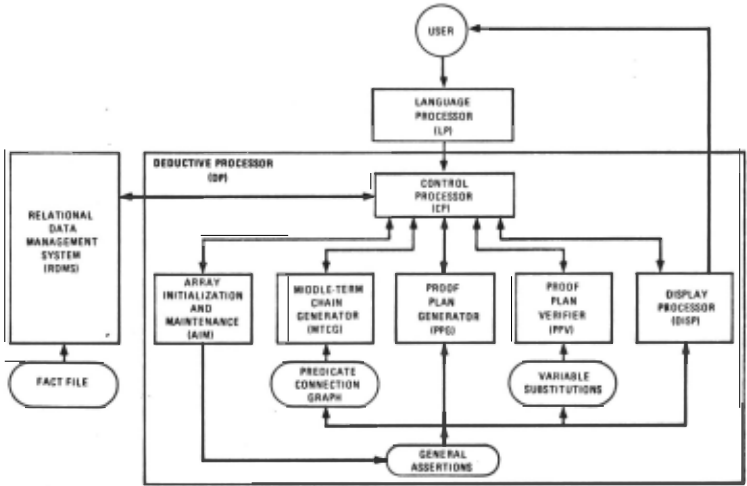
Figure 1 displays the various components of the deductive processor as well as its position in a deductive data management system. The language processor is currently not a part of our initial prototype environment but will be incor porated at a later date. The control processor shown in Figure 1 currently accepts premises and queries in primitive conditional form as well as user advice and commands. It accesses and coordi nates the several system components described below.
Array Initialization and Maintenance
Information abstracted from the premises is segmented into seven internal arrays. This segmen tation contributes to good system structuring and increases processing efficiency. Each predicate occurrence is assigned a unique integer index. In formation about a particular predicate occurrence is obtained from the array containing the kind of information needed by indexing into the array with the integer associated with the occurrence. The seven arrays are:
Premise Arra~: Each entry represents a premise and conta1ns a list of the occurrences (i.e., occurrence indices) in the premise, the plausibility of the premise, and the premise itself, both symbolic {primitive conditional form) and English, for purposes of display.
Predicate Array: This array contains the relations known to the system. Associated with each relation is its support indicator, i.e., the method used to resolve the relation when it occurs as a subgoal (deduce, search data base, compute).
a one-to-one correspondence to the position of the unifications in the unifications array.
Middle-Term Chain Generator
Each input query is broken down (based on the logical connectives in the query) into sets of assumptions (from query antecedents) and goals (from query consequents). The predicate connec tion graph is used to find deductive implication chains between assumptions and goals. "Wave fronts" are expanded out of assumptions and out of goals until an intersection is found, at which point .the middle-term chain is identified and extracted.
Proof Plan Generator
For each middle-term chain generated, the system extracts the premises whose occurrences are part of the chain. Any subgoals resulting from the premises are set up as requiring deductive support through the premises, data-base search, or procedural computation. Subgoals are added to a proof proposal tree, which contains proof plans as they are being formed and developed. Proof plans having no remaining deduce subgoals are then passed on to the verifier.
Proof Plan Verifier
The variable substitutions required by the unifications in a proof plan are examined for con sistency. If there are no clashes, i.e., no variable taking on more than one distinct constant value, then verification is successful. If there are any remaining subgoals requiring data-base support, the data management system is called to search the file of specific facts.
Display Processor
The user has a wide variety of display options available to monitor the operation of the deductive system. In particular, he can examine middle termchains generated, proof plans formed, subgoals, proof plan verification, data-base search requests, data-base values returned, answers, completed proofs, and premises used in proofs.
COMPUTER EXAMPLES
In Figures 2 and 3 we illustrate examples of the current operation of our initial DP prototype interfaced to a sma 11 ROMS. (Both DP and ROMS are written in LISP 1.5 and operate on an IBM 370/158
computer.)
In the first example, we illustrate the generation of short inference and search/compute plans for the question, "What ships are closer to the Kittyhawk's home port than the Kittyhawk is?" The query is first shown in English and then in the primitive conditional symbolic form that our prototype currently recognizes. The query is expressed in terms of a conjunctive goal composed of the predicates CLOSER-THAN and HOME-PORT. Constants (e.g., Kittyhawk) are specified by being enclosed in parentheses, while variables (e.g., x andy) are not. One of the query goals (HOME-PORT) is to be given data-base support, i.e., it .has been characterized as defined by data-base ·values, while the other goal (CLOSER-THAN) is to be deduced. Since the antecedent in the query is empty, middle-term chaining defaults to backward chaining. The system back-chains from CLOSER-THAN through premise 29. The plausibility (sim)lar to certainty factors in MYCIN1°) of the plan 1n th1s case is simply the plausibil1ty of the single premise used. Premise plausibilities range from 1 to 99 and are set by the user.
Two new search requests (in addition to HOME PORT) result from premise 29, as well as a compute relation containing functional arguments. Computa tions for the functions and the relation are delayed until values for the variables x and y have been found in the data base (i.e., values which satisfy the search requests).
The system sends the three search requests to the ROMS, which finds two ships, the Forrestal and the Gridley, that are closer to the Kittyhawk's home port (San Diego) than the Kittyhawk is. The system then displays the proof that led to the first answer (the Forrestal). A proof using the other answer would be identical to this one except that Gridley would replace Forrestal in the proof, and the distance between the Gridley and San Diego would replace 310 (the distance between the Forrestal and San Diego). The symbols G2, G3, etc., represent nodes in the proof proposal tree and are used here for reference. G2 and G3 represent the original goals as also shown in the inference plan. G5, G6, and G7 are subgoals that resulted from premise 29, which was used to deduce G2. Thus, these three subgoals are indented below G2.
The middle-term-chaining and proof-planning processes are more evident in the example in Figure 3. The input query contains two assumptions (DAMAGED and DESTINATION) and one goal (TRANSPORT). Taurus and NY are constants; Cargo and x are variables. The query asks the system to find values for x that satisfy the query. The variable x is restricted to range over ships. (This is an example of a domain class specification for a variable. Such domain specifications could also have been used in the previous example.) In the course of developing deductions, the system will not allow values to be substituted for x that belong to
domain classes other than ships.
The inference plan shown in Figure 3 has al ready been verified. To see the planning mechanism more clearly, we will refer to Figure 4. The first middle-term chain generated connects the DESTINATION assumption to the TRANSPORT goal via premise 23. This is shown by the unifications u 1 and u in Figure 4. The predicate occurrences invol~ing the relations AVAILABLE and OFFLOAD become subproblems. The former is to be given data-base support; the latter is deduced by a middle-term chain from the DAMAGED assumption through premises 7 and 15. The chain is shown in
Figure 4 by the unifications u 3 ,u 4 , and u 5 . The two new subproblems are to be given data-base support. Thus the plan generated uses three premises and contains three subproblems requiring data-base search. The plausibility of the plan is currently calculated by a fuzzy intersection (the minimum of the plausibilities of the premises -~ involvedl9).
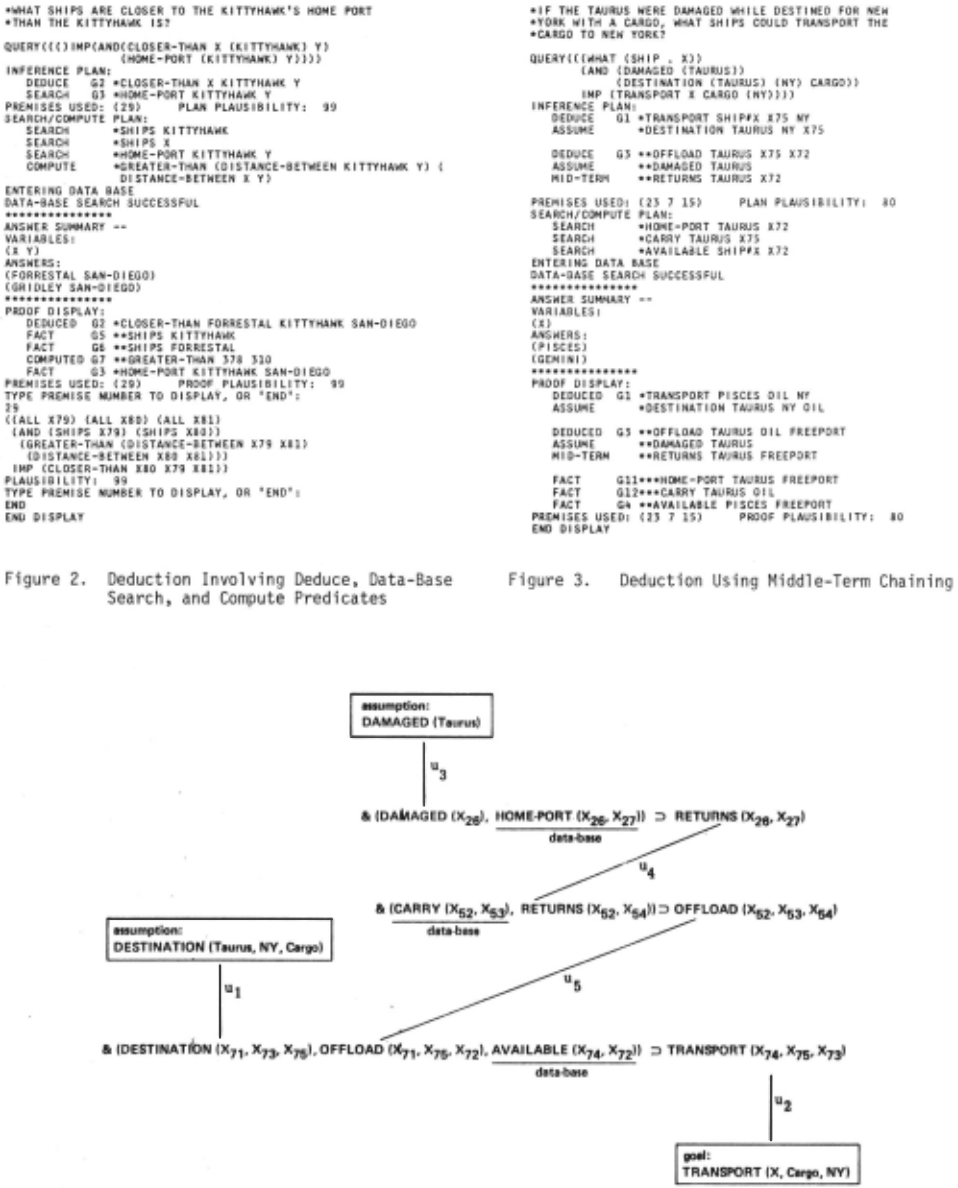
The plan is then verified with variable sub stitutions inserted in the plan and in the search requests (Figure 3). Note the variable con straints in the search requests. The variable x 72 represents the home port of Taurus; values found for this variable must be the same as those found for x 7 in the AVAILABLE search request. The proof 6isplay is given for the first answer found (the Pisces) .
In Figure 4 we note that the unifications u and u 5 were computed when these premises were 4 first entered into the system and stored in the PCG . Also stored in the PCG were the implication connections within the premises, e.g., between DAMAGED and RETURNS, between RETURNS and OFFLOAD, and between DESTINATION and TRANSPORT. The unifications u 1 , u 1 , and u 2 were computed after query input (b~cause they ,nvolve predicate occurrences in the query) and serve to locate possi ble middle-term-chain end po ints. Once these end points were identified, only the PCG was used for middle-term chaining.
SUMMARY AND FUTURE PLANS
We have described a deductive system specifi cally designed to provide inferential capability for a data management system. From a set of general assertions, the system generates skeletal deriva tions or proof plans in response to given input queries. These plans are then used to trigger data-base search requests for the specific facts needed to instantiate and thus complete proof plans, turning them into proofs and answers. General information is thus used to guide and direct the proof-planning process and to identify subproblems that may be resolved by data-base search or by computation. (Or subproblems may be left open in the display of incomplete proof plans to the user, thus identifying information which cannot be found within the system but which the user may be able to supply from without.)
We are currently expanding the prototype along several different dimensions in line with our goal of eventually incorporating the deductive processor into an operational data management sys tem and language processor environment. A number of improvements in man-machine interaction and user displays are being made in order to allow users to have more direct and flexible control of the proof-plan-generation and data-base-search processes. Additional semantic constraints on the generation of plans will be introduced through the use of a semantic net to further restrict the range of variables, as well as through extensions to the existing semantic-advice condition-recom mendation formalism. Work in these two critical areas of improved user and semantic control of deductive processes is being supplemented by additional investigations into the encoding and integration of incomplete and plausible knowledge.
ACKNOWLEDGEMENTS
The research reported here has been supported by the Advanced Research Projects Agency of the Department of Defense and is monitored by the Office of Naval Research under Contract N00014-76-C-0885.
@inproceedings{ijcai1977p44,
  title     = {Deductive Methods for Large Data Bases},
  author    = {Kellogg, Charles and Klahr, Philip and Travis, Larry},
  booktitle = {Proceedings of the Fifth International Joint Conference on
               Artificial Intelligence, {IJCAI-77}},
  publisher = {International Joint Conferences on Artificial Intelligence},
  editor    = {Raj Reddy},
  pages     = {203--208},
  year      = {1977},
  note      = {Representation of Knowledge},
  url       = {https://ijcai.org/proceedings/1977/44},
}
TY - CPAPER TI - Deductive Methods for Large Data Bases AU - Kellogg, Charles AU - Klahr, Philip AU - Travis, Larry T2 - Proceedings of the Fifth International Joint Conference on Artificial Intelligence, IJCAI-77 PB - International Joint Conferences on Artificial Intelligence PY - 1977 SP - 203 EP - 208 UR - https://ijcai.org/proceedings/1977/44 ER -Copied
Machine-readable versions of this paper, for tools and AI agents:
 Welcome
 Future Conferences
 AI Journal Division
 IJCAI Proceedings
 About IJCAI
 IJCAI Awards