
Language Access to Distributed Data with Error Recovery
Proceedings of the Fifth International Joint Conference on Artificial Intelligence. Representation of Knowledge. Pages 196-201.
© 1977 International Joint Conferences on Artificial Intelligence
Abstract
This paper discusses an effort in the application of artificial intelligence to the access of dat a from a large, distribut ed data base over a com puter network. A running system is described that provides real - time access over the ARPANET to a data base distributed over several ma c hines. The system accepts a rather wide range of natural l anguage questions a bout the data, plans a sequence of appropriate queries to the data base management system to ans wer the questi o n, determines on which machine(s) to carry out the qu erie s, establishes links to those machines over the ARPANET, monitors the pros ec ution of the queri es and recovers from ce rtain errors in execution, and prepares a relevant a nswer. In addition to the components that make up the demonstration system, more sophisticated functionally equivalent co mpon e nts are discussed and proposed.
- J. Farrell, "The Da tacomputer -A Network Data Utility," Proc. Berkeltl Workshop on Distributed Data Management and Computer Networks, Berkeley, Ca., pp. 352-364 (May 1976) 0
- Computer Corporation of America, "Datacomputer Version 1 User Manual," CCA, Cambridge , Mass. (August 1975) .
- W. Tei telman, "INTER LISP Reference Manual," Xerox PARC, Palo Alto, Ca. (December 1975).
- G. G. Hendrix, "Human Engineering for Applied Natural Language Processing," ~ 2:h ~ Cambridge, Mass. (August 1977). IJCAI
- W. A. Woods, "Transition Network Grammars for Natural Language Analysis," CACM, Vol . 13 , No. 10, pp. 591-606 (October 1970).
- J . S. Brown and R. R. Burton, "Multiple Representations of Knowledge for Tutorial Reasoning," pp. 311-349, D. G. Bobrow and A. Collins, eds., Representation and Understanding (Academic Press, New York, 1975).
- R. R. Burton , "Semantic Grammar: An Engineering Technique for Constructing Natural Language Understanding Systems," BBN Report No. 3453, Boston, Mass. (December 1976).
- D. Waltz, "Natural Language Access to a Large Data Base an Engineering Approach," Proc. 4th IJCAI, Tbilisi, USSR, pp. 868 •• 872 (September 1975) . IJCAI
- E.F. Codd . "A Relational Model of Data for Large Shared Data Banks." CACM, Vol. 13 No. 6, pp. 377-397 (June 1970).
- D. Sagalowicz, "IDA: An Intelligent Data Access Program," submitted to 3rd VLDB Conference, Tokyo, Japan (October 1977) .
- M. Minsky, "A Framework for Representing Knowledge," Artificial Intelligence Memo No. 306 , MIT, Cambridge, Mass. (June 1974).
- K. Furukawa, "A Deductive Question Answering System on Relational Data Bases," Proc . .5ih IJCAI, Cambridge, Mass. (August 1977). IJCAI
- B. M. Wilber, "A QLISP Reference Manual , " Artificial Intelligence Center Technical Note No. 118, Stanford Research Institute, Menlo Park, Ca. (March 1976).
- P. Morris and D. Sagalowicz, "Managing Network Access to a Distributed Data Base," Proc. Second Berkeley Workshop on Distributed Data Management~ Computer Networks, Berkeley, Ca. (May 1977).
- D. G. Bobrow and B. Wegbreit, "A Model for Control Structures for Artificial Intelligence Programming Languages," Proc. 3.!:Q. IJCAI, Stanford, Ca., pp. 246-253 (August 1973). IJCAI
- D. Walker et al., "An Overview of Speech Understanding Research at SRI . " Proc. 5i!1 IJCAI, Cambridge, Mass. (August 1977) .
- CODASYL Data Base Task Group, April 1311 Report (ACM, New York, 1971). KnnwlerlRP Repr.-1: Sacprrlotl
References were extracted automatically from the PDF and may contain errors.
Full text extracted automatically from the PDF; figures, tables and equations may differ. The PDF is the version of record.
Language Access to Distributed Data with Error Recovery
Earl D. Sacerdoti Artificial Intelligence Center Stanford Research Institute
This paper discusses an effort in the application of artificial intelligence to the access of data from a large, distributed data base over a computer network. A running system is described that provides real - time access over the ARPANET to a data base distributed over several machines. The system accepts a rather wide range of natural l anguage questions about the data, plans a sequence of appropriate queries to the data base management system to answer the question, determines on which machine(s) to carry out the queries, establishes links to those machines over the ARPANET, monitors the prosecution of the queries and recovers from certain errors in execution, and prepares a relevant answer. In addition to the components that make up the demonstration system, more sophisticated functionally equivalent components are discussed and proposed.
The work described in this paper represents the joint efforts of an integrated, energetic group at SRI. Members of this group include Rich Fikes (now at Xerox PARC) , Koichi Furukawa (now ~ t ETL) , Gary Hendrix, Paul Morris (now at UC Irvine) , Nils Nilsson, Bill Paxton, Jane Robinson , Danie l Sagalowicz, Jonathan Slocum, and Mike Wilber. The research reported herein, other than the development of the LIFER system, was supported by the Advanced Research Projects Agency of the Department of Defense under contract DAAG29-76-C-001 2 with the U. S. Army Research Office.
A. Introduction
Man's use of tools shapes his environment. Man's use of tools also shapes his behavior. As technology evolves more complex tools, the impositions these tools make on their users become more stringent. Although it is difficult to reproduce strings of ten digits, we learn to do it well, because the interface to the telephone system demands it. Although it is difficult to type very fast (the standard keyboard was originally designed to allow enough time between keystrokes to keep early typewriters from jamming), we train ourselves to us e a suboptimal - -indeed, subaverage-- arrangement of keys, because the interface to keyboard systems demands it.
As the amount of information moving across the man-machine interface increases, the impositions of machines on our behavior also increase. Since computers exchange large amounts of information with their human users they place great impositions on us. A goal of research in Artifical Intelligence is to reduce the extent of these impositions, thus making the benefits of computer use more widely available.
One example of the imposition set by the computer arises in the area of management information systems . Imagine that a user in a decision-making role knows that his data base contains some information that pertains to a decision he must make. The user wishes to extract that information from the data base and restructure, summarize, or analyze it in some way. Ideally, the user would be able to interact with the computer in his own terminology and issue a request for the information he desired. But today's computer systems typically require following a very stilted, formal mode of interaction. Even then, the user will only be able to obtain certain preprogrammed reports, and this is hardly what is needed for the typical decision maker in his role of managing by exception.
If the decision maker wants a new perspective on the information in the data base, he must call in a programmer who works with the data base on a regular basis·. The programmer carries in his head four kinds of knowledge that must be used in order to gather the desired information. First, he knows how to translate the request for information from the decision maker's terms into the terms of the data that is actually stored in the data base. Second, he is able to convert the request for data from the overall data base into a series of requests for particular items of data from particular files. Third, he knows how to translate the particular requests into programs or calls on the data base management system's primitives in order to actually initiate the appropriate computation. Fourth, he knows how to monitor the execution of his request to ensure that the expected data is being obtained.
For the past year, a group at SRI has been working on automating the activities carried out by our hypothetical data base expert. The following section presents an overview of a running system that performs at least some of the expert's functions both reliably and efficiently. Our current progress on representing and using each of the four kinds of knowledge described above will be detailed in the subsequent sections.
B. Overview of the LADDER m!&m.
Our running demonstration system, called LADDER (for Language Access to Distributed Data with Error Recovery) represents an application of state-of-the-art techniques from the field of artificial intelligence in a real-time performance system. Because it consists of a number of rather independent, modular components, new capabilities can be incorporated easily as we learn how to make them run efficiently.
LADDER has been developed as a management aid to Navy decision makers, so the examples presented throughout this paper are drawn from the domain of Navy command and control. Applications of this work to other decision making and data access problems should be obvious.
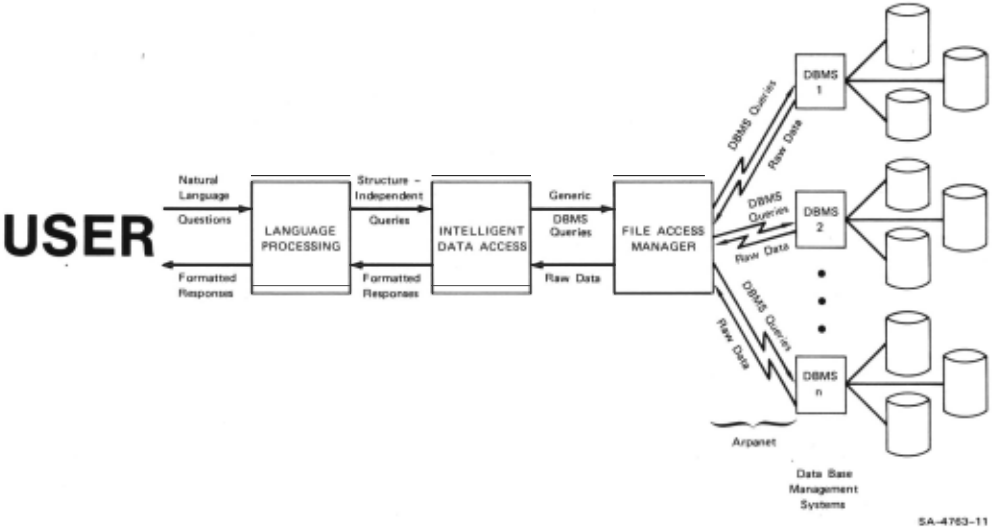
The LADDER system consists of three major functional components, as displayed in Figure 1, that provide levels of buffering of the user from a dat~ base management system (DBMS). LADDER employs the DBMS to retrieve specific field values from specific files just as a programmer might , so that the user of LADDER need not be aw~re of the names of specific fields, how they are formatted, how they are structured into files, or even where the files are physically located. Thus the user can think he is retrieving information from a "general information base" rather than retrieving specific items of data from a highly formatted traditional data base LADDER's first component accepts queries in a restricted subset of natural language. This component , called INLAND (for Informal Natural Language Access to Navy Data) produces a query or queries. to the data base as a whole . The queries to the data base refer to specific fields, but make no mention of how the information in the data base is broken down into files.
For example , suppose a user types in "What is the length of the Kennedy?" (or "Give me the Kennedy's length" or even "Type length Kennedy"). INLAND would translate this into the query:
((? LGH) (NAM EQ 'JOHN#F.KENNEDY')). where LGH is the name of the length field NAM the name of the ship name field, and 'JOHN#F.KENNEDY' the value of the NAM field for the record concerned with the Kennedy. This query is then passed along to the second component of the system.
The queries from INLAND to the data base are specified without any presumption about the way the data is broken up into files. The second functional component . called IDA (for Intelligent Data Access) breaks down the query against the entire data base into a sequence of queries against various files. IDA employs a model of the structure of the data base to perform this · operation, preserving the linkages among the records retrieved so that an appropriate answer to the overall query may be returned to the user
For example suppose the data base consists of a single file whose records contain the fields
( NAM CLASS LGH) .
Then, to answer the data base query issued above , IDA can simply create one file retrieval query that says, in essence, "For the ship record with NAM equal 'JOHN#F.KENNEDY', return the value of the LGH field " Suppose, however, that the data base is structured in two files, as follows:
SHIP: (NAM CLASS ... )
CLASS: (CLASSNAME LGH .. )
In this case the single query about the Kennedy's length ·must be broken into two file queries . These would say, first, "Obtain the value of the CLASS field for the SHIP record with NAM equal 'JOHN/IF. KENNEDY' . " Then , "Find the corresponding CLASS record, and return the value of the LGH field from that record." Finally, IDA would compose an answer that is relevant to the user s query (i . e. it will return NAM and LGH data , supressing the
CLASS- to-CLASSNAME link) .
In addition to planning the correct sequence of file queries . IDA must actually compose those queries in the language of the DBMS . Our current system accesses , on a number of different machines, a DBMS called the Datacomputer [1] [2] , whose input language is called Datalanguage . IDA creates the relevant Datalanguage by inserting field and file names into pre .. stored templates. However, since the data base in question is distributed over several different machines, the Datalanguage that IDA produces does not refer to specific files in specific directories on specific machines. It refers instead to generic files files containing a specific kind of record For example , the queries discussed above might refer to the SHIP file rather than file SHIP .ACTIVE in directory NAVY on machine DBMS 3. It is the function of the third major component of LADDER to find the location of the generic files and manage the access to them.·
To carry out this function the third component, called FAM (for File Access Manager) relies on a locally stored model showing where files are located throughout the distributed data base. When it receives a query expressed in generic Datalanguage, it searches its model for the primary location of the file (or files) to which it refers. It then establishes connections over the ARPANET to the appropriate computers logs in, opens the files , and transmits the Datalanguage query, amended to refer to the specific files that are being accessed. If at any time, the remote computer crashes the file becomes inaccessible, or the network connection fails , FAM can recover , and, if a backup file is mentioned in FAM's model of file locations, it can establish a connection to a backup site and retransmit the query.
The existing system, written in INTERLISP [3], can process a fairly wide range of queries against a data base consisting of some 14 files containing about 100 fields. Processing a typical question takes a very few seconds of cpu time on a DEC KA-10 computer. An annotated transcript of a session with the system is provided in the Appendix
Thus LADDER provides at least some of the functions of the hypothetical data base expert in each area of expertise mentioned in the previous section. The following sections will provide more detailed views of the demonstration programs and
ongoing research efforts in each of these areas.
C. Natural Language Interface
The task of providing access to the data base in the decision maker's terms is served by a functional component that accepts typed English text as input and produces formal queries to the IDA component as output. In order to provide truly natural access, this component must allow each user to expand the language definition with his own idiosyncratic language use.
We are developing a family of language interface components with increasing generality and true "understanding" of the input . In this section we describe our initial performance system.
· In the introduction we described four activities that our system would carry out , and here we are describing only three functional components. This is because the third activity, translating particular queries into the primitives of particular DBMS 's, is shared between IDA and FAM.
Our initial system is built around a package of programs for language definition and parsing called Language Interface Facility with Ellipsis and Recursion (LIFER) [4) LIFER consists of a parser and a set of interactive functions for specifying a language fragment oriented towards access of an existing computer system . The language is defined by what may be viewed as a set of productions of the form
meta-symbol => pattern , expression, where meta -symbol is a meta-symbol in the language, pattern is a list of meta-symbols and symbols in the language, and expression is a LISP expression whose value, when computed , is assigned as the value of the meta. symbol .
The set of productions is used by LIFER to build internal structures, called transition trees, that represent the language defined.* The transition trees are then used to parse user inputs in a top- down, left-to-right order. The response of the system to a user ·s input is simply the evaluation of the response expression associated with the top-level pattern that matches the input, together with all the subsidiary response expressions associated with meta-symbols contained in the expansion of the top-level pattern or any expansion of a higher-level meta-symbol.
The most important feature of LIFER from the point of view of developing a rich and usable . language definition is the ease with which the grammar can be updated and the consequent changes tested. The ease of altering the grammar is such that LIFER provides a facility for casual users to add paraphrases to the language definition, in English. For example the user might type DEFINE (? LENGTH KENNEDY) TO BE LIKE
* Transition trees are a simplification of Woods' augmented transition networks [5].
(WHAT IS THE LENGTH OF THE KENNEDY) .
Subsequently, the system will accept
? COMMANDER KITTY HAWK
and
? SPEED AND CURRENT POSITION SUBS WITHIN 400 MILES OF GIBRALTAR and interpret them correctly. Questions 8 through 12 in the Appendix provide further examples .
The LIFER parser has a very powerful mechanism for processing elliptical inputs, as exemplified by questions 2 and 15. Simple kinds of anaphoric reference, such as that shown in question 4 , are handled within the language definition .
The nature of the LIFER parser imposes a discipline on the developer of the language definition. For parsing to operate efficiently, the grammar must severely restrict the number of acceptable words at each point in a sentence, and the tests applied to words in the left-to-right scan must be as cheap as possible. These goals are best satisfied with a language definition that directly encodes into the syntax most of the restrictions imposed by the semantics of the domain. Rather than contain meta·-symbols like "noun phrase," the INLAND grammar is composed of entities like "ship specification," "carry-verb phrase," and "pair of positions." Questions 14 and 15 give examples of a small fragment of the INLAND grammar . This approach of producing a semantically-oriented syntax is similar to that used by Brown and Burton [6] [7] and Waltz [8].
Using LIFER's interactive language definition facilities we have developed a language definition that we believe is one of the most extensive that has been incorporated into a computer system . It accepts a wide range of queries about the information in the data base as well as queries about the definitions of data base fields and about the grammar. itself.
D Intelligent Data Access
A casual user would like to be able to access a data base as if it were an unstructured mass of information. Unfortunately, a data base is in reality a collection of files, often with very complex linkages among them . Even worse, a distributed data base may consist of different files on different machines, possibly handled by different DBMSs. An operation amounting to automatic problem solving is required to decide how to link up the files in the data base to extract and aggregate the information requested in a given query. An example of this situation is presented in question 6 in the Appendix, where a single question from the user s point of view requires four queries of three files to develop an answer.
Our initial efforts in this area have concen.tra ted on access planning for collections of data bases supporting a relational model of the data [9]. The knowledge necessary to decide how to link among relations is contained in what we call a structural schema. The structural schema contains information for each relation describing how it can be linked to other relations. In addition it contains information about each field s counterparts in other relations and certain special-case information.
We have taken two approaches to the process of : intelligent data access. The first, embodied in a program called IDA [10] uses a heuristic approach to the problem of linking among files. The structural schema is embodied in a frame-like representation [11] with individual frames defined for each field and each file. The program generates a single query at a time, examines the results, and then determines the next query to be asked. This approach can lead to suboptimal sequences of file accesses or can even fail to answer an answerable question, but it trades these shortcomings for rapid execution and straightforward extensibility.
Our second approach, embodied in a design for a program called DBAP (for Data Base Access Planner) [12], uses a formal, theorem-proving approach. The structural schema is represented as a set of axioms about the elements in the query language, the fields, and the files. These axioms are encoded as QLISP [13] procedures. The program builds a complete sequence of queries to the data base before beginning the actual interactions with it. Thus, it can plan an optimal sequence of file accesses, given a sufficiently detailed model of the data base . A partial implementation indicates that this approach is essentially an order of magnitude slower than IDA. For very large files this expenditure of planning time would undoubtedly be repaid by faster data base retrieval.
E. File Access Management
The third major component of LADDER . called FAM (for File Access Manager) [14], locates particular files within the distributed data base, establishes connections to them, and transmits to and monitors the responses from the remote computers where the files are located. FAM can recover from a range of expected types of errors by establishing links to backup files and retransmitting the failed query.
FAM accepts as input Datalanguage commands that refer not to specific files on specific machines, but to generic files , as defined in Section B. Based on a locally stored model of the distributed file system, FAM selects the appropriate specific files for the generic files mentioned in the commands. If network links to the machines where the files reside do not yet exist, they are established If the files in question are not yet open . they are opened Finally, the query, modified to refer to specific file names, is transmitted to the remote machine.
If certain types of errors occur during the prosecution of the query, FAM will attempt to recover. FAM currently handles two types of error conditions. The first is a failure of the network connection which is usually noticed by the TENEX operating system as a lack of interaction over the network for a given interval of time . In this case FAM attempts to find alternative locations for the files referenced in the query, establishes links to them, and retransmits the query. The second type of error is an explicit complaint from the Datacomputer . In practice, this usually arises when FAM's model is inaccurate, and a file that was expected to be in a particular location in fact was not. In this case, FAM updates its model and attempts to recover as before.
FAM is implemented by making strong use of the features of INTERLISP that support multiple control and access environments [3] [15]. When FAM opens a connection to a particular machine, it builds a piece of pushdown stack that contains as locally bound variables the appropriate information about that connection, and whose control environment is poised to interact with the remote machine. An interaction with a particular remote machine can thus be invoked via a generator function.
F. Directions for Further Work
As of March 1977, the LADDER system has been brought to a stage of development where it can be used with some success and enjoyment by casual users. It accepts a rather wide range of queries against a simple data base, and is quite robust. This has been achieved by making many simplifying assumptions. The language component does not understand the user's queries in any fundamental sense; rather, it reflexively invokes IDA with the appropriate arguments. The data access component assumes that all queries can be answered by joining records from various files. Both systems make strong assumptions that the user knows the kinds of information that are in the data base and is asking relevant questions. Now that an initial system has been developed and demonstrated , we can concentrate on efforts to improve its robustness . generality, and coverage of the language.
Until recently, there existed a clear trade off between building two kinds of language systems On the one hand, systems existed that ran reliably in real time but had very meagre semantic underpinnings, whose extensibility was clearly limited, and which did not truly understand inputs to them, in the sense that they did not compose an internal representation of their meanings. On the other hand there were systems that covered the language much more thoroughly, were better grounded linguistically, and developed a representation of what the inputs meant, but that could not run in real time. Even worse, there was no clear way to integrate the efforts being put into the two approaches: the underlying control structures and language defintition systems were incompatible.
After evaluating the benefits of the LIFER approach and reexamining the requirements and behavior of the more semantically based systems, we have developed a "core language system" that is capable of supporting both approaches, and of supporting . systems at intermediate positions on the tradeoff between real-time performance and linguistic grounding.
The core system accepts a wide range of styles of language definition, ranging from the semantically oriented syntax of the INLAND grammar to an ~malgam of multiple knowledge sources similar to that used by the SRI speech understanding system [16]. It accepts language definitions at intermediate points within that range as well, and it should thus constitute a vehicle for bringing more linguistically and semantically oriented styles of language processing into actual use in a staged fashion. We are developing a research plan that should enable us to simultaneously explore the issues involved in true language understanding while augmenting the power, coverage, and linguistic relevance of the demonstration system.
Our plans for data access include extensions to the input language of IDA to permit quantified queries. This will enable the system to distinguish between such queries as "What is the last reported position of each sub?" and "What is the last reported position of any sub?"
We will attempt to demonstrate the generality of our approach to data base access planning by interfacing to a distributed data base stored partially on a DBMS supporting a CODASYL-type [17] model and partially on the Datacomputer supporting a relational model.
In addition to these efforts, which we expect will improve our performance system, we are continuing to progress in our longer range research. An integrated language understanding and access planning system built around the representation of knowledge in semantic network form is being designed. The longer term efforts will benefit from the tool-building involved in the performance-oriented work. Development of the performance system is guided and prioritized by the results and problems encountered in our longer term research. The early successes of this program have provided an initial demonstration of the benefits of simultaneously pursuing lower risk research aimed at cost-effective performance and higher risk research aimed at advancing the state of the art.
@inproceedings{ijcai1977p43,
  title     = {Language Access to Distributed Data with Error Recovery},
  author    = {Sacerdoti, Earl D.},
  booktitle = {Proceedings of the Fifth International Joint Conference on
               Artificial Intelligence, {IJCAI-77}},
  publisher = {International Joint Conferences on Artificial Intelligence},
  editor    = {Raj Reddy},
  pages     = {196--201},
  year      = {1977},
  note      = {Representation of Knowledge},
  url       = {https://ijcai.org/proceedings/1977/43},
}
TY - CPAPER TI - Language Access to Distributed Data with Error Recovery AU - Sacerdoti, Earl D. T2 - Proceedings of the Fifth International Joint Conference on Artificial Intelligence, IJCAI-77 PB - International Joint Conferences on Artificial Intelligence PY - 1977 SP - 196 EP - 201 UR - https://ijcai.org/proceedings/1977/43 ER -Copied
Machine-readable versions of this paper, for tools and AI agents:
 Welcome
 Future Conferences
 AI Journal Division
 IJCAI Proceedings
 About IJCAI
 IJCAI Awards