
A Variable Capacitance Touch Sensor
Proceedings of the Fifth International Joint Conference on Artificial Intelligence. Robotics. Pages 772--1.
© 1977 International Joint Conferences on Artificial Intelligence
Abstract
Full text extracted automatically from the PDF; figures, tables and equations may differ. The PDF is the version of record.
A VARIABLE CAPACITANCE TOUCH SENSOR*
Clifford C. Geschke Coordinated Science Laboratory University of Illinois at Urbana-Champaign Urbana, Illinois 60801
Tactile feedback is useful in performing many robot manipulator tasks. This paper describes the simple touch sensor used on the robot manipulator at the Coordinated Science Laboratory. This sensor has a range of 1 to 80 ounces with a resolution of about 0.2 ounces at the low end of the scale. It is inexpensive, easy to construct, and relatively free of hysteresis, drift and fatigue. Also, the output is inherently digital, which aids in interfacing to a computer controller.
The sensor consists of a variable capacitor which controls the frequency of an oscillator. The output of the oscillator is connected to a simple 8-bit frequency counter which can be read by a computer, or fed into a D/A converter. The variable capacitor consists of two parallel plates constructed from copper clad glass-epoxy printed circuit board stock. The two plates are separated by a 3/32" thickness of plastic foam. One plate is rigidly affixed to the robot manipulator, and the other to a movable finger tip. Applying a force to the finger tip compresses the foam which reduces the distance between the plates increasing the capacitance.
The oscillator circuit is constructed from two TTL monostables and generates a train of fixed 230 nanosecond pulses separated by 300 to 550 nanoseconds, as determined by the variable capacitor. A preloaded down counter is used to count the pulses during a fixed time period. Therefore, a higher pressure (lower frequency) will result in a higher number in the counter.
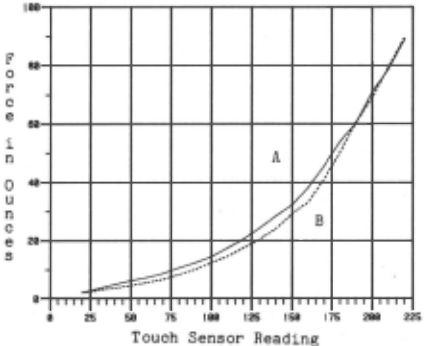
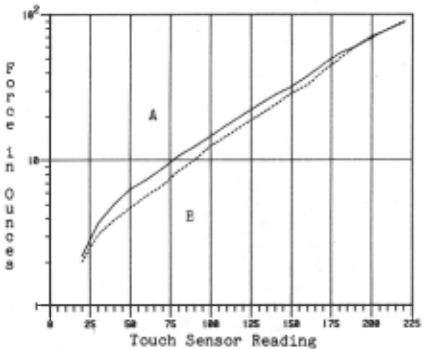
Sensor readings from 20 to 220, which correspond to from 3 to 90 ounces of force, may be read directly. However, error in the frequency counter causes successive readings to jitter by plus and minus 4 counts. By reducing this jitter with a simple digital filter, the range is extended downward to one ounce with a resolution of 0.2 ounces. Figure 1 shows a plot of force as a function of touch sensor reading. Plot A was made after the touch sensor had been idle overnight. Plot B was made after several minutes of use. The differences between these plots is due to fatigue in the plastic foam. Figure 2 shows the same data as Figure 1 except that the log of the force is plotted. The relationship between the touch sensor reading and the force applied is approximated by:
*This work was supported by the Joint Services Electronics Program (U. S. Army, U. S. Navy, and U. S. Air Force) under Contract DAAB-07-72-C-0259.
where F is the force applied and x is the touch sensor reading.
The recent advances in hybrid circuit fabrication would indicate that an array of very small capacitors might be constructed to provide a shape-sensitive touch sensor. Finding a material which acts as a compressible insulator may be a problem, but connections to an LSI oscillator/frequency counter should be straightforward.
The touch sensor is used in a software servo loop to control the closing force of the CSL robot manipulator hand. Using this device, delicate tasks such · as handling eggs and squeezin~ and releasing a plastic bottle without dropping it, are possible with very little programming effort.
@inproceedings{ijcai1977p185,
  title     = {A Variable Capacitance Touch Sensor},
  author    = {Geschke, C. C.},
  booktitle = {Proceedings of the Fifth International Joint Conference on
               Artificial Intelligence, {IJCAI-77}},
  publisher = {International Joint Conferences on Artificial Intelligence},
  editor    = {Raj Reddy},
  pages     = {772---1},
  year      = {1977},
  note      = {Robotics},
  url       = {https://ijcai.org/proceedings/1977/185},
}
TY - CPAPER TI - A Variable Capacitance Touch Sensor AU - Geschke, C. C. T2 - Proceedings of the Fifth International Joint Conference on Artificial Intelligence, IJCAI-77 PB - International Joint Conferences on Artificial Intelligence PY - 1977 SP - 772 EP - -1 UR - https://ijcai.org/proceedings/1977/185 ER -Copied
Machine-readable versions of this paper, for tools and AI agents:





