
GOALEM from Prague
Proceedings of the Fifth International Joint Conference on Artificial Intelligence. Robotics. Pages 771--1.
© 1977 International Joint Conferences on Artificial Intelligence
Abstract
Full text extracted automatically from the PDF; figures, tables and equations may differ. The PDF is the version of record.
GOALEM FROM PRAGUE
Bohuslav Kirchmann, Pavel Kopecky, Zdenek Zdrahal
CZECH TECHNICAL UNIVERSITY, DEPT. OF CONTROL
PRAGUE, CZECHOSLOVAKIA
Our purpose is to inform of the present results achieved at Czech Technical University, Department of Control in the field of robotics.
GOALEM (GOAL-oriented Electrical Manipulator) is a computer controlled electromechanical arm with 6 degrees of freedom and an autonomous vision system. Design of the arm mechanics supposes the approximate load of O.Skg. Its geometric parameters are similar to those of a human arm. D.C. motors are used to actuate each joint. Kinema tic structure and mechanical arrange ment of the arm is shown at the picture attached below. A closed-loop motion controller gets information on current state of joints trough analog position and velocity sensors. The lowest level motion control loop is partly closed through the computer and analog circuits introduce computer independent velocity· loop. In the computer memory the dyna mic model is constructed and improved during the execution of motions.
Variations of inertia moments and gravity load are taken into account. Para meter space is discretized with respect to arm configuration and the parameter values are precised during action. The whole system enables to generate . coordinated movement along the prescri bed trajectory in the working space . This control level performs transforma tion of command position and orientatbn of jaws specified in the reference frame to corresponding joint variables. A simple man - machine interface has been set for operator to help him to generate basic movements in symbolic language.
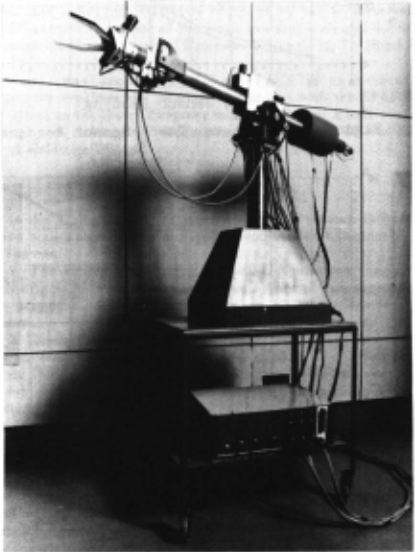
Dislocation of objects on the working floor can be specified by means of the vision system operating at the same computer. A picture scanned by the vidicon TV camera is sampled and stored in the computer memory. Maximal resolu tion of digitized picture attainsl30 x 180 points, but only 128 x 128 or 64 x 64 points are usually processed. Light intensity is divided into 16 le vels (4 bit word) . In the phase of real time processing a map of the working space is constructed on the base of these data . The map is stored in terms of coordinates of objects. Naturally, only simple bodies are considered.
The . whole development is directed to the accomplishment of assembly task. For this purpose a vision system using two TV cameras is in preparation . The above mentioned map will serve for approximate navigation of the arm's jaws and a simple plan generation. The plan prescribes only the sequence of actions and is not considered as a substantional aim. Each action will consist from two partial motions:
- ballistic motion of jaws to the position near the final one
- approach motion in a closed-loop with complete two-cameras vision system, based on non numerical information as for example:
lst camera: slightly left, fairly down 2nd camera: a little right, slightly up.
The control word is to be derived from these commands in similar form for each joint. The method should eliminate the considerable inaccuracy of the mechanical arm in fine approach manoeuvre.
@inproceedings{ijcai1977p184,
  title     = {GOALEM from Prague},
  author    = {Kirchmann, Bohuslav and Kopecky, Pavel and Zdráhal, Zdenek},
  booktitle = {Proceedings of the Fifth International Joint Conference on
               Artificial Intelligence, {IJCAI-77}},
  publisher = {International Joint Conferences on Artificial Intelligence},
  editor    = {Raj Reddy},
  pages     = {771---1},
  year      = {1977},
  note      = {Robotics},
  url       = {https://ijcai.org/proceedings/1977/184},
}
TY - CPAPER TI - GOALEM from Prague AU - Kirchmann, Bohuslav AU - Kopecky, Pavel AU - Zdráhal, Zdenek T2 - Proceedings of the Fifth International Joint Conference on Artificial Intelligence, IJCAI-77 PB - International Joint Conferences on Artificial Intelligence PY - 1977 SP - 771 EP - -1 UR - https://ijcai.org/proceedings/1977/184 ER -Copied
Machine-readable versions of this paper, for tools and AI agents:





