
A Model for Motor Control and Learning
Proceedings of the Fifth International Joint Conference on Artificial Intelligence. Robotics. Pages 761--1.
© 1977 International Joint Conferences on Artificial Intelligence
Abstract
- Albus, J.S., •A New Approach to Manipulator Control: The Cerebellar Model Articulation Controller (CMAcr. j . D:ynamic S:ystems, Measurement , and Control, trans. of AS ME, Series C, [l, 3, Sept., 1975, pp. 220-227.
- Raibert, M.H., •A State Space Model for Sensorimotor Control and Learning•. MIT Artificial Intelligence Memo No. J51, January, 1976.
- Raibert, M.H ., •control and Learning by the State Space Model: Experimental Findings•, MIT Artiftctal lntt/ltgence Memo No. 412, March, 1977.
- Tsypkln, Y.Z., Adaptation and Learning in Automatic s,stems, Translated by Nlkololc, Z.J., (Academic Press, New York, 1971).
References were extracted automatically from the PDF and may contain errors.
Full text extracted automatically from the PDF; figures, tables and equations may differ. The PDF is the version of record.
A MODEL FOR MOTOR CONTROL AND LEARNING
by Marc Raibert Artificial Intelligence Laboratory Massachusetts Institute of Technology Cambridge, Massachusetts 02139
The human motor system acquires control of each limb in the body, adapts to mechanical and sensory changes, performs coordinate transformations from visual space to motor space, and uses limbs Interchangeably In executing motor programs. It is supposed that any flexible motor control system, biological or otherwise, can be viewed In terms of high- and low-level processes which accomplish these tasks; High-level processes generate. descriptions of desired trajectories without considering the mechanical properties of any one effector system, and low level mechanisms, tailored to the kinematic and dynamic properties of a particular effector system, translate these descriptions into motor plans. I propose a controller which uses an 'internal inverse dynamic model' to perform these low-level translations for a mechanical arm [Ralbert 1976].
The translator employs a form of the equations of motion that allows a tabular representation of a manipulator's state dependent mechanical behavior. The table, actually a multi dimensional memory organized by state variables, Is supplied with data derived from the analysis of 'practice' movements. When a movement Is practiced, accelerations and actuator torques are estimated and stored In a temporary buffer until analysis can be performed. During analysis sets of acceleration estimates, made while the manipulator was near a single state, are Inverted In order to find constants of mecltanical description. This procedure Is quite simple and does not employ iterative error correction techniques, as do other learning schemes described In the literature [Albus 1975, Tsypkln 1971]. Since iterative methods are avoided problems Involving local minima are not encountered. Once the analysis is performed, the resultant mechanical constants are stored in the state-space memory in weighted combination with previously stored data.
When presented with explicit descriptions of desired trajectories, the translator uses the tabular equations of motion In conjunction with the state-space memory to produce motor plans. A controller that operates In this way should have a number of deslreable properties:
- The non-linear dynamic properties of the arm are controlled.
- The quality of control Improves with practice.
- The controller adapts to mechanical changes.
- .f. Practice generalizes between similar movements.
- . 5. Trajectories may be specified In any one of a variety of coordinate systems.
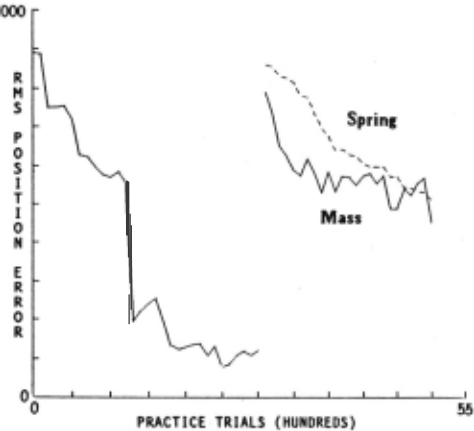
Three joints of the MIT-Schelnman arm, each powered by a DC torque motor and provided with position and velocity sensors, were used to Implement the controller and assess its properties [Ralbert 19771 Each joint Is completely backdrlvable, allowing for the type of Interactions that characterize the manipulator control problem. A PDP-11/iS was used to perform all information processing and real-time functions required by the model. To date I have demonstrated the controller's ability to acquire usable mechanical descriptions of the manipulator from practice data, to adapt to mechanical disturbances (Inertial and elastic loads), and to generalize information derived from the practice of one movement to the execution of other similar movements. (See Fig. 1.) Preliminary data also show that desired trajectories may be specified In any of a large class of coordinate systems, provided practice measurements are available in that system.
@inproceedings{ijcai1977p181,
  title     = {A Model for Motor Control and Learning},
  author    = {Raibert, Marc H.},
  booktitle = {Proceedings of the Fifth International Joint Conference on
               Artificial Intelligence, {IJCAI-77}},
  publisher = {International Joint Conferences on Artificial Intelligence},
  editor    = {Raj Reddy},
  pages     = {761---1},
  year      = {1977},
  note      = {Robotics},
  url       = {https://ijcai.org/proceedings/1977/181},
}
TY - CPAPER TI - A Model for Motor Control and Learning AU - Raibert, Marc H. T2 - Proceedings of the Fifth International Joint Conference on Artificial Intelligence, IJCAI-77 PB - International Joint Conferences on Artificial Intelligence PY - 1977 SP - 761 EP - -1 UR - https://ijcai.org/proceedings/1977/181 ER -Copied
Machine-readable versions of this paper, for tools and AI agents:
 Welcome
 Future Conferences
 AI Journal Division
 IJCAI Proceedings
 About IJCAI
 IJCAI Awards