
A General Backtrack Algorithm That Eliminates Most Redundant Tests
Proceedings of the Fifth International Joint Conference on Artificial Intelligence. Problem-solving and Search. Pages 457--1.
© 1977 International Joint Conferences on Artificial Intelligence
Abstract
- Fillmore, J., and S. Williamson, "On Backtracking: A Combinatorial Description of the Algorithm", SIAM J. Computing (3), No. 1 (March 1974), pp. 41-55.
- Knuth, D., "Estimating the Efficiency of Backtrack Programs", Mathematics of Computation (29), No. 129 (Jan. 1975), pp. 121-136.
- Swinehart, D., and B. Sproull, SAIL, Stanford AI Project Operating Note No. 57.2, January 1971.
References were extracted automatically from the PDF and may contain errors.
Full text extracted automatically from the PDF; figures, tables and equations may differ. The PDF is the version of record.
A GENERAL BACKTRACK ALGORITHM THAT ELIMINATES MOST REDUNDANT TESTS
John Gaschnig Dept. of Computer Science Carnegie-Mellon University Pittsburgh, Pa. 15213
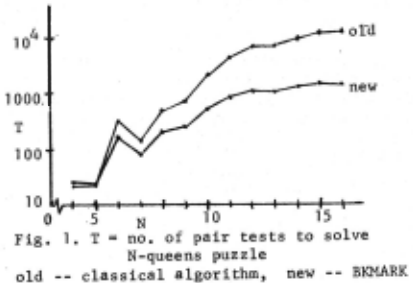
We define a faster algorithm functionally equivalent to the classical backtrack algorithm for assignment problems, of which the Eight Queens puzzle is an elementary example "[Fillmore & Williamson 1974, Knuth 1975]. Experimental · measurements (figure 1) reveal reduction by a factor of 2.5 for the 8-queens puzzle (factor of 8.7 for 16 queens) in T, the number of pair-tests performed before finding a solution (i.e., first solution). A pair-test in this case determines whether a queen on square (i 1 , j 1 ) attacks a queen on square (i2· i2>· In cpu seconds, net speedup is by a factor of 2.0 and 6.0 for 8and 16-queens, respectively. 16-queens was solved in 0.14 seconds on a PDP KL/10. The speedup can be attributed to the elimination of almost all redundant tests otherwise recomputed in many parts of the search tree, as indicated in figure 2, which shows the mean number of times, D, an arbitrary pair-test is executed. If D = 1 then all tests are distinct (no recomputatiOn). Note that each data point in the fig.ures represents the mean over 30 or 70 problem instances that differ as follows: instead of instantiating queen 3, say, on square (3,1), then on (3,2), ... , th7n (3,8), these 8 squares are ordered randomly. A problem mstance is defined by choosing a "legal squares ordering" for each queen. Random ordering generally gives a smaller value of T, on the average, than the "natural" 1,2,3, ... ,N ordering (for 20-queens, a factor of 5 00 smaller!).
The algorithm exploits an advantageous time-space tradeoff and is defined below in general form by recursive SAIL procedure BKMARK [Swinehart & Sproull 1971]. The classical backtrack algorithm is defined the same, minus the underlined portions (except that "NEW[VAR)" in line 7 is replaced by "1"). The algorithm applies to any problem having NVARS variables (8, for 8-queens), each variable xi having NVALS[i] a priori possible values (8 squares for each queen (=one row of board), except 4 for queen 1. for symmetry reasons). An assignment vector ASSIGN[1:NVARS] of values to variables is a solution iff PAIRTEST(i> ASSIGN[i], j, ASSIGN[j)) is true for all 0 < i < j < NVARS (iff no queen can take any other queen). Below, ASSIGN contains indices to the actual values. Top level invocation for 8-queens takes the form tmp +- BKMARK(l, 8, A, 8, C, D) with array dimensions D[ 1 :NVARS) and C[ 1 :NVARS, 1 :k), where k is the maximum of the B[i) values (=8 for 8-queens). Initial values of A are irrelevant· C and D values are initially 1. BKMARK returns 1, with s'olution in ASSIGN, or returns 0 if no solution exists. Define PAIRTEST for 8-queens and trace the execution (new vs. old versions) to see how it works. (Suggestion: define an array VALUES with same dimensions as MARK so that an element of VALUES encodes a board location.)' For brevity, the symbol "!" stands for "comment".
recursive integer procedure bkmark(integer var, nvars;
integer array assign, nvals, mark, new);
begin integer i, val;
boolean testflg;
far val +- 1 step 1 until nvals[var] do
if mark[var,val) geq new[var] then
begin testflg +- true;
tor i +- new[var] step 1 while i < var and testflg do testflg +- pairtest(i, assign[i), var, val);
mark[var,val) +- i - 1i
! #of successful tests;
if testflg then
! if passed all tests ... ;
begin assign[var) .... val;
if var = nvars then return( 1) ! done, so unwind;
else if bkmark(var+1, nvars, assign, nvals, mark, new)
= 1 then return( 1)
end
end;
new[var] .... var - 1; ! reset state of this var ... ; for i +- var + 1 step 1 until nvars do ! .. ~and others; if new[i] > new[var] then new[i) .... new[~ar]; return(O) ! backtrack and contmue search;
end;
@inproceedings{ijcai1977p102,
  title     = {A General Backtrack Algorithm That Eliminates Most Redundant Tests},
  author    = {Gaschnig, John},
  booktitle = {Proceedings of the Fifth International Joint Conference on
               Artificial Intelligence, {IJCAI-77}},
  publisher = {International Joint Conferences on Artificial Intelligence},
  editor    = {Raj Reddy},
  pages     = {457---1},
  year      = {1977},
  note      = {Problem-solving and Search},
  url       = {https://ijcai.org/proceedings/1977/102},
}
TY - CPAPER TI - A General Backtrack Algorithm That Eliminates Most Redundant Tests AU - Gaschnig, John T2 - Proceedings of the Fifth International Joint Conference on Artificial Intelligence, IJCAI-77 PB - International Joint Conferences on Artificial Intelligence PY - 1977 SP - 457 EP - -1 UR - https://ijcai.org/proceedings/1977/102 ER -Copied
Machine-readable versions of this paper, for tools and AI agents:
 Welcome
 Future Conferences
 AI Journal Division
 IJCAI Proceedings
 About IJCAI
 IJCAI Awards