
On The System Of Concepts Relations And Outline Of The Natural Language System
Proceedings of the Fourth International Joint Conference on Artificial Intelligence. Natural Language Understanding. Pages 449-453.
© 1975 International Joint Conferences on Artificial Intelligence
Abstract
Systems that simulates thinking processes of a man through natural language are called natural language systems . We present here outline of a natural language system in connection with the system of concepts relations which plays important role in our system. The system of concepts relations is a set of words or short sentences connected through various basic view-points. Semantic analyses procedure using the system of concepts relations is shown by an example. We regard desire as basic cause of thinking in our system. Outline of the relation between desire system and thinking processes using natural language as a base is given in later chapters.
Full text extracted automatically from the PDF; figures, tables and equations may differ. The PDF is the version of record.
Abstract
Systems that simulates thinking processes of a man through natural language are called natural language systems . We present here outline of a natural language system in connection with the system of concepts relations which plays important role in our system. The system of concepts relations is a set of words or short sentences connected through various basic view-points.
Sho Yoshida Department of Computer Science Kyushu Institute of Technology Tobata 804 JAPAN
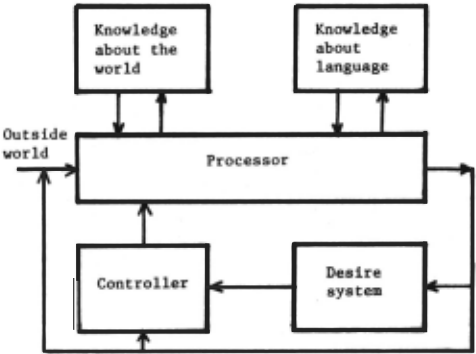
judgement about input sentences, it is necessary to consult environment concerning input sentences simultaneously from outside world. Environment including experiences from the past to the present are also needed in the system, and these are stored in the system as "knowledge about the world". In Figure 1, "knowledge about language" gives relation between language and its meanings, "desire system" starts thinking and controls the overall system.
Semantic analyses procedure using the system of concepts relations is shown by an example. We regard desire as basic cause of thinking in our system. Outline of the relation between desire system and thinking processes using natural langu age as a base is given in later chapters.
Structure of the Natural Language System
Natural language systems are the systems that simulate thinking processes of man ( processes that perceive of our world ) by describing them through natural language. We are living with thinking or behaving all the time. We behave as a result of thinking and think as a result of behav ior. What determines a man's thinking and behav ior is the existence of desires. So to speak, desires are the basic cause of all behavior of man.
Thinking and behavior are means of satisfying desires, have no meanings to be satisfied, and therefore what binds the relation between thinking and behavior internally are desires, and in order to satisfy the desires thinking is necessary as the means for realizing them. Our life is satis faction or processes of satisfying of various de sires each of us have in our mind, and as the means for satisfying these desires we inquire of thinking under the restrictions of environment.
Natural Language System
The natural language system is consisted of "world ( outside world )" given in natural language and "thinking system". The natural language system simulates thinking processes on the things about outside world using natural language as a part of meta language ( in other words, using nat ral language as a part of means for describing thinking processes ). The input to the system are given in natural language sentences ( given from outside world or generated internally from the thinking system ) and then the system thinks about these sentences, and outputs results in nat ral language sentences. In short, "outside world" i s a set of input sentences.
Structure of the Thinking system
Figure 1 shows structure of the thinking sys tem. Input sentences ( from outside world ) are infered ( generate new sentences ), judged ( give modalities ·such as 'true','false','doubtful', etc. ) while making syntactic, semantic and pragmatic analyses. In order to do such inferrence and
Behavior of the Thinking System
The thinking system in Figure 1 behaves as follows.
A) Analyze input sentences and give which are the intervals among words, which word consist "bun setsu" ( the smallest element that can be a sen tence, which is consisted by an independent word and annex words), what are the dependency rela tions among bunsetsu's in the input sentences.
These stages of analyses and the following stages of B,C,D are not independent to each other, therefore the system is only able to get possible analyses of sentences by following grammatical rules including tendencies ( or statistical rules) in this stage of analyses.
B) After guessing structures of input sentences, the system generates a set of normal form sen tences which the system can process more easily than original sentences by simplifying, formaliz ing and uniformalizing the sentences on/in which the system can handle. In short, a normal form sentence consists of a formal expression ( sen tences ) which expresses predicate and case rela tions between the predicate and the ob 'ects that original sentence intended to express; and of the formal expression of the annex words and their mean ings which intended to express modalities of the predicate. We also use normal form sentences for describing the system ( to describe "environment",
"knowledge about language" etc. ).
These two stages of A and B may be called input sentence recognizing stages.
- After generating normal form sentences ( in correct, after assuming), the system will proceed to semantic analyses of them by getting meanings of them through certain view-points. In this stage of analyses the system needs "system of con cepts relations" in the "knowledge about language" and "view-point selection signals" from the cont roller.
- Next ( in parallel with above analyses ), the system analyzes normal form sentences pragmaticaly ( analyzes relation between desires and normal form sentences ). In this stage of analyses ( thinking ) relations to desires, to environment with normal form sentences are watched and normal form sentences which express "what want to do" are generated and stacked, and control the direction of thinking. We will discuss C and D in the following chapters.
System of Concepts Relations
The system of concepts relations gives infor mation between language and their semantics, and constitutes a part of "knowledge about language" in the thinking system. If we try to describe meanings of a word by using words belonging to the same language, it becomes necessary that the sys tem of words and thei r meanings express mutual re lations among words. Though relations between words and their concepts do not make a one to one relatic»n in the strict sence , it can roughly be said that a certain concept is denoted by a word or a short phrases.
Abstract Words
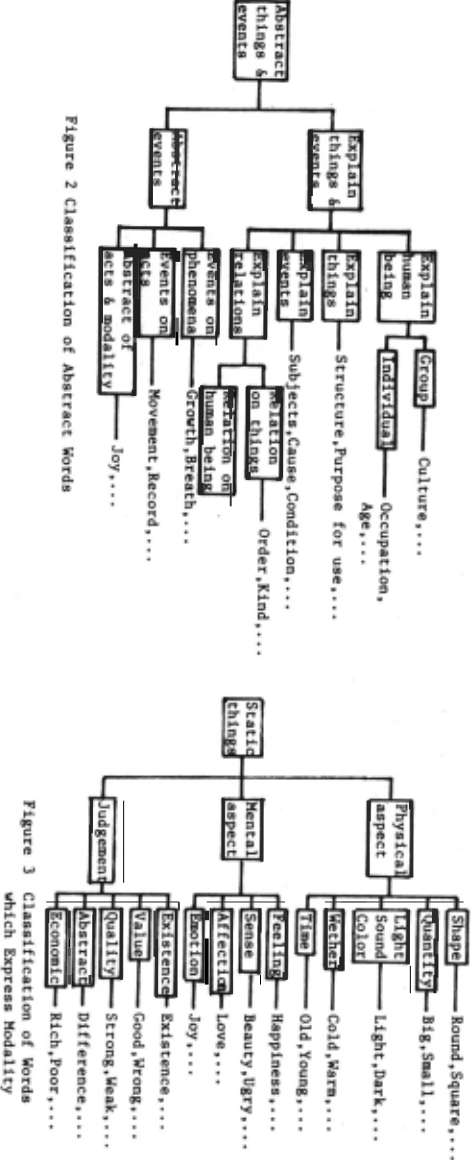
Abstract words are classified roughly as Fig ure 2. Abstract words are described in the sys tem of concepts relations from the followingstand points.
- Rough classification of abstract words through the view-point of 'kind'( or upper and lower relation) .
- In what relation with other 'things' or 'events' do they defined? In other words, what kind of sentences containing these abstrct words are hold.
Example 1. Abstract word 'subject' is classified as 'the words explaining events' . If thing or event (N) is the subject of P then the sentence 'N is the subject of P' hold. Where 'P' denotes any predicate having subject case (al most all predicates have subject case). We ex press this as follows.
< Jlcause & ef ec_l 4 · (VP)P(N(s)) Example 2. Abstract word 'thought' is classified as ' the words explaining mental behavior of human being'. It is explained as the concept that holds following sentences.
Subject~jEx{lanatio~ ~ (YP)P(_(s)P)
Thought .-.IExplana~iot -.(!IN) (Think(man(s),
N ) of
' !Cause & e fe_~~
~Know(man(s) ,N(o)) [mode of 'Know'c (desire]]
~Know(man(s)'N(o))
Words that Express Modality
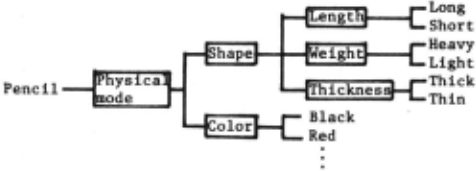
Adjectives and adverbs are classified as Figure 3 which is a tree structure. Each word belonging to this class expresses modality of things and events . When we give the mode to a given thing or event, suitable word (mode) belonging to the considering classification item is chosen from this classification tree. Figure 4 is an exsample of modalities of 'pencil'.
Verbs
Verbs are described from the following stand points.
1) In what case relation with other concepts does the verb defined?
For example, a verb 'Eat' is defined by the case relation, indicated in parenthesis, with other objects indicated by< ) , like
Eat: <man or animal) (subject of eat) ,<Pbjects that can be object to ea~ ( ~j t f t) · < ti ·' < 1 ~o ec o ea me/ (when to eat)' p a e (where to eat)' <way> (how to eat)
We call this as 'basic expression of semantics' (BES). It becomes important problem what classi fication level concepts should be used as things and objects in the BES. (See classification of con crete nouns) All verbs have case relations with time and place. Therefore, they may be omitted except when they are necessary for the verbs. Therefore, we have to obtain necessary cases for each verb, and have to given them the class of things and objects.
- ~y what cause and ~ffect relation does the verb relates to other verb ?
Eat(manfs) ,concrete objectr 0 )) 4 Deminish(con crete object(s))
Hungry(man(s) __. Eat(man(s) ,concrete object(o)) [mod~ Of 'Eat'·[destr~]]
are cause and effect relations.
Cause and effect relations are expressed like 'P ~ cause-effect _., P 2 ', and indicates the re la~ion that if objects denoted by P 1 holds then the objects denoted by P may hold. This relation is divided into sub-rela~ions such as 'before and after relation','cause and effect relation in the narrower sense','means or way','logical condition' 'synonymous relation',etc. There may be direct cause and effect relations and indirect cause and effect relations in each case.
Example:
Drink(man{s)'liquor(o))~ Intoxicate(man(s))
······ indtr~ct
Drink(man(s)'liquor(o))~ Decrease(liquor(s))
···.·· dir~ct
- Descriptive description(definition) of a verb.
An example of descriptive description is as follows.
where '*' indicates repetition. Note that all sentences appearing in this description can be found in the chain of cause and effect relations, but this description is needed in order to give description of eating behavior directly.
Concrete nouns
Concrete nouns are classified from the follow ing standpoin~.
- Classification in order to give basic words.
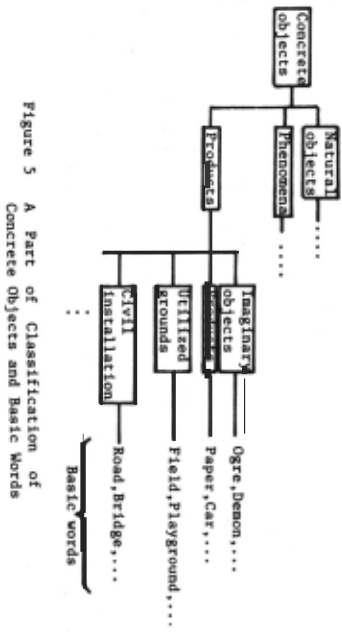
Basic words are those which are too vague if they are classified more roughly and are too fine that almost every word becomes compound word (like list-watch, color-pencil, ··· ) if they are clssified more finer. Basic words are words used in ordinary sentences. For example, a sentence 'Animal bought product.' is too vague to knowwhat kind of animals, what kind of products the animal bought. Instead, 'I bought television.' is a sentence which can be used as an ordinary sentence, though it does not say what kind of I or what kind of television.
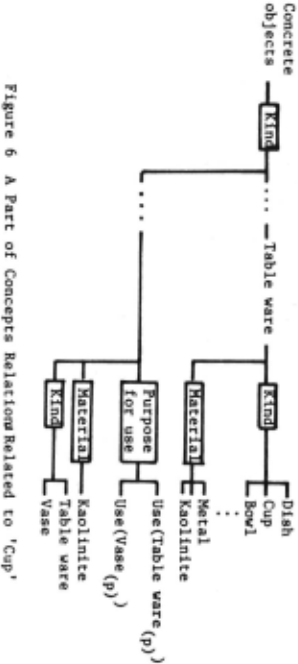
- Begining from basic words, obtain their kinds defined by basic view-points. At the same time we give words relating to basic words through basic view-points. See FigureS.
Here the problems are: 'Are there basic view pointS·?' If there are view-points, how can we fined them out? Chose a basic word W from a dictionary and select words intuitively which are related to W. Then try to find out through what view-points are they related to W. For example, let W='paper'. Then chose words related toW 'manuscript paper','pulp','write','wrap',
Between 'paper' and 'manuscript paper' we can find the view-point "purpose for use". Namely, 'manuscript paper' is a kind of 'paper' seeing through the view-point "purpose for use".
After extracting the view-point "purpose for use" we judge it whether it is acceptable as a basic view-point or not by examining it as follows.
Choose any word W'(;W) and related words, then examine whether the view-point "purpose for use" is applicable between W' and related words. Repeating this process several times choosing dif ferent W's, we know that the view-point "purpose
use" can be a basic view-point. We can obtain basic view-points for "concrete objects" by this way.
System of Concepts Relations and Semantic Analysis
Substitution Rules for 'Kinds'
When the system makes inferrence using the sys tem of concepts relations, the system must know how to refer to it. In the system of concepts relations, concepts are related through basicview points, therefore, the system must know how tomake use of them when making inferrence. For exampl~ when we infer
- "kind", we usually make this form of inferrence.
Animal is living ~ Dog is living we use following inferrence rule. V(x)(A(x)-.Live(x)) A(a) Live(a) Where A(y) means 'y is a kind of A' (A=Animal) To the basic view-point Bfrd Here the problem is:Is the inferrence rule necessary for each view point?
Let us discuss this problem in the following.
Elements Necessary for Inferrence
Drop(I(s)'cup(o))[mode of 'Drop'·[perfect]]
..···.· BES in normal form
From this sentence, we will infer 'Cup is broken' (Break(cupls\)[mode of 'Break'·[intransi tive)'be ·.· en']), And examine the process of the inferrence.
- Get the BES with respect to the verb 'Drop'.
- Drop:Wlal(s)w2a2(o)W3a3(d)W4a4(ar)
- ······.· BES of the 1st kind d·departure point, ar·arrival point 2) Drop:Concrete object(o\ ·.····· BES of the 2nd kind 3) Drop:Concrete object(o)'Abstract object(m) BES of the 2nd kind
m'"llleans
- or 2) is applicable BES to 'Drop(I(s)' cup )'. For this is obtained ftom the following fgiation 'kind'(or 'upper and lower' relation) between concepts.
I Eman eanimal Econcrete objects
cup E table ware E products €concrete objects
Drop(Ils\'cup(o)) ~ Drop(manls)'cup(o))
--.Dr~p\man ,concrete objects )
B) Next we w!ii analyze the proc~~~ of 'Drop
(man{ ),cup£ 0 )) ~ Break(cup(a))'.
f Drop(c6p(o)) ~ Break(~6p~))
- Drop(table ware(o)) ~ Break(table ware(S))
- Drop(china(o)) ~ Break(china(S))
- Drop(concrete object(o)) ~ Break(concrete object(S))
Among cause and effect relations (with respect to the verb 'Drop' ) from 1) to 4), it is no prob lem if there exist,for each word,cause and effect relation like 'cup' as 1). Though we can not expect the existence of these, they may exist in the system of concepts relations as empirical (expe rienced) facts. It is expected tha.t there exist cause and effect relation 2) in the system of con cepts relations.
Cause and effect relations 3) and 4) are proba bly in the system of concepts relations (especially 4)).
Let the cause and effect relation 3) Drop(china( )) ~ Break(china(l)) be found id 0 the system of conc~pts relations. In this case, if it is inferred that 'cup' is a kind of 'china', we can infer Drop(cup ) ··· Break(cup ) from the<~611owing inferre~g~ rule. P 1 (A) -+ P 2 (A) aEA P 1 (a) ~ P 2 (a) where P 1 (x):Drop(x(o)) P 2 (x):Break(x($)) A:china a:cup a E A means 'a is a kind of A' ·We cannot expect that 'cup' is directly related in the system of concepts relations as a kind of 'china'. Then how can we infer that 'cup' is a kind of 'china'? Let us consider a part of the system of concepts relations of Figure 6.
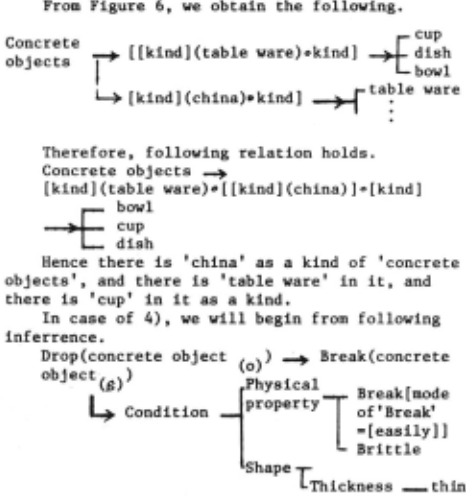
From this cause and effect relation and its conditions (to hold), it can be known that in order to break a concrete object it is necessary that it has physical property 'Breakable', or its thickness is 'thin'. Therefore, the system has to find out that 'cup' is a kind of concrete ob ject and it has physical property 'Breakable'.
From above considerations, we know that the inferrence processes use following information.
- We use 'kind','material','purpose for use', 'physical property', ··· as basic view-points, but basic view-points are used in order to make compo sition of (generate) 'detailed kinds'.
- Cause and effect relations among verbs are used.
- BES with respect to verbs are used.
- From the conditions described with the cause and effect relations and BES with respect to verbs are hold.basic view-points are chosen to make inferrence. ·
- Substitution with respect to the concepts related through the basic view-point 'kind' is used.
- Functions that generates (fined out) con cepts related to a given concepts through compo sitioned (generated) view-points are required.
Here those factors which plays important role in making inferrence as desires are neglected.
Control of View-points in the System of Concepts
Relations
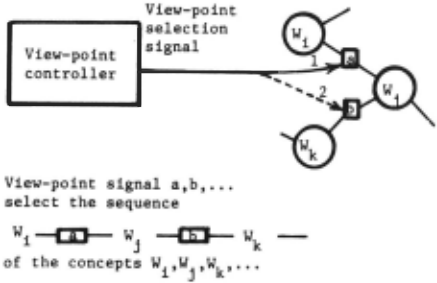
As mentioned above, the system is able to get meanings of concepts (in other words, relation to other concepts with the concept) by following the concepts related through certain view-points in the system of concepts relations. In this case the system has to select view-points in successio~
We call the system which generates these view point selection signal as 'view-point controller'. The structure of view-point controller is not clear and we expect to psychological,engineering inves tigations about the structure of view-point cont roller. Primary factors which select view-point~
namel~primary factors which controls the view point controller are as follows.
- Personal or general tendencies (acquired tendencies).
- Primary tendencies (like instincts).
- Restrictions of environment (including ex periences).
- Of these factors, restrictions of environment are given first from the 'environment' in the thinking system, and then view-points selection will be made following the factors of A and B.
Desire System as a Basic Cause of Thinking
Relation between Desires and Language
Desires give to the system basic cause of thinking 'what to think about', and the system be haves to realize the desire under restrictions of environment. We call this process thinking.
Desire realizing processes (thinking processes) for a given desire are as follows:
- Select verbs directly related to each de sire.
- Get the BES with respect to the verb. There may be several BES for each verb.
- Generate normal form sentences for each BES.
- Store the normal form BES generated for each desire to the storage which has suitable storing structures.
There may be many kind of models for storing structures. Pushdown stacking can be one of the models. Conditions to erase the stored contents should be given to the system. For example, nor mal form sentences generated in relation to the desire 'appetite' may be erased after the desire is satisfied.
Desire System and Stimulation
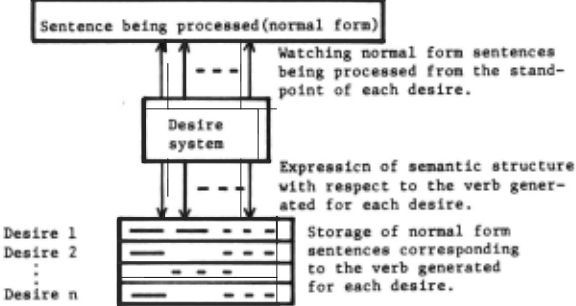
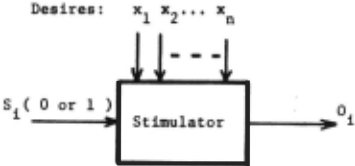
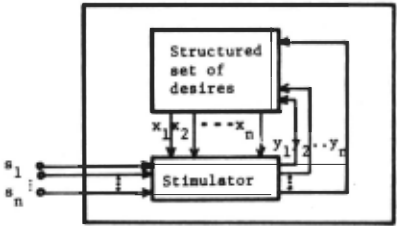
~ mentioned above, each desire is watching input sentences from its own stand-point of whether the input normal form sentences can be stimulative to the desire system . If it is judged that the input normal form sentence can give stimuli to the desire system. , then the system sends out a signal to till dtimulator. When the stimulator receives the signal, it produces output (stimulation) having certain strength and it will change states of the desire system. Strength of the stimuli is deter mined by the states of the desire system.
The procedures of semantic and pragmatic ana lysis of input sentences (given in natural langu age) given to the thinking system are as follows:
A)Generates normal form sentences from input sentences.
- Watching generated normal form sentences from the standpoint of each desire, the desire system determines whether they should produce sti mulating signal to the desire system or not.
- B-1) Analyze the normal form sentences from the standpoint of each desire.
Example:
Watch the input sentence 'run' from the standpoint of 'desire for evasion 1 · Get the following chain from the system of concepts relations.
run ~ move ~ tired ... evasion
- B-2) Such chains are stored in the system for each verb. Therefore, the system is able to know for each desire, whether the given verb satisfies the given desire or not, and hence the system is able to know whether the given verb should produce stimulating signal or not. In this example,'run' produces stimulating signal to the desire. for eva sion.
- Send out stimulating signals. Signals s 1 ,s 2 , ... ,sn in Figure 9.
- Then the stimulator works according to the input signals s 1 ,s 2 , ··. ,s and the states of struc tured set of deaires may Rhange to new states.
- Thus the states of desires are determined. With this states and normal form sentences gene rated from input sentences, the thinking system generates normal form sentences expressing 'what to do (about what does the system want to think)'.
Example:
r':'n ......, tired . · . evasion s 1 : run[mode of 'run'·[want)[mode of 'want'· [negation)))Therfore the system generates normal form sen tence s 1 , and stores it in the structured storage.
Thinking Processes
Thinking processes are the processes that starting from the given initial states of the desire system, try to realize (in this realization process semantic analyses mentioned before are needed, though we do not go into details of this process in this paper) the stated contents of the normal form sentences (indicating 'what to do') in the store getting information from the system of concepts relations, under the restrictions of en vironment. While thinking, new normal form sen tences may be generated and stored in the system and at the same time some of the stored information may be erased according to the change of states of the desire system. In these thinking processes, generated information such as input normal form sentences (for each desire), sentences expressing environment etc. should be stored in the system and the relation to each stored normal form sen tence (relation graph) have to be generated.
@inproceedings{ijcai1975p71,
  title     = {On The System Of Concepts Relations And Outline Of The Natural Language System},
  author    = {Yoshida, Sho},
  booktitle = {Proceedings of the Fourth International Joint Conference on
               Artificial Intelligence, {IJCAI-75}},
  publisher = {International Joint Conferences on Artificial Intelligence},
  editor    = {Patrick Winston and Carl Hewitt},
  pages     = {449--453},
  year      = {1975},
  note      = {Natural Language Understanding},
  url       = {https://ijcai.org/proceedings/1975/71},
}
TY - CPAPER TI - On The System Of Concepts Relations And Outline Of The Natural Language System AU - Yoshida, Sho T2 - Proceedings of the Fourth International Joint Conference on Artificial Intelligence, IJCAI-75 PB - International Joint Conferences on Artificial Intelligence PY - 1975 SP - 449 EP - 453 UR - https://ijcai.org/proceedings/1975/71 ER -Copied
Machine-readable versions of this paper, for tools and AI agents:
 Welcome
 Future Conferences
 AI Journal Division
 IJCAI Proceedings
 About IJCAI
 IJCAI Awards