
Negation And Focus in Man - Machine Communication
Proceedings of the Fourth International Joint Conference on Artificial Intelligence. Natural Language Understanding. Pages 443-447.
© 1975 International Joint Conferences on Artificial Intelligence
Abstract
A sketch of a programme for man-machine communication as being prepared by Prague linguists is presented, with a characterization of the scope of negation and of the nature of focus - two problema that appeared crucial with respect to the following issues1 (i) grammatical analysis of input texts, yielding unambiguous semantic representations (SR's) of subsequent sentences, (ii) algoritbme translating the SR's into a logical language in the form of which the information gained from the natural language input is to be stored in the computer memory, (iii) form of the SR's, i.e. the language serving, among other purposes, as the output of (i) and input of (ii). It is shown especially that the logical impact of natural language negation can be accounted for only if the topic/focus dichoto~ is duly analyzed.
- P.Garvin, Fulcrum Techniques to Semantic Analysis, Final Report, Thompson Hamo Wooldridge Inc., Canoga Park, Calif., 1963
- T.Winograd, Understanding Natural Laagua,e, Edinburgh 1972
- P.Sgall 1 E.Hajicova, and E.Benesova, Topic, Focus, and Generative Semantics, Kronberg/Ts., 1973
- u.aierwiscL, On Classifying Semantic Feat- ures, in: Semantics, eds. D.D.Stein- berg and L.A.Jakobovits, Cambridge 1971, PP• 4lo-435
- P.Kfizek, Towards a For1118l Account of the Semantics of Noun Phrases, Prague Bulletin of Mathematical Linguistics 20 1 1973, PP• 43-58
- E.Benefiova, E.Hajicova, and P.Sgall, Re- marks on Topic/Comment Articulation, Part I, Prague Bulletin of lllthemat- ical Linguistics 19 1 1973, PP• 29-58; Part II, PBML 20 1 1973 1 PP• 3-42 1 see esp. § 10.2
- E.Hajicova, P.Kriiek, and P.Sgall, A Generat- ive Approach to Semantics, in press in Linguistics Silesiana, Katowice
- P.F.Strawson, Introduction to Logical Theory, London 1952, PP• 174f.
- C.J.Fillmore, Types of Lexical Information, in1 Studies in Syntax and Semantics, ed. by F.Kiefer, Dordrecht 1969, PP• 109-137
- E.Hajicova, Some Hamarks on Presuppositions (presented at 1971 International Conference On Computational Linguist- ics, Debrecen), Prague Bulletin of Mathematical Linguistics 17 1 1972 1 PP• 11-~3
- E.Hajicova, Weaning, Presupposition, and Allegation, Philologies Pragensia 17, 1974 1 PP• 18-25
- E.liajicova, Negation and Topic vs. Comment, Philologies Pragansia 16 1 1972, PP• Bl-93
- J H.Posner, Theorie des Koamentierens, Frank- furt/m. 1972 , (esp. Chapter 2) 448
- J.M.Zemb, Lea structures logiques de la proposition allemande, Paris l9b9 Y.Bar-Hillel, Indexical Expressions, Mind 63, 1954 1 PP• 359-371
- D.Davidaon 1 The Logical Form of Action Sentences, in1 T.be Logic of Decision and Action 1 ed. N.Rescher , Pittsburg 1968 1 PP• 81-120.
References were extracted automatically from the PDF and may contain errors.
Full text extracted automatically from the PDF; figures, tables and equations may differ. The PDF is the version of record.
Abstract
A sketch of a programme for man-machine communic ation as being prepared by Prague linguists is presented, with a characterization of the scope of negation and of the nature of focus - two problema that appeared crucial with respect to the follow ing issues1 (i) grammatical analysis of input texts, yielding unambiguous semantic represent ations (SR's) of subsequent sentences, (ii) algo ritbme translating the SR's into a logical lan guage in the form of which the information gained from the natural language input is to be stored in the computer memory, (iii) form of the SR's, i.e. the language serving, among other purposes, as the output of (i) and input of (ii). It is shown especially that the logical impact of natural language negation can be accounted for only if the topic/focus dichoto~ is duly analyzed.
- A programme for man-machine communication, using a full-fledged analysis of natural language, is being prepared by linguists working at the FaNlty of Uatbsmatica and Physics, Charles Uni versity, Prague. The algorithms that are forDUlat ed are divided into the following groups:
- (i) gra.matical analysis of input texts (i.e. of Czech texts on electronics), yielding unambig uous semantic representations of subsequent sent ences (in the form of linearized dependency graphs);
- (ii) algorithms translating from the semantic representations (which still have a linguistic character) into a logicBl language, well adapted to the purposes of the theory of inference etc.; in this form the information gained from the nat ural language input is to be stored in the comput er memory (and confronted with further such inform ation, gained later from other texts);
(iii) algorithms looking for information
Petr Sgall, Eva Hajicova Center of Numerical Mathematics Charles University, Prague Czechoslovakia
needed according to questions formulated by the users in Czech and analyzed according to the algorithms of (i);
- (iv) algorithm& of the synthesis of answers (in Czech).
We want to characterize in the present paper tbs solution of two problems that appeared ~rucial for (i) and (ii), as well aa for the form of the semantic representations (sR's) of sentences (the language serving as the output of ( i) and input of (ii), amon~ other purposes).
- Linguistic considerations have led to the following form of SR's (where every A stands for a lexical unit, accompanied, possibly, by markers of ·morphological meanings" (grammatemss), such as Plural, Preterite, etc., the subscript denoting the function of the given item in the sentence: Actor, Objective, Dative, Place, Direction, etc.)l
Each of the participants, denoted here as Ax'
can, of course, itself consist in a group headed by the verb, so that a structure of the shape (1) may be embedded, under certain conditions (specif ied by a generative gralllll8r using dependency syntax) into another such structure.
The superscript ~ is attached to those ele ments that are contextually bound, i.e. included in the topic; the others constitute the comment or the focus of the sentence. The left-to-right order (with topic preceding the focus) may be regarded as a "deep" word order, corresponding to the primary word order of the surface level (combined with a neutral intonation). With a "hyperaentence" of the Ross-Sadock type an SR can be paraphrased as "I tell you about Topic that Focus", e.p:. (I tell YOU about) ~(that he) is coming. (I tell you about) reading newspaper§ (that it) cap be boring. (I tell you_abQ!!.i the fact) 1Q!!. Mabt.l Cl!l!8 xeater ~ll (that it) waa gurprising.
We consider the topic/focus dichotomy as re levant for the linguistic aspects of man-machine communication for the following reasons:
- (a) The semantic content is organized in natural language in a different way than in formal logical languages, one of the main distinctions consisting in that what is rendered, e.g. in predicate logic, by the order of quantifiers, is expressed in nat ural language (together with some other pheno mena) by the articulation of tt~ sentence into topic and focus and by the so-called scale of com municative dynamism (CD, realized, in the surface sentences, by certain features of word order and intonation, and denoted in our shape of SR 'a by the left-to-right order of participants). As the exam flea in the Appendix show, these phenomena are crucial for one of the most basic discussions in contemporary linguistics (that between Chomakian and LakoviAn wings in TG) and can be treated ade quately if the topic/focus dichotomy is duly accounted for.
- (b) An account of the dichotomy is not a mere question of linguistic theory, but has a consider able impact on applications concerning the use of computers 18 already Garvin claimed (1].
- (c) Winograd [2, p.ll6) wants to represent know ledge in an imperative form, so that not only the declarations 18 such, but also the way they are to be used should be specified. It must be noticed that in natural language (contrary to predicate logic) a declarative sentence is constructed not merely 18 an assertion, but as an instruction to the bearer what familiar (known, already fore grounded in his memory) items he should pick up and modify somehow (combining them with new proper ties, or bringing them into new relations with other items, etc.). This introduction-like charact er of a sentence underlies ita appropriateness to be used at a certain point of the discourse or text, or more broadly, in a certain situation: if we have just spoken about George, we say ~ met Paul, while having spoken about Paul, we say rather Paul wag met by George or It was George who met Paul. (In these simple examples, the two variants have identical truth conditions, but in
the general case ttds does not bold, cf. the exam ples in the Appendix.)
Our treatment of topic and focus, which fol lows, as for an empirical analysis, the tradition of Czech linguistics (relatively rich in this respect), is characterized in 110re detail in [3] , where also a critical commentary on Chomsky's rather incomplete account of focus is given; it is shown there that operative and testable criteria such as the question teat, the teat of negation, properties of enclitical pronouns in some languages can be used to determine both the scale of communic ative dynamism (which is an older but more precise formulation of what Chomsky calla "range of per missible focus") and the dichotomy of topic (Chomsky's and Jackendoff'a "presupposition") and focus (the traditional comment or rbeme).
3. Some important questions concerning SR 's can be solved only if the position of negation is well understood. It is well knowr. today that .. an ing proper must be distinguished from presupposit ions, or, more precisely, that three types of linguistic units must be distinguishedr 1 if the assertion A is logically entailed by the given SR (in a certain situation and content), tbena
- (a) the negation of the given SR (Neg-SR) logically entails Neg-A; in this case, A belongs to the I!!!Bning proper of the sentences corresponding to that SR;
- (b) Neg-SR logically entails A; here A is a presupposition;
- (c) Neg-SR logically entails neither A, nor Neg-A; in this case, A is an allegatiQn.
In such examples as (2) or (3) the entailed items (4) and (5), respectively, are allegations: they are not entailed by the negation of (2) or (3), and neither their negations are. On the other hand, if the relevant part of the sentence is contextually bound, the entailed item is presupposed; thus (6) presupposes (5), since not only (6) but also its negation entails (5). (The capital letters in the examples denote the bearer of the intonation centre.)
- ( 2) He was upset by the arrival of my FRIENDS.
- John visited countries that suffered from poor CHOPS.
- His friends CAME.
- Some countries suffered from peor CROPS.
- Countries that suffered from poor crops were visited by JOHN.
An explanation offers itself in terlllB of the scope of negation: as our investigations of negat ion },ave shown, 2 in the primary (unmarked) case, the scope of negation is specified on the left-hand side of the scale of CD by the position of the operator of negation and on the right-hand side by the end of the semantic representation of the sent ence. The operator of negation stands either im mediately before or immediately after the bound ness juncture. (We use tte term boundness juncture for the boundary between the contextually bound and the non-bound elements of the SR.) Primarily, the verb is non-bound (it predicates something about the topic), and the scope of negation extends from the boundness juncture to the end of the semantic representation (He didn't COME yesterday., cf. (7) below). What is negated here, is the relation between the bound segment (the topic) and the fo cus. In the secondary case, where the verb is con textually bound, there are two possibilities: the negation of assertion with the scope of negation from the boundness juncture to the end of the semantic representation (It wasn't YE§TERDAY t~ £!!!!!!.·, cf. ( 8) below), or the negation of predicat ion, where the scope of negation includes the verb alone (It was YES!ERDAY he Qi~'t COme ·· cf. (9); the end of the scope of negation is the boundness juncture). Thus, the following three possibilities of the placement of the operator of negation and of the scope of negation with regard to the position of the boundness juncture are accounted for in the functional generative description:
where V is understood to stand - as for the seale of communicative dynamism - after all ecntextually bound elements (with an additional specification stating that Neg precedes V if the boundness junct ure does not intervene). Notice that (7) is the primary ease, while ( 8) corresponds to the so-called "constituent negation" in surface syntax, and in
(9) only the verb is negated (which corresponds to a "lexical negation" rather than to a negation of the SR as such. An allegation is entailed only by a sentence where the eleoent determining it is not in the scope of negation (which does not necessar ily coincide with the focus), but where the element determining an allegation is not connected with a corresponding presupposition; i.e. when the determ ining element is included in the scope of negation (as e.g. countries that ··· in the negation of (3)), the corresponding statement is no longer entailed. Meaning proper (assertion) consists in the relationship between what is talked about and what is said about it: in the sentence, the speaker asserts sometl,ing (identified by the focus) about something (identified by the contextually bound segment); if the focus is negated, then the corresponding negative statement is entailed.
- Taking into account also the delimiting features (such as Definite, Indefinite, Speci fying) , the shape of an SR as given in ( 1) should be complemen~ed in the following way:
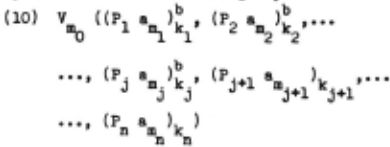
where the indices of the form mi specify lexical units, the indices of the form ki specify the "eases" (participants, syntactic functions) 3 and Pi stands for one of the operators SPEC, DEF, INDEF, EV, FEW, MANY, i.e. for delimiting features (understood here in the sense of Bierwisch ( 4) ; for a discussion cf. [ 5] ; for the purpose of our present discussion, we class here also ~ and few as delimiting features). The formula (10) re presents an SR of a sentence with a contextually non-bound verb; if the verb is contextually bound,
then y is attached a superscript ~.
We assume that it is possible to foriJLllate a procedure translating the SR's to a formal language sharing the advantages of predicate calculus (with its rules of inference, etc.), but lacking some of its drawbacks (connected with the well known fact that the formulae of the calculus "do not say directly how they should be used" in procedures conearning inference) · To this aim, we introduced a new operator St x (read as: "for~ such that ··· "). §.1 is an operator with a free number of arguments; in its nature, it is close to the epsilon operator but it is p,eneralized for a greater (arbitrary, but finite) nuqj)er of name arguments t.av!ng a set character. We write St(x)(F(x)}(G(x)), to be read "for such~ for which ri!l holds, 91!1 holds", which can be compared with Russell's G(X(F(x))), and ~ stands for a sequence of set name variables (where no aqj)iguity can arise, we do not distin~ uiah the name of an element from that of the set having only this one element).
The first step of this translating procedure, determined by Rule T, depends on the fact whether the verb occurring in the given SR is or is not contextually bound.
Rule T:
If the SR has the shape ( 10), it is rewritten as (11);
- if the SR differs from ( 10) only in that ! has the superscript ~. the SR is rewritten as (12):
Note: It would be more correct if the super script denoting the delimiting operator that binds the variable ' (i, · 1,2, ··· ,!I) were included
also in the first parenthesis following the symbols St or B_; but no misunderstanding can arise here.
Afterwards we eliminate, step by step, the oc currences of the symbol St (for a teetmi cal presentation of the wl.ole procedure cf. ( 3, p.l99-203), (6, § 10.2] , and(7)) in such a way that it is replaced by one of the usual quantifiers (determined by the given delimiting feature) and, after other modifications stated in· an algorithmic form, a formula of the second order predicate cal crulus is acbieved (see the examples in the Appen dix).
If an SR contains the symbol Neg, Rule T is applied first disregarding Neg; afterwards,
- (a) if !leg has not been assigned the super aeript ~. then the symbol NON (for logical negat ion) is written to the left of the translation of the string &(w) in the formula representing the reault of the application of I to the given SR;
- (b) if Negb is present in the translated SR (before .f), then NON V instead of ! is written in the resulting formula.
Appendix: 4 Example 1:
- (a) A boy made a CANCB out of every log.
- b b b (b) Jlake ((SPEC Boy) 1 , (EV Log)) , (SPEC Canoe) 2 )
Example 2:
- (a) The boy told few girls about IIIBJly PROBLEJe.
- b (b) Tell ( (DEF Boy) 1 , (FEW Girl) 2 , (lWff Problem) 3 ~
- (c) St(~) (Boy(~DEF)) (St(R,~,x 3 ) (Tell(R) l a: Girl(x;EW) a: Problem(x~)) (R(~,x 2 ,x 3 l))
EXAMPLE 3:
- (a) The girl saw no BOY.
(c 1 ) St(x 1 ) (�irl(x~)) NON (St(R,x 2 ) (see (R) a:
Note: In Example 3 we illustrate the three posit ions of Neg by giving three different sa's, namely (b 1 ), (b 2 ), and (b 3 ). Since the delimiting feature INDEF cannot occur in (b 3 ), i.e. out of the scope of negation after such a verb as "see", we work instead with SPEC.
Notes:
- 1 See e.g. [8,pp.l74f.] and [9] for the notion of presupposition; [10] and [ 11,] for the trichotomy
- of semantic units as discussed below.
- 2 For a detailed discussion of the motivations that led to the specification of the scope of negation as sullllllllrized here, cf. [12) · Various operational testa can be used to check the scale of CD, the contextual boundneaa and the poai t ion of negation in an SR1 the well-known quest ion teat, used in our investigations, has yield ed results similar to those reached by [13, esp. Chapter 2 J 1 cf. also [ 14] ·
- 3 The double indices ki stand for per111.1tat1ona of the numbers l, ··· ,n, not necessarily ordered according to the syatemic ordering, cf. what was said about topicalization in [ 3) 1 but this ord ering necessarily appears inside the translated formula, cf. the substring R(x 1 , ··· ,xn) in (1) and (2). It is possible to introduce also a more subtle quantification of verbs (for repeated actions, non-immediate or gnomic events, etc.), ct. [15] and[l6].
- 4 Our examples are chosen in such a wa, that they might show how the proposed type of deecription permits to avoid tLe difficulties tLat have forced Ct.omsky to "extend" his standard theory, and Lakotr to introduce the (too atrong) global constraints. - We do not specify tha morphologic al grammatemes (of tense, number, etc.) here, since they are not relevant for the present dis cussion. Under (a) we give here the surface sent ence (capital letters denoting the bearer of the intonational centre), (b) being one of ita sa's, (c) the result of the application of T (and ita extension for sa's containing tt~ symbol Neg), (d) the result(a) of (individual steps of) further algoritl~ yielding finally a formula of the second order predicate calculus.
@inproceedings{ijcai1975p70,
  title     = {Negation And Focus in Man - Machine Communication},
  author    = {Sgall, Petr and Hajicová, Eva},
  booktitle = {Proceedings of the Fourth International Joint Conference on
               Artificial Intelligence, {IJCAI-75}},
  publisher = {International Joint Conferences on Artificial Intelligence},
  editor    = {Patrick Winston and Carl Hewitt},
  pages     = {443--447},
  year      = {1975},
  note      = {Natural Language Understanding},
  url       = {https://ijcai.org/proceedings/1975/70},
}
TY - CPAPER TI - Negation And Focus in Man - Machine Communication AU - Sgall, Petr AU - Hajicová, Eva T2 - Proceedings of the Fourth International Joint Conference on Artificial Intelligence, IJCAI-75 PB - International Joint Conferences on Artificial Intelligence PY - 1975 SP - 443 EP - 447 UR - https://ijcai.org/proceedings/1975/70 ER -Copied
Machine-readable versions of this paper, for tools and AI agents:
 Welcome
 Future Conferences
 AI Journal Division
 IJCAI Proceedings
 About IJCAI
 IJCAI Awards