
Levels Of Decision Making And Certain Problems Of Artificial Intellect
Proceedings of the Fourth International Joint Conference on Artificial Intelligence. Psychological Aspects Of A.I.. Pages 938--1.
© 1975 International Joint Conferences on Artificial Intelligence
Abstract
Full text extracted automatically from the PDF; figures, tables and equations may differ. The PDF is the version of record.
CTH Ma.mml", "CoBeTCKOe p8,1tKO". M., !972, CTp. 33.
- H.C.ReiTec "YMCTBeHBHe cnoco6aocTH H. oospacT". "IIpocBe~~teHHe", !9'70.
- A.P.Rypu "MBJieHDKBJt RHHra o 6om.mol
- USMRTH", MTY, !969.
- "l!eJIOBeK H KOMIJDJ)'l'ep", MI'Y, !972.
- A.H.ReOHTE»eB ABTOMaTH3~ H t:I9JIOBe:tt. "IIcBXonorHt:lecRHe HccJie~oBamWt, mm.2, MI"Y, !970.
B. ~.JIOMoB. liH4>c>JNaiXBOHHoe BSaHMO~elcTBHe t:I8JIOB9Ra H Ma DIHHH. B KH. IIpaBOBHe H COIIH BJIDHo-DCBXOJIOrHt:leCRHe acDeR TH ynpaBJieHlUI. "3H8HJ1Ie", !972.
- nqeJIOB9R H 313M", "3KOHOMHRa", !973.
LEVELS OP DECISION MAKING ABD CERTAIN PROBLEMS OF ARTIFICIAL
INTELLECT
b.N.Zavalishina, B.F.Lomov, V.F.Rubachin, Institute of Ps,ychology Acade~ of Sciences of the USSR? Vavilov Street,J7a,
Moscow, USSR
Pecularities of Decision making pro cesses on senso-perceptual and speech thinking levels are described. The pro ductive oharactes of these processes are
demonstrated.
One of the traditional ways of arti ficial intellect constructing is an ana lysis of real decision ·making processes of man and subsequent formal description of them. Heuristic programming, however, representing to ~ scientists mind an acme in realizing this approach has not approved hopes, pinned on it neither practical, nor theoretical ones (see,for example, 3,4 ).
From the ps,ychological point of view the initial position of heuristic model ing pf thinking (in particular the prog ram of Common Decision Maker Problem by Newell, Simon, Show) contradicts to the principal characteristics of mental pro cesses: a)to their reflective character (they are the reflection of objective world, but not an operating by simbols); b)to active character of this reflection (mental reflection is not a passive re production of outer world objects, it is not a reproductional choice, sorting of already acquired knowledge, it is cop tion, i.e. It is an active productive "bailing" from objects new and new con tent by means of including them into new
s,ystems of relations /1/.
On the present stage the research of man cognitive processes having been signi
ficantly realized in connection vdth decision making (DM) problem.
In this paper it is supposed to ana lyse the peculiarities of decision mak ing on a perceptive - identificative le vel (signal detecting, visual perception and identification, uncoding of aeropho tographs and so on) and on speech-thin king level (operative tasks solving, in which the main purpose is to construct a mode of action).
There are many classifications of decision making situations. To characte rize tasks being solved on different le vels we use one of these classification&
V.V.Drudshinin and D.S.Kontorov /2/ consider three types of decision making situations (systems)a informative, ope rative, organizational.
Informative decisiops are to answer question'what is trully?' and consist in situation diagnosis ('situation distin guishing' according to the authors' ter minology).
Operative decisions are to answer question 'how to act' and consist in wor king out a mode of control.
Qrganizat1ona1 decisions are to an~ wer question 'what for a system or an or ganization it must be?' and consist in structure determining and in functions distributing in ~ supposed organization.
Mentioned above classification per mits to consider DM on perceptive-iden tificative level (perception and identi fication tasks) as informative decisions and working out a mode of acting by ope rative tasks solving as operative deci sions.
There are two basic stages in DM processesz informative preparation of decision (stage of 'predicision' accord ing to P.K.Anochin) - search and distin guishing information about situation, building its image; and procedure of DM itself - construction or actualization af bypotheses about an objeci; working out a principal and a program of action.
Pgychologica1 Peculiarities of Decision ¥aking on Perceptive identificative Level
The process of solving a perceptive identificative task and especially its stage of. informative preparation of deci sion is closely connected with search operations, with searching stimuli,with searching indications of objects, being completed by , forming object image.
One of the authors researched form ing perceptive image in the process of perception certain sets of figures repre senting arbitrary combination of straight and curve lines. Phase character of this process was demonstrated in this research.
In the first phase of perceptive image formation a position of figure in visual field relative to basic coordina tes of space, general sizes and propor tions of the figure and basic colour are reflected.
In the second phase reflection of the most sharp overa11 of figure coun turs and its basic (the biggest) details takes place; specification of the figure colour characteristics in going on here.
In the third phase differentiation of figure small details and specifica tion of its colour characteristics take place.
In the forth phase forming adequate image is being completed and its correct ing is being carried out.
So a substancial psychological cha racteristics of a perceptive image form ing and search operations, providing it, is an intensive analitical-synthetical activity with distinguishing different indications of object in different pha ses of prqcess.
Analogours data were recieved by one of the authors by researching perception and identification of complex single and group objects (noisy images). Objects al phabet consisted of 18 stimuli with 10 gradations of resolution (from 7 to 40
min/mm).
Two levels of information process ing were demonstrateda 'topological' and 1 cathegorical 1 · On the former level (up to 10 min/mm) there were distinguished two underlevelsa a)grouping not clear 1 blurrs 1 relative to their sizes;b)group ing not clear images according to 'topo logy'; c)inner-group differentiation.One the latter level (above 10 min/mm)there were distinguished underlevels of group ing and differentiation of objects con figurations as semantic 'formations' in conformity with their classes (underclaa ses) and types, i.e. it is being carried out section concretization.
Researches of group compositions have shown that by significant distor tion of an image by noises the losses of its elements could be compensated in ca ses of usage of outer obstacle steady in dicators and also by increasing idea ac tivity (imagination) and thinking activi ty. Dispute the fact that this process is being carried out already beyond the limits of image resolution the aim of identification could be reached.
It has been demonstrated in experi ments that the process of perception has an extensive search character and inclu des to more or lese extent indicative components, taken from previous experi ence, it seems to counter only on sepa rate sections.
The process of simple objects iden tification has completely different cha· racter. This process is curtailed and has no clearly distinguished stages, it is based on different ways of observing and on different operative unite of per ception. It is typical for identifica tion a sharp shortening indications dis tinguishing process by preserving a de finite set of familiarising components. In outer plan minimization comes to di rect 'output' into ~etry axis or to figure centre, to excluding several regions from analysis, to more regulated observation of remained regions. In inner plan minimization comes to usage of dif ferent combinations of indications owing to distinguishing them, enlarging aDd posterior semantic coding. Identification actions are realized in different time regimes.
In table 1 is shown a quantitative comparative characteristic of processes of perceptive studying and identi~ing on the level of basic multitude (defini tions of object type according to the main parameters of eye movement during perception tasks solving).
Table 1.
Comparative characteristic of perceptive studying and identi~ing processes (average data)
| dh8- rae- te- ria- tic pro- cess | DUration (sec.) | QU8ii- tity of fie- sa- tion po- ints | D1 atribUtion of trajectoi) para- feters | |||
|---|---|---|---|---|---|---|
| of task solv- ing | of' fie- sa- tion | rans- lati- onal move- mente | ( re- se move- mente | return ver-move- mente | ||
| Per cep tive stu- dy i | 9,24 | O,J6 | 14 29 | . 42 | 16 | 42 |
| iden tifi- ca- tion | J,OO | 0,28 | 6 10 | 50 | 25 | 25 |
The search of given objects against 'motley' background as it takes place in the tasks of decording is more complecat ed. The strategy of objects search in de cording processes has different characte~ depending on given task, content of deco~ ding objects, stage of searching and ef ficiency of operator. Particularly on the stage of complex objects analysis and simple objects search there were re vealed three types of search: chaotic, choieing or search itself and search by semantic analysis. Por chaotic systemleas search is typical dependence on ita dynamics, on physical strength of stimu li perceived, there are absence of plan in work and low degree of communication here. For choiaing search is typical de finite sequence in decording: a) move ment according to planned search direc tions on the base of using inner samples and comparative analysis of perceived objects (parallel identification of ob jects), b) classification of perceived multitude upon relative submultitude on base of using outer samples (in aeropho tograph itself) and comparative analysis (successive identification of objects). Search by semantic analysis is based on caurse and effect associations correla tion interconnections among situation elements. For this search is typical creating prelimenar.y s,ystem of hypothe ses about content of studied situation. It is going an intensive analysis through synthesis. In the result of ad ditional analysis certain hypotheses are thrown away, several hypotheses are con firmed and different ones are corrected. The decisions in complex perceptive-iden tificative tasks are connected not only with rechoising hypotheses, but building them, as well.
The DM stage on perceptive-identi ficative level, as we have already men tioned, includes operations of building and choising hypotheses and collating them with formed image of object.
For clearning general dynamics of process of hypothesis building there we re carried out experiments on identifi cation of noisy photoimages of geometri cal figures w1 th ·12 resolution grada tions (from 5 till 35 min/mm) in diffe rent time regimes (from 0,3 till 1,5 sec).
Depending on task and physical con ditions of experiment the choice of hy pothesis can be realized on different levels. The knowledge of information a priori provedes possibility of output to final level omitting a number of inter mediate ones. In case of difficulty in hypothesis choising on the level of ba sic multitude there could be transition to less concrete levels. Experimental researches testify that different percep tive and semantic indications including integral ones are used on ever,y informa tive level.
The ps,ychological analysis of the DM stage b,y digits recognition (inscrip tion according to McWorth) and of the Russian alphabets letters ( w1 th exposi Uon time about 30 me) allowed to reveal the connection of this stage with level of perceptual image formingness and le vel of standard .generalization. As expe riments showed, the whole number of 'standards', from which singling out is realized, becomes actual by perception of each digit. In addition to this, the number of actualized 'standards' (the length of a series) is different for dif ferent digits. The indications by which the collation is taken are also changing.
It turned out that by repeated ex positions of the same digits subjects applied to other standards while reco gnizing them. It can be supposed that by multiple identification of an object it is collated every time with different 'standard' ('alphabet') s,yatema depend ing on what phase of image forming the collation is being carried out. One can say that those indications which man can uses by identification are s1iding and depend on dynamics of image forming. Doing it subjects collate ever,y time the perceptual image only with a small quan tity of 'standards' changing those indi cations according to which the collation is taken.
One can suppose that ·standards' search shortening is also conditioned by the fact that each of them is a genera lized image of objects categor,y. 'Standard' generalization accounts also for possibility of identification of objects which have not been met in previous ex perience but have features common with those objects which have been met.
Thus DM processes on a perceptual identificative level - especially when DM is being done under difficult condi tions - are characterized b,y the follow ing peculiarities:
- These processes as on the stage of information search and perceptual ~ ge forming, so on the proper DJ4 stage ha ve productive character expressing ina
- constant joining an object of perception or identification in new sys tems of connections by means of analyti ca-synthetical activity (indications al phabet changing, alphabet 1 s 1 sliding' character),
- changing a generalization level of objects' indications (transition from perceptive indications to semantic ones, enlargement of operative perception units).
- Dl4 procedure on this level is carried out to a considerable extent not owing to actualization and sorting out, but owing to hypotheses constructing.We think that the latter circumstance is ve ry important, as the situation of singl ing out sorting out hypothese is consi dered in the most works on Dl4 problem (ref.2,4) as typical for a DM process.
- ). A DM stage is substantially de termined by a preciding standard of gai ning infomation, by a character of per ceptive ~. In other words,the image takes part in the process of actualiza tion and singling out hypotheses not on ly as an object of collation, but alao as an substantially thing; its features provide selectivity of hypotheses actualization.---------------------
PS¥cholog1ca1 features of PM on a speech-thiriking level
One of the most important aspects of DM problem is that DM tasks solving,first of all for actiop aims.
Or saying it in other words, DJI is DM on actiop, on a definite mode of acti2e in a gi~en situation.
In the psychological analysis of iD formatiop decieiop processes allows us to draw a conclusion auout substantial relatione existing between different co gnitive results of a DM process (between 'sliding' images and formed hypotheses or actualized ones), the ope;atiye deci ~ analysis (i.e. decision~ about an action mode in a situation) has to ans wer the question Whether the same sUbs tantial relations exist between cogniti ve and iperational components· of DK. In other words, we must obtain an answer to a question whether an operational scheme is conditioned by cognitive activity or operational object's transformations are 's.ymbolic 1 , formal activity. (We would remind you that just in the latter sense this question is considering in heuris tic programming).
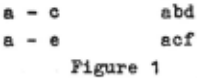
One of the authors has developed experimental tasks in Ydlich an action mode construction is the most important aim of subjects. In general the task con sisted in disposing on a surface six ob jects designated by letters 'a', 1b','c', 'd', 'e', 'f' on the basis of knowledge about the mutual disposition of these ob jects (for example, a ···· b, a ···· d, see figure 1). This disposition was given by a logical condition of the task, and a 'cue' to the usage of this condition was g1 ven in an instruction. Figure 1 shows the result of solving one of tasks (i.e. required configuration of six objects).
For analyeio purpose we considered actual action modes of subjects as unity of a reflective component (the action principle) and of an operative one (operational scheme, action program).
We shall understand by the action principle (AP) a factua1 (not always co~ scious, or verbalized) tef1ection of pro perties of both a base and others objects of transformation. rea1lY participating in actiyitY regulation. (That object is called 'base', from wliich the subject be gins his decision, i.e, which he ·fixes first of ell ) ,
By the operational component (OC)we understand such a rea1 operation system, with help of which a situation transfor mation for goal achievement is being car ried out,
In our case transformation situation, consists of objects 'a', 'b', 'c', 'd', 'e', 'f' together with their relations (disposition with respect to each other).
But these objects are not homoge neous in regard to an amount of relations (i.e. in regard to the quantity of hei~ bours', or objects with which they are standing side by side). The objects at~ ding in the middle points of the confi guration (see figure 1, the objects 'b' and 'c') have three relations, i.e. they are standing side by side simultaniously with three objects. The other four ob jects 'a', 'd', 'e', 'f' are disposed at the extremes of the configuration and axe standing side by side only with the two objects, This nonhom:ogeneity of objects in logical task conditions is fixed by the quantity of conditions per object: the objects having two relations are re presented by three conditions (three couples). It is sufficient for task sol ving to single out and fix two objects having three relatione (ell six objects will be incircled and fixed in the con figuration). Thus the presence of ob jects with three relations is an essen tiel property of the transformation ob ject.
We succeeded in singling out three levels of AP and three levels of OC respectively. These levels have analogous hierarchic structure in which the reflec tion character of task conditions is fix ed and first of all, the degree of singl ing out essential properties of the trans formation object. The third level is the hieghest, the most general (it is cha racterized by singling out two objects having three constraints).
Analysis has showed that interrela tion of levels of AP and OC is characte rized by the following peculiarities:
An operational scheme is falling be hind from the appropriate level of AP.Be sides that, this felling behind is relat ed with frequency characteristics (the rize of AP level occurs faster than the rize of OC level) and time characteris tics. In particular the construction of an operat ' Jnal scheme of the highest le vel occurs later than achievement of this AP level.
Thus there have been revealed in our experiments on operational task solving, the following characteristics:
- ·1. Essential dependence of an action program content (an operational scheme) on action principle (the reflective com ponent),
- Tendency in the course of task solving to relization of these components at the graving level of generalization,
- Regular felling behind of OC from .· P in time; besides that, its overcoming is possible only in the process of speci al activity on OC construction at the le vel of achieved AP (or in other words,OC is not an automatically consequence of AP). It can be suggested that the noted incoincidence of AP and OC levels is a sufficiently typical characteristic of various types of man activity. Evidently this fact of relative independence of e stage of operational action schama cons truction was a base for its absolutiza tion and known opoeition of cognitive ac tivity of man in the theory of heuristic
progranuning.
- Shown by us a fact of a special constructiOI· of an operational schama proves that an operative task solving doesn't necesserialls mean down a situa tion of selecting an action mode from possible ones. Tlie last is only a peculi ar case of DM about action at the level of speech-thinking processes.
Suppger;v
- The processes of informational prepa ration of dicision essentially determine the procedure of DM on all levels of DM. On a perceptual-ncognizing level it is expressed in peculiarities of info:nnati on search and the level of fo:nningness of a perceptual image that provide selec tivity of actualization and construction of those or these hypotheses. B,y forming action mode (on a speech-thinking level) this is expressed in corresponding gene ralization level of an action program to the generalization level of the action principle although the foostone falls be
- hind the latter.
- The process of DM at the both stages (preparation and DM itself) is pro4ucti n 'bailing' a new content from an ob ject b,y means of including it in new and new systems of relatione. It results in changing the generalization level of sing led out properties of an object (showing up more substantial properties of an ob ject, changing its indications alphabet, enlargement of operative units of percep
- tion).
- ). The DM procedure consists as a rule not in a mechanical sorting out but in selective actualization or hypotheses construction (on a perceptual-recogniz ing level), or in a special construction of an action mode (on a speech-thinking level).
- Psychological peculiarities of DM being showed up in experiments allow to suggest that simulation of mentioned abo-
ve characteristics inherent in all le vels of man DM can become one of the ef ~ective approaches to artificial intel lect problem solving.
BibliographY
- BpyDLilHHCIII A A.B. ncHXOJIOilUI KHDUie HHJI H KHCS8J118THKa. M., H~. "MHC.Jib", 19?0
- ,lq>ymuntH B.B.' KOH'I'OpoB ,n.C.~eR, aJirOJM'l'M, pemeHHe. ( npHHJITHe pemeHHA H a:& 'l'OMa'I'H~JI). M.' H~.MO ~P. 1972.
- TBXOMHpOB O.K. C'l'pyKTypa MHCJDI'l'EUlb HOA ,~teJl'l'eJibHOc'l'H qeJio:eexa. M., H~.MrY, 1969.
- ~re.Jlb JI., OyaHc A., YOJDD M. Hcxyc CTBeHHYA HH'I'8~8K'I' H 8BO~OHH08 MO,It8JIH poB8.HHe. M., H~. "MHp", 1969.
@inproceedings{ijcai1975p149,
  title     = {Levels Of Decision Making And Certain Problems Of Artificial Intellect},
  author    = {Zavalishina, D. and Lomov, B. and Rubachin, Y.},
  booktitle = {Proceedings of the Fourth International Joint Conference on
               Artificial Intelligence, {IJCAI-75}},
  publisher = {International Joint Conferences on Artificial Intelligence},
  editor    = {Patrick Winston and Carl Hewitt},
  pages     = {938---1},
  year      = {1975},
  note      = {Psychological Aspects Of A.I.},
  url       = {https://ijcai.org/proceedings/1975/149},
}
TY - CPAPER TI - Levels Of Decision Making And Certain Problems Of Artificial Intellect AU - Zavalishina, D. AU - Lomov, B. AU - Rubachin, Y. T2 - Proceedings of the Fourth International Joint Conference on Artificial Intelligence, IJCAI-75 PB - International Joint Conferences on Artificial Intelligence PY - 1975 SP - 938 EP - -1 UR - https://ijcai.org/proceedings/1975/149 ER -Copied
Machine-readable versions of this paper, for tools and AI agents:





