
Neuronal Mechanisms Of Determination The Direction Upon The Sound Source
Proceedings of the Fourth International Joint Conference on Artificial Intelligence. Psychological Aspects Of A.I.. Pages 921-922.
© 1975 International Joint Conferences on Artificial Intelligence
Abstract
• model of the neuronal structures of the auditory system is worked out to determine the direction upon the source of the sound signal with steep-sided front. The direction upon the sound source is determined on the basis of a generalized parameter which is the result of two measurements: (I) moments of arrival of the signals at each ear; (2) a.plitudes of these signals.The result is the precision determination of the direction upon the sound source. '!'he model represents a five-level neuronal structures, each level consisting of the elements of the same kind. 'l'he inrorma~~vn about the direction upon the source of sound is encoded in the location of the excited region at the output level of the model.
- I.Jli>6HHCK11It:! !A.A., ilOSHH H.B., liluene:a Jl.A. Bao~aHKa,XYW, BHn.I,IU5-IIU,I97S.
- An:& TUSH R.A.JlOKSJIHaS4tf.R a:ayKa. JI., 11 HayKB 11 , I~72.
- Tonndorf J., JASA, v.34,p.8, !962.
- Pa~Hoao:aa E.A. ~yHKnHoaan:&Ha.R xapaK- TepHcTHKa Het:fpOHOB KOXJieapHHX .R~ep H CJiyXOB8.R ~yHKnlf.R. A.,"HayKa 11 ,I~7I.
References were extracted automatically from the PDF and may contain errors.
Full text extracted automatically from the PDF; figures, tables and equations may differ. The PDF is the version of record.
Introduction
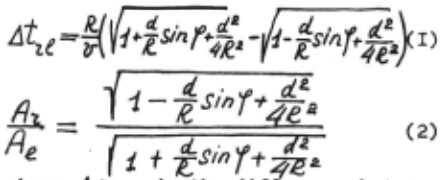
The system determining the direc tion upon the source of sound is able to detect exactly only with the use of ) the parameters .6 t 1l , At. , Ae , · where R (the distance from the source) is unknown. Where R is given, the deter mination problem may be solved with the uze either of Atz.t (based on the equa tion (I) ) or At and At. (based on the
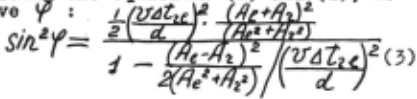
·) The determination of the direction upon sound source with the help of two point receivers~ situated at distance d from each other comes to solving a set of 2 equations relative to f :
NEURONAL llECIWUSMS Ol!' DETERilllU.'l'ION 'l'HE DIRBC'l'ION UPON '!'HE SOUND SOURCE
I.A.Lubinaky, N.V.Pozin, L.A.Shmelev
Institute of Control Sciences, Acad.Sci.USSR, Moscow
equation (2) ) [I] · Under real condi tions, however, the parameter R is unknown, so it is necessary to use the information about the difference of the mcaents of arrival of the si&:l{lls and about their amplitudes (see C3) ).
Where the direction is determined on the base of the parameter .4 t,e only and the information about the amp~itu des is notused, it means the case the·) sound source is located at infinity. · But because of the finite value of R in this method of evaluating f the greater error is commited the smaller is the value of R ~
Living organisms determine ~ by using the parameters Att{ , At. , A 't · This conclusion is based on the follo wing: I) If two signals differing in amplitude arrive simultaneouslly (via headphones) at the right and left ear, the subjective sensation is that the sourse is shifted to the side of the largest signal. 2) Electrophysiological characteristics of neurons of the medial superior oliva~ nuclei (taking part in sound localizat~on) are similarly depen dent on the difference of arrival mo ments and the difference of signal ampli tudes ( [2], page 77 ).
The main stae;es in the transforma tion in the model.
On the strength of what has been said, it may be concluded that neural structures evaluating 'f calculate either the exact value of '( (accord:t.ng to equation (3) or a similar, more cor rect formula, taking account of the dif fraction of sound waves on the head and the helixes), or its approximation. l!'or a ~pical case where R>>d, 'f in a first approximation (.alculated by (3) ) is the following:
·) In this case the wave becomes (Ar = AI), so t Sin 'f =- 2J"'ft zf (from (3) ) · plane
IBl) E. g. if R ~t: d, and 'f = 30° the undgrstating of estimation of f by 4.4 is allowed.
The analysis of biological data warrants the assumption that this kind of estima ·tion is calculated in neural structures of living organisms with passive sound source localization. The evaluation is then produced in two stages, so that there are two structure- fUnctional blocks in the model described below.
At the first stage in the block of monaural transformation (from both the right and left side) the aaplitude of sound impulse (or the impulse front,to be more precise) is transformed into an equivalent time delay. This time delay is summed up with the actual moment of arrival from this very side. Finally, some resultant moment (phase) of appear ance of the standard signal i· formed (from each side of model). This resul tant moment is determined by two para meters: I) the real moment of impulse arriv~~ at the given earJ and 2) the amplitude of signal coming from this
side. At the second stage, in the block of binaural processing the actual de termination of direction on the sound source is produced by calculating of tae resultant interaural delay, i.e. the difference between the moments when sig nals appear from each side of the first block. What is important here is that the difference between the resultant moments of appearance of the signals (determined in the first block) is cal culated. So the result is the function both of the difference of phases and the difference of amplitudes.
The model structure.
The first level L of the model is formed by the receptive elements (main ly the internal hair cells of the cohlea, which perceive the vibrations of the ba silar membrane. ·:rhe basilar membrane is represented roughly as a regulated set of frequency sensible elements, the iner·tia of the latter increases mono tonously along the axis X (longitudinally along the membrane).
The consideration of the basilar membrane model L3J shows that the sound pulses differing in their stepness and duration produce the maximum in the different parts of the latter. The grea ter the steepness of the pulse and/or its duration the closer to the apical end of the membrane is the region of the maximum vibrations. On the strength of this property we assume that the membra ne distributes the received sound signal over a great number of channels (the re ceptor being the beginning of each chan nel). As a result, the transmission of the information about the sound pulses differing in steepness and duration is produced through the different channels. The coordinate x of the working channel thus gives the concrete input signal.
Each receptor - the element of the level L 4 of the modeltransforms the deviation of the membrane into the aembrane potential. The receptor is connected with a column of neurons, their thre sholds increasing monotonously along Y. 'rhese columns of neurons in the model fill up a two-dimensional layer (the le vel L ) with coordinate axes X (along the m~brane) and Y (the direction of the varying of the threcholds of the elements). (:rhe level L 2 corresponds to the spiral ganglion of ~he audito~ system). Each element of the level L 2 responds to the input signal with oDiy one pulse, i.e. it works discretely. In response to the pulse sound signal an excited region appears at the level Lz This excited region dilates along the Y-axis (a column with coordinate x), the velocity of the dilation depending on the type of signal - the steepness and the amplitude of the pulse front.
The neurons of the level L are the speed detectors, or, more exact~y, the detectors of a velocity variation law. Each detector with the coordinates (x,y;) is triggered if in the inferior (at ~e level L ) colUJm (with the aaae coordinate x) tfie propagation velocity has a peak about the point where 7 2 = 7 3 1 increases if 7? 7~ and decreases if 7 2 7 3 · The larger'the coordinate 7 2 of the point (at the level L ), where the propogation velocity cu;fe reaches its peak, the greater is the correspon ding coordinate 7 of the triggered detector at the l~vel L~. The result is that the triggering of ~he detector in channel x at the level L with the iar gest coordinate 7 3 dete~es the ampli tude of the sound pulse at the aoment
when its steepness is maximal.
The level ~ models the operation of the anterior division of the ventral cochlear nucleus. The presence of the · detectors of steepness of sound pulse fronts in these nuclei has been establi shed in electrophysiological experiments [4].
The fourth level of the model L 4
(that corresponding to the superior medial olivary nuclei) consists of the neurons which are coincidence elements. The pulses from the right and left side arrive at the inputs of these neurons through the delay lines - the neuronal dendrites. Here the neurons are also organized in "columns", each having the coordinate x and oriented in Y -direc
tion. At the level L the encoding of the sound amplitude in~an additional delay takes place with the help of the follo wing connection between L and L z the greater the coordinate 7~3of the~neu ron - detector at the level ~ , the closer to coincidence element ( at L 4 ) will this detector signal be at the delay line (dendrite). ·J.bus, on the right and left inputs of the element the "resultant" moaents of signal arrival
· ( t and t ) are formed.The coin cideK~e elem~At responds with a probabi lity equal to 1, if the difference of the moments ( A tr = trr - trl ) of signals arrival from right and left is less than zero. The probability of res ponse of the element decreases monoto nously as A t increases. Owing to the difference in rthe duration of the delay lines on the right and left in elements with different coordinates y , the shift of the above- mentioned char~cteristics occurs by a magnitude proportional to y 4 · ~inally, the distribution of probabilities of the responses of the neu rons - coincidence elements - along axis Y is equal to 1 if the difference of the resultant moments is less than or equal to Yu. (A tr~ y 4 ) and decreas es monotonousLy U At > y · The co ordinate y' of the po:i!t wh~re the pro bability b~gins to decrease is equal to the difference of the resultant moments Atr. This y~ thus determines the direction upon the sound source ( y'll.,...,'f).
(the analog of the inferior colliculus) is to effect the precision determination of coordinate y 4 ~ Y 4 is brought out
The designation of the level L 5
by statistical processing of the respon ses of a large number of elements at the level L 4 · This operation is carried out by neuronal structures with lateral couplings.
As the final result at the level L 5 a local region of e~cited elements appears with coordinatJs x5 and y 5 * The coordinate x~ describes the shape of the signal, and the coordinate y~~- the direction upon the source. At tn1s point the determination of the di rection is completed.
@inproceedings{ijcai1975p146,
  title     = {Neuronal Mechanisms Of Determination The Direction Upon The Sound Source},
  author    = {Lubinsky, I. and Pozin, N. and Shmelev, L.},
  booktitle = {Proceedings of the Fourth International Joint Conference on
               Artificial Intelligence, {IJCAI-75}},
  publisher = {International Joint Conferences on Artificial Intelligence},
  editor    = {Patrick Winston and Carl Hewitt},
  pages     = {921--922},
  year      = {1975},
  note      = {Psychological Aspects Of A.I.},
  url       = {https://ijcai.org/proceedings/1975/146},
}
TY - CPAPER TI - Neuronal Mechanisms Of Determination The Direction Upon The Sound Source AU - Lubinsky, I. AU - Pozin, N. AU - Shmelev, L. T2 - Proceedings of the Fourth International Joint Conference on Artificial Intelligence, IJCAI-75 PB - International Joint Conferences on Artificial Intelligence PY - 1975 SP - 921 EP - 922 UR - https://ijcai.org/proceedings/1975/146 ER -Copied
Machine-readable versions of this paper, for tools and AI agents:





