
Heuristics In The Alloy Designing
Proceedings of the Fourth International Joint Conference on Artificial Intelligence. Robots And Productivity Technology. Pages 782-787.
© 1975 International Joint Conferences on Artificial Intelligence
Abstract
A systematic approach to the alloy designing problem, which is one of the typical ill-structured problems considered to be solvable only by inspirations of a genius metallurgist, is discussed with respect to the heuristic approach. The procedure to design an alloy of required properties consists of two parts;searching of a starting point(a root) and constructing a tree in order to improve the properties of the material corresponding to . the root by applying tactics. A CAD system having a data base for metallurgy is used in order to establish a method to perform this procedure.
- Mishima,Y., Ishino,S., Materials Sci. & Eng'g. 11,(1973), ppl63.
- Mishima, Y.," Newer Metals", Corona-sha, (1973) in Japanese.
- Slagle ,J. R., " Artificial Intelligence : The Heuristic Programming Approach", McGraw-Hill, Inc. (1971) .
- Robinson,J.A., An Overview of Mechanical lneoretical Approaches to Non-Numeric Problem Solving, pp 2-20, Spring-Verlag, New York (1970).
References were extracted automatically from the PDF and may contain errors.
Full text extracted automatically from the PDF; figures, tables and equations may differ. The PDF is the version of record.
Introduction
As it has been already pointed out in our earlier paper(!), the alloy designing problem comprises four sub-problems;(i)data processing of metal data, (ii)rearrangement of alloy developing strategies, (iii)synthetic decision based on the subproblems(i) and (ii), (vi)verification of sub problems(iii) by experiments. These sub-problems must be connected closely with one another by essential methods, that is, by the science-orient ed method and/or by the engineering-oriented method.
The science-oriented method is so fundamental that it has united all tactics ever deduced and/or induced from theoretical or experienced rules into some strategies based on the science. From the point of view of the alloy designing, the science oriented method may only be successful in designing required alloys if the tactics of improvements have been already formulated quantitatively. However, the quantitative formulations have rarely been established except for ideal cases as a single crystal, pure metals etc, under restricted conditions and for a few properties. Therefore the science-oriented method must often rely on theoretical simulations which require a great deal of CPU time, and/or quantitative estimations by the theoretical speculations for sophisticated requirements especially when the requirements are potentially directed towards the use of newer metal of little information. Furthermore the number of combinations of parameters which de scribe alloys and conditions is enormous,so that it is impossible to carry out exhaustive combina torial or logical manipulations for all materials in designing required alloys.
Therefore it is necessary to reduce the number of materials and to restrict them to better materials with respect to the requirements impos ed, so as to avoid combinatorial explosions. This procedure of selecting better materials can be classified into two parts :
- (i)selection of a starting material by plac ing thresholds of requirements,
- (ii)improvements of the starting material by making use of tactics.
In order to perform this procedure, we mu~c aL
S. Iwata, S. Ishino andY. Mishima University of Tokyo Bunkyo-ku, Tokyo, Japan
first prepare a data base for materials and man machine interfaces with the data base. These preparations are described in the later sections.
The further research by experiments or by simulations follows this procedure, and it will be reported in another paper. In this paper the method of selecting better materials is discussed as an applications of AI in metallurgy.
Procedure of selections
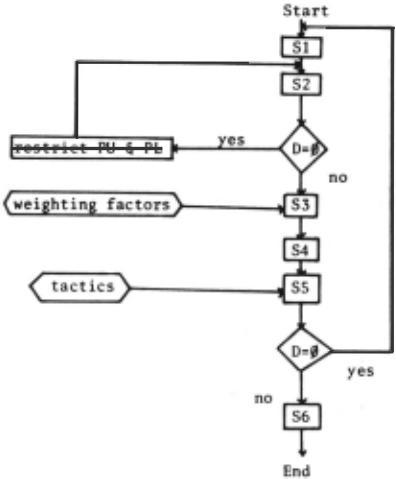
The procedure of selecting better materials can be described as:
(i)select a starting material,
- Sl.inputs of requirements by designating the ranges of required properties,
- S2.retrieval of information of materials which satisfy the requirements,
- S3 . evaluation of selected materials,
- S4.selection of a starting material by the evaluated results,
- (ii)improve the starting materials, SS.application of the tactics created in the data base so as to improve the starting material with respect to the required properties,
S6.evaluation of the improved materials. This procedure is illustrated in Fig.l, and the steps Sl-S6 are described in more detail in the later section .
Information storage and retrieval
It is worth while to describe the data base for metals briefly in order to make the problem of selecting better materials clear.
Metal data
The met:1l data are classified into two types, i.e., structure-sensitive and structure insensitive. The data of the latter type can be easily described with fixed number of parameters, so that the optimum alloy for the requirements with respect to the properties of this type can be easily decided by seeking a peak in a multi dimensional metric space. On the contrary the data of structure-sensitive properties are unable to be described by a fixed representation because of the limitations to observations of the related parameters. The limitations also restrict the applications of established theories concerning this type data. This situation, however, is the main reason for the heuristic approach to the alloy designing problem.
The insufficiency of alloy data, particularly in structure-sensitive properties, must be taken for granted owing to the limitations of physical and chemical observations, so that we are obliged to refer another kind of information in order to estimate the regions of insufficient data. Such information become tactics, which can be classified into 'alloying' and' heat-treatment and working', and phase diagrams by which elementary patterns as shown in Fig.7 can be recognized. Both of these information are represented by networks except for the effects of 'heat-treatment and working'. These effects are caused by the fact that the effects are the function of both the tactics and reciprocal reactions of them. Therefore the tactics with respect to heat treatment and working are dealt with qualitatively by man after the procedure described in the following section has been finished.
Data structure
In our system named CAAD-I(Computer-Aided Alloy-Designing-I), the information of materials are classified into five types;(i)fundamental properties as atomic weight, atomic radius etc,(ii) phase diagrams,(iii)alloy data, (iv)strategies for developing alloys and tactics and (v)photographs.
(i)Fundamental properties are represented by arrays, the element of which corresponds to the value of a property of an element having the atomic number equivalent to the index of the arra~
(ii)Binary phase diagrams are represented by line figures in squares . Then in order to repre sent them effectively with respect to memory size, a figure is divided into line elements and inter secting points. Each line element is approximated by selected points . The number of the selected points is restricted from 2(for straight lines) to 7. The terminal points are always selected. Then for each line element are stored such information as the number of selected points and the temperatures and compositions of selected points. Each intersecting point is represented by such data as the degree of node(point), the names of incident branches(line elements), and its temperature and its composition.
According to the criterions described below, the pattern of each intersecting point is recognized and the information of the pattern is added to each node.
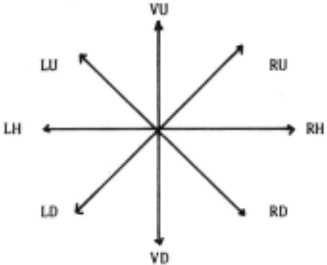
The line element is encoded as LU,LH,LD,VD,RD,RH, RU and VU according to the directions as shown in Fig.2.
The criterions for elementary patterns are as follows:
!.eutectic and eutectoid systems =LH & RH & W & RU 2.peritectic and peritectoid systems =LH & RH & LD & RD or LH & RH & VD 3.monotectic and monotectoid systems =LH & RH & W &(RU & RD) & RD or =LH & RH & RU & (LU & LD) & LD 4.intermetallic compounds =LD & LD & RD & RD or LD & VD & RD S.solubility
=LU & LD & RH or LH & RU & RD.
The complete solid solution can be recognized by the criterion as follows . This pattern is represented by the double-valued functions of compositions except for the boundaries where the temperatures are single values.
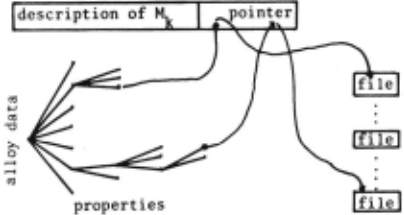
(iii)The alloy data can be defined by making use of categories which are structured into a tree logically as illustrated in Fig.3. The corre spondance between an alloy and the value of a property is defined by a direct product of element names, their compositions, the parameters and the nodes from the root to the related leaf.
(iv)The strategy to select better materials can be represented by a directed graph if we assume the required properties as nodes and tactics to improve the required properties as branches.
(v)Photographs of microstructures of metals can be represented by two dimentional arrays of the gradations.
Information retrieval
The information retrieval is performed by selecting menues displayed on the CRT and by sett ing the ranges of requirements, or by referring the strategies already created in the file. By the selection of menues the values of a property are retrieved and by setting the ranges a set of materials which satisfy the requirements is creat ed in a temporary file. Two operations are prepared so as to manipulate the created sets; the union of the sets and the intersection of the sets.
Data creation
The data without the strategies are created in the data files by making use of conventional devices as TSS, CRT and card readers. The strategies are created through the operations of CAAD-I.
As the summary of this section, the types of metal data are listed in Table 1, and the mean waiting times between the menu selections and the displays of the retrieved data are listed in Table 2. Owing to the variety of resource allocations by the operating system, the CPU time for the retrieval is not constant.
Table 1. Types of metal data
| Type | Structure | Mapping | Remarks |
|---|---|---|---|
| Fundamental data | array | F :El~Vl04 p p | rarely updated, s |
| Phase diagram | network | 2 F:E..,.network | rarely updated,DA |
| Alloy data | tree bucket | F :EnXPm p -+datum | often updated,DA |
| Strategy | network | object...,etwork | often updated,DA |
| Photograph | array | F: no .-t array | not updated S, omitted in CAAD-I |
/*E: element, V:value,P:property, F and F~mapping
S:sequential access, DA: direct access
*/
Table 2. Mean waiting times
| Data type | Mean waiting time (sec) | Capacity(KB) |
|---|---|---|
| !Fundamental | 1 | 100 |
| Phase diagram | 20 | 1000 |
| fo\lloy data | so | 2000 |
| Strategy | 5 | 500 |
Formulation of the problem
According to the procedure of selections as described before, the problem to be solved is formulated in the following way for the steps Sl S6.
Step Sl
The requirements should be defined quanti tatively as the sets of upper and lower limits for required properties, PU and PL, under a certain condition C as:
where a.(b.) is equal the reqOir~d property the condition j. to the upper(lower) limit for i, and c . is a value under J
Step S2
Let F. be the mapping from a description of a material 1 to the value of the material with respect to a property i under a condition C. A material is described by a set of variables,e.g., compositions of elements, heat-treatment etc.,
where k is the name of material and p is the number of variables of Mk. The p depends on k and it is represented as
The retrieved value vk. of a material Mk regard to property 1 i is represented with by Fi
The set of materials which satisfy the requirements on property i is
where M is the universal set of M. (j=l, 2,
... )
J created in the data base. The materials which satisfy the requirements are obtained by the intersection of the sets
The set D of selected materials, however, is empty for almost any cases, so that we must replace a part of intersections in (8) by unions in order to obtain starting materials. If Dis not empty, go to Step 53.
The replacement are performed by the tollOWlng algorithm.
(i)Decide the number of variables necessary to describe a property by counting the number of d~O.
The d is the mean difference quotient of V j = (v I Fi 1 (v) € M) with respect to one of the , mk)'
variables (m 1 , m 2 ,
where xkj is the value of the variable N is the number of Mk(k=l, N). j of Mk and
(ii) Rearrange the required properties in the order of the number obtained by the method (i).
(iii) Classify the sets S.(i=l,r) into two types; the sets of one type have 1 single-valued functions of compositions with respect to the mapping from a description of a material to the value of the material on a property. This classification corresponds to the one of metals data, i.e., structure-sensitive and structure-insensitive.
The starting materials can be decided as the intersection of the first type sets
where the indices are the numbers decided in (ii). Without the intersections of the first type sets, the intersections in (8) are replaced by unions for a preparations of Step 55,
Thus, the starting materials are restricted by the operation (10).
Step 53
The evaluation of calculating the scalar factor W=(w 1 w 2 , the materials user and Ds is performed by products of a weighting ,wr ) predetermined by a matrix V s as,
where n is the number of starting materials and ei is a value of this evaluation for selected material i.
Step 54
The materials of the highest value eh is selected as a starting material for the require ments. These steps are represented by a visible tree, and the optimization of the procedure about these steps can be established if the order of the properties as described in Step 52 is decided by making use of the data base. The following steps however, are unable to be represented by a visible tree except for a few ideal cases for which theoretical explanations are given in a quantita-
~ive way. These steps comprjsp two aooroximations ;(i) a provisional one consisting of interpolation and extrapolation, and (ii) theoretical one by taking advantage of theoretical formulae. In selecting a starting material, the metals data are assumed as a set of points, but in the following steps they are assumed as a kind of information to create continuous spaces.
Step SS
tion of the starting material decided in the preceding steps. Then the values of the required properties of Ms are
where vsi=1CMs) as defined by (6). The evaluated
value es of Ms is calculated by the inner product
of Vso and W,
The improvements of Ms with respect to the proper
ties of the second type as defined in Step 52 must be performed under the boundary condition the evaluated value of an improved material is greater than e . The goal of improvements is to obtain the s description of the material which has the maximum evaluated value. Under present conditions however, regions approximated numerically are restricted due to the insufficiency and complexity of metal data.
Therefore the improvements have been Jepending upon the heuristics of the metallurgists which consists of inductive inferences by refer - ing the metals data and experiences of metallurgists, and deductive inferences by theoretical speculations. The deductive inferences could be partly performed by sympolic and algebraic manipulations, but they are unable to be performed in our present system.
The inductive inferences are performed by taking advantage of the tactics described in non numeric formats as explained below. The effects of alloying elements are generally unable to be quantifi.ed and the expressions of them are as follows:
(base metal, alloying element, range of the alloying element, effect to a property)
where a=name of a base metal, b=name of an alloy ing element, c=lower value of the range, d=higher value of the range and e=effect to a property. For example, the alloying tactics accumulated by Mishima(2), can be rewritten with this expression as follows.
(Ni, Mo, 3.0, 10.0, heat resistance) Then, let T(a, b, c, d, e) be one of the tactics of this type. A strategy which have been applied in order to develop an alloy can be described by the combination of alloying tactics if we consider an alloy only with respect to its components. Then, let Mk be represented by
the set of compositions of its components Mit=( ml, m2, 'me) (1/.) where m 1 ~ m 2 ~ . . . ~me, and they are compositions of elements a 1 , a 2 , the ac respectively. Then the strategy to develop Mit is
where bll~m/m*lOO. 0~ do( , m=mi + mj and ~=(2c-i)(i-l)/2+j-l. The impurities are the elements whose presence in an all~y are undesired, so that the T of undesired terms should be subtracted from H(Mk). The values of the third and fourth term of T are assumed as the lower and upper limit of the same components, phase and effect in order to reflect the status of the data base, if the established tactics have not been created in the data base.
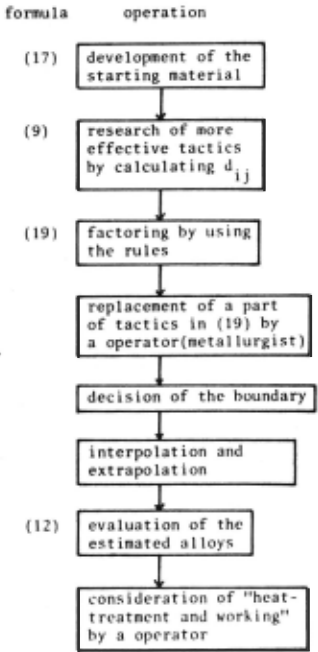
From the point of view of CPU time, it is convenient to create general tactics in advance rather than to refer alloy data at each step in the development (17). These preparations are achieved by resolv ing the description Mk into the sum of T, as shown in (17),and by defining b 1 , d 1 , gl,b2,d2,g2, ,bc(c-l)/2'dc(c-l)/2'
gc(c-l)/ 2 ' in question and answer modes. The T of higher compositions in (16) are basically syntactic and the T of lower compositions are semantic in nature. Furthermore, the former type T are the ones applied to obtain in general main effects which can be deduced by tracing trees having been constructed as "common sences of metallurgists" through the operation of CAAD- I. On the contrary the latter type T cannot be applied mech~ni cally to describe Mk due to the complexity of their meanings, so that the applica tions of this kind of T must depend on metallurgists. The optimum tactics which are induced by multivariate analyses are shown to ~etallurgists as references, if and only if multivariate analyses are possible.
These procedures as described above are performed by solving the alloy desig~ ing problem in the reverse direction by taking advantage of alloy data having already been created in the data base. Then the improvements of the starting material are considered by using the solu tions in the following way. By the notation of Slagle(3), the alloy des1gn1ng problem can be described by the combina tion of two concepts as
- (i) syllogism principle of propositional calculus,
- (ii)instantiation principle of predicate calculus.
In order to deduce an improved alloy Mk'
(m 1 ,,m 2 ,, ,me,) from Mk, we must at first resolve H(Mk,) by the tactics already created with using the result about the starting material Mit as
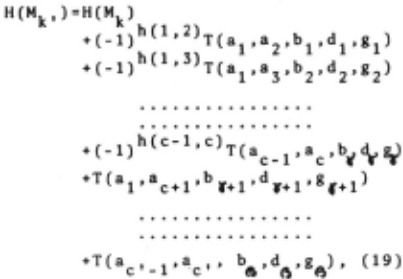
where h(i,j) is a function to perform factoring
- J where Ql.=(2c-i)(i - 1)/2+j-1, m=mi,+ mj' l=c(c-1)/2 and S=c'(c'-1)/2, and T having one of the elements of ac+ 1 ,ac+ 2 , ,ac' are the newer tactics applied to obtain Mk,.
The rules of the applications with respect to the alloying tactics are induced by metallurgical inferences and are formulated into WFF( well formed formula). For example, if the pattern P(m./(m.+ m. )*100.0, m. /(m . + m. )*lOO.O) 1 1 J J 1 J of phase diagram (a., a . ) is equal to the 1 J . pattern P(m. ,/y,m. ,/y) (y=m.,+m. ,) of phase 1 J 1 J diagram (a . ,, a . ,), then the fifth term of 1 J the alloying tactics T(a . ,,a . ,,b',d',g') 1 J is assumed to be equal to the fifth term of T(a., a . ,b,d,g). These kinds of 1 J rules are unable to be deduced from the information in the data base, so that they must be given by man in our system.
Then we perform numerical approxima tions, i.e., interpolation and extrapolation, within the region whose boundary is defined by b 1 , b 2 , bB , d 1 , d 2 , , d 8 by m a k in g us e o f the retrieved data of the same effect g. These approximations are performed under the assumption that the retrieved data are included in a complete sub-Sp4~~ i~
its boundary is the boundary of the pitase diagrams.
Owing to the insufficiency of related data, those developments as shown in (17) and (19) are not always possible. In fact in case of nickel base alloys, the alloy ing procedure can be represented by a network as shown in Fig.4.
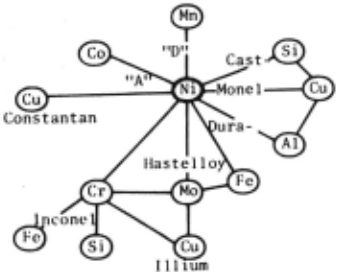
In order to bridge between the insuf ficiency of data and the development of (17) , the first and second terms of T are replaced by the name of an alloy and/or by the name of a metallic compound. This replacement is generally performed with respect to the first term, and almost all alloys can be described by the development of (17) with respect to the alloying procedure. Although this replacement is convenient to describe the already obtain ed alloys, it is ambiguous enough to obtain newer alloys. In other words this replacement contribute a heavy traffic of ideas into its termini, but it is dangerous to depend on this replacement in designing alloys. Therefore we must obtain a complete resolution of H(Mk). The interaction between T must be considered with the "heat-treatment and working".
Step 56
The evaluation of alloys which are estimated in Step SS is performed by the method as described in Step 53. The possibility of heat-treatment and working is now not considered in CAAD-1.
As the summary of this section, the learning procedure and the alloy designing procedure are illustrated in Fig . S and Fig . 6 .
Conclusion
The situation of CAAD-1 is at the point of creating tactics. The tactics are created by setting the last three
-teaching by human-- --learning by CAAD-1------terms of T which is questioned one by one according to the resolution of the formula (17). When a new alloy data are created in the data base, the tactics are reviewed and modified with respect to the third and the fourth terms of T so as to include the new case. By the combination of these tactics are described the process of developments with respect to a part of commercial alloys. Therefore we can decide the starting material if the ranges of required properties and weighting factors are defined. The selection of the optimum material are impossible, but the selection of better materials can be performed by taking advantage of the tactics already created. The further research to deside the optimum material is left to human.
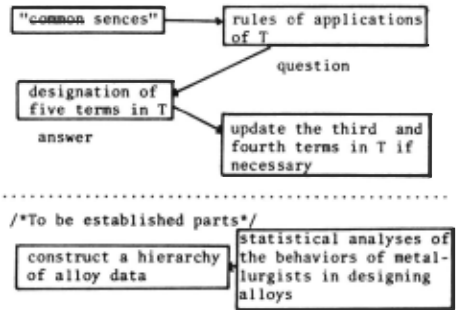
The main reason of our investigation to apply the methods of heuristic programming is that they are convenient to divide the alloy designing problem into two parts, i.e., mechanically inferred part and mechanically not inferred part.
Acknowledgement
The authers wish to express their gratitude to Prof. Dr. M. Iri( Mathematical Engineering and Instrumentation Physics) and Assoc. Prof. Dr. T. Yamamoto (Computer Center) for their technical comments .
Appendix
The information of phase diagrams are processed in the following way.
(i)Set the name of a phase diagram.
- (ii)Retrieve the phase diagram.
- (iii)Set the values of temperature and composition.
- (iv)Select branches which include the above composition within their ranges.
- (v)Select nodes incident to the selected branches.
- (vi)Recognize patterns of the nodes accord ing to the algorithm described in the preceding section.
- (vii)Select the pattern of the node as the pattern of the point if the codes of directions are equivalent at both points by connecting the points.
- (viii)Decide the suffix, i.e. ,"-tic" or "-toid" by counting the number of branches over the designated point.
@inproceedings{ijcai1975p124,
  title     = {Heuristics In The Alloy Designing},
  author    = {Iwata, S. and Ishino, S. and Michima, V.},
  booktitle = {Proceedings of the Fourth International Joint Conference on
               Artificial Intelligence, {IJCAI-75}},
  publisher = {International Joint Conferences on Artificial Intelligence},
  editor    = {Patrick Winston and Carl Hewitt},
  pages     = {782--787},
  year      = {1975},
  note      = {Robots And Productivity Technology},
  url       = {https://ijcai.org/proceedings/1975/124},
}
TY - CPAPER TI - Heuristics In The Alloy Designing AU - Iwata, S. AU - Ishino, S. AU - Michima, V. T2 - Proceedings of the Fourth International Joint Conference on Artificial Intelligence, IJCAI-75 PB - International Joint Conferences on Artificial Intelligence PY - 1975 SP - 782 EP - 787 UR - https://ijcai.org/proceedings/1975/124 ER -Copied
Machine-readable versions of this paper, for tools and AI agents:





