
Isolating And Identifying Objects In Line Drawings
Proceedings of the Fourth International Joint Conference on Artificial Intelligence. Visual Information Processing. Pages 656-662.
© 1975 International Joint Conferences on Artificial Intelligence
Abstract
The analysis and representation of complex line drawings is treated and applied. A method for rating the complexity of drawings is developed and compared with the difficulties of human subjects in memorizing them. The problem of isolating and recognizing these memorized figures embedded in more extensive patterns is then investigated. Differing types of embedment are defined by their effect on the original components of the memorized figures. Degrees of embedment are calculated for each memorized figure and compared with experimental results. Predictions are made for human difficulties in recognizing a simple figur~ under various conditions of embedment.
- Morofsky, E.L. and Wong, A.K.C. Computer per- ception of complex patterns. Second International Joint Conference on Artifi- cial Intelligence, Advance Papers of the Conference, British Computer Society, 1971, 248-257. IJCAI
- Morofsky, E.L. Computer perception of complex line patterns. Doctoral dissertation, Carnegie-Mellon Univ., University Microfilms, 1972, No. 72-29, 862 .
- Morofsky, E. L. and Wong, A.K.C. Interactive on-line perception of line patterns. Behav. Res. Meth. and Instru., 1973, Vol. 5(2), 139-146.
- Freeman, H. Computer processing of line-draw- ing images. Computing Surveys, Vol. 6, No . 1, March, 1974, 57-97.
- Djang, S. The role of past experience in the visual perception of masked forms. Journal of Experimental Psychology, 1937, 20, 29-59 .
- Rosenfeld, A. and Lee, Y.H. A clustering heuristic for line-drawing analysis. IEEE Transactions on Computers, August, 1972, 904-11.
References were extracted automatically from the PDF and may contain errors.
Full text extracted automatically from the PDF; figures, tables and equations may differ. The PDF is the version of record.
Introduction
The recognition of a familiar figure embedded in a more extensive pattern is not only an inter esting perceptual task, but more nearly recreates the conditions under which most human perception is accomplished. Thus, a critical test of any descriptive framework that hopes to simulate human performance is its ability to isolate and recog nize figures embedded in a scene. For figures embedded in a complex drawing, isolation of the figure must precede identification. Isolating embedded figures varies in difficulty, for both human and automated systems, depending on the extent to which the familiar figure has been in corporated into the drawing. If the component parts of the familiar figure survive intact, isola tion of the figure is straightforward. This is a simple elaboration of the figure without a change in its structure. When the components of the familiar figure are merged, wholly or in part, into new components isolation becomes more diffi cult, sometimes virtually impossible.
Thi s paper attempts to employ the methodologies of the Pattern Perception System, PPS, to recog ni ze fami liar figures embedded in more complex line patterns. The PPS representations are used in an attempt to measure the relative complexity of patterns as indicated by the difficulties of human observers in memorizing their structures and to predict the observer's ability to recognize a familiar fi&ure embedded in an unknown one . A n~re intensive introduction to PPS is available in references (l) and (2).
Analys is of a drawing
PPS analyzes line drawings into their constitu ent components or structural unit s . The analysis i s not unique, but may be accomplished in several ways resulting in a different set of components . These components are intended to correspond to the way in which an observer might copy a drawi ng on paper in steps during which contact between paper and pencil is maintained for each component , with no backtracking or retracing. Of course, one must question whether the resulting components make possible a descriptive structure that allows efficient processing of descriptions and corre sponds with human structuring inferred from psycho logical experiments. The specific psychological evidence that served as the motivating influence on the design of PPS is treated in (3). The pre sent paper investigates the suitability of the descriptive structure for identifying embedded figures.
The input to PPS is a digitized array of 1 and 0 elements obtained from a line drawing ·by a modi fied form of the grid intersection method (4) . The trace algorithm proceeds from element to ele ment recording its path as a series of bearings and applies junction heuristics when alternative paths are present. Components are open or closed lines that together comprise the drawing and whose interrelationships form the basis for the repre sentation and identification of the drawing. A junction occurs at any point where a choice is available to the trace algorithm, usually at the joining or intersection of two or more components. A free end is the termination point of a component where no junction is present. The .types of junc tions considered in PPS are the T, K, Y and X junctions. The drawing of Figure l has been seg mented into five components A, B, C, D and E. A is a quadrilateral inscribed in the quadrilateral B and together making the four K-junctions 1-4 . The component C makes two T-junctions (5 and 6) with B, and C terminates at both. D and E make T-junctions (7-8) with C and terminate at the free ends 9 and 10.
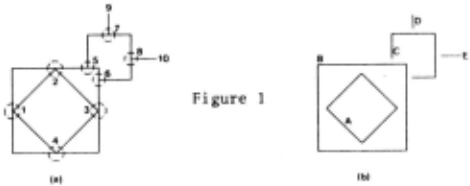
a) a line drawing with junctions 1-10 indi cated.
- drawing of a) segmented into components A-E.
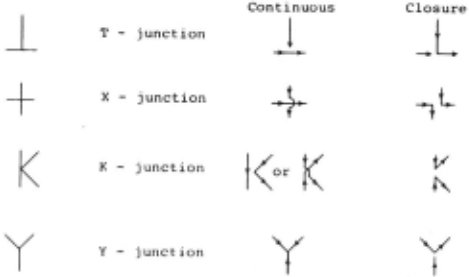
Two main objectives commonly influence the decisions taken by the trace algorithm at junc tions -continuity and closure. Continuity uses the various bearings available at the junction i n deciding which components continue and in what direction and which terminate. This deci sion is based on minimization of bearing change between entering and leaving the junction of one or mo re of the components. On such a bas i s the deci sion at the various types of junctions are eas i l y resolved as shown in Figure 3. In separating the intersecting squares into two components the

continuity cri terion would be used , but for the squares touchi ng at the corners continuity would yi eld one self-intersecting component. To This strategy is termed closure because it seeks to close the component being traced without regard for bearing changes.

t
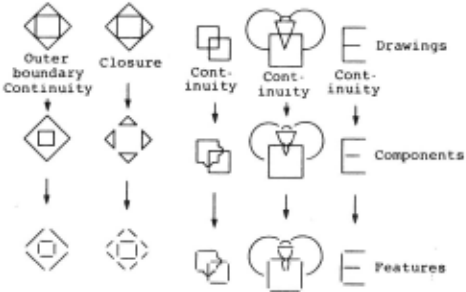
A potential factor that may occur in the seg mentation of a drawing is the outer boundary, which is a closed line that bounds the entire drawing. Human subjects frequently select the outer boundary as a component (5), when one is present, especially if it also satisfies the con tinuous criterion at junctions or is itself a familiar shape such as a square or circle. These various possibilities are illustrated in the analyses of the drawing in Figure 2.
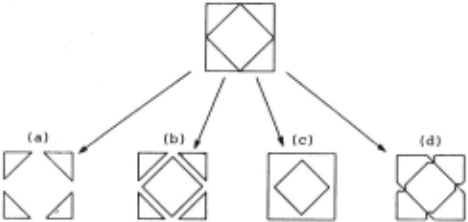
Closure produces four triangles in (a) with large changes in bearing at the K-junctions. A variant of closure that produces closed shapes bounding every elemental area is known as the elemental area trace (b) and is simply the outer boundary trace with a changed criterion of choice at the junctions. It involves the retracing of some lines and corresponds to outlining every piece of a puzzle. The outer boundary trace pro duces a square inscribed within another in (c), while continuity will give either (c) or (d) since the total bearing change at the K-junctions is the same in both. Since the resulting components of (c) are more familiar or "simpler" figures than those of (d), it is the more likely analysis. The possible strategies at the various junction types are illustrated in Figure 3.
In PPS, the interrelations among the components form the structural description. The components isolated by PPS may be likened to the units used by human subjects when reproducing a pattern. Each stage in the reproduction corresponds to an addi tional component. The most primitive level of analysis is the constituent features of each com ponent, i.e., straight lines and segments of vary ing curvature. The patterns of Hgure 4 are first segmented into components and these are then sub divided into features. Each component can be represented generally by a feature code, which is merely the product of prime numbers that have been assigned to each primitive feature and other pro perties as follows,
closed component
2
contains straight line
3
contains curved segment
5
convex curve
7
concave curve
- 11
component self-intersecting - 13
contains an angle
- 17
A square and a triangle would both have a feature code represented by 2 x 3 x 17 = 102 indicating that both are closed, contain straight lines and angles, but gives no information on the number of the respective features, their size or the sequence of thei~ occurrence -thus, equivalent codes for the square and triangle. However, this code is quite sufficient to differentiate the following component from either of the above and to indicate the sole non-shared feature among them is the pre sence of a convex curve feature, since 714/102 c 7. Then, to test any component for the presence of a feature or property listed above simply divide the code by the primary number
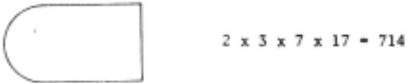
CJ 2 X 3 X 7 X 17 · 714
corresponding to the feature and a zero residue indicates a positive result. The particular format employed is a product of the APL environment in which PPS is presently implemented, but the philos ophy of having a dual level of description where the initial level reduces considerably the search space for the more exact description is a basic consideration of PPS.
Structural description of a drawing
Components resulting from the analysis are grouped into a hierarchy that represents the mean ingful structural interrelationships among the components. This structure is flexible enough to allow additional components to be added or old ones removed and can represent a single figure or multiple figures comprising a scene. It also allows efficient processing of descriptions in such operations as matching patterns for corre spondence. The construction of the description is treated in this section.
Hierarchical structures are composed of multiple levels each occupied by one or more components. Each component is designated by a hierarchical label (X Y), indicating the Yth component on the Xth hierarchical level. The components are grouped about the first level of the hierarchy and are assigned levels on the basis of their relationship to it. When the first level is occupied by one component it is referred to as the reference component or with multiple components, as the reference group. The simplicity criterion is introduced as an initial guide in choosing a reference. The criterion chooses as reference the component that when acting as reference results in the lowest average hierarchical level for the structural description. A drawing is analyzed into components A, B, C, D, E, F, and G. Figure 5 indicates two possible hierarchies. When struc tured with A as reference it has an average hier archical level of 17/7, while the structure with C as reference has 18/7 . The simplicity criterion indicates component A as the reference. Although often coinciding with human judgement, it is only
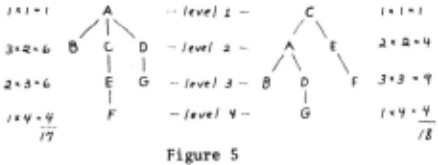
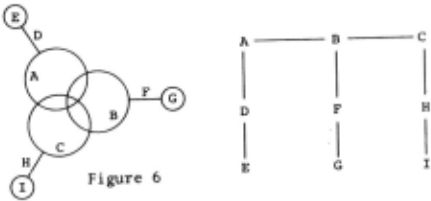
a guide that is often modified by factors such as the relative sizes and the shapes of the various components. Of course, one structure can be trans lated into other possible variants if need be. If structures are to be compared and classified, a consistent method of representation is necessary. Elaborations of a known pattern should not change the basic structure, nor should minor distortions, translations or rotations. These goals are accom plished in PPS. The drawing of Figure 6 illus trates the occurr~nce of a reference group, in this case the components A, B and C. They cannot be differentiated by the simplicity criterion and are symmetrically related one to the other.
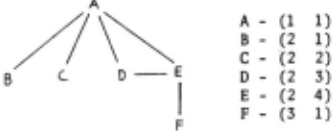
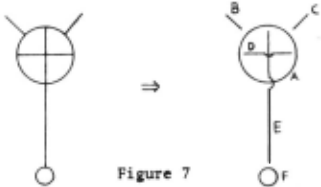
The component or components acting as reference are assigned hierarchical level one. Components sharing a junction with level one components are assigned hierarchical level two and, in general, components are assigned a level greater by one than the lowest level component with which they share a junction. This is illustrated in the draw ing of Figure 7 which is analyzed into components and grouped into a structure with hierarchical labels assigned.
F
Component A is the reference and all components sharing a junction with it are level two, com ponent F is on level three.
The structural relations between components are then characterized. The basic relation is between a pair of components that share a junction . The components are referred . to as a junction component pair of form (k Z)(m n), where k and mare hier archical levels. Indices of the two components are given by Z and n. The reference forms a junc tion component pair with each second level com ponent in turn. Pairs may also be formed between components on the same hierarchical level. The relation between components indicates the type of junction and the relative relationship of the second member of the pair to the first or, alter natively, of the referent to the referee. The junction code factors which represent these rela tions are
| T-junction | 2 | |
| Double junction | 3 | |
| X-junction or intersection | 5 | |
| Outside of a closed referee/negative side of an open referee | 7 | |
| Inside of a closed referee/positive side of an open referee | - | 11 |
| K-junction | - | 13 |
| Y-junction | - | 17 |
Thus, for the three component drawing shown in Figure 8 the junction component pairs arc arranged

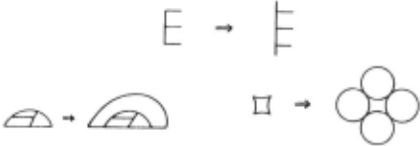
- simple figures altered in such a way that a previous component(s) is wholly incorpor ated into a new component. Most effective if applied to the reference component.
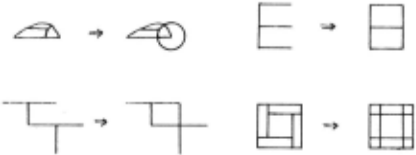
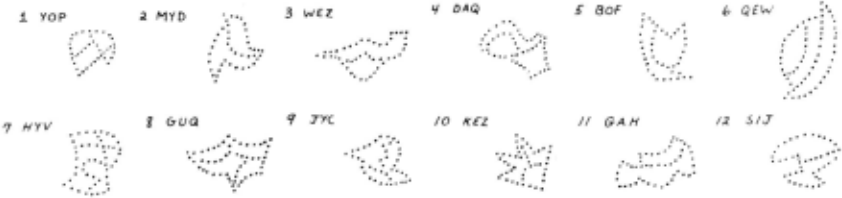
The general applicability of these classifica tions to the human task should be readily apparent. It is assumed embedment of type (c) is most effec tive and (a) is relatively ineffective. This method is applied to further results of Djang to test its validity. The twelve complex figures shown in Figure 13 were presented to observers who twelve complex figures and the ranking assigned to each embedment by the PPS classification. The classification indicates the relative difficulties quite well except for the complex figure POQ, which contains the simple figure KEZ. Again the familiar subgroups of this figure have resulted in a deviation from the classification assuming nonsense figures.
KOT QoW 1'06! rEH GID ){UR ~AP ZU8 CfF Gitv ZIF lAT ~fW >1£Z Ku 511 &OF I'IYD HYV DAQ C}IJQ J'{C. YOP GAll .a lb ~ 1c Ji. fD 'II. ,hJC sb s~ she siJJC 's .J7 .11 .7J.. .7J.. .5.3 .¥.; .~ .~r .~ .t6 .11 .1:1. $1 ... ,,. ,, .. ..,. ( ... ,, .. !tiiU"t!5 ,j,fl,'uJty ,. ""' ,-reo "6<1· <>! '"ccc$f./W./ "'ct'lo/IMn..
Table II. PPS rating of embedment difficulty and results of Djang experiment.
If applied to "clean" line drawings, rather than to the rather fuzzy dot patterns of Djang, the ratings should be more reliable. Figure 14 contains four figures with an embedded "E". It also shows the PPS continuity components and rates the patterns according to assumed difficulty in isolating the "E". For a different approach to these patterns, see [6]. The ranking certainly seems to correspond to human difficulties in this case.
The type of matching illustrated in Figure 10
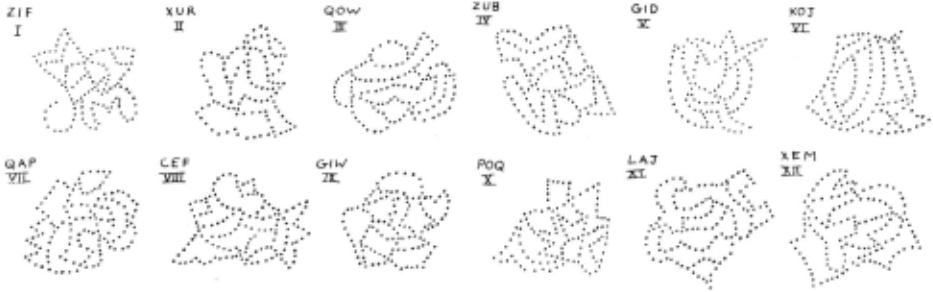
memorized their structure. Each contains one of the formerly memorized simple figures of Figure 11 embedded within it. The occurrence of the simple figures as structural units in the reconstruction of the complex figures by the observers was noted and varied widely from figure to figure. These results prompted Djang to conclude that"··· past experi ence plays an important role in our visual organization". The evidence indicated that the diffi culty of recognizing embedded figures was related to complexity of both the masked-figure and the figure containing it, although the rela tion was not explicit enough to interpret the results of the experiment or predict the results of further experiments . Djang understood that the results depended on the"··· relative ease of dis solving the.different test-figures into the simple figures and the parts making up the camouflage". Table II indicates the ability of observers to recognize the embedded figure in each of the and defined in the previous section cannot be applied without modification when a figure is embedded by types (b) and (c) where some or all of the original components may have been incor porated into new components. At this point PPS, like the human observer, adopts a search heuris tic in which the complex pattern is .taken apart and reconstructed in a variety of ways. PPS tries the various trace strategies, yielding differing component sets, and attempts to spot a likely reference component from which to construct the embedded figure.
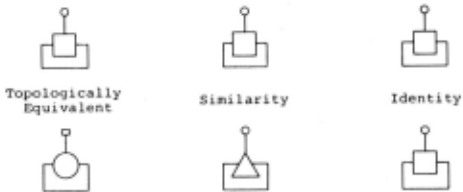
Condition (a) requires equality of feature codes between corresponding rows of the descriptions, while condition (b) requires equivalence in link age fields between levels l-1 and l. Condition (c) is the junction equivalence for the two types of row elements. For topological equivalence con dition (a) is relaxed to the presence of feature factors 2 and 13. For identity the hash coded features must be compared in each component for type, number, order and size. Clearly the lesser degrees of correspondence are least subject to transformation. Topologically equivalent descrip tions may be rotated, stretched, bent, etc. and remain topologically equivalent as long as the junctions remain undisturbed. Figure 12 illus trates three types of correspondence that may occur between figures.
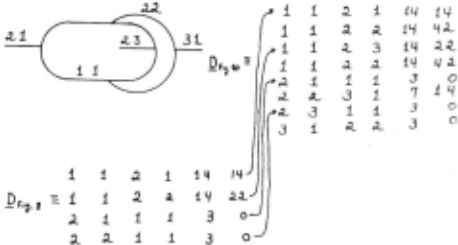
The above matching algorithm is used as the basis of scene analysis and the isolation of embedded figures of type (a) as defined in the next section. The algorithm can be illustrated by reference to the matching components in the two descriptions of Fig. 10. Let the description of the pattern of Fig. 8 be D and that of Fig. 10 be .Q.', then for Z · 2,
Embedded figures -their isolation and recognition
The description .Q. of a line drawing may be com posed of one or more separable figures. A des cription containing multiple figures is referred to as a scene. The identification of the con stituent figures of a scene is naturally a more difficult problem than identifying an isolated figure. It involves both the segmentation of the scene into separate patterns and their assignment to pattern classes. Normally this segmentation must be accomplished before classification can begin. However, PPS performs both the separation and classification simultaneously by using the analysis-by-synthesis approach. That is, an identifiable figure is synthesized or constructed from components contained in D until a definite classification is made- this-is the first step in the analysis of .Q. into its constituent figures . Thus, the isolation is accomplished by a synthesis or clustering [6] of available components to con struct pattern classes in the universe of PPS. This synthesis can begin at the reference com ponent of other "nucleation" components that dis play the properties of a likely foundation.
While a scene implies the presence of multiple patterns, an embedded figure indicates a known figure ''hidden" or camouflaged in a more complex pattern. This section investigates the ability of PPS to recognize embedded figures and compares this to the ability of humans in similar tasks. A method, based on PPS, is proposed for rating the difficulties involved in isolating embedded figures.
The ability of PPS to extract or identify a familiar embedded or simple figure within a com plex figure depends on the type of embedding. These degrees of "embedment" are distinguished by their effects on the original components of the simple figure and may occur simultaneously. The difficulty of achieving the isolation and identi fication of an embedded figure in PPS is dependent on the survival of the components of the embedded figure. If the components remain the same after embedment, then isolation is relatively straight forward.
- simple figure given additional components without affecting the integrity of the original components,
E
8
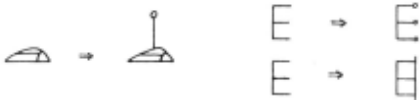
- simple figures altered such that an original component is partially incorpor ated into two or more new components, more effective if the new component is smoother, simpler, etc. than the original.
contribution to complexity is the number of fea tures contained in the figure and the number of hierarchical levels needed to structure the figure. These measures have been combined into n
E number of features x i, where n is the greatest i=l
hierarchical level. Thus, features at the refer ence level contribute least to complexity. The actual PPS structures used with those given by Djang as the dominant organization used by observers, e.g., figures 8, 9, 10, 11, 12 were organized by giving the outer boundary and filling i n the details. The type of intersection also contributes to the complexity by allowing alter nate organizations, self-intersection, T-junctions of a component with itself and Y-junctions count ing more heavily toward greater complexity. The third measure is the number of elemental areas or separate "pieces" of the pattern. These three measures are computed and combined as shown in Table 1. Remembering that the table is based on greater than or equal to three, the above scheme or a similar one would be able to predict com plexity in controlled situations such as presented in the next section.
Identification by comparison of descriptions
This section formalizes the comparison of two descriptions and the various degrees of correspon dence that may exist between them. The next section will apply this method to embedded figures.
In matching descriptions to determine their correspondence in terms of structure and features, several degrees of correspondence are utilized, ranging from identity to topological equivalence. Pattern matching in PPS begins at the reference component and proceeds to greater levels of the hierarchy. The following makes this more definite.
the description of a pattern.
| 'I JYG | GVQ | 7 HYV | 1), 51J | II GAH | .:!. 1'1YD | 'I D~Q | yop | ' BOF | 10 kfl | 3 WEZ | (, QEIV | ~a.}Yie o f ~~-p i, r, ,~.~.,.~ |
| a ¥.63 | Y.s.r | 'M | .3. g!' | 3.77 | 3.7~ | 3.6.1.. | 3.)'S | 3 .17 | .:Z.& | :J .S | /.Kf | «ve r .. 1 c 71 0. t~! to«. I!; i n 7rlt.''"(l r!J4 1!1" 7f |
| h 13 | IS | /0 | 13 | 13 | I I | /I | 7 | IO | 18 | / 0 | 6 | hi4. ..-.,b~tr (I( PP.~ / o.J.fuf"'tf:. |
| (. ;u | I S | II | I ii | !It | I I | 1:{ | K | /0 | .;<0 | II | r | ~0. ~~ /ru~..lu.rlis Lti'UlJ. A tt:rtt r-cf, ,~a / /t!~l"./ |
| d 0 | 0 | 7 | 0 | 0 | .:2. | .;t | 'I | .:2. | 0 | 0 | 0 | we :,J..t <d / ,., f~r.st c i , iJ H s |
| e :J. I | ! 8 | / 8 | 1'/ | I f' | ! .] | I 'I | I :L | / :/.. | :w | II | 'I | row ( ,. r ow d |
| I 3 | 'f | s- | :L | :<. | :l. | 3 | II | :l. | .3 | :l. | 3 | dem•n.t"- 1 1</..ltds. |
| j :2.'/ | ~:L | .:1.3 | / (, | lb | / 5 ' | 17 | / 6 | 1 1 / | .2.3_ | 13 | 12. | row e ,. r c .v I |
one dominant organization among various used by the observers and the possible influence of famil iar portions or whole figures, the results of Djang roughly correspond to the difficulties calculated. The highest and lowest scores go, respectively, to JYC and QEW with corresponding greatest and least difficulties. The other figures are partitioned into three groups with similar scores with the exception of KEZ. It is assumed that KEZ contains some familiar sub-figures which have effectively reduced its complexity and, indeed, if we imagi ne that one sees in KEZ the letter "M" sitting on a triangle -the score is reduced to 12 which fits nicely with its neighbours. Line drawings, rather than the dot patterns, would restrict the number of structures possible and clarify some junctions. It is thought that with the number of components a description with greatest hierarchica l level of n.
the ith row of the description D.
the ith row with ki = r, where k is the hierarchical level of the referee.
A sub-description of D, of Z levels, is defined as Dz = ~ [l; ], where l r epresents the row indices of all di r. D such that r ~ l . r
The s imilari ty relation between a description Q and another description D', D ~ D' , requires that at any level Z of the match process, with l 1 1 and l ~ n, Dz ~ Dz. Dz ~ Dz, if and only if, in rows starting with the reference and including all components. The f and g for each row are the feature code and junction code. The junction code for the component pair (1 1) (2 1), or g 1 , is 2 x 7 · 14, indicating a T-junction with the referent outside the referee. For the component pair (1 1) (2 2) the junction code, or g 2 , is 2 x 11 · 22, indicating a T-junction with the referent on the inside of the referee. Filling in the f's and g's of the above array results in the following description,
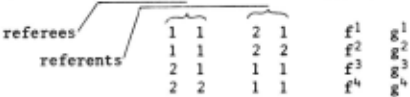
where the entries for g 3 and g 4 simply restate the fact that (2 1) and (2 2) have no higher level referents. Such components are called terminators. An array consisting of each component acting in turn as referee with all of its referents listed, including feature and junction codes, forms the basis for the description of a drawing. When a referee has multiple referents, they are listed in the sequence they are encountered as the referee is traced, with the stipulation that closed com ponents are traced in a clockwise manner. This is illustrated by the drawing of Figure 9. This
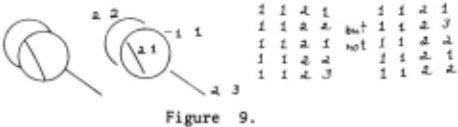
simply establishes some rule of representation to standardize processing and simplify comparisons. The above example indicates that the description of a closed referee with multiple referents may begin with various component pairs while retaining the role of an equivalent description. PPS auto matically sequences the referents of one of the descriptions when two drawings are being compared until a matching sequence occurs. This is neces sary because component (2 2) of one drawing may correspond to component (2 3) of a matching drawing.
In addition to the feature code description of each component a more detailed description of every feature contained in the component, in sequence, is necessary. The feature code is simply an abridged version of this description. In the APL implementation of PPS, these descrip tions are hash coded and the indices are stored in column seven of the array. This seven column array is known as the description, D. The detailed feature description stored-as hash code is required only when feature and junction code screenings have proved affirmative. Thus, general characteristics are matched and used to eliminate non-corresponding patterns before a detailed match is attempted. Only an identity match requires inspection of the hash coded features, while for topological equivalence the feature and junction codes are sufficient.
In Figure 10 the drawing of Figure 8 is given additional components and the two descriptions are shown with the matching indicated. This is the basis of detecting embedded patterns or simply familiar subpatterns. PPS performs both the separ ation and classification simultaneously by using the analysis-by-synthesis approach. That is, an identifiable pattern is synthesized or constructed from components contained in the description until a definite correspondence is established. Non matching components are simply passed over in the sequential search for matching components. This process is given a more formal basis in the follow ing section.
The complexity of a pattern bears some relation to the number of individual features it contains, the number of components that comprise it and the number of different ways in which it can be organ ized. It is usually measured by observing the relative difficulties encountered by human sub jects in memorizing and reproducing various pat terns. The experiments by Djang (5) will be used to illustrate the application of PPS to interpre tation of such measurements.
Attempts to quantify complexity are made diffi cult by the possibility that the figure, or part of it, corresponds more or less closely to a pre viously known or familiar figure. This usually reduces the complexity of a figure, although not always (5). The observer will often try to find something familiar in a novel pattern to facili tate structuring and different observers will see different things. The initial analysis and repre sentation of PPS are based on a novel pattern assumption although the recognition of a known pattern class can cause a simplified restructuring of the representation. Experiments by Djang involved the presentation of simple figures which were memorized by the subjects and which subse quently occurred embedded in more complex figures.
"- "- 1 1
Figure 10. Description of Fig. 8 is matched with the description of an elaborated figure contain ing it. The matching components are indicated.
The twelve simple figures used by Djang, along with their associated nonsense names, are shown in Figure 11. Table 1 indicates the complexity of each figure as measured by the average number of trials needed to be able to accurately reproduce the figure. Let us see how a PPS view of com plexity will rank these figures. The first
1) B E 8 8
c
b
2) B I
a
El a,b I I
3) B 8 E 8
- Djang, S. The role of past experience in the visual perception of masked forms. Journal of Experimental Psychology, 1937, 20, 29-59 .
- Rosenfeld, A. and Lee, Y.H. A clustering heuristic for line-drawing analysis. IEEE Transactions on Computers, August, 1972, 904-11.
- Decreasing difficulty
- Figure 14. Row 1, four line drawings with an embedded "E", type of embedment shown under each. Row 2 gives the components resulting from a continuity trace. Row 3 shows the draw ings arranged in decreasing order of difficulty based on the PPS ranking system.
The following illustrates the usefulness of multiple trace strategies.
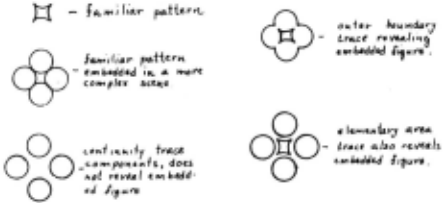
A distinction is required between (1) perceiv ing an embedded figure and using it as a natural structural unit (as was intended in the experiments of Djang), and (2) deliberate search to isolate possible embedded figures. The fourth example under type (c) embedment will readily be admitted to contain the simpler figure, but perception of the embedded figure as a visual unit is highly unlikely. Performance of humans in such tasks is hi ghly variable often depending on their initial organization of the pattern which then becomes difficult to alter.
@inproceedings{ijcai1975p103,
  title     = {Isolating And Identifying Objects In Line Drawings},
  author    = {Morofsky, Edward L. and Wong, Andrew K. C.},
  booktitle = {Proceedings of the Fourth International Joint Conference on
               Artificial Intelligence, {IJCAI-75}},
  publisher = {International Joint Conferences on Artificial Intelligence},
  editor    = {Patrick Winston and Carl Hewitt},
  pages     = {656--662},
  year      = {1975},
  note      = {Visual Information Processing},
  url       = {https://ijcai.org/proceedings/1975/103},
}
TY - CPAPER TI - Isolating And Identifying Objects In Line Drawings AU - Morofsky, Edward L. AU - Wong, Andrew K. C. T2 - Proceedings of the Fourth International Joint Conference on Artificial Intelligence, IJCAI-75 PB - International Joint Conferences on Artificial Intelligence PY - 1975 SP - 656 EP - 662 UR - https://ijcai.org/proceedings/1975/103 ER -Copied
Machine-readable versions of this paper, for tools and AI agents:





