
Application of Questionnaire Theory to Pattern Recognition
Proceedings of the Second International Joint Conference on Artificial Intelligence. Pages 391-400.
© 1971 International Joint Conferences on Artificial Intelligence
Abstract
Analogies between Pattern Recognition and Statistical Communication Theory are pointed out. Wit:. the relative entropy between the "ideal attribute" and "heuristic attribute" sets as an index o!' performance, optimum selection of possible heuristic operators results in a recognition decision in probabilitty, with the smallest possible average number of tests during a "sequential analysis". On the other hand, a computer generation of q_:;.asi -optimal operators may be done based on n ' ..:r~e rical attributes using the same entropy index of performance. Experimental res:;.! t s are presented : Optimal operator choice is demonstrated for recognition of handwritten capital letter words and for vocoder speech recognition. Cccputer building of quasi-optimal operators is stcwn fer digitized images. They are limited to first level linear pumerical operators.
- A:kr-.c••le:igement : The authors wish to thank a num- ber . :f graduate students, who during 69-71 have par:icipated to this study : M!-~. Davencens, Huet, l:ie•.de , Raabe , Sabah, Poussin, Sechet. REFERE:!"CES ( 1)
- Ash R. B. : "I,lformation Theory". Interscience Publishers. John Wiley & sons (1967).
- Becker P. W. : "Recogr.ition of Patterns", Polyteknisk Forlag, Copenhaguen (1968).
- Benzecri J. P. : "Theorie de l'Information et Classification". ISUP. Paris ( 1969).
- Benzecri J. P. : "St atistical Analysis as a t ool t o make Patt.erns emerge from data" pp. 35-74 in Methodologies of Pattern Recognitior. by Watanabe M. S. -Academic Press. ( 1969) .
- Bongard M. : "Pattern Recognition". Spartan books ( 1970).
- Bush R. R. and Estes W. K. : "Studies in Ma- thematical Learning Theory". Stanford Univ . Press. -Cal i f. (1968) .
- Fane R. M. : "Transmission of Information". MIT press. ( 1963) .
- Fu K.' S. ; "Sequential Methods in Pattern Re- cognition and Machine Learning". Acade- mic Press. ( 1968). (;i
- Evans T. G. : "Grammatical Inference Techni- ques in Pattern Analysis". Third Inter- national Symposium on Computer and In- f o rmation Sciences". Miami Beach, Fla. Dec. 18-20(1969).
- LeYis P. M. : "The Characteristic Selection Problem in Recognitior. Systems". 401 IRE Trans. Infer. Theory~. pp. 171-178 ( 1962).
- Masson C. G. : "Hierarchical Clustering of Data with a Mutual Entropy Criterion, its Structural Feature Extraction Abili- ty". IEEE Conference Record of the sym- posium on feature extraction and selec- tion in Pattern Recognition p. 155 ;
- Monod J. : "Le hasard et la necessite". Edi- tions du Seuil. Paris (1970).
- Picard : "Theorie des Questionnaires". Gau- thier-Villars. Paris (1965).
- Shaw A. C. : "The formal Description and Par- sing of Pictures". SLAG report n° 84, Stanford Linear Accelerator Center, Stanford Univ., Calif. (March 1968).
- Terrenoire, Faure and Chesnais : "Aide au diagnostic en Toxicologie". Congres d'Informatique. Toulouse (March 1970).
- Tou J. T. and Heydron R. P. : "Some approa- ches to optimum feature extraction" in "Computer and Information Sciences". Academic Press.
- N. Y. 1967.
- Uhr L. and Vossler Ch. :"A pattern recogni- tion program that generates and evalua- tes its OYn operators" en "Computer and Thought" by Feigelbaum and Feldman, Me. Graw Hill, 1963 .
- Uhr L. and Jordan S. : "The Learning of Para- meters for Generating Compound Charac- terizers for Pattern Recognition". Pro- ceedings of the IJCAI 1969. May 7-9. IJCAI
- Washington D. C.
References were extracted automatically from the PDF and may contain errors.
Full text extracted automatically from the PDF; figures, tables and equations may differ. The PDF is the version of record.
1 . Wor d recogr.itic~
The five operat ors of this stage are : {vhich l etter is the jth I j = 1, 2 ·· 5}.
The progra.r.. asks seq'J.entially for the most in formative letter detec t ion , until the vord proba bility detection reaches eo %. Fifty vords of five letters are to be read ; they vere selected at randon. Or. the average or.ly tvo letters out of fi ve had t o be deterrr.ined to obtain an eo % probabi lity.
2. Letter recogr.iti8n
'w'her. the jtr. letter has to be "read" , prepro cess ing of Xj is made. Frorr. tr. e prin:itive pattern Xj of 0 and l, "characteristic features" are ex tracted by a progra:::. These features are st raight segmer.ts. A ne· pri~itive pattern Y is obtained. Let us represent Y.
The first line contains the na.r..es of object or rel ati or.s cor.si dered in tl'.e colur..ns. Other li r.es are the analys i s res'.llts or attributes for rel&tions of feature s . Let us take the ex~~ple cf the letter A.
| PRI!~ | PRI!~ 2 | ?OS | POS 2 AGL |
| y 1 | 2 | c | 0 0 |
| 1 | 3 | 2 | 0 3 |
| 2 | 3 | 2 |
The seccr. d line contains feat ures and 2 (col~~n 1 and 2) ; 0 ir. the t hird and f ourth co lumns n:eans that they are linked by their tails ; 0 in the fift~ column codes the angle in octal re presentation . This representation is quite similar t o Sr.a1o1's F. D. L. ( 14)
Nine operat ors ere ap:;: lied t c a pat terr. Y.
- n'J!Tlber of prirr.i ti ve features.
- number of relations.
- number of primitive features found only in one line, 1.e. l inked t o one other feature only.
- · 4 nur.:ber cf grap::-. cycl es of a letter.
- &5 number of features linked by the 'middle .
- &6 POS 1 + 3 x POS 2 of second line ; this line is the first obtained through the preproces sing performed in a standard vay.
- &7 angle of second line (column five ) .
- &e angle of third line.
- &9 ~gle of fourth line.
Experience shovs that only c.,, &.2 and &e are called consistently by the progra.xr.. Alon.e they are sufficient to reach a decision on a letter vith high probability. The other operators thus are rejected.
On the average four questions vere sufficient to select a vord among fifty vith an 80 ~ probabi lity. For instance ZEBRE vas tested that vay :
Quest ion &2 on x2 (second letter).
Question 2 &2 on x, ( first letter ) .
Question 3 c., on x,.
Question 4 &e on x,.
Four questions were asked instead of the f or ty five possible questions.
II. 4 SPEECH RECOGNITION
Descripticr. of the experi~ent
The goal of tr.is progra.rr. is tc detect -:.r.e highest probability "phoneme s" in experi~er.t a:i. patterns delivered by a "vocoder". Fig. 1 dis plays the vocoder output ; a "line" is obtained every 23 milliseconds, it gives the digitized va lues of t he selecti ve filters and t he p:tc~ ve:i.ue.
- a . Seventeen he:.~ri st i c operators &. 1 , · · · &. 17 -.;ere implemented, such as :
- existence of a pitch di fferent fro~ zer c cr not.
- -number of relative maxima (formants ) .
- relative difference betveen first ~axir.: .. :.:-:-. and minimum.
- difference betveer. biggest maxinur.. an~ s~al lest minim· ..1m.
- variation of average intensi ty bet veen t··:o successive lines.
The operator choice was based on the need for being invariar.t t o translati ons of t he frequency and of t he intensity axes ( loga~i th mic scales ) .
- "Training set". A human operator had to de·: i de what is the phoneme to be recognized (set S1) versus the pattern obtained vith the vocoder. Fig. 1 shovs some of the VISU pro gra~ res~ts used by the human operator.
897
696
tt99
900
901
902
90J
904
'IUS
906
907
906
90~
911)
911
912
91J
91-
915
916
917
91a
919
0121)
921
922
'123
92 ..
925
926
927
9c8
929
931i
931
93c
933
93 ..
935
936
937
9l1S
939
940
~
A
0 0 1 0 0 0 1 1 2 2 1 I)
0 1 1 I) 0 1 0 1 2 2 2 0
5 3 J l 1 1 1 2 2 1 2 0
6 5 4 3 2 2 2 2 3 2 1 1
a 1 .... 3 J 2 3 3 2 l · ~
7 1 5 .. 3 3 .. - .. 3 2 J
9 7 5 5 J .. 3 .. .. 4 J 3
8 1 5 l 3 3 2 3 · 3 2 3
6 5 .. 3 2 l 3 3 3 3 2 3
1 s · 3 a l ;s · · · · 3 ·
9 d 7 7 6 ~ s 5 5 .. .. 5
1111 a 9 6 ~54 · ·s :s ·
131'+1012 9 7 .. 5 0 6 J ..
121312 91Q 0 .. ~ ~ 6 ~ 6
121-121d 9 6 5 ~ ! t ~ 6
12131311 9 6 '+ '+ & a '+ a
11111210 d 6 3 3 3 ~ 3 3
1 a 1 5 · 3 2 e: 3 3 2 ·
1111 9 8 8 a 6 6 6 5 '+ 5
a 8 9 6 b 3 ! 3 3 J e: 3
6 6 5 3 3 l 1 3 3 3 2 2
1 .. .. 1 0 1 1 2 3 2 2 1
0 1 1 0 0 0 l 1 3 ~ 1 0
0 0 0 0 0 1 1 2 2 2 2 0
.. J 3 J .. 3 5 ~ .. 5 5 0
1110 6 5 5 b 8 5 7 7 .. 6
10 8 7 6 .. 5 3 3 5 .. 2 3
.. 3 2 1 0 1 1 1 2 2 1 1
~ 3 .. 1 1 1 1 1 2 2 2 1
3 3 3 0 0 1 1 1 3 2 2 1
2 ~ ~ 0 0 1 1 1 3 ~ 1 1
6 .. 3 2 3 3 2 3 3 2 2 2
11 ~ 9 9 8 6 7 ~ 6 5 3 ..
11 8 ...... 6 .. 5 4 3 3 2
9 .. 2 2 2 3 3 5 3 3 2 1
9 6 6 .. 5 .. 6 t 5 3 3 ..
11 9 6 5 6 5 .. 5 6 .. 3 ..
11 8 5 .. 5 · - 6 6 .. 2 3
10 6 4 2 3 2 c ~ 7 5 ~ 3
10 - J 0 0 1 1 3 s 3 4 4
7 .. 3 1 0 1 1 2 3 ~ 2 3
5 2 2 1 0 0 1 2 3 2 1 1
.. 1 1 0 0 1 1 1 3 2 1 1
2 0 0 0 0 1 1 ~ 3 ~ 1 0
B
c
0
u
0
0
u
0
J
0
0
0 a
0
90
9J
69
90
0
0
O·
0
0
0
0
0
I)
0
0
(j
0
0 c
0
0
0
.. 33
2
3
..
:s
..
:s
.. 55 ..
7 0
1
6
66
6
.. ..
55
33
22
2
5 s
2
2 2
111
111 -
3 11
5
5
52 ..
0 ..
lOb S
105 s
0 5
117 s
118 3
o· 2
0 2
0 1
5
2 2
11
111
11 1
1
11
22a 1
2 222
2 1
11111 1
a2a a
2
2 a
33 2
53 3
3 3
.. 3
2
112
111
1
1
1111
l a
3
.. 33 3
~ 2 l
11
111
1
1
11
J 2
2
2 33 2
3 3 2
2 33 1
1 3 1
2 22
l 1
1
1
1
D
Fig. 1 VISU program giving the vocoder information "'hen the french "'ords "forte pluie" are pronounced
- A c Lir.e number, B Fitch values, D quency. Filter digitized outputs. "Formant" amplitude and, fre-
c. The program PROBA builts up the !:latrix lip (c..J(i ) , aj(k ) )II cf. Fig. 2.
- The program CORREL gives all the I (A j ; Ak) , j ~ k, j = E {1,.,., 17}.
- The program SYNTHE "'orks according to the algorithm described in §II.1; II.2, on a ne"' set of data, different from the training set. Fig. 3 sho"'s the modifications of (p (p (...(i) I aq)) for q = 1, 2, ... , 10,
Result
2
····
...
··
· ··
II<·········
<·········
<<··········
II<··········
~c··········
IO
10
I 1
I 2
I 3
I 3
I 3
I 3
I 2
I 2
<···········
IIV<<<·······
<···········
lfWVV<·······
IUwv<··«·<
lllllllf<··<<··
···v·<···<·<
·w·wv<······
IIIWII<··<V·<
<V<·········
tiWVVII«<<···
VVV<<·······
<<····
··
····
·····
····
..
I
I
I
I
I
I
I
I
I
I 2
I 1
..
10
10
10
I 1
I 1
I 1
I l
I 1
I 1
I 1
I 2
5 l 2
& I 3
6 I 3
5 I 3
6 1 3
5 I a
I - 5
IO
IO
I 1
I
···········<
IIW< .. <V·<<·<
tiV<<········
···
···
··
· ··
... . ..
I
I 1
I 1
I 1
10
I 2
J
<···········
. . . . .
tNVVVY<<<···
·v···<······
'tl*·········
tiV<·<···<···
V<<···<<····
IIIli·····<<···
·<······<···
<··
·····
···
···
·
..
· ····
...
E
- E Another display of filter outputs.
- Fi Four filter output sum, i = 1 first to four, i · 2 five to eight, i ~ 3 nine to t"'elve.
Results obtained
The results seem satisfactory at first vie"'· For instance, Fig. 3 sho"'s that STRATUS is reco gnized as :
?,S,S,S,S,R,T,T,R,A,A,A,R,R,R,R,R,T,?,U,U,U,R,S,S
The poor ability of the vocoder to detect S, R and L has to be remembered.
I
I
I
2
3
I
c.
I 3
I 2
I 2
I 2
I 1
IO
IIi I 1
I
I
I
·3
I 1
10
IO
10
I
I
I
10
IO
10
IO
I 1
I 3
I a
I 1
I 2
I 2
I 2
I 1
10
10
10
10
IO
3
·
..
..
3
2
2
3
10
IO
10
I 1
I 1
I 1
I 1
I 1
I 1
I 2
I 2
I 2
I 2
I 3
I 2
I 3
I 1
I 1
I 1
I 2
I 1
I 1
10
10
I 2
I 3
I l
10
I 1
I 1
I 1
I 1
I 2
I 1
I 1
I 2
I 2
I 2
I 2
I 2
I 1
I 1
I 1
10
.., .
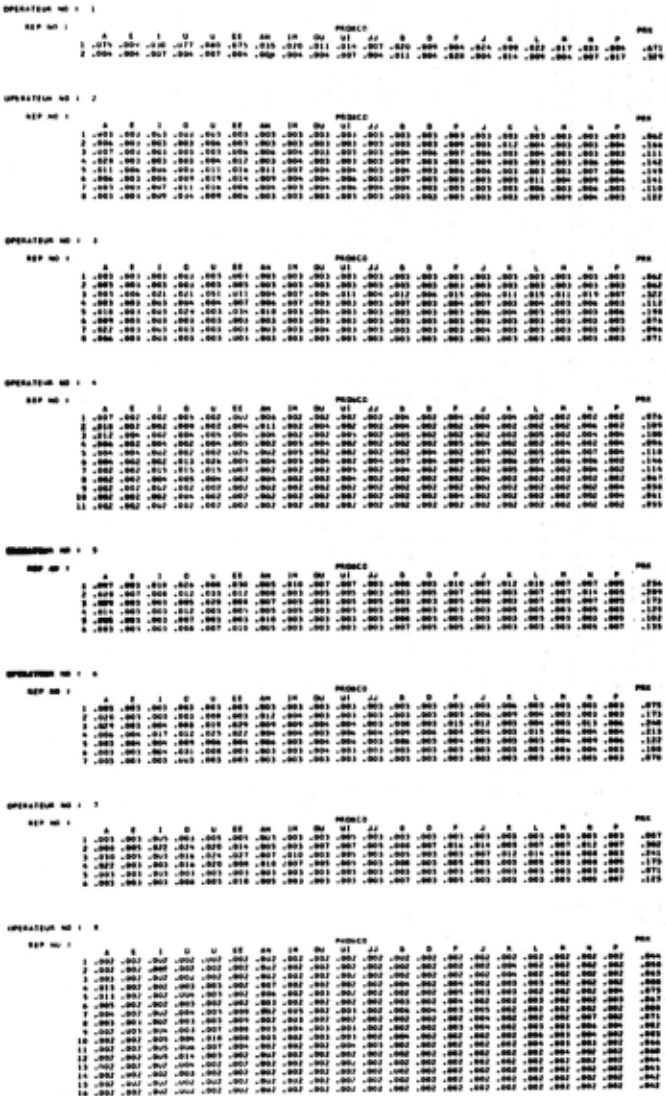
Fig. 2
For different &; used for operator evaluation I . ~
I .
I ' ' . I
u·,UIIl
| I' I ' | I ~ I I I I I )IU'O(I I I I ' ' I I .. . . . | ||||||||||||||||||
| I .. ... . ..... ..... | . • ' I ' It I• "" " I I ' . , . .. " . . . . .. .. . 0 . .. . . .. . . . | ||||||||||||||||||
| 10 , ..... .. | ' ' • • " .. .. .. .. | ||||||||||||||||||
| ...... .. ....... | • . . . | ' | |||||||||||||||||
| ....... II | ' ' . . . • ' . . . . • . " •• . . . . . • . . .. .. . . . . .. .. .. | ||||||||||||||||||
| ..... .. ..... .. | : • • . . . . . • . . " " .. T • • I ' . . . . . .. .. . . . | ||||||||||||||||||
| I (lll'-1 ...... ..... | ' • • • .. IO WI " • • ' . I . . . I I .. •• . I 0 • • . . .. .. . .. . . | • | ' | I I | |||||||||||||||
| " " • • lo .. .. I | I | I | |||||||||||||||||
| -- "''"II ..... .... ..... .. ...... .. | c • • . I • • • • . • •• .. I . . .. .. I . . . . . . | ||||||||||||||||||
| • •• '111:1 I• | . . . .. | ~ | |||||||||||||||||
| ...... II . | " . s . .. .. . .. .. . | : . | |||||||||||||||||
| . ' | . . .. | ' . . | I | I | I . | ||||||||||||||
| , .... o. ..... ,, ....... , I ..... . . | . . . . ' .. .. I• .. Ul " • • I . ' . I " " I . . . • • .. I . . 0 . . • . . . . | . | . | 0 | I | ||||||||||||||
| "" ... .. ...... . | " II " . .. .. . .. | I• 0 0 | 0 | ||||||||||||||||
| ,,. •o• II | • II | " | |||||||||||||||||
| ...... .. . | • . ' .. . II | ||||||||||||||||||
| "'" ""' II ...... | • • " . . • .. .. . . .. | . | |||||||||||||||||
| .. " . I ' | . . • . s . . • • ' . . . . • . • . .. . . 10 ... 01 " . . . .. .. . | I . . .. . | I | I | I . . | ||||||||||||||
| I .. . -.o. . ... . | • ' " .. .. . II .. | " I . | I | ||||||||||||||||
| .,.. .,..,. , .. | • .. .. I | I• I | |||||||||||||||||
| ' ...... | . . " ' • .. . .. .. I | ||||||||||||||||||
| ....... , I• . | ' . . ' . " . II I . . . . . . . .. | ||||||||||||||||||
| ...... ... .... II ....... " I I | " . .. .. ' . . .. " I s . . . .. I I • • .. .. | ' I • • I .. | I | . . | . | ||||||||||||||
| I , ,,. 11101 ...... .. . 1101 ' u• ..01 | I• • I u • ' . . . . .. .. IO . • 0 . .. " . . . • . . .. .. ' .. . . . .. , . . ' .. . . . . .. . .. .. . . . . . . . . . | ' ' I | I | ' | |||||||||||||||
| lo u• ..01 " "" ... I• (1JO'IGI | I . I I | 0 | |||||||||||||||||
| " ...... .. | 0 | . | |||||||||||||||||
| I I . .......... | " 0 . .. .. . ' .. s . • • • . ' I .. .. .. .. .. . . . . . . . .. . . .. . . | ' ' I ' l l .. . .. .. . | . | . | |||||||||||||||
| I> ...... II u• ..,, .. ..... ...... | l ' I ' I I . • I II • | " " lo I ' . . . . | .. | I | I | ||||||||||||||
| . ....... u• ..,, .. ... II | . .. , . .. • " .. • • .. .. . • .. .. • .. .. .. n , | . | |||||||||||||||||
| t.•..u• ..... " I | • . . • . • . . • I ' . . I • . . • • .. I , I | ' . | . | . . | . | ||||||||||||||
| I .. I I ... | " R . . • . . .. I . .. ULIIII(.f ' • " .... , . . . .. .. .. | ; I . I I I I . | . . | . | . | • • | |||||||||||||
| I I .. . I . .. ... .. ...... ..... . | I !tU.tllltl • I' ll ' . ' ' . I It I . .. . | ' ' ' I I . . .. | I | I | , | ||||||||||||||
| u• _,, . .. | . . .. ' ,, .. " . . . . ' . ' lo . I . . II I ' I . • .. .. .. . . . • .. , " • • -L-1 . : . . . | ||||||||||||||||||
| -- O" -• • .... .. | ' " . . .. . . . | ||||||||||||||||||
| ...... ... - II ... -· .. ... . | • " • It " . • • " .. T • . . I• .. . . . . . .. .. . . . , . • .. .. . . .. | ,· | • | . | |||||||||||||||
| ..... . ,. ... . ..... .. ....... . | ' ' . . I . I• ... VI " I • I • . • . . . ,, .. 10 . . • . . .. ' .. . . . . . . . .. . • . . " . . 10 .. | ||||||||||||||||||
| .... .. ._ . f!C I ,, | ' • . . . . .. . . 10 | ||||||||||||||||||
| .... v• -.co II | • .. . . . . . . . , . | ||||||||||||||||||
| " ..... .. II | " ., .. . . • I . . . . . . , | ||||||||||||||||||
| "'" •. ' .. . . | . " T ' . • .. , . . . | ||||||||||||||||||
| ..... ... -· ...... | • ' . " .. IO "" ' . I . . .. .. 10 I • . .. " . . . .. • ' I .. I | ||||||||||||||||||
| ... ...... . ..... II . | • .. ' I .. I • | ||||||||||||||||||
| M ... ' ,.J# • • | I . . .. • I . .. I | ||||||||||||||||||
| " ..... .. o• •• . ... .. | . : .. I . . . . .. . . ... . . . . . . .. | ||||||||||||||||||
| II . 10 o• •• - .. ..... .. | " R II I . .. .. .. .... .. " .. . ' .. " " • " . . . .. .. .. . . I II .. | ||||||||||||||||||
| ..... .. ..... . .. | ; ' I I . . • II . I . • .. II 0 I . . | ||||||||||||||||||
| ...... " ..... . .. I• | " . I • . .. . I . | ||||||||||||||||||
| ... ... .. ..... .. .. ..... | • • • . . . • .. . . . . . . . 011 . . I ' . . .. .. .. .. . . . . . . | ||||||||||||||||||
| " ... II&IUU . I ... I I .. • .. | A . .. I• ... .. . . . . .. | • | •I | I | |||||||||||||||
| u• "'' ' ..... . .. ..... . .. | II " .. II .. .. | " ' I " I I | ' | ||||||||||||||||
| .... . .. .. | |||||||||||||||||||
| ...... .. ..... II .. h. WI | |||||||||||||||||||
| .. " ..... .. | |||||||||||||||||||
| .. v••• | |||||||||||||||||||
| .. | |||||||||||||||||||
| .. .. A | |||||||||||||||||||
| • | |||||||||||||||||||
| • ' | |||||||||||||||||||
| ... UIJUit ... . . . . | |||||||||||||||||||
| . | |||||||||||||||||||
| .. | |||||||||||||||||||
| . . | . | . • . . . . |
.
"
Fig. 3
Successive probability distribution of phonemes after operators applications .
Decision is made after ten applications.
II. 5 GEJ>ERAL RECOGNITION PROGRAMMATION
The programs PROBA, CORREL, SYNTHE are general a11d may be utilized as an aid for building a pat tern recognition system :
- ( i) Take a "training set" and a "test set" of data Both of them are presented to the "teacher" or Ideal operator &id ; the results are intro duced in the computer.
- (ii) Implement some "heuristic" operators (&. I j E 1, ..· p}.
- (iii) See with CORREL if they are correlated by pair. ModifY the operators until Max I l&j ; ~) <Is, either by grouping or suppress1ng some of them.
- (iv) Use SYNTHE and see if the chosen number of operators is sufficient ; if not, add other operators to the set and go to (ii) ; if it is sufficient go to (iv) .
- ( v) What are the operators used by SYNTHE? Use PR<r BA to see if a probability clustering is appa rent. If possible, group some operators accor ding to this clustering. Go to (iii) .
If (v) is successful, only one operator re mains, very close to the "~deal operator". Other vise a pattern recogniti on process as described in §I. 1. has to be started anev on the new attribute sets, giving birth to a nev recognition level.
§III GEJ;ERATION OF QUASI OPTIMAL NUMERICAL OPERATORS
III. 1 PRINCIPLE
In paragraphe II, the operators &j are suppo sed t o be implemented by the human experimenter. The computer production of nev operators certain ly vould be of interest. For this purpose, we tried to introduce a program that builds new ope rators by combining the attributes of some former operators .
Let us consider e. "retina" made of elementary cells. The result registered by one of these cells may be considered as the attribute of a "hidden" operator. Let ai· aj · ·· be the variable names of these cell attributes ; each of these is an ele ment of the sets Ai, Aj··· Again the ideal opera tor &id will result in classifYing the X presented to the retina. Here this &id will be implemented by the experimenter himself, who will decide to which class X belongs.
In paragraph II, the process of using the string aj 1 , aj 2 ..· aj could be considered there sult of the action ofqa "union operator", the at tribute of which is an element of Aq (cf. II.l of this paper). We found that the information value of a string was H IU I Aq).
Let us consider an operator & 0 p working on p attributes and giving a new attribute a 0 p E Aop· The value of an operator & 0 is to reduce the dimensionality of the attriEute space. It follows from the same source as the idea of defining "re gions" by decision surfaces. But we can show, cf. Ash ( 1) p. 85, that the &ap performance index
By reducing the dimensionality we must try not to loose much information.
III.2 EXPERIMENT
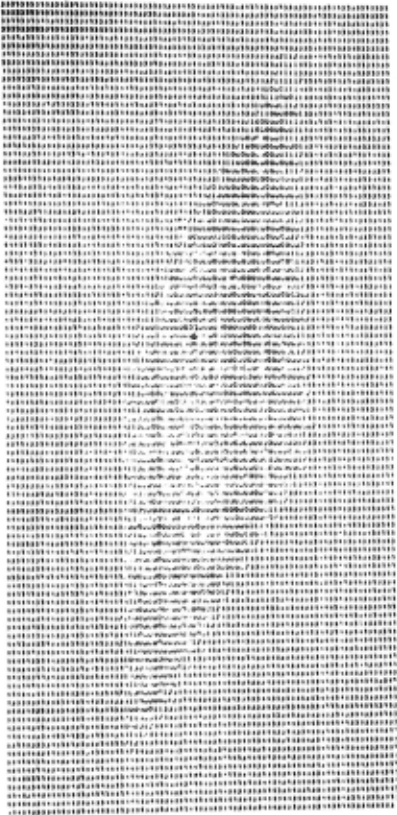
The pattern X is the result of an image digi tizer of four levels (0, 1, 2 , 3). The objects are simple shapes of nearly uniform level, cf. Fig. 5-a.
Let us call &r a parametered operator, such that it gives a 7 x 7 square subpattern . The parameters of &r are the coordinates XT, YT of the square center. Inside this 7 x 7 square, 49 attributes may be obtained for a certain xT, YT· They may be considered to be the results of 49 suboperators &r(v), with 1 < v < 49.
The geal is to decide which class the subpat tern selected by &r is from among the set ll = {,, ,N}. The elements of ll are determined by &id· here a human experimenter working with a "training set", cf. Fig. 4.
| n elements | (french) | (english) |
| BORD | BOUNDARY | |
| BLANC | WHITE | |
| N | NOIR | BLACK |
The training set is made of one hundred ele ments of each class, parts of wtich are shown on Fig. 4. The membership decision is made by the human ideal operator &id· In arbitrary units the entropy of n is H I Q = 143.
Using the matrix lip (W:i) I aj (k) )ll obtained vi th the training set, the operators 8r("v ) perfor mances are evaluated. The mutual informations bet ween &r(v) and ~d are given by Table I.
| 50 | 52 | 57 | 57 | 52 | 51 | 45 |
| 52 | 59 | 58 | 58 | 58 | 56 | 52 |
| 52 | 57 | 6o | 60 | 64 | 61 | 51 |
| 53 | 57 | 63 | 65 | 63 | 60 | 51 |
| 51 | 58 | 6o | 62 | 58 | 55 | 52 |
| 52 | 55 | 56 | 60 | 61 | 56 | 47 |
| 48 | 55 | 57 | 58 | 59 | 56 | 50 |
Table I
The quantities have to be compared to H(ll) · 143. The center cell maximum mutual infor mation value shows that the knowledge of the cor responding attribute alone is far from enabling us to make a correct decision.
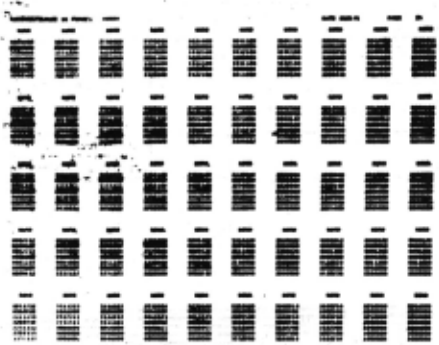
-
-
==
Sample of the "Training set" for BOUNDARY
UIIIU - = = = !!!5
.......... -~-... -
~- - - .... -- .. - -
- - -
| -~-... | .. | .. | .. | |||||
|---|---|---|---|---|---|---|---|---|
| ~- - - .... | - | ,. | - | ....... | - .. .. ..... | |||
| 1'"1~·~1. | -- I | !iii! ' na '" ... | - m::: ...... u: ...... | - -.an 5* | - -•u -· -··· - -.ua | -· _. .. , = _ .. | -· =: ....... -· | |
| ~ - | ||||||||
| I It' . •w- IUUU | - !!I 1::.1111 nuu1 | -I ........ | lllllll &:::~ UU.&&I ....... | !HS* ....... = | IIIII II Ulltll nnm ::::~· | 1111111 W:1!!! | t= ~ | ~ |
| ' .... | - | ... | - | |||||
| - ... u. - --- ... ,.. - - - - | ::::11 | §I | - - | - - | - | - - | ||
| ~ | § | = = | = | = e | - - - - - | - - - - - | - e | - - - - - |
| ....... | ||||||||
| - - - - - | == | - _ .. | - - | - - | UIIIW - | - | ||
| ; | ~ | - - - | - - - | - -· | - - | - - - | ~ | |
| = :::.~ | = | - - | - - - | - - - | - - | |||
| - - - - | - - | ·- - | -- - - | ··- - - | - -- - | - -- | ||
| ·- | - | - - - | - - ·- | ~ | - - | - - | - - - | |
| 5 | ||||||||
| - - | ||||||||
| · | ||||||||
- - -
- ..
,. _ _ .. _ .. _ .. _ ..
- - -
- - -
| ,,. .... | ::a | 'l | - | - | == | =- | |
| -....... , ..... | i | I | .. - | ||||
| ·-· - ...... | ~ | i | I | a | = - = | ii | |
| "'"'" u•- - | - :::. ::= ....... ... | -· -. | - | - | - | .. | |
| II | |||||||
| ....... | - | i!E | == | ||||
| uuow ·- ...... ....... | i -= I •• !Ill | i . | I | I ... | - | a - | |
| .. _ •"WII ...... UUIU .... .,, | = iii!! 1111111 | ·~·~-1-. I ........ ~:.r· , - | i ':'· | I I - | I I | ||
| ~ IUIUJ .. | I ~ | I - | I | ||||
| I | -:II | I | |||||
| i | - | - | |||||
| ... - | lliot' | II! | |||||
| ..,, -....... ... " | =- | ||||||
| I | |||||||
| ....... | |||||||
| .. ,,,. | |||||||
| "' | ~ | ||||||
| .... | |||||||
| !!!!! | |||||||
| !!!!!!! | |||||||
| I | |||||||
| . | = | ||||||
| !!!!!! | |||||||
| !!I |
..,, .. =- = · · II! I I
Fi g. 4 - Sample of the "Training set"- for BLACK
A list of the operators sing value of !o is made of operators is implement ed such that are ordered according to a decrea I [ &, n I . Thus the starting list the 49 operators ~(v) .
-Two operators are picked up randomly, their attributP.s are added. The new operator is inser ted 1n ! ·, tne lowest I value operator is discar ded.
After a number of iterations (2 minutes on UNIVAC 1108), an operator & is on t op of!.
Table II giyes the coefficient s a (v) such That : & : X ... a · L a(v)aT(V) ; I I 6. ; n I is equal to 103. v
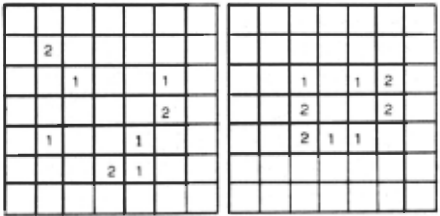
I · 103
Table II
I = 107
Tabl e III
2 Taking the first eleven operators of £ 0 , their attribute addition two by t wo generates 55 new operators. The starting l i st nov consists of 104 elements. Applying the same proces s as before, after 120 iterations an operator & is obtained on top of!. Table III gives t he coeffi ci ents a (v ) of this &, the mutual information I [ & ; Q is nov equal to 107 .
3 Using the multipl i cat i on operation
With the method of 2., the best & has an I [U ; &1 · 75. The B(v) are given by Table IV · The performance is barely better than the center cell performance.
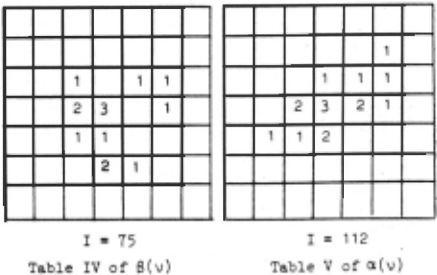
4 - Using the 104 initial list £0 , see 2 , the associated operators are selected so that the sum I ( U ; & 1 ) + I f U ; &k) is maximum, &1, &k having not been selected before. The new operator & is obtained by the addition of the two &1, &k attri butes. Table V gives a(v) for the operator & on top of £ after iterations .
The mutual information is I [U; & )z 112. This operator & is quite similar to a "digital filter" such as an experimenter would provide af ter examination of the proposed problem.
The performance of this la5t operator was tes ted. Table VI give5 the frequency of occurence of & attributes a versus the &id attributes on the training set.
| I:>: | 0 1 3 | 7 | 10 | 12 | 13 | t6 | 21 23 | 28 | 29 | 32 | 33 | 35 3E |
| !BOUND !BLACK | • 6 | ·a o | a | 2 2 | I? | I 3 | 13 13 I | I 0 | 4 9 | 2 I 2 | 3 I 0 | IS I 4 I |
| WHITE ac | 9 IS t | 2 | 6 | N |
--.... ..........._ .... ..
........................... __.. ......................... "'. ·.· ............ """''' .. ······ ...... -........... ........ .. .
Fig. 5-b : results of the § III experimenc
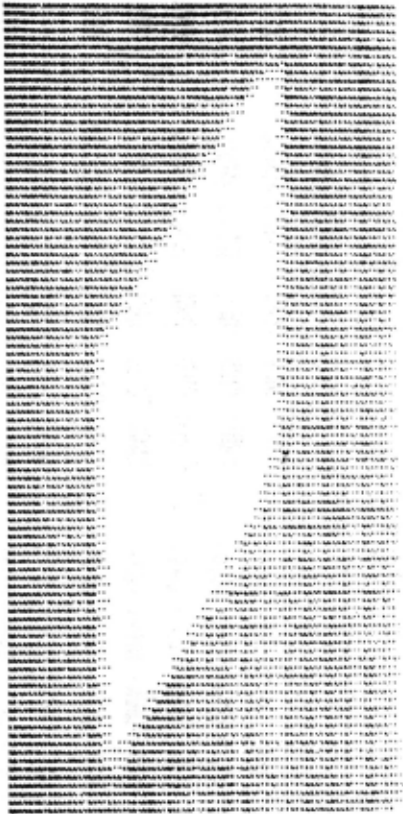
Examination of Table VI leads to choosing the thresholds betYeen 3 and 7 and 23 and 28. A neY operator classifier &c of attribute ac is imple:!lented such that Ac = { , . , N}.
The couple &c o & of sequentially applied ope rators is an approximation of &id· The discrepan-. cy rate with &id is close to 11 %. Application of this machine generated operator is shoYn on Fig. 5-b. The results are satisfactory.
III . 3 CONCLUDING REMARK
Modern biochemists believe that an evolutiona ry process has built up the nucleotide strings by random variations folloYed by performance tests. Life did not alloY the uninteresting or unfit bio molecules to survive, cf. Monod J. (12).
Our results have a similarity to this point of vieY. One Yonders if brain organisation may not have gone through a similar evolution : random for~ation of neY operators, selection of the best by their performances. This point of vieY is also te~pting in practical Pattern Recognition, though the process of building up at random the highest order operators seems some··hat improbable,
A:kr-.c··le:igement : The authors wish to thank a num ber .:f graduate students, who during 69-71 have par:icipated to this study : M!-~. Davencens, Huet, l:ie·.de , Raabe , Sabah, Poussin, Sechet.
REFERE:!"CES
- ( 1) Ash R. B. : "I,lformation Theory". Interscience Publishers. John Wiley & sons (1967).
- Becker P. W. : "Recogr.ition of Patterns", Polyteknisk Forlag, Copenhaguen (1968).
- Benzecri J. P. : "Theorie de l'Information et Classification". ISUP. Paris ( 1969).
- (~) Benzecri J. P. : "St atistical Analysis as a t ool t o make Patt.erns emerge from data" pp. 35-74 in Methodologies of Pattern Recognitior. by Watanabe M. S. -Academic Press. ( 1969) .
- ( 5) Bongard M. : "Pattern Recognition". Spartan books ( 1970).
- Bush R. R. and Estes W. K. : "Studies in Ma thematical Learning Theory". Stanford Univ . Press. - Cal i f. (1968) .
- Fane R. M. : "Transmission of Information". MIT press. ( 1963) .
- ( b) Fu K.' S. ; "Sequential Methods in Pattern Re cognition and Machine Learning". Acade mic Press. ( 1968).
- (;i) Evans T. G. : "Grammatical Inference Techni ques in Pattern Analysis". Third Inter national Symposium on Computer and In formation Sciences". Miami Beach, Fla. Dec. 18-20(1969).
- ( 10) LeYis P. M. : "The Characteristic Selection Problem in Recognitior. Systems".
IRE Trans. Infer. Theory~. pp. 171-178 ( 1962).
- ( 11) Masson C. G. : "Hierarchical Clustering of Data with a Mutual Entropy Criterion, its Structural Feature Extraction Abili ty". IEEE Conference Record of the sym posium on feature extraction and selec tion in Pattern Recognition p. 155 ; Argonne National Laboratory, Argonne Illinois, U. S. A. Oct. 5-7-(1970).
- Monod J. : "Le hasard et la necessite". Edi tions du Seuil. Paris (1970).
- ( 13) Picard : "Theorie des Questionnaires". Gau thier-Villars. Paris (1965).
- ( 14) Shaw A. C. : "The formal Description and Par sing of Pictures". SLAG report n° 84, Stanford Linear Accelerator Center, Stanford Univ., Calif. (March 1968).
- ( 15) Terrenoire, Faure and Chesnais : "Aide au diagnostic en Toxicologie". Congres d'Informatique. Toulouse (March 1970).
- ( 16) Tou J. T. and Heydron R. P. : "Some approa ches to optimum feature extraction" in "Computer and Information Sciences". Academic Press. N. Y. 1967.
- ( 17) Uhr L. and Vossler Ch. :"A pattern recogni tion program that generates and evalua tes its OYn operators" en "Computer and Thought" by Feigelbaum and Feldman, Me. Graw Hill, 1963 .
- ( 18) Uhr L. and Jordan S. : "The Learning of Para meters for Generating Compound Charac terizers for Pattern Recognition". Pro ceedings of the IJCAI 1969. May 7-9. Washington D. C.
@inproceedings{ijcai1971p40,
  title     = {Application of Questionnaire Theory to Pattern Recognition},
  author    = {Simon, J. C. and Roche, C.},
  booktitle = {Proceedings of the Second International Joint Conference on
               Artificial Intelligence, {IJCAI-71}},
  publisher = {International Joint Conferences on Artificial Intelligence},
  editor    = {D.C. Cooper},
  pages     = {391--400},
  year      = {1971},
  url       = {https://ijcai.org/proceedings/1971/40},
}
TY - CPAPER TI - Application of Questionnaire Theory to Pattern Recognition AU - Simon, J. C. AU - Roche, C. T2 - Proceedings of the Second International Joint Conference on Artificial Intelligence, IJCAI-71 PB - International Joint Conferences on Artificial Intelligence PY - 1971 SP - 391 EP - 400 UR - https://ijcai.org/proceedings/1971/40 ER -Copied
Machine-readable versions of this paper, for tools and AI agents:





