
Pattern Recognition by an Artificial Tactile Sense
Proceedings of the Second International Joint Conference on Artificial Intelligence. Pages 376-383.
© 1971 International Joint Conferences on Artificial Intelligence
Abstract
This paper proposes an artificial tactile pattern recognition system, which combines recognition b)' touching the object surface with an artificial tactile sense and recognition by grasping the object with an artificial hand. The inspiration for this proposition was found in the function of the tactile sense of a human hand. The fundermental principle of artificial tactile pattern recognition is to process a stress distribution that the unknown object produces in the artificial tactile sense elements. In the proposed method, the 3-dimensional stress distribution is partitioned into a 2-dimensional peripheral pattern and a threshold decrement by analogy with threshold phenomena in the living body. The object surface is recognized as a sequence of the peripheral processings at each threshold decrement. A simple experiment classifying cylinders and square pillars was performed by the artificial hand with on-off switches instead of the pressure sense elements. As the result, a high reliability of recognition is obtained.
Full text extracted automatically from the PDF; figures, tables and equations may differ. The PDF is the version of record.
1. Introduction
A manipulator system extending the function of the human hand has been carried out mainly for controlling nuclear " hot ce lis ". In this sys tem, the perception of the handled objects is performed by the visual and tactile senses of an oparator. He can see the object, but the system requires a closed loop to feed back tactile sen sory information to the oparator's hand. The op erator senses only pressure which is given by the bilateral servo in the manipulator system. Howev er, in this system an artificial hand is not being operated by machine, but by the operator. In contrast, the authors intend to develop a system for an artificial hand which is operated automat ically by the machine.
In considering a system for an artificial hand or a manipulator system with artificial intel ligence for handling the cubic objects, it is nec essary that the system should have the functions to carry out the various mechanical operations automatically with respect to the results of recognition of the objects. Therefore, the device The following steps are considered to be the process of pattern recognition of an artificial hand with an artificial tactile sense.
1) Detecting quantitatively the size or form of the object from the sensing of the hand which is gripping the object.
2) Judging the state of the object surface by the artificial tactile sense.
3) Judging the state of the other surface by cha nging the grip state of hand.
4) Perceiving the object from the information of step 1) -step 3). The main discussion here is of the perception of the object surface state of st ep 2) .
2.2 A Model of Tactile Receptor.
As shown in Fig . l, a simple model of tactile sense is derived from the physiological one. A rectangular box in the figure indicates the rece ptor of Fig.2. It is well known that the sensory nerve and its ending which governs the tactile sense exist in skin. The model ignores the funct ions of temperature, pain and touch and arranges a piezo-electric element or strain sensor corres" ponding to the pressure sense.
Until the collagen fibers become aligned in the direction of applied stress, the microscopic arc hitecture of the collagen fibers in the dermis of skin is such as to allow a large deformation at very low stress.
Therefore, the authors consider the model in which the area surrounding a piezo-electric elem ent is filled by semi-elastic material. When any object comes in contact with the surface of model, a strain resulting in elastic deformation of mate rial induces and is converted to an electrical signal by a piezo-electric element. Also, the Ma ch phenomenon which has the action of extracting the object edge feature occurs in skin similar to visual sense. The Mach phenomenon may be used in the processing of pattern.
2.3 A Realization of Receptor
It is well known that the physiological recept or corresponding to pressure sense is the Pacini an corpuscle emits impulses according to corpuscle deformation which results from the strain of skin tissue . The sensory nerve ending in a Pacinian corpuscle is surrounded by a lamellated fluid-fi lled capsule which is dependent on the viscous element. Then, an object pattern is able to be discriminated through the pressure pattern or str ess distribution of a group of Pacinian corpuscl es. Therefore, the receptor unit corresponds to Pacinian corpuscle described above and its unit input given as shown in Fig.2 can be considered as the surface of Pacinian corpuscle. As shown in Fig . 2, the inner potential I of the receptor is compared with a given thresh8ld e. If the inner potential I is greater than a threshold e, the receptor oufput is given by a function generator. The inner potential lp is an unknown factor, but it is able to determine a level on the basis of the threshold ; In case of pressing globular surface against a surface of tactile sense, the str ess distribution rasing in the receptive field corresponding to receptive group is shown in Fig. 3. Its distribution is a 3-dimensional one. The stress distribution is processed by the informa tion for the each threshold. The authors consid er the recognition of the surface shape of an object by the following method.
2.4 Recognition of the Pressure Distribution
From the result of the preceeding section, the pressure distribution due to the object is rec ognized by the VARISHOLD Method.
Let R be a region of the receptive field and let V( x,y,z ) be the distribution of pressure in R, and R, V( x,y,z ) are a subset of 3-dimen sional Euclidean space E.
V C R C E
V( x,y,z ) is supposed as a convex from the object shape. Moreover, the threshold distribu tion e is considered as a plane.
Consider the intersection Xi between V(x,y,z) and p ( e ) .
where ei is taken by the value for which Xi is not an empty set.
P( ei=l )is given by a supporting hyperplane to V( x,y,z ). Suppose that
V( x, y, z ) may be described approximately,
where IJ , Iii are a direct swn and a direct product, respectively .
Therefore, as a boundary of Xi represents Xsi. for each i, recognizing these 2-dimensional pat terns Xsi , that is , periphery pattern of Vi, 3-dimensional pattern V( x,y,z ) is recognized by the following method.
Pattern V( x,y,z ) is approximately given by the patterns x 8 i recognized in close succ~ssion. Intersection ~ between standard plane P and V( x,y,z ) may be defined as
~here P ·P( ei =o ), o is a small value. P and P( e i ) are planes and parallel to each other .
Let MS define a lin~ 1 parallel to z-axis and a line(' parallel to (through any point ui.of ·the set Xi on the 2-dimensional plane P( e i ), and let ui' be~a point sue~ that Then, a parallel projection may be defined as
By the~parallel projection in the direction of the line r. the e~ements in the pattern xi are projected on the p . Xi' may be defined as
for i= 1,2, 3, ...... ,n
A subscript i correspondsto the threshold ei and in the case of the subscript i = 1, the plane P( ~=l) is a supporting hyperplane of V(x,y,z).
Therefore, the parallel projection for each threshold ei satisfies the following relation, which shows the relationship between a mapped Xi' and X for the form of V( x,y,z ).
- Pillared form
A cylinder --- Xi ; a circle for each subscript i.
A square pillar ---- X! ; a square for ea~h subscript i.
- Pyramidal form or spherical form
- Ridge or hip form
- Frustum
Frustum of a cone --- X! ; a circle for each subs~ript i.
Frustum of a pyramid ---- X! ; a square for each subscfipt i.
5) Plane
where p,s and w are a point, a segment and a small closed plane, respectively.
From this classification, it is apparent that the overall pattern V( x,y,z ) is recognized by the state of touch sensation in case of subscript i · 1.
A point of u 1 , u. and u on the line 1· may be described by an equAtion of a form similar to the equation [6),
and u. is satisfied by the following equation 1
A cross-sectional patte~ X 1 , ~ and x·. given by the threshold P( e 1 ),~ ~na P( e. ) 1 are represented by J (X ), J( X) and J~( X. ), res~ectively. Thl relationship betweefi th~ J 1 (X 1 ) 1c X) and J. ( X. ) is given by the following theorem. 1 1
Theorem
Ihe following inequality for the Jl( xl ), }c X ) and Ji ( Xi ) is established
the equal sign is valid for a case which V(x,y;z) is a pillar and frustum form .
Proof ~t W( x,y,z ) be a solid figure of which ·the pattern ~.s the pattern x 1 connected with the pattern X. W( x,y,z ) is included in the V(x,y,z) which is a convex pattern. The pattern ~. may be defined as 1
X. is included in the pattern Xi because of W( x!y,z )C V( x,y,z ).
Therefore,
for W( x,y,z~), the area corresponding to the pattern X 1 , X and~. is given by Minkovsky's inequality. 1
Then, the inequality [18] is shown by the inequality [20] and [21].
3. Pattern Recognition of the Grasped Object by the Artificial Hand .
Pattern recognition of the grasped object is carried out by the artificial hand with the tac tile sense . in an important factor for recogniz ing the surface shape of grasped object by the artificial hand. There are two distinct types of recognition for the grasped object by the artifi cial hand with the tactile sense. It is divided into two important properties of a method of recognition in which one type is to detect a point of contact with the surface of the object, another is to recognize the surface shape of the object as the information for recognizing the pattern of the grasped object surface by the artificial hand. In the each case, a possibility of detecting a coordinate of the artificial hand or finger must be included and the function of the artificial hand with the tactile sense is classified into 4 groups.
It is difficult that piezoelectric elements are closely arranged on the hand or the fingers as mentioned in the previous section. This section describes that the artificial hand as shown in Fig.4 grips the object and recognizes the object shape by means of the data, that is, the points of contact which are given by the artificial hand and the object.
as the art{ficial tactile sense is arranged on the surface of the artificial hand or finger.
h~en the artificial hand grasps the ob ject, the pattern of r-on-off switches, x 1 ,x 2 , . .. . . . . . , x is defined as v( x 1 ,x 2 , .·. ,x ) which represent§ a point in a r-dimens1onal shipe, which is associated x 1 ,x,, ..... , x with the co-ordinate axis, respectively. r
A set of the points in the space, v 1 ( x 1 ,x 2 , ... .. ,x ),v 2 (x 1 ,x~·······x ), ....... v(x 1 , x,, : . ... .. , x )~is given byrgrasping theqobject many times. Th~n. the set of these points is clas sified by some categories which correspond to the pattern of the object. Let us define a hyperplane ~hich classifies the set of these points, for example, point v. belong to the category a, point v. belong to the 1 category 8, that is, J

where A ~ B represents the inner product of A and B, lA I = A · A.
Therefore, the set belonging to the each cat egory is classified by the same hyperplanes and the object is classified by the category which corresponds to the object . .
3. 1 An Experiment of Pattern Recognition by the Artificial Hand with the Tactile Sense.
The tactile sense as shown in Fig . 4 consists of 22 on-off switches arranged in order . A coef ficient of the hyperplane equation is decided by grasping separately two kinds of object, a cyl inder ( 90 mm in diameter ) and a square pillar ( 70 mm in a side).
The artificial hand grasps each object 10 times and the pattern of on-off switch is given by v 1 ( xl , x2' .. · .... · x22 ), v2( xl,x2, ....... · x22). ......... , v 70 C x 1 ,x 7 , .... ..... , x 77 ).
These hyperplanes for separating Hie cylinder and the squar pillar can be given and a coeffi cien t of the following equation [23) can be made into table 1 ,
2 2
A position signs. of v.( x 1 ,x,, for each hyperplane ~ay beJdef1ne8 as A sign table is made into table 2. From the sign table, the hyperplane is eliminated by the method which lists up the representative point in the same subspace. Table 2 can be rewritten as table 3 (2).
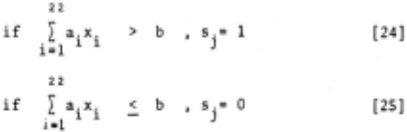
It is clear from table 3 that row v 4 can be eliminate from table 4 regardless of pattern classification, if v 1 , that is, s . for the hyper plane I of pattern 2 and v , s . f6r the hyperpla ne III of pattern 2 have tRe v!lue 1 or 0. Then, table 4 is given, and a block diagram of pattern classification is shown in Fig . 5 .
3.2 Experimental Results
The classification of the grasped object by the artificial hand is carried out automatically on the basis of a sequence consisting of search action, grasping action and action of classifi cation.
Grasping action is carried out with the fol lowing steps as shown in Fig.6 for processing the grasp uniformly.
Step 1. The object is grasped by the thumb and the index finger .
Step 2. The object is lifted by a wrist rotation.
Step 3 The little finger grasps the object in addition .
Step 4. The index finger is removed from the object .
Step 5. The object is grasped by the thumb and fingers.
The experiment of the classification is car ried out by using the objects of the cylinder and the square pillar including the one which is used for deciding the coefficient of the hyperplane.
Table 5 shows the object type which is used for the experiment. The number of times, and the square pillar is grasped by the state which is slightly rotated on its axis. As the experimental results, a percentage of correct answers for the classification is tabulated in table 5.
It is evident that the percentage of correct answer is over 90 percent for a neighbourhood of the object, C3 and 53 which is used for deciding the coefficient of hyperplane. The result of the experiment may be applied to the recognition of the object by adjusting the finger length in case of limited objects.
4. Conclusion
A method of pattern recogn1t1on has been dis cussed which uses an artificial tactile model which has been compared to a physiological model of skin.
It is shown that recognition of its shape over the surface of the solid object can be easily carried out by the artificial tactile sense,rath er than by the artificial visual sense and also that the artificial tactile sense can be used as an supplementary method for processing of the ar tificial visual sense. The relationship of the area of patterns for each threshold is given.
Moreover, the method and some experiments for recognizing the grasped object are given. A sim ple experiment classifying the cylinders and the square pillars is performed by the artificial hand with on-off switches instead of the elements of the artificial tactile sense .
Experimental results show a high probability of recognition.
5. Acknowledgement
The authors wish to ackno .. ·ledge the co-opera tion of Mr.K.Takase in constructing the artifi cial hand and its logic circuit from the model studied on a digital computer. The authors thank also to Dr . Y.Umetani for helpful discussions.
@inproceedings{ijcai1971p38,
  title     = {Pattern Recognition by an Artificial Tactile Sense},
  author    = {Kinoshita, Gen-ichiro and Aida, Shuhei and Mori, Masahiro},
  booktitle = {Proceedings of the Second International Joint Conference on
               Artificial Intelligence, {IJCAI-71}},
  publisher = {International Joint Conferences on Artificial Intelligence},
  editor    = {D.C. Cooper},
  pages     = {376--383},
  year      = {1971},
  url       = {https://ijcai.org/proceedings/1971/38},
}
TY - CPAPER TI - Pattern Recognition by an Artificial Tactile Sense AU - Kinoshita, Gen-ichiro AU - Aida, Shuhei AU - Mori, Masahiro T2 - Proceedings of the Second International Joint Conference on Artificial Intelligence, IJCAI-71 PB - International Joint Conferences on Artificial Intelligence PY - 1971 SP - 376 EP - 383 UR - https://ijcai.org/proceedings/1971/38 ER -Copied
Machine-readable versions of this paper, for tools and AI agents:





