
3D-Aided Deep Pose-Invariant Face Recognition
Proceedings of the Twenty-Seventh International Joint Conference on Artificial Intelligence. Main track. Pages 1184-1190.
https://doi.org/10.24963/ijcai.2018/165
Keywords
- Machine Learning: Transfer, Adaptation, Multi-task Learning
- Machine Learning: Semi-Supervised Learning
- Machine Learning: Learning Generative Models
- Computer Vision: Biometrics, Face and Gesture Recognition
- Machine Learning: Neural Networks
- Machine Learning: Deep Learning
- Computer Vision: Computer Vision
Abstract
Learning from synthetic faces, though perhaps appealing for high data efficiency, may not bring satisfactory performance due to the distribution discrepancy of the synthetic and real face images. To mitigate this gap, we propose a 3D-Aided Deep Pose-Invariant Face Recognition Model (3D-PIM), which automatically recovers realistic frontal faces from arbitrary poses through a 3D face model in a novel way. Specifically, 3D-PIM incorporates a simulator with the aid of a 3D Morphable Model (3D MM) to obtain shape and appearance prior for accelerating face normalization learning, requiring less training data. It further leverages a global-local Generative Adversarial Network (GAN) with multiple critical improvements as a refiner to enhance the realism of both global structures and local details of the face simulator’s output using unlabelled real data only, while preserving the identity information. Qualitative and quantitative experiments on both controlled and in-the-wild benchmarks clearly demonstrate superiority of the proposed model over state-of-the-arts.
- Abadi et al., ] Martín Abadi, Paul Barham, Jianmin Chen, Zhifeng Chen, Andy Davis, Jeffrey Dean, Matthieu Devin, Sanjay Ghe- mawat, Geoffrey Irving, Michael Isard, et al. Tensorflow: A sys- tem for large-scale machine learning.
- [Amberg et al., 2007] Brian Amberg, Sami Romdhani, and Thomas Vetter. Optimal step nonrigid icp algorithms for surface registra- tion. In CVPR, pages 1-8, 2007.
- [Blanz and Vetter, 1999] Volker Blanz and Thomas Vetter. A mor- phable model for the synthesis of 3d faces. In SIGGRAPH, pages 187-194, 1999.
- [Cao et al., 2014] Chen Cao, Yanlin Weng, Shun Zhou, Yiying Tong, and Kun Zhou. Facewarehouse: A 3d facial expression database for visual computing. TVCG, 20(3):413-425, 2014.
- [Cheng et al., 2017] Yu Cheng, Jian Zhao, Zhecan Wang, Yan Xu, Karlekar Jayashree, Shengmei Shen, and Jiashi Feng. Know you at one glance: A compact vector representation for low-shot learning. In ICCVW, pages 1924-1932, 2017.
- [Crosswhite et al., 2017] Nate Crosswhite, Jeffrey Byrne, Chris Stauffer, Omkar Parkhi, Qiong Cao, and Andrew Zisserman. Template adaptation for face verification and identification. In FG, pages 1-8, 2017.
- [Gross et al., 2010] Ralph Gross, Iain Matthews, Jeffrey Cohn, Takeo Kanade, and Simon Baker. Multi-pie. JIVC, 28(5):807- 813, 2010.
- [Hassner et al., 2016] Tal Hassner, Iacopo Masi, Jungyeon Kim, Jongmoo Choi, Shai Harel, Prem Natarajan, and Gerard Medioni. Pooling faces: template based face recognition with pooled face images. In CVPRW, pages 59-67, 2016.
- [He et al., 2016] Kaiming He, Xiangyu Zhang, Shaoqing Ren, and Jian Sun. Deep residual learning for image recognition. In CVPR, pages 770-778, 2016.
- [Huang et al., 2017] Rui Huang, Shu Zhang, Tianyu Li, and Ran He. Beyond face rotation: Global and local perception gan for photorealistic and identity preserving frontal view synthesis. arXiv preprint arXiv:1704.04086, 2017.
- [Kan et al., 2014] Meina Kan, Shiguang Shan, Hong Chang, and Xilin Chen. Stacked progressive auto-encoders (spae) for face recognition across poses. In CVPR, pages 1883-1890, 2014.
- [Klare et al., 2015] Brendan F Klare, Ben Klein, Emma Taborsky, Austin Blanton, Jordan Cheney, Kristen Allen, Patrick Grother, Alan Mah, and Anil K Jain. Pushing the frontiers of uncon- strained face detection and recognition: Iarpa janus benchmark a. In CVPR, pages 1931-1939, 2015.
- [Li et al., 2016] Jianshu Li, Jian Zhao, Fang Zhao, Hao Liu, Jing Li, Shengmei Shen, Jiashi Feng, and Terence Sim. Robust face recognition with deep multi-view representation learning. In ACM MM, pages 1068-1072, 2016.
- [Masi et al., 2016] Iacopo Masi, Stephen Rawls, Gérard Medioni, and Prem Natarajan. Pose-aware face recognition in the wild. In CVPR, pages 4838-4846, 2016.
- [Parkhi et al., 2015] O. M. Parkhi, A. Vedaldi, and A. Zisserman. Deep face recognition. In BMVC, 2015.
- [Paysan et al., 2009] Pascal Paysan, Reinhard Knothe, Brian Am- berg, Sami Romdhani, and Thomas Vetter. A 3d face model for pose and illumination invariant face recognition. In AVSS, pages 296-301, 2009.
- [Ranjan et al., 2017] Rajeev Ranjan, Carlos D Castillo, and Rama Chellappa. L2-constrained softmax loss for discriminative face verification. arXiv preprint arXiv:1703.09507, 2017.
- [Sagonas et al., 2015] Christos Sagonas, Yannis Panagakis, Ste- fanos Zafeiriou, and Maja Pantic. Robust statistical face frontal- ization. In ICCV, pages 3871-3879, 2015.
- [Sankaranarayanan et al., 2016] Swami Sankaranarayanan, Azadeh Alavi, Carlos D Castillo, and Rama Chellappa. Triplet probabilis- tic embedding for face verification and clustering. In BTAS, pages 1-8, 2016.
- [Schroff et al., 2015] Florian Schroff, Dmitry Kalenichenko, and James Philbin. Facenet: A unified embedding for face recog- nition and clustering. In CVPR, pages 815-823, 2015.
- [Shrivastava et al., 2016] Ashish Shrivastava, Tomas Pfister, Oncel Tuzel, Josh Susskind, Wenda Wang, and Russ Webb. Learn- ing from simulated and unsupervised images through adversarial training. arXiv preprint arXiv:1612.07828, 2016.
- [Simonyan and Zisserman, 2014] Karen Simonyan and Andrew Zisserman. Very deep convolutional networks for large-scale im- age recognition. arXiv preprint arXiv:1409.1556, 2014.
- [Sun et al., 2015a] Yi Sun, Ding Liang, Xiaogang Wang, and Xi- aoou Tang. Deepid3: Face recognition with very deep neural networks. arXiv preprint arXiv:1502.00873, 2015.
- [Sun et al., 2015b] Yi Sun, Xiaogang Wang, and Xiaoou Tang. Deeply learned face representations are sparse, selective, and ro- bust. In CVPR, pages 2892-2900, 2015.
- [Taigman et al., 2014] Yaniv Taigman, Ming Yang, Marc'Aurelio Ranzato, and Lior Wolf. Deepface: Closing the gap to human- level performance in face verification. In CVPR, pages 1701- 1708, 2014.
- [Tran et al., 2017] Luan Tran, Xi Yin, and Xiaoming Liu. Disentan- gled representation learning gan for pose-invariant face recogni- tion. In CVPR, 2017.
- [Wu et al., 2015] Xiang Wu, Ran He, Zhenan Sun, and Tieniu Tan. A light cnn for deep face representation with noisy labels. arXiv preprint arXiv:1511.02683, 2015.
- [Xiao et al., 2016] Shengtao Xiao, Jiashi Feng, Junliang Xing, Hanjiang Lai, Shuicheng Yan, and Ashraf Kassim. Robust facial landmark detection via recurrent attentive-refinement networks. In ECCV, pages 57-72, 2016.
- [Yang et al., 2016] Jiaolong Yang, Peiran Ren, Dong Chen, Fang Wen, Hongdong Li, and Gang Hua. Neural aggregation network for video face recognition. arXiv preprint arXiv:1603.05474, 2016.
- [Yim et al., 2015] Junho Yim, Heechul Jung, ByungIn Yoo, Changkyu Choi, Dusik Park, and Junmo Kim. Rotating your face using multi-task deep neural network. In CVPR, pages 676-684, 2015.
- [Zhao et al., 2017a] Jian Zhao, Jianshu Li, Fang Zhao, Shuicheng Yan, and Jiashi Feng. Marginalized cnn: Learning deep invariant representations. In BMVC, 2017.
- [Zhao et al., 2017b] Jian Zhao, Lin Xiong, Panasonic Karlekar Jayashree, Jianshu Li, Fang Zhao, Zhecan Wang, Panasonic Su- giri Pranata, Panasonic Shengmei Shen, Shuicheng Yan, and Ji- ashi Feng. Dual-agent gans for photorealistic and identity pre- serving profile face synthesis. In NIPS, pages 65-75, 2017.
- [Zhu et al., 2015] Xiangyu Zhu, Zhen Lei, Junjie Yan, Dong Yi, and Stan Z Li. High-fidelity pose and expression normalization for face recognition in the wild. In CVPR, pages 787-796, 2015.
References were extracted automatically from the PDF and may contain errors.
Full text extracted automatically from the PDF; figures, tables and equations may differ. The PDF is the version of record.
1 Introduction
Even though (near-) frontal 1 face recognition seems to be solved under constrained conditions [Yim et al., 2015;
∗ indicates equal contributions.
† Jian Zhao and Yu Cheng were interns at Panasonic R&D Center Singapore during this work. Jian Zhao is the corresponding author. Homepage: https://zhaoj9014.github.io/. Author e-mails: {zhaojian90, jianshu}@u.nus.edu, {lin.xiong, yi.cheng, yan.xu, karlekar.jayashree, sugiri.pranata, shengmei.shen}@sg.panasonic.com, {chengyu996, zhouli2025}@gmail.com, jlxing@nlpr.ia.ac.cn, {elefjia, eleyans}@nus.edu.sg.
1 "Near frontal" faces are almost equally visible for both sides and their yaw angles are within 10◦ from frontal view.
Schroff et al., 2015], the more general problem of face recognition in the wild still needs more studies, desiderated by many practical applications. Among various challenging factors, the one that harms face recognition performance arguably the most is pose variation.
To address this challenge, some research attempts [Tran et al., 2017; Huang et al., 2017] have been made to employ synthetic frontal face images to learn pose-invariant models. However, naively learning from synthetic images can be problematic due to the distribution discrepancy between synthetic and real face images. The low-quality synthesized face images would cause the learned face recognition model to overfit to fake information only contained in synthetic images and fail to generalize well on real faces. Manually increasing the realism of the simulator is often expensive in terms of time cost and manpower, if possible.
In this work, we propose a novel and unified deep neural network, termed as 3D-Aided Deep Pose-Invariant Face Recognition Model (3D-PIM), which automatically recovers natural frontal face images from arbitrary poses for poseinvariant face recognition. 3D-PIM effectively leverages a 3D face model and meanwhile overcomes the drawback of low realism essentially. The 3D-PIM takes faces of arbitrary poses with other potential distracting factors (e.g., bad illumination or different expressions) as input. It recovers photo-realistic frontal faces with preserved discrimination across different identities, offering appealing robustness to pose variations, as illustrated in Fig. 1.
In particular, the 3D-PIM unifies a simulator for 3D face reconstruction and frontal view synthesis, and a refiner for realism refinement. The two components learn in a conjugated way. The simulator is aided by a 3D Morphable Model (3D MM) [Blanz and Vetter, 1999] to provide shape and appearance prior for accelerating face normalization learning, requiring less training data. The refiner is a global-local Generative Adversarial Network (GAN) to improve the realism of both global structures and local details of the simulator's output using unlabeled real data, while preserving the identity information. Different from vanilla GANs, 3DPIM introduces facial structure loss to address self-occlusion, identity perception loss to preserve identity information of the generated faces, and adversarial loss to avoid artifacts of both global facial structures and local details which are critical for face recognition. The refined synthetic frontal face images present photo-realistic quality with well preserved identity information, which facilitate pose-invariant model learning. For stabilizing the training process of 3D-PIM, we update the discriminator using a history of refined results.
We conduct extensive qualitative and quantitative experiments on various benchmarks, including both controlled and in-the-wild datasets. The results demonstrate the effectiveness of 3D-PIM on recognizing faces with extreme poses and also its superiority over the state-of-the-arts consistently on all the benchmarks.
2 RelatedWork
Traditional face frontalization methods rely on 2D/3D local texture warping [Zhu et al., 2015], statistical modeling [Sagonas et al., 2015], and deep learning based methods [Huang et al., 2017; Tran et al., 2017; Kan et al., 2014; Yim et al., 2015]. For instance, Kan et al. [Kan et al., 2014] use Stacked Progressive Auto-Encoders (SPAE) to rotate a profile face to frontal. Despite encouraging results, the synthesized faces lack fine details and tend to be blurry and unreal under a large pose. The quality of synthesized images with current methods is still far from satisfactory for recognizing faces with large pose variation. Deep learning methods often handle pose variance through a single pose-agnostic or several pose-specific models with pooling operation and specific loss functions [Cheng et al., 2017; Zhao et al., 2017a; Li et al., 2016]. For instance, the VGGFace model [Parkhi et al., 2015] adopts the VGG architecture [Simonyan and Zisserman, 2014]. The DeepFace [Taigman et al., 2014] model uses a deep CNN coupled with 3D alignment. FaceNet [Schroff et al., 2015] utilizes the inception architecture. The DeepID2+ [Sun et al., 2015b] and DeepID3 [Sun et al., 2015a] extend the FaceNet [Schroff et al., 2015] model by including joint Bayesian metric learning and multi-task learning. However, such data-driven methods heavily rely on well annotated data. Collecting labeled data covering all variations is expensive and even impractical.
Our proposed 3D-PIM is based on a similar idea with TP-GAN [Huang et al., 2017] and DR-GAN [Tran et al., 2017] that synthesize faces based on GAN framework, SimGAN [Shrivastava et al., 2016] that learns from simulated and unsupervised images, and DA-GAN [Zhao et al., 2017b] that considers incorporating 3D MM [Blanz and Vetter, 1999] as a prior during face syethesis. Our method differs from them in following aspects: 1) 3D-PIM aims to recover photorealistic and identity-preserving frontal faces to address the large pose variance issue in unconstrained face recognition, whereas DA-GAN tries to synthesize profile faces for balancing pose distribution and SimGAN is designed for much simpler scenarios (e.g., eye and hand image refinement); 2) TPGAN suffers from severe over-fitting risk and DR-GAN suffers from identity information loss under large poses, which limit their effectiveness in face recognition.
3 3D-Aided Deep Pose-Invariant Model
3.1 Simulator
Large pose variation is the main challenge to unconstrained face recognition, and also the key obstacle for learning a wellperforming pose-invariant model. To address this problem, we propose to impose a prior on the generation process, with the aid of a 3D MM [Blanz and Vetter, 1999]. This reduces the training complexity and leads to better empirical performance with limited data.
The 3D MM is one of the most successful methods that describe the 3D face space. Constructed by linear combinations of face scans in the PCA space, 3D MM can approximate an arbitrary face shape with considerable accuracy.
where S is the 3D face, ¯ S is the mean shape, Aid denotes the principle axes trained on the 3D face scans with neutral expressions, αid denotes the identity coefficient vector, Aexp denotes the principle axes trained on the offset between expression scans and neutral scans, and αexp is the expression coefficient vector.
To fit 3D MM to a face image, we project the face model onto the image plane with the Weak Perspective Projection:
where s is the 2D positions of 3D points on the image plane, f is the scale factor, P is the the orthographic projection ma-
structed with α-pitch, β-yaw, γ-roll, and t is the translation vector.
The fitting process is to search the ground truth 2D coordinates sGT of 3D points and estimate the 3D MM coefficients {αid, αexp, f,R(α, β, γ), t} by minimizing the Euclidean distance between s and sGT:
where n is the number of the 2D facial landmarks.
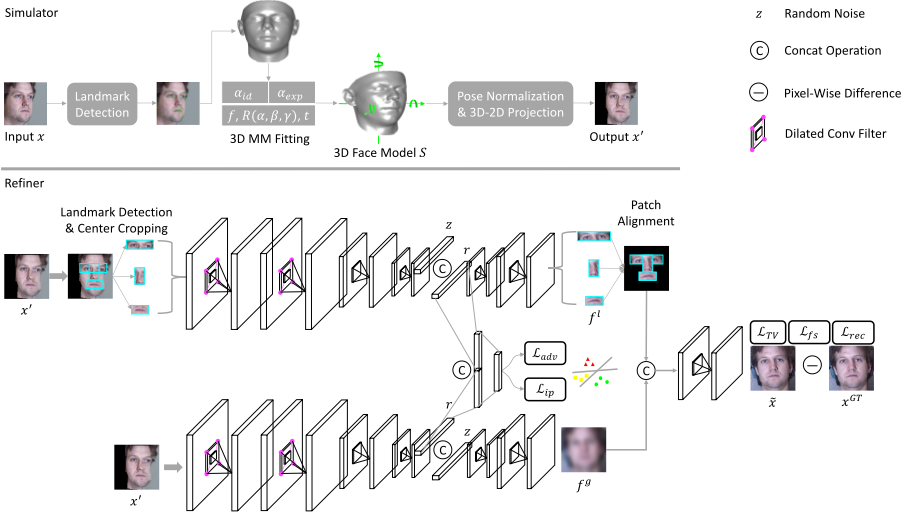
Finally, we simulate frontal face images x′ in canonical view from the input x under arbitrary poses, as shown in the upper panel of Fig. 2. However, the performance of the simulator decreases dramatically under large poses due to artifacts and severe texture loss caused by self-occlusion, causing the network to overfit to fake information only contained in synthetic images and fail to generalize well on real data.
3.2 Refiner
In order to generate photo-realistic and identity-preserved frontal face images which are truly beneficial for unconstrained face recognition, we further refine the abovementioned simulated frontal face images with the proposed refiner network, which consists of a Global-Local Generator (GLG) and a Global-Local Discriminator (GLD), learning in a competitive way.
Global-Local Generator
Since convolutional filters are usually shared across all the spatial locations, merely using a single-path generator cannot learn filters that are powerful enough for both refining global face structures and local details. To address this issue, we propose a Global-Local Generator (GLG), as inspired by [Huang et al., 2017; Zhu et al., 2015], where one path aims to refine the global sketch and the other to attend to refine local facial details, as shown in the bottom panel of Fig. 2.
In particular, the global-path generator Gθg (with learnable parameters θg ) consists of a transition-down encoder and a transition-up decoder. The local path generator Gθl also has an auto-encoder architecture, containing three identical subnetworks that learn separately to refine the following three center-cropped local patches: eyes, nose, and mouth. These patches are acquired by an off-the-shelf landmark detection model. Given a simulated frontal face image x′ , to effectively integrate information from the global and local paths, we first align the feature maps f l predicted by Gθl to a single feature map according to a pre-estimated landmark location template, which is further concatenated with the feature map f g from the global path and then fed to following convolution layers to generate the final refined image ˜x. We also concatenate a Gaussian random noise z at the bottleneck layer of the GLG to model variations of other factors besides pose, which may also help recover invisible details. Instead of using only the standard convolutional layers, we also employ a variant called dilated convolution in GLG. Dilated convolution uses kernels that are spread out, leading to a much larger input area for computing each output pixel with the same number of parameters and computational power. By using dilated convolutions, the model can effectively "see" a larger area of the input image when computing each output pixel than with standard convolutional layers. This is important for our refinement task, as the context information is critical for producing plausible hypothesis for the missing regions.
Formally, let the input simulated frontal face image with three landmark patches be collectively denoted as x′ . Then the refined face is ˜x = Gθ(x′ ). The key requirement for the GLG is that the refined image ˜x should visually resemble a real one and preserve the identity information as well as local textures.
To this end, we propose to learn the parameters {θg , θli } (here i=1, . . ., 3 index the three local-path models) by minimizing the following composite losses:
where Ladv is the adversarial loss for adding realism to the synthetic images and alleviating artifacts, Lip is the identity perception loss for preserving the identity information, Lrec is the reconstruction loss for encouraging multi-scale image content consistency, Lfs is the facial structure loss for alleviating self-occlusion issue, LTV is the total variation loss for reducing spiky artifacts, and {λk}k=30 are weighting parameters among different losses.
Lrec is introduced to enforce the multi-scale content consistency between the final frontalized face and corresponding ground truths, defined as Lrec = ‖˜x - ˜xGT‖/|˜xGT|, where |˜xGT| is the size of ˜xGT.
Since symmetry is an inherent feature of human facial structures, Lfs is introduced within the Laplacian space to exploit this prior information and impose the symmetry constraint on the recovered frontal view for alleviating selfocclusion issue:
where W, H denote the width and height of the final recovered frontal face image ˜x, respectively.
The standard LTV is introduced as a regularization term on the refined results to reduce spiky artifacts:
Global-Local Discriminator
To add realism to the synthetic images to really benefit face recognition performance, we need to narrow the gap between the distributions of synthetic and real images. An ideal generator will make it impossible to classify a given image as real or refined with high confidence. Meanwhile, preserving the identity information is essential and critical for recognition. An ideal generator will generate the refined face images that have small intra-class distance and large inter-class distance in the feature space spanned by the deep neural networks for unconstrained face recognition. These motivate us to employ an adversarial Global-Local Discriminator (GLD) which distinguishes real v.s. fake and identity information of global facial structures and local details simultaneously.
To facilitate this process, we simply leverage the same architecture respectively in the global-path encoder and the local-path encoder as the global-path discriminator Dφg (with learnable parameters φg ) and the local-path discriminator Dφl (with learnable parameters φl ), which learn separately without weight sharing, to avoid typical GAN tricks, as shown in the bottom panel of Fig. 2. The feature maps from Dφg and Dφl are further concatenated and fed into a fully connected layer to compute Ladv and Lip, which serve as a supervision to push the synthesized image to reside in the manifold of photorealistic frontal view images, prevent blur effect, and produce visually pleasing results while preserving the identity information. In particular, Ladv is defined as
where N is the number of training samples, xReal denotes the real frontal face image, and y is the binary label indicating the image is synthesized or real.
An underlying problem of adversarial training is that the discriminator only focuses on the latest refined results. This lack of memory may cause 1) divergence of the adversarial training, and 2) re-introduced artifacts by the refiner which the discriminator has forgotten about. Any refined image generated by the refiner at any time during the entire training procedure is a "fake" image for the discriminator. Hence, the discriminator should be able to classify all these images as fake. Based on this observation, we further extend the GLD with an external buffer to improve the stability of adversarial training by updating the GLD using a history of refined results, rather than only with those in the current minibatch, as first introduced in [Shrivastava et al., 2016].
In order to preserve the identity discriminability of refined face images, we define Lip with the multi-class cross-entropy loss based on the output from the bottleneck layer of Dφ.
where Y is the identity ground truth.
Thus, minimizing Lip would encourage deep features of the refined face images with the same identity to be close to each other. If one visualizes the learned deep features in the high-dimensional space, these learned deep features form several compact clusters, and each cluster may be far away from others. Each cluster has a small variance. In this way, the refined face images are enforced with well preserved identity information.
Using Lip alone makes the results prone to annoying artifacts, because the search for a local minimum of Lip may go through a path that resides outside the manifold of natural face images. Thus, we combine Lip with Ladv as the final objective function for Dφ to ensure that the search resides in that manifold and produces photo-realistic and identity-preserved face image:
where λ4 is a weighting parameter between Ladv and Lip.
4 Experiments
We evaluate 3D-PIM qualitatively and quantitatively under both controlled and in-the-wild settings for pose-invariant face recognition. For qualitative evaluation, we show visualized results on Multi-PIE [Gross et al., 2010] benchmark dataset. For quantitative evaluation, we evaluate face recognition performance on Multi-PIE and IJB-A datasets.
| Method | ±90◦ | ±75◦ | ±60◦ | ±45◦ | ±30◦ | ±15◦ |
|---|---|---|---|---|---|---|
| b1 | 18.80 | 63.80 | 92.20 | 98.30 | 99.20 | 99.40 |
| b2 | 33.00 | 76.10 | 95.20 | 97.90 | 99.20 | 99.80 |
| w/o refiner | 28.81 | 46.52 | 61.26 | 78.41 | 89.87 | 98.74 |
| w/o Lrec | 65.86 | 85.73 | 96.29 | 97.06 | 98.04 | 98.83 |
| w/o Lip | 66.70 | 86.53 | 97.10 | 98.44 | 98.93 | 99.15 |
| w/o Ladv | 67.13 | 87.97 | 97.51 | 98.75 | 99.14 | 99.40 |
| w/o Gθli | 67.35 | 88.20 | 97.74 | 98.12 | 98.59 | 99.10 |
| w/o Lfs | 68.61 | 89.49 | 98.03 | 98.85 | 99.10 | 99.32 |
| w/o DC | 69.76 | 90.65 | 98.19 | 98.76 | 99.02 | 99.18 |
| w/o Dφli | 70.77 | 91.67 | 98.21 | 99.03 | 99.17 | 99.37 |
| w/o buffer | 71.95 | 92.86 | 98.40 | 99.15 | 99.31 | 99.56 |
| 3D-PIM1 | 73.17 | 94.03 | 98.57 | 99.21 | 99.52 | 99.67 |
| 3D-PIM2 | 76.12 | 94.34 | 98.84 | 99.34 | 99.47 | 99.83 |
Implementation Details Throughout the experiments, the size of the RGB images of the input profile face (x), the simulator synthesis (x′ ), and the GLG prediction (˜x) is fixed as 128×128; the sizes of the three RGB local patches (i.e., eyes, nose and mouth) are fixed as 80×40, 32×40, and 48×32, respectively; the dimensionality of the Gaussian random noise z is fixed as 100; the constraint factors λ0 to λ4 are empirically fixed as 0.05, 1.0, 0.1, 5×10⁻⁴ , and 0.1, respectively; the batch size and learning rate are fixed as 16 and 3 × 10⁻⁵ , respectively; we use the RAR [Xiao et al., 2016] framework for landmark detection; we merge two popular face models with Non-Rigid ICP [Amberg et al., 2007] to construct our 3D MM; the identity basis (Aid) comes from the BFM [Paysan et al., 2009] and the expression basis (Aexp) comes from the Face Warehouse [Cao et al., 2014]; the proposed network is implemented based on the publicly available TensorFlow [Abadi et al., ] platform, which is trained using Adam (β1=0.5) on a single NVIDIA TITAN X GPU with 12G memory.
4.1 Evaluations onMulti-PIE Benchmark
The CMU Multi-PIE dataset is the largest multi-view face recognition benchmark, which contains 754,204 images of 337 identities from 15 view points and 20 illumination conditions. We conduct experiments under two settings: Setting1 concentrates on pose, illumination, and minor expression variations. It only uses the images in session one, which contains 250 identities. The images with 11 poses within ±90◦ and 20 illumination levels of the first 150 identities are used for training. For testing, one frontal viewwith neutral expression and illumination (i.e., ID07) is used as the gallery image for each of the remaining 100 identities, and other images are used as probes. Setting-2 concentrates on pose, illumination, and session variations. It uses the images with neutral expression from all four sessions, which contains 337 identities. The images with 11 poses within ±90◦ , and 20 illumination levels of the first 200 identities are used for training. For testing, one frontal view with neural illumination is used as the gallery image for each of the remaining 137 identities, and other images are used as probes.
Component Analysis
We first investigate different architectures and loss function combinations of 3D-PIM to see their respective roles in pose-invariant face recognition. We compare 11 variants of 3D-PIM, i.e., different face recognition network architectures (3D-PIM1: ResNet-50 [He et al., 2016] vs. 3D-PIM2: Light CNN-29 [Wu et al., 2015]), w/o refiner (recognition with simulator output), w/o local-path generator Gθli , w/o dilated convolution (DC), w/o local-path discriminator Dφli , w/o buffer, w/o Lrec, w/o Ladv, w/o Lfs, and w/o Lip, in each case.
Averaged Rank1 recognition rates are compared in Setting1 in Tab. 1. The results on the profile images serve as our baselines (i.e., b1 and b2). The results of the middle panel variations are all based on Light CNN-29. By comparing the results from the top and bottom panels, we observe that our 3D-PIM is not restricted to the face recognition backbone architecture used, since similar improvements (e.g. 54.37% v.s. 43.12% under ±90◦ ) can be achieved with our joint 3D-aided frontal face reconstruction and global-local realism refinement framework. The refiner, reconstruction loss, and identity perception loss contribute the most to improving the face recognition performance, especially for large pose cases. The adversarial training, global-local refiner, facial structure loss, and DC collaboratively add realism to the simulator, for both global facial structures and local details, which are beneficial for improving the recognition performance. Although not apparent, the buffer also helps improve the recognition performance. It is especially useful for stabilizing the training process.
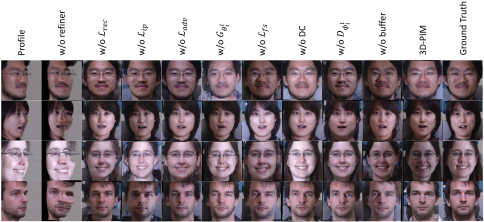
Fig. 3 illustrates the perceptual performance of these variants. As expected, the inference results without refiner, Lrec, and Lip deviate from the true appearance severely. The synthesis without adversarial training and buffer tends to present unnatural artifacts while that without facial structure loss sometimes shows factitious asymmetrical effect. The synthesis without the local-path generator and discriminator tends to lose local details while that without DC tends to lose highfrequency information.
Qualitative Results
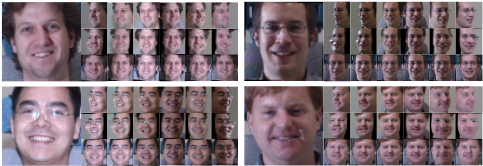
Most previous works on face frontalization address problems within a pose range of ±60◦ , since it is commonly believed with a pose larger than 60◦ , it is difficult for a model to generate faithful frontal images or learn discriminative yet generalizable facial representations. However, the proposed 3D-PIM is able to recover high-fidelity and identity-preserved frontal faces under very large poses. The recovered face images in the frontal view are visualized in Fig. 4 (a). We observe that the 3D-PIM consistently recovers faces well for all cases, and the recovered frontal face images are intuitively beneficial for pose-invariant face recognition.
| Method | ±90◦ | ±75◦ | ±60◦ | ±45◦ | ±30◦ | ±15◦ |
|---|---|---|---|---|---|---|
| CPF [Yim et al., 2015] | - / - | - / - | - / 61.90 | 71.65 / 79.90 | 81.05 / 88.50 | 89.45/95.00 |
| DR-GAN [Tran et al., 2017] | - / - | - / - | - / 83.20 | - / 86.20 | - / 90.10 | - / 94.00 |
| TP-GAN [Huang et al., 2017] | 64.03 / 64.64 | 84.10 / 77.43 | 92.93 / 87.72 | 98.58 / 95.38 | 99.85 / 98.06 | 99.78 / 98.68 |
| 3D-PIM | 76.12 / 86.73 | 94.34 / 95.21 | 98.84 / 98.37 | 99.34 / 98.81 | 99.47 / 99.48 | 99.83 / 99.64 |
| Method | Verification | Identification | |||
|---|---|---|---|---|---|
| TAR@FAR=0.01 | TAR@FAR=0.001 | TAR@FAR=0.0001 | FNIR@FPIR=0.01 | Rank1 | |
| OpenBR [Klare et al., 2015] | 0.236±0.009 | 0.104±0.014 | - | 0.934±0.017 | 0.246±0.011 |
| GOTS [Klare et al., 2015] | 0.406±0.014 | 0.198±0.008 | - | 0.953±0.024 | 0.433±0.021 |
| Pooling faces [Hassner et al., 2016] | 0.309 | - | - | - | 0.846 |
| Triplet Similarity [Sankaranarayanan et al., 2016] | 0.790±0.030 | 0.590±0.050 | - | 0.444±0.065 | 0.880±0.015 |
| VGG-Face [Parkhi et al., 2015] | 0.805±0.030 | - | - | 0.539±0.077 | 0.913±0.011 |
| PAMs [Masi et al., 2016] | 0.826±0.018 | 0.652±0.037 | - | - | 0.840±0.012 |
| DR-GAN [Tran et al., 2017] | 0.831±0.017 | 0.699±0.029 | - | - | 0.901±0.014 |
| Triplet Embedding [Sankaranarayanan et al., 2016] | 0.900±0.010 | 0.813±0.002 | - | 0.247±0.030 | 0.932±0.010 |
| Template Adaptation [Crosswhite et al., 2017] | 0.939±0.013 | 0.836±0.027 | - | 0.226±0.049 | 0.928±0.001 |
| NAN [Yang et al., 2016] | 0.941±0.008 | 0.881±0.011 | - | 0.183±0.041 | 0.958±0.005 |
| DA-GAN [Zhao et al., 2017b] | 0.976±0.007 | 0.930±0.005 | - | 0.110±0.039 | 0.971±0.007 |
| ℓ2-softmax [Ranjan et al., 2017] | 0.970±0.004 | 0.943±0.005 | 0.909±0.007 | 0.085±0.041 | 0.973±0.005 |
| 3D-PIM | 0.989±0.002 | 0.977±0.004 | 0.953±0.012 | 0.064±0.045 | 0.990±0.002 |
Quantitative Results
Tab. 2 shows the face recognition performance comparison of our 3D-PIM with other state-of-the-arts in Setting-1 and Setting-2. 3D-PIM consistently achieves the best performance across all poses, especially for large yaw angles. In particular, for Setting-1, 3D-PIM outperforms TP-GAN and c-CNN Forest by 12.09% and 28.86% under ±90◦ , respectively. Note that TP-GAN has the same face recognition backbone as ours, and c-CNN Forest is an ensemble of three models which is much more complex than 3D-PIM. For Setting-2, 3D-PIM outperforms TP-GAN by 22.09% under ±90◦ , and outperforms TP-GAN and DR-GAN by 10.65% and 15.17% under ±60◦ , respectively.
4.2 Evaluations on IJB-A Benchmark
IJB-A contains 5,397 images and 2,042 videos from 500 subjects, captured from in-the-wild environment to avoid near frontal bias. For training and testing, 10 random splits are provided by each protocol, respectively. It contains two tasks, face verification and face identification. The performance is evaluated by TAR@FAR, FNIR@FPIR, and Rank metrics, respectively.
The performance comparison of 3D-PIM with other stateof-the-arts on IJB-A unconstrained face verification and identification protocols are given in Tab. 3. With the injection of photo-realistic and identity-preserved frontal faces generated by 3D-PIM without extra human annotation efforts, our "recognition via generation" method outperforms the 2nd -best by 4.40% for TAR@FAR=0.0001 of verification, 1.70% for Rank1 of identification close set and 2.10% for FNIR@FPIR=0.01 of identification open set. This well shows the promising potential of recovered frontal view face images by 3D-PIM on large-scale and challenging unconstrained face recognition.
5 Conclusion
We proposed a novel 3D-Aided Deep Pose-Invariant Face Recognition Model (3D-PIM) for photo-realistic and identity-preserved frontal face synthesis and a "recognition via generation" framework to address the challenging face recognition with large pose variations. 3D-PIM unifies a simulator for 3D face reconstruction and frontal view synthesis, and a refiner for realism refinement, which learn in a conjugated way. The simulator is aided by a 3D MM to provide shape and appearance prior for accelerating face normalization learning, requiring less training data, and the refiner is a global-local GAN to improve the realism of both global facial structures and local details of the simulator's output using unlabeled real data while preserving identity information. Comprehensive experiments demonstrate the superiority of 3D-PIM over state-of-the-arts. We plan to apply 3D-PIM to other transfer learning applications in future.
Acknowledgements
The work of Jian Zhao was partially supported by China Scholarship Council (CSC) grant 201503170248. The work of Junliang Xing was partially supported by the National Science Foundation of Chian 61672519. The work of Jiashi Feng was partially supported by NUS startup R-263-000-C08-133, MOE Tier-I R-263-000-C21-112, NUS IDS R-263-000-C67646 and ECRA R-263-000-C87-133.
@inproceedings{ijcai2018p165,
  title     = {3D-Aided Deep Pose-Invariant Face Recognition},
  author    = {Zhao, Jian and Xiong, Lin and Cheng, Yu and Cheng, Yi and Li, Jianshu and Zhou, Li and Xu, Yan and Karlekar, Jayashree and Pranata, Sugiri and Shen, Shengmei and Xing, Junliang and Yan, Shuicheng and Feng, Jiashi},
  booktitle = {Proceedings of the Twenty-Seventh International Joint Conference on
               Artificial Intelligence, {IJCAI-18}},
  publisher = {International Joint Conferences on Artificial Intelligence Organization},
  editor    = {Jérôme Lang},
  pages     = {1184--1190},
  year      = {2018},
  month     = {7},
  note      = {Main track},
  doi       = {10.24963/ijcai.2018/165},
  url       = {https://doi.org/10.24963/ijcai.2018/165},
}
TY - CPAPER TI - 3D-Aided Deep Pose-Invariant Face Recognition AU - Zhao, Jian AU - Xiong, Lin AU - Cheng, Yu AU - Cheng, Yi AU - Li, Jianshu AU - Zhou, Li AU - Xu, Yan AU - Karlekar, Jayashree AU - Pranata, Sugiri AU - Shen, Shengmei AU - Xing, Junliang AU - Yan, Shuicheng AU - Feng, Jiashi T2 - Proceedings of the Twenty-Seventh International Joint Conference on Artificial Intelligence, IJCAI-18 PB - International Joint Conferences on Artificial Intelligence Organization PY - 2018 SP - 1184 EP - 1190 DO - 10.24963/ijcai.2018/165 UR - https://doi.org/10.24963/ijcai.2018/165 ER -Copied
Machine-readable versions of this paper, for tools and AI agents:





