
Enhancing Surveillance and Decision-Making on Dengue Using Agent-Based Modelling and Simulation
Proceedings of the Second IJCAI AI for Good Symposium in Africa hosted by Deep Learning Indaba. Indaba. Pages 50-60.
https://doi.org/10.24963/ijcai.aai4g.2024/8
Keywords
- Indaba: Indaba
Abstract
Dengue fever has spread globally and outbreaks are experienced. This study analyzed the roles of climatic variables in the spread of dengue fever in a Sub-Saharan Africa region using Agent-Based Modelling (ABM) and Simulation. Dengue ABM was implemented using GAMA 1.9.1 framework and simulation results were analyzed using Python 3.9. Initially, the model was simulated for 300 days with 1200 mosquito agents (approximately 0.2 infected) and 2000 human agents (approximately 0.005 infected). Weather data from the Tanzania Meteorological Agency (2012-2022) for the Dar es Salaam region was used. Simulation results showing the dynamics in mosquito agents’ infection status and human agents’ infection status are presented. The fluctuations in dengue incidences with weather parameters are also presented. Analysis of this information aids in informing policy-makers, health data stakeholders, and epidemiologists, and enhances surveillance and decision-making.
- [Aguiar et al., 2022] Maíra Aguiar, Vizda Anam, Kon- stantin B. Blyuss, Carlo Delfin S. Estadilla, Bruno V. Guer- rero, Damián Knopoff, Bob W. Kooi, Akhil Kumar Srivas- tav, Vanessa Steindorf, and Nico Stollenwerk. Mathemati- cal models for dengue fever epidemiology: A 10-year sys- tematic review. Physics of Life Reviews, 40:65-92, 2022. https://doi.org/10.1016/j.plrev.2022.02.001. DOI
- [Arquam et al., 2020] Md Arquam, Anurag Singh, and Houda Cherifi. Impact of seasonal conditions on vector-borne epidemiological dynamics. IEEE Access, 8:94510-94525, 2020. https://doi.org/10.1109/ACCESS. 2020.2995650. DOI
- [Auchincloss and Garcia, 2015] Amy H. Auchincloss and Leandro M. T. Garcia. Brief introductory guide to agent- based modeling and an illustration from urban health re- search. Cadernos de Saúde Pública, 31(Suppl.1):65-78, 2015. https://doi.org/10.1590/0102-311X00051615. DOI
- [Bershteyn et al., 2018] Anna Bershteyn, Jaline Gerardin, Daniel Bridenbecker, Christopher W. Lorton, Jonathan Bloedow, Robert S. Baker, Guillaume Chabot-Couture, Ye Chen, Thomas Fischle, Kurt Frey, Jillian S. Gauld, Hao Hu, Amanda S. Izzo, Daniel J. Klein, Dejan Lukacevic, Kevin A. McCarthy, Joel C. Miller, Andre Lin Ouedraogo, T. Alex Perkins, Jeffrey Steinkraus, Quirine A. Ten Bosch, Hung-Fu Ting, Svetlana Titova, Bradley G. Wag- ner, Philip A. Welkhoff, Edward A. Wenger, Christian N. Wiswell, and Institute for Disease Modeling. Implementa- tion and applications of emod, an individual-based multi- disease modeling platform. Pathogens and Disease, 76(5), 2018. https://doi.org/10.1093/femspd/fty059. DOI
- [Bomblies, 2014] Arne Bomblies. Agent-based modeling of malaria vectors: the importance of spatial simulation. Par- asites & Vectors, 7:308, 2014. https://doi.org/10.1186/ 1756-3305-7-308. DOI
- [Borges et al., 2015] Francisco Borges, Albert Gutierrez-Milla, Remo Suppi, Emilio Luque, and Marylene de Brito Arduino. An agent-based model for assessment of aedes aegypti pupal produc- tivity. In Proceedings of the 2015 Winter Sim- ulation Conference (WSC), pages 159-170, 2015. https://doi.org/10.1109/WSC.2015.7408161. DOI
- [Carley et al., 2005] Kathleen M. Carley, Douglas Fridsma, Elizabeth Casman, Alex Yahja, Neal Altman, Li-Chiou Chen, Boris Kaminsky, and Démian Nave. Biowar: Scal- able agent-based model of bioattacks. IEEE Transac- tions on Systems, Man, and Cybernetics A, 35(3):339-350, 2005. https://doi.org/10.1109/TSMCA.2005.851291. Catching et al., 2021] DOI
- Adam Catching, Sara Capponi, Ming Te Yeh, Simone Bianco, Raul Andino, et al. Examining the interplay between face mask usage, asymptomatic transmission, and social distancing on the spread of covid-19. Scientific Reports, 11(1):15998, 2021. https://doi.org/10.1038/s41598-021-94960-5. DOI
- [Chen et al., 2004] Li-Chiou Chen, Boris Kaminsky, Tiffany Tummino, Kathleen M. Carley, Elizabeth Casman, Dou- glas Fridsma, and Alex Yahja. Aligning simulation mod- els of smallpox outbreaks. In Intelligence and Security Informatics, Lecture Notes in Computer Science, volume 3073 of LNCS, pages 1-16, 2004. https://doi.org/10.1007/ 978-3-540-25952-7 1. DOI
- [Chipwaza et al., 2014] Beatrice Chipwaza, Joseph P. Mu- gasa, Majige Selemani, Mbaraka Amuri, Fausta Mosha, Steve D. Ngatunga, and Paul S. Gwakisa. Dengue and chikungunya fever among viral diseases in outpatient febrile children in kilosa district hospital, tanzania. PLOS Neglected Tropical Diseases, 8(11):e3335, 2014. https: //doi.org/10.1371/journal.pntd.0003335. DOI
- [Crooks et al., 2018] Andrew T. Crooks, Alison J. Heppen- stall, and Nick Malleson. Agent-based modelling. In Bo Huang, editor, Comprehensive Geographic Informa- tion Systems, volume 1, pages 218-243. Elsevier, Oxford, UK, 2018. https://doi.org/10.1016/B978-0-12-409548-9. 09704-9. DOI
- [Dalski et al., 2017] Jan Dalski, Christian Hüning, and Thomas Clemen. An output and 3d visualization concept for the msaas system mars. In Agent-Directed Simulation Symposium (SpringSim ADS '17), volume 49 of Simula- tion Series, pages 1-12, 2017. http://hdl.handle.net/20. 500.12738/1739. Link
- [Deng et al., 2008] Chengbin Deng, Haiyan Tao, Zhiwei Ye, et al. Agent-based modeling to simulate the dengue spread. In Proceedings of *Geo-Simulation and Virtual GIS Envi- ronments* (SPIE, vol. 7143), volume 7143, pages 566- 575, 2008. https://doi.org/10.1117/12.812589. DOI
- [Deza-Cruz et al., 2019] Iñaki Deza-Cruz, Aileen Mill, Steven Rushton, and Patrick Kelly. Comparison of the use of serum and plasma as matrix specimens in a widely used noncommercial dengue igg elisa. The American Journal of Tropical Medicine and Hygiene, 101(2):456-458, 2019. https://doi.org/10.4269/ajtmh.19-0112. DOI
- [Deza-Cruz, 2018] Iñaki Deza-Cruz. Epidemiology of Dengue, Chikungunya and Zika in a Naïve Population in St. Kitts, West Indies. PhD thesis, Newcastle University, 2018. http://theses.ncl.ac.uk/jspui/handle/10443/4381. Link
- [Dumont et al., 2008] Yves Dumont, Frédéric Chiroleu, and Claude Domerg. On a temporal model for the chikungunya disease: Modeling, theory and numerics. Mathematical Biosciences, 213(1):80-91, 2008. https://doi.org/10.1016/ j.mbs.2008.02.008. DOI
- [Eidelson and Lustick, 2004] Benjamin M. Eidelson and Ian P. Lustick. Vir-pox: An agent-based analysis of small- pox preparedness and response policy. Journal of Ar- tificial Societies and Social Simulation, 7(3):1-6, 2004. http://jasss.soc.surrey.ac.uk/7/3/6.html. Link
- [Gharakhanlou et al., 2020] Navid Mahdizadeh Gharakhan- lou, Navid Hooshangi, and Marco Helbich. A spatial agent-based model to assess the spread of malaria in rela- tion to anti-malaria interventions in southeast iran. ISPRS International Journal of Geo-Information, 9(9):549, 2020. https://doi.org/10.3390/ijgi9090549. DOI
- [Guzzetta et al., 2020] Giorgio Guzzetta, Francesco Vairo, Alessia Mammone, Simone Lanini, Piero Poletti, Mattia Manica, Roberto Rosa, Beniamino Caputo, Angelo Solim- ini, Alessandra Della Torre, Paola Scognamiglio, Alimud- din Zumla, Giuseppe Ippolito, and Stefano Merler. Spa- tial modes for transmission of chikungunya virus during a large chikungunya outbreak in italy: a modeling analysis. BMC Medicine, 18(1):226, 2020. https://doi.org/10.1186/ s12916-020-01674-y. DOI
- [Hackl and Dubernet, 2019] Jürgen Hackl and Thibaut Du- bernet. Epidemic spreading in urban areas using agent- based transportation models. Future Internet, 11(4):92, 2019. https://doi.org/10.3390/fi11040092. DOI
- [Hoogeveen et al., 2014] Johannes G. M. Hoogeveen, Kevin Croke, Andrew Dabalen, Gabriel Demombynes, and Marcelo M. Giugale. Collecting high frequency panel data in africa using mobile phone interviews. Canadian Jour- nal of Development Studies / Revue canadienne d'études du développement, 35(1):186-207, 2014. https://doi.org/ 10.1080/02255189.2014.876390. DOI
- [Hossain et al., 2022] Md Shakhawat Hossain, Md Ezaz Rai- han, Md Sakir Hossain, M. M. Mahbubul Syeed, Harunur Rashid, and Md Shaheed Reza. Aedes larva detec- tion using ensemble learning to prevent dengue endemic. BioMedInformatics, 2(3):405-423, 2022. https://doi.org/ 10.3390/biomedinformatics2030026. DOI
- [Jacintho et al., 2010] L. F. O. Jacintho, A. F. M. Batista, T. L. Ruas, and F. A. Silva. An agent-based model for the spread of the dengue fever: A swarm platform simu- lation approach. In Proceedings of the 2010 Spring Simu- lation Multiconference (SpringSim), 2010. https://doi.org/ 10.1145/1878537.1878540. DOI
- [Jarlais et al., 2022] Don C. Des Jarlais, Georgiy Bobashev, Jonathan Feelemyer, and Courtney McKnight. Modeling hiv transmission among persons who inject drugs (pwid) at the "end of the hiv epidemic" and during the covid-19 pandemic. Drug Alcohol Dependence, 238:109573, 2022. https://doi.org/10.1016/j.drugalcdep.2022.109573. DOI
- [Jindal and Rao, 2017] Akshay Jindal and Shrisha Rao. Agent-based modeling and simulation of mosquito-borne disease transmission. In Proceedings of the 16th Inter- national Conference on Autonomous Agents and Multia- gent Systems (AAMAS 2017), pages 426-435, 2017. https: //dl.acm.org/doi/10.5555/3091125.3091190. DOI
- [Kajeguka et al., 2017] Debora C. Kajeguka, Maulid Msonga, Karin L. Schiøler, Dan W. Meyrowitsch, Polyxeni Syrianou, Filemoni Tenu, Michael Alifrangis, Franklin W. Mosha, and Reginald A. Kavishe. In- dividual and environmental risk factors for dengue and chikungunya seropositivity in north-eastern tanza- nia. Infection, Disease & Health, 22(2):65-76, 2017. https://doi.org/10.1016/j.idh.2017.04.005. DOI
- [Kampango et al., 2021] Ayubo Kampango, Peter Furu, Di- vakara L. Sarath, Khamis A. Haji, Flemming Konradsen, Karin L. Schiøler, Michael Alifrangis, Fatma Saleh, and Christopher W. Weldon. Risk factors for occurrence and abundance of aedes aegypti and aedes bromeliae at hotel compounds in zanzibar. Parasites & Vectors, 14(1):544, 2021. https://doi.org/10.1186/s13071-021-05005-9. DOI
- [Kasaie and Kelton, 2016] Parastu Kasaie and W. David Kel- ton. Guidelines for design and analysis in agent-based simulation studies. In Proceedings of the 2015 Winter Simulation Conference (WSC '15), pages 183-193, 2016. https://doi.org/10.1109/WSC.2015.7408163. DOI
- [Kayombo and Mayo, 2018] Sia Kayombo and Aveline Mayo. Assessment of microbial quality of vegetables irri- gated with polluted waters in dar es salaam city, tanzania. Environment and Ecology Research, 6(4):229-239, 2018. https://doi.org/10.13189/eer.2018.060403. DOI
- [Lukens et al., 2014] Sara Lukens, Jessica J. Grefenstette, R. Rosenfeld, J. R. DePasse, Nicole T. Stone, Peter C. Cooley, W. Wheaton, A. Fyshe, D. D. Galloway, A. Sri- ram, H. Guclu, T. Abraham, and David S. Burke. A large- scale immuno-epidemiological simulation of influenza a epidemics. BMC Public Health, 14:1019, 2014. https: //doi.org/10.1186/1471-2458-14-1019. DOI
- [Macal and North, 2009] Charles M. Macal and Michael J. North. Agent-based modeling and simulation. In M. D. Rossetti, R. R. Hill, B. Johansson, A. Dunkin, and R. G. Ingalls, editors, Proceedings of the 2009 Winter Simula- tion Conference, 2009. Paper ID 009 in WSC 2009; avail- able via IEEE Xplore.
- [Mahmood et al., 2020] Imran Mahmood, Mishal Jahan, Derek Groen, Aneela Javed, and Faisal Shafait. An agent- based simulation of the spread of dengue fever. In Pro- ceedings of ICCS 2020, Part III, volume 12139 of Lec- ture Notes in Computer Science, pages 103-117. Springer, 2020. https://doi.org/10.1007/978-3-030-50420-5 8. DOI
- [Manson et al., 2020] Steven Manson, Li An, Keith C. Clarke, Alison Heppenstall, Jennifer Koch, Brittany Krzyzanowski, Fraser Morgan, David O'Sullivan, Bryan C. Runck, Eric Shook, and Leigh Tesfatsion. Methodological issues of spatial agent-based models. Journal of Artificial Societies and Social Simulation, 23(1):3, 2020. https://doi.org/10.18564/jasss.4174. DOI
- [Miksch et al., 2019] Florian Miksch, Beate Jahn, Kurt Jun- shean Espinosa, Jagpreet Chhatwal, Uwe Siebert, and Nikolas Popper. Why should we apply abm for deci- sion analysis for infectious diseases? -an example for dengue interventions. PLOS ONE, 14(8):e0221564, 2019. https://doi.org/10.1371/journal.pone.0221564. DOI
- [Mniszewski et al., 2014] S. M. Mniszewski, C. A. Manore, C. Bryan, S. Y. Del Valle, and D. Roberts. Towards a hy- brid agent-based model for mosquito borne disease. Simu- lation Series, 46(10):66-73, 2014. Presented at Summer- Sim 2014 (SCS 2014).
- [Narassima et al., 2021] M. S. Narassima, S. P. Anbuu- dayasankar, Guru Rajesh Jammy, Rashmi Pant, Lincoln Choudhury, Aadharsh Ramakrishnan, and Denny John. An agent-based model for assessing transmission dynam- ics and health systems burden for covid-19. Indonesian Journal of Electrical Engineering and Computer Science, 24(3):1735-1743, 2021. https://doi.org/10.11591/ijeecs. v24.i3.pp1735-1743. DOI
- [National Bureau of Statistics, United Republic of Tanzania, 2022] National Bureau of Statistics, United Republic of Tanza- nia. 2022 Population and Housing Census of the United Republic of Tanzania: Initial Results. Technical report, National Bureau of Statistics, Ministry of Finance & Planning, Tanzania, 2022. Released October 2022; census reference night: August 22-23, 2022.
- [Okada et al., 2019] Kazuma Okada, Ryo Morita, Kazutaka Egawa, Yuki Hirai, Atsushi Kaida, Michinori Shirano, Hideyuki Kubo, Tetsushi Goto, and Seiji P. Yamamoto. Dengue virus type 1 infection in traveler returning from tanzania to japan, 2019. Emerging Infectious Diseases, 25(9):1782-1784, 2019. https://doi.org/10.3201/eid2509. 190814. DOI
- [Pascoe and Mwangoka, 2016] Luba Pascoe and Joseph Wynn Mwangoka. A smartphone-based reporting application for routine health data: system require- ments, analysis and design. International Journal of Telemedicine and Clinical Practice, 1(?):323-344, 2016.
- Asmartphone-basedreportingapplicationforroutinehealthdata: systemrequirements,analysisanddesign(2016).
- [Pascoe et al., 2022] Luba Pascoe, Thomas Clemen, Karen Bradshaw, and Devotha Nyambo. Review of importance of weather and environmental variables in agent-based ar- bovirus models. International Journal of Environmental Research and Public Health, 19(23):15578, 2022. https: //doi.org/10.3390/ijerph192315578. DOI
- [Pascoe et al., 2023] Luba Pascoe, Devotha Godfrey Nyambo, Karen Bradshaw, and Thomas Clemen. Agent-based modeling and simulation for transmis- sion dynamics and surveillance of dengue: concep- tual and design model. In Proceedings of the 16th IEEE AFRICON (IEEE AFRICON 2023). IEEE, 2023. https://doi.org/10.1109/AFRICON55910.2023.10293299. DOI
- [Puthanakit et al., 2022] Thanyawee Puthanakit, Suvaporn Anugulruengkitt, and Watsamon Jantarabenjakul. Preven- tion of emerging infections in children. Pediatric Clinics of North America, 69(1):185-202, 2022. https://doi.org/ 10.1016/j.pcl.2021.08.006. DOI
- [Pérez and Dragicevic, 2009] Liliana Pérez and Suzana Dragicevic. An agent-based approach for modeling dynamics of contagious disease spread. Interna- tional Journal of Health Geographics, 8:50, 2009. https://doi.org/10.1186/1476-072X-8-50. DOI
- [Sabzian et al., 2019] Hossein Sabzian, Mohammad Ali Shafia, Ali Maleki, Seyeed Mostapha Seyeed Hashemi, Ali Baghaei, and Hossein Gharib. Theories and prac- tice of agent based modeling: Some practical implications for economic planners. arXiv preprint arXiv:1901.08932, 2019. https://doi.org/10.48550/arXiv.1901.08932. DOI
- [Sambo and for Africa, 2014] Luis Gomes Sambo and World Health Organization Regional Office for Africa. The health of the people: What works -the african re- gional health report 2014. Technical report, World Health Organization Regional Office for Africa, 2014. Prepared under guidance of Luis G. Sambo; assesses health trends and successful interventions in WHO African Region :contentReference[oaicite:1]index=1.
- [Sharma et al., 2023] V. Sharma, S. K. Ghosh, and S. Khare. A proposed framework for surveillance of dengue disease and prediction. In O. Altan, F. Sunar, and D. Klein, editors, International Archives of the Photogrammetry, Remote Sensing and Spatial Infor- mation Sciences, XLVIII-M-1-2023, ISRSE-39 Sympo- sium, pages 317-323, 2023. https://doi.org/10.5194/ isprs-archives-XLVIII-M-1-2023-317-2023. DOI
- [Shrestha et al., 2022] Dhan Bahadur Shrestha, Pravash Budhathoki, Bipana Gurung, Subash Subedi, Shishir Aryal, Anisha Basukala, Barun Aryal, Anurag Adhikari, Ayusha Poudel, Gopal Kumar Yadav, Mtanis Khoury, Binod Rayamajhee, and Lok Bahadur Shrestha. Epidemi- ology of dengue in saarc territory: a systematic review and meta-analysis. Parasites & Vectors, 15(1):389, 2022. https://doi.org/10.1186/s13071-022-05409-1. DOI
- [Singh et al., 2016] Dhirendra Singh, Lin Padgham, and Brian Logan. Integrating bdi agents with agent-based sim- ulation platforms. Autonomous Agents and Multi-Agent Systems, 30(6):1050-1071, 2016. https://doi.org/10.1007/ s10458-016-9332-x. DOI
- [Singh et al., 2022] Sarbhan Singh, Lai Chee Herng, Lok- man Hakim Sulaiman, Shew Fung Wong, Jenarun Jelip, Norhayati Mokhtar, Quillon Harpham, Gina Tsarouchi, and Balvinder Singh Gill. The effects of meteoro- logical factors on dengue cases in malaysia. Inter- national Journal of Environmental Research and Pub- lic Health, 19(11):6449, 2022. https://doi.org/10.3390/ ijerph19116449. DOI
- [Stiner and Chellamuthu, 2020] Shandi Stiner and Vinodh Chellamuthu. An agent-based model of west nile virus: Predicting the impact of public health agents and vac- cinations on horses. Curiosity: Interdisciplinary Jour- nal of Research and Innovation, 3(17130), 2020. https: //doi.org/10.36898/001c.17130. DOI
- [Tancredi et al., 2020] Alessandra Tancredi, Davide Papan- drea, Michele Marconcini, Rebeca Carballar-Lejarazu, Mauricio Casas-Martinez, Eugenia Lo, Xiao-Guang Chen, Anna R. Malacrida, and Mariangela Bonizzoni. Trac- ing temporal and geographic distribution of resistance to pyrethroids in the arboviral vector Aedes albopic- tus. PLOS Neglected Tropical Diseases, 14(6):e0008350, 2020. https://doi.org/10.1371/journal.pntd.0008350. DOI
- [Thorne et al., 2007] Bryan C. Thorne, Alexander M. Bailey, and Shayn M. Peirce. Combining experiments with multi- cell agent-based modeling to study biological tissue pat- terning. Briefings in Bioinformatics, 8(4):245-257, 2007. https://doi.org/10.1093/bib/bbm024. DOI
- [Vodovotz and An, 2019] Yoram Vodovotz and Gary An. Agent-based models of inflammation in translational sys- tems biology: A decade later. Wiley Interdisciplinary Re- views: Systems Biology and Medicine, 11(6):e1460, 2019. https://doi.org/10.1002/wsbm.1460. DOI
- [Ward et al., 2017] Tara Ward, Moody Samuel, Dorit Maoz, Silvia Runge-Ranzinger, Ross M. Boyce, Jo ao Toledo, Raman Velayudhan, and Olaf Horstick. Dengue data and surveillance in tanzania: A systematic literature review. Tropical Medicine & International Health, 22(8):960- 970, 2017. https://doi.org/10.1111/tmi.12903. DOI
- [World Health Organization, 2022a] World Health Organi- zation. Laboratory testing for zika virus and dengue virus infections: Interim guidance. Technical Report WHO/ZIKV DENV/LAB/2022.1, World Health Organi- zation, July 2022. Interim guidance published 14 July 2022 (14 pages); ensures DOI/link appears in bibliogra- phy.
- [World Health Organization, 2022b] World Health Organi- zation. Surveillance and control of arboviral diseases in the who african region: assessment of country capacities. Technical Report 978-92-4-005291-8, World Health Orga- nization Regional Office for Africa, 2022. Cross-sectional capacity survey of all 47 countries in the WHO African Region across seven domains.
- [World Health Organization, 2024] World Health Organiza- tion. Dengue and severe dengue. Technical report, World Health Organization, April 2024. Fact sheet published 23 April 2024, summarizing global incidence, clinical features, prevention, and management of dengue/severe dengue.
References were extracted automatically from the PDF and may contain errors.
Full text extracted automatically from the PDF; figures, tables and equations may differ. The PDF is the version of record.
1 Introduction and Background
Health data comprise complex large datasets that need intelligent data-driven techniques to collect, analyze, and process them to generate meaningful information that the decisionmakers can effectively utilize. Establishing good monitoring, investigation, and reporting systems for infectious disease incidences is crucial. Every year, millions of individuals are put at risk of serious illness as a result of new infectious and communicable diseases [World Health Organization, 2022b; World Health Organization, 2024]. This seriously threatens public health security at local, regional, or national levels, due to the lack of infrastructure for timely epidemic data collection, analysis, and reporting [Mahmood et al., 2020]. It has been noted that policy-makers, epidemiologists, and other related health data stakeholders highly depend on timely and accurate information to make informed decisions that will improve the well-being of the nation as well as the national healthcare system [Hoogeveen et al., 2014; Mahmood et al., 2020; Pascoe and Mwangoka, 2016]. Furthermore, reliable and real-time data provide decisionmakers with the information they need to respond effectively to the population's health needs as a result the value of better effective data collection can be realized [Sambo and for Africa, 2014].
Dengue fever caused by Dengue Virus (DENV) is a highly dangerous arboviral disease with high levels of transmission in America, the Western Pacific, and Southeast Asia posing a threat to around 4 billion people. The disease has been identified in Europe since 2010, with an outbreak in Madeira in 2012. All four serotypes of DENV have been reported in Africa, with DENV-2 being the most frequently reported in Africa [Ward et al., 2017]. In Tanzania, Dar es Salaam was declared as an epicenter of the dengue outbreak that occurred in 2019 and the preceding outbreaks even if there have been some occurrences in different regions [Kampango et al., 2021; Okada et al., 2019]. The 2019 outbreak resulted in 6670 confirmed cases and 13 deaths[Kampango et al., 2021].
Agent-based modeling (ABM) refers to computational simulation models that are made up of a large number of discrete agents [Thorne et al., 2007; Vodovotz and An, 2019]. An agent is any form of self-contained component in the real world whose behavior can change from simple reactive decision rules to complicated adaptive intelligence [Auchincloss and Garcia, 2015; Crooks et al., 2018; Dalski et al., 2017]. ABM is a valuable tool for epidemics modeling because it can better track the spread of disease in specific geographic regions and account for interactions among individual contacts [Gharakhanlou et al., 2020; Kasaie and Kelton, 2016; P´erez and Dragicevic, 2009]. Epidemiologic applications aim to employ the ABM approach to help researchers perform preliminary "what-if" analyses to investigate how systems behave in various scenarios and determine which control measures are most effective [Carley et al., 2005; Chen et al., 2004; Eidelson and Lustick, 2004].Thus, ABM can be 124 considered as a technology for processing health data and producing simulations that can provide meaningful information for decision-makers concerning different disease outbreaks, surveillance, reporting, and containment. This study intended to explore the benefits of ABM in disease modeling to enhance the surveillance of dengue fever in Sub-Saharan Africa.
1.1 RelatedWork on ABMand Disease Surveillance
Thus, ABM can be 124 considered as a technology for processing health data and producing simulations that can provide meaningful information for decision-makers concerning different disease outbreaks, surveillance, reporting, and containment. This study intended to explore the benefits of ABM in disease modeling to enhance the surveillance of dengue fever in Sub-Saharan Africa.84 ABM has several benefits including its ability to harness the heterogeneity and stochasticity in a modeling environment, agents' behaviors being defined with boundaries and their decision-making capability, agents' ability to learn and engage in dynamic strategic behaviors, agents' ability to adapt and change their behaviors, and agents' ability to represent a spatial component to their behaviors and interactions [Macal and North, 2009; Sabzian et al., 2019]. These benefits and many more make ABM suitable for modeling various health systems and phenomena such as infectious diseases-EMOD framework [Bershteyn et al., 2018], EpiSims software [Mniszewski et al., 2014], spatial agent-based malaria model [Bomblies, 2014; Gharakhanlou et al., 2020], transport planning and epidemic spread [Hackl and Dubernet, 2019], mosquito modeling [Stiner and Chellamuthu, 2020] and Dengue epidemic [Jacintho et al., 2010; Jindal and Rao, 2017; Mahmood et al., 2020].
Various disease surveillance applications have utilized the benefits of ABM to enhance disease surveillance globally. This includes tracking the spread of HIV, control of mosquitoborne diseases, and the simulation of influenza outbreaks [Arquam et al., 2020; Jarlais et al., 2022; Lukens et al., 2014; Miksch et al., 2019]. The outcomes of employing various public health interventions on disease transmissions could also be tracked using ABM, such as the use of face masks during the COVID-19 pandemic [Catching et al., 2021; Narassima et al., 2021].
A study by [Sharma et al., 2023] proposed a framework for the surveillance and prediction of dengue disease after reviewing various literature and identifying various tools used for modeling and the factors that contributed to the spread and dynamics of dengue disease. The framework included remote sensing, epidemiological data, and health infrastructure inputs. Surface trend analysis, polynomial regression models, and cluster analysis made up the dengue spread submodel. The dengue risk sub-model was developed using the risk model together with the spatial Poisson point process model, and lastly, various statistical machine learning models would develop the dengue prediction sub-model [Sharma et al., 2023].
Furthermore, a study by [Guzzetta et al., 2020] stated that "it is crucial to understand and quantify the transmission of infections caused by mosquitoes over space and time through strengthening health system entomological and human surveillance, guidance on the implementation of vector control measures, safe blood transfusion, delivery of vaccine, and the ability to assess transmission risk," [Guzzetta et al., 2020].
Therefore, this study plays a great role in strengthening the health system reporting and surveillance, especially on infectious diseases, through the provision of timely, accurate, complete, and consistent data. This is possible when the crucial surveillance information obtained from dengue ABM is deployed through a mobile application that will be used by health workers and epidemiologists to monitor the dengue transmission dynamics.
1.2 Climatic Factors and Dengue Fever
Urbanization, globalization of trade and travel, increased population density, and the lack of effective prevention control methods have been identified as the risk factors associated with dengue transmission in East African countries, Tanzania being among them [Chipwaza et al., 2014; Kajeguka et al., 2017]. Age, sex, and education are among the individual factors that determine the risk of contracting DENV, while the number of people residing in a room and community size make up the household factors that increase the chance of contracting DENV [Dumont et al., 2008]. Furthermore, precipitation, humidity, temperature, humanmigration, wind speed, and sanitation contributed to the epidemic conditions in areas affected by dengue and chikungunya [Dumont et al., 2008; Tancredi et al., 2020; Singh et al., 2022]. Integrated vector control strategies are recommended by WHO to prevent and control dengue outbreaks and infections [Sambo and for Africa, 2014] [Puthanakit et al., 2022; Hossain et al., 2022]. Most of the control and prevention strategies are based on mosquito vector density management [Puthanakit et al., 2022; Sambo and for Africa, 2014], influenced by different factors, among them being climatic and environmental.
A review on the influence of environmental variables (vegetation index, households, mosquito habitats, and breeding sites) and climatic variables (precipitation or rainfall, temperature, and relative humidity) on dengue disease modeling using an agent-based model in an African context and globally revealed that temperature, precipitation, humidity, and environmental factors influenced dengue transmission dynamics and surveillance [Pascoe et al., 2022]. This review nailing the need for enhancing dengue surveillance through agent-based modeling and simulation while considering the influence of climatic factors on mosquito lifecycle and dengue transmission dynamics.
2 Materials andMethods
2.1 Study Area
This study was conducted in the Dar es Salaam region, which has an approximate area of 1,393 square kilometers (km2) and is located between latitude 6°20' S to 7°30' S and longitude 39°00' E to 39°30' E [Kayombo and Mayo, 2018]. The region has a population of 5,383,728, of which women are 2,783,710, making 52%, and men are 2,600,018, making 48%, with an annual growth rate of 2.1% [National Bureau of Statistics, United Republic of Tanzania, 2022]. In Tanzania, dengue fever outbreaks have been reported from different districts in the Dar es Salaam region, making the region a suitable study area to address the research question.
2.2 Developed ABM for Dengue Surveillance
Overview, Design Concepts, and Details (ODD) protocol was used in the domain and design model of dengue fever surveillance ABM to ensure transparency and reproducibility. The ODD protocol ensured that the model was designed to capture the key concepts and details necessary for accurately simulating dengue disease transmission dynamics in the study population. Seven elements of the ODD protocol have been adopted in the developed dengue fever ABM [Pascoe et al., 2023]. The ABM was implemented using GAMA 1.9.1, which uses GAML scripting language based on Java Development Kit (JDK) and supports Java 17, x86, and ARM architecture. GAMA excels in managing spatial information and integrating Geographic Information Systems (GIS), rendering it particularly suitable for modeling scenarios with significant spatial components. This functionality is crucial for depicting spatial patterns and processes across human, natural, and combined human-environmental systems [Manson et al., 2020] as well as modeling vector-borne diseases like dengue that have strong spatial components. GAMA can handle large-scale simulations with up to millions of agents while supporting their complex behaviors. GAMA supports real-time data integration frommultiple sources, including climate, epidemiology, reports, and remote sensing data, making it ideal for data-driven simulations. GAMA's ability to provide advanced 2D/3D visualizations outstands other frameworks as it provides intuitive model exploration by providing real-time interaction with the model and facilitating stakeholder engagement. The advanced capabilities of GAMA make it a more robust tool for studies on complex, spatially explicit, and cognitively sophisticated agent-based models. Its capacity to incorporate GIS data, accommodate intricate agent behaviors, and offer versatility across diverse fields makes it a preferred choice for models that require detailed and realistic simulations of complex systems [Singh et al., 2016; Manson et al., 2020]. Therefore, the GAMA benefits have led the researchers opt for GAMA framework to better model and simulate the ABM for dengue surveillance with inclusion of weather parameters.
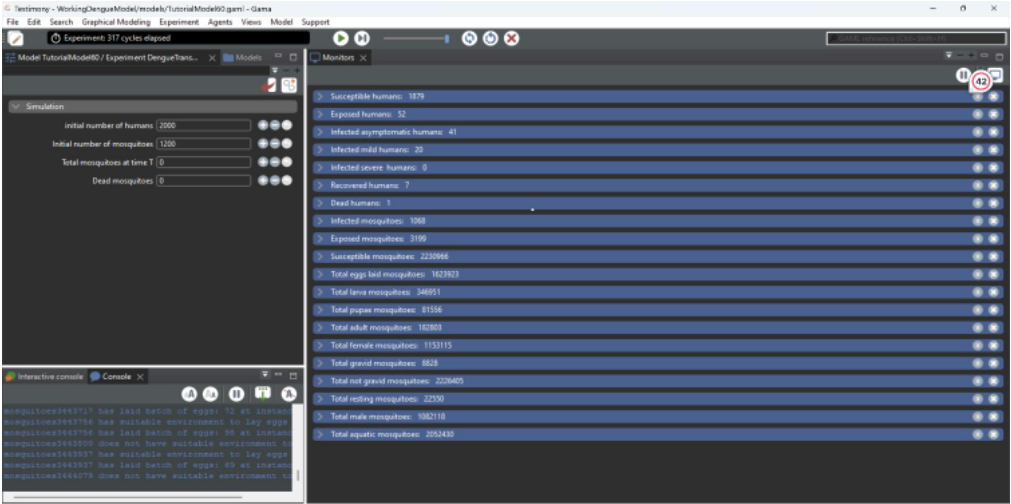
Figure 1 presents the implemented ABM for dengue fever using GAMA. The model was initially simulated with 2000 human agents (approximately 0.005 infected) and 1200 mosquito agents (approximately 0.2 infected). Humans' and mosquitoes' initial infection status were set at different infection rates to represent an ongoing disease spread. Agent parameters were selected to reflect real-world conditions to ensure accurate simulation results. Epidemiological data, demographic and population data, and entomological data obtained from health reports, dengue outbreak data, previous dengue related studies together with expert knowledge and assumptions helped to obtain parameters such as infection rate, recovery time, mortality rate, population density, age distribution, mosquito lifespan, biting rate, egg-laying frequency, and movement range.
The model initialization data is presented in Table 1. Weather data from the Tanzania Meteorological Agency (TMA) (2012-2022) for the Dar es Salaam region was used. Input weather parameters in the dengue ABM for the year 2017 included temperature, which was believed to influence mosquito survival and virus incubation period; precipitation, and relative humidity, which affected mosquito breeding sites. The defined agent parameters directly influenced agent behavior in the simulation, such as the susceptibility, mobility, and symptoms development of the agents, the mosquito life cycle, the infection probability of agents, the feeding behavior of mosquito agents, and their movement patterns. Mosquito reproduction rate, survival, and biting activity, as well as the availability of breeding sites, were influenced by environmental and climatic parameters.
The initial conditions in the model were set for mosquitoes and human agents based on the literature reviews and information obtained from previous dengue outbreaks. The initial mosquito agent population was set to ensure progression to disease dynamics as well as mosquito population at different stages of the life cycle. Changing the initial mosquito population affected the simulation results; when the initial number was set below 1200, the mosquito population vanished after 150 simulation days. Alternatively, overestimating the mosquito population would overestimate the speed and extent of dengue spread as well as population growth. The life stages of mosquito agents and immunity levels of human agents reflected the biological and epidemiological knowledge obtained from literature reviews and expert knowledge. Human immunity could not be ignored because it would be unrealistic and would result in missing the protective effects of existing immunity in the population.
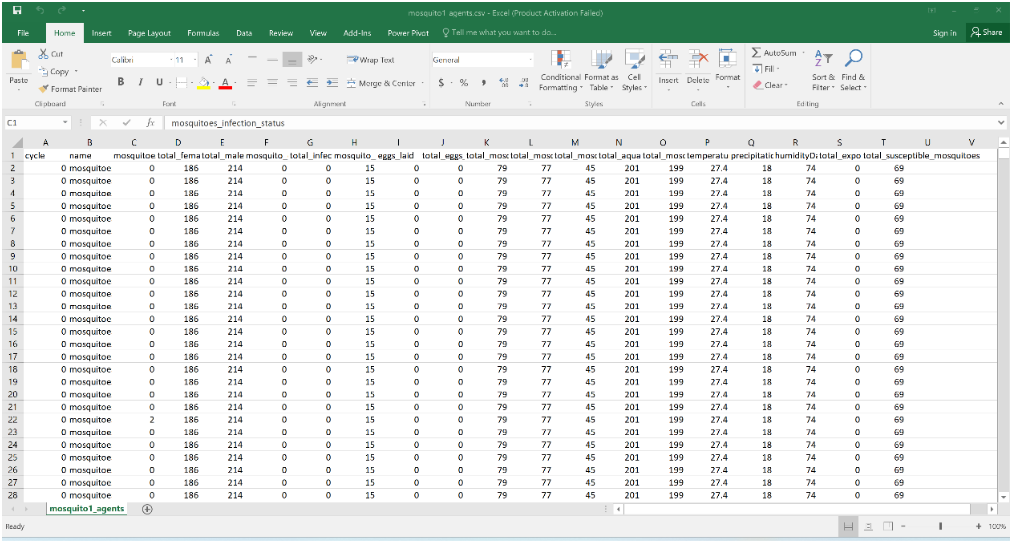
Figure 2 presents the output file generated after the model simulation representing the changes in the population of mosquito agents at different stages of the life cycle as well as the changes in their infection status.
3 Results and Discussion
The ABM for dengue surveillance was simulated with weather variables, including temperature, precipitation, and relative humidity. The influence of these parameters on the mosquito life cycle and dengue fever transmission to the mosquito population and human population was observed. Weather parameters were believed to influence mosquito lifecycle and activities [Pascoe et al., 2022]. The results showed that the weather parameters influenced the mosquito lifecycle and various mosquito activities as a result, the transmission dynamics of dengue fever depended on the weather parameters. Mosquito activities such as reproduction, flight capability, biting rate, hatching rates, mosquito population, and dengue infections were influenced by weather parameters. As a result, dengue infection in human agents was also affected by these dynamics. This was also observed in a study by [Miksch et al., 2019] that demonstrated the influence of weather parameters on dengue dynamics and assessed the impact of interventions on mosquito population.
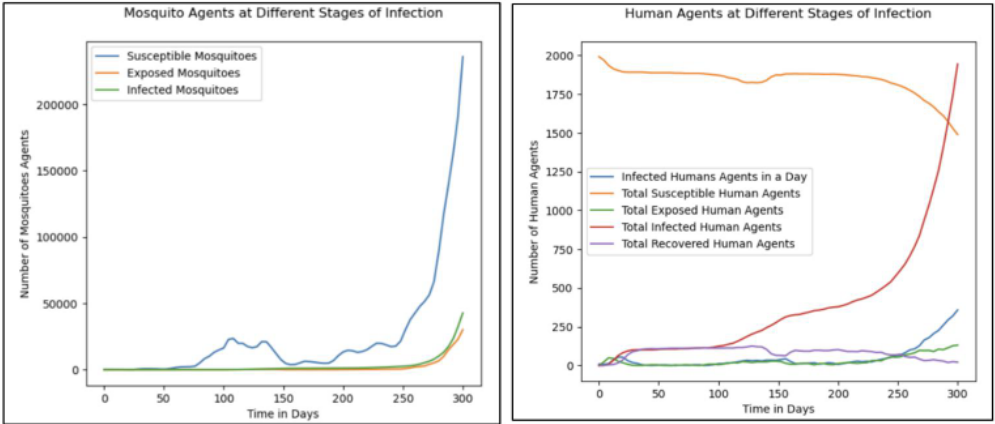
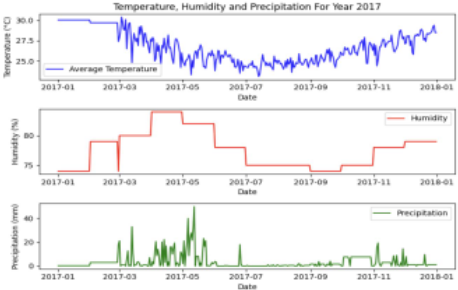
Figure 3 and Figure 4 provide a comprehensive analysis of dengue transmission dynamics by linking mosquito and human infection stages with climatic factors (temperature, humidity, and precipitation). Figure 3 shows infection trends in mosquito and human populations, while Figure 4 shows the climatic data that influenced mosquito population growth and dengue transmission. The mosquito population increased towards the end of the year, indicating a likelihood of favorable breeding conditions such as temperature and precipitation. Compared to the susceptible population, the infected mosquitoes remained relatively lower, suggesting that transmission might have been controlled by other factors such as host availability and virus incubation period. The population of infected human agents increased significantly towards the end of the simulation, correlating with the rise in infected mosquitoes. The graphs indicated that transmission was climate-dependent, whereas peak mosquito populations coincided with rainy seasons (March-May, OctoberDec). Low temperatures reduced mosquito activity and human infections. The graphs also show human infection lags behind mosquito trends in which infection spikes in humans appeared after the mosquito population increased, indicating the incubation delay in dengue transmission.
| Agents | Parameters | Value/Range | Reference/source |
|---|---|---|---|
| Human- Agent | Exposed days The probability of being bitten Probability of infection Asymptomatic probability Infectious days Probability of recovery Immunity days Probability of hospitalization | 4-10 days 0.5 0.5 0.5 3-14 days 0.95 120 days 0.5 | [World Health Organization, 2022a] [World Health Organization, 2022b] [Deza-Cruz, 2018; Deza-Cruz et al., Study knowledge [Shrestha et al., 2022] [Borges et al., 2015] [World Health Organization, 2022b] Study knowledge [World Health Organization, 2024] |
| Ae. Aegypti mosquito agent | Pregnant time Life span (egg to | 0.75 8-12 | |
| 0.995 0.05 12 days 0.26-0.67 | 2019] | ||
| Probability of recovery after Probability of death | Study knowledge Study knowledge [Deza-Cruz, 2018] [Deng et al., 2008] [Aguiar et al., 2022] | ||
| Mosquito Days (egg to adult) Probability of infection | |||
| hospitalization | |||
| day | |||
| Biting rate per | [Aguiar et al., 2022] | ||
| Incubation period | 9 days, days | [Borges et al., 2015; Deng et al., 2008] [Deza-Cruz et al., 2019] [World Health Organization, 2024] | |
| 3 days | [Deng et al., 2008; Deza-Cruz et al., 2019] | ||
| death) | 30 days | [Deng et al., 2008; Deza-Cruz et al., 2019] | |
| Number of eggs laid per time/batch | 100-200 | [Deng et al., 2008; Deza-Cruz et al., 2019] | |
| Egg-laying cycle Approximated total laid eggs per | 3 times | Study knowledge | |
| lifetime | 300 | Study knowledge |
Based on this result, future outbreaks could be anticipated by tracking rainfall and temperature patterns among other factors. Dengue preventive measures could as well be implemented before peak mosquito seasons. All this information is useful in assisting the health data stakeholders and epidemiologists in decision-making during an outbreak or before an outbreak. This also helps to highlight the kind of resources needed at different stages of the dengue transmission dynamics depending on the spatial-temporal data available. As a result, decision-making could be enhanced thus, accurate intervention strategies could be employed, and suitable resources needed to combat the dengue fever could be allocated.
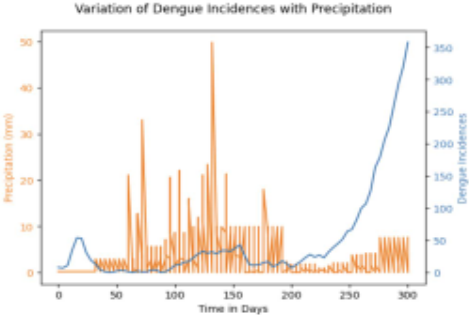
Figure 5 shows the possible correlation between precipitation and dengue cases in which the rainy period (days 50100) preceded the first spike in dengue cases, which peaked in days 150, suggesting that the increased precipitation created breeding sites for mosquitoes, leading to a delayed surge in dengue cases. A time lag between dengue incidences and precipitation was observed, and this could be explained by mosquito activities such as the mosquito lifecycle, virus incubation period, and human infection dynamics. Although there was a decline in precipitation towards the end of the simulation, dengue cases were observed to continue rising sharply. This could be explained by the fact that once a high mosquito population was established, dengue transmission could sustain itself even with reduced rainfall. Therefore, the simulation results suggested a strong link between precipitation and dengue incidences with a delayed effect. Rainfall events created breeding conditions for mosquitoes, leading to a later increase in infections. Thus, public health interventions could focus on mosquito control during and shortly after rainy periods to reduce dengue transmission.
Figure 6 presents the association rules developed, the developed association rules had a lift greater than one indicating there existed positive associations between the antecedents and the consequents. The analysis of association rules revealed that increases in human infections and total exposed individuals were strongly correlated with a rise in mosquito infections, indicating that infected humans were crucial in transmitting dengue to mosquitoes.
Elevated mosquito infection rates were closely associated with growth in the female mosquito population, which are the primary vectors for dengue spread. This finding suggested that female mosquitoes were the main culprits in dengue transmission. Environmental factors, such as higher temperatures, precipitation, and extended transmission periods, resulted in greater human exposure, implying that climate played a significant role in the spread of dengue.
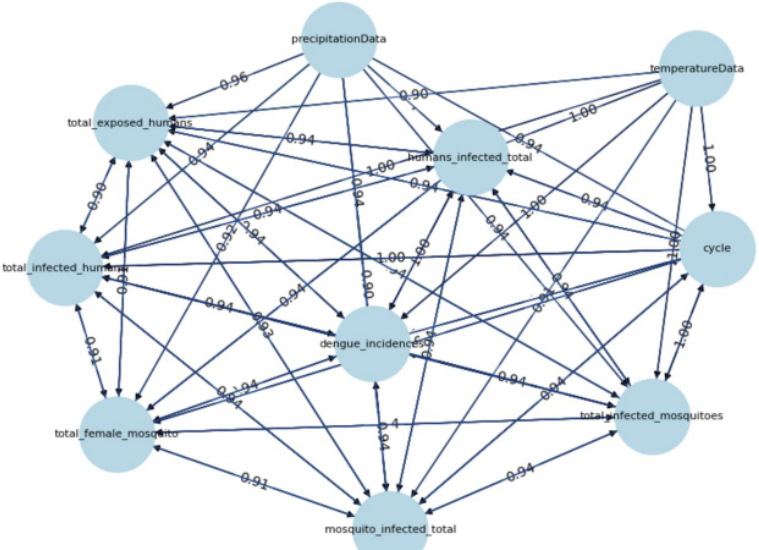
Figure 7 presents the network graph of the association rules, showing the association between different variables related to dengue fever transmission, the climatic factors and population dynamics of both human and mosquito agents. The edges represented the correlations between the parameters with confidence values ranging from 0.90 to 1.00 suggesting strong associations between the variables. Weather parameters (precipitation and temperature) were strongly linked to many parameters such as total infected mosquitoes, total infected humans, and the dengue incidence rate indicating that the weather conditions play a significant role in dengue transmission dynamics. Infected mosquito populations were strongly linked to human infection and dengue incidences emphasizing the cycle of transmission between vector and human hosts. The network graph of the association rules was used to enhance the predictive model for dengue outbreaks thus health authorities could predict when and where outbreaks were most likely to occur allowing for timely interventions. Furthermore, understanding these associations assists policymakers and healthcare professionals in making well informed data-driven decision based on dengue fever which are crucial for outbreak prediction, targeted control measures and public health planning.
The model simulation results that represent Dar es Salaam as a case study can be applied in other Sub-Sahara African regions that experience tropical climates such as Tanzaniathe presence of similar Ae. Aegypti species and pathogen strains in other Sub-Sahara African areas also enhance the applicability of the study findings in those regions. The model can be adopted and calibrated with appropriate local environmental, social, and epidemiological conditions from other regions making the findings applicable in those areas. The resulting simulation results would then help inform epidemiologists and other public health stakeholders on the disease spread dynamics and facilitate informed decision-making and surveillance. Initial model sensitivity analysis was performed to identify the high-sensitivity parameters from which the threshold values for the parameters were identified to determine the robustness of the parameters. High-sensitive parameters identified included precipitation, temperature, number of infected mosquitoes in a simulation cycle, dengue incidences per simulation cycle, the total number of exposed human agents, and the total number of infected mosquitoes. Adjusting the threshold values of their parameters would cause a drastic change in the outcomes.
Figure 5: Changes in dengue incidences with precipitation pattern
The next step is observing the effects of varying key parameter values with scenario testing. Model validation was performed using domain experts such as epidemiologists, public health officials, and climate and environmental scientists, who initially validated the conceptual model, mosquito lifecycle sub-model, and the disease progression sub-model to ensure that the assumptions made and the rules adopted accurately represented the mosquito biology and epidemiology of Ae. Aegypti. The use of the ODD protocol provided a means for model validation as it ensured transparency and reproducibility of the model and the simulation scenarios. Data validation was carried out to ensure accurate calibration of the model parameters. Dengue outbreak data for 20182019 and weather data from the TMA were used. Challenges encountered during validation included data incompleteness, unavailability of mosquito population data, and the inability of the model to fully capture all the environmental interactions that influence mosquito behavior apart from the weather parameters considered. To account for the stochastic nature of the model, it was crucial to run multiple simulations, which were time-consuming and computationally expensive.
4 Conclusion
The developed agent-based model can be adapted to simulate the impact of various public health interventions on dengue transmission to utilize the benefit of ABM to capture the complexity of interactions between individual agents, environmental factors, and interventions. Feasible interventions could include the reduction of breeding sites that would eliminate the larval habitat. This would reduce the ability of mosquitoes to find suitable breeding sites, thus demonstrating how the reduction of the mosquito population at the larva stage would influence the overall mosquito population dynamics and the transmission of dengue. Other interventions could include the use of vaccinations, the model would reflect how vaccination reduced the susceptible human population and its effect on dengue transmission dynamics. Public awareness campaigns could be implemented in the ABM whereby changes to human behavior could be modeled in response to the effects of the designed public health campaigns such as the use of mosquito repellants or participation in the reduction of mosquito breeding sites and other measures.
Thus, this paper presents an ABM for dengue fever surveillance and decision-making in which the model was implemented using the GAMA framework, different simulation scenarios were implemented, and the simulation results were analyzed. Overall results indicated the dependence of dengue fever transmission dynamics on the weather parameter, which influenced the mosquito population at different stages of the infection cycle, the fluctuations in the rate of infection in human agents and mosquito agents. The graphs presented the ability of the simulation results to convey valuable information to epidemiologists and health data stakeholders.
Thus, ABMs for dengue dynamics with climatic factors are useful tools for studying the transmission dynamics and can be used to inform public health experts on the effectiveness of intervention when the models incorporate intervention strategies. The model was calibrated with dengue incidence data for the 2018-2019 outbreak in the Dar es Salaam region. Based on the benefits of ABM in epidemiological studies, this model will help inform public health policies and ultimately reduce the burden of dengue on communities. Future work involves completing the dengue ABM sensitivity analysis to further explore the impact of various parameters
@inproceedings{ijcai_aai4g_2024p8,
  title     = {Enhancing Surveillance and Decision-Making on Dengue Using Agent-Based Modelling and Simulation},
  author    = {Pascoe, Luba and Clemen, Thomas and Nyambo, Devotha and Bradshaw, Karen},
  booktitle = {Second IJCAI AI for Good Symposium in Africa hosted by Deep Learning Indaba},
  publisher = {International Joint Conferences on Artificial Intelligence Organization},
  editor    = {Avishkar Bhoopchand, Girmaw Abebe Tadesse, Sibusisiwe Makhanya, Frank Dignum, Georgina Curto},
  pages     = {50--60},
  year      = {2024},
  month     = {9},
  note      = {Indaba},
  doi       = {10.24963/ijcai.aai4g.2024/8},
  url       = {https://doi.org/10.24963/ijcai.aai4g.2024/8},
}
TY - CPAPER TI - Enhancing Surveillance and Decision-Making on Dengue Using Agent-Based Modelling and Simulation AU - Pascoe, Luba AU - Clemen, Thomas AU - Nyambo, Devotha AU - Bradshaw, Karen T2 - Second IJCAI AI for Good Symposium in Africa hosted by Deep Learning Indaba PB - International Joint Conferences on Artificial Intelligence Organization PY - 2024 SP - 50 EP - 60 DO - 10.24963/ijcai.aai4g.2024/8 UR - https://doi.org/10.24963/ijcai.aai4g.2024/8 ER -Copied
Machine-readable versions of this paper, for tools and AI agents:





