
PERELMAN: Pipeline for Scientific Literature Meta-Analysis
Proceedings of the Thirty-Fifth International Joint Conference on Artificial Intelligence. Demo Track. Pages 8513-8517.
https://doi.org/10.24963/ijcai.2026/992
Keywords
- AI: Agent-based and Multi-agent Systems
Abstract
We present PERELMAN (PipEline foR sciEntific Literature Meta-ANalysis), an agentic framework designed to extract specific information from a large corpus of scientific articles to support large-scale literature reviews and meta-analyses. Our central goal is to reliably transform heterogeneous article content into a unified, machine-readable representation. PERELMAN first elicits domain knowledge-including target variables, inclusion criteria, units, and normalization rules-through a structured dialogue with a subject-matter expert. This domain knowledge is then reused across multiple stages of the pipeline and guides coordinated agents in extracting evidence from narrative text, tables, and figures, enabling consistent aggregation across studies. In order to assess reproducibility and validate our implementation, we evaluate the system on the task of reproducing the meta-analysis of layered Li-ion cathode properties LiNi0.8Mn0.1Co0.1O2 (NMC811). We describe our solution, which has the potential to reduce the time required to prepare meta-analyses from months to minutes.
- [Auer et al., 2024] Christoph Auer, Maksym Lysak, Ahmed Nassar, Michele Dolfi, Nikolaos Livathinos, Panos Vage- nas, Cesar Berrospi Ramis, Matteo Omenetti, Fabian Lindlbauer, Kasper Dinkla, Lokesh Mishra, Yusik Kim, Shubham Gupta, Rafael Teixeira de Lima, Valery Weber, Lucas Morin, Ingmar Meijer, Viktor Kuropiatnyk, and Pe- ter W. J. Staar. Docling technical report. arXiv preprint arXiv:2408.09869, 2024.
- [Beltagy et al., 2019] Iz Beltagy, Kyle Lo, and Arman Co- han. Scibert: A pretrained language model for scien- tific text. In Proceedings of the 2019 Conference on Em- pirical Methods in Natural Language Processing and the 9th International Joint Conference on Natural Language Processing (EMNLP-IJCNLP), pages 3615-3620, Hong Kong, China, November 2019. Association for Computa- tional Linguistics.
- [Cherepanov et al., 2023] Egor Cherepanov, Alexey Staroverov, Dmitry Yudin, Alexey K Kovalev, and Aleksandr I Panov. Recurrent action transformer with memory. arXiv preprint arXiv:2306.09459, 2023.
- [Cherepanov et al., 2025] Egor Cherepanov, Alexey K Ko- valev, and Aleksandr I Panov. Elmur: External layer mem- ory with update/rewrite for long-horizon rl. arXiv preprint arXiv:2510.07151, 2025.
- [Cheung et al., 2024] Jerry Cheung, Yuchen Zhuang, Ying- hao Li, Pranav Shetty, Wantian Zhao, Sanjeev Grampuro- hit, Rampi Ramprasad, and Chao Zhang. POLYIE: A dataset of information extraction from polymer material scientific literature. In Proceedings of the 2024 Confer- ence of the North American Chapter of the Association for Computational Linguistics: Human Language Technolo- gies (Volume 1: Long Papers), pages 2370-2385, Mexico City, Mexico, June 2024. Association for Computational Linguistics.
- [Circi et al., 2025] Defne Circi, Miles Bradley, Sam Blouir, Boris Wilthan, Antonis Anastasopoulos, Amarda Shehu, L. Catherine Brinson, and Bhuwan Dhingra. Information extraction from diverse charts in materials science, 2025. Workshop paper at COLM 2025. [Crossref, 2025] Crossref. Crossref status report (crossref stats page). Website, 2025. Updated Dec 25, 2025.
- [Foppiano et al., 2024] Luca Foppiano, Guillaume Lambard, Toshiyuki Amagasa, and Masashi Ishii. Mining exper- imental data from materials science literature with large language models: an evaluation study. Science and Tech- nology of Advanced Materials: Methods, 4(1), 2024. Ar- ticle 2356506.
- [Huang and Cole, 2020] Shu Huang and Jacqueline M. Cole. A database of battery materials auto-generated using chemdataextractor. Scientific Data, 7(1):260, 2020.
- [Jung et al., 2017] Roland Jung, Michael Metzger, Filippo Maglia, Christoph Stinner, and Hubert A. Gasteiger. Oxy- gen release and its effect on the cycling stability of lin- ixmnycozo2 (nmc) cathode materials for li-ion batteries. Journal of The Electrochemical Society, 164(7):A1361- A1377, 2017.
- [Li et al., 2015] Jing Li, Laura E. Downie, Lin Ma, Wenda Qiu, and Jeff R. Dahn. Study of the failure mecha- nisms of lini0.8mn0.1co0.1o2 cathode material for lithium ion batteries. Journal of The Electrochemical Society, 162(7):A1401-A1408, 2015.
- [Liang et al., 2025] Xun Liang, Jiawei Yang, Yezhaohui Wang, Chen Tang, Zifan Zheng, Shichao Song, Zehao Lin, Yebin Yang, Simin Niu, Hanyu Wang, et al. Surveyx: Aca- demic survey automation via large language models. arXiv preprint arXiv:2502.14776, 2025.
- [Livathinos et al., 2025] Nikolaos Livathinos, Christoph Auer, Maksym Lysak, Ahmed Nassar, Michele Dolfi, Panos Vagenas, Cesar Berrospi Ramis, Matteo Omenetti, Kasper Dinkla, Yusik Kim, Shubham Gupta, Rafael Teix- eira de Lima, Valery Weber, Lucas Morin, Ingmar Meijer, Viktor Kuropiatnyk, and Peter W. J. Staar. Docling: An efficient open-source toolkit for ai-driven document conversion. arXiv preprint arXiv:2501.17887, 2025.
- [Lo et al., 2020] Kyle Lo, Lucy Lu Wang, Mark Neumann, Rodney Kinney, and Daniel Weld. S2orc: The semantic scholar open research corpus. In Proceedings of the 58th Annual Meeting of the Association for Computational Lin- guistics, pages 4969-4983, Online, July 2020. Association for Computational Linguistics.
- [Lopez, 2009] Patrice Lopez. Grobid: Combining auto- matic bibliographic data recognition and term extraction for scholarship publications. In Research and Advanced Technology for Digital Libraries: 13th European Confer- ence, ECDL 2009, Corfu, Greece, September 27-October 2, 2009, Proceedings, pages 473-474. Springer, 2009.
- [Luan et al., 2018] Yi Luan, Luheng He, Mari Ostendorf, and Hannaneh Hajishirzi. Multi-task identification of en- tities, relations, and coreference for scientific knowledge graph construction. In Proceedings of the 2018 Conference on Empirical Methods in Natural Language Processing, pages 3219-3232, Brussels, Belgium, October-November 2018. Association for Computational Linguistics.
- [Marshall et al., 2015] Iain J. Marshall, Joël Kuiper, and By- ron C. Wallace. Robotreviewer: evaluation of a system for automatically assessing bias in clinical trials. Jour- nal of the American Medical Informatics Association, 23(1):193-201, 2015.
- [Masry et al., 2022] Ahmed Masry, Do Xuan Long, Jia Qing Tan, Shafiq Joty, and Enamul Hoque. Chartqa: A bench- mark for question answering about charts with visual and logical reasoning. In Findings of the Association for Computational Linguistics: ACL 2022, pages 2263-2279, Dublin, Ireland, May 2022. Association for Computational Linguistics.
- [OpenAI et al., 2025] OpenAI, Sandhini Agarwal, Lama Ahmad, Jason Ai, Sam Altman, Andy Applebaum, Ed- win Arbus, Rahul K. Arora, Yu Bai, Bowen Baker, et al. gpt-oss-120b & gpt-oss-20b model card. arXiv preprint arXiv:2508.10925, 2025.
- [Savina and Abakumov, 2023] Aleksandra A. Savina and Artem M. Abakumov. Benchmarking the electrochemical parameters of the lini0.8mn0.1co0.1o2 positive electrode material for li-ion batteries. Heliyon, 9(12):e21881, 2023.
- [Schick et al., 2023] Timo Schick, Jane Dwivedi-Yu, Roberto Dessì, Roberta Raileanu, Maria Lomeli, Luke Zettlemoyer, Nicola Cancedda, and Thomas Scialom. Toolformer: Language models can teach themselves to use tools. arXiv preprint arXiv:2302.04761, 2023.
- [Swain and Cole, 2016] Matt E. Swain and Jacqueline M. Cole. Chemdataextractor: A toolkit for automated ex- traction of chemical information from the scientific liter- ature. Journal of Chemical Information and Modeling, 56(10):1894-1904, 2016.
- [van de Schoot et al., 2021] Rens van de Schoot, Jonathan de Bruin, Raoul Schram, Parisa Zahedi, Jan de Boer, Fe- lix Weijdema, Bianca Kramer, Martijn Huijts, Maarten Hoogerwerf, Gerbrich Ferdinands, Albert Harkema, Joukje Willemsen, Yongchao Ma, Qixiang Fang, Sybren Hindriks, Lars Tummers, and Daniel Oberski. An open source machine learning framework for efficient and trans- parent systematic reviews. Nature Machine Intelligence, 3(2):125-133, 2021.
- [Wang et al., 2024a] Bin Wang, Chao Xu, Xiaomeng Zhao, Linke Ouyang, Fan Wu, Zhiyuan Zhao, Rui Xu, Kaiwen Liu, Yuan Qu, Fukai Shang, Bo Zhang, Liqun Wei, Zhihao Sui, Wei Li, Botian Shi, Yu Qiao, Dahua Lin, and Conghui He. Mineru: An open-source solution for precise docu- ment content extraction. arXiv preprint arXiv:2409.18839, 2024.
- [Wang et al., 2024b] Zirui Wang, Mengzhou Xia, Luxi He, Howard Chen, Yitao Liu, Richard Zhu, Kaiqu Liang, Xindi Wu, Haotian Liu, Sadhika Malladi, Alexis Cheva- lier, Sanjeev Arora, and Danqi Chen. Charxiv: Charting gaps in realistic chart understanding in multimodal llms. arXiv preprint arXiv:2406.18521, 2024.
- [Yao et al., 2022] Shunyu Yao, Jeffrey Zhao, Dian Yu, Nan Du, Izhak Shafran, Karthik Narasimhan, and Yuan Cao. React: Synergizing reasoning and acting in language mod- els. arXiv preprint arXiv:2210.03629, 2022.
- [Zhong et al., 2019] Xu Zhong, Jianbin Tang, and Anto- nio Jimeno Yepes. Publaynet: largest dataset ever for doc- ument layout analysis. arXiv preprint arXiv:1908.07836, 2019.
References were extracted automatically from the PDF and may contain errors.
Full text extracted automatically from the PDF; figures, tables and equations may differ. The PDF is the version of record.
1 Introduction
Scientific literature is growing faster than researchers can synthesize it: the number of published papers in 2025 is roughly twice that of 2019 [Liang et al., 2025], while Crossref already indexes on the order of 108 DOI records [Crossref, 2025]. In many experimental domains, this growth hinders reproducible evidence synthesis because key metrics must be aggregated across many partially inconsistent studies.
We introduce PERELMAN (PipEline foR sciEntific Literature Meta-ANalysis), an agentic pipeline that extracts target variables from domain papers into auditable structured records for expert meta-reviews. PERELMAN combines (i) expert-guided domain knowledge elicitation, (ii) layoutaware PDF parsing into an LLM-readable representation (text + figure assets), and (iii) figure-centric multimodal extraction with image normalization and a text fallback. The system outputs a per-article json record with provenance for selective human verification.
The approach builds on automated evidence-synthesis tools [Marshall et al., 2015; van de Schoot et al., 2021], scientific document infrastructure [Lo et al., 2020; Lopez, 2009; Zhong et al., 2019], text-focused scientific IE [Beltagy et al., 2019; Luan et al., 2018; Cheung et al., 2024], and chart benchmarks that expose persistent numerical-reasoning gaps in VLMs [Masry et al., 2022; Wang et al., 2024b; Circi et al., 2025]. In materials and chemistry, this is aligned with hybrid extraction pipelines that combine models, schemas, and normalization [Swain and Cole, 2016; Huang and Cole, 2020; Foppiano et al., 2024]. At the workflow level, PERELMAN follows tool-using agentic designs [Yao et al., 2022; Schick et al., 2023]; memory-augmented architectures such as RATE and ELMUR are relevant for long-horizon context tracking [Cherepanov et al., 2023; Cherepanov et al., 2025].
We evaluate PERELMAN on a subset of the NMC811 benchmark meta-analysis dataset [Savina and Abakumov, 2023]. The study focuses on extracting first-cycle discharge capacity, first-cycle coulombic efficiency, and voltage range, and shows that domain-knowledge-enhanced prompting improves over a page-wise VLM baseline in this single-domain demo setting.
A video demonstrating its use is available at 1 .
2 Pipeline
2.1 Agentic SystemArchitecture
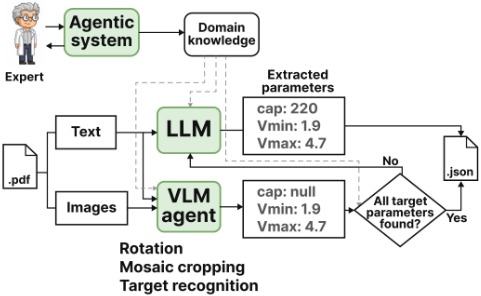
The architecture of the agentic system consists of three major components:
- (i) agentic system for extracting domain knowledge,
- (ii) an article-parsing tool,
- (iii) an agent for extracting data from the parsed articles, using domain knowledge.
The principal architecture is presented in Figure 1.
2.2 Domain knowledge
Domain knowledge is represented as a structured object via a three-step pipeline. A clarification agent first resolves ambiguity by asking 2-5 focused questions, with expert answers appended to the research context. A constraints agent then converts the enriched description into a typed schema {query understanding, entity type, entity description, limitations, search queries}, where limitations are verifiable conditions and queries specify domain and recency.
1 https://youtu.be/RL9MOHb3uD0
2.3 Data Collection
The module runs parallel Tavily searches, extracts typed candidates with provenance using LLM batch analysis, deduplicates them by normalized names plus an LLM DedupPlan, and verifies candidates with 1-2 combined queries before PDF metric extraction.
2.4 Article Parsing
The core parser can be any OCR system that preserves table structure and produces LLM-readable output. In our setup, the best results were obtained with Docling [Auer et al., 2024; Livathinos et al., 2025]. We convert each PDF into layout-aware Markdown and extract figure images into a dedicated folder, preserving captions when available.
2.5 VLMAgent
Figure data extraction
Data extraction is multimodal. For each figure, we build extra context: the caption plus a ±1000 character window around figure mentions in Markdown. This context is passed to the vision model to ground extraction in nearby textual descriptions.
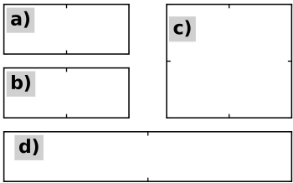
We use a VLM to predict a strict JSON schema that includes mosaic grid (rows/cols), panel labels, optional target panel, relevance flag, and required rotation. If the model outputs a 1x1 grid but labels indicate multiple panels, we correct the grid; if labels are absent, we apply a simple aspect-ratio heuristic and split the image into panels. The same invocation predicts rotation (0◦ , 90◦ , 180◦ , 270◦ ), and the figure is rotated if needed.
Multi-modal Metric Extraction
After image normalization, a larger VLM processes the target image together with the full extra content from Section 2.5. Target parameters are extracted in json format according to the expert-defined domain knowledge (Section 2.2). If image extraction fails, we fall back to a text-only LLM; in our default setup, the extractor uses GPT-oss 120B [OpenAI et al., 2025]. Text extraction runs on overlapping Markdown chunks, and first non-null values are merged into the final record.
Outputs
At the end of the pipeline, we produce a json file with extracted target metrics for downstream expert analysis and meta-review writing. These records are candidate extractions, and fields with lower reliability, especially chart-derived Coulombic efficiency, remain targets for human verification. In this setup, the cropping module reaches 70.83% accuracy. Given correctly cropped images, the target-image classifier reaches 88.25%. The effective Image Normalizer accuracy is therefore 70.83% · 88.25% = 62.5%.
Table 3 shows that most target information is located in figures. At the same time, chart extraction remains substantially weaker than text/table extraction. In an earlier pipeline version, extraction accuracy was 86% for text, 100% for tables, but only 34.6% for charts.
Chart-based Question Answering Specialized chart-QA benchmarks show that modern VLMs still do not reach human-level performance on scientific charts [Wang et al., 2024b]. We evaluated top models from this benchmark, together with several recent VLMs, on retrieval of target chart values. Results are presented in Table 4. After prompt tuning, extraction was run only on expert-selected, cropped, and normalized target images. The main tuning change was explicit injection of expert domain knowledge: metric definitions, typical reporting locations, and chart-reading heuristics. As shown in Table 5, this improves target-parameter extraction by up to an order of magnitude (from 4.55% to 80.95% for one metric).
3 Experiments
Layered oxides of the form LiNixMnyCozO2 (NMC, x + y + z = 1) are key Li-ion cathode materials. The Nirich composition LiNi0.8Mn0.1Co0.1O2 (NMC811) provides high specific capacity (≈ 200 mAh g-1 ) and is widely studied for high-energy cells [Li et al., 2015]. At the same time, NMC811 suffers from complex degradation mechanisms, which leads to partially inconsistent metrics across the literature [Jung et al., 2017]. Savina and Abakumov addressed this with a large-scale manual meta-analysis of NMC811, aggregating 548 articles and more than 950 records [Savina and Abakumov, 2023]. Their benchmark highlights both the value of systematic synthesis and the high manual effort required. We reproduce a 24-article expert-grounded subset: each target value is linked to its source location, including the specific figure or panel and extraction procedure. For each record, the reference meta-analysis reports: firstcycle discharge capacity (mAhg-1 ), first-cycle Coulombic efficiency (%), upper cut-off voltage and C-rate.
| System | First Discharge Capacity | Coulombic Efficiency | Voltage (max) | Voltage (min) |
|---|---|---|---|---|
| Ours | 58.33% | 33.33% | 95.83% | 70.80% |
| Ours (MinerU parser) | 54.17% | 33.33% | 87.50% | 87.50% |
| Ours (DoclingOCR) | 53.85% | 30.77% | 84.62% | 73.08% |
| Ours (DeepSeekOCR) | 53.85% | 23.08% | 84.62% | 73.08% |
| GPT-5.2 Pro Extended Thinking | 25.00% | 0.00% | 79.20% | 79.20% |
| GPT-5.2 Thinking Heavy | 8.30% | 8.30% | 58.30% | 58.30% |
| VLM | Text | First cycle Discharge Capacity | Coulombic efficiency | Voltage (max) | Voltage (min) |
|---|---|---|---|---|---|
| - | gpt-oss-120b | 19.23% | 11.54% | 42.31% | 30.77% |
| granite-2b | gpt-oss-120b | 50.00% | 19.23% | 80.77% | 69.23% |
| granite-8b | gpt-oss-120b | 53.85% | 30.77% | 84.62% | 73.08% |
| Source | Text | Table | Chart |
|---|---|---|---|
| Fraction | 29% | 1% | 70% |
| Model | Avg. | Cap. | CE | Vmax | Vmin |
|---|---|---|---|---|---|
| Claude 3.7 Sonnet | 30.7 | 0.0 | 0.0 | 72.7 | 50.0 |
| Gemma 3 27B | 0.0 | 0.0 | 0.0 | 0.0 | 0.0 |
| GLM 4.5V | 8.0 | 0.0 | 0.0 | 18.2 | 13.6 |
| GPT-5 Mini | 9.1 | 0.0 | 0.0 | 13.6 | 22.7 |
| Grok-4 | 3.6 | 0.0 | 0.0 | 7.1 | 7.1 |
| Nemotron-12B-V2 | 15.3 | 0.0 | 0.0 | 27.8 | 33.3 |
| Qwen 3 VL 235B | 17.1 | 4.6 | 0.0 | 31.8 | 31.8 |
| Approach | Cap. | CE | Vmax | Vmin |
|---|---|---|---|---|
| Default | 4.55% | 0.00% | 31.82% | 31.82% |
| Tuned + normalized | 80.95% | 36.36% | 95.65% | 73.91% |
4 Results
Evaluation metric. A prediction is counted as correct if it falls within ±3% relative tolerance of the benchmark value in [Savina and Abakumov, 2023]. For voltage ranges, both endpoints must satisfy this criterion. Table 1 reports N = 24
results. On a larger n = 200 run with the same setup, accuracies were 56.00%, 49.50%, 86.70%, and 85.64% for capacity, Coulombic efficiency, voltage maximum, and voltage minimum, respectively.
In Table 1, "Ours" denotes the full pipeline with granite-8b for figure annotation and GPT-oss 120B for text extraction. The MinerU [Wang et al., 2024a] parser variant is close to Docling on the main metrics, but was more than 2× slower in our sampled runs. "DoclingOCR" and "DeepSeekOCR" replace the figure-annotation VLM, while GPT-5.2 rows are page-wise baselines without pipeline components. We also analyze configuration effects; for example, Table 2 shows that larger chart-annotation VLMs improve end-to-end extraction accuracy.
We observed three main challenges: chart extraction with minimal domain context, component coupling through targetimage classification, and complex multi-panel figures that violate near-uniform mosaic splitting. The low Coulombicefficiency scores also show that reliability is uneven across scientific parameters.
5 Conclusions
We introduced PERELMAN, an agentic pipeline for multimodal literature meta-analysis. Combining layout-aware parsing with figure-centric extraction, it outperforms VLMonly baselines on an expert-grounded NMC811 benchmark with figure/panel-level source annotations. PERELMAN reduces manual effort by producing auditable candidate records for expert verification; future work will improve complex multi-panel figure handling and test schema-based adaptation beyond NMC811.
@inproceedings{ijcai2026p992,
  title     = {PERELMAN: Pipeline for Scientific Literature Meta-Analysis},
  author    = {Sherki, Daniil and Merkulov, Daniil and Savina, Aleksandra and Kikov, Dzhantemir and Parpulov, Dmitry and Ivanov, Alexander and Abakumov, Artem and Muravleva, Ekaterina},
  booktitle = {Proceedings of the Thirty-Fifth International Joint Conference on
               Artificial Intelligence, {IJCAI-26}},
  publisher = {International Joint Conferences on Artificial Intelligence Organization},
  editor    = {Diego Calvanese},
  pages     = {8513--8517},
  year      = {2026},
  month     = {8},
  note      = {Demo Track},
  doi       = {10.24963/ijcai.2026/992},
  url       = {https://doi.org/10.24963/ijcai.2026/992},
}
TY - CPAPER TI - PERELMAN: Pipeline for Scientific Literature Meta-Analysis AU - Sherki, Daniil AU - Merkulov, Daniil AU - Savina, Aleksandra AU - Kikov, Dzhantemir AU - Parpulov, Dmitry AU - Ivanov, Alexander AU - Abakumov, Artem AU - Muravleva, Ekaterina T2 - Proceedings of the Thirty-Fifth International Joint Conference on Artificial Intelligence, IJCAI-26 PB - International Joint Conferences on Artificial Intelligence Organization PY - 2026 SP - 8513 EP - 8517 DO - 10.24963/ijcai.2026/992 UR - https://doi.org/10.24963/ijcai.2026/992 ER -Copied
Machine-readable versions of this paper, for tools and AI agents:





