
Double Bounded Neural Ray Queries
Proceedings of the Thirty-Fifth International Joint Conference on Artificial Intelligence. Demo Track. Pages 8475-8478.
https://doi.org/10.24963/ijcai.2026/983
Keywords
- AI: Machine Learning
Abstract
We introduce a novel neural ray tracing method designed for compact scene representations and real-time rendering. To compress the scene with minimal fidelity losses, we address the issue of limiting the search space for intersections. For each scene we first construct two lightweight proxy shells that tightly bound the original surface from inside and outside. While executing ray queries, we intersect the rays with the shells and extract the regions that potentially contain the intersection with the original surface. Extracted regions are passed to the small neural network to retrieve the exact intersection location. We implement our method as part of a GPU-accelerated hybrid path tracing pipeline. We demonstrate it running real-time rendering on a variety of scenes, achieving up to 300x memory reduction and surpassing existing compressed ray tracing techniques in memory-quality trade-off.
- [Aumentado-Armstrong et al., 2022] Tristan Aumentado- Armstrong, Stavros Tsogkas, Sven Dickinson, and Allan Jepson. Representing 3d shapes with probabilistic di- rected distance fields. In Proceedings of the IEEE/CVF conference on computer vision and pattern recognition, pages 19343-19354, 2022.
- [Chabra et al., 2020] Rohan Chabra, Jan Eric Lenssen, Eddy Ilg, Tanner Schmidt, Julian Straub, Steven Lovegrove, and Richard Newcombe. Deep local shapes: Learning local sdf priors for detailed 3d reconstruction. In Computer Vi- sion -ECCV 2020: 16th European Conference, Glasgow, UK, August 23-28, 2020, Proceedings, Part XXIX, page 608-625, Berlin, Heidelberg, 2020. Springer-Verlag.
- [Feng et al., 2022] Brandon Feng, Yinda Zhang, Danhang Tang, Ruofei Du, and Amitabh Varshney. Prif: Primary ray-based implicit function. In Computer Vision -ECCV 2022: 17th European Conference, Tel Aviv, Israel, October 23-27, 2022, Proceedings, Part III, page 138-155, Berlin, Heidelberg, 2022. Springer-Verlag.
- [Fujieda et al., 2023] Shin Fujieda, Chih Chen Kao, and Takahiro Harada. Neural Intersection Function. In Jacco Bikker and Christiaan Gribble, editors, High-Performance Graphics -Symposium Papers. The Eurographics Associ- ation, 2023.
- [Fujieda et al., 2025] Shin Fujieda, Chih-Chen Kao, and Takahiro Harada. Lsnif: Locally-subdivided neural inter- section function. volume 8, New York, NY, USA, May 2025.
- [Gaschler et al., 2015] Andre Gaschler, Quirin Fis- cher, Alois Knoll, and Technische Universität München Lehrstuhl für Rechnertechnik und Rech- nerorganisation. The Bounding Mesh Algorithm. TUM-I. TUM Technische Universität München, Institut für Informatik, 2015.
- [Haydel et al., 2023] Jacob Haydel, Cem Yuksel, and Larry Seiler. Locally-adaptive level-of-detail for hardware- accelerated ray tracing. ACM Trans. Graph., 42(6), De- cember 2023.
- [Kim et al., 2024] Doyub Kim, Minjae Lee, and Ken Museth. Neuralvdb: High-resolution sparse volume repre- sentation using hierarchical neural networks. ACM Trans. Graph., 43(2), 2024.
- [Kingma and Ba, 2014] Diederik Kingma and Jimmy Ba. Adam: A method for stochastic optimization. In Inter- national Conference on Learning Representations, 2014.
- [Liu et al., 2023] Zhuoman Liu, Bo Yang, Yan Luximon, Ajay Kumar, and Jinxi Li. Raydf: Neural ray-surface dis- tance fields with multi-view consistency. In Advances in Neural Information Processing Systems, volume 36, pages 25238-25267, 2023.
- [Maggiordomo et al., 2023] Andrea Maggiordomo, Henry Moreton, and Marco Tarini. Micro-mesh construction. ACM Trans. Graph., 42(4), July 2023.
- [Müller et al., 2022] Thomas Müller, Alex Evans, Christoph Schied, and Alexander Keller. Instant neural graphics primitives with a multiresolution hash encoding. ACM Trans. Graph., 41(4), July 2022.
- [Polyak and Juditsky, 1992] Boris Polyak and Anatoli Judit- sky. Acceleration of stochastic approximation by av- eraging. SIAM Journal on Control and Optimization, 30(4):838-855, 1992.
- [Sivaram et al., 2024] Venkataram Sivaram, Tzu-Mao Li, and Ravi Ramamoorthi. Neural geometry fields for meshes. In ACM SIGGRAPH 2024 Conference Papers, SIGGRAPH '24, 2024.
- [Takikawa et al., 2021] Towaki Takikawa, Joey Litalien, Kangxue Yin, Karsten Kreis, Charles Loop, Derek Nowrouzezahrai, Alec Jacobson, Morgan McGuire, and Sanja Fidler. Neural geometric level of detail: Real-time rendering with implicit 3d shapes. In 2021 IEEE/CVF Conference on Computer Vision and Pattern Recognition (CVPR), pages 11353-11362, 2021.
- [Takikawa et al., 2022] Towaki Takikawa, Alex Evans, Jonathan Tremblay, Thomas Müller, Morgan McGuire, Alec Jacobson, and Sanja Fidler. Variable bitrate neural fields. In Special Interest Group on Computer Graphics and Interactive Techniques Conference Proceedings, SIGGRAPH '22, page 1-9. ACM, August 2022.
- [Takikawa et al., 2023] Towaki Takikawa, Thomas Müller, Merlin Nimier-David, Alex Evans, Sanja Fidler, Alec Ja- cobson, and Alexander Keller. Compact neural graphics primitives with learned hash probing. In SIGGRAPH Asia 2023 Conference Papers, SA '23, New York, NY, USA, 2023. Association for Computing Machinery.
- [Weier et al., 2024] Philippe Weier, Alexander Rath, Élie Michel, Iliyan Georgiev, Philipp Slusallek, and Tamy Boubekeur. N-bvh: Neural ray queries with bounding vol- ume hierarchies. In ACM SIGGRAPH 2024 Conference Papers, SIGGRAPH '24, 2024.
- [Zakharov et al., 2024] Sergey Zakharov, Katherine Liu, Adrien Gaidon, and Rares Ambrus. Refine: Recursive field networks for cross-modal multi-scene representa- tion. In ACM SIGGRAPH 2024 Conference Papers, SIG- GRAPH '24, New York, NY, USA, 2024. Association for Computing Machinery.
- [Zhang et al., 2025] Congyi Zhang, Jinfan Yang, Eric Hedlin, Suzuran Takikawa, Nicholas Vining, Kwang Moo Yi, Wenping Wang, and Alla Sheffer. Nesi: Neu- ral explicit-shape-intersection-based geometry representa- tion. ACM Trans. Graph., 44(5), July 2025.
References were extracted automatically from the PDF and may contain errors.
Full text extracted automatically from the PDF; figures, tables and equations may differ. The PDF is the version of record.
1 Introduction
Modern rendering applications demand the storage and realtime rendering of highly detailed geometry. Dominant industry approaches rely on triangle meshes, which are relatively cheap to evaluate but memory intensive [Maggiordomo et al., 2023; Haydel et al., 2023]. Recent neural compression methods achieve favorable quality-to-size trade-offs but remain computationally expensive for real-time rendering [Takikawa et al., 2021; Sivaram et al., 2024; Zhang et al., 2025; Chabra et al., 2020]. Other works introduce compact spatial encoding and enable relatively efficient sampling and queries [Kim et al., 2024; Zakharov et al., 2024; M¨uller et al., 2022; Takikawa et al., 2022; Takikawa , 2023 ], yet they are still costly for ray tracing, as multiple neural network evaluations are required per ray query. Neural ray tracing techniques reduce computational cost by limiting network evaluations, operating directly on rays [Weier et al., 2024; Fujieda et al., 2025].
In this paper, we introduce a neural ray tracing method 1 that achieves real-time performance while surpassing existing approaches in compression-to-quality trade-off. Our contributions are as follows:
1 To access the code and additional materials, please see https://github.com/Alehandreus/double-bounded-rt
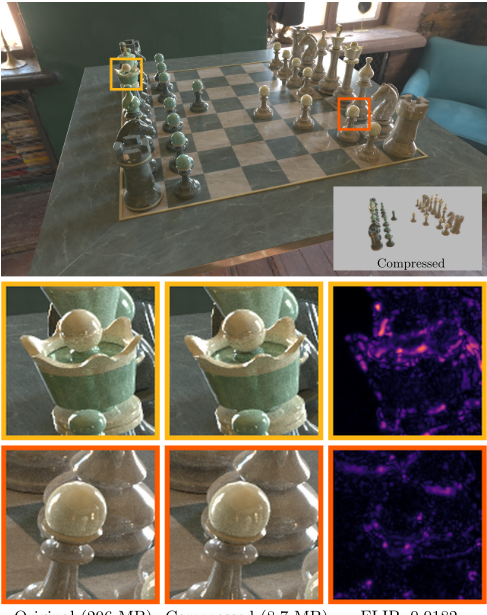
- We propose a novel neural geometry compression method designed for ray tracing that achieves up to 300× memory reduction with minimal quality loss;
- We devise an algorithm that mitigates discontinuities in the target function by splitting rays into multiple segments and evaluating them separately;
- We implement an efficient hybrid inference pipeline, demonstrating real-time path tracing on complex scenes.
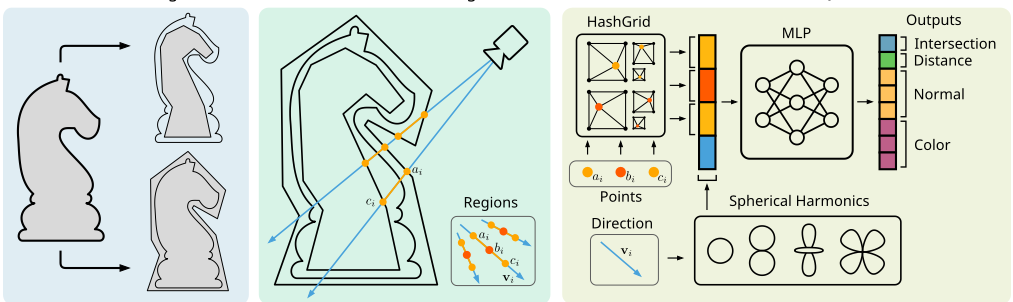
Generate Bounding Shells
Select Intersection Regions
Execute Neural Queries
2 RelatedWork
Neural ray tracing relies on extracting the intersection point given both the origin and the direction of a ray [Fujieda et al., 2023]. Unlike a signed distance field, this function suffers from discontinuities: for non-convex objects, a slight movement of ray position can lead to a sharp change of the hit point coordinates. Various encodings and auxiliary losses were proposed to ensure consistency [Aumentado-Armstrong et al., 2022; Feng et al., 2022; Liu et al., 2023].
Prior work has shown that the largest accuracy improvements come from limiting the search space. [Fujieda et al., 2025] encloses the original surface in a sparse voxel grid, while [Weier et al., 2024] constructs a shallow BVH tree. The network is then provided with the narrow region that potentially contains the intersection point.
However, both voxels and BVH nodes form an uneven surface; furthermore, axis-aligned bounding boxes cannot ensure tight bounding for most geometries, exacerbating the discontinuity issue.
3 Proposed Pipeline
To mitigate the problem of frequent bumps in the target function, we propose to enclose the original surface in two coarse bounding meshes. For each target object, we construct an inner and an outer shell using the Bounding Mesh algorithm [Gaschler et al., 2015].
3.1 Rendering
During inference, only lightweight shells and the neural network are available. For each ray, we first extract a region possibly containing the intersection with the original surface. The first point ai of a region is the entry point to the outer shell. The second point ci is either the exit point from the outer shell or the entry point to the inner shell, whichever is closer to ai. Each new outer shell entry forms a new region (Figure 2).
To improve sensitivity to small details, we spatially encode the regions. The start ai, end ci, and middle bi points of a region are encoded with a multi-resolution hash grid encoding [M¨uller et al., 2022]. The hash grid contains 16 levels of 2n 4-dimensional features, n is left as a hyperparameter. The direction of a ray vi is encoded with 16 spherical harmonics. All embeddings are concatenated and passed to an MLP containing 4 hidden layers of 128 neurons. The MLP outputs the color, normal, distance to the intersection point, and a binary classification result for the existence of an intersection point between the ray and the original surface inside the segment. To minimize the number of neural network evaluations, we process all ray segments in order: we first traverse the full BVH of coarse shells to extract the ray segment closest to the ray origin. If the neural query classifies the segment as not containing the intersection, we do another traversal pass to extract the next segment.
The renderer is a wavefront path tracer implemented in CUDA. To improve performance, we run neural inference in half precision, perform ray compaction after each bounce and neural query, and employ CUDA-OpenGL interoperation to reduce transfers between host and device. Unlike [Weier et al., 2024], our implementation does not require injecting neural inference amid BVH traversal and takes advantage of hardware-accelerated ray tracing for shell intersection.
Analogous to [Weier et al., 2024], our rendering framework supports hybrid rendering of scenes with partial compression. Each ray is traced against both uncompressed parts of the scene and neural objects.
3.2 Training
We train in batches of 105 rays sampled dynamically. Directions are generated as random unit vectors and origins are sampled on the outer mesh surface to ensure good coverage of the scene. We use Adam [Kingma and Ba, 2014] optimizer with a learning rate of 10-3 and train for 200k iterations with EMA [Polyak and Juditsky, 1992]. We employ binary crossentropy loss for the classification output, L2 loss for the color and L1 loss for the distance and the normal. The final loss is the weighted sum of all components:
| Uncompressed | Ours | N-BVH | ||||||
|---|---|---|---|---|---|---|---|---|
| Scene | Size (MB) | FPS | Size (MB) | FPS ↑ | FLIP ↓ | Size (MB) | FPS ↑ | FLIP ↓ |
| CHESS | 296 | 594 | 8.70 | 115 | 0.0165 | 11.23 | 69 | 0.0278 |
| ANDALUSIAN | 204 | 267 | 9.97 | 61 | 0.0604 | 27 | 0.0722 | |
| EXHIBITION | 2521 | 545 | 8.88 | 124 | 0.0147 | 38 | 0.0274 | |
| STATUETTE | 642 | 970 | 8.94 | 155 | 0.0049 | 97 | 0.0126 | |
The training pipeline is implemented in PyTorch, with a custom CUDA library for BVH traversal. On a single NVIDIA RTX 5090, training takes between 30 and 60 minutes depending on the scene.
4 Results
We compute the original memory cost as the sum of buffers allocated for vertex positions, face indices, UV coordinates and textures, as well as BVH nodes. After compression, we consider inner and outer shells, which require only vertex positions and face indices, and the neural network parameters.
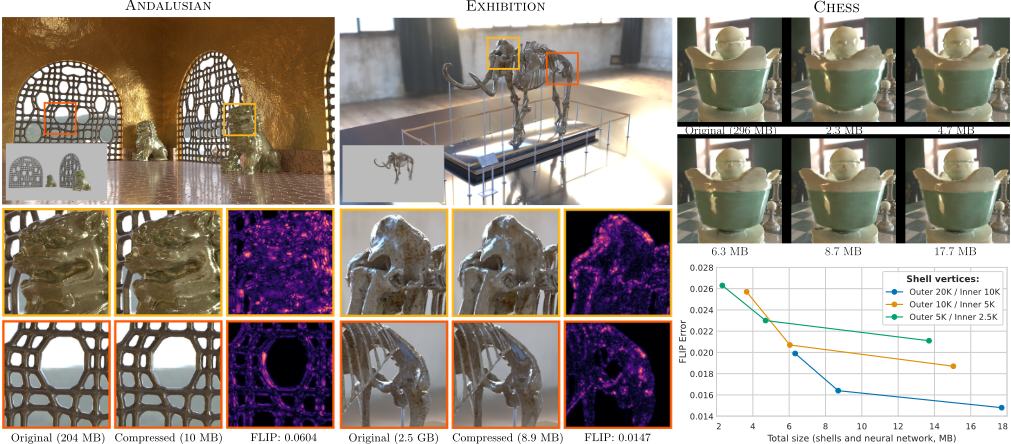
We evaluate our method on four scenes introduced in [Weier et al., 2024] (Figure 1 for the CHESS scene and Figure 3 for others) and compare with N-BVH [Weier et al., 2024]. We configure our renderer to match the reference renderer of N-BVH. For all scenes, we use hash grid of size 216 for both methods. We also define space-limiting structures of both methods to be approximately the same size: for our method, we use outer shells of approximately 20k vertices and inner shells of 10k vertices (5-6 MB), while for N-BVH we use 275k nodes (8.33 MB). Due to tighter bounding, our method achieves significantly better quality at a slightly better compression level. With our method being designed for hardware RT, we achieve 1.6 - 3.2× better performance compared to N-BVH (Table 1).
Towards higher precision, the shell size becomes the primary factor (Figure 3, right), suggesting the hashgrid is most efficient at heavy compression configurations.
5 Conclusion
We propose a novel compressed ray tracing method focused on reducing the search space for intersection. Compared to existing approaches, our method supports hardwareaccelerated ray tracing and is superior in both quality and performance. The hybrid path tracing pipeline is efficient and ready to be integrated into existing physically based rendering engines.
Acknowledgments
The work of Alexander Nikolaev and Roman Rodionov was supported by the The Ministry of Economic Development of the Russian Federation in accordance with the subsidy agreement (agreement identifier 000000C313925P4H0002; grant No 139-15-2025-012).
@inproceedings{ijcai2026p983,
  title     = {Double Bounded Neural Ray Queries},
  author    = {Nikolaev, Alexander and Mozokhin, Nikolay and Rodionov, Roman and Frolov, Vladimir},
  booktitle = {Proceedings of the Thirty-Fifth International Joint Conference on
               Artificial Intelligence, {IJCAI-26}},
  publisher = {International Joint Conferences on Artificial Intelligence Organization},
  editor    = {Diego Calvanese},
  pages     = {8475--8478},
  year      = {2026},
  month     = {8},
  note      = {Demo Track},
  doi       = {10.24963/ijcai.2026/983},
  url       = {https://doi.org/10.24963/ijcai.2026/983},
}
TY - CPAPER TI - Double Bounded Neural Ray Queries AU - Nikolaev, Alexander AU - Mozokhin, Nikolay AU - Rodionov, Roman AU - Frolov, Vladimir T2 - Proceedings of the Thirty-Fifth International Joint Conference on Artificial Intelligence, IJCAI-26 PB - International Joint Conferences on Artificial Intelligence Organization PY - 2026 SP - 8475 EP - 8478 DO - 10.24963/ijcai.2026/983 UR - https://doi.org/10.24963/ijcai.2026/983 ER -Copied
Machine-readable versions of this paper, for tools and AI agents:





