
DeepMed Search: An Open-Source Agentic Platform for Medical Deep Research with Introspective Verification
Proceedings of the Thirty-Fifth International Joint Conference on Artificial Intelligence. Demo Track. Pages 8453-8457.
https://doi.org/10.24963/ijcai.2026/978
© 2026 International Joint Conferences on Artificial Intelligence
Keywords
- AI: AI Ethics, Trust, Fairnes
- AI: Agent-based and Multi-agent Systems
Abstract
Navigating the deluge of heterogeneous medical data, from academic literature (PubMed) to clinical guidelines (Web) and private knowledge bases remains a critical bottleneck for evidence-based medicine. While commercial black-box tools lack transparency, standard open-source RAG implementations frequently suffer from ``reasoning drift'' when handling complex, long-tail queries. We present DeepMed Search, a fully open-source, agentic platform designed for transparent medical deep research. Built on a high-performance Next.js architecture, DeepMed Search features a source-adaptive router that autonomously dispatches sub-queries to PubMed, web search, or local graph-based knowledge bases based on information density. Crucially, the platform integrates an introspective verification module, powered by a causal-consistent multi-agent debate framework, to validate retrieved evidence against diagnostic logic before synthesis. To demonstrate its robustness, we showcase DeepMed Search's ability to autonomously decompose high-difficulty rare disease queries, filter out confounding noise, and generate structured, citation-backed research reports in minutes. By open-sourcing this software, we provide the community with a robust infrastructure to democratize access to trustworthy, glass-box medical reasoning at a commercial-grade performance level, which is publicly available at: https://www.deepmedsearch.cloud and the demonstration video is available at: https://youtu.be/4U4aok8yLpk.
- [Chan et al., 2023] Chi-Min Chan, Weize Chen, Yusheng Su, Jianxuan Yu, Wei Xue, Shanghang Zhang, Jie Fu, and Zhiyuan Liu. Chateval: Towards better llm-based evaluators through multi-agent debate. arXiv preprint arXiv:2308.07201, 2023.
- [Du et al., 2024] Yilun Du, Shuang Li, Antonio Torralba, Joshua B Tenenbaum, and Igor Mordatch. Improving fac- tuality and reasoning in language models through multi- agent debate. In Forty-first international conference on machine learning, 2024.
- [Izacard and Grave, 2021] Gautier Izacard and Edouard Grave. Leveraging passage retrieval with generative mod- els for open domain question answering. In Proceedings of the 16th conference of the european chapter of the asso- ciation for computational linguistics: main volume, pages 874-880, 2021.
- [Ji et al., 2023] Ziwei Ji, Nayeon Lee, Rita Frieske, Tiezheng Yu, Dan Su, Yan Xu, Etsuko Ishii, Ye Jin Bang, Andrea Madotto, and Pascale Fung. Survey of halluci- nation in natural language generation. ACM Computing Surveys, 55(12):1-38, March 2023.
- [Kandpal et al., 2023] Nikhil Kandpal, Haikang Deng, Adam Roberts, Eric Wallace, and Colin Raffel. Large language models struggle to learn long-tail knowledge. In Andreas Krause, Emma Brunskill, Kyunghyun Cho, Barbara Engelhardt, Sivan Sabato, and Jonathan Scarlett, editors, International Conference on Machine Learn- ing, ICML 2023, 23-29 July 2023, Honolulu, Hawaii, USA, volume 202 of Proceedings of Machine Learning Research, pages 15696-15707. PMLR, 2023.
- [Karpukhin et al., 2020] Vladimir Karpukhin, Barlas Oguz, Sewon Min, Patrick Lewis, Ledell Wu, Sergey Edunov, Danqi Chen, and Wen-tau Yih. Dense passage retrieval for open-domain question answering. In Proceedings of the 2020 conference on empirical methods in natural lan- guage processing (EMNLP), pages 6769-6781, 2020.
- [Kiciman et al., 2024] Emre Kiciman, Robert Osazuwa Ness, Amit Sharma, and Chenhao Tan. Causal reason- ing and large language models: Opening a new frontier for causality. Transactions on Machine Learning Research (TMLR), August 2024. Selected for presentation at ICLR 2025.
- [Lewis et al., 2020] Patrick Lewis, Ethan Perez, Aleksan- dra Piktus, Fabio Petroni, Vladimir Karpukhin, Naman Goyal, Heinrich Küttler, Mike Lewis, Wen-tau Yih, Tim Rocktäschel, et al. Retrieval-augmented generation for knowledge-intensive nlp tasks. Advances in neural infor- mation processing systems, 33:9459-9474, 2020.
- [Mallen et al., 2023] Alex Mallen, Akari Asai, Victor Zhong, Rajarshi Das, Daniel Khashabi, and Hannaneh Ha- jishirzi. When not to trust language models: Investigating effectiveness of parametric and non-parametric memories. In Proceedings of the 61st annual meeting of the associ- ation for computational linguistics (volume 1: Long pa- pers), pages 9802-9822, 2023.
- [Park and Lee, 2024] Seong-Il Park and Jay-Yoon Lee. To- ward robust ralms: Revealing the impact of imperfect re- trieval on retrieval-augmented language models. Trans- actions of the Association for Computational Linguistics, 12:1686-1702, 2024.
- [Pearl, 2009] Judea Pearl. Causality: Models, Reasoning, and Inference. Cambridge University Press, Cambridge, 2nd edition, 2009.
- [Qiu et al., 2025] Pengcheng Qiu, Chaoyi Wu, Shuyu Liu, Weike Zhao, Zhuoxia Chen, Hongfei Gu, Chuanjin Peng, Ya Zhang, Yanfeng Wang, and Weidi Xie. Quantifying the reasoning abilities of llms on real-world clinical cases. arXiv preprint arXiv:2503.04691, 2025.
- [Rudin, 2019] Cynthia Rudin. Stop explaining black box machine learning models for high stakes decisions and use interpretable models instead. Nature machine intelligence, 1(5):206-215, 2019.
- [Singhal et al., 2025] Karan Singhal, Tao Tu, Juraj Got- tweis, Rory Sayres, Ellery Wulczyn, Mohamed Amin, Le Hou, Kevin Clark, Stephen R Pfohl, Heather Cole- Lewis, et al. Toward expert-level medical question an- swering with large language models. Nature medicine, 31(3):943-950, 2025.
- [Tu et al., 2023] Tao Tu, Shekoofeh Azizi, Danny Driess, Mike Schaekermann, Mohamed Amin, Pi-Chuan Chang, Andrew Carroll, Chuck Lau, Ryutaro Tanno, Ira Ktena, Basil Mustafa, Aakanksha Chowdhery, Yun Liu, Si- mon Kornblith, David Fleet, Philip Mansfield, Sushant Prakash, Renee Wong, Sunny Virmani, Christopher Sem- turs, S Sara Mahdavi, Bradley Green, Ewa Dominowska, Blaise Aguera y Arcas, Joelle Barral, Dale Webster, Greg S. Corrado, Yossi Matias, Karan Singhal, Pete Flo- rence, Alan Karthikesalingam, and Vivek Natarajan. To- wards generalist biomedical ai, 2023.
- [Wang et al., 2025] Ziyue Wang, Junde Wu, Linghan Cai, Chang Han Low, Xihong Yang, Qiaxuan Li, and Yueming Jin. Medagent-pro: Towards evidence-based multi-modal medical diagnosis via reasoning agentic workflow. arXiv preprint arXiv:2503.18968, 2025.
- [Xiong et al., 2024] Guangzhi Xiong, Qiao Jin, Zhiyong Lu, and Aidong Zhang. Benchmarking retrieval-augmented generation for medicine. In Lun-Wei Ku, Andre Mar- tins, and Vivek Srikumar, editors, Findings of the Asso- ciation for Computational Linguistics ACL 2024, pages 6233-6251, Bangkok, Thailand and virtual meeting, Au- gust 2024. Association for Computational Linguistics.
- [Yang et al., 2022] Xi Yang, Aokun Chen, Nima PourNe- jatian, Hoo Chang Shin, Kaleb E Smith, Christopher Parisien, Colin Compas, Cheryl Martin, Mona G Flores, Ying Zhang, Tanja Magoc, Christopher A Harle, Gloria Lipori, Duane A Mitchell, William R Hogan, Elizabeth A Shenkman, Jiang Bian, and Yonghui Wu. Gatortron: A large clinical language model to unlock patient informa- tion from unstructured electronic health records, 2022.
- [Yao et al., 2022] Shunyu Yao, Jeffrey Zhao, Dian Yu, Nan Du, Izhak Shafran, Karthik R Narasimhan, and Yuan Cao. React: Synergizing reasoning and acting in language mod- els. In The eleventh international conference on learning representations, 2022.
References were extracted automatically from the PDF and may contain errors.
Full text extracted automatically from the PDF; figures, tables and equations may differ. The PDF is the version of record.
1 Introduction
Large Language Models (LLMs) have revolutionized clinical question answering [Singhal et al., 2025; Tu et al., 2023; Yang et al., 2022], yet their deployment in highstakes evidence-based medicine remains hindered by limited transparency and auditability [Ji et al., 2023; Rudin, 2019]. Medical deep research requires synthesizing heterogeneous data from academic literature, constantly updating clinical guidelines, and structured patient records. While RetrievalAugmented Generation (RAG) is widely adopted to ground model outputs [Lewis et al., 2020; Karpukhin et al., 2020; Izacard and Grave, 2021], standard RAG implementations often rely on static, linear pipelines that are vulnerable to Retrieval-Induced Reasoning Drift, especially in complex, long-tail scenarios such as rare disease diagnosis [Mallen et al., 2023]. In these contexts, standard semantic retrievers suffer from commonality bias [Kandpal et al., 2023], preferentially surfacing generic evidence that supports common mimic conditions and causing the LLM to be hijacked by plausible but non-discriminative distractors. Although commercial AI research tools attempt to address this issue, their black-box nature prevents clinicians from auditing the causal logic behind retrieved evidence, which remains a nonnegotiable requirement in clinical workflows.
∗Corresponding Author.
To democratize trustworthy and auditable AI in healthcare, we introduce DEEPMED SEARCH, a fully opensource, agentic platform engineered for transparent medical deep research. Moving beyond simple RAG frameworks, DEEPMED SEARCH introduces a source-adaptive router that autonomously orchestrates sub-queries across heterogeneous endpoints, including PubMed APIs, live web search, and a local Neo4j-based knowledge graph. Furthermore, to ensure the causal alignment and faithfulness of the retrieved evidence, the platform features an introspective verification module [Kiciman et al., 2024]. This engine employs contrastive hypothesis expansion to filter confounding noise and utilizes a multi-agent adversarial debate framework [Du et al., 2024; Yao et al., 2022] to rigorously stress-test reasoning paths before final synthesis.
In this paper, we showcase the system's glass-box interactivity, while clinicians can observe DEEPMED SEARCH as it autonomously decomposes complex queries, routes searches, and conducts real-time multi-agent deliberations. Ultimately, the system generates structured, citation-backed research reports while maintaining complete interpretability [Xiong et al., 2024].
2 SystemArchitecture
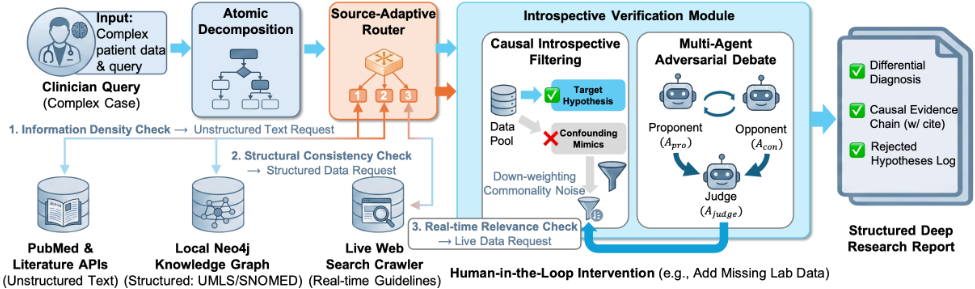
DEEPMED SEARCH is engineered as a modular, agentic workflow designed to transform high-level clinical inquiries into structured research insights. As illustrated in Figure 1, the platform transitions from autonomous data orchestration to rigorous causal verification across three primary stages: Source-Adaptive Routing, Causal Introspective Filtering, and Multi-Agent Synthesis.
2.1 Source-Adaptive Routing
A core pillar of DEEPMED SEARCH is its ability to navigate heterogeneous data landscapes. Unlike monolithic RAG systems, our platform incorporates a Source-Adaptive Router that treats the information retrieval process as a sequential decision-making task.
Upon receiving a clinical query, the system first performs Atomic Decomposition, breaking the input into distinct clinical constraints (e.g., symptomatic triad, temporal progression, and treatment resistance). The Router then dynamically evaluates the information density of each sub-query to dispatch them to optimal endpoints:
- Scientific Evidence: Direct API integration with PubMed for fetching peer-reviewed literature and clinical trial abstracts [Qiu et al., 2025].
- Pathophysiological Logic: Querying a local NEO4J knowledge graph (integrating UMLS and SNOMEDCT) to identify multi-hop causal links between symptoms [Pearl, 2009].
- Real-time Guidelines: Utilizing a Web Search crawler to retrieve the latest consensus statements and medical news.
2.2 Causal Introspective Filtering
To mitigate the Commonality Bias identified in clinical LLMs [Kandpal et al., 2023], the platform utilizes a Causal Introspective Filtering mechanism. This stage aligns the retrieved evidence with diagnostic logic via two steps: 1) Contrastive Hypothesis Expansion: The system proactively formulates "confounding hypotheses", prevalent diseases that mimic the target long-tail condition (e.g., generating "Essential Hypertension" when analyzing potential "Pheochromocytoma") [Park and Lee, 2024]. 2) Evidence Downweighting: Chunks are filtered based on a discriminative score Si = sim(ci,Htarget) sim(ci,Hmimic)+ϵ . Here, sim(·, ·) denotes the cosine similarity between BGE-M3 sentence embeddings, and ϵ
is set to 10-6 to avoid division by zero. A candidate chunk is regarded as discriminative when Si is larger than the threshold τs; chunks failing to meet a dynamic threshold are tagged as "non-discriminative noise" and visually dimmed in the interface, ensuring the model's attention remains on the longtail signals.
2.3 Multi-Agent Synthesis
The final reasoning phase is handled by an introspective verification module, instantiated as a multi-agent adversarial debate framework [Chan et al., 2023]. The system deploys three distinct agents: a Proponent (Apro) that constructs reasoning chains from evidence to diagnosis, an Opponent (Acon) that identifies missing causal links or inconsistencies, and a Judge (Ajudge) that delivers the final verdict once reasoning converges (Information Gain < τ ).
Crucially, rather than producing a single-line answer, the synthesis engine generates a structured research report. These reports are citation-backed and organized into sections: Differential Diagnosis, Supporting Evidence (from both Graph and Text), and Rejected Hypotheses. This "glass-box" output allows clinicians to audit the platform's logic in real-time.
3 Implementation Details
The DEEPMED SEARCH backend is engineered for highthroughput concurrent processing to support real-time clinical deep research workflows. Frontend & Orchestration: Built on NEXT.JS, the frontend integrates a WebSocket-driven UI for streaming real-time agent deliberations. A dedicated orchestration layer handles the concurrent dispatch of sub-queries via the Source-Adaptive Router. Knowledge Engines: Structured multi-hop reasoning is powered by a NEO4J graph database integrating UMLS and SNOMED-CT. For unstructured evidence, we use MILVUS to index the MIRAGE corpus (Textbooks and PubMed) [Xiong et al., 2024], utilizing BGE-M3 for dense vector similarity coupled with a lightweight cross-encoder for precise re-ranking. LLMServing: To meet the computational demands of deploying three concurrent agents (Proponent, Opponent, Judge), we serve models like QWEN2.5-14B and DEEPSEEK-V3 via VLLM,
Query: "Patient presents with paroxysmal hypertension, headache, palpitations, and sweating. Standard anti-hypertensive drugs ineffective."
× Vanilla RAG Response:
Diagnosis: Essential Hypertension. Treatment involves lifestyle changes...
[Error: Fixates on common disease; ignores paroxysmal & sweating cues]
✓DEEPMED SEARCH (Ours):
Diagnosis: Pheochromocytoma.
Reasoning: 1. Contrastive Filter: 'Essential Hypertension' downweighted (cannot explain sweating). 2. Debate Verdict: Symptom triad strongly indicates catecholamine-secreting tumor.
Table 1: Case study: DEEPMED SEARCH actively filters common disease noise (Hypertension) to correctly identify the rare condition.
leveraging PagedAttention to optimize memory footprint and maximize throughput. Report Generation Engine: A custom synthesis module compiles the verified evidence into a structured markdown/PDF report, automatically mapping reasoning steps to specific reference nodes (PubMed IDs or Graph edges) to ensure full traceability.
4 Demonstration Scenarios
We present using real-world rare disease cases from the MedR-Bench dataset, as exemplified in Table 1. The web interface allows clinicians to input complex case reports and interactively audit the deep research process.
4.1 Scenario 1: Autonomous Routing &Causal Filtering
Consider a patient presenting with episodic hypertension, headaches, and palpitations. A standard RAG system typically retrieves generic guidelines for "Primary Hypertension", leading to reasoning drift. In DEEPMED SEARCH: 1) Routing in Action: The Router identifies the temporal cue ("episodic") and dispatches parallel queries to Neo4j and PubMed. 2) Noise Filtering: The "Evidence Panel" marks generic hypertension evidence with a Low Relevance tag (visualized as dimmed text), explicitly stating it was downweighted due to overlap with common confounders. Conversely, evidence pointing to Pheochromocytoma is dynamically highlighted.
4.2 Scenario 2: Glass-Box Debate &Report
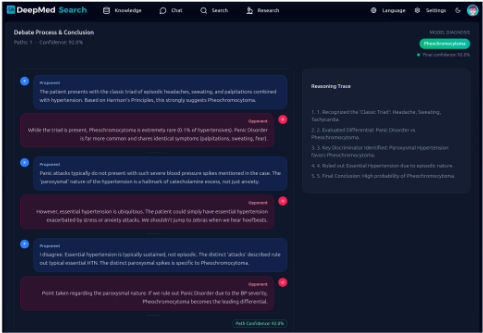
For complex diagnoses, the clinician can activate the introspective debate mode. 1) Real-Time Deliberation: As illustrated in Figure 2, a streaming panel opens where Apro argues for Pheochromocytoma citing paroxysmal symptoms, while Acon challenges the evidence density. 2) Human-inthe-Loop: Crucially, the clinician can inject missing parameters (e.g., "Add lab result: elevated metanephrines") directly into the debate stream. Structured Output: The Ajudge finalizes the verdict, and the system instantly compiles a deep research report, linking the diagnosis to verified graph nodes.
5 Evaluation
As summarized in Table 2, DEEPMED uniquely integrates source-adaptive routing and multi-agent verification, bridging the gap between vanilla RAG and commercial black-box tools.
Performance Gains: We evaluated on the MIRAGE benchmark [Xiong et al., 2024]. DeepMed Search consistently outperforms standard RAG baselines. On the challenging PubMedQA subset, our method improves accuracy by approximately 9.0% over vanilla RAG (using Qwen3-8B). For rare diseases, experiments on the MedR-Bench dataset show that our approach achieves an accuracy of 76.43% (using DeepSeek-v3.2), bridging the gap between automated systems and expert-level reasoning.
| Capabilities | Vanilla RAG | Commercial | Ours |
|---|---|---|---|
| Open-Source Transparency | ✓ | × | ✓ |
| Adaptive Routing (Web/Graph) | × | ✓ | ✓ |
| Causal-Consistent Filtering | × | × | ✓ |
| Multi-Agent Verification | × | × | ✓ |
| Structured Deep Reports | × | ✓ | ✓ |
6 Conclusion
DEEPMED SEARCH provides a transparent, agentic platform for medical deep research. It combines source-adaptive routing, causal-consistent filtering, and multi-agent verification to mitigate retrieval-induced reasoning drift in medical LLMs [Park and Lee, 2024] and generate structured, citation-backed reports. Current limitations include additional computational and latency overhead and the lack of a formal clinician user study. Future work will improve efficiency, involve clinicians in evaluation, and extend the framework to multimodal data such as medical imaging [Wang et al., 2025].
Acknowledgments
This work was supported by the National Natural Science Foundation of China under Grant No. 62306173.
@inproceedings{ijcai2026p978,
  title     = {DeepMed Search: An Open-Source Agentic Platform for Medical Deep Research with Introspective Verification},
  author    = {Liu, Maolin and Xu, Fanyu and Xu, Ruoqing and Zhang, Jiahang and Wang, Hao and Wang, Rui},
  booktitle = {Proceedings of the Thirty-Fifth International Joint Conference on
               Artificial Intelligence, {IJCAI-26}},
  publisher = {International Joint Conferences on Artificial Intelligence Organization},
  editor    = {Diego Calvanese},
  pages     = {8453--8457},
  year      = {2026},
  month     = {8},
  note      = {Demo Track},
  doi       = {10.24963/ijcai.2026/978},
  url       = {https://doi.org/10.24963/ijcai.2026/978},
}
TY - CPAPER TI - DeepMed Search: An Open-Source Agentic Platform for Medical Deep Research with Introspective Verification AU - Liu, Maolin AU - Xu, Fanyu AU - Xu, Ruoqing AU - Zhang, Jiahang AU - Wang, Hao AU - Wang, Rui T2 - Proceedings of the Thirty-Fifth International Joint Conference on Artificial Intelligence, IJCAI-26 PB - International Joint Conferences on Artificial Intelligence Organization PY - 2026 SP - 8453 EP - 8457 DO - 10.24963/ijcai.2026/978 UR - https://doi.org/10.24963/ijcai.2026/978 ER -Copied
Machine-readable versions of this paper, for tools and AI agents:





