
BAMFair: Barycenter Aligned Mediation for Fairness Across Multiple Sensitive Attributes
Proceedings of the Thirty-Fifth International Joint Conference on Artificial Intelligence. Main Track. Pages 862-870.
https://doi.org/10.24963/ijcai.2026/97
© 2026 International Joint Conferences on Artificial Intelligence
Keywords
- Data Mining: Collaborative filtering
- AI Ethics, Trust, Fairnes: Fairness and diversity
- Data Mining: Recommender systems
Abstract
Achieving fairness in machine learning models while maintaining high accuracy is an important but complex task, especially when handling multiple sensitive attributes. Traditional fairness methods often struggle to eliminate bias within subgroups divided by sensitive attributes. Several key challenges have been identified in this context: (1) Multiple sensitive attribute scalability challenge, where methods fail to ensure fairness as the number of sensitive attributes increases, despite scenarios with multiple sensitive attributes being prevalent in real-world applications; (2) Multiple objective optimization conflict challenge, where simultaneously optimizing for accuracy, fairness, and other relevant objectives leads to conflicting gradient updates, causing suboptimal performance. To address these challenges, we propose BAMFair, a Barycenter Aligned Mediation framework for fairness across multiple sensitive attributes. It comprises two core modules: a Global Barycentric Alignment (GBA) module and a Nash Fairness Mediator (NFM) module. Specifically, GBA innovatively introduces a global fair barycenter and minimizes the distances from subgroups divided by sensitive attributes to it, providing a scalable and efficient solution for fairness optimization across multiple sensitive attributes. Subsequently, NFM negotiates an agreement among inconsistent gradient updates between different objectives. Extensive experiments on four real-world datasets validate that BAMFair outperforms state-of-the-art methods in scenarios with multiple sensitive attributes.
- [AHRQ, 2016] AHRQ. The mep16 dataset (meps hc-192). https://meps.ahrq.gov/mepsweb/data stats/ download data files detail.jsp?cboPufNumber=HC-192, 2016. Link
- [Becker and Kohavi, 1996] Barry Becker and Ronny Ko- havi. Adult. UCI Machine Learning Repository, 1996.
- [Chakraborty et al., 2021] Joymallya Chakraborty, Su- vodeep Majumder, and Tim Menzies. Bias in machine learning software: Why? how? what to do? Computing Research Repository, 2021.
- [Chen et al., 2022] Zhenpeng Chen, Jie M. Zhang, Federica Sarro, and Mark Harman. Maat: a novel ensemble ap- proach to addressing fairness and performance bugs for machine learning software. In ESEC/FSE 2022. Associ- ation for Computing Machinery, 2022.
- [Chen et al., 2024] Zhenpeng Chen, Jie M. Zhang, Federica Sarro, and Mark Harman. Fairness improvement with mul- tiple protected attributes: How far are we?, 2024.
- [Cuturi, 2013] Marco Cuturi. Sinkhorn distances: Light- speed computation of optimal transportation distances, 2013.
- [Dai and Wang, 2021] Enyan Dai and Suhang Wang. Say no to the discrimination: Learning fair graph neural networks with limited sensitive attribute information. Computing Research Repository, 2021.
- [Dai et al., 2024] Enyan Dai, Tianxiang Zhao, Huaisheng Zhu, Junjie Xu, Zhimeng Guo, Hui Liu, Jiliang Tang, and Suhang Wang. A comprehensive survey on trust- worthy graph neural networks: Privacy, robustness, fair- ness, and explainability. Machine Intelligence Research, 21(6):1011-1061, 2024.
- ['Alessandro et al., 2017] Brian d'Alessandro, Cathy O'Neil, and Tom LaGatta. Conscientious classifica- tion: A data scientist's guide to discrimination-aware classification. Big Data, 5(2):120-134, 2017.
- [Dwork et al., 2012] Cynthia Dwork, Moritz Hardt, Toniann Pitassi, Omer Reingold, and Richard Zemel. Fairness through awareness. In ITCS 2012, page 214-226. Asso- ciation for Computing Machinery, 2012.
- [Hardt et al., 2016] Moritz Hardt, Eric Price, and Nathan Srebro. Equality of opportunity in supervised learning. In NIPS, page 3323-3331.
- [Hu et al., 2024] Francois Hu, Philipp Ratz, and Arthur Charpentier. A sequentially fair mechanism for multiple sensitive attributes. AAAI, 38(11):12502-12510, 2024.
- [Kamiran and Calders, 2011] Faisal Kamiran and Toon Calders. Data pre-processing techniques for classification without discrimination. KAIS, 33, 2011.
- [Kamiran et al., 2012] Faisal Kamiran, Asim Karim, and Xi- angliang Zhang. Decision theory for discrimination-aware classification. In ICDM 2012, page 924-929. IEEE Com- puter Society, 2012.
- [Kamishima et al., 2012] Toshihiro Kamishima, Shotaro Akaho, Hideki Asoh, and Jun Sakuma. Fairness-aware classifier with prejudice remover regularizer. In ECML PKDD, page 35-50. Springer-Verlag, 2012.
- [Liao et al., 2024a] Xinting Liao, Weiming Liu, Chaochao Chen, Pengyang Zhou, Fengyuan Yu, Huabin Zhu, Bin- hui Yao, Tao Wang, Xiaolin Zheng, and Yanchao Tan. Rethinking the representation in federated unsupervised learning with non-iid data. 2024 IEEE/CVF Conference on Computer Vision and Pattern Recognition (CVPR), pages 22841-22850, 2024.
- [Liao et al., 2024b] Xinting Liao, Weiming Liu, Pengyang Zhou, Fengyuan Yu, Jiahe Xu, Jun Wang, Wenjie Wang, Chaochao Chen, and Xiaolin Zheng. Foogd: Federated collaboration for both out-of-distribution generalization and detection. In A. Globerson, L. Mackey, D. Belgrave, A. Fan, U. Paquet, J. Tomczak, and C. Zhang, editors, Advances in Neural Information Processing Systems, vol- ume 37, pages 132908-132945.
- Curran Associates, Inc., 2024.
- [Liao et al., 2025] Xinting Liao, Weiming Liu, Jiaming Qian, Pengyang Zhou, Jiahe Xu, Wenjie Wang, Chaochao Chen, Xiaolin Zheng, and Tat-Seng Chua. Focoop: en- hancing out-of-distribution robustness in federated prompt learning for vision-language models. In Proceedings of the 42nd International Conference on Machine Learning, ICML'25. JMLR.org, 2025.
- [Liu et al., 2019] Bingyu Liu, Weihong Deng, Yaoyao Zhong, Mei Wang, Jiani Hu, Xunqiang Tao, and Yaohai Huang. Fair loss: Margin-aware reinforcement learning for deep face recognition. In ICCV, pages 10051-10060, 2019.
- [Liu et al., 2021] Bo Liu, Xingchao Liu, Xiaojie Jin, Peter Stone, and Qiang Liu. Conflict-averse gradient descent for multi-task learning. In NIPS, volume 34, pages 18878- 18890.
- [Liu et al., 2025a] Yuwen Liu, Lianyong Qi, Xingyuan Mao, Weiming Liu, Shichao Pei, Fan Wang, Xuyun Zhang, Amin Beheshti, and Xiaokang Zhou. Variational graph auto-encoder driven graph enhancement for sequential rec- ommendation. In Proceedings of the Thirty-Fourth Inter- national Joint Conference on Artificial Intelligence, pages 3144-3152, 2025. IJCAI
- [Liu et al., 2025b] Yuwen Liu, Lianyong Qi, Xingyuan Mao, Weiming Liu, Fan Wang, Xiaolong Xu, Xuyun Zhang, Wanchun Dou, Xiaokang Zhou, and Amin Beheshti. Hy- perbolic variational graph auto-encoder for next poi rec- ommendation. In Proceedings of the ACM on Web Con- ference 2025, pages 3267-3275, 2025.
- [Liu et al., 2026] Yuwen Liu, Lianyong Qi, Xingyuan Mao, Weiming Liu, Xuhui Fan, Qiang Ni, Xuyun Zhang, Yang Zhang, Yuan Tian, and Amin Beheshti. Hyperbolic- enhanced mixture-of-experts mamba for sequential recom- mendation. In Proceedings of the AAAI Conference on Ar- tificial Intelligence, volume 40, pages 15403-15411, 2026.
- [Lokhande et al., 2020] Vishnu Suresh Lokhande, Aditya Kumar Akash, Sathya N. Ravi, and Vikas Singh. Fairalm: Augmented lagrangian method for training fair models with little regret. In ECCV, page 365-381. Springer-Verlag, 2020.
- [Luo et al., 2025] Renqiang Luo, Huafei Huang, Ivan Lee, Chengpei Xu, Jianzhong Qi, and Feng Xia. Fairgp: A scalable and fair graph transformer using graph partition- ing. In AAAI, pages 12319-12327. AAAI, 2025.
- [Mehrabi et al., 2021] Ninareh Mehrabi, Fred Morstatter, Nripsuta Saxena, Kristina Lerman, and Aram Galstyan. A survey on bias and fairness in machine learning. ACM Computing Surveys, 54(6), 2021.
- [Navon et al., 2022] Aviv Navon, Aviv Shamsian, Idan Achi- tuve, Haggai Maron, Kenji Kawaguchi, Gal Chechik, and Ethan Fetaya. Multi-task learning as a bargaining game, 2022.
- [Peng et al., 2022] Kewen Peng, Joymallya Chakraborty, and Tim Menzies. Fairmask: Better fairness via model- based rebalancing of protected attributes, 2022.
- [ProPublica, 2016] ProPublica. The compas dataset. https: //github.com/propublica/compas-analysis, 2016. Link
- [Sener and Koltun, 2018] Ozan Sener and Vladlen Koltun. Multi-task learning as multi-objective optimization. In NIPS, page 525-536.
- [Smith Brain Trust, 2018] Smith Brain Trust. The problem with amazon's ai recruiter. https://www.rhsmith.umd.edu/ research/problem-amazons-ai-recruiter, 2018. Accessed: 2018-10-31. Link
- [Wang et al., 2024] Fan Wang, Chaochao Chen, Weiming Liu, Tianhao Fan, Xinting Liao, Yanchao Tan, Lianyong Qi, and Xiaolin Zheng. Ce-rcfr: Robust counterfactual regression for consensus-enabled treatment effect estima- tion. In Proceedings of the 30th ACM SIGKDD Confer- ence on Knowledge Discovery and Data Mining, pages 3013-3023, 2024.
- [Wang et al., 2025a] Fan Wang, Lianyong Qi, Weiming Liu, Bowen Yu, Jintao Chen, and Yanwei Xu. Inter-and intra- similarity preserved counterfactual incentive effect estima- tion for recommendation systems. ACM Trans. Inf. Syst., 43(6), 2025.
- [Wang et al., 2025b] Xiuyuan Wang, Chaochao Chen, Weiming Liu, Xinting Liao, Fan Wang, and Xiaolin Zheng. Efficient source-free unlearning via energy-guided data synthesis and discrimination-aware multitask op- timization. In Proceedings of the 42nd International Conference on Machine Learning, 2025.
- [Wang et al., 2026a] Fan Wang, Hengyu Yue, Bowen Yu, Weiming Liu, Zongxin Yang, Xuyun Zhang, Xiaolin Zheng, Chaochao Chen, and Shuiguang Deng. Spiked-cfr: Causal representation learning from llms via wasserstein projection pursuit. In ICML, 2026.
- [Wang et al., 2026b] Xiuyuan Wang, Weiming Liu, Hongyu Cai, Xin Gao, Fan Wang, Chaochao Chen, and Xiaolin Zheng. Preference-calibrated optimization with score- level distribution alignment for text-to-image diffusion model unlearning. In ICML, 2026.
- [Xie et al., 2021] Jianye Xie, Haotong Sun, Junsheng Zhou, Weiguang Qu, and Xinyu Dai. Event detection as graph parsing. In Findings of the Association for Computational Linguistics: ACL-IJCNLP 2021, pages 1630-1640, 2021.
- [Xie et al., 2026a] Jianye Xie, Chunhua Hu, Lianyong Qi, Fan Wang, Xiaolong Xu, Haolong Xiang, Xuyun Zhang, Shichao Pei, Amin Beheshti, Wanchun Dou, et al. Plikd: Prompt learning with instance-aware knowledge distilla- tion for web-scale semantic image classification. In Pro- ceedings of the ACM Web Conference 2026, pages 3788- 3799, 2026.
- [Xie et al., 2026b] Jianye Xie, Lianyong Qi, Weiming Liu, Anqi Wang, Xiaolong Xu, Haolong Xiang, Xuyun Zhang, Wenwen Gong, Yang Zhang, Amin Beheshti, et al. Joint similar user exploration and informative behavior guid- ance for multi-modal new item recommendation. In Pro- ceedings of the ACM Web Conference 2026, pages 6218- 6229, 2026.
- [Xie et al., 2026c] Jianye Xie, Lianyong Qi, Fan Wang, Anqi Wang, Wenjuan Gong, Danxin Wang, Wanchun Dou, Yang Cao, Shichao Pei, and Xiaokang Zhou. Retrieval- driven reasoning for deliberative visual classification. In Proceedings of the AAAI Conference on Artificial Intelli- gence, volume 40, pages 11060-11068, 2026.
- [Yeh, 2009] I-Cheng Yeh. Default of credit card clients. UCI Machine Learning Repository, 2009. DOI: https://doi.org/10.24432/C55S3H. DOI
- [Yu et al., 2020] Tianhe Yu, Saurabh Kumar, Abhishek Gupta, Sergey Levine, Karol Hausman, and Chelsea Finn. Gradient surgery for multi-task learning. In NIPS, vol- ume 33, pages 5824-5836.
- Curran Associates, Inc., 2020.
- [Yu et al., 2024] Jun Yu, Yutong Dai, and Xiaokang Liu. Unleashing the power of multi-task learning: A compre- hensive survey spanning traditional, deep, and pretrained foundation model eras. CoRR, 2024.
- [Zhang and Harman, 2021] Jie M. Zhang and Mark Harman. "ignorance and prejudice" in software fairness. In ICSE, page 1436-1447, 2021.
- [Zhang et al., 2023] Jizhi Zhang, Keqin Bao, Yang Zhang, Wenjie Wang, Fuli Feng, and Xiangnan He. Is chatgpt fair for recommendation? evaluating fairness in large language model recommendation. In RecSys 2023, pages 993-999. ACM, sep 2023.
- [Zhang et al., 2025] Wenbin Zhang, Shuigeng Zhou, Toby Walsh, and Jeremy C. Weiss. Fairness amidst non-iid graph data: A literature review, 2025.
References were extracted automatically from the PDF and may contain errors.
Full text extracted automatically from the PDF; figures, tables and equations may differ. The PDF is the version of record.
1 Introduction
In recent years, machine learning has been increasingly applied to assist decision-making in critical social scenarios including visual recognition [Xie et al., 2026c; Xie et al., 2026a], recommendation systems [Xie et al., 2026b; Liu et al., 2026; Liu et al., 2025b], and justice [Mehrabi et al., 2021], etc. With the rapid advancement of machine learning, concerns about its fairness have intensified [Zhang and Harman, 2021]. In practice, machine learning algorithms often exhibit unfair behaviors related to sensitive attributes such as gender, race, age, and region. For instance, Amazon's recruitment model exhibited gender bias [Smith Brain Trust, 2018], favoring male candidates; in fairness testing via the FairLLM benchmark [Zhang et al., 2023], ChatGPT was found to have fairness flaws across eight sensitive attributes in movie recommendations.
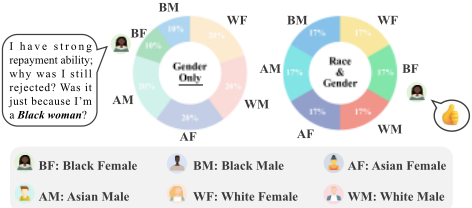
Therefore, algorithmic fairness has become increasingly important to reduce unintentional biases in machine learning. Existing research has proposed various fairness algorithms [Smith Brain Trust, 2018]. Recently, main approach is first to divide data into different subgroups based on predefined sensitive attributes, and then to improve fairness by addressing the imbalance among different subgroups. For instance, Reweighting (RW) [Kamiran and Calders, 2011] assigns different weights to different subgroups to improve fairness; Fair-SMOTE [Chakraborty et al., 2021] achieves fairness by creating synthetic data for minority subgroups to fix the imbalance. Currently, most existing work on fairness focuses on debiasing for a single sensitive attribute. However, it is common for multiple sensitive attributes occurring simultaneously in real-world applications. Consider an example of a loan approval scenario with two sensitive attributes (e.g., gender and race), as shown in Figure 1. We observe that when considering only gender, the approval rate for black people is significantly lower. This will not only exacerbate gender inequality, but also may undermine public trust in the fairness of the financial system [Smith Brain Trust, 2018]. Only by considering both race and gender can we ensure that different subgroups have comparatively fair opportunities in loan approval. Notably, other sensitive attributes (e.g., marital status and educational level) can also influence decision outcomes in practice. Ignoring such attributes may cause severe discrimination in the real world. Thus, it is critical to address fairness across multiple sensitive attributes.
However, existing methods primarily focus on single sensitive attribute and lack exploration of multiple sensitive attributes. Therefore, the first challenge is (CH1): Fairness models based on sensitive attribute grouping cannot remain effective when extended to multiple (two or more) sensitive attributes. To verify the importance of multiple sensitive attributes, we conducted a preliminary experiment comparing scenarios with different sensitive attributes, as shown in Table 1. When we consider only gender, the fairness of gender improves. However, racial fairness becomes even worse than the baseline with no sensitive attributes. Only by considering both gender and race can the model achieve fairness for both groups. Although some studies have explored fairness with two sensitive attributes, they remain difficult to extend to scenarios with more sensitive attributes. For instance, although Fair-SMOTE can be extended to more sensitive attributes, it requires C 2 2n alignment operations between 2n subgroups (formed by pairwise combinations of sensitive attributes) in a binary classification task with n sensitive attributes, which leads to a high computational cost.
Furthermore, as the number of sensitive attributes increases, the number of subgroups divided by these attributes grows correspondingly. This makes fairness optimization across subgroups more challenging. For instance, when fairness objectives expand from singular focus on racial fairness to multiple targets encompassing race, gender, and age, conflicts emerge in multi-objective optimization. We thus pose the following challenge (CH2): The existing work overlooks to negotiate an agreement among inconsistent gradient up-
1MEOP is a fairness metric, where smaller values indicate better fairness. Its formal definitions is provided in Section 3.2.
| Sensitive Attribute | Acc | M Gender EOP | M Race EOP |
|---|---|---|---|
| None | 69.79 | 0.1252 | 0.1047 |
| Gender | 68.87 | 0.0118 | 0.1176 |
| Gender & Race | 68.91 | 0.0123 | 0.0181 |
dates between accuracy and complex fairness objectives.
In this paper, we propose a novel fairness framework named BAMFair, a Barycenter Aligned Mediation framework for Fairness across Multiple Sensitive Attributes. To address CH1, BAMFair introduces a global fair barycenter and innovatively transforms the fairness problem into minimizing the distances from individual subgroups to this barycenter. This approach effectively avoids the high complexity of na¨ıve methods that rely on pairwise alignments between all subgroups. By focusing on subgroup-barycenter matching instead, this design significantly reduces the complexity of fairness optimization. We provide a detailed time complexity analysis in Section 4.1. Furthermore, by reducing the number of optimization objectives, the proposed alignment strategy notably alleviates CH2. Specifically, GBA changes the number of fairness goals from O(T 2 ) pairwise matches to only O(T) alignments, where T is the number of subgroups. By significantly reducing the total number of optimization targets, our method makes it easier to negotiate an agreement among inconsistent gradient updates between accuracy and fairness objectives. To further mitigate CH2, BAMFair incorporates a Nash Fairness Mediator (NFM), which dynamically ensures the accuracy and fairness of the model.
We summarize our main contributions as follows:
- We propose a novel framework BAMFair, which realizes the subgroup-barycenter alignment strategy, thus effectively addressing the fairness problem with multiple sensitive attributes.
- The BAMFair framework contains two modules: GBA and NFM. Specifically, GBA innovatively transforms the fairness problem into minimizing the distances from individual subgroups to the barycenter. NFM negotiates an agreement among inconsistent gradient updates between accuracy and fairness objectives.
- Extensive experiments conducted on four real-world datasets demonstrate the effectiveness and scalability of our proposed BAMFair, compared with other state-ofthe-art methods.
2 RelatedWork
With the widespread deployment of machine learning, fairness models have gained significant attention. Fairness methods are categorized by their mitigation stage into pre-processing, in-processing, and post-processing. Preprocessing debiases data before training [d'Alessandro et al., 2017], in-processing embeds constraints during training [Dai and Wang, 2021], and post-processing adjusts model predictions [Dai et al., 2024]. While flexible and model-agnostic, the effectiveness of pre-processing and post-processing is limited because the training process itself can introduce new biases [Zhang et al., 2025]. Consequently, many methods focus on adjusting the training process. For instance, [Kamishima et al., 2012] developed a bias remover using discrimination-aware regularization, while [Lokhande et al., 2020; Liu et al., 2019] incorporate fairness metrics directly into loss function.
Despite these advancements, research on multiple sensitive attributes remains limited [Chen et al., 2024]. Although some existing methods such as [Chakraborty et al., 2021] and [Peng et al., 2022] can handle two sensitive attributes, they suffer from high computational complexity and inconsistent gradient between accuracy and complex fairness objectives. A na¨ıve solution to extend current methods to multiple sensitive attributes is pairwise alignment between subgroups, which also leads to a large number of targets and heavy computational costs. In this paper, we propose BAMFair, an inprocessing method designed for efficient and scalable fairness optimization involving multiple sensitive attributes.
3 Preliminary
3.1 Notations
Consider a binary classification task with dataset D = {(x, y, s)}, where x ∈ Rd is the input attribution, y ∈ {0, 1} is the binary ground truth label, and s = (s1, s2, . . . , sk) ∈ {0, 1} represent k binary sensitive attributes. We use ˆ y ∈ {0, 1} to represent the predicted label. Let G = (g1, g2, . . . , gT ) represent the set of subgroups divided by sensitive attributes, where T = 2k .
3.2 Fairness EvaluationMetrics
We define two fairness metrics for a binary label y ∈ {0, 1}. To handle multiple sensitive attributes, we evaluate the disparity between any two subgroups gr, gw ∈ G.
Definition 1. Demographic Parity (DP) [Dwork et al., 2012]. DP requires the model's predictions to be independent of sensitive attributes. The disparity is quantified by MDP, which measures the maximum difference in acceptance rates between any two subgroups:
where P(·) denotes the probability measure.
Definition 2. Equal Opportunity (EOP) [Hardt et al., 2016]. EOP requires that the true positive rate be consistent across all subgroups. The deviation is measured by MEOP, reflecting the maximum gap in positive prediction probabilities for individuals with positive ground-truth labels:
4 Method
In this section, we will introduce the details of our proposed method BAMFair for solving CH1 and CH2. The framework of BAMFair is shown in Figure 2. BAMFair mainly has two modules, i.e., global barycentric alignment (GBA) module and nash fairness mediator (NFM) module. Specifically, BAMFair first obtains embeddings of each subgroup through the backbone network ψ [Liao et al., 2025; Liu et al., 2025a; Xie et al., 2021]. Then, GBA constructs a fair barycenter distribution of all subgroups, and continues to calculate the distance from each subgroup distribution to the barycenter to construct the fairness loss Lfair. Finally, NFM dynamically balances different losses, outputting the optimal parameter update direction.
4.1 Global Barycentric Alignment (GBA)
We first introduce the Global Barycentric Alignment (GBA) module in BAMFair, which consists of two key steps: global barycentric construction and fairness loss construction. The global barycentric construction aims to calculate distribution of global fairness barycenter through subgroups. The fairness loss construction aims to quantify the distance between each subgroup and barycenter to form the fairness loss. These two steps align subgroups with the barycenter, thereby enhancing fairness with limited time cost.
Step 1: Global Fair Barycenter Construction
To quantify the prediction distribution of each subgroup, we first discretize the model's output scores into histograms. For subgroup gt ∈ G, the range of prediction scores is divided into M continuous non-overlapping bins. For the i-th bin of gt, vt,i represents the center value of the i-th bin in gt, and at,i represents the proportion of samples in gt with scores falling into the i-th bin, satisfying at,i ≥ 0 and ∑Mi=1 at,i = 1. The discretized distribution of gt is thus Pt = {(at,i, vt,i)}Mi=1 . After that, we construct a global fair barycenter P ∗ as an unbiased reference distribution, which is also represented as a histogram with N bins, i.e., P ∗ = {(bj, µj)} (for j = 1 to N), where µj represents the center value of the j-th bin of the barycenter, while bj represents the probability mass of the jth bin of the barycenter, satisfying bj ≥ 0 and ∑Nj=1 bj = 1. We define πt,ij as the transport plan, representing the mass transferred from the i-th bin of subgroup t to the j-th bin of the barycenter, Then, the optimal transport problem [Wang et al., 2026a] from subgroups to barycenter is formulated as:
where the distance matrix Ct,ij = ∥vt,i - µj∥22 , and H(π) = - ∑i,j πt,ij(log πt,ij -1) is the entropy of the transport plan, and ε controls the weight of entropy.
We define potential functions ft,i, qj. The transport plan πt,ij can be expressed as:
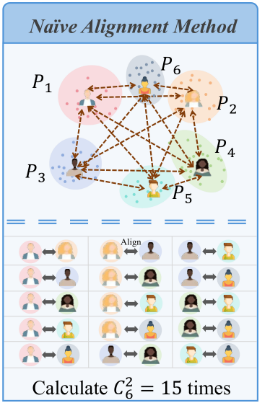
(a) Na¨ıve Alignment Method
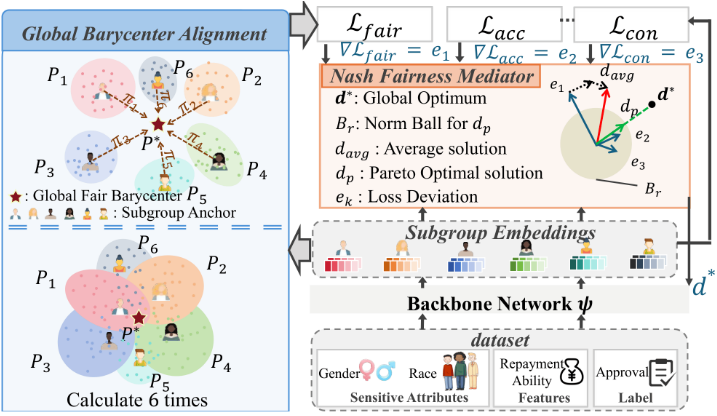
(b) Framework of BAMFair
Figure 2: The subfigure (b) is the overview of BAMFair, including two modules: (1) GBA constructs a global barycenter from subgroups and only requires T = 6 alignments. In contrast, the subfigure (a) shows that na¨ıve pairwise alignment method requires C2T = 15 operations for T = 6 subgroups. (2) NFM negotiates an agreement among inconsistent gradient updates between different objectives, aiming to handle conflicting requirements and achieve the optimal update direction.
Meanwhile, by using constraints △ imposed on the marginals, we derive:
After updating transport plan, we can fix πt,ij and update µj :
Upon convergence, we obtain the histogram distribution P ∗ = {bj , µj} of the global barycenter.
Step 2: Fairness Loss Construction
After getting the barycenter distribution P ∗ , the fairness loss construction continues to quantify the deviation between each subgroup distribution Pt = {at,i, vt,i} and the barycenter P ∗ by calculating the Sinkhorn distance [Wang et al., 2024; Wang et al., 2025a]:
Finally, the fairness loss Lfair is defined as the average of Sinkhorn distances from all subgroups to the barycenter:
According to the triangle inequality property, the distance between any two arbitrary subgroups gr and gw is upper-bounded by their distances to the global barycenter: S(Pr, Pw) ≤ S(Pr, P ∗ ) + S(Pw, P ∗ ). Consequently, minimizing Lfair in Eq.(9) effectively constrains the pairwise disparity across all subgroup combinations. This strategy resolves CH1 by reducing the complexity from O(T 2 ) pairwise comparisons to O(T) alignments, providing a scalable fairness guarantee for multiple sensitive attributes.
Complexity Analysis
Aligning subgroups with a global fair barycenter can reduce the computational burden while ensuring fairness across multiple sensitive attributes. For all subgroups, the time complexity of fairness alignment is O(T · M · N), compared to traditional pairwise alignment with time complexity O(T 2 · M 2 ). This ensures BAMFair maintains efficiency while enhancing fairness for multiple sensitive attributes.
4.2 Nash Fairness Mediator (NFM)
In addition to the fairness loss Lfair, we introduce an accuracy loss Lacc and a contrastive learning loss Lcon. The accuracy loss quantifies the discrepancy between the model's predictions and the ground-truth labels, ensuring the model retains predictive power while optimizing for fairness. For binary classification tasks, it is defined using cross-entropy loss:
where y ∈ {0, 1} is the ground-truth label, ˆ y ∈ [0, 1] is the model's predicted probability of positive class, and the expectation is taken over the dataset. The contrastive learning loss Lcon enhances the model's ability to represent features irrelevant to sensitive attributes, reducing reliance on sensitive attributes and improving robustness and fairness of features[Liao et al., 2024b; Liao et al., 2024a]:
where hm and hn form a positive pair, with hs as negative samples. sim(·, ·) uses cosine similarity to measure feature vector similarity, and the temperature parameter τ regulates the sharpness of the similarity distribution. Positive sample pairs consist of samples that differ in sensitive attributes yet exhibit high similarity in non-sensitive attributes and share consistent labels. This design compels the model to learn the common, discriminative features across such pairs, thereby reducing its over-reliance on sensitive attributes for prediction and enhancing fairness.
Inspired by [Navon et al., 2022], the nash fairness mediator module aims to dynamically balance conflicts in multi-objective optimization, specifically coordinating gradient conflicts between the accuracy loss Lacc, fairness loss Lfair, and contrastive learning loss Lcon, ensuring the model does not sacrifice accuracy while improving fairness[Wang et al., 2025b; Wang et al., 2026b]. First, compute the gradients of each loss: ∇Lacc (accuracy gradient), ∇Lfair (fairness gradient), and ∇Lcon (contrastive learning gradient), and construct the gradient matrix G = [∇Lacc,∇Lfair,∇Lcon], denoted as E = [e1, e2, e3].
The Nash bargaining solution aims to find non-negative weights α = (α1, α2, α3) that satisfy the Nash equilibrium condition through a weighted gradient combination:
where d is the parameter update direction, and ·⊤ denotes the transpose operation. This condition ensures equal marginal gains for each loss, preventing a single loss from dominating the update direction due to scale advantages.
α(0) is initialized to a uniform distribution, with αk ≥ 0 and ∑k αk = 1. In each iteration, update the weights α by solving the following optimization problem:
This objective function is derived from the Nash bargaining solution, where e⊤k d(t) represents the projection of the gradient ek onto the current update direction d(t) , reflecting the contribution of the loss k to the current update. The constraints ensure that the weights are non-negative and sum to 1, maintaining the property of a convex combination. To solve this optimization problem efficiently, we can use Lagrange multipliers. Construct the Lagrangian function:
The final solution for the weights can be expressed as:
This formula demonstrates that the weight of each loss is inversely proportional to its projection onto the current update direction, balancing the contributions of different gradients.
After obtaining the new weights α(t+1) , update the parameter update direction:
This direction optimizes all losses simultaneously, avoiding bias caused by gradient scale differences.
4.3 Putting Together
Model parameters θ are updated using the coordinated direction d from NFM, with a learning rate η:
By operating on gradients (which encode local optimization directions) rather than raw loss values, the model avoids bias from differing loss magnitudes.
5 Experiment
In this section, we conduct extensive experiments to address five research questions: RQ1: How does BAMFair perform compared to the state-of-the-art fairness method? RQ2: What are the effects of different model components? RQ3: How does our method perform in terms of accuracy, fairness and time cost when it is extended to multiple sensitive attributes? RQ4: Why do we choose NFM over other multiobjective optimization methods?
5.1 Experimental Setup
Datasets
We conduct research using four real-world datasets: Adult [Becker and Kohavi, 1996], Compas [ProPublica, 2016], Credit [Yeh, 2009], and Mep16 [AHRQ, 2016]. For experiments involving two sensitive attributes, we select gender and race from the datasets; for three sensitive attributes, we add age as an additional sensitive attribute. For each experiment trial, we split the data into 70% training, 10% validation, and 20% testing sets. We repeat this procedure 10 times for statistical analysis and report the mean and standard deviation.
Comparison Methods
We compare BAMFair with several state-of-the-art fairness improvement methods, covering pre-processing, inprocessing, and post-processing methods. Pre-processing includes RW [Kamiran and Calders, 2011], Fair-SMOTE [Chakraborty et al., 2021]. In-processing includes MAAT [Chen et al., 2022], FairGP [Luo et al., 2025]. Postprocessing includes ROC [Kamiran et al., 2012], FairMask [Peng et al., 2022], SFM [Hu et al., 2024]. We also compare our method with a traditional model without fairness restriction named Default [Chen et al., 2024].
Evaluation Metrics
The evaluation metrics for the model include Accuracy (Acc) 2 , MDP , and MEOP . Smaller values of the fairness metrics MDP andMEOP indicate the model is fairer.
2 In this paper, we use the percentage of correctly predicted samples as Acc.
| Methods | Compas | Adult | ||||
|---|---|---|---|---|---|---|
| Acc(%) ↑ | MDP (%) ↓ | MEOP (%) ↓ | Acc(%) ↑ | MDP (%) ↓ | MEOP (%) ↓ | |
| Default | 69.7932 ± 0.5819 | 13.5147 ± 1.2436 | 10.2758 ± 0.9123 | 81.7061 ± 0.4728 | 9.4873 ± 0.8345 | 22.3982 ± 1.5267 |
| ROC | 66.7853 ± 0.3941 | 6.0682 ± 0.4159 | 3.3764 ± 0.3572 | 77.9938 ± 0.5314 | 20.7895 ± 1.6723 | 21.3471 ± 1.2958 |
| RW | 67.1689 ± 0.6274 | 12.4935 ± 0.9561 | 8.8729 ± 0.7846 | 79.4325 ± 0.3187 | 10.1364 ± 0.5932 | 18.7753 ± 0.7689 |
| MAAT | 67.7541 ± 0.4583 | 21.2867 ± 1.5892 | 15.0178 ± 1.1349 | 79.4186 ± 0.6251 | 17.7248 ± 1.3476 | 24.0139 ± 1.7824 |
| Fair-SMOTE | 68.6827 ± 0.3759 | 2.7763 ± 0.2984 | 1.5371 ± 0.2468 | 78.9542 ± 0.4439 | 8.2957 ± 0.6518 | 15.6124 ± 0.9375 |
| FairMask | 67.4485 ± 0.5136 | 12.2479 ± 0.8842 | 4.8835 ± 0.4921 | 79.6678 ± 0.3594 | 7.9263 ± 0.4857 | 6.7489 ± 0.6234 |
| SFM | 68.0274 ± 0.4356 | 3.1589 ± 0.3742 | 2.8461 ± 0.2957 | 79.2845 ± 0.4173 | 6.7329 ± 0.5486 | 5.9274 ± 0.4731 |
| FairGP | 68.1356 ± 0.4928 | 2.3287 ± 0.3469 | 9.7341 ± 0.8573 | 78.3169 ± 0.5842 | 10.9138 ± 0.7765 | 4.1259 ± 0.5182 |
| BAMFair | 68.9173 ± 0.4265 | 1.7948 ± 0.3692 | 0.4683 ± 0.2157 | 81.4092 ± 0.5578 | 5.8034 ± 0.7196 | 1.3572 ± 0.3849 |
| Methods | Credit | Mep16 | ||||
|---|---|---|---|---|---|---|
| Acc(%) ↑ | MDP (%) ↓ | MEOP (%) ↓ | Acc(%) ↑ | MDP (%) ↓ | MEOP (%) ↓ | |
| Default | 81.2743 ± 0.3971 | 2.3685 ± 0.4532 | 3.0867 ± 0.4195 | 86.0883 ± 0.3246 | 4.7359 ± 0.6874 | 3.7642 ± 0.5481 |
| ROC | 80.6629 ± 0.2584 | 1.1573 ± 0.2168 | 0.6249 ± 0.1435 | 85.2467 ± 0.4189 | 9.6932 ± 1.0357 | 6.4185 ± 0.7692 |
| RW | 81.0658 ± 0.4427 | 1.7639 ± 0.3854 | 0.6672 ± 0.2589 | 85.5074 ± 0.2761 | 4.3482 ± 0.5193 | 0.3265 ± 0.1874 |
| MAAT | 78.2891 ± 0.5163 | 0.6642 ± 0.3078 | 1.9053 ± 0.4762 | 84.0938 ± 0.4652 | 4.0576 ± 0.7249 | 11.6983 ± 1.2478 |
| Fair-SMOTE | 80.8376 ± 0.3249 | 2.2581 ± 0.4136 | 0.5147 ± 0.1953 | 79.8865 ± 0.6734 | 5.2048 ± 0.7431 | 5.3926 ± 0.6859 |
| FairMask | 80.5324 ± 0.2895 | 0.7965 ± 0.2641 | 1.4483 ± 0.3597 | 85.4391 ± 0.3376 | 4.0638 ± 0.5724 | 0.4691 ± 0.1685 |
| SFM | 80.7942 ± 0.3568 | 1.5274 ± 0.2836 | 0.8953 ± 0.1672 | 85.3164 ± 0.3057 | 4.2185 ± 0.5693 | 0.5842 ± 0.1736 |
| FairGP | 78.1367 ± 0.6348 | 0.6759 ± 0.2935 | 1.6084 ± 0.4321 | 85.3752 ± 0.2987 | 6.8179 ± 0.8564 | 0.3489 ± 0.1563 |
| BAMFair | 81.3492 ± 0.4753 | 0.1068 ± 0.1249 | 0.2437 ± 0.1758 | 85.5189 ± 0.3842 | 3.8057 ± 0.6489 | 0.1643 ± 0.1392 |
Implementation Details
For binary classification tasks, we use a logistic regression model to generate classification results. We set the batch size as 128 and adopt Adam optimizer with the learning rate η as 0.002. We set M (number of bins for subgroup distributions) to 100. The temperature parameter τ is set to 0.07. ε (entropy weight in optimal transport) is set to a conventional value of 0.1 [Cuturi, 2013]. In NFM, the initial weights α(0) are uniformly initialized as (1/3, 1/3, 1/3) to ensure equal initial contributions of accuracy, fairness, and contrastive losses. The codes are available at https://github.com/getachAnGe/BAMFair.
5.2 Experimental Results
Performance Comparison (RQ1)
Table 2 presents results across four datasets with race and gender as sensitive attributes. We observe that: (1) BAMFair consistently outperforms all baselines in terms of fairness. This superiority stems from GBA's effective subgroup alignment (addressing CH1) and NFM's optimization of parameter update directions across conflicting losses (addressing CH2). (2) BAMFair achieves the highest accuracy among all fairness-optimizing baselines. Accuracy is slightly lower than Default because we sacrifice marginal performance for fairness. However, this drop remains minimal, and BAMFair still provides better accuracy than all other fairness-optimizing baselines. (3) In-processingmethods achieve a better trade-off between accuracy and fairness. In contrast, pre-processing methods often show unstable performance across datasets, as modifying raw data can lead to the loss of critical feature information. Methods like MAAT, FairGP, and BAMFair dynamically integrate fairness constraints into representation learning, making them more robust in complex scenarios.
| Module | Metric | ||||
|---|---|---|---|---|---|
| GBA | Lcon | NFM | Acc(%) ↑ | MDP (%) ↓ | MEOP (%) ↓ |
| ✗ | ✗ | ✗ | 67.7532 ± 0.3918 | 5.3247 ± 0.4736 | 4.1958 ± 0.3823 |
| ✓ | ✗ | ✗ | 67.8541 ± 0.4583 | 2.1467 ± 0.2392 | 4.1478 ± 0.4249 |
| ✓ | ✓ | ✗ | 68.3689 ± 0.3574 | 1.8335 ± 0.1961 | 0.8129 ± 0.1146 |
| ✓ | ✓ | ✓ | 68.9173 ± 0.4265 | 1.7948 ± 0.3692 | 0.4683 ± 0.2157 |
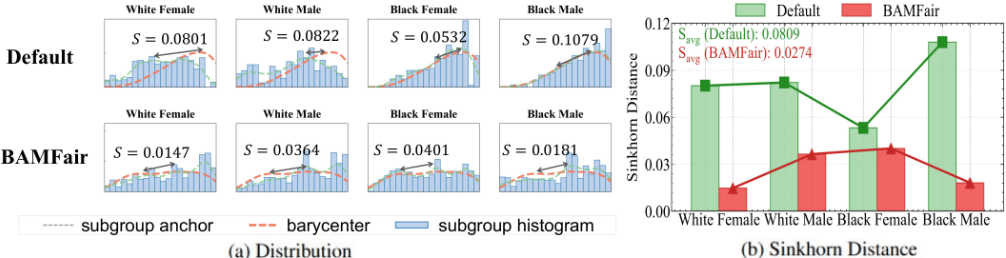
To verify if BAMFair generates fairer distributions, we visualize model outputs on Compas in Figure 3. While the Default model exhibits clear bias (e.g., higher distance (S) for Black Males), BAMFair produces nearly identical distributions across subgroups by minimizing Sinkhorn distances, effectively achieving group fairness.
Ablation Study (RQ2)
To study the effects of individual components, we conduct ablation study on the Compas dataset, with results presented in Table 3. The improvement boost from incorporating GBA proves the effectiveness of aligning subgroups with the barycenter. Adding Lcon further improves results, validating that contrastive learning strengthens subgroup representation consistency. Finally, the performance improvement through augmenting NFM, (i.e., the complete BAMFair framework) achieves the best balance, proving its ability to reach global optimality by reconciling multi-objective conflicts.
| Train Dataset | Test Dataset | |||||
|---|---|---|---|---|---|---|
| Method | Acc | MDP | MEOP | Acc | MDP | MEOP |
| GBA + PCgrad | 68.27% | 0.0518 | 0.0175 | 67.99% | 0.0365 | 0.0471 |
| GBA + CAgrad | 68.78% | 0.0452 | 0.0236 | 67.57% | 0.0207 | 0.0511 |
| GBA + Uncertainty | 68.33% | 0.0569 | 0.0342 | 68.08% | 0.0236 | 0.0327 |
| GBA +MGDA | 67.91% | 0.0247 | 0.0212 | 66.78% | 0.0186 | 0.0089 |
| GBA + NFM | 68.45% | 0.0196 | 0.0180 | 68.91% | 0.0179 | 0.0046 |
Analysis of Scalability (RQ3)
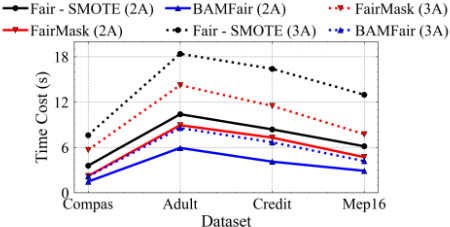
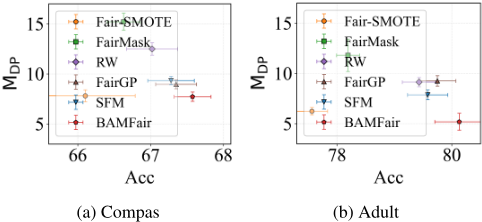
Results with three sensitive attributes highlight the scalability of BAMFair. As shown in Figure 5, BAMFair maintains superior performance while scaling efficiently, making it highly suitable for complex real-world applications. As shown in Figure 4, BAMFair consistently achieves the lowest time cost compared to all scalable methods, regardless of whether two or three sensitive attributes are used. Meanwhile, our method demonstrates a much smaller increase in computational cost as the number of sensitive attributes grows. For methods like Fair-SMOTE and FairMask, the time spikes significantly by 141.42% and 156.66% respectively. In contrast, the time cost of BAMFair grows by only 46.88%, which proves the scalability of BAMFair.
Comparison with other MTL (RQ4)
To validate NFM, we compare several main multiple task learning (MTL) methods [Yu et al., 2024] on the Compas dataset. As shown in Table 4, NFM achieves the best performance. Among these methods, MGDA [Sener and Koltun, 2018] biases toward fairness due to its smaller loss scale. Other MTL methods [Yu et al., 2020; Liu et al., 2021], on the other hand, lean towards larger scaled accuracy loss, resulting in poor fairness performance. Although CAgrad gets higher accuracy, its fairness performance is notably worse than that of NFM. Only NFM manages to strike a good balance between fairness and accuracy.
6 Conclusion
To achieve fairness across multiple sensitive attributes, this paper proposes BAMFair. It utilizes GBA to align subgroups with a global barycenter, reducing alignment complexity while enhancing fairness and scalability, and NFM to resolve gradient conflicts. Across four publicly available realworld datasets, BAMFair outperforms state-of-the-art methods in terms of accuracy and fainess.
Acknowledgments
The work was supported by the National Natural Science Foundation of China (No.62572486), Natural Science Foundation of Shandong Province (No.ZR2023MF007), European Union under the Horizon Europe programme (grant numbers: 101135930, 101168438), in part by the UKRI through the UK Government's Horizon Europe funding Guarantee (grant numbers: 10119564, 10126241).
@inproceedings{ijcai2026p97,
  title     = {BAMFair: Barycenter Aligned Mediation for Fairness Across Multiple Sensitive Attributes},
  author    = {Yue, Hengyu and Wang, Fan and Liu, Weiming and Liu, Yuwen and Qi, Lianyong and Xiang, Haolong and Xu, Xiaolong and Zhang, Xuyun and Pei, Shichao and Ni, Qiang},
  booktitle = {Proceedings of the Thirty-Fifth International Joint Conference on
               Artificial Intelligence, {IJCAI-26}},
  publisher = {International Joint Conferences on Artificial Intelligence Organization},
  editor    = {Diego Calvanese},
  pages     = {862--870},
  year      = {2026},
  month     = {8},
  note      = {Main Track},
  doi       = {10.24963/ijcai.2026/97},
  url       = {https://doi.org/10.24963/ijcai.2026/97},
}
TY - CPAPER TI - BAMFair: Barycenter Aligned Mediation for Fairness Across Multiple Sensitive Attributes AU - Yue, Hengyu AU - Wang, Fan AU - Liu, Weiming AU - Liu, Yuwen AU - Qi, Lianyong AU - Xiang, Haolong AU - Xu, Xiaolong AU - Zhang, Xuyun AU - Pei, Shichao AU - Ni, Qiang T2 - Proceedings of the Thirty-Fifth International Joint Conference on Artificial Intelligence, IJCAI-26 PB - International Joint Conferences on Artificial Intelligence Organization PY - 2026 SP - 862 EP - 870 DO - 10.24963/ijcai.2026/97 UR - https://doi.org/10.24963/ijcai.2026/97 ER -Copied
Machine-readable versions of this paper, for tools and AI agents:





