
Sparse ProtoPatient: Interactive Multi-Prototype Explanations for Clinical Diagnosis Prediction
Proceedings of the Thirty-Fifth International Joint Conference on Artificial Intelligence. Demo Track. Pages 8389-8392.
https://doi.org/10.24963/ijcai.2026/963
Keywords
- AI: Humans and AI
- AI: Multidisciplinary Topics and Applications
- AI: AI Ethics, Trust, Fairnes
- AI: Natural Language Processing
Abstract
We present the Sparse ProtoPatient Demo, a publicly available interactive system for interpretable ICD-10 diagnosis prediction from clinical admission notes.
The system is designed for clinicians in training, researchers, and educators exploring prototype-based diagnostic reasoning.
The demo links predictions to learned prototypical patient representations and token-level evidence, allowing users to input custom text or select preset cases, inspect predicted ICD-10 codes, visualize label-wise saliency, retrieve supporting prototype notes, and compare alternative prototype cohorts.
The demo provides a reproducible platform for interactive inspection of prototype-based clinical reasoning, enabling complementary opinion exploration, model auditing, and teaching of interpretable diagnosis prediction.
The deployed model is trained on the publicly released CodiEsp corpus (1000 clinical notes, 955 ICD-10 labels) using a sparse multi-prototype architecture with five prototypes per label.
We use the official machine-translated English CodiEsp-MT release to support English-language interaction.
It achieves a macro-AUROC of 0.92 on a held-out test set and supports real-time interaction (300ms per query).
The system is fully containerized for public research and educational use.
- [Bibal et al., 2022] Adrien Bibal, Romain Cardon, David Alfter, Judith Wilke, Johannes Schaeffer, and Robert West. Is Attention Explanation? An Introduction to the Debate. In Proceedings of the 60th Annual Meeting of the Associ- ation for Computational Linguistics (Volume 1: Long Pa- pers). Association for Computational Linguistics, 2022.
- [Figueroa et al., 2024] Alexei Figueroa, Jens-Michalis Pa- paioannou, Conor Fallon, et al. Boosting long-tail data classification with sparse prototypical networks. In Albert Bifet, Jesse Davis, Tomas Krilavičius, Meelis Kull, Eirini Ntoutsi, and Indrė Žliobaitė, editors, Machine Learning and Knowledge Discovery in Databases. Research Track. Springer Nature Switzerland, 2024.
- [Gu et al., 2020] Yu Gu, Robert Tinn, Hao Cheng, Michael R. Lucas, Naoto Usuyama, Xiaodong Liu, Tristan Naumann, Jianfeng Gao, and Hoifung Poon. Domain-specific language model pretraining for biomed- ical natural language processing. ACM Transactions on Computing for Healthcare (HEALTH), 3:1 -23, 2020.
- [Hajialigol et al., 2023] Daniel Hajialigol, Derek Kaknes, Tanner Barbour, et al. Drgcoder: Explainable clinical cod- ing for the early prediction of diagnostic-related groups. In Yansong Feng and Els Lefever, editors, Proceedings of the 2023 Conference on Empirical Methods in Natural Language Processing: System Demonstrations. Associa- tion for Computational Linguistics, 2023.
- [Kim et al., 2022] Juyong Kim, Abheesht Sharma, Suhas Shanbhogue, Jeremy Weiss, and Pradeep Ravikumar. Ane- mic: A framework for benchmarking icd coding models. In Wanxiang Che and Ekaterina Shutova, editors, Proceed- ings of the 2022 Conference on Empirical Methods in Nat- ural Language Processing: System Demonstrations. Asso- ciation for Computational Linguistics, 2022.
- [van Aken et al., 2021] Betty van Aken, Jens-Michalis Pa- paioannou, Manuel Mayrdorfer, Klemens Budde, Felix Gers, and Alexander Loeser. Clinical outcome prediction from admission notes using self-supervised knowledge in- tegration. In Proceedings of the 16th Conference of the European Chapter of the Association for Computational Linguistics (EACL), 2021.
- [van Aken et al., 2022] Betty van Aken, Jens-Michalis Pa- paioannou, Marcel Naik, et al. This patient looks like that patient: Prototypical networks for interpretable diag- nosis prediction from clinical text. In Yulan He, Heng Ji, Sujian Li, Yang Liu, and Chua-Hui Chang, editors, Pro- ceedings of the 2nd Conference of the Asia-Pacific Chap- ter of the Association for Computational Linguistics and the 12th International Joint Conference on Natural Lan- guage Processing (Volume 1: Long Papers). Association for Computational Linguistics, 2022.
References were extracted automatically from the PDF and may contain errors.
Full text extracted automatically from the PDF; figures, tables and equations may differ. The PDF is the version of record.
1 Introduction
Clinical outcome prediction is a central task in clinical NLP [van Aken et al., 2021]. We focus on diagnosis prediction, where a model predicts discharge ICD codes from admissiontime clinical text. Modern neural classifiers provide limited insight into why a diagnosis was predicted, while real-world code distributions are highly skewed, with many clinically relevant conditions appearing only sparsely in training data. In high-stakes settings, systems must perform well and expose the evidence supporting their decisions.
Prototype-based models address this tension by representing each diagnosis through learned example-like embeddings rather than opaque weight vectors [van Aken et al.,
2022]. During training, prototypical patient representations are learned from archived clinical data. At inference time, a new patient note serves as a query, activating the most similar prototypes and retrieving representative archived patient cases. Label-wise attention highlights clinically relevant concepts in the input text. Sparse ProtoPatient (S-Proto) [Figueroa et al., 2024] extends this approach by learning multiple prototypes per label, capturing heterogeneous disease subtypes and presentation patterns.
We release a live demo interface for ICD-10 prediction from clinical admission notes that combines multi-prototype reasoning, token-level saliency visualization, and prototype cohort switching, revealing (i) which tokens influenced each prediction, (ii) which prototypical patients were retrieved, and (iii) how alternative prototype cohorts support the diagnosis. The service performs stateless inference and does not store user input.
Prior clinical coding demos [Hajialigol et al., 2023; Kim et al., 2022] and attention visualization tools have typically exposed either token-level attention or exemplar retrieval in isolation. Unlike these systems, the Sparse ProtoPatient Demo unifies both within a single interactive interface centered on multi-prototype cohort exploration, enabling comparison of multiple supporting patient groups for the same diagnosis and inspection of heterogeneous diagnostic patterns rather than a single explanation pathway.
The Sparse ProtoPatient Demo supports interactive analysis of diagnostic predictions by clinicians, researchers, and NLP practitioners through the following capabilities:
- Interactive multi-prototype exploration: Clinicians and medical trainees can explore multiple learned prototypes per diagnosis and compare heterogeneous disease sub-cohorts.
- Integrated token-level evidence visualization: Users see which terms influenced each prediction, supporting verification of clinically meaningful cues and detection of spurious associations.
- Transparent long-tail reasoning: For infrequent diagnoses, the system retrieves similar archived patient cases with expert-coded labels and highlights the clinical indicators supporting the prediction.
2 SystemOverview
Task, Dataset, andModel. The task is multi-label ICD-10 diagnosis prediction from free-text clinical admission summaries. The deployed model is trained on the publicly available CodiEsp corpus, consisting of 1000 de-identified clinical notes annotated with 955 ICD-10 codes. We use an 80/10/10 train-validation-test split.
While prior S-Proto results were reported on larger private corpora such as MIMIC-IV, the public demo uses the official English CodiEsp-MT release (machine-translated from the original Spanish notes) to enable licensing-compliant public deployment and full reproducibility, while preserving the explanation mechanism demonstrated in the interface.
The backend serves a frozen PubMedBERT [Gu et al., 2020] encoder with Sparse ProtoPatient (S-Proto) prototypes, packaged in a single Docker deployment with a React frontend and Flask API. The trained model checkpoint is publicly available on Hugging Face 1 to support reproducibility and further experimentation.
Model Configuration. The deployed S-Proto model [Figueroa et al., 2024] uses a frozen PubMedBERT encoder and five prototypes per label, following prior ablation experiments in the original S-Proto study [Figueroa et al., 2024], where five prototypes provided a stable trade-off between long-tail F1 gains and parameter efficiency. Each label has an independent validation-tuned decision threshold to maximize per-label F1.
1 https://huggingface.co/DATEXIS/sproto
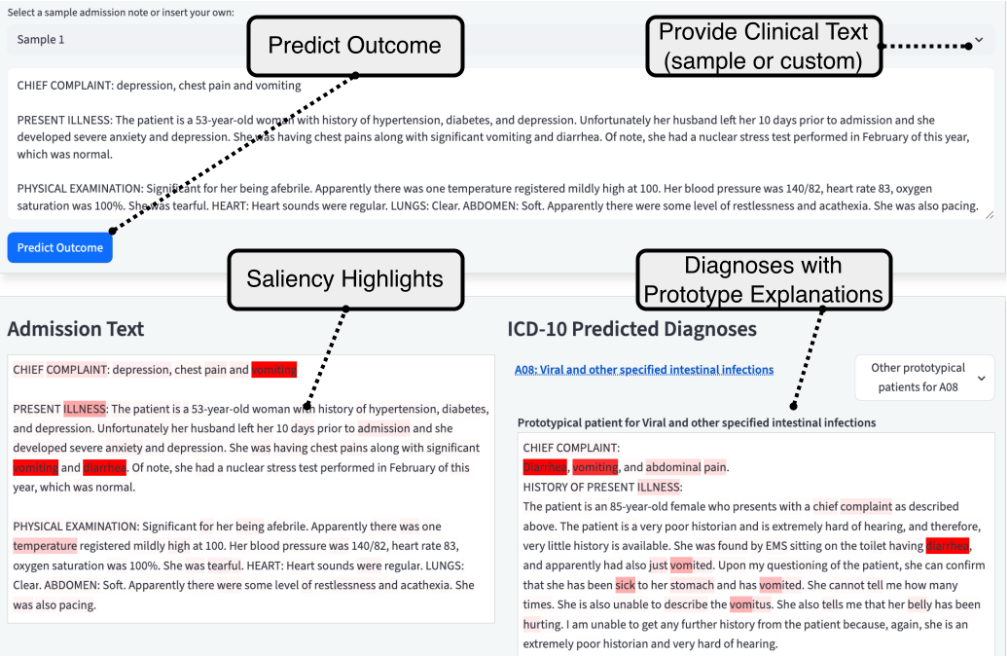
Explanations Exposed in the Interface. As shown in Figure 1, users enter clinical text, receive ranked ICD-10 predictions, and inspect prototype-based explanations in a dedicated panel. Selecting a diagnosis reveals the highest-activated prototype, with optional switching between alternative cohorts. Token-level attention weights are displayed on both the input and retrieved notes, aggregated to word level for readability.
3 DemonstrationWorkflow
Stage 1: Input. A medical student or junior doctor enters findings as free-text notes or selects predefined cases from the CodiEsp dataset. Inference is performed in real time, and no user-entered text is stored.
Stage 2: Outcome Prediction. The system returns a ranked list of predicted ICD-10 codes. Each diagnosis is evaluated using its own validation-tuned decision threshold, enabling calibrated multi-label predictions rather than a fixed global threshold.
Stage 3: Prototype Retrieval and Evidence Highlighting. For each predicted diagnosis, the system retrieves the most strongly activated prototypical patient. Label-wise attention weights are projected onto the input note, highlighting clinically salient tokens that drive the prediction. Attention-based highlights are also displayed within the prototype note, revealing shared clinical aspects (e.g., symptoms, comorbidities, medications) that link the current case to prior patients.
Stage 4: Zoom into Selected Prototypical Patients. Users can open a detailed prototype view to inspect the retrieved patient note in full. Side-by-side comparison supports qualitative analysis of similarities and differences.
Stage 5: Cohort Switching. When multiple prototypes exist for a diagnosis, users can toggle between alternative representative patients. This reveals distinct sub-cohorts corresponding to different disease presentations. Alternative prototypes are surfaced only when the associated diagnosis passes its validation-tuned threshold, ensuring faithfulness to the multi-label decision process.
3.1 Representative Use Cases
Clinician. A clinician inputs a clinical note and inspects predicted ICD-10 codes with highlighted evidence. By comparing salient tokens and retrieved prototypes, they can assess whether the prediction reflects a clinically coherent presentation, including rare diagnoses, supporting rapid qualitative auditing.
Researcher. A researcher uses the demo to examine how prototype-based models organize clinical patterns. By toggling alternative prototypes for the same diagnosis, they can observe how heterogeneous disease presentations are partitioned into distinct learned cohorts. Saliency overlays support targeted error analysis and inspection of attention patterns.
Long-tail inspection. For rare diagnoses, users can examine how predictions are grounded in specific prototype cohorts. Distinct prototypes often correspond to different clinical subtypes within the same ICD-10 code, making sparse predictions directly inspectable.
4 Evaluation and Validation
Predictive Performance. On the held-out CodiEsp test set, the deployed S-Proto-5P model achieves 91.95 macroAUROC and 36.90 F1 on long-tail diagnoses. The model outperforms a strong PubMedBERT encoder baseline, with particularly pronounced improvements on rare labels. Performance is sufficient to support stable interactive inspection.
4.1 Clinical Validation and Faithfulness
A clinician co-author qualitatively reviewed all preset demo cases and found that highlighted spans frequently correspond to clinically meaningful cues, including explicit diagnoses, symptoms, medications, and comorbidities. Occasional mismatches occurred when the model overweighted explicit mentions, reflecting expected limitations of a compact public checkpoint.
As a sanity check, removing highly attended tokens typically reduced prediction confidence, suggesting that highlighted evidence reflects model-internal decision signals rather than arbitrary artifacts [Figueroa et al., 2024]. The public CodiEsp-based deployment preserves the same attention mechanism; large-scale robustness experiments are beyond the scope of this system demonstration.
4.2 Latency and Reproducibility
The system performs inference in approximately 300ms per query, enabling smooth interactive exploration. The full pipeline is containerized with Docker and can be rebuilt endto-end with a single command. This enables reproducible experimentation and portable deployment on modest hardware.
5 Limitations and Responsible Use
Attention weights reflect model-internal relevance signals and do not constitute causal or human-like explanations [Bibal et al., 2022]; they are provided as transparency tools rather than clinical evidence. The deployed system uses a sparse multi-prototype model trained on the publicly available CodiEsp dataset (1000 clinical notes, 955 ICD-10 labels), limiting coverage of rare diagnoses and generalization compared to larger clinical corpora. The interface currently supports single-note inference only and does not include longitudinal trajectories or multi-note aggregation. Freezing the encoder improves stability and reproducibility but constrains domain adaptation. Allowing fine-tuning may improve predictive performance at the cost of comparability and deployment simplicity. The prototype count is fixed at five per label; while empirically effective, this may not fully capture intra-class heterogeneity. The system is intended strictly for research and educational use. The demo illustrates model behavior and explanation mechanisms, not clinical correctness.
6 Availability and Conclusion
The live system, source code, and fully reproducible Docker deployment are publicly available. 2
Sparse ProtoPatient makes multi-prototype clinical reasoning inspectable in real time. Instead of returning a single opaque prediction, it exposes multiple supporting patient cohorts and the token-level evidence linking them to the input case. This reframes heterogeneous ICD-10 prediction from a black-box output into an interactive reasoning process.
By unifying saliency visualization, prototype retrieval, and cohort switching within a single interface, the demo provides a practical environment for auditing, analysis, and education in clinical NLP. As a fully reproducible, public platform, it demonstrates how interpretable prototype-based reasoning can be operationalized in safety-critical healthcare AI.
Ethical Statement
All data used in this demonstration are publicly available and fully de-identified. The system does not store or log usersubmitted input. The demo is intended strictly for research and educational purposes and must not be used for clinical decision-making. Saliency visualizations reflect modelinternal attention signals and do not constitute causal medical reasoning.
2 Live Demo · Walkthrough Video · Source Code + Docker.
Acknowledgments
Our work is funded by the German Federal Ministry of Education and Research (BMBF) under the grant agreements 01-S23013C (More-with-Less), and 01-S23015A (AI4SCM). This work is also funded by the Deutsche Forschungsgemeinschaft (DFG, German Research Foundation) Project-ID 528483508 - FIP 12, as well as the European Union under the grant project 101079894 (COMFORT - Improving Urologic Cancer Care with Artificial Intelligence Solutions). Views and opinions expressed are however those of the author(s) only and do not necessarily reflect those of the European Union or European Health and Digital Executive Agency (HADEA). Neither the European Union nor the granting authority can be held responsible for them. Also funded with the project SOOFI: Large Reasoning Models, Project-ID 13IPC040D.
@inproceedings{ijcai2026p963,
  title     = {Sparse ProtoPatient: Interactive Multi-Prototype Explanations for Clinical Diagnosis Prediction},
  author    = {Fallon, Conor and Kostić, Bogdan and van Aken, Betty and Papaioannou, Jens-Michalis and Figueroa, Alexei and Bressem, Keno and Löser, Alexander},
  booktitle = {Proceedings of the Thirty-Fifth International Joint Conference on
               Artificial Intelligence, {IJCAI-26}},
  publisher = {International Joint Conferences on Artificial Intelligence Organization},
  editor    = {Diego Calvanese},
  pages     = {8389--8392},
  year      = {2026},
  month     = {8},
  note      = {Demo Track},
  doi       = {10.24963/ijcai.2026/963},
  url       = {https://doi.org/10.24963/ijcai.2026/963},
}
TY - CPAPER TI - Sparse ProtoPatient: Interactive Multi-Prototype Explanations for Clinical Diagnosis Prediction AU - Fallon, Conor AU - Kostić, Bogdan AU - van Aken, Betty AU - Papaioannou, Jens-Michalis AU - Figueroa, Alexei AU - Bressem, Keno AU - Löser, Alexander T2 - Proceedings of the Thirty-Fifth International Joint Conference on Artificial Intelligence, IJCAI-26 PB - International Joint Conferences on Artificial Intelligence Organization PY - 2026 SP - 8389 EP - 8392 DO - 10.24963/ijcai.2026/963 UR - https://doi.org/10.24963/ijcai.2026/963 ER -Copied
Machine-readable versions of this paper, for tools and AI agents:





