
RUVA: Personalized Transparent On-Device Graph Reasoning
Proceedings of the Thirty-Fifth International Joint Conference on Artificial Intelligence. Demo Track. Pages 8375-8379.
https://doi.org/10.24963/ijcai.2026/960
Keywords
- AI: AI Ethics, Trust, Fairnes
- AI: Humans and AI
- AI: Natural Language Processing
- AI: Knowledge Representation and Reasoning
Abstract
The Personal AI landscape is currently dominated by "Black Box" Retrieval-Augmented Generation. While standard vector databases offer statistical matching, they suffer from a fundamental lack of accountability: when an AI hallucinates or retrieves sensitive data, the user cannot inspect the cause nor correct the error. Worse, "deleting" a concept from a vector space is mathematically imprecise, leaving behind probabilistic "ghosts" that violate true privacy. We propose Ruva, the first "Glass Box" architecture designed for Human-in-the-Loop Memory Curation.
Ruva grounds Personal AI in a Personal Knowledge Graph, enabling users to inspect what the AI knows and to perform precise redaction of specific facts. By shifting the paradigm from Vector Matching to Graph Reasoning, Ruva ensures the "Right to be Forgotten." Users are the editors of their own lives; Ruva hands them the pen.
- [Agarwal et al., 2025] Agarwal et al. gpt-oss-120b & gpt- oss-20b model card. https://arxiv.org/abs/2508.10925, 2025. Accessed: 2026-06-10. Link
- [Aghilar et al., 2023] Potito Aghilar, Vito Walter Anelli, Michelantonio Trizio, and Tommaso Di Noia. Scalable cloud-native pipeline for efficient 3d model reconstruction from monocular smartphone images. In Bedir Tekinerdo- gan, Catia Trubiani, Chouki Tibermacine, Patrizia Scan- durra, and Carlos E. Cuesta, editors, Software Architecture -17th European Conference, ECSA 2023, Istanbul, Turkey, September 18-22, 2023, Proceedings, Lecture Notes in Computer Science, pages 266-282. Springer, 2023.
- [Aghilar et al., 2025] Potito Aghilar, Vito Walter Anelli, Michelantonio Trizio, Eugenio Di Sciascio, and Tom- maso Di Noia. Training-free, identity-preserving image editing for fashion pose alignment and normalization. Ex- pert Syst. Appl., 293:128579, 2025.
- [Anelli et al., 2017] Vito Walter Anelli, Tommaso Di Noia, Pasquale Lops, and Eugenio Di Sciascio. Feature fac- torization for top-n recommendation: From item rat- ing to features relevance. In Yong Zheng, Weike Pan, Shaghayegh (Sherry) Sahebi, and Ignacio Fernández, edi- tors, Proceedings of the 1st Workshop on Intelligent Rec- ommender Systems by Knowledge Transfer & Learning co-located with ACM Conference on Recommender Sys- tems (RecSys 2017), Como, Italy, August 27, 2017, CEUR Workshop Proceedings, pages 16-21. CEUR-WS.org, 2017.
- [Bai et al., 2025] Bai et al. Kimi k2: Open agentic intelli- gence. https://arxiv.org/abs/2507.20534, 2025. Accessed: 2026-06-10. Link
- [Balog and Kenter, 2019] Krisztian Balog and Tom Kenter. Personal knowledge graphs: A research agenda. In Pro- ceedings of the 2019 ACM SIGIR International Confer- ence on Theory of Information Retrieval, ICTIR 2019, Santa Clara, CA, USA, October 2-5, 2019, pages 217-220. ACM, 2019.
- [Cohen, 1968] Jacob Cohen. Weighted kappa: Nominal scale agreement provision for scaled disagreement or par- tial credit. Psychological Bulletin, 70(4):213-220, 1968.
- [Di Palma et al., 2025] Dario Di Palma, Alessandro De Bel- lis, Giovanni Servedio, Vito Walter Anelli, Fedelucio Nar- ducci, and Tommaso Di Noia. Llamas have feelings too: Unveiling sentiment and emotion representations in llama models through probing. In Wanxiang Che, Joyce Nabende, Ekaterina Shutova, and Mohammad Taher Pile- hvar, editors, Proceedings of the 63rd Annual Meeting of the Association for Computational Linguistics (Volume 1: Long Papers), ACL 2025, Vienna, Austria, July 27 -August 1, 2025, pages 6124-6142. Association for Computational Linguistics, 2025.
- [Edge et al., 2024] Darren Edge, Ha Trinh, Newman Cheng, Joshua Bradley, Alex Chao, Apurva Mody, Steven Tru- itt, and Jonathan Larson. From local to global: A graph RAG approach to query-focused summarization. CoRR, abs/2404.16130, 2024.
- [Grattafiori et al., 2024] Grattafiori et al. The llama 3 herd of models. https://arxiv.org/abs/2407.21783, 2024. Ac- cessed: 2026-06-10. Link
- [Kamath et al., 2025] Kamath et al. Gemma 3 technical re- port. https://arxiv.org/abs/2503.19786, 2025. Accessed: 2026-06-10. Link
- [Kautz, 2022] Henry A. Kautz. The third AI summer: AAAI robert s. engelmore memorial lecture. AI Mag., 43(1):93- 104, 2022.
- [Kim et al., 2024] Seungone Kim, Jamin Shin, Yejin Cho, Joel Jang, Shayne Longpre, Hwaran Lee, Sangdoo Yun, Seongjin Shin, Sungdong Kim, James Thorne, and Min- joon Seo. Prometheus: Inducing fine-grained evaluation capability in language models, 2024.
- [Krippendorff, 2011] Klaus Krippendorff. Computing krip- pendorff's alpha-reliability. 2011. Accessed: 2026-06-10.
- [Lee et al., 2025] Yukyung Lee, JoongHoon Kim, Jaehee Kim, Hyowon Cho, Jaewook Kang, Pilsung Kang, and Na- joung Kim. CheckEval: A reliable LLM-as-a-judge frame- work for evaluating text generation using checklists. In Proceedings of the 2025 Conference on Empirical Meth- ods in Natural Language Processing, pages 15771-15798, Suzhou, China, November 2025.
- [Lewis et al., 2020] Patrick Lewis, Ethan Perez, Aleksan- dra Piktus, Fabio Petroni, Vladimir Karpukhin, Na- man Goyal, Heinrich Küttler, Mike Lewis, Wen-tau Yih, Tim Rocktäschel, Sebastian Riedel, and Douwe Kiela. Retrieval-augmented generation for knowledge-intensive NLP tasks. In NeurIPS, 2020.
- [Liang et al., 2025] Weixin Liang, Yaohui Zhang, Mihai Co- dreanu, Jiayu Wang, Hancheng Cao, and James Zou. The widespread adoption of large language model-assisted writing across society. Patterns, 6(12):101366, 2025.
- [Luo et al., 2025] Yun Luo, Zhen Yang, Fandong Meng, Yafu Li, Jie Zhou, and Yue Zhang. An empirical study of catastrophic forgetting in large language models dur- ing continual fine-tuning. IEEE Transactions on Audio, Speech and Language Processing, 2025.
- [McHugh, 2012] Mary L. McHugh. Interrater reliability: the kappa statistic. Biochemia Medica, 22(3):276-282, 2012.
- [Servedio et al., 2025] Giovanni Servedio, Alessandro De Bellis, Dario Di Palma, Vito Walter Anelli, and Tom- maso Di Noia. Are the hidden states hiding some- thing? testing the limits of factuality-encoding capabil- ities in llms. In Wanxiang Che, Joyce Nabende, Eka- terina Shutova, and Mohammad Taher Pilehvar, editors, Proceedings of the 63rd Annual Meeting of the Associa- tion for Computational Linguistics (Volume 1: Long Pa- pers), ACL 2025, Vienna, Austria, July 27 -August 1, 2025, pages 6089-6104. Association for Computational Linguis- tics, 2025.
- [Skjæveland et al., 2024] Martin G. Skjæveland, Krisztian Balog, Nolwenn Bernard, Weronika Lajewska, and Trond Linjordet. An ecosystem for personal knowledge graphs: A survey and research roadmap. AI Open, 5:55-69, 2024.
- [Spearman, 1904] Charles Spearman. The proof and mea- surement of association between two things. The Ameri- can Journal of Psychology, 15(1):72-101, January 1904.
- [Traag et al., 2019] Vincent A. Traag, Ludo Waltman, and Nees Jan van Eck. From louvain to leiden: guarantee- ing well-connected communities. Scientific Reports, 9(1), March 2019.
- [Wang et al., 2023] Shoujin Wang, Yan Wang, Fikret Sivrikaya, Sahin Albayrak, and Vito Walter Anelli. Data science for next-generation recommender systems. Int. J. Data Sci. Anal., 16(2):135-145, 2023.
- [Wang et al., 2025] Shang Wang, Tianqing Zhu, Dayong Ye, and Wanlei Zhou. When machine unlearning meets retrieval-augmented generation (rag): Keep secret or for- get knowledge? IEEE Transactions on Dependable and Secure Computing, page 1-16, 2025.
- [Yang et al., 2025] Yang et al. Qwen3 technical report. CoRR, abs/2505.09388, 2025. Accessed: 2026-06-10.
References were extracted automatically from the PDF and may contain errors.
Full text extracted automatically from the PDF; figures, tables and equations may differ. The PDF is the version of record.
1 Introduction
Since their release, Large Language Models have quickly transitioned from novelties to commodities [Liang et al., 2025]. The early industry dream of hyper-personalizing these models via fine-tuning has collapsed under the weight of computational costs and the risk of catastrophic forgetting [Luo et al., 2025]. Consequently, the field has converged on Retrieval-Augmented Generation (RAG) [Lewis et al., 2020] as the only viable path for personalization [Wang et al., 2023; Anelli et al., 2017]. However, the reliance on standard Vector RAG has created a crisis: the "Black Box" problem. Current RAG systems compress a user's life (e.g., emails, photos, chats, calendar entries) into high-dimensional embedding spaces. While efficient for matching semantically similar keywords, the user cannot inspect why the system fails, or fix it [Servedio et al., 2025; Di Palma et al., 2025]. More critically, true privacy requires the ability to delete, but one cannot surgically remove a concept from a vector space; one can only suppress it. This mathematical imprecision leaves behind "probabilistic ghosts", traces of sensitive data that the AI might accidentally resurrect [Wang et al., 2025].
∗Corresponding authors.
GraphRAGmethods [Edge et al., 2024] address these limitations by incorporating graph topology into retrieval.
We introduce RUVA (the Etruscan word for "Brother"), a system designed to be as trustworthy and protective as a close sibling. RUVA is a neuro-symbolic GraphRAG architecture [Kautz, 2022] that runs entirely on-device, representing a paradigm shift from opaque retrieval to transparent reasoning. Trust begins with sovereignty. By running locally, RUVA ensures that the user's Personal Knowledge Graph (PKG) [Balog and Kenter, 2019; Skjæveland et al., 2024] never leaves their device. There is no cloud to hack; the user's life remains physically in their pocket. Unlike vector stores, RUVA grounds its intelligence in a "Glass Box" architecture. Here, every memory is an explicit node, and every association is a visible edge. This structure highlights a core consideration: Vectors allow Matching; Graphs allow Reasoning. Consider the query: "Did Sarah call before I arrived at work?" A standard vector system simply retrieves chunks containing "Sarah" and "Work" based on similarity, often hallucinating the temporal relationship. In contrast, RUVA traverses the graph topology, comparing the timestamp of the Call node against the Arrival node to provide the answer.
Finally, RUVA redefines the user's role from a passive data source to the Editor-in-Chief. Because the memory is structured, it is fully editable. If RUVA learns something incorrect or sensitive, the user can use the "Red Pen" to perform a precise redaction, cutting that specific node (the reified information object) and its edges. The knowledge is deleted instantly and mathematically, ensuring the "Right to be Forgotten." RUVA is not another chatbot. It is an AI that users can actually trust, because RUVA allows them to see inside its head and edit its memories. The project and the demo video are available at https://ruva-assistant.github.io/.
2 The RUVA Architecture
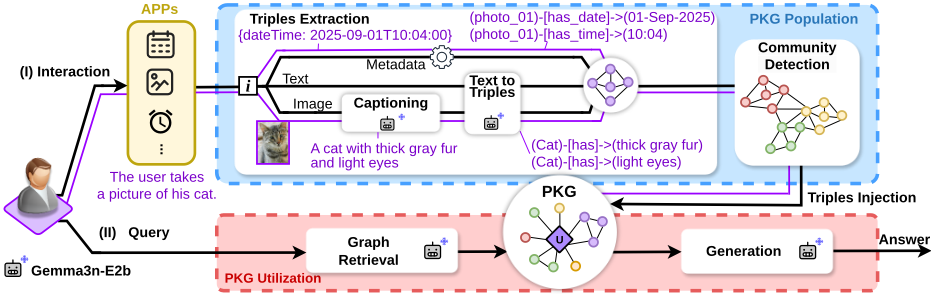
RUVA is engineered as an offline-first, mobile-native system designed to guarantee data sovereignty. To ensure that personal data never leaves the user's possession, all computation occurs locally on the user's mobile device; the Personal Knowledge Graph (PKG) is physically bound to the handset, eliminating cloud-based attack vectors [Aghilar et al., 2023]. Furthermore, the system is optimized for mobile constraints, utilizing quantized models and efficient storage to operate alongside the OS without draining the battery. As illustrated in Figure 1, RUVA implements a Type 3 NeuroSymbolic architecture (taxonomy from Kautz [2022]) that separates perception from memory. The Neural Component employs a Small Vision Language Model (SVLM, i.e., Gemma-3n-E2b [Kamath et al., 2025]) as the system's "eyes and ears." Its role is to convert unstructured noise (pixels, raw text) into structured signals, accepting the probabilistic nature of recognition. These signals are fed into the Symbolic Component, a PKG used for storage and reasoning (Figure 2a). Unlike the neural component, the memory, once created, is deterministic, inspectable, and editable. The system backbone is a hybrid storage engine: a SQLite database extended with sqlite-vec. For this research, the engine is extended to accommodate GraphRAG [Edge et al., 2024] operations. This design choice is critical for the "Glass Box" paradigm. The resulting "spiderweb" topology roots at a central User node, from which entities (Events, Photos, Messages) branch via typed edges, unifying the user's digital footprint.
2.1 Multimodal IngestionWorkflow
RUVA operates a background "Triple Extraction" pipeline that transforms heterogeneous data streams into semantic triples. For visual data, such as a photo of a train ticket, the image is passed to the local SVLM [Aghilar et al., 2025]. The SVLM generates a dense caption, which is then parsed to extract structured entities, effectively converting pixels into nodes like (:Receipt)-[:cost]->("95 EUR"). Textual data, such as emails or notes, is processed directly by the SVLM to extract entities and temporal metadata. To prevent graph fragmentation, RUVA employs an Entity Resolution strategy along with community detection (Leiden algorithm [Traag et al., 2019]). For instance, clustering merges an email from "Sarah Green" and an invite from "S. Green" into a single Person node, preventing duplicates.
2.2 Graph-Grounded Retrieval Workflow
Standard Vector RAG fails at complex reasoning because it relies solely on semantic similarity. RUVA solves this via a multi-step Graph-Grounded Retrieval mechanism. Upon receiving a query like "Did Sarah call before I arrived at work?", the system first executes an Anchor Search using vector similarity to find the relevant "Anchor Nodes" (e.g., the Person:Sarah node and the Location:Work node). It then performs a configurable Topological Expansion, executing an N-hop traversal from these anchors to identify connected events. Finally, during Answer Generation (Figure 2b), the retrieved subgraph, containing explicit timestamps and relationships, is serialized and fed into the SVLM.
2.3 The DeletionMechanism
One of the most significant advantages of the RUVA architecture is user-controlled knowledge deletion. In vectoronly systems, deleting a concept is mathematically imprecise, leaving behind probabilistic ghosts. In RUVA, since every memory is a discrete node in a relational database, deletion is exact. When a user chooses to forget a specific memory (e.g., "The project meeting on Friday"), RUVA executes a standard SQL DELETE CASCADE transaction targeting the reified information object. The node, its properties, and associated vector indices are permanently excised from the memory, granting users deterministic control over their digital past.
3 Demonstration Scenarios
We demonstrate the "Glass Box" RUVA architecture with three use cases: (i) ingestion of a multimodal memory; (ii) complex reasoning, and (iii) memory deletion.
The demonstration begins with Multimodal Ingestion (Scenario 1), illustrating how the system reacts when multimodal data enters the system. Let us introduce an example. The user syncs a calendar containing a "Weekend Trip" and uploads a photo of a train ticket. The Multimodal Ingestion Workflow triggers: the local VLM converts the ticket pixels into a structured node (:Receipt :amount "95 EUR"), while the system identifies the temporal overlap with the calendar event, forging a relationship edge.
Next, we demonstrate the Complex Reasoning (Scenario 2). Again, let us show it through an example. The user asks: "How much have I spent on the trip so far?" Answering this requires bridging the concept "The Trip" from the calendar with granular data "95 EUR" from the image. The GraphRAG runtime executes a multi-hop traversal, locating the Trip node and following the temporal edge to the Receipt node, answering "You have spent 95 EUR for the ticket."
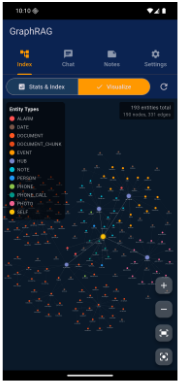
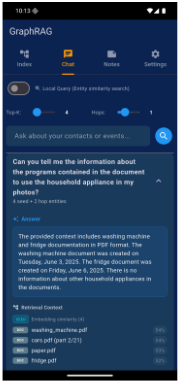
Figure 2: RUVA App Screenshots. Figure 2a shows the inferred PKG, while in Figure 2b RUVA answers leveraging multimodal data.
Finally, we showcase the Deterministic Deletion (Scenario 3), addressing the "Right to be Forgotten." In this example, the user decides that a financial piece of information (i.e., the receipt in Scenario 2) is sensitive and should not be retained. By selecting the Receipt in the gallery app and removing it, the system executes a deterministic DELETE cascade transaction. The node and all associated vector indices are excised. To verify this, the user asks the same question again, and the system responds: "I couldn't find relevant information to answer your question." This scenario demonstrates true data sovereignty: the user acts as the editor of their own memory, enforcing privacy with mathematical certainty in a way that opaque vector-only systems cannot guarantee.
4 Evaluation
This section assesses the RUVA's operational feasibility of the architecture and the semantic reasoning quality.
Performance. We deployed the systemon a constrained environment, a Google Pixel 8 Pro. RUVA periodically scans the device's local data and compares it with existing nodes. Despite the constrained environment, RUVA ensures interactive latencies, with an average ingestion time of 2.4s (including VLM processing and triple extraction) and a graph retrieval latency of only 38ms for single-hop queries.
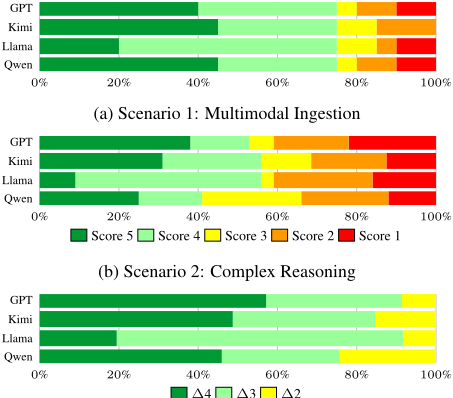
Model Accuracy. To comprehensively test RUVA, we prepared a benchmark comprising 71 multi-source objects (spanning calendar events, images, notes, textual documents, calls, alarms, and contacts) and 52 triplets containing questions, desired answers, and RUVA's answers. The benchmark specifically probes three distinct scenarios: Multimodal Ingestion (Figure 3a), Complex Reasoning (Figure 3b), and Deterministic Deletion (Figure 3c). The benchmark consists of 20 ingestion checks and 32 complex reasoning questions. To as-
∆4 ∆3 ∆2
(c) Scenario 3: Deterministic Deletion (Delta Scores)
Figure 3: Judicial scores for Scenario 1 and 2, and ∆ scores for 3.
sess Deterministic Deletion, each question is evaluated with (score0) and without (score1) its corresponding information objects, measuring ∆ = score0 - score1. We considered answers whose judges' score is positive (3-5).
Experiments. We employ a panel of four state-of-the-art LLMs: Llama3.3-70B [Grattafiori et al., 2024], Qwen332B [Yang et al., 2025], GPT [Agarwal et al., 2025], and Kimi K2 [Bai et al., 2025] Instruct. Following the Prometheus [Kim et al., 2024] strategy, judges evaluate benchmark triplets via Chain-of-Thought reasoning. To mitigate inter-model bias [Lee et al., 2025], we map the resulting 5-point scores to three categories: Positive (4-5), Neutral (3), and Negative (1-2). RUVA demonstrates robust reasoning, with 61% of responses rated as Positive, increasing to 71% when including Neutral responses. (Figure 3a, Figure 3b). Reliability analysis shows strong cross-model agreement, with a Spearman's Rank Correlation (ρ) [Spearman, 1904] of 0.82 and a Krippendorff's Alpha [Krippendorff, 2011] of 0.81, indicating consistency in ordinal evaluations. The 83%Percentage Agreement [McHugh, 2012] and Cohen's κ [Cohen, 1968] of 0.81 confirm this finding. Notably, GPT and Kimi K2 achieve up to 92% agreement (κ = 0.92), highlighting highly aligned assessments.
5 Conclusion
We introduce RUVA, redefining Personal AI from an opaque service into a transparent framework. By adopting a neuro-symbolic GraphRAG paradigm, we addressed the "Black Box" limitations that plague current retrieval systems. Achieving interactive latencies and high semantic accuracy on edge devices, RUVA proves the cloud is no longer a prerequisite for intelligence, ensuring data sovereignty. Its graph topology enables deterministic deletion, operationalizing the "Right to be Forgotten". By allowing users to inspect, correct, and erase memories, RUVA restores human agency.
Acknowledgments
The authors acknowledge partial support of OVS Fashion Retail Reloaded, Lutech Digitale 4.0, Servizi Locali 2.0, Konecta New KOCS ERA, P+ARTS, PNRR-MAD-202212376656, REACH-XY and CALLIOPE. Furthermore, this work has been carried out while Giovanni Servedio was enrolled in the Italian National Doctorate on Artificial Intelligence run by Sapienza University of Rome in collaboration with Politecnico di Bari.
@inproceedings{ijcai2026p960,
  title     = {RUVA: Personalized Transparent On-Device Graph Reasoning},
  author    = {Conte, Gabriele and Mattiace, Alessio and Carmosino, Gianni and Aghilar, Potito and Servedio, Giovanni and Musicco, Francesco and Anelli, Vito Walter and Di Noia, Tommaso and Donini, Francesco Maria},
  booktitle = {Proceedings of the Thirty-Fifth International Joint Conference on
               Artificial Intelligence, {IJCAI-26}},
  publisher = {International Joint Conferences on Artificial Intelligence Organization},
  editor    = {Diego Calvanese},
  pages     = {8375--8379},
  year      = {2026},
  month     = {8},
  note      = {Demo Track},
  doi       = {10.24963/ijcai.2026/960},
  url       = {https://doi.org/10.24963/ijcai.2026/960},
}
TY - CPAPER TI - RUVA: Personalized Transparent On-Device Graph Reasoning AU - Conte, Gabriele AU - Mattiace, Alessio AU - Carmosino, Gianni AU - Aghilar, Potito AU - Servedio, Giovanni AU - Musicco, Francesco AU - Anelli, Vito Walter AU - Di Noia, Tommaso AU - Donini, Francesco Maria T2 - Proceedings of the Thirty-Fifth International Joint Conference on Artificial Intelligence, IJCAI-26 PB - International Joint Conferences on Artificial Intelligence Organization PY - 2026 SP - 8375 EP - 8379 DO - 10.24963/ijcai.2026/960 UR - https://doi.org/10.24963/ijcai.2026/960 ER -Copied
Machine-readable versions of this paper, for tools and AI agents:





