
You Don't Bring Me Flowers: Mitigating Unwanted Recommendations Through Conformal Risk Control (Extended Abstract)
Proceedings of the Thirty-Fifth International Joint Conference on Artificial Intelligence. Sister Conferences Best Papers. Pages 8260-8265.
https://doi.org/10.24963/ijcai.2026/923
© 2026 International Joint Conferences on Artificial Intelligence
Keywords
- AI: Uncertainty in AI
- Data Mining: Recommender systems
- AI Ethics, Trust, Fairnes: Societal impact of AI
- AI: Machine Learning
Abstract
Recommenders are significantly shaping online information consumption. While effective at personalizing content, these systems increasingly face criticism for propagating irrelevant, unwanted, and even harmful recommendations. Such content degrades user satisfaction and contributes to significant societal issues, including misinformation, radicalization, and erosion of user trust. Although platforms offer mechanisms to mitigate exposure to undesired content, these mechanisms are often insufficiently effective and slow to adapt to users' feedback. This paper introduces an intuitive, model-agnostic, and distribution-free method that uses conformal risk control to provably bound unwanted content in personalized recommendations by leveraging simple binary feedback on items. We also address a limitation of traditional conformal risk control approaches, i.e., the fact that the recommender can provide a smaller set of recommended items, by leveraging implicit feedback on consumed items to expand the recommendation set while ensuring robust risk mitigation. Our experimental evaluation on data coming from a popular online video-sharing platform demonstrates that our approach ensures an effective and controllable reduction of unwanted recommendations with minimal effort.
- [Ahn et al., 2024] Yongsu Ahn, Quinn K Wolter, Jonilyn Dick, Janet Dick, and Yu-Ru Lin. Interactive counterfac- tual exploration of algorithmic harms in recommender sys- tems. In 2024 IEEE Visualization in Data Science (VDS), pages 35-39. IEEE, 2024.
- [Anderson et al., 2014] Ashton Anderson, Ravi Kumar, An- drew Tomkins, and Sergei Vassilvitskii. The dynamics of repeat consumption. In Proceedings of the 23rd inter- national conference on World wide web, pages 419-430, 2014.
- [Angelopoulos and Bates, 2023] Anastasios N. Angelopou- los and Stephen Bates. Conformal prediction: A gentle introduction. Found. Trends Mach. Learn., 16(4):494-591, March 2023.
- [Angelopoulos et al., 2023a] Anastasios N Angelopoulos, Stephen Bates, Adam Fisch, Lihua Lei, and Tal Schuster. Conformal risk control. ICLR, 2023.
- [Angelopoulos et al., 2023b] Anastasios N Angelopoulos, Karl Krauth, Stephen Bates, Yixin Wang, and Michael I Jordan. Recommendation systems with distribution-free reliability guarantees. In Conformal and Probabilistic Pre- diction with Applications, pages 175-193. PMLR, 2023.
- [Bernstein et al., 2013] Michael S Bernstein, Eytan Bakshy, Moira Burke, and Brian Karrer. Quantifying the invisible audience in social networks. In Proceedings of the SIGCHI conference on human factors in computing systems, pages 21-30, 2013.
- [Boratto et al., 2021] Ludovico Boratto, Gianni Fenu, and Mirko Marras. Connecting user and item perspectives in popularity debiasing for collaborative recommendation. Information Processing & Management, 58(1):102387, 2021.
- [Cai and Zhu, 2019] Yuanfeng Cai and Dan Zhu. Trustwor- thy and profit: A new value-based neighbor selection method in recommender systems under shilling attacks. Decision Support Systems, 124:113112, 2019.
- [Cai et al., 2023] Xuheng Cai, Chao Huang, Lianghao Xia, and Xubin Ren. LightGCL: Simple yet effective graph contrastive learning for recommendation. In The Eleventh International Conference on Learning Representations, 2023.
- [Campos et al., 2024] Margarida Campos, António Farin- has, Chrysoula Zerva, Mário A. T. Figueiredo, and André F. T. Martins. Conformal prediction for natural language processing: A survey. Transactions of the Association for Computational Linguistics, 12:1497-1516, 11 2024.
- [Chee et al., 2024] Jerry Chee, Shankar Kalyanaraman, Sindhu Kiranmai Ernala, Udi Weinsberg, Sarah Dean, and Stratis Ioannidis. Harm mitigation in recommender sys- tems under user preference dynamics. In Proceedings of the 30th ACM SIGKDD Conference on Knowledge Dis- covery and Data Mining, pages 255-265, 2024.
- [Chen et al., 2024] Sirui Chen, Jiawei Chen, Sheng Zhou, Bohao Wang, Shen Han, Chanfei Su, Yuqing Yuan, and Can Wang. Sigformer: Sign-aware graph transformer for recommendation. In Proceedings of the 47th International ACM SIGIR Conference on Research and Development in Information Retrieval, SIGIR '24, page 1274-1284, New York, NY, USA, 2024. Association for Computing Ma- chinery.
- [Dai et al., 2024] Sunhao Dai, Changle Qu, Sirui Chen, Xiao Zhang, and Jun Xu. Recode: Modeling repeat con- sumption with neural ode. In Proceedings of the 47th International ACM SIGIR Conference on Research and Development in Information Retrieval, SIGIR '24, page 2599-2603, New York, NY, USA, 2024. Association for Computing Machinery.
- [De Toni et al., 2025a] Giovanni De Toni, Nastaran Okati, Suhas Thejaswi, Eleni Straitouri, and Manuel Gomez- Rodriguez. Towards human-ai complementarity with pre- diction sets. In Proceedings of the 38th International Con- ference on Neural Information Processing Systems, NIPS '24, Red Hook, NY, USA, 2025.
- [De Toni et al., 2025b] Giovanni De Toni, Erasmo Purifi- cato, Emilia Gomez, Andrea Passerini, Bruno Lepri, and Cristian Consonni. You don't bring me flowers: Mitigating unwanted recommendations through conformal risk con- trol. In Proceedings of the Nineteenth ACM Conference on Recommender Systems, RecSys '25, page 492-502, New York, NY, USA, 2025. Association for Computing Ma- chinery. [Deldjoo et al., 2021]
- Yashar Deldjoo, Markus Schedl, Balázs Hidasi, Yinwei Wei, and Xiangnan He. Multime- dia recommender systems: Algorithms and challenges. In Recommender systems handbook, pages 973-1014. Springer, 2021.
- [Elahi et al., 2022] Mehdi Elahi, Dietmar Jannach, Lars Skjærven, Erik Knudsen, Helle Sjøvaag, Kristian Tolonen, Øyvind Holmstad, Igor Pipkin, Eivind Throndsen, Agnes Stenbom, et al. Towards responsible media recommenda- tion. AI and Ethics, pages 1-12, 2022.
- [Eslami et al., 2015] Motahhare Eslami, Aimee Rickman, Kristen Vaccaro, Amirhossein Aleyasen, Andy Vuong, Karrie Karahalios, Kevin Hamilton, and Christian Sand- vig. " i always assumed that i wasn't really that close to [her]" reasoning about invisible algorithms in news feeds. In Proceedings of the 33rd annual ACM conference on hu- man factors in computing systems, pages 153-162, 2015.
- [Eslami et al., 2016] Motahhare Eslami, Karrie Karahalios, Christian Sandvig, Kristen Vaccaro, Aimee Rickman, Kevin Hamilton, and Alex Kirlik. First i" like" it, then i hide it: Folk theories of social feeds. In Proceedings of the 2016 cHI conference on human factors in computing systems, pages 2371-2382, 2016.
- [Fernández and Bellogín, 2020] Miriam Fernández and Ale- jandro Bellogín. Recommender systems and misinforma- tion: The problem or the solution? In OHARS@RecSys, pages 40-50, 2020.
- [Gao et al., 2022] Chongming Gao, Shijun Li, Yuan Zhang, Jiawei Chen, Biao Li, Wenqiang Lei, Peng Jiang, and Xi- angnan He. Kuairand: An unbiased sequential recom- mendation dataset with randomly exposed videos. In Pro- ceedings of the 31st ACM International Conference on In- formation & Knowledge Management, CIKM '22, page 3953-3957, New York, NY, USA, 2022. Association for Computing Machinery.
- [Gao et al., 2023] Chen Gao, Yu Zheng, Nian Li, Yinfeng Li, Yingrong Qin, Jinghua Piao, Yuhan Quan, Jianxin Chang, Depeng Jin, Xiangnan He, and Yong Li. A survey of graph neural networks for recommender systems: Challenges, methods, and directions. ACM Trans. Recomm. Syst., 1(1), March 2023.
- [Ge et al., 2010] Mouzhi Ge, Carla Delgado-Battenfeld, and Dietmar Jannach. Beyond accuracy: evaluating recom- mender systems by coverage and serendipity. In Proceed- ings of the fourth ACM conference on Recommender sys- tems, pages 257-260, 2010.
- [Ghanem et al., 2022] Nada Ghanem, Stephan Leitner, and Dietmar Jannach. Balancing consumer and business value of recommender systems: A simulation-based anal- ysis. Electronic Commerce Research and Applications, 55:101195, 2022.
- [He et al., 2017] Xiangnan He, Lizi Liao, Hanwang Zhang, Liqiang Nie, Xia Hu, and Tat-Seng Chua. Neural collab- orative filtering. In Proceedings of the 26th international conference on world wide web, pages 173-182, 2017.
- [Li et al., 2023] Chaoliu Li, Lianghao Xia, Xubin Ren, Yaowen Ye, Yong Xu, and Chao Huang. Graph trans- former for recommendation. In Proceedings of the 46th in- ternational ACM SIGIR conference on research and devel- opment in information retrieval, pages 1680-1689, 2023.
- [Liu et al., 2024] Alexander Liu, Siqi Wu, and Paul Resnick. How to train your youtube recommender to avoid un- wanted videos. In Proceedings of the International AAAI Conference on Web and Social Media, volume 18, pages 930-942, 2024.
- [Loukili et al., 2023] Manal Loukili, Fayc ¸al Messaoudi, and Mohammed El Ghazi. Machine learning based recom- mender system for e-commerce. IAES International Jour- nal of Artificial Intelligence, 12(4):1803-1811, 2023.
- [Nguyen et al., 2018] Tien T Nguyen, F Maxwell Harper, Loren Terveen, and Joseph A Konstan. User personality and user satisfaction with recommender systems. Infor- mation systems frontiers, 20:1173-1189, 2018.
- [Sánchez-Fernández and Jiménez-Castillo, 2021] Raquel Sánchez-Fernández and David Jiménez-Castillo. How social media influencers affect behavioural intentions towards recommended brands: the role of emotional attachment and information value. Journal of Marketing Management, 37(11-12):1123-1147, 2021.
- [Seo et al., 2022] Changwon Seo, Kyeong-Joong Jeong, Sungsu Lim, and Won-Yong Shin. Siren: Sign-aware recommendation using graph neural networks. IEEE Transactions on Neural Networks and Learning Systems, 35(4):4729-4743, 2022.
- [Shafer and Vovk, 2008] Glenn Shafer and Vladimir Vovk. A tutorial on conformal prediction. Journal of Machine Learning Research, 9(3), 2008.
- [Straitouri and Rodriguez, 2024] Eleni Straitouri and Manuel Gomez Rodriguez. Designing decision support systems using counterfactual prediction sets. In Proceed- ings of the 41st International Conference on Machine Learning, ICML'24. JMLR.org, 2024.
- [Straitouri et al., 2023] Eleni Straitouri, Lequn Wang, Nas- taran Okati, and Manuel Gomez Rodriguez. Improving expert predictions with conformal prediction. In Inter- national Conference on Machine Learning, pages 32633- 32653. PMLR, 2023.
- [Tomlein et al., 2021] Matus Tomlein, Branislav Pecher, Jakub Simko, Ivan Srba, Robert Moro, Elena Stefancova, Michal Kompan, Andrea Hrckova, Juraj Podrouzek, and Maria Bielikova. An audit of misinformation filter bubbles on youtube: Bubble bursting and recent behavior changes. In Proceedings of the 15th ACM Conference on Recom- mender Systems, RecSys '21, page 1-11, New York, NY, USA, 2021. Association for Computing Machinery.
- [Tommasel et al., 2021] Antonela Tommasel, Daniela Godoy, and Arkaitz Zubiaga. Ohars: Second workshop on online misinformation-and harm-aware recommender systems. In Proceedings of the 15th ACM Conference on Recommender Systems, RecSys '21, page 789-791, New York, NY, USA, 2021. Association for Computing Machinery.
- [Wang and Joachims, 2023] Lequn Wang and Thorsten Joachims. Uncertainty quantification for fairness in two-stage recommender systems. In Proceedings of the Sixteenth ACM International Conference on Web Search and Data Mining, WSDM '23, page 940-948, New York, NY, USA, 2023. Association for Computing Machinery.
- [Xu et al., 2024] Yunpeng Xu, Wenge Guo, and Zhi Wei. Two-stage conformal risk control with application to ranked retrieval. arXiv preprint arXiv:2404.17769, 2024.
- [Xue et al., 2023] Wanqi Xue, Qingpeng Cai, Zhenghai Xue, Shuo Sun, Shuchang Liu, Dong Zheng, Peng Jiang, Kun Gai, and Bo An. Prefrec: Recommender systems with human preferences for reinforcing long-term user engage- ment. In Proceedings of the 29th ACM SIGKDD Confer- ence on Knowledge Discovery and Data Mining, 2023.
References were extracted automatically from the PDF and may contain errors.
Full text extracted automatically from the PDF; figures, tables and equations may differ. The PDF is the version of record.
1 Introduction
The widespread use of recommender systems on online platforms has significantly changed how users engage with content. These systems are integral to modern digital media, facilitating personalized navigation through extensive online content across domains such as e-commerce [Ghanem et al., 2022; Loukili et al., 2023], social media [Gao et al., 2023; S´anchez-Fern´andez and Jim´enez-Castillo, 2021], and content streaming [Deldjoo et al., 2021; Elahi et al., 2022], and tailoring experiences based on historical behaviors and expressed preferences [Fern´andez and Bellog´ın, 2020; Boratto et al., 2021]. By leveraging user-generated data, recommenders aim to enhance user engagement [Xue et al., 2023], satisfaction [Nguyen et al., 2018], and platform profitability [Cai and Zhu, 2019]. However, despite their proven utility and benefits, the basic concepts that make recommendation algorithms effective, such as similarity-based filtering and preference prediction, can inadvertently contribute to the spread of unwanted content [Liu et al., 2024]. Platforms have faced increasing criticism for creating filter bubbles and rabbit holes that reinforce existing beliefs, and for spreading potentially dangerous or harmful content [Tomlein et al., 2021]. Such dynamics are often attributed to algorithms that prioritize engagement, sometimes at the expense of content quality and truthfulness [Tommasel et al., 2021]. Features like the "Not Interested" button on YouTube [Liu et al., 2024] suffer from issues like low user awareness, complexity of use, or limited effectiveness. The lack of transparency and explainability in such strategies further exacerbates these problems, making it difficult for users to understand why they are being shown certain content and how to avoid it. As a result, users develop "folk theories" to explain the recommendations they are getting and try to influence the recommender outcomes [Bernstein et al., 2013; Eslami et al., 2015; Eslami et al., 2016; Liu et al., 2024]. Recent works have studied how to mitigate unwanted content, biases, or ensure fairness in recommendations [Chee et al., 2024; Ahn et al., 2024], but it remains unclear how to grant users precise and transparent control over the systems' risk.
∗ Full version appears in the proceedings of RecSys 2025 [De Toni et al., 2025b], winner of the Best Paper Award.
†Disclaimer: The view expressed in this extended abstract is purely that of the authors and may not, under any circumstances, be regarded as an official position of the European Commission.
Our contributions. We propose a post-hoc method based on conformal prediction [Shafer and Vovk, 2008; Angelopoulos and Bates, 2023] to provably mitigate the exposure to unwanted recommendations in expectation. Conformal prediction is a framework for uncertainty quantification for machine learning models that constructs prediction sets containing the true output with a user-specified confidence level, assuming data exchangeability. It uses non-conformity scores from model outputs to provide distribution-free, finite-sample guarantees. Conformal methods have recently been applied to decision support in classification tasks [Straitouri et al., 2023; Straitouri and Rodriguez, 2024; De Toni et al., 2025a], natural language processing [Campos et al., 2024], and recommendation systems [Angelopoulos et al., 2023b; Xu et al., 2024]. However, in recommender systems, current approaches often overlook key challenges, such as rerecommending unwanted items or balancing personalization with content filtering. To address this, we apply conformal risk control [Angelopoulos et al., 2023a], which generalizes conformal prediction to control general loss functions (or "risk") rather than coverage. Our method builds recommendation sets by filtering potentially unsafe items and replacing them with previously consumed, safe content, while provably respecting a user-defined risk level. Specifically, our contributions include:
- A comprehensive analysis of real data to understand reporting patterns and watch time behavior related to unwanted content, providing insights into how users interact with and respond to such content.
- Amethod based on conformal risk control that provably limits unwanted content in recommendations, with theoretical guarantees, by leveraging repeated content.
- A practical heuristic to choose safe alternative content, balancing the need for personalization and the goal of minimizing unwanted recommendations.
- Experiments and ablations with a real-world dataset, highlighting our approach's effectiveness in significantly reducing unwanted content.
2 Case Study: AVideo-Sharing Platform
We begin our study by examining data from a popular Chinese short-form video-sharing platform, Kuaishou, which has over 300 million daily users at the time of writing. We use the KuaiRand dataset [Gao et al., 2022], which was collected by sampling 27000 Kuaishou users who collectively watched approximately 32 million videos over one month (from April 8 to May 8, 2022). This dataset contains various user interaction signals, such as watch time for each video and whether users liked or commented on a video. The dataset also includes negative feedback signals, such as when users click the "Do not recommend" or "Report" buttons while watching a video. We focus exclusively on short videos, removing advertisements and videos with zero duration (e.g., dynamic photos). Notably, approximately 29% of users provided negative feedback on at least one video during the data collection period. Consequently, our analysis is restricted to this subset. After further filtering, our dataset consists of 7601 users, 56 million interactions, and 10 million unique videos. On average, a user watched 7, 417 videos during the collection period (median: 4, 623), with a large standard deviation of 9, 223.
Summary of the analysis. From our analysis 1 , we report some key insights that will be useful in designing riskcontrolling recommendation systems:
- The engagement and perceived harmfulness of videos are not fully correlated. Reported videos have the same
1 The full in-depth analysis of KuaiRand is available in Section 3 of the main manuscript [De Toni et al., 2025b].
| Behaviour | I (%) | U (%) | Watch Time 1st (s) | Watch Time 2nd (s) |
|---|---|---|---|---|
| → | 99.79 | 100.0 | 2.71±12.15 (1.39) | 10.48±25.85 (7.95) |
| → | 0.11 | 8.69 | 0.50±7.41 (0.0) | 10.73±20.85 (10.13) |
| → | 0.07 | 6.33 | 7.74±15.83 (6.64) | 7.85±15.86 (6.72) |
| → | 0.03 | 1.49 | 1.36±6.91 (0.0) | 6.46±25.42 (2.5) |
watch time distribution as non-reported videos. Thus, maximizing engagement does not imply providing less harmful videos to users.
- In Kuaishou, the system suggests undesired content despite explicit user feedback (cf. → / Table 1). Since over 95% of users report less than 1% of videos they watch, recommender systems should maximize the usefulness of this little explicit negative feedback;
- With 21% of interactions resulting in no watch time and a strong peak near zero in view time distribution, very short engagement can serve as an early indicator of harmful or undesired content.
3 Recommender Systems With Risk Control
Given the key insights obtained from the analysis of Kuaishou data, let us now define more formally a risk-controlling recommender system. Consider a finite set of items I ∈ {i1, . . . , iN} and a finite set of users U ∈ {u1, . . . , uM}, each represented by d-dimensional feature vectors, respectively. Our recommender system outputs a set of items S(U) ⊆ I based on some relevance score estimated by a ranker f(U, I) ∈ R predicting how much an item I is relevant for a user U based on the information within U and I (e.g., in terms of watch-time). In two-stage recommender systems, we might perform further post-processing activities to filter certain items, before presenting the final recommendation to the user. Similarly to [Angelopoulos et al., 2023b], let us consider a post-processing step where we employ some threshold λ ∈ R to pick only certain items, based on a score s : U × I → R. For example, consider s(U, I = i) = f(U, I = i), we might want to keep only items with a predicted relevance above a certain base value:
After post-processing, our objective becomes providing the best set Sλ(U) ⊆ Tλ(U) maximizing a target metric computed on the recommendations (e.g., serendipity [Ge et al., 2010]). Generally, we are interested in recommending the most relevant items to each user, under a budget k ≤ N e.g., the number of slots in a YouTube main page. Let us define π(I) = {i1, . . . , iN} as the order induced by sorting the items given the ranker scores f(U, I = ij). If our ranker is reasonably good, then the optimal solution would be simply picking up to the k-th item from π(Tλ(U)):
In classical learning-to-rank tasks, we try to learn the optimal ranker f ∗ = argmaxf∈F E[ℓ(Sλ(U, k))] where ℓ : I → R is our target metric, such as the nDCG. Besides picking the most relevant items for the user, now we want to control the risk of the set Sλ(U, k) induced by the optimal ranker f ∗ . Let us assume we have a risk metric R : I → (0, 1) we would like to provably bound below a certain value α ∈ (0, 1). For example, we might want the fraction of unwanted content in Sλ(U, k) to be below a user-defined value. Since we want to avoid performing costly operations such as re-training the ranker f ∗ , an intuitive way to reach such an objective is by acting on the post-processing step, by finding the optimal λ threshold ensuring our risk is below a user-defined level α ∈ (0, 1):
In our setting, we consider an item unwanted for a user if she expresses distaste for it once seen within the recommendations. Given a set of recommendations Sλ(U, k), we denote its overall risk as the fraction of items the user has flagged once presented with it:
3.1 Conformal Risk Control
By simply plugging the previous risk definition in Eq. (3), we have our optimization objective. However, how do we pick the threshold λ to control the risk defined by Eq. (4)? We can find the optimal threshold via conformal risk control [Angelopoulos et al., 2023a] by employing a held-out calibration set {(u, i, h))j}ni=1 , where for each user-item pair we also record if it was flagged as unwanted (h = 1). We first state the main theorem from [Angelopoulos et al., 2023a], and then we explain its practical implications.
Theorem 1. Assume that RH(Sλ(U, k)) is non-increasing in λ, right-continuous, RH(Sλmax (U, k)) ≤ α and supλ RH(Sλ(U, k)) ≤ 1 < ∞ almost surely. Consider ˆR(λ) = 1n ∑nj=1 RH(Sλ(U = uj , k)), given a held-out calibration set. Given any desired risk upper bound α ∈ [0, 1], if we choose a threshold as:
then, we have E[R(Sˆλ (U, k))] ≤ α.
In practice, as long as our risk function decreases as λ increases, by choosing ˆλ as in Theorem 1, we are guaranteed the risk will be provably bound in expectation. If we consider the ranker output s(U, I) = f(U, I) as a score, as we increase the threshold, fewer items will be contained within Tλ(U). Thus, the likelihood of picking harmful items within Sλ(U, k) decreases monotonically since by removing items, we cannot increase RH(Sλ(U, k)).
4 Risk Control via ItemReplacement
Recent applications of conformal prediction to recommender systems consider only the simple filtering approach as detailed in Eq. (1) [Angelopoulos et al., 2023b; Xu et al.,
Algorithm 1 Risk-controlling Recommender System
Require: U, user, I, items, α, risk level, f : U × I → R, ranker, s : U × I → R+, score function, k set size
- 1: ˆλ ← RISKCONTROL(α) {Theorem 1}
- 2: Tˆλ (U) ← {i ∈ I : s(U, i) ≥ ˆλ}
- 3: T (safe) ← {i′ ∈ IU : H(U, i′ ) = 0 ∧W%(U, i′ ) > β}
- 4: T (replace) ˆλ (U) ← Tˆλ (U) ∪ T (safe) (U)
- 5: return {ij ∈ π(T (replace) ˆλ (U)) : j ≤ k}
2024]. The approach ensures the monotonicity requirements of Theorem 1 but at the price of losing control of the size of the resulting set Sλ(U, k) [De Toni et al., 2025b, Prop. 5.1]. Rather than simply removing items, we take an alternative approach, which consists of replacing potentially unwanted items with safer ones. However, how do we choose these safe items? Our approach exploits a simple fact: users consume previously seen items [Anderson et al., 2014; Dai et al., 2024]. Inspired by the analysis in Section 2, if we consider items the user has seen before, that were not reported as unwanted, we might as well suggest them again in place of potentially unsafe items. As shown in Table 1, there exist rare items (cf. → , 0.11%) that are reported only the second time a user watches them. Therefore, we need a sensible way to select previously seen videos for which we are reasonably sure the user will not report anew. We formalize this desideratum in a simple property that can be tested by employing historical interaction patterns:
Property 1. Denote with H1st ∈ {0, 1} the event that the user has reported an item the first time they saw it. There exists a variable C and a value β ∈ supp(C) such that the probability of an item being flagged a second time is zero P (H = 1 | H1st = 0, C > β) = 0.
In the case of Kuaishou, we can pick as C the watch time of videos. Then, we can simply choose videos on which the users have spent time W%(U, I) above a certain threshold. If Property 1 holds, we can replace items with a score below the risk control threshold with items the user has previously seen and not flagged as harmful, for which we have C > β. Let us denote the pool of safe videos as:
where IU ⊆ I indicates the items previously shown to the user U. Thus, the new pool of items will become:
It is straightforward to show that the new set T (replace) λ (U) satisfies the monotonicity requirements of conformal risk control, and it ensures we can always pick k items to show to the user [De Toni et al., 2025b, Proposition 2]. We consolidate the previous findings into Algorithm 1, a post-hoc algorithm applicable to any pre-trained recommender system.
5 Experiments With Real Data
We evaluate the effects of the risk control strategies (Eqs. (1) and (7)) on a simple two-stage recommender setup for a realistic video recommendation task, towards understanding what the impact of the conformal risk control on standard evaluation metrics (e.g., Recall@k and nDCG@k) is and what the effects of employing different strategies for risk control are (Eq. (1) and Eq. (7)). In the full paper, we further analyze other aspects, such as how many items we have to replace to achieve the desired risk level, or how approximately satisfying Property 1 impacts the desired unwanted content reduction [De Toni et al., 2025b, Sec. 7].
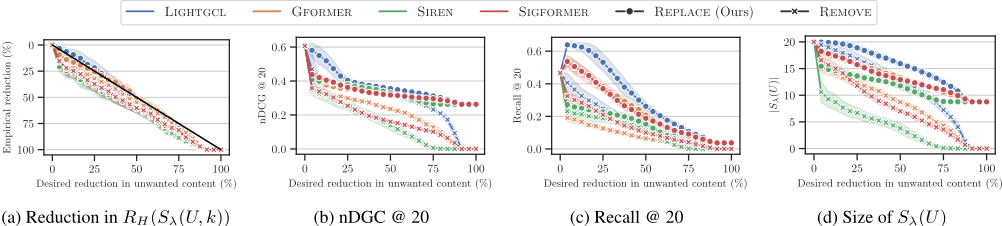
Dataset & Metrics. We use the KuaiRand dataset [Gao et al., 2022], which contains both positive and negative user feedback, along with information about interactions with previously seen videos. For our experiments, we focus on videos viewed at least twice by at least one user, resulting in a dataset that includes both repeated and single interactions. This leaves us with 5657 unique users, 117695 unique items, and more than 3 million interactions. Then, we partition the full interaction set into two datasets based on whether the interaction is repeated or not. We adopt a 10-core setting, randomly splitting the subset with only single interactions into training (70%), validation (15%), and test (15%) sets. The validation set also serves as a calibration set for determining the threshold λ as defined in Theorem 1. To ensure evaluation fidelity, we exclude all test set videos from the repeated interaction set. Thus, the repeated interaction set only considers videos previously seen by users - i.e., those appearing in either training or validation. We compare the effect of the risk control and various strategies on two widely used metrics: Recall@k and nDCG@k. In our experiments, we set k = 20 as is usually done in the literature [Chen et al., 2024]. We also measure the empirical risk, i.e., the fraction of unwanted content in the recommendations, as defined in Eq. (4).
Models. Similar to previous studies [Wang and Joachims, 2023], we evaluate the effectiveness of risk control using a two-stage recommender architecture. We consider two riskcontrol strategies: REMOVE (Algorithm 1 without line 3 and T (safe) = {}) and REPLACE (Algorithm 1). REMOVE is the classical risk-control strategy for recommender systems [Angelopoulos et al., 2023b]. For simplicity, under the REPLACE strategy, repeated items are not re-scored; instead, their original watch time is reused. We experiment with several stateof-the-art methods, including both sign-aware and unsigned graph-based models, depending on whether they incorporate negative user feedback (e.g., reported videos): LightGCL [Cai et al., 2023], GFormer [Li et al., 2023], SiReN [Seo et al., 2022], and SIGFormer [Chen et al., 2024]. For the re-ranking stage, we adopt a simple Neural Collaborative Filtering (NCF) model [He et al., 2017], as our focus is not on maximizing performance on the Kuaishou dataset, but rather on isolating the effects of risk control. Our full implementation is openly available 2 to support further research.
6 Results &Discussion
Fig. 1a shows how the level of harmfulness is tightly controlled across all strategies and ranking models. For any target reduction in unwanted content (α in Algorithm 1), the empirical reduction on the test set is equal to or better (i.e., all points lie on or below the diagonal) than the desired target, confirming that Algorithm 1 reliably enforces risk control. In general, the REMOVE strategy tends to exceed the target reduction, removing more items than strictly necessary. This proves that Algorithm 1 provides a provable link between user actions (e.g., flagging content) and the resulting changes in recommendations. Indeed, by specifying a desired reduction level, users can provably influence their experience with guarantees on the expected reduction in unwanted content. Figs. 1b and 1c show how risk control affects nDCG@20 and Recall@20. Removing items sharply degrades nDCG as the desired reduction level (α in Eq. (3)) increases, due to the shrinking pool of candidate items (Eq. (1)). In contrast, the REPLACE strategy retains a higher nDCG, though some degradation still occurs as previously seen items are reintroduced into the ranking. This performance drop is partly explained by our experimental setup: we do not rescore repeated items but instead reuse their original watch time, which may not reflect user interest upon second exposure. Recall decreases under both strategies, as removing or replacing items may discard potentially relevant, unseen content. Finally, Fig. 1d illustrates that, when full removal of unwanted content is required (α = 0), the sole option is to eliminate or replace all items in the recommendation set. Moreover, for the REPLACE strategy, we might recommend fewer than k items at test time, since we have finite replacement options.
Ultimately, our experimental results demonstrate that our framework can controllably reduce exposure to unwanted recommendations by providing a trade-off between the recommendation set size and utility. These findings point toward developing safer and user-centric recommender systems.
2 https://github.com/geektoni/mitigating-harm-recsys
Acknowledgments
The work of GDT, BL, and AP was partially supported by the following projects: Horizon Europe Programme, grants #101120237-ELIAS and #101120763-TANGO. Funded by the European Union. Views and opinions expressed are however those of the author(s) only and do not necessarily reflect those of the European Union or the European Health and Digital Executive Agency (HaDEA). Neither the European Union nor the granting authority can be held responsible for them.
@inproceedings{ijcai2026p923,
  title     = {You Don't Bring Me Flowers: Mitigating Unwanted Recommendations Through Conformal Risk Control (Extended Abstract)},
  author    = {De Toni, Giovanni and Purificato, Erasmo and Gómez, Emilia and Passerini, Andrea and Lepri, Bruno and Consonni, Cristian},
  booktitle = {Proceedings of the Thirty-Fifth International Joint Conference on
               Artificial Intelligence, {IJCAI-26}},
  publisher = {International Joint Conferences on Artificial Intelligence Organization},
  editor    = {Diego Calvanese},
  pages     = {8260--8265},
  year      = {2026},
  month     = {8},
  note      = {Sister Conferences Best Papers},
  doi       = {10.24963/ijcai.2026/923},
  url       = {https://doi.org/10.24963/ijcai.2026/923},
}
TY - CPAPER TI - You Don't Bring Me Flowers: Mitigating Unwanted Recommendations Through Conformal Risk Control (Extended Abstract) AU - De Toni, Giovanni AU - Purificato, Erasmo AU - Gómez, Emilia AU - Passerini, Andrea AU - Lepri, Bruno AU - Consonni, Cristian T2 - Proceedings of the Thirty-Fifth International Joint Conference on Artificial Intelligence, IJCAI-26 PB - International Joint Conferences on Artificial Intelligence Organization PY - 2026 SP - 8260 EP - 8265 DO - 10.24963/ijcai.2026/923 UR - https://doi.org/10.24963/ijcai.2026/923 ER -Copied
Machine-readable versions of this paper, for tools and AI agents:





