
QA-MoE: Quality-Aware and Stable Multimodal Mixture-of-Experts for Robust Clinical Prediction in Noisy and Missing-Modal Settings
Proceedings of the Thirty-Fifth International Joint Conference on Artificial Intelligence. AI and Health. Pages 6886-6894.
https://doi.org/10.24963/ijcai.2026/766
Keywords
- Multimodal data: Multimodal data
- Public health: Public health
- Medical diagnosis: Medical diagnosis
Abstract
Clinical prediction increasingly relies on multi-modal inputs, where reliability and efficiency are crucial for real-world deployment. However, mainstream fusion and MoE gating typically treat all available modalities as uniformly beneficial and allow noisy or weakly informative modalities to perturb routing, leading to instability, routing collapse, and miscalibrated confidence under missingness and shift. We propose QA-MoE, a Quality-Aware and stable multimodal Mixture-of-Experts that decouples reliability estimation from routing to enable robust, sparse, and interpretable fusion. QA-MoE adopts a modular architecture where each modality is initially encoded into a shared embedding space. To deal with structurally missing data, we employ a completion pathway that maintains a consistent interface. Unlike standard approaches, QA-MoE separates reliability estimation from the routing process. We propose an Evidential Quality Scorer to measure epistemic uncertainty, which then guides a Stability-Enhanced Subset Selector to filter out noisy modalities on the fly. Additionally, we include a Ternary Expert Aggregation mechanism acting as a specialized branch to stabilize predictions when data missingness is severe. Evaluations on clinical benchmarks (ADNI for Alzheimer’s staging and MIMIC-IV for Length-of-Stay) demonstrate that QA-MoE outperforms strong multimodal baselines, improving reliability while cutting down unnecessary computation. This indicates that QA-MoE offers a robust solution for multimodal decision support, especially in clinical settings prone to noise and missing data.
- [Abboud et al., 2024] Zeinab Abboud, Herve Lombaert, and Samuel Kadoury. Sparse bayesian networks: Efficient uncertainty quantification in medical image analysis. In International Conference on Medical Image Computing and Computer-Assisted Intervention, pages 675-684. Springer, 2024.
- [Chang et al., 2025] Jee Suk Chang, Hyunwook Kim, Eun Sil Baek, Jeong Eun Choi, Joon Seok Lim, Jin Sung Kim, and Sang Joon Shin. Continuous multimodal data supply chain and expandable clinical decision support for oncology. npj Digital Medicine, 8(1):128, 2025.
- [Chen et al., 2024] Mengyuan Chen, Junyu Gao, and Chang- sheng Xu. R-edl: Relaxing nonessential settings of eviden- tial deep learning. In International Conference on Learning Representations (ICLR), 2024.
- [Dai et al., 2024] Yusheng Dai, Hang Chen, Jun Du, Ruoyu Wang, Shihao Chen, Haotian Wang, and Chin-Hui Lee. A study of dropout-induced modality bias on robustness to missing video frames for audio-visual speech recognition. In Proceedings of the IEEE/CVF Conference on Computer Vision and Pattern Recognition, pages 27445-27455, 2024.
- [Dörrich et al., 2025] Marion Dörrich, Matthias Balk, Tatjana Heusinger, Sandra Beyer, Hamed Mirbagheri, David J Fis- cher, Hassan Kanso, Christian Matek, Arndt Hartmann, Heinrich Iro, et al. A multimodal dataset for precision on- cology in head and neck cancer. Nature Communications, 16(1):7163, 2025.
- [Fan et al., 2024] Lei Fan, Mingfu Liang, Yunxuan Li, Gang Hua, and Ying Wu. Evidential active recognition: Intel- ligent and prudent open-world embodied perception. In Proceedings of the IEEE/CVF Conference on Computer Vi- sion and Pattern Recognition (CVPR), pages 16351-16361, 2024.
- [Fedus et al., 2022] William Fedus, Barret Zoph, and Noam Shazeer. Switch transformers: Scaling to trillion parame- ter models with simple and efficient sparsity. Journal of Machine Learning Research, 2022.
- [Gao et al., 2024] Zixian Gao, Xun Jiang, Xing Xu, Fumin Shen, Yujie Li, and Heng Tao Shen. Embracing unimodal aleatoric uncertainty for robust multimodal fusion. In Pro- ceedings of the IEEE/CVF Conference on Computer Vi- sion and Pattern Recognition (CVPR), pages 26876-26885, 2024.
- [Gliozzo et al., 2025] Jessica Gliozzo, Mauricio A Soto Gomez, Arturo Bonometti, Alex Patak, Elena Casiraghi, and Giorgio Valentini. miss-snf: a multimodal patient similarity network integration approach to han- dle completely missing data sources. Bioinformatics, 41(4):btaf150, 2025.
- [Golovanevsky et al., 2022] Michal Golovanevsky, Carsten Eickhoff, and Ritambhara Singh. Multimodal attention- based deep learning for alzheimer's disease diagnosis. Journal of the American Medical Informatics Association, 29(12):2014-2022, 2022.
- [Han et al., 2024] Xing Han, Huy Nguyen, Carl Harris, Nhat Ho, and Suchi Saria. Fusemoe: Mixture-of-experts trans- formers for fleximodal fusion. Advances in Neural Infor- mation Processing Systems, 37:67850-67900, 2024.
- [Hao et al., 2025] Yan Hao, Chao Cheng, Juanjuan Li, Hong- wen Li, Xingsi Di, Xiaoxia Zeng, Shoumei Jin, Xiaodong Han, Chongsong Liu, Qianqian Wang, et al. Multimodal in- tegration in health care: Development with applications in disease management. Journal of medical Internet research, 27:e76557, 2025.
- [Jaegle et al., 2021] Andrew Jaegle, Sebastian Borgeaud, Jean-Baptiste Alayrac, Carl Doersch, Catalin Ionescu, David Ding, Skanda Koppula, Daniel Zoran, Andrew Brock, Evan Shelhamer, et al. Perceiver io: A general architecture for structured inputs & outputs. arXiv preprint arXiv:2107.14795, 2021.
- [Johnson et al., 2023] Alistair E. W. Johnson, Tom J. Pollard, Roger G. Mark, et al. Mimic-iv, a freely accessible elec- tronic health record dataset. Scientific Data, 2023.
- [Kim and Kim, 2024] Donggeun Kim and Taesup Kim. Miss- ing modality prediction for unpaired multimodal learning via joint embedding of unimodal models. In European Conference on Computer Vision, pages 171-187. Springer, 2024.
- [Le et al., 2025] Lien P Le, Thu Nguyen, Michael A Riegler, Pål Halvorsen, and Binh T Nguyen. Multimodal missing data in healthcare: A comprehensive review and future directions. Computer Science Review, 56:100720, 2025.
- [Li et al., 2025] Tianyu Li, Yan Xin, et al. Moe-ce: Enhanc- ing generalization for deep learning based channel estima- tion via a mixture-of-experts framework. arXiv preprint arXiv:2509.15964, 2025.
- [Liu et al., 2025] Yuanye Liu, Zheyao Gao, Nannan Shi, Fup- ing Wu, Yuxin Shi, Qingchao Chen, and Xiahai Zhuang. Merit: Multi-view evidential learning for reliable and in- terpretable liver fibrosis staging. Medical Image Analysis, 102:103507, 2025.
- [Sensoy et al., 2018] Murat Sensoy, Lance Kaplan, and Mehmet Kandemir. Evidential deep learning to quantify classification uncertainty. In Advances in Neural Informa- tion Processing Systems (NeurIPS), 2018.
- [Sidheekh et al., 2024] Sahil Sidheekh, Pranuthi Tenali, Saurabh Mathur, Erik Blasch, and Sriraam Natarajan. On the robustness and reliability of late multi-modal fusion using probabilistic circuits. In 2024 27th International Conference on Information Fusion (FUSION), pages 1-8. IEEE, 2024.
- [Tocchetti and Mancini, 2024] Tommaso T Tocchetti and Massimiliano Mancini. Credal deep ensembles for un- certainty quantification. In Advances in Neural Information Processing Systems (NeurIPS), volume 37, 2024.
- [Wang and Yang, 2025] Xiaoyang Wang and Christopher Yang. Moe-health: A mixture of experts framework for robust multimodal healthcare prediction. In Proceedings of the 16th ACM International Conference on Bioinformatics, Computational Biology, and Health Informatics, pages 1-9, 2025.
- [Wang et al., 2025a] Hongyu Wang, Jiayu Xu, Ruiping Wang, Yan Feng, Yitao Zhai, Peng Pei, Xunliang Cai, and Xilin Chen. Mote: Mixture of ternary experts for memory-efficient large multimodal models. arXiv preprint arXiv:2506.14435, 2025.
- [Wang et al., 2025b] Muyu Wang, Shiyu Fan, Yichen Li, Zhongrang Xie, and Hui Chen. Missing-modality enabled multi-modal fusion architecture for medical data. Journal of Biomedical Informatics, 164:104796, 2025.
- [Wang et al., 2025c] Ziteng Wang, Jun Zhu, and Jianfei Chen. Remoe: Fully differentiable mixture-of-experts with relu routing. 2025.
- [Weiner et al., 2010] Michael W. Weiner, Danielle P. Veitch, Paul S. Aisen, et al. The Alzheimer's disease neuroimaging initiative: A review of papers published since its inception. Alzheimer's & Dementia, 2010.
- [Xu et al., 2023] Peng Xu, Xiatian Zhu, and David A Clifton. Multimodal learning with transformers: A survey. IEEE Transactions on Pattern Analysis and Machine Intelligence, 45(10):12113-12132, 2023.
- [Yan et al., 2025] Shen Yan, Xingyan Bin, Sijun Zhang, Yisen Wang, and Zhouchen Lin. Tc-moe: Augmenting mixture of experts with ternary expert choice. In The Thir- teenth International Conference on Learning Representa- tions, 2025.
- [Yao et al., 2024] Wenfang Yao, Kejing Yin, William K Che- ung, Jia Liu, and Jing Qin. Drfuse: Learning disentangled representation for clinical multi-modal fusion with miss- ing modality and modal inconsistency. In Proceedings of the AAAI conference on artificial intelligence, volume 38, pages 16416-16424, 2024.
- [Yun et al., 2024] Sukwon Yun, Inyoung Choi, Jie Peng, Yangfan Wu, Jingxuan Bao, Qiyiwen Zhang, Jiayi Xin, Qi Long, and Tianlong Chen. Flex-moe: Modeling ar- bitrary modality combination via the flexible mixture-of- experts. Advances in Neural Information Processing Sys- tems, 37:98782-98805, 2024.
- [Zhang et al., 2025] Baoyi Zhang, Zhuoya Wan, Yige Luo, Xi Zhao, Josue Samayoa, Weilong Zhao, and Si Wu. Mul- timodal integration strategies for clinical application in oncology. Frontiers in Pharmacology, 16:1609079, 2025.
References were extracted automatically from the PDF and may contain errors.
Full text extracted automatically from the PDF; figures, tables and equations may differ. The PDF is the version of record.
1 Introduction
Multimodal perception and reasoning is a key bottleneck on the path toward reliable, deployable AI systems, and the challenge is particularly acute in healthcare [Le et al., 2025; Zhang et al., 2025]. Modern clinical decision support must integrate diverse signals. These inputs range from structured EHR (Electronic Health Record) variables to free-text reports. Imaging and lab measurements are also essential [Chang et al., 2025]. However, these data types differ drastically. They vary significantly in availability. Their resolution and reliability also differ [Hao et al., 2025]. Critically, real-world patients rarely present with "complete" multimodal evidence: some modalities are missing by design due to cost, workflow, and contraindications, while others are present but noisy or weakly informative [D¨orrich et al., 2025; Wang et al., 2025b]. There is a pressing need for multimodal models that can reason about which modalities are actually useful for a given patient, rather than assuming that using more data is always better.
Recent work advanced multimodal clinical modeling and scalable MoE routing [Yun et al., 2024; Fedus et al., 2022], but two limitations remain: (i) most fusion pipelines treat all available modalities as uniformly helpful [Yao et al., 2024], and (ii) missing-modality completion does not guarantee taskrelevant information [Kim and Kim, 2024]. Consequently, robust trade-offs between performance and reliability under heterogeneous quality are still challenging.
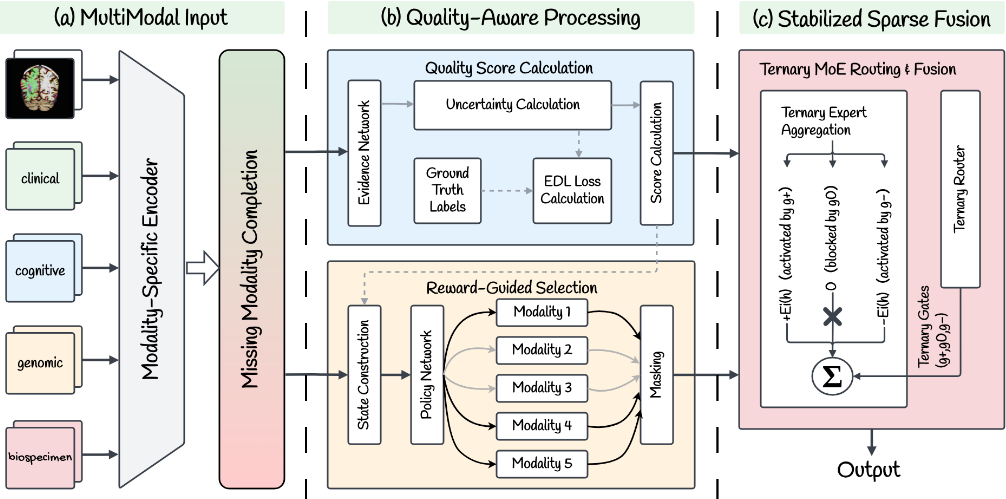
To address these limitations, we propose a quality-aware and stable multimodal MoE framework (QA-MoE) that explicitly learns modality-subset selection: for each patient, the model predicts a task-adaptive combination of modalities, instead of always using all available modalities of inputs. The core idea is to decouple reliability estimation from routing. Concretely, QA-MoE (i) assigns each modality a calibrated reliability score via evidential modeling [Sensoy et al., 2018], (ii) performs stability-enhanced gating to select an informative subset of modalities under noise and missingness, and (iii) routes the selected representation through a ternary MoE router that supports positive, zero, and negative expert contributions to mitigate interference.
Our main contributions are three-fold:
- We introduce a quality-aware multimodal MoE that learns instance-wise modality-subset selection for clinical prediction, reflecting the practical observation that strong performance can often be achieved with only a small, high-signal subset of modalities.
- We propose a stable selection-and-routing pipeline that couples evidential reliability estimation with bootstrapconsensus gating and ternary expert fusion, improving robustness to heterogeneous modality quality.
- We demonstrate consistent gains on two clinical benchmarks,
ADNI for Alzheimer's staging [Weiner et al., 2010] and MIMIC-IV for LOS prediction [Johnson et al., 2023], while achieving favorable calibration and lower computational cost. Notably, while validated here on clinical tasks, our framework is model-agnostic and readily adaptable to other safety-critical scenarios requiring high reliability.
The rest of this paper is organized as follows. Section 2 reviews related work. Section 3 introduces QA-MoE and its components. Section 4 presents experiments and analyses on ADNI and MIMIC-IV. Section 5 concludes with limitations and future directions. Our code is publicly available at https: //github.com/Illidon/QA-MoE.
2 RelatedWork
Multimodal Mixture-of-Experts MoE-based multimodal architectures have gained attention due to their ability to activate modality-specific pathways. FuseMoE [Han et al., 2024] introduces flexible routing for missing modalities, and FlexMoE [Yun et al., 2024] further extends this idea by offering expert libraries specialized for observed subsets, enabling partial-modality composition in heterogeneous clinical inputs. MoE-Health [Wang and Yang, 2025] explores EHR-image fusion using sparse expert activation for clinical classification. Although these systems improve flexibility, routing still relies on softmax-based gating, which is highly sensitive to inter-modal noise and lacks explicit reliability modeling. Recent vision-language MoEs reinforce similar observations:
dynamic gating is fragile to modality imbalance and quality heterogeneity.
Quality Estimation andMultimodal Uncertainty Reliable uncertainty estimation is critical in clinical settings. Classical approaches including Monte Carlo dropout, deep ensembles, and approximate variational inference are computationally expensive or unstable under sparse activation [Abboud et al., 2024; Tocchetti and Mancini, 2024]. Evidential Deep Learning provides a deterministic alternative by predicting Dirichlet evidence that encodes both class probabilities and epistemic uncertainty [Chen et al., 2024]. Although EDL has been applied in perception and medical diagnosis [Fan et al., 2024; Liu et al., 2025], its integration into multimodal MoE routing has not been explored. Existing multimodal uncertainty techniques often rely on heuristic confidence measures that are not calibrated under distribution shift.
Positioning w.r.t. confidence-weighted fusion and MoE gating. A key source of conceptual overlap in this space is where uncertainty is injected. Confidence-weighted fusion methods typically inject reliability after modality encoding, by weighting modality embeddings or logits during fusion [Gao et al., 2024; Sidheekh et al., 2024], which improves robustness but does not necessarily prevent unreliable modalities from perturbing the routing signal. In contrast, missing-modality completion methods focus on recovering representations when modalities are absent, but do not explicitly decide whether a recovered modality is useful for the downstream task. TC-MoE-style [Yan et al., 2025; Wang et al., 2025a] routers improve expert stability through ternary activation, yet do not model modality reliability. QAMoE is distinguished by injecting quality before subset selection and routing: reliability scores guide a stable instance-wise modality subset, and the selected representation is then routed through a ternary MoE. This separation clarifies that our gains arise from the interaction between calibrated quality estimation, sparsity-inducing subset selection, and stable ternary routing, rather than any single component alone. Unlike prior works that address modality missingness or expert routing in isolation, QA-MoE contributes a tightly coupled pipeline where evidential uncertainty directly stabilizes the selection and gating mechanisms under severe structural missingness.
Stabilizing MoE Routing MoE routers suffer from load imbalance, expert collapse, and high-variance gradient flows. MoE-CE [Li et al., 2025] introduces auxiliary-free load balancing via dynamic bias shifts, SAFEx mitigates gating variance through bootstrap masking, and TC-MoE proposes ternary expert activation to reduce negative interference. Concurrent work in large-scale sparse models emphasizes the importance of expert frequency regularization and router debiasing for stable training [Wang et al., 2025c]. While these methods improve routing behavior, they do not incorporate modality quality awareness and therefore remain vulnerable to heterogeneous or incomplete multimodal inputs. QA-MoE unifies uncertainty estimation and routing stabilization within a multimodal framework.
Missing-Modality and Noisy-Modality Fusion In medical applications, missingness is structural and cannot be treated as random dropout. Methods such as Modality Dropout, confidence-aware gating, or imputation-based fusion address missing or corrupted signals, but do not scale well to high-dimensional clinical modalities [Dai et al., 2024; Gliozzo et al., 2025]. Recent work in RAG (RetrievalAugmented Generation) proposes a principled approach for missing-modality completion by selecting appropriate partialmodality experts. We extend this mechanism by employing a flexible completion strategy as a fallback pathway: when a modality is structurally missing, QA-MoE selects a partialmodality embedding template before scoring and routing, ensuring consistency in the downstream MoE pipeline.
3 Method
QA-MoE comprises four components: (i) modality encoders that generate continuous embeddings from heterogeneous clinical data; (ii) an Evidential Quality Scorer that computes calibrated reliability scores; (iii) a Stability-Enhanced Subset Selector that determines which modalities to retain; and (iv) a ternary MoE router with adaptive load balancing and expert fusion. The design is fully modular, enabling each component to operate independently or to be ablated individually.
3.1 Modality Encoders
Each modality xm is processed through a modality-specific encoder to produce an embedding em ∈ RD . For images, lightweight convolutional encoders are used; for clinical and genomic features, multilayer perceptrons map structured data to the shared embedding space; for text or free-text clinical narratives, a projection layer maps high-dimensional contextual embeddings to D. Each encoder includes a learned noise parameter that models intrinsic signal variability in medical measurements. When a modality is structurally missing, a partial-modality embedding template is substituted in place of the missing encoder output, ensuring consistent downstream quality scoring and routing.
3.2 Evidential Quality Scoring
The Evidential Quality Scorer provides calibrated reliability estimates for each modality by leveraging evidential deep learning principles. For each modality embedding em ∈ RD , a lightweight MLP ϕevid maps em to evidence parameters fm ∈ RK , where K denotes the number of classes:
where the evidence parameters are clamped to prevent numerical instability. These parameters are then transformed into Dirichlet concentration parameters αm ∈ RK :
The Dirichlet distribution Dir(αm) models the epistemic uncertainty over class predictions. The total evidence strength is quantified as Sm = ∑Kk=1 αm,k, and the epistemic uncertainty is defined as:
The reliability score qm ∈ [0, 1] is then computed as:
This formulation ensures that modalities with high evidence (large Sm) receive high reliability scores, while noisy or uncertain modalities yield low scores. The uncertainty regularizer Luncert encourages calibration by penalizing overconfident predictions with low evidence:
where ˆ pm,k = αm,k/Sm is the predicted class probability and y is the one-hot encoded ground truth. The first term encourages accurate predictions, while the second term regularizes uncertainty estimates to prevent overconfidence. This scoring mechanism is fully differentiable and provides explicit quality estimates that directly inform the subset selection process.
Remark on the evidential regularizer Our uncertainty penalty is a lightweight surrogate designed for stability in a sparse, multi-component optimization setting. It deviates from standard EDL objectives. In this submission, we utilize it as a practical calibration-oriented regularizer, leaving more rigorous theoretical justifications and alternative evidential formulations to future work. Although this heuristic trades strict theoretical guarantees for empirical stability in sparse routing, our ablations confirm its practical necessity.
Usefulness vs. confidence We emphasize that qm measures predictive confidence under the learned representation, which is not identical to task usefulness: a modality can be confident but irrelevant or spurious for the target. QA-MoE mitigates this gap by coupling quality scoring with task-driven selection: encoders and the evidential scorer are trained jointly with the supervised objective, and the subset selector is optimized to maximize downstream performance under a sparsity budget. Nevertheless, confident-but-misleading modalities remain a possible failure mode; we discuss this limitation and suggested diagnostics in Section 5.
3.3 Stability-Enhanced Subset Selection
The subset selector produces an instance-wise modality mask from quality scores and embeddings. Given {qm}Mm=1 and {em}Mm=1 , we form a state vector
A lightweight actor πθ outputs continuous selection probabilities:
which are used as soft masks in training; at inference we threshold at τ = 0.5:
The filtered embeddings are then computed as ˜ em = mm · em. To stabilize selection against noise, we adopt a SAFExinspired bootstrap consensus and quality gate. We treat this mechanism as a non-differentiable regularizer. Consequently, gradients flow primarily through the continuous-mask path.
The selector is trained using a reward signal that balances task accuracy and modality sparsity:
where η = 0.2 encourages selecting fewer modalities, and λreg penalizes high variance in selection patterns.
Selector objective. We use a differentiable reward-weighted term (no environment interaction loop):
where ¯R is a batch baseline and ϵ is a small constant.
3.4 TernaryMoE Routing and Fusion
The Ternary MoE Router extends standard MoE gating to enable experts to contribute positively, abstain, or provide negative contributions. Filtered embeddings {˜ em}Mm=1 are first aggregated into a routing token:
A linear gate Wg ∈ RD×N produces base logits for N experts:
For each expert i, QA-MoE generates three logits corresponding to positive (+1), zero (0), and negative (-1) contributions:
where {b+i , b0i , b-i } are learnable per-expert biases. The large negative offset (-10) in ℓ0i initially biases experts toward abstention. A per-expert softmax is applied to obtain ternary gate values:
ensuring g+ i +g0 i +gi = 1 for each expert. This ternary formulation prevents global competition between experts and allows experts to abstain when input signals are unreliable, reducing interference from noisy modalities. An explicit g0 i provides a learned abstention option (instead of manual thresholds).
We apply ALFLB (Auxiliary-Loss-Free Load Balancing) [Fedus et al., 2022] bias updates to reduce persistent expert imbalance (hyperparameters in Section 3.5).
Fusion is performed by combining expert outputs according to their ternary gate values. Each expert Ei computes a base output Ei(h) ∈ RD . The final fused representation is:
This formulation enables experts to: (i) amplify their responses when g+ i is high, (ii) abstain when g0 i dominates, and (iii) invert their contributions when gi is high, modeling antagonistic modality interactions. The final prediction is obtained via a linear classifier:
where Wout ∈ RK×D and bout ∈ RK are learnable parameters. This ternary fusion mechanism enhances robustness when clinical modalities disagree, as experts can explicitly model conflicting signals through negative contributions.
3.5 Training Objective
All components are optimized end-to-end with a joint objective that combines task supervision, quality calibration, selection regularization, and MoE balancing:
where Ltask is the cross-entropy loss, Luncert is the evidential uncertainty regularizer (Eq. (9)), Lbal encourages balanced expert utilization, and Lsel is a reward-guided differentiable term that biases the selector toward subsets that improve downstream accuracy while reducing average subset size (as in Eq. (18)). This formulation clarifies that improvements are not attributed to a single mechanism: calibration shapes qm, selection turns qm into patient-specific sparsity, and ternary routing stabilizes expert fusion under disagreement. Beyond simply reducing noise, this adaptive sparsity lowers the computational burden at inference time. Since it skips uninformative branches, QA-MoE represents an efficient solution for clinical environments that lack high-end hardware but require rapid triage.
| Dataset | Modality | AvailableMissingMissing Rate | ||
|---|---|---|---|---|
| ADNI | Clinical | 3,746 | 1,119 | 23.0% |
| Genomic | 757 | 4,108 | 84.4% | |
| Image | 3,231 | 1,634 | 33.6% | |
| Biospecimen | 2,639 | 2,226 | 45.8% | |
| Cognitive | 4,861 | 4 | 0.1% | |
| MIMIC-IV | Lab | 447,690 | 98,082 | 18.0% |
| Diagnosis | 545,497 | 275 | 0.1% | |
| Demographic | 218,171 | 327,725 | 60.0% | |
4 Experiments
We evaluate QA-MoE on two complementary medical benchmarks: (i) ADNI for neurodegenerative disease staging, and (ii) MIMIC-IV for hospital Length-of-Stay (LOS) prediction. These datasets represent two distinct challenges. The first is heterogeneous multimodal quality in neuroimaging, while the second is missing or noisy clinical variables in EHR data.
4.1 ADNI: Alzheimer's Disease Progression (3-way Classification)
Task Setup We construct a uniquely comprehensive ADNI benchmark spanning five distinct modalities: MRI scans, cognitive assessments, clinical features, and biospecimen biomarkers. This multi-view selection captures a holistic profile of disease progression. We formulate a three-class classification task over CN (Cognitively Normal), MCI (Mild Cognitive Impairment), and AD (Alzheimer's disease).
Modalities We use the following pre-processing pipeline to encode each modality in the ADNI dataset:
- Structural MRI: 3D volume, encoded via 3D-ResNet18 → GAP
- Clinical scores: 50-d, encoded via MLP
- Genomic SNPs: 1000-d, encoded via MLP
- Cognitive tests: 30-d, encoded via MLP
- CSF biomarkers: 100-d, encoded via MLP
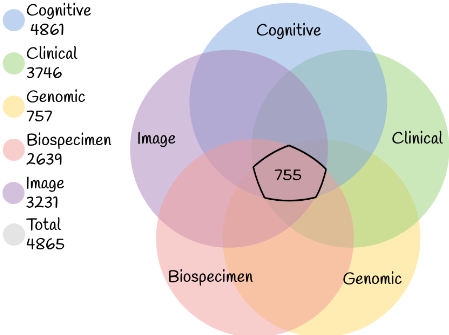
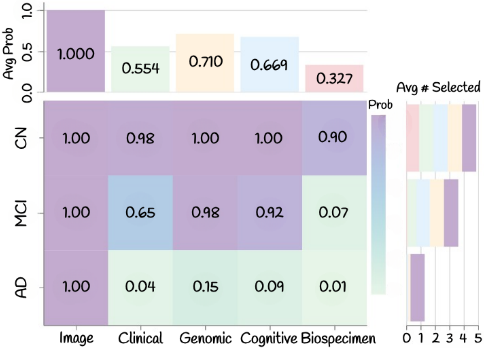
Dataset Statistics Our curated subset addresses the limitations of prior works by significantly expanding both modality coverage and patient count. Figure 2 and Table 1 summarize the data availability. Unlike standard subsets used in previous MoE studies, our pipeline successfully integrates nearly 80% more patients, providing a significantly more rigorous testbed for multimodal reliability. Figure 3 visualizes the learned class-dependent selection patterns.
4.2 MIMIC-IV: LOS Prediction (6-class)
Task Setup Unlike prior benchmarks that focus on binary mortality prediction within 24 hours of admission which often lacking practical utility for long-term resource planning, we address the more challenging and granular task of LOS prediction. We retain only the final admission per patient, excluding deceased and invalid entries. The continuous stay duration is discretised into six clinically relevant categories: <1 day (Class 0), 1-3 days (Class 1), 3-7 days (Class 2), 7-14 days
(Class 3), 14-30 days (Class 4), and >30 days (Class 5). This formulation requires the model to distinguish between complex LOS ranges with varying class distributions, providing a rigorous test for multimodal reasoning.
Modalities
- Lab tests: 100-d, mean-aggregated 100 frequent tests
- Diagnosis codes (ICD): 200-d, multi-hot of top 200 ICD codes
- Demographics: 10-d, expanded age + gender
Modalities are highly incomplete: lab panels are frequently missing (≈ 30%), and ICD codes vary widely by case. While demographics exist at the patient level, our LOS setup operates at the admission level and requires joining multiple tables; consequently, demographic features are not available for all admissions after preprocessing (Table 1), and missing demographics are represented by a zero vector.
4.3 Baselines
We compare QA-MoE with a compact yet representative set of state-of-the-art multimodal baselines to evaluate the necessity of quality-aware expert routing under noisy and missingmodality conditions. We include dense multimodal Transformers, MMT [Xu et al., 2023] (Multimodal Transformer) and Perceiver-IO [Jaegle et al., 2021], as strong non-sparse baselines that rely on attention-based fusion and serve to assess whether MoE-style sparsity provides additional benefits. To directly compare against existing multimodal MoE designs, we evaluate FuseMoE [Han et al., 2024], which performs modality-aware routing under missing inputs, FlexMoE [Yun et al., 2024], which extends MoE routing with partial-modality expert libraries and is particularly relevant for missing-modality completion, and TC-MoE [Yan et al., 2025], which introduces ternary expert activation to stabilize MoE training. Finally, we consider robustness-oriented and uncertainty-oriented fusion methods that do not employ expert routing, including MADDi [Golovanevsky et al., 2022] for noise- and missingness-robust multimodal learning, EDLbased fusion [Sensoy et al., 2018] for uncertainty-weighted integration, and Modality Dropout as a strong and widely adopted robustness baseline. Together, these baselines cover dense fusion, sparse MoE routing, and uncertainty-aware integration.
| Category | Model | ACC↑ | F1↑ | AUC↑ | ECE↓ | FLOPs↓ |
|---|---|---|---|---|---|---|
| MoE Routing | TC-MoE | 0.6969 ±0.0081 | 0.6990 ±0.0068 | 0.8160 ±0.0050 | 0.1620 ±0.0036 | 0.3507G |
| Multimodal MoE | FuseMoE FlexMoE | 0.6696 ±0.0269 0.6903 ±0.0269 | 0.6721 ±0.0254 0.6929 ±0.0254 | 0.7932 ±0.0216 0.8177 ±0.0216 | 0.1358 ±0.06025 0.1288 ±0.0593 | 0.3523G 0.3518G |
| Non-MoE | MMT | 0.6947 ±0.0095 0.7040 ±0.0038 | 0.6892 ±0.0025 0.7020 ±0.0060 | 0.8337 ±0.0066 0.8390 ±0.0010 | 0.1045 ±0.0070 | 0.4172G |
| MADDi Perceiver-IO | 0.6321 ±0.1220 | 0.7032 ±0.0063 | 0.8403 ±0.0008 | 0.0600 ±0.0115 | 0.0207G | |
| 0.7051 ±0.0036 | 0.5680 | 0.0592 ±0.0123 | 0.9508G | |||
| Quality | EDL | ±0.1970 | 0.7195 ±0.1559 | 0.0760 ±0.0221 | 0.3431G | |
| QA-MoE | 0.8912±0.0140 | 0.8914±0.0139 | 0.9555±0.0088 | 0.0224±0.0055 | 0.1742G |
| Category | Model | ACC↑ | Weighted-F1↑ | AUC↑ | ECE↓ | FLOPs↓ |
|---|---|---|---|---|---|---|
| MoE Routing | TC-MoE | 0.4420 ±0.0052 | 0.3920 ±0.0205 | 0.8140 ±0.0026 | 0.0600 ±0.0088 | 0.0099G |
| Multimodal MoE | FuseMoE FlexMoE | 0.3133 ±0.0001 0.4380 ±0.0050 | 0.0795 ±0.0001 0.3880 ±0.0190 | 0.5000 ±0.0001 0.8120 ±0.0028 | 0.0981 ±0.0006 0.0640 ±0.0085 | 0.0100G 0.0099G |
| Non-MoE | MMT MADDi Perceiver-IO | 0.4850 ±0.0058 0.4744 ±0.0017 0.4780 ±0.0042 | 0.4020 ±0.0264 0.3873 ±0.0052 0.3980 ±0.0220 | 0.8180 ±0.0019 0.8182 ±0.0011 0.8150 ±0.0020 | 0.0477±0.0121 0.0574 ±0.0075 0.0520 ±0.0100 | 0.0111G 0.0003G 0.0253G |
| 0.4400 ±0.0055 | 0.3900 ±0.0200 | 0.8150 ±0.0025 | 0.0620 ±0.0090 | 0.0019G | ||
| Quality | EDL | |||||
| QA-MoE | 0.5210±0.0139 | 0.4550±0.0123 | 0.8350±0.0048 | 0.0505 ±0.0059 | 0.0034G |
4.4 Implementation Details
Experiments were performed on an NVIDIA RTX 3090 GPU with a data split of 70% training, 15% validation, and 15% testing. We report the average results over three runs with different random seeds. Baselines are trained using the official settings from their respective papers to ensure fair comparison. regarding our proposed method, for ALFLB we use τover=2.0, τunder=0.8, and step size γbias (ADNI: 0.02; MIMIC-IV LOS: 0.003) with tanh bias clipping. For the selector/SES, we set bootstrap samples B (ADNI: 100; MIMIC-IV LOS: 50), SES trigger probability (ADNI: 0.3; MIMIC-IV LOS: 0.1), Gaussian perturbation scale σnoise=0.05, consensus threshold 80%, and inference threshold τ=0.5. Full parameter settings are available in the Supplementary Material.
4.5 Main Results
Performance on ADNI. As shown in Table 2, QA-MoE establishes a new state-of-the-art on the ADNI benchmark, achieving an accuracy of 89.12% and an AUROC of 95.55%. This represents a substantial margin over existing methods, outperforming the strongest MoE baseline (TC-MoE) by +19.4% in accuracy and the best non-MoE baseline (Perceiver-IO)
by +18.6%. Notably, QA-MoE achieves this superior performance with remarkable efficiency: its computational cost is approximately half that of TC-MoE and less than one-fifth of Perceiver-IO. Furthermore, our method demonstrates exceptional reliability, achieving the lowest ECE, indicating that its confidence estimates are highly aligned with true probabilities. The pronounced margin on ADNI occurs because extreme structural missingness degrades standard baselines, whereas QA-MoE explicitly prunes noisy paths.
The dramatic performance leap on ADNI highlights the efficacy of our quality-aware routing in high-dimensional, heterogeneous feature spaces. Unlike standard MoE approaches which treat all modalities as potentially useful, QA-MoE effectively filters out noise through its quality scoring mechanism. The learned subsets allow the model to focus computational resources on the most diagnostic signals while suppressing less informative or noisy modalities. This selective activation not only boosts predictive accuracy but also significantly reduces floating-point operations by bypassing irrelevant expert pathways.
Performance onMIMIC-IV. On the MIMIC-IV LOS prediction task (Table 3), QA-MoE consistently outperforms all baselines, achieving the highest accuracy, weighted-F1, and AUROC. Compared to the competitive MMT baseline, QAMoE yields a solid improvement of +3.6% in accuracy and +5.3% in weighted-F1. In terms of efficiency, QA-MoE remains extremely lightweight, surpassing the efficiency of both Perceiver-IO and TC-MoE while maintaining superior predictive capability.
The MIMIC-IV results underscore the robustness of QA- MoE in scenarios characterized by severe missingness and class imbalance. By explicitly modeling the quality of available modalities, QA-MoE stabilizes the routing process, ensuring that decision-making is driven by the most reliable clinical indicators. Notably, regarding calibration, while MMT achieves a marginally lower mean ECE, QA-MoE exhibits significantly superior stability, with a standard deviation less than half that of MMT. This indicates that our quality-driven approach prevents the large fluctuations in reliability estimates often observed in baselines, offering a more consistent and reproducible solution for clinical deployment.
4.6 Ablation Studies
Impact of Key Components. To systematically verify the contribution of each design module, we conduct an ablation study on the ADNI dataset, as summarized in Table 4. We sequentially remove the Subset Selection mechanism, the Quality Scorer, the Ternary Routing extension, and the auxiliary training objectives (ALFLB and Stability Masking).
The results clearly indicate that Subset Selection is the most critical component, with its removal leading to the largest performance drop. This validates our core hypothesis: in highdimensional clinical spaces, strictly limiting the input scope to a coherent subset of modalities is more effective than soft weighting. The Quality Scorer is the second most influential factor, confirming that dynamically estimating modality reliability is essential for robust expert routing. Furthermore, removing the ALFLB regularization and Ternary Extension results in notable degradation, demonstrating that stable, mathematically grounded routing objectives are necessary to prevent the collapse often seen in sparse MoE training. Collectively, these ablations show that QA-MoE's performance is not driven by a single trick, but by the synergistic interaction between quality estimation and discrete, reliable expert selection.
| Method | ACC↑ | ∆ACC |
|---|---|---|
| QA-MoE (full) | 0.8912±0.0140 | - |
| - EDL Quality Scorer | 0.8475 ±0.018 | ↓4.9 |
| - Subset Selection | 0.8279 ±0.019 | ↓7.1 |
| - Ternary Extension | 0.8582 ±0.017 | ↓3.7 |
| - ALFLB + Reward Loss | 0.8519 ±0.018 | ↓4.4 |
| - SES Stability Masking | 0.8733 ±0.016 | ↓2.0 |
4.7 Modality Selection Analysis
Figure 3 visualizes the learned class-dependent selection policies. We observe a striking inverse correlation between disease severity and modality usage. For CN subjects, the model adopts a "holistic validation" strategy, activating nearly all available modalities to rigorously rule out pathology. In contrast, for AD, the router converges to a highly sparse, MRIdominant regime. This suggests the model has learned that structural atrophy visible in MRI is sufficiently diagnostic for advanced disease, rendering noisy auxiliary signals redundant. Notably, MRI acts as a universal anchor, while weaker modalities are selectively pruned to maximize the signal-to-noise ratio.
5 Discussion
QA-MoE improves accuracy and calibration on ADNI and MIMIC-IV by better stabilizing multimodal fusion. Instead of relying on standard methods, we combine quality-aware scoring with ternary routing to separate useful diagnostic signals from noisy inputs. This leads to direct efficiency gains: because the model dynamically skips non-informative experts, QA-MoE beats state-of-the-art dense architectures with much fewer FLOPs. This suggests our approach is valid for resourceconstrained clinical settings.
Despite these results, limitations remain. Although we achieved a theoretical reduction in FLOPs, we still need to measure end-to-end latency to understand the real-world hardware overhead of dynamic routing. Also, we only tested reliability on in-distribution data; future work needs to verify performance under out-of-distribution (OoD) shifts. Finally, distinguishing between a modality's reliability and its semantic usefulness is a complex problem that requires better interpretability tools.
6 Conclusion
In this work, we propose QA-MoE, a multimodal Mixture-ofExperts framework built to tackle reliability and scalability issues in medical data. Instead of standard fusion methods, we combine evidential quality scoring with a stability-enhanced routing mechanism. This creates a model that is both interpretable and robust, even when data is severely missing. Our evaluation on ADNI and MIMIC-IV shows that QA-MoE outperforms dense Transformers and uncertainty-based baselines in accuracy, while significantly cutting down computational costs. Given this balance of efficiency and performance, we believe QA-MoE is a viable option for deployment in clinical decision support systems.
@inproceedings{ijcai2026p766,
  title     = {QA-MoE: Quality-Aware and Stable Multimodal Mixture-of-Experts for Robust Clinical Prediction in Noisy and Missing-Modal Settings},
  author    = {Sun, Linpeng and Sheng, Victor S.},
  booktitle = {Proceedings of the Thirty-Fifth International Joint Conference on
               Artificial Intelligence, {IJCAI-26}},
  publisher = {International Joint Conferences on Artificial Intelligence Organization},
  editor    = {Diego Calvanese},
  pages     = {6886--6894},
  year      = {2026},
  month     = {8},
  note      = {AI and Health},
  doi       = {10.24963/ijcai.2026/766},
  url       = {https://doi.org/10.24963/ijcai.2026/766},
}
TY - CPAPER TI - QA-MoE: Quality-Aware and Stable Multimodal Mixture-of-Experts for Robust Clinical Prediction in Noisy and Missing-Modal Settings AU - Sun, Linpeng AU - Sheng, Victor S. T2 - Proceedings of the Thirty-Fifth International Joint Conference on Artificial Intelligence, IJCAI-26 PB - International Joint Conferences on Artificial Intelligence Organization PY - 2026 SP - 6886 EP - 6894 DO - 10.24963/ijcai.2026/766 UR - https://doi.org/10.24963/ijcai.2026/766 ER -Copied
Machine-readable versions of this paper, for tools and AI agents:





