
Amortized Multi-Objective Optimization Across Tasks with Generative Solution Modeling
Proceedings of the Thirty-Fifth International Joint Conference on Artificial Intelligence. Main Track. Pages 6361-6369.
https://doi.org/10.24963/ijcai.2026/708
© 2026 International Joint Conferences on Artificial Intelligence
Keywords
- Search: Evolutionary computation
- Uncertainty in AI: Sequential decision making
- Search: Search and machine learning
Abstract
Many real-world applications require solving families of expensive multi-objective optimization problems~(EMOPs) under varying operational conditions. This can be formulated as parametric expensive multi-objective optimization problems (P-EMOPs) where each task parameter defines a distinct optimization instance. Current multi-objective Bayesian optimization methods have been widely used for finding finite sets of Pareto optimal solutions for each task. However, P-EMOPs present a fundamental challenge: the continuous task parameter space can contain infinite distinct problems, each requiring separate expensive evaluations. To address this, we propose learning an inverse model to amortize the multi-objective optimization cost across the continuous task-preference space, enabling direct solution prediction for any query without the need for expensive re-evaluation. This paper introduces a novel parametric multi-objective Bayesian optimizer that learns this inverse model by alternating between (1) generative solution sampling via conditional generative models and (2) acquisition-driven search leveraging inter-task synergies. This approach enables effective optimization across multiple tasks and finally achieves direct solution prediction for unseen parameterized EMOPs without re-evaluations. We theoretically justify the faster convergence by leveraging inter-task synergies through task-aware Gaussian processes. Based on that, empirical studies in synthetic and real-world benchmarks further verify the effectiveness of the proposed parametric optimizer.
- [Balandat et al., 2020] Maximilian Balandat, Brian Karrer, Daniel Jiang, Samuel Daulton, Ben Letham, Andrew G Wilson, and Eytan Bakshy. Botorch: A framework for ef- ficient monte-carlo bayesian optimization. In Advances in Neural Information Processing Systems, volume 33, pages 21524-21538.
- Curran Associates, Inc., 2020.
- [Bali et al., 2021] Kavitesh Kumar Bali, Abhishek Gupta, Yew-Soon Ong, and Puay Siew Tan. Cognizant multitask- ing in multiobjective multifactorial evolution: Mo-mfea-ii. IEEE Trans. on Cybern., 51(4):1784-1796, 2021.
- [Belakaria et al., 2019] Syrine Belakaria, Aryan Deshwal, and Janardhan Rao Doppa. Max-value entropy search for multi-objective bayesian optimization. In Advances in Neural Information Processing Systems, volume 32. Cur- ran Associates, Inc., 2019.
- [Branke, 2008] Jürgen Branke. Multiobjective optimization: Interactive and evolutionary approaches, volume 5252. Springer Science & Business Media, 2008.
- [Brookes et al., 2019] David Brookes, Hahnbeom Park, and Jennifer Listgarten. Conditioning by adaptive sampling for robust design. In Proceedings of the 36th Interna- tional Conference on Machine Learning, volume 97 of Proceedings of Machine Learning Research, pages 773- 782. PMLR, 09-15 Jun 2019.
- [Char et al., 2019] Ian Char, Youngseog Chung, Willie Neiswanger, Kirthevasan Kandasamy, Andrew Oakleigh Nelson, Mark Boyer, Egemen Kolemen, and Jeff Schnei- der. Offline contextual Bayesian optimization. In Ad- vances in Neural Information Processing Systems, vol- ume 32.
- Curran Associates, Inc., 2019.
- [Cheng et al., 2025a] Ji Cheng, Xi Lin, Bo Xue, and Qingfu Zhang. Parametric pareto set learning: Amortizing multi- objective optimization with parameters. IEEE Transac- tions on Evolutionary Computation, pages 1-1, 2025.
- [Cheng et al., 2025b] Ji Cheng, Bo Xue, and Qingfu Zhang. Parametric pareto set learning for expensive multi- objective optimization, 2025.
- [Cully et al., 2015] Antoine Cully, Jeff Clune, Danesh Tara- pore, and Jean-Baptiste Mouret. Robots that can adapt like animals. Nature, 521(7553):503-507, May 2015.
- [Daulton et al., 2020] Samuel Daulton, Maximilian Balan- dat, and Eytan Bakshy. Differentiable expected hyper- volume improvement for parallel multi-objective bayesian optimization. Advances in Neural Information Processing Systems, 33:9851-9864, 2020.
- [Deb et al., 2002] K. Deb, L. Thiele, M. Laumanns, and E. Zitzler. Scalable multi-objective optimization test prob- lems. In Proceedings of the 2002 Congress on Evolu- tionary Computation. CEC'02, volume 1, pages 825-830 vol.1, 2002.
- [Emmerich et al., 2006] M.T.M. Emmerich, K.C. Gian- nakoglou, and B. Naujoks. Single-and multiobjective evo- lutionary optimization assisted by gaussian random field metamodels. IEEE Trans. on Evol. Comput., 10(4):421- 439, 2006.
- [Gupta et al., 2016a] Abhishek Gupta, Yew-Soon Ong, and Liang Feng. Multifactorial evolution: toward evolutionary multitasking. IEEE Trans. on Evol. Comput., 20(3):343- 357, 2016.
- [Gupta et al., 2016b] Abhishek Gupta, Yew-Soon Ong, Liang Feng, and Kay Chen Tan. Multiobjective multi- factorial optimization in evolutionary multitasking. IEEE Trans. on Cybern., 47(7):1652-1665, 2016.
- [Hernandez-Lobato et al., 2016] Daniel Hernandez-Lobato, Jose Hernandez-Lobato, Amar Shah, and Ryan Adams. Predictive entropy search for multi-objective bayesian op- timization. In Proceedings of The 33rd International Con- ference on Machine Learning, volume 48 of Proceedings of Machine Learning Research, pages 1492-1501, New York, New York, USA, 20-22 Jun 2016. PMLR.
- [Ho et al., 2020] Jonathan Ho, Ajay Jain, and Pieter Abbeel. Denoising diffusion probabilistic models. In Advances in Neural Information Processing Systems, volume 33, pages 6840-6851.
- Curran Associates, Inc., 2020.
- [Kandasamy et al., 2015] Kirthevasan Kandasamy, Jeff Schneider, and Barnabas Poczos. High dimensional bayesian optimisation and bandits via additive models. In Proceedings of the 32nd International Conference on Machine Learning, volume 37 of Proceedings of Machine Learning Research, pages 295-304, Lille, France, 07-09 Jul 2015. PMLR.
- [Kim et al., 2021] Yeonju Kim, Zherong Pan, and Kris Hauser. Mo-bbo: Multi-objective bilevel bayesian op- timization for robot and behavior co-design. In 2021 IEEE International Conference on Robotics and Automa- tion (ICRA), pages 9877-9883, 2021.
- [Kingma and Welling, 2022] Diederik P Kingma and Max Welling. Auto-encoding variational bayes, 2022.
- [Knowles, 2006] J. Knowles. Parego: a hybrid algorithm with on-line landscape approximation for expensive mul- tiobjective optimization problems. IEEE Trans. on Evol. Comput., 10(1):50-66, 2006.
- [Li et al., 2024] Beichen Li, Bolei Deng, Wan Shou, Tae- Hyun Oh, Yuanming Hu, Yiyue Luo, Liang Shi, and Wo- jciech Matusik. Computational discovery of microstruc- tured composites with optimal stiffness-toughness trade- offs. Science Advances, 10(5):eadk4284, 2024.
- [Li et al., 2025] Bingdong Li, Zixiang Di, Yongfan Lu, Hong Qian, Feng Wang, Peng Yang, Ke Tang, and Aimin Zhou. Expensive multi-objective bayesian optimization based on diffusion models. Proceedings of the AAAI Conference on Artificial Intelligence, 39(25):27063-27071, Apr. 2025.
- [Lin et al., 2022] Xi Lin, Zhiyuan Yang, Xiaoyuan Zhang, and Qingfu Zhang. Pareto set learning for expensive multi- objective optimization. In Advances in Neural Information Processing Systems, volume 35, pages 19231-19247.
- [Liu et al., 2025] Jiao Liu, Abhishek Gupta, Chinchun Ooi, and Yew-Soon Ong. Extremo: Transfer evolutionary mul- tiobjective optimization with proof of faster convergence. IEEE Trans. on Evol. Comput., 29(1):102-116, 2025.
- [Makatura et al., 2021] Liane Makatura, Minghao Guo, Adriana Schulz, Justin Solomon, and Wojciech Matusik. Pareto gamuts: exploring optimal designs across varying contexts. ACM Trans. on Graph., 40(4), July 2021.
- [Miettinen, 1999] Kaisa Miettinen. Nonlinear multiobjective optimization, volume 12. Springer Science & Business Media, 1999.
- [Min et al., 2019] Alan Tan Wei Min, Yew-Soon Ong, Ab- hishek Gupta, and Chi-Keong Goh. Multiproblem surro- gates: Transfer evolutionary multiobjective optimization of computationally expensive problems. IEEE Trans.on Evol. Comput., 23(1):15-28, 2019.
- [Nickelson et al., 2023] Anna Nickelson, Kagan Tumer, and William D. Smart. Contextual multi-objective path plan- ning. In 2023 IEEE International Conference on Robotics and Automation (ICRA), pages 10240-10246, 2023.
- [Ozaki et al., 2022] Yoshihiko Ozaki, Yuki Tanigaki, Shuhei Watanabe, Masahiro Nomura, and Masaki Onishi. Mul- tiobjective tree-structured parzen estimator. J. Artif. Int. Res., 73, May 2022.
- [Paria et al., 2020] Biswajit Paria, Kirthevasan Kandasamy, and Barnabás Póczos. A flexible framework for multi- objective bayesian optimization using random scalariza- tions. In Proceedings of The 35th Uncertainty in Artifi- cial Intelligence Conference, volume 115 of Proceedings of Machine Learning Research, pages 766-776. PMLR, 22-25 Jul 2020.
- [Picheny, 2015] Victor Picheny. Multiobjective optimization using gaussian process emulators via stepwise uncertainty reduction. Statistics and Computing, 25(6):1265-1280, 2015.
- [Pierrot et al., 2022] Thomas Pierrot, Guillaume Richard, Karim Beguir, and Antoine Cully. Multi-objective qual- ity diversity optimization. In Proceedings of the Genetic and Evolutionary Computation Conference, GECCO '22, page 139-147, New York, NY, USA, 2022. Association for Computing Machinery.
- [Sohn et al., 2015] Kihyuk Sohn, Honglak Lee, and Xinchen Yan. Learning structured output representation using deep conditional generative models. In Advances in Neural In- formation Processing Systems, volume 28.
- [Srinivas et al., 2012] Niranjan Srinivas, Andreas Krause, Sham M. Kakade, and Matthias W. Seeger. Information- theoretic regret bounds for Gaussian process optimization in the bandit setting. IEEE Trans. on Information Theory, 58(5):3250-3265, 2012.
- [Tu et al., 2022] Ben Tu, Axel Gandy, Nikolas Kantas, and Behrang Shafei. Joint entropy search for multi-objective bayesian optimization. In Advances in Neural Information Processing Systems, volume 35, pages 9922-9938.
- Curran Associates, Inc., 2022.
- [Turchetta et al., 2020] Matteo Turchetta, Andreas Krause, and Sebastian Trimpe. Robust model-free reinforcement learning with multi-objective bayesian optimization. In 2020 IEEE International Conference on Robotics and Au- tomation (ICRA), pages 10702-10708, 2020.
- [Wei et al., 2022] Tingyang Wei, Shibin Wang, Jinghui Zhong, Dong Liu, and Jun Zhang. A review on evolution- ary multitask optimization: Trends and challenges. IEEE Trans. on Evol. Comput., 26(5):941-960, 2022.
- [Wei et al., 2024] Tingyang Wei, Jiao Liu, Abhishek Gupta, Puay Siew Tan, and Yew-Soon Ong. Bayesian forward- inverse transfer for multiobjective optimization. In Par- allel Problem Solving from Nature -PPSN XVIII, pages 135-152, Cham, 2024. Springer Nature Switzerland.
- [Wei et al., 2025] Tingyang Wei, Jiao Liu, Abhishek Gupta, Puay Siew Tan, and Yew-Soon Ong. (θ l ,θ u )-parametric multi-task optimization: Joint search in solution and in- finite task spaces. IEEE Trans. on Evol. Comput., pages 1-1, 2025.
- [Williams and Rasmussen, 2006] C. K. Williams and C. E. Rasmussen. Gaussian Processes for Machine Learning. MIT Press, 2006.
- [Zhang and Golovin, 2020] Richard Zhang and Daniel Golovin. Random hypervolume scalarizations for provable multi-objective black box optimization. In Proceedings of the 37th International Conference on Ma- chine Learning, volume 119 of Proceedings of Machine Learning Research, pages 11096-11105. PMLR, 13-18 Jul 2020.
- [Zhang et al., 2022] Dinghuai Zhang, Jie Fu, Yoshua Ben- gio, and Aaron Courville. Unifying likelihood-free infer- ence with black-box sequence design and beyond. In Inter- national Conference on Learning Representations, 2022.
- [Zhu et al., 2023] Yiheng Zhu, Jialu Wu, Chaowen Hu, Ji- ahuan Yan, kim hsieh, Tingjun Hou, and Jian Wu. Sample-efficient multi-objective molecular optimization with gflownets. In Advances in Neural Information Pro- cessing Systems, volume 36, pages 79667-79684.
- Curran Associates, Inc., 2023.
- [Zitzler and Thiele, 1998] Eckart Zitzler and Lothar Thiele. Multiobjective optimization using evolutionary algorithms -a comparative case study. In Parallel Problem Solving from Nature -PPSN V, pages 292-301, Berlin, Heidel- berg, 1998. Springer Berlin Heidelberg.
References were extracted automatically from the PDF and may contain errors.
Full text extracted automatically from the PDF; figures, tables and equations may differ. The PDF is the version of record.
1 Introduction
Expensive multi-objective optimization problems (EMOPs) are crucial in black-box optimization, aiming to identify optimal trade-off solutions among multiple conflicting criteria under limited evaluation budgets [Knowles, 2006; Min et al., 2019]. Due to their focus on conflicting objective functions and costly evaluations, EMOP formulations have been applied to a plethora of real-world applications encompassing materials discovery [Li et al., 2024], drug discovery [Zhu et al., 2023], and robotics [Turchetta et al., 2020; Kim et al., 2021].
∗Corresponding author
To efficiently identify trade-off solutions, surrogate modeling has become essential for reducing the cost of evaluating expensive objectives. Among these, multi-objective Bayesian optimization (MOBO) stands out as the leading strategy. MOBO methods have been widely utilized for searching finite sets of Pareto Sets by scalarizing multiple objectives into single objectives [Knowles, 2006; Paria et al., 2020] or by optimizing indicators such as expected Hypervolume improvement [Emmerich et al., 2006; Daulton et al., 2020] and uncertainty reduction [Picheny, 2015; Hernandez-Lobato et al., 2016; Tu et al., 2022; Belakaria et al., 2019]. To move beyond these finite solution-set approximations and directly model the entire Pareto front, recent studies have extended MOBO to continuous Pareto-manifold learning methods [Lin et al., 2022; Li et al., 2025; Cheng et al., 2025b].
However, in many real-world scenarios, optimization problems emerge not as isolated tasks but as families of related tasks under varying operational conditions. For example, turbine components must be optimized across different wind speeds [Makatura et al., 2021], and robotic control policies must be optimized for diverse damage conditions [Cully et al., 2015]. These cases lead to fundamental challenges: the continuous range of operational conditions forms infinitely many related optimization problems, each requiring separate, costly evaluations for current MOBO methods. As operational conditions frequently shift [Nickelson et al., 2023], repeatedly performing full optimizations to evaluate tradeoffs across multiple scenarios becomes prohibitively expensive and computationally infeasible. Therefore, tackling families of related EMOPs urges new approaches capable of amortizing the efforts of repeated multi-objective optimizations across the operational condition space into a lightweight framework. To our best knowledge, little existing work has systematically addressed this parametric multi-task setting. Some related works are discussed in Appendix E.
This paper proposes to amortize the work of potential repeated multi-objective optimization across infinite tasks via a single inverse generative model pass, introducing a novel parametric multi-objective Bayesian optimizer. Our approach alternates between two complementary phases: (1) generative solution sampling via conditional generative models, which learns high-quality solution distributions conditioned on task parameters and preferences, and (2) acquisition-driven search guided by task-aware Gaussian processes, which explicitly leverages inter-task correlations to efficiently explore the solution space. This dual strategy not only can enhance optimization efficiency across multiple related tasks but also finally builds an inverse model for predicting optimized solutions to previously unseen EMOPs without expensive reevaluations. The major contributions of this paper can be summarized as follows:
- We propose a novel inverse generative model to predict optimized solutions to each task query within the continuous task parameter space, thereby addressing the challenge of solving families of EMOPs.
- We design an alternating optimization approach that curates the conditional generative solution sampling with acquisition-driven search, enabling both efficient multitask optimization and inverse model building.
- We develop a Parametric Multi-Task Multi-Objective Bayesian Optimizer (PMT-MOBO) with task-aware Gaussian Processes, demonstrating its faster convergence over single-task counterparts empirically and theoretically.
2 Preliminaries
2.1 Expensive Multi-Objective Optimization
We consider expensive multi-objective optimization problems (EMOPs) defined as follows:
where x ∈ X ⊆ RD denotes the decision variable, and each black-box objective function fm(x) : X → R,m = 1, . . . ,M, can be costly to evaluate and exhibits trade-offs with other objective functions. The goal of optimizing EMOP is to approximate the Pareto set of non-dominated solutions that balance these conflicting objectives under limited evaluation budgets.
Definition 1 (Pareto Dominance). Solution x(a) ∈ X is considered Pareto dominate another solution x(b) ∈ X if ∀i ∈ [M], fi(x(a) ) ≤ fi(x(b) ) and ∃ i′ ∈ [M] such that fi′ (x(a) ) < fi′ (x(b) ) [Branke, 2008].
Definition 2 (Pareto Optimality). Solution x∗ ∈ X is considered Pareto optimal or non-dominated if there exists no other candidate solutions that can dominate x∗ . Consequently, Pareto Set (PS) and Pareto Front (PF) contain all the set of Pareto optimal solutions and their corresponding objective vectors [Branke, 2008].
2.2 Parametric Expensive Multi-Objective Optimization
In many real-world scenarios, EMOPs must be solved repeatedly under varying environmental [Makatura et al., 2021] or operational conditions [Pierrot et al., 2022]. These variations can be represented using continuous task parameters θ ∈ Θ ⊆ RV , which defines a family of different EMOPs over the same decision space. This leads to the formulation of a parametric expensive multi-objective optimization problem (P-EMOP):
where each task parameter θ defines a distinct expensive multi-objective problem task F(x, θ). The ideal goal of PEMOP is to search all the Pareto Sets across potentially infinite task parameters under limited evaluation budgets. We address this by learning an inverse model M(θ, λ) that generates optimized solutions for any task parameter θ and preference vector λ without expensive re-optimization. This represents a shift from single-task optimization to learning generalized solution mappings across the continuous task parameter space. Here, sλ(·) : RM → R is a scalarization function characterized by preference vector λ. We incorporate λ into the inverse model since the Pareto Set generally lies on a continuous manifold for non-trivial multi-objective optimization [Miettinen, 1999], enabling M(θ, λ) to output a single solution vector rather than a solution set.
Although (2) contains infinitely many tasks, these EMOPs share inter-task synergies due to their parametric relationship. Rather than treating tasks in isolation, we solve a finite sample {θ1, . . . , θK} as a multi-task optimization problem [Wei et al., 2022], assuming tasks belong to a coherent family sharing solution components or objective landscape regularities. This assumption, pioneered by multi-objective multifactorial optimization [Gupta et al., 2016b] and commonly exploited in subsequent multi-task optimization works [Gupta et al., 2016a; Wei et al., 2024; Bali et al., 2021] and recent parametric multi-objective optimization studies [Cheng et al., 2025a], enables more efficient solution search across the task parameter space through inter-task synergies, thereby yielding higher-quality solutions for constructing the inverse model.
2.3 Gaussian Processes for Multi-Objective Optimization
In this paper, we adopt Gaussian Process (GP) [Williams and Rasmussen, 2006] as surrogate models to efficiently solve expensive multi-objective optimization problems (EMOPs). A GP defines a distribution over functions, assuming that f ∼ GP(µ(·), κ(·, ·)), where µ(x) = E[f(x)] is the mean function and κ(x, x′ ) = Cov[f(x), f(x′ )] is the kernel or covariance function. Given a dataset {(x(i) , y(i) )}Ni=1 , where each observation is corrupted by Gaussian noise y(i) = f (x(i) ) + ϵ(i) , ϵ(i) ∼ N (0, σ2 ϵ ), the posterior at a test point x is a normal distribution N(µ(x), σ2 (x)) with:
where k ∈ RN is the kernel vector between x and training inputs, K ∈ RN×N is the kernel matrix with Kp, q = κ(x(p) , x(q) ), and y ∈ RN collects the observed outputs.
In EMOPs, Gaussian Processes (GPs) serve as probabilistic surrogates for approximating costly objective functions, enabling uncertainty-aware exploration using acquisition functions. Following the theoretically sound multiobjective Bayesian optimization (MOBO) framework in [Paria et al., 2020], in this paper, we adopt independent GP models for each objective and apply a scalarization-based acquisition function. In each iteration, we randomly sample a preference vector λ ∈ Λ that defines a trade-off among objectives via the scalarization function sλ(·), and optimize a scalarized acquisition function score, defined as:
where α(x) ∈ RM denotes the vector of acquisition function values for each objective. We refer to this method as STMOBO, which serves both as the base module in our framework and as a single-task (ST) baseline EMOP solver in our empirical study.
3 Methodology
3.1 Overview
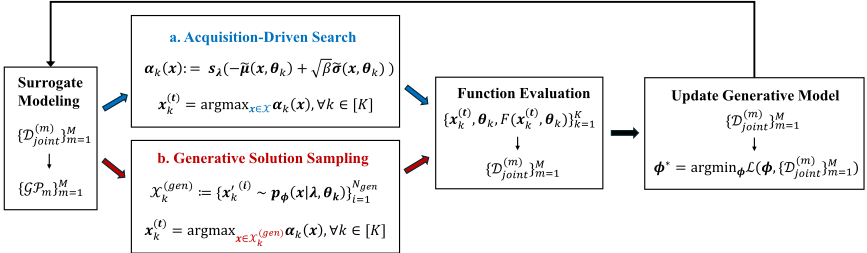
To efficiently solve a family of EMOPs under limited evaluation budgets in (2), we propose to build an inverse model by an alternating optimization framework that integrates taskaware surrogate modeling and conditional generative modeling, as shown in Figure 1. The former, instantiated via the Parametric Multi-Task Multi-Objective Bayesian Optimization (PMT-MOBO) module, exploits inter-task relationships via task-aware GP to guide acquisition-driven search in a sample-efficient manner. The latter, introduced as the conditional generative model, captures the distribution of high-performing solutions and enables task- and preferencealigned search in promising regions. Both components are executed in an alternating loop, as illustrated in Figure 1, enabling both sample-efficient multi-task search and finally achieving a high-quality inverse model.
3.2 PMT-MOBOwith Task-Aware GP
We extend the baseline ST-MOBO to PMT-MOBO by incorporating task-aware GPs. Each task-aware GP model receives both the decision variable x and the task parameter θ as joint input. Formally, for a given EMOP instance parametrized by θ′ , the m-th objective is modeled as:
with mean functions and kernels defined over the joint input space X×Θ. Based on these models, we extend the scalarized acquisition function defined in (4) into follows:
where ˜α(x, θk) ∈ RM denotes the vector of task-aware acquisition function values for the EMOP task instance parameterized by θk. We refer to this method as PMT-MOBO. For clarity, a comparative workflow of either ST-MOBO or PMTMOBO is showcased in Algorithm 2 of Appendix F.
By explicitly incorporating task parameters into the GP models, PMT-MOBO accounts for inter-task relationships during solution acquisition and model training. In the next subsection, we provide a theoretical analysis that quantifies its improved convergence compared to ST-MOBO.
3.3 Theoretical Analysis of Faster Convergence
For our theoretical analysis, we instantiate the acquisition functions α(x) and ˜α(x, θk) using the Lower Confidence Bound (LCB) [Srinivas et al., 2012]. These LCB instantiations coincide with the acquisition rules employed in our practical ST-MOBO and PMT-MOBO algorithms, so the following regret analysis directly characterizes the convergence behavior of the implemented methods. Specifically, for STMOBO, the acquisition function in (4) becomes:
where β denotes a trade-off coefficient, and µ(·), σ(·) ∈ RM denote the vector of predictive means and standard deviations of M GP models. Correspondingly, for PMT-MOBO, the task-aware acquisition function in (5) becomes:
For an EMOP with a total evaluation budget T, the goal is to obtain a set of solutions XT ⊂ X that approximates the true Pareto Set X ∗ . Following the analysis technique [Paria et al., 2020], this goal can be quantified using the notion of Bayes Regret, which evaluates the quality of the obtained solution set with respect to random preference vectors.
Definition 3 (Bayes Regret). Given a preference distribution p(λ) over preference vectors, the Bayes regret of a solution set XT is defined as:
where Pareto Set X ∗ includes all the Pareto-optimal solutions x∗λ = argminx∈X sλ(F (x)), ∀λ ∈ Λ.
Deriving an upper bound on Bayes regret is nontrivial [Zhang and Golovin, 2020], since it measures the collective regret of the entire solution set rather than point-wise regret. Therefore, a surrogate of Bayes regret is introduced, termed as Cumulative Regret, which quantifies the total pointwise regret incurred across all evaluation rounds.
Definition 4 (Cumulative Regret). Given a set of sampled preference vectors {λ(t) }Tt=1 , the cumulative regret of a solution set XT = {x(t) }Tt=1 is defined as:
Assumption 1. For each objective fm and each task parameter θk, the function x ↦→ fm(x, θk) satisfies the same regularity and GP assumptions as in Theorem 1 of [Paria et al., 2020] (independent sub-Gaussian noise on a compact domain, and scalarizations that are monotone and Lipschitz in all objectives).
Theorem 1 (Regret Bounds for ST-MOBO, Theorem 1 in [Paria et al., 2020]). Under Assumption 1, ST-MOBO satisfies:
and furthermore, its Bayes regret is controlled by:
In Theorem 1, γT denotes the largest maximum information gain (MIG) over all M objective functions:
where γT,m denotes the MIG for each objective function fm(·), quantifying the maximal uncertainty reduction about the objective function fm(·) from observing T solutions:
where I stands for mutual information. Although Theorem 1 is stated for a single EMOP instance, it applies equally well to each of the K tasks in isolation. For task k, let
be the task-specific MIG of ST-MOBO and then Theorem 1 gives the corresponding E[R(k) C (T)] and E[R(k) B (T)] with γT replaced by γT,k = maxm γT,m,k. With the same upper bound of Lipschitz constant J and observation noise variance σ2 , the Bayes regret bound is determined primarily by per-task MIG γT,k. A reduction in the MIG translates into a smaller upper bound on Bayes regret. Thus, establishing that PMT-MOBO's per-task MIG ˜ γT,k is smaller than that of ST-MOBO confirms its accelerated convergence.
Theorem 2 (Tightened Regret Bounds for PMT-MOBO). Under Assumption 1, consider a PMT-MOBO model where the task-aware kernel yields covariance values equivalent to the single-task kernel for any pair of inputs belonging to the same task. Let ˜ γT,k = maxm∈[M] ˜ γT,m,k be the largest MIG of PMT-MOBO across M objectives over T scalarized evaluations for task k.
Then, for all m ∈ [M] and k ∈ [K], it holds that
and accordingly ˜ γT,k ≤ γT,k for every k ∈ [K]. Since the proof of Theorem 1 depends on each task only through its MIG term, the same regret bounds remain valid with γT,k replaced by ˜ γT,k, and consequently
i.e., PMT-MOBO achieves a tighter upper bound on Bayes regret than standard ST-MOBO.
Theorem 2 establishes that PMT-MOBO achieves a tighter Bayes regret bound than ST-MOBO. The detailed proof (Appendix A) demonstrates that conditioning on observations from related tasks reduces the posterior covariance for the target task. Crucially, under the same regularity assumptions utilized in [Paria et al., 2020], one can ensure that the structural form of the original regret upper bound remains valid. Since this bound is a monotonically increasing function of the Maximum Information Gain (MIG), the inequality, ˜ γT,k ≤ γT,k derived from the reduced posterior variance, translates to a strictly lower upper bound on the cumulative regret.
3.4 Conditional Generative Model
Pure acquisition-based search via PMT-MOBO provides sample-efficient guidance, but can steer sampling into lowquality regions when X is large in (5) and budgets are tight [Brookes et al., 2019; Zhang et al., 2022]. To complement this, we learn an elite-solution distribution via a conditional generative model. As illustrated in Figure 1, we let
where ϕ denotes the model parameters, λ encodes the scalarization preference, and θk specifies the current task k. We draw a pool of candidate solutions X (gen) k per task from this model, then score each with the acquisition function in (5) and pick the best for evaluation as follows:
Algorithm 1 Generative PMT-MOBO Framework
Input: Tasks {θk}Kk=1 , objectives {fm}Mm=1 , preference dist. Λ, generative model Gϕ.
Output: Final datasets {Dk}Kk=1
- 1: for t = 1 to T do
- 2: Sample λ(t) ∼ Λ
- 3: mode ← ACQUISITION or GENERATIVE (RoundRobin)
- 4: for each task θk do
- 5: if mode = ACQUISITION then
- 6: Select x(t) k using (5)
- 7: else
- 8: Sample {x′(i) k }Ngen i=1 ∼ pϕ(x|λ(t) , θk)
- 9: Select x(t) k using (15)
- 10: end if
11:
Evaluate F(xk, θk) and append to Dk
- 12: end for
- 13: Jointly retrain all task-aware GPs on ⋃k Dk
- 14: if mode = GENERATIVE then
- 15: Extract elite subset from ⋃k Dk
- 16: Update Gϕ using L(ϕ;D(gen) )
- 17: end if
- 18: end for
- 19: return {Dk}Kk=1
In this way, distribution-aware sampling is seamlessly blended with uncertainty-driven exploration. We instantiate this generative model via either Variational Autoencoder (VAE) [Kingma and Welling, 2022] or Denoising Diffusion Probabilistic Model (DDPM) [Ho et al., 2020] as follows.
Conditional Variational Autoencoder The dataset D of elite solutions x is collected with conditioning vectors c = (λ, θk). We introduce a latent code z and parameterize
An encoder qϕe (z|x, c) approximates the posterior, and a decoder pϕd (x|z, c) models the conditional likelihood. We learn ϕ = (ϕe, ϕd) by maximizing the variational lower bound [Kingma and Welling, 2022; Sohn et al., 2015] on D. During generative solution sampling, candidate solutions x′ can be obtained from the learned distribution as follows:
Conditional Diffusion Model The dataset D of elite solutions x is collected with conditioning vectors c = (λ, θk). We model the data distribution through a forward diffusion process that gradually adds Gaussian noise over ˆ T timesteps:
where {ˆ βt} ˆ Tt=1 follows a linear noise schedule. The forward process admits a closed-form expression:
with ¯αt = ∏ts=1 (1- ˆ βs). Thereafter, a neural net ϵϕ(xt, t, c) is trained to predict the noise added at timestep t given the noisy solution xt and conditioning c. We learn ϕ by minimizing the denoising objective following [Ho et al., 2020]. The learned diffusion model parameterizes the conditional distribution of elite solutions as follows:
where pϕ(x0|x ˆ T , c) represents the reverse denoising process implemented. During the generative solution sampling phase, candidate solutions x′ are obtained as:
3.5 Alternating Optimization Loop
The complete framework alternates between two complementary search modes as illustrated in Figure 1: acquisitiondriven search via PMT-MOBO and generative solution sampling using the conditional generative model. Algorithm 1 presents the detailed workflow alternating between ACQUISITION and GENERATIVE modes. We alternate between generative sampling and acquisition-driven modes every iteration in a round-robin fashion. In GENERATIVE mode, candidates are sampled from pϕ(x|λ(t) , θk) and the best is selected using the acquisition function. In ACQUISITION mode, solutions are directly selected by optimizing the task-aware acquisition function. Both update task-aware GPs after evaluation, while the generative model gets retrained during GENERATIVE iterations using D(gen) .
Elite Solution Collection We maintain datasets per taskpreference pair (λ, θk), storing top Q% solutions by scalarization score sλ(F(x, θk)) [Ozaki et al., 2022]. Preference vectors λ are generated via random sampling from Λ. Each elite solution x pairs with conditioning vector c = (λ, θk) for generative model training. More detailed settings can be found in Appendix C.3.
4 Results
We provide empirical experiments demonstrating our method's ability to build effective inverse models for PEMOPs. Our experiments verify three key claims: (1) PMTMOBO achieves faster convergence by exploiting inter-task synergies, (2) conditional generative models further improve solution quality, and (3) the built inverse model M(θ, λ) can directly predict optimized solutions for unseen EMOP tasks without additional evaluations. We evaluate all methods using the Hypervolume indicator [Zitzler and Thiele, 1998] across both seen and unseen EMOP tasks.
Benchmarks. We evaluate our methods on classical synthetic benchmarks: DTLZ-1, DTLZ-2, and DTLZ-3 [Deb et al., 2002], and real-world problems including lamp generation, solar rooftop generation [Makatura et al., 2021], magnetic sifter design [Liu et al., 2025], and UAV controller design [Makatura et al., 2021]. We modify these base EMOP problems so that each benchmark defines a family of related EMOPs, where θ represents operational conditions (e.g., physical configurations of UAVs). More problem details are provided in the Appendix B.
| Method | DTLZ-1 | DTLZ-2 | DTLZ-3 | LAMP | SOLAR | UAV |
|---|---|---|---|---|---|---|
| PSL-MOBO CDM-PSL PPSL-MOBO PMT-MOBO-VAE PMT-MOBO-DDPM | 2.82e+04 (1.78e+03)≈- 1.92e+04 (3.85e+03)-- 2.24e+04 (1.10e+02)-- 2.88e+04 (2.57e+03) 3.47e+04 (4.85e+02) | 1.90e+00 (1.30e-01)-- 2.52e+00 (8.49e-02)-- 2.98e+00 (3.56e-02)-- 3.10e+00 (2.99e-02) 3.13e+00 (1.41e-02) | 2.39e+04 (3.22e+03)+- 1.83e+03 (1.31e+03)-- 2.67e+04 (6.08e+02)+- 1.78e+04 (7.28e+03) 3.20e+04 (1.98e+03) | 5.01e-01 (7.32e-02)-- 6.19e-01 (4.45e-02)≈- 6.12e-01 (1.05e-01)≈- 6.31e-01 (7.33e-02) 6.70e-01 (5.82e-02) | 3.54e-01 (4.06e-02)-- 6.54e-01 (3.11e-02)-- 4.86e-01 (1.11e-01)-- 7.93e-01 (1.56e-02) 7.65e-01 (1.30e-02) | 4.12e-01 (7.30e-03)-- 4.26e-01 (3.09e-02)-- 5.24e-01 (1.71e-01)-- 6.08e-01 (1.88e-02) 6.05e-01 (2.44e-02) |
Baselines. Our empirical studies include state-of-the-art single-task MOBO methods: ST-MOBO [Paria et al., 2020], qPAREGO [Balandat et al., 2020], qEHVI [Daulton et al., 2020], PSL-MOBO [Lin et al., 2022], and CDM-PSL [Li et al., 2025], a diffusion model based MOBO variant. Moreover, to evaluate performance in utilizing inter-task synergies, we compare against multi-task MOBO methods: OCMOBO [Char et al., 2019] and PPSL-MOBO [Cheng et al., 2025b]. Finally, we evaluate variants of our approaches that serve as ablation studies: PMT-MOBO (acquisitiondriven only), PMT-MOBO-VAE, and PMT-MOBO-DDPM (full framework with different generative models).
Experimental Setup. We optimize K = 8 parameterized EMOPs per benchmark with uniformly sampled task parameters. Each task uses 20 random initial solutions and the budget T = 50, repeated over U = 20 independent runs. We set Q = 10 for elite solution extraction following [Ozaki et al., 2022] and β follows [Kandasamy et al., 2015]. Additional implementation details are in the Appendix C.
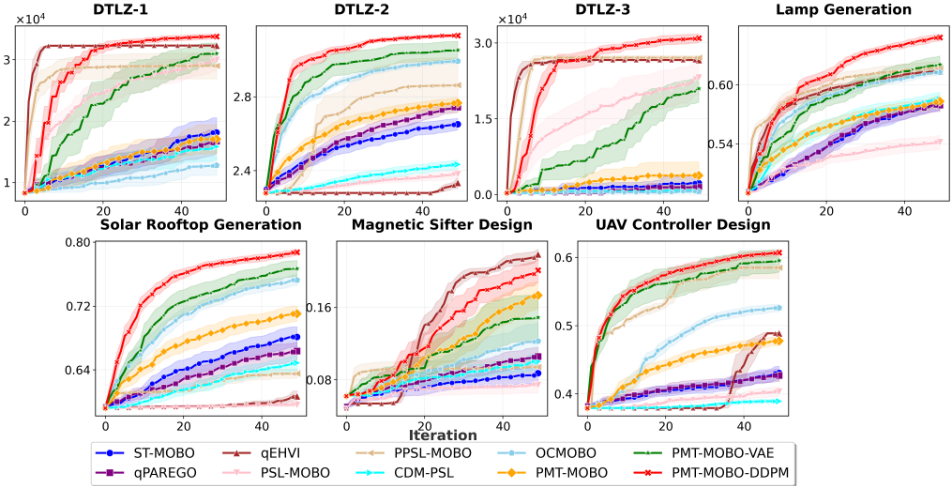
Discussions. Figure 2 and Table 1 demonstrate our framework's effectiveness on synthetic and real-world benchmarks. PMT-MOBO-VAE and PMT-MOBO-DDPM generally show superior or comparable results compared to state-of-the-art single-task and multi-task MOBO baselines in discovering high-quality Pareto solutions across distinct tasks. The exception in magnetic sifter motivates us to further explore the integration of our methods with EHVI based acquisition functions so that the proposed framework can be more flexibly adapt to diverse applications. Table 1 further shows that our inverse models generalize well to unseen EMOP tasks, outperforming the single-task and multi-task inverse models constructed by PSL-MOBO and PPSL-MOBO. With taskaware kernel and the alternating optimization loop, our PMTMOBO-DDPM's inverse model can also outperform the diffusion model of CDM-PSL across all the problems. To evaluate this generalization capability, we extract the trained inverse models after optimization and apply them to W = 100 completely new tasks. For each unseen task, we query the inverse model with S uniformly sampled preference vectors (S = 100 for bi-objective, S = 1000 for tri-objective) to generate predicted solutions, then compute the Hypervolume of the resulting solution set.
Competitive Optimization Performance. Figure 2 and Table 5 in Appendix D.1 summarize the Hypervolume results across all benchmarks. Wilcoxon signed-rank tests (at 95% confidence) demonstrate that our proposed methods significantly outperform the baselines in most scenarios.
Specifically, against the eight competing methods across all tasks (56 pairwise comparisons), PMT-MOBO-VAE attains a win/tie/loss record of 45/8/3, effectively dominating difficult tasks such as LAMP and SOLAR. The PMT-MOBO-DDPM further enhances optimization capability, achieving a record of 55/0/1, statistically surpassing all baselines in every benchmark except for the low-dimensional magnetic sifter design.
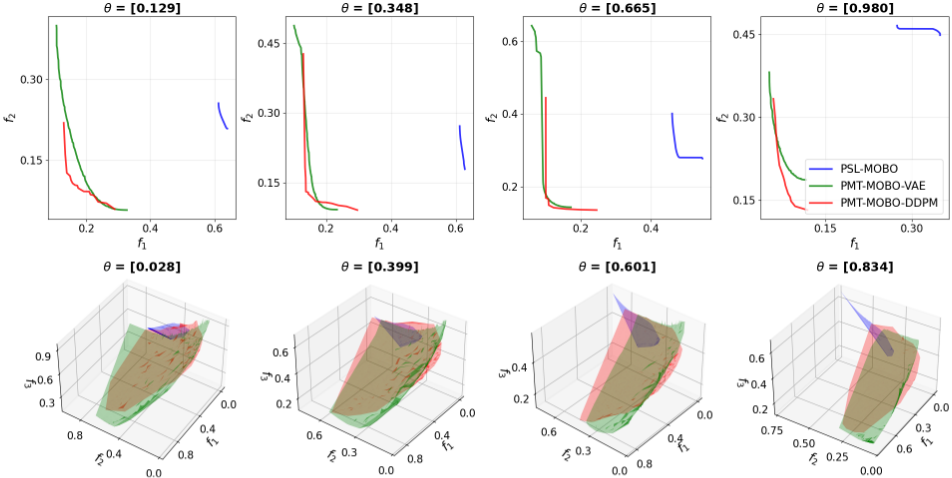
Effective InverseModel Generalization. Table 1 confirms that our alternating optimization strategy yields robust inverse models for unseen tasks. PMT-MOBO-DDPM demonstrates superior generalization across the majority of benchmarks, achieving the highest Hypervolume on DTLZ-1, DTLZ-2, DTLZ-3, and LAMP generation. Notably, it statistically outperforms both PSL-MOBO and PPSL-MOBO baselines on every tested problem instance. PMT-MOBO-VAE excels on the remaining real-world engineering tasks, with the best performance on SOLAR and UAV controller design, though it struggles with the highly multimodal landscape of DTLZ-3 compared to the DDPM variant. We omit the magnetic sifter design set due to the prohibitive computational cost of evaluating hundreds of distinct tasks. To further validate these metrics, Figure 3 visualizes the approximated Pareto Fronts. Both PMT-MOBO variants discover fronts with significantly better convergence and coverage than the PSL-MOBO baseline. Consistent with Table 1, PMT-MOBO-DDPM generally provides the broadest coverage, while PMT-MOBO-VAE offers smoother approximations, illustrating a potential tradeoff between the expansive generation of diffusion models and the structured latent embedding of VAEs.
Ablation Studies and SensitivityAnalysis. To validate the necessity of our alternating optimization strategy, we compared the full framework against decoupled baselines (pure acquisition search and pure generative sampling). The results, detailed in Appendix D.3, confirm that neither component is sufficient in isolation. Specifically, generative sampling enhances the diversity of candidate generation, while the alternating acquisition search lowers the variance inherent in pure generative sampling, resulting in robust convergence. Figure 2 also demonstrates the superior performance of PMT-MOBO-VAE and PMT-MOBO-DDPM compared to PMT-MOBO, showcasing the value of integrating generative modeling.
Furthermore, our sensitivity analysis on the elite ratio parameter Q reveals a critical trade-off: too large a Q reduces selective pressure, pushing the generative model to learn lowquality solutions, whereas too small a Q incurs large variance and provides insufficient data to train a well-behaved model. Empirically, Q = 10% achieves the optimal balance across both VAE and DDPM variants (see Tables 6 and 7 in Appendix D.4).
5 Conclusion
We introduce a novel parametric multi-objective Bayesian optimizer that can amortize the computational effort of solving families of expensive EMOPs into a single inverse generative model. By alternating between acquisition-driven search and generative solution sampling, our method constructs a robust mapping that captures complex Pareto geometries, significantly improving generalization to unseen tasks and optimization efficiency, as verified by synthetic and real-world benchmarks. Theoretically, we showed that incorporating task-aware GPs yields tighter regret bounds than single-task counterparts. Future work will explore extensions to combinatorial problems and advanced acquisition strategies like EHVI to further broaden the impact of amortized optimization across tasks [Wei et al., 2025].
Acknowledgments
This research is partly supported by the MTI under its AI Centre of Excellence for Manufacturing (AIMfg) (Award W25MCMF014), the Centre for Frontier AI Research (CFAR) under Agency for Science, Technology and Research (A*STAR), and the College of Computing and Data Science, Nanyang Technological University. Abhishek Gupta is supported by the Ramanujan Fellowship from the Anusandhan National Research Foundation (ANRF), Government of India (Grant No. RJF/2022/000115).
@inproceedings{ijcai2026p708,
  title     = {Amortized Multi-Objective Optimization Across Tasks with Generative Solution Modeling},
  author    = {Wei, Tingyang and Liu, Jiao and Gupta, Abhishek and Ooi, Chin Chun and Tan, Puay Siew and Ong, Yew-Soon},
  booktitle = {Proceedings of the Thirty-Fifth International Joint Conference on
               Artificial Intelligence, {IJCAI-26}},
  publisher = {International Joint Conferences on Artificial Intelligence Organization},
  editor    = {Diego Calvanese},
  pages     = {6361--6369},
  year      = {2026},
  month     = {8},
  note      = {Main Track},
  doi       = {10.24963/ijcai.2026/708},
  url       = {https://doi.org/10.24963/ijcai.2026/708},
}
TY - CPAPER TI - Amortized Multi-Objective Optimization Across Tasks with Generative Solution Modeling AU - Wei, Tingyang AU - Liu, Jiao AU - Gupta, Abhishek AU - Ooi, Chin Chun AU - Tan, Puay Siew AU - Ong, Yew-Soon T2 - Proceedings of the Thirty-Fifth International Joint Conference on Artificial Intelligence, IJCAI-26 PB - International Joint Conferences on Artificial Intelligence Organization PY - 2026 SP - 6361 EP - 6369 DO - 10.24963/ijcai.2026/708 UR - https://doi.org/10.24963/ijcai.2026/708 ER -Copied
Machine-readable versions of this paper, for tools and AI agents:





