
MemoVAD: Resource-Efficient Video Anomaly Detection via Dynamic Semantic Memory in Edge Computing Scenarios
Proceedings of the Thirty-Fifth International Joint Conference on Artificial Intelligence. Main Track. Pages 5549-5557.
https://doi.org/10.24963/ijcai.2026/618
Keywords
- Multidisciplinary Topics and Applications: Ubiquitous computing cystems
- Multidisciplinary Topics and Applications: Real-time systems
- Multidisciplinary Topics and Applications: Sensor networks and smart cities
Abstract
Deploying Video Anomaly Detection (VAD) in real-world surveillance faces a fundamental tension between the demand for high-level semantics to ensure effectiveness and the limited computational resources of edge devices. Vision–Language Models (VLMs) provide rich open-vocabulary semantics, but their latency and computational cost preclude on-device deployment. To address the challenge, we propose MemoVAD, an edge–cloud collaborative framework that selectively incorporates VLM semantics into streaming VAD. MemoVAD runs most inference on the edge with a lightweight detector and a causal Temporal Context Encoder (TCE) to model temporal dependencies. Specifically, we introduce an Uncertainty-Aware Gating (UAG) policy grounded in Subjective Logic to model perceived uncertainty and query the cloud-based VLM only for high-uncertainty and semantically novel clips. Besides, a Dynamic Semantic Memory (DSM) is designed to cache VLM-verified prototypes for efficient retrieval, enabling the edge model to progressively incorporate VLM-level semantics via a semantic adapter. Experiments on UCF-Crime and XD-Violence datasets via a real edge device show that MemoVAD substantially reduces communication overhead while surpassing state-of-the-art performance. The demo video is available at: https://memovad2026.github.io/.
- [Abdalla et al., 2025] Moshira Abdalla, Sajid Javed, Muaz Al Radi, Anwaar Ulhaq, and Naoufel Werghi. Video anomaly detection in 10 years: A survey and outlook. Neu- ral Computing and Applications, pages 1-44, 2025.
- [Chen et al., 2023] Yingxian Chen, Zhengzhe Liu, Baoheng Zhang, Wilton Fok, Xiaojuan Qi, and Yik-Chung Wu. Mgfn: Magnitude-contrastive glance-and-focus network for weakly-supervised video anomaly detection. In Pro- ceedings of the AAAI Conference on Artificial Intelligence, volume 37, pages 387-395, 2023.
- [Deng et al., 2025] Huilin Deng, Hongchen Luo, Wei Zhai, Yanming Guo, Yang Cao, and Yu Kang. Vmad: Visual- enhanced multimodal large language model for zero-shot anomaly detection. IEEE Transactions on Automation Sci- ence and Engineering, 2025.
- [Fang et al., 2024] Heng Fang, Sheng Huang, Wenhao Tang, Luwen Huangfu, and Bo Liu. Sam-mil: A spatial con- textual aware multiple instance learning approach for whole slide image classification. In Proceedings of the 32nd ACM International Conference on Multimedia, pages 6083-6092, 2024.
- [Ghasemi et al., 2024] Mahshid Ghasemi, Zoran Kostic, Javad Ghaderi, and Gil Zussman. Edgecloudai: Edge- cloud distributed video analytics. In Proceedings of the 30th Annual International Conference on Mobile Comput- ing and Networking, pages 1778-1780, 2024.
- [Guo et al., 2025] Siyan Guo, Cong Zhao, Shusen Yang, Yingying Liang, Yimeng Wang, and Qing Han. Edge- cloud collaborative real-time video object detection for in- dustrial surveillance systems. IEEE Intelligent Systems, 2025.
- [Joo et al., 2023] Hyekang Kevin Joo, Khoa Vo, Kashu Ya- mazaki, and Ngan Le. Clip-tsa: Clip-assisted temporal self-attention for weakly-supervised video anomaly detec- tion. In 2023 IEEE International Conference on Image Processing (ICIP), pages 3230-3234. IEEE, 2023.
- [Karim et al., 2024] Hamza Karim, Keval Doshi, and Yasin Yilmaz. Real-time weakly supervised video anomaly de- tection. In Proceedings of the IEEE/CVF Winter Con- ference on Applications of Computer Vision, pages 6848- 6856, 2024.
- [Khan et al., 2022] Muhammad Asif Khan, Ridha Hamila, Aiman Erbad, and Moncef Gabbouj. Distributed inference in resource-constrained iot for real-time video surveil- lance. IEEE Systems Journal, 17(1):1512-1523, 2022.
- [Kumar et al., 2024] Tajinder Kumar, Purushottam Sharma, Jaswinder Tanwar, Hisham Alsghier, Shashi Bhushan, Hesham Alhumyani, Vivek Sharma, and Ahmed I Alu- taibi. Cloud-based video streaming services: Trends, chal- lenges, and opportunities. CAAI Transactions on Intelli- gence Technology, 9(2):265-285, 2024.
- [Li et al., 2022] Shuo Li, Fang Liu, and Licheng Jiao. Self- training multi-sequence learning with transformer for weakly supervised video anomaly detection. In Proceed- ings of the AAAI Conference on Artificial Intelligence, vol- ume 36, pages 1395-1403, 2022.
- [Li et al., 2025a] Fei Li, Wenxuan Liu, Jingjing Chen, Ruixu Zhang, Yuran Wang, Xian Zhong, and Zheng Wang. Ano- mize: Better open vocabulary video anomaly detection. In Proceedings of the Computer Vision and Pattern Recogni- tion Conference, pages 29203-29212, 2025.
- [Li et al., 2025b] Guo Li, Jiandian Zeng, Zihao Peng, Yuzhu Liang, Xi Zheng, and Tian Wang. E2ec: Edge-to-edge collaboration for efficient real-time video surveillance in- ference. IEEE Transactions on Mobile Computing, 2025.
- [Liu et al., 2024] Yang Liu, Dingkang Yang, Yan Wang, Jing Liu, Jun Liu, Azzedine Boukerche, Peng Sun, and Liang Song. Generalized video anomaly event detection: Sys- tematic taxonomy and comparison of deep models. ACM Computing Surveys, 56(7):1-38, 2024.
- [Mishra et al., 2024] Pratik K Mishra, Alex Mihailidis, and Shehroz S Khan. Skeletal video anomaly detection using deep learning: Survey, challenges, and future directions. IEEE Transactions on Emerging Topics in Computational Intelligence, 8(2):1073-1085, 2024.
- [Mondal et al., 2024] Manash Kumar Mondal, Sourav Banerjee, Debashis Das, Uttam Ghosh, Mohammed S Al- Numay, and Utpal Biswas. Toward energy-efficient and cost-effective task offloading in mobile edge computing for intelligent surveillance systems. IEEE Transactions on Consumer Electronics, 70(1):4087-4094, 2024.
- [Pu et al., 2024] Yujiang Pu, Xiaoyu Wu, Lulu Yang, and Shengjin Wang. Learning prompt-enhanced context fea- tures for weakly-supervised video anomaly detection. IEEE Transactions on Image Processing, 2024.
- [Radford et al., 2021] Alec Radford, Jong Wook Kim, Chris Hallacy, Aditya Ramesh, Gabriel Goh, Sandhini Agar- wal, Girish Sastry, Amanda Askell, Pamela Mishkin, Jack Clark, et al. Learning transferable visual models from nat- ural language supervision. In International Conference on Machine Learning, pages 8748-8763. PmLR, 2021.
- [Sensoy et al., 2018] Murat Sensoy, Lance Kaplan, and Melih Kandemir. Evidential deep learning to quantify classification uncertainty. Advances in Neural Information Processing Systems, 31, 2018.
- [Shao et al., 2025] Yihua Shao, Haojin He, Sijie Li, Siyu Chen, Xinwei Long, Fanhu Zeng, Yuxuan Fan, Muyang Zhang, Ziyang Yan, Ao Ma, et al. Eventvad: Training- free event-aware video anomaly detection. In Proceedings of the 33rd ACM International Conference on Multimedia, pages 2586-2595, 2025.
- [Sharshar et al., 2025] Ahmed Sharshar, Latif U Khan, Waseem Ullah, and Mohsen Guizani. Vision-language models for edge networks: A comprehensive survey. IEEE Internet of Things Journal, 2025.
- [Shathik, 2025] J Anvar Shathik. Smart vision systems for public safety: Real-time crowd monitoring and anomaly detection in urban spaces using deep learning and edge computing. International Journal of Applied Mathemat- ics, 38(6s):720-743, 2025.
- [Sultani et al., 2018] Waqas Sultani, Chen Chen, and Mubarak Shah. Real-world anomaly detection in surveil- lance videos. In Proceedings of the IEEE Conference on Computer Vision and Pattern Recognition, pages 6479-6488, 2018.
- [Tang et al., 2023] Wenhao Tang, Sheng Huang, Xiaoxian Zhang, Fengtao Zhou, Yi Zhang, and Bo Liu. Multiple in- stance learning framework with masked hard instance min- ing for whole slide image classification. In Proceedings of the IEEE/CVF International Conference on Computer Vi- sion, pages 4078-4087, 2023.
- [Tian et al., 2021] Yu Tian, Guansong Pang, Yuanhong Chen, Rajvinder Singh, Johan W Verjans, and Gustavo Carneiro. Weakly-supervised video anomaly detection with robust temporal feature magnitude learning. In Pro- ceedings of the IEEE/CVF International Conference on Computer Vision, pages 4975-4986, 2021.
- [Tong et al., 2022] Zhan Tong, Yibing Song, Jue Wang, and Limin Wang. Videomae: Masked autoencoders are data-efficient learners for self-supervised video pre- training. Advances in Neural Information Processing Sys- tems, 35:10078-10093, 2022.
- [Wang et al., 2025] Hanling Wang, Qing Li, Li Chen, Haidong Kang, Fei Ma, and Yong Jiang. Holotrace: Llm-based bidirectional causal knowledge graph for edge- cloud video anomaly detection. In Proceedings of the 33rd ACM International Conference on Multimedia, pages 6510-6519, 2025.
- [Wu and Liu, 2021] Peng Wu and Jing Liu. Learning causal temporal relation and feature discrimination for anomaly detection. IEEE Transactions on Image Processing, 30:3513-3527, 2021.
- [Wu et al., 2020] Peng Wu, Jing Liu, Yujia Shi, Yujia Sun, Fangtao Shao, Zhaoyang Wu, and Zhiwei Yang. Not only look, but also listen: Learning multimodal violence detec- tion under weak supervision. In European Conference on Computer Vision, pages 322-339. Springer, 2020.
- [Wu et al., 2024a] Peng Wu, Xuerong Zhou, Guansong Pang, Zhiwei Yang, Qingsen Yan, Peng Wang, and Yan- ning Zhang. Weakly supervised video anomaly detection and localization with spatio-temporal prompts. In Pro- ceedings of the 32nd ACM International Conference on Multimedia, pages 9301-9310, 2024.
- [Wu et al., 2024b] Peng Wu, Xuerong Zhou, Guansong Pang, Lingru Zhou, Qingsen Yan, Peng Wang, and Yan- ning Zhang. Vadclip: Adapting vision-language models for weakly supervised video anomaly detection. In Pro- ceedings of the AAAI Conference on Artificial Intelligence, volume 38, pages 6074-6082, 2024.
- [Yang et al., 2024] Zhiwei Yang, Jing Liu, and Peng Wu. Text prompt with normality guidance for weakly super- vised video anomaly detection. In Proceedings of the IEEE/CVF Conference on Computer Vision and Pattern Recognition, pages 18899-18908, 2024.
- [Ye et al., 2025] Muchao Ye, Weiyang Liu, and Pan He. Vera: Explainable video anomaly detection via verbalized learning of vision-language models. In Proceedings of the Computer Vision and Pattern Recognition Conference, pages 8679-8688, 2025.
- [Zanella et al., 2024] Luca Zanella, Willi Menapace, Massi- miliano Mancini, Yiming Wang, and Elisa Ricci. Harness- ing large language models for training-free video anomaly detection. In Proceedings of the IEEE/CVF Conference on Computer Vision and Pattern Recognition, pages 18527- 18536, 2024.
- [Zhang et al., 2022] Hongrun Zhang, Yanda Meng, Yitian Zhao, Yihong Qiao, Xiaoyun Yang, Sarah E Coupland, and Yalin Zheng. Dtfd-mil: Double-tier feature distillation multiple instance learning for histopathology whole slide image classification. In Proceedings of the IEEE/CVF Conference on Computer Vision and Pattern recognition, pages 18802-18812, 2022.
- [Zhang et al., 2023] Chen Zhang, Guorong Li, Yuankai Qi, Shuhui Wang, Laiyun Qing, Qingming Huang, and Ming- Hsuan Yang. Exploiting completeness and uncertainty of pseudo labels for weakly supervised video anomaly de- tection. In Proceedings of the IEEE/CVF Conference on Computer Vision and Pattern Recognition, pages 16271- 16280, 2023.
- [Zhang et al., 2025] Yang Zhang, Hanling Wang, Qing Bai, Haifeng Liang, Peican Zhu, Gabriel-Miro Muntean, and Qing Li. Vavlm: Toward efficient edge-cloud video ana- lytics with vision-language models. IEEE Transactions on Broadcasting, 2025.
- [Zhou et al., 2023] Hang Zhou, Junqing Yu, and Wei Yang. Dual memory units with uncertainty regulation for weakly supervised video anomaly detection. In Proceedings of the AAAI Conference on Artificial Intelligence, volume 37, pages 3769-3777, 2023.
References were extracted automatically from the PDF and may contain errors.
Full text extracted automatically from the PDF; figures, tables and equations may differ. The PDF is the version of record.
1 Introduction
The widespread deployment of surveillance cameras in public spaces has resulted in an explosive growth of video data, creating an urgent demand for automated Video Anomaly Detection (VAD) [Shathik, 2025]. The primary objective of VAD is to identify abnormal events, such as accidents or criminal activities, within long sequences of normal activities. While recent advancements in deep learning have significantly improved detection accuracy, deploying the models in real-world scenarios remains a significant challenge. The difficulty arises primarily from the inherent conflict between the need for sophisticated semantic reasoning and the constrained computational resources available on edge devices [Ghasemi et al., 2024; Guo et al., 2025].
∗ Corresponding Author
Traditional VAD approaches typically rely on reconstruction or prediction paradigms that operate under unsupervised or weakly supervised settings [Wu et al., 2024b; Li et al., 2025a]. The methods generally learn the distribution of normal patterns and treat deviations as anomalies. Although computationally efficient enough for some edge applications, they often struggle to distinguish between genuine anomalies and benign distributional shifts, such as dynamic background changes or camera jitter [Sultani et al., 2018; Tian et al., 2021]. Furthermore, the methods lack highlevel semantic understanding, which restricts their ability to interpret complex scenes. Conversely, the emergence of Vision-Language Models (VLMs) has introduced a new paradigm where visual data is aligned with rich textual semantics through CLIP-based encoding [Deng et al., 2025; Li et al., 2025a]. VLMs demonstrate remarkable capability in zero-shot anomaly detection and semantic reasoning [Zanella et al., 2024; Ye et al., 2025; Shao et al., 2025]. However, their massive parameter counts and heavy computational requirements render them unsuitable for direct deployment on resource-constrained edge hardware.
To leverage the semantic power of VLMs without overwhelming edge resources, edge-cloud collaboration offers a promising direction [Zhang et al., 2025]. A naive solution is to transmit all video data to a cloud-based VLM for processing [Kumar et al., 2024; Wang et al., 2025; Sharshar et al., 2025]. Nevertheless, it incurs huge bandwidth costs and high latency, which are unacceptable for real-time surveillance applications [Khan et al., 2022; Mondal et al., 2024; Li et al., 2025b]. Consequently, a critical research gap exists in developing a framework that can maintain the low latency of edge processing while selectively integrating the high-level semantic capabilities of cloud-resident large models.
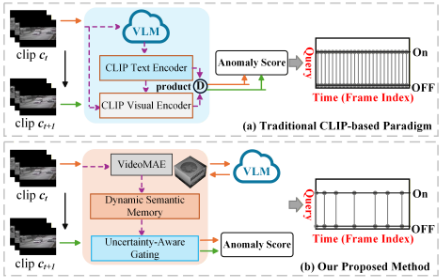
To bridge the gap, we propose MemoVAD, a resourceefficient framework for video anomaly detection via dynamic semantic memory in edge computing scenarios. As shown in Fig. 1, anomalies typically exhibit recurring semantic patterns and manifest as temporally continuous segments. Therefore, continuous reliance on a computationally expensive VLM is unnecessary. Instead, we introduce a novel collaborative mechanism where a lightweight edge detector handles the majority of the inference workload and queries the remote VLM only when necessary. Specifically, MemoVAD introduces three components to balance semantic capability and edge efficiency. First, it adopts a lightweight detector that uses a frozen VideoMAE [Tong et al., 2022] backbone for motion feature extraction, together with a causal Temporal Context Encoder (TCE) to model local temporal dependencies. Second, we propose an Uncertainty-Aware Gating (UAG) mechanism grounded in Subjective Logic [Sensoy et al., 2018], which estimates perceived uncertainty and triggers a VLM query when the edge model lacks sufficient evidence for a reliable decision. Finally, we develop a Dynamic Semantic Memory (DSM) that caches VLM-verified semantic prototypes on the edge. For semantically similar events, the model retrieves relevant knowledge from the memory instead of contacting the remote server, enabling efficient online knowledge distillation and progressively transferring VLM-level semantics to the edge model.
In summary, our main contributions are as follows:
- We propose MemoVAD, a resource-efficient collaborative framework that harmonizes the speed of edge computing with the semantic reasoning of large VLMs.
- We introduce an uncertainty-aware subjective-logic gate to query VLMs only under high perceived uncertainty, and a dynamic semantic memory caching VLM insights to reduce communication overhead while preserving accuracy.
- Our MemoVAD demonstrates remarkable improvements compared to various benchmarks across two public datasets, validating its superior performance.
2 RelatedWorks
2.1 Weakly Supervised Video Anomaly Detection with VLMs
Due to the huge cost of frame-level annotations, current research predominantly focuses on Weakly Supervised Video Anomaly Detection (WSVAD), where only video-level labels are available [Mishra et al., 2024; Abdalla et al., 2025;
Liu et al., 2024; Wu et al., 2024a; Karim et al., 2024; Zhang et al., 2023; Pu et al., 2024]. Multiple Instance Learning (MIL) serves as the dominant framework in the domain, treating videos as bags of clips to distinguish anomalous bags from normal ones [Zhang et al., 2022; Tang et al., 2023; Fang et al., 2024]. However, standard MIL-based detectors typically rely on discriminative feature embeddings that lack explicit semantic interpretability. To mitigate the issue, recent studies have integrated Vision-Language Models (VLMs), leveraging the zero-shot capabilities of models like CLIP [Radford et al., 2021] and GPT-4V to identify anomalies via textual prompting [Wu et al., 2024b; Ye et al., 2025; Yang et al., 2024; Zanella et al., 2024; Shao et al., 2025]. While VLMs demonstrate superior performance in recognizing semantically complex events, their substantial computational overhead poses a significant barrier to real-time deployment. Our work builds upon the efficient MIL formulation but enhances it by integrating explicit semantic knowledge. Specifically, to mitigate the computational cost of VLMs, we adopt an online knowledge distillation strategy that continuously updates the edge model via a dynamic memory mechanism.
2.2 Efficient Edge-Cloud Collaboration
Deploying deep learning models on edge devices requires careful optimization to balance accuracy and efficiency [Guo et al., 2025; Ghasemi et al., 2024]. Common techniques include model compression methods such as quantization, pruning, and lightweight architecture design. While the techniques reduce inference latency, they often degrade model capacity and performance. Edge-cloud collaborative intelligence seeks to mitigate the issue by offloading heavy computation to the cloud [Zhang et al., 2025; Shathik, 2025]. Traditional offloading strategies decide which parts of a model to execute locally and which to transmit based on bandwidth and battery constraints. However, most existing collaborative frameworks focus on partition points within a fixed network architecture rather than dynamic interaction based on sample difficulty. Our approach differs by employing an uncertaintydriven policy that dynamically determines the necessity of cloud interaction. By utilizing Subjective Logic to quantify evidence sufficiency, MemoVAD ensures that communication resources are expended only on hard and novel samples, thereby achieving a superior balance between resource efficiency and detection performance.
3 Methodology
3.1 ProblemDefinition
We formulate WSVAD as a Multiple Instance Learning (MIL) task. Let X = {(Vi, Yi)}|X| i=1 denote the training set, where Vi is an untrimmed video and Yi ∈ {0, 1} is the videolevel label. Yi = 0 indicates a normal video, while Yi = 1 implies the video contains at least one anomalous event. Each video Vi is divided into a sequence of T non-overlapping clips {c1, c2, . . . , cT }.
The objective is to learn a clip-level anomaly scoring function fθ(ct) → yt ∈ [0, 1], such that yt is high for anomalous clips and low for normal ones. Under the MIL assumption, the relationship between clip scores and the video label is defined as:
Specifically, for a normal bag Yi = 0, all clips are normal yt ≈ 0; for an anomalous bag Yi = 1, at least one clip is anomalous yt ≈ 1.
Unlike traditional centralized VAD, we consider an edgecloud collaborative scenario. The local edge device has limited computational resources and must minimize communication with the remote VLM. The goal is to maximize detection performance while adhering to a strict communication budget:
where I(·) is the indicator function for triggering a remote VLM query, and δ is the desired performance threshold.
3.2 Overview
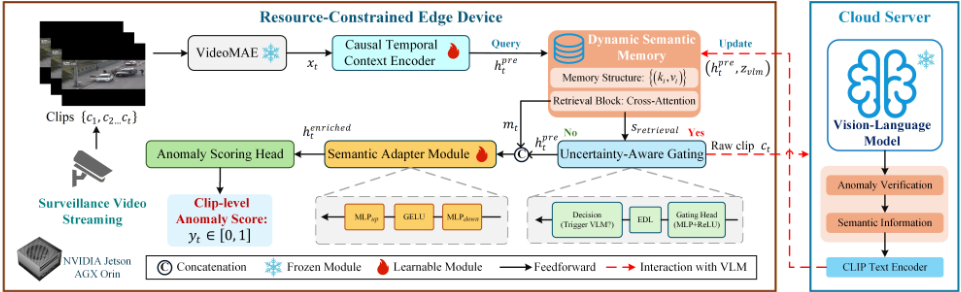
We propose MemoVAD, a resource-efficient framework designed to bridge the gap between lightweight edge detection and semantic reasoning. As illustrated in Fig. 2, the framework operates under an edge-cloud collaborative paradigm to identify anomalies from the input video clips defined in Sec. 3.1. MemoVAD comprises three key components:
- Edge-Resident Detector: A lightweight network utilizing a frozen VideoMAE backbone for initial feature extraction and temporal modeling.
- Uncertainty-Aware Gating (UAG): A policy module that determines whether to query the VLM based on perceived uncertainty.
- Dynamic Semantic Memory (DSM): A continuously updating memory bank that stores VLM-verified prototypes, enabling the edge model to retrieve high-level semantic knowledge without recurring communication costs.
3.3 Edge-Resident Network
Feature Extraction
To guarantee real-time inference on resource-constrained edge devices, we adopt VideoMAE-Small [Tong et al., 2022]
as our visual backbone. We freeze the pre-trained weights to preserve its generalizable motion features and prevent catastrophic forgetting during domain adaptation. Given an input video clip ct ∈ RC×F×H×W , the backbone extracts a compact feature vector xt:
where Dstu denotes the feature embedding dimension. For the input preprocessing, we resize frames to a standard spatial resolution of H ×W and sample F frames with a fixed temporal stride τ.
Causal Temporal Context Encoder
Since the backbone processes clips independently, the extracted feature xt lacks temporal context required for detecting complex anomalies. To bridge the gap, we introduce a lightweight Temporal Context Encoder (TCE) implemented as a 2-layer causal Transformer Encoder, which aggregates information from a fixed-length history window of L clips. To retain sequential order information, learnable positional embeddings are added to the input sequence before encoding:
where P denotes learnable positional embeddings. The output hpre t ∈ RDstu is the pre-enrichment contextual student feature for clip t. In deployment, we implement the causal Transformer with KV-cache for streaming inference, enabling amortized constant-time updates per incoming clip.
3.4 Dynamic Semantic Memory (DSM)
DSM is designed to realize online knowledge distillation by caching VLM reasoning results and enabling semantic retrieval on the edge.
Memory Structure
We structure the memory as a set of key-value pairs M = {(ki, vi)}Ni=1 with memory size N.
- Key ki ∈ RDstu stores the pre-enrichment student feature hpre for a VLM-confirmed event. It ensures that keys share the same distribution as incoming queries.
- Value vi ∈ RDvlm stores the corresponding semantic embedding produced by the teacher VLM, serving as highlevel knowledge to be distilled.
Memory Retrieval
For each incoming clip feature hpre t , we retrieve relevant semantic information fromM using multi-head cross-attention. The query is derived from the student feature, while the memory keys and values serve as K and V :
The retrieved semantic information mt is computed via the attention mechanism:
Simultaneously, to quantify retrieval confidence for gating, we compute the maximum cosine similarity between hpre t and stored keys:
The metric sretrieval measures how well the current input matches the known anomalous prototypes in the memory.
Semantic Adapter Module (SAM)
Directly fusing semantic prototypes into the student space may cause distribution mismatch. We introduce a lightweight Semantic Adapter Module (SAM) to align and fuse mt into the student feature space.
We first project the retrieved semantic prototype to the student dimension via a lightweight projection ϕ : RDvlm → RDstu (e.g., a single linear layer). Then we concatenate and pass through a bottleneck adapter:
where MLPdown compresses by ratio r = 4, σ is GELU, and MLPup restores to Dstu. The enriched student feature is obtained by a gated residual connection:
where α is a learnable scalar initialized to 0 to prevent negative transfer in early training.
3.5 Uncertainty-Aware Gating (UAG)
Continuous VLM querying is extremely expensive. UAG requests VLM assistance only for hard or novel samples, using perceived uncertainty and memory confidence.
Gating Policy
Softmax confidence cannot reliably separate aleatoric and perceived uncertainty. We adopt Subjective Logic [Sensoy et al., 2018] to estimate perceived uncertainty via evidential learning.
Given the pre-enrichment feature hpre t , the gating head predicts non-negative evidence:
for the Normal and Anomalous classes. Evidence defines a Dirichlet distribution Dir(αt):
where St represents evidence strength. The perceived uncertainty is defined as inverse total evidence:
To improve robustness under domain shift where models can be over-confident yet wrong, we trigger VLM queries when the case is uncertain and novel. The triggering condition is:
where τunc, τsim are hyper-parameters trading off accuracy and communication cost.
VLM Inference and Memory Update
When triggered, the raw clip ct is transmitted to the remote VLM. We uniformly sample F frames from ct and provide a lightweight prompt for anomaly verification. The VLM outputs: (1) Anomaly Verification, deciding whether the clip truly contains an anomaly; and (2) Semantic Extraction, producing a text-aligned embedding zvlm ∈ RDvlm .
If the VLM confirms an anomaly, we write the new knowledge into memory:
Online Semantic-Diversity Replacement. To keep a fixed memory budget Nmax while avoiding quadratic recomputation, we maintain a redundancy score for each key:
When inserting a new key knew, we compute cos(knew, ki) for all stored keys and update affected ρi incrementally. If the memory is full, we remove the most redundant key argmaxi ρi, yielding an online replacement with amortized O(NDstu) per insertion.
3.6 Objective Function
The model is trained with weak video-level labels. Let S(·) denote the anomaly classifier head followed by a Sigmoid. The predicted anomaly score for the t-th clip is:
MIL Ranking Loss
We formulate weakly supervised VAD as a Multiple-Instance Learning task. Normal videos are negative bags Bn and anomalous videos are positive bags Ba. Using the standard MIL assumption, the video-level score is represented by the maximum clip score. The ranking loss is:
where m ∈ (0, 1) is the margin hyperparameter.
Semantic Distillation Loss
To distill semantic knowledge from the VLM, we minimize the distance between student and teacher representations. We introduce a projection head ψ : RDstu → RDvlm (two-layer MLP) and apply supervision only when teacher signals are available. The distillation loss is:
where ϵ is a small constant for numerical stability. Here, Mt = 1 if the VLM is triggered for clip t, and 0 otherwise. The stop-gradient operator treats the VLM as a fixed semantic anchor.
Temporal Smoothness Loss
We impose temporal continuity and sparsity priors:
where the first term enforces smoothness, and the second encourages sparsity of anomaly predictions. λsp is a sparsity hyper-parameter that balances the two constraints. It prevents the trivial solution where the model predicts high scores for all clips.
Gating Head Supervision
We supervise the evidential gating head following Evidential Deep Learning [Sensoy et al., 2018]. Let Ybag ∈ {0, 1} be the video-level label. To reduce label noise under MIL, we apply the loss only to the top-scoring clip(s) in each bag:
Total Loss
The final objective function is a weighted sum of the components:
where λ1, λ2, and λ3 are pre-defined hyperparameters that balance the trade-off between anomaly detection, semantic alignment, and uncertainty estimation.
4 Experiments
4.1 Experimental Settings
Datasets. We evaluate MemoVAD on two large-scale weakly supervised video anomaly detection benchmarks. (1) UCF-Crime [Sultani et al., 2018] contains 1,900 real-world surveillance videos spanning 13 anomaly categories and normal activities. (2) XD-Violence [Wu et al., 2020] consists of 4,754 videos collected from movies and games, providing audio-visual signals. In our experiments, we use only the visual modality.
Metrics. Following standard protocols, we employ the Area Under the Receiver Operating Characteristic Curve (AUC)
| Method | Ref. | Backbone | AUC (%)↑ | AP (%)↑ |
|---|---|---|---|---|
| Sultani et al. | CVPR'18 | C3D | 77.92 | 73.20 |
| RTFM | ICCV'21 | I3D | 84.30 | 77.81 |
| CRFD | TIP'21 | I3D | 84.89 | 75.90 |
| MSL | AAAI'22 | I3D | 85.62 | 78.58 |
| MGFN | AAAI'23 | I3D | 86.67 | 80.11 |
| UR-DMU | AAAI'23 | I3D | 86.97 | 81.66 |
| CLIP-TSA | ICIP'23 | CLIP | 87.58 | 82.17 |
| TPWNG | CVPR'24 | CLIP | 87.79 | 83.68 |
| VadCLIP | AAAI'24 | CLIP | 88.02 | 84.51 |
| OVVAD | CVPR'25 | CLIP | 86.40 | 69.31 |
| EventVAD | MM'25 | CLIP | 87.51 | 64.04 |
| MemoVAD (Ours) | - | VideoMAE-S | 89.45 | 85.97 |
| Method | FPS ↑ | Latency (s)↓ | CRUCF(%)↓ | CRXD(%)↓ |
|---|---|---|---|---|
| I3D baseline | 23.7 | 0.868 | 0.00 | 0.00 |
| CLIP-based baseline | 11.5 | 1.512 | 100.0 | 100.0 |
| MemoVAD (Ours) | 36.2 | 0.475 | 8.63 | 15.72 |
for UCF-Crime and Average Precision (AP) for XD-Violence to evaluate detection performance. In addition to detection performance, we strictly evaluate resource efficiency in edge scenarios. Specifically, we report Throughput (FPS) and Latency (s) to verify real-time capabilities, and define Communication Rate (CR) as the percentage of clips that trigger a VLM query.
Baselines. For comparison, Sultani et al. [Sultani et al., 2018], RTFM [Tian et al., 2021], CRFD [Wu and Liu, 2021], MSL [Li et al., 2022], MGFN [Chen et al., 2023], URDMU [Zhou et al., 2023], CLIP-TSA [Joo et al., 2023], TPWNG [Yang et al., 2024], VadCLIP [Wu et al., 2024b], OVVAD [Li et al., 2025a], and EventVAD [Shao et al., 2025] are chosen as baselines.
4.2 Comparison with State-of-the-Art Methods
Main Results. As presented in Table 1, MemoVAD achieves 89.45% AUC on UCF-Crime and 85.97% AP on XDViolence, consistently outperforming prior approaches with C3D/I3D or CLIP-based feature backbones. Such consistent gains across two widely used benchmarks indicate the strong effectiveness and robustness of our method under different anomaly categories and evaluation metrics. In particular, MemoVAD improves the best baselines TPWNG and VadCLIP by an absolute margin of 1.66% and 1.43% AUC on UCF-Crime, and 2.29% and 1.46% AP on XD-Violence, respectively. Notably, the gains are achieved by utilizing the frozen VideoMAE-S as a resource-efficient student backbone, demonstrating that accurate anomaly detection does not strictly require computationally intensive foundation models. Efficiency Results. MemoVAD is explicitly designed for real-time anomaly detection under an edge-collaborative setting, where both on-device computation and communication costs are critical. As detailed in Table 2, MemoVAD maintains real-time capability on the Jetson AGX Orin by achieving a throughput of 36.2 FPS. The performance represents a substantial improvement over the I3D baseline, which operates exclusively on the edge at 23.7 FPS. Furthermore, MemoVAD significantly outpaces the CLIP-based baseline that relies continuously on remote VLM support, running at only 11.5 FPS. The throughput improvement is also reflected in the latency metrics, where MemoVAD achieves a rapid response time of 0.475 seconds, markedly outperforming both the CLIP-based baseline and the I3D-based baseline. Such a performance gain validates the efficacy of utilizing the lightweight VideoMAE-S architecture, which avoids the computational bottlenecks often associated with the heavier semantic backbones employed by competing methods. Beyond local computational efficiency, MemoVAD significantly minimizes the dependency on remote VLM access. While the CLIP-based baseline necessitates a 100% query rate to function, our method initiates VLM queries for merely 8.63% and 15.72% of the clips on the UCF-Crime and XD-Violence datasets respectively. By processing the vast majority of clips locally, MemoVAD effectively circumvents the bandwidth limitations and latency penalties often associated with expensive remote inference.
| TCE | DSM | UAG | SAM | AUC (%)↑ | FPS ↑ | Latency (s)↓ | CR (%)↓ |
|---|---|---|---|---|---|---|---|
| × | × | × | × | 72.33 | 40.6 | 0.266 | 0.00 |
| ✓ | × | × | × | 79.56 | 39.8 | 0.353 | 0.00 |
| ✓ | ✓ | × | × | 90.10 | 12.8 | 1.481 | 100.0 |
| ✓ | ✓ | ✓ | × | 87.85 | 37.5 | 0.462 | 8.63 |
| ✓ | ✓ | ✓ | ✓ | 89.45 | 36.2 | 0.475 | 8.63 |
| Gating Strategy | Metric | AUC (%)↑ | CR (%)↓ |
|---|---|---|---|
| Softmax Entropy | Confidence | 86.12 | 12.45 |
| Evidential Uncertainty (Only) | Uncertainty | 87.05 | 9.80 |
| Retrieval Similarity (Only) | Similarity | 88.20 | 14.20 |
| Hybrid (Ours) | Unc. + Sim. | 89.45 | 8.63 |
4.3 Ablation Studies
Effectiveness of Key Components. Table 3 summarizes the incremental contributions of each module. Starting with the baseline in Row 1, the frozen VideoMAE backbone achieves 72.33% AUC at 40.6 FPS, but is constrained by the lack of temporal modeling. Incorporating the causal TCE as shown in Row 2 effectively aggregates historical motion cues and boosts AUC to 79.56% with a negligible latency overhead resulting in 39.8 FPS. To gauge the maximum potential of semantic reasoning, we evaluate a teacher forcing variant with DSM in Row 3 that queries the VLM for every clip. While the configuration yields a peak AUC of 90.10%, it incurs huge costs including a 100% communication rate and a throughput drop to 12.8 FPS with a high latency of 1.481 seconds, which renders it impractical for edge deployment. To mitigate the issue, the UAG mechanism in Row 4 selectively triggers queries only for clips with high-uncertainty and novelty, reducing communication to 8.63% and restoring a real-time throughput of 37.5 FPS with 0.462 seconds, while incurring only a modest AUC drop to 87.85%. Finally, the introduced SAM alleviates the feature distribution mismatch between the student and teacher. By aligning retrieved semantics, it recovers the AUC to 89.45% and closely matches the upper bound while maintaining a high efficiency of 36.2 FPS and a marginal latency of 0.475 seconds.
| Update Policy | AUC (%)↑ | AP (%)↑ |
|---|---|---|
| First-In-First-Out (FIFO) | 87.34 | 83.10 |
| Random Replacement | 86.90 | 82.55 |
| Least Recently Used (LRU) | 88.10 | 84.20 |
| Semantic-Diversity (Ours) | 89.45 | 85.97 |
Analysis of Gating Policies. To validate the design of our Uncertainty-Aware Gating, we compare the proposed method against standard baselines as detailed in Table 4. The baseline utilizing solely Softmax confidence yields suboptimal performance of 86.12%, primarily due to its inability to discriminate between hard samples and out-of-distribution data. While employing evidential uncertainty alone improves precision, it fails to capture novel semantic events that are statistically confident yet semantically unfamiliar. Consequently, our hybrid approach achieves the optimal synergy by triggering VLM queries exclusively when the model exhibits perceived uncertainty or when the input remains semantically distinct from existing memory prototypes.
Effectiveness of Memory Dynamics. We further investigate the impact of memory management on long-term learning stability in Table 5. Naive strategies, such as FIFO or Random replacement, result in the catastrophic forgetting of rare anomaly prototypes, leading to a performance degradation exceeding 2%. In contrast, our Online SemanticDiversity Replacement ensures the retention of a spanning set of diverse abnormal information, thereby maximizing the utility of the fixed storage budget of 2,048 slots.

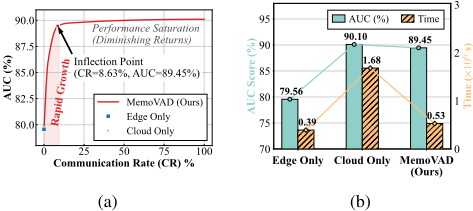
Efficiency-Accuracy Trade-off. Fig. 3 illustrates the balance between computational efficiency and detection accuracy. To characterize the operational envelope of MemoVAD, we systematically modulate the gating hyperparameters, specifically the uncertainty threshold τunc and the similarity threshold τsim. Fig. 3a reveals a smooth Pareto frontier where the proposed method maintains an AUC exceeding 89% even when the communication overhead is constrained to less than 10%. Furthermore, we provide a comparative analysis against the baseline deployment paradigms in Fig. 3b. Specifically, while exhibiting a marginal degradation in AUC compared to the Cloud-only approach, our method significantly reduces the inference latency. Notably, the total runtime of MemoVAD is approximately one-third of that required by the Cloud-only paradigm, demonstrating its practicality for real-time edge computing scenarios. Such performance significantly surpasses the baselines and underscores the adaptability of our framework to fluctuating network bandwidths in real-world deployments.
4.4 Qualitative Analysis
Qualitative Visualization. Fig. 4 details the inference dynamics of MemoVAD across diverse scenarios. The blue curves denote the predicted anomaly scores and the black vertical stems indicate VLM query triggers. As presented in Fig. 4a, the query frequency spikes immediately at the anomaly onset to resolve high perceived uncertainty. Upon the termination of the event, the system rapidly validates the return to a normal state, resulting in a rapid decay of the anomaly score. Similarly, in Fig. 4b, where the anomaly persists until the end of the video, the system maintains robust recognition throughout the abnormal event duration. Notably, in Fig. 4c, the MemoVAD successfully validates the interval between events to confirm the temporary restoration of normality, demonstrating its ability to capture complex temporal dependencies. In the normal video depicted in Fig. 4d, our system maintains consistently low anomaly scores with extremely sparse updates, effectively minimizing computational costs in the absence of semantic shifts. Overall, MemoVAD precisely localizes events matching ground-truth red borders, while meeting rate limits via content-adaptive resources.
Feature DiscriminationVisualization. To intuitively evaluate the quality of learned representations, we visualize the feature distributions on the UCF-Crime dataset using t-SNE, as depicted in Fig. 5. The visualization in Fig. 5a reveals that the baseline VideoMAE exhibits a high degree of feature entanglement, where anomalous samples exhibit heavily overlap with normal patterns due to the lack of discriminative semantic guidance. In contrast, as illustrated in Fig. 5b, benefiting from specific optimization and semantic enrichment of MemoVAD, the learned features form distinct and compact clusters with clear decision boundaries. It further demonstrates that MemoVAD effectively disentangles anomalous features away from the normal distribution.
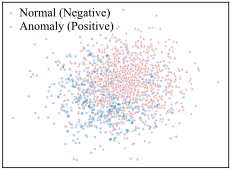
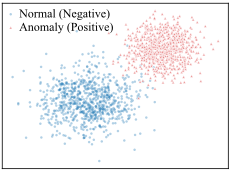
Figure 5: Feature visualization via t-SNE on UCF-Crime dataset.
5 Conclusion
In this work, we proposed MemoVAD, a framework that strategically bridges a lightweight edge detector with a powerful remote VLM. Instead of continuously relying on the cloud, our system learns to seek remote guidance only when uncertain, caching the insights locally to improve over time. Our experiments confirm that the uncertainty-driven collaboration yields state-of-the-art performance with minimal bandwidth usage, demonstrating a practical path for deploying foundation model capabilities in real-world surveillance without being overwhelmed by their computational weight.
Future work will explore extending the paradigm to collaborative edge computing scenarios, where distributed devices can share semantic knowledge and jointly maintain memory. We will also investigate long-term adaptation under nonstationary environments, including scene shifts and evolving anomaly patterns. In addition, more robust memory update and validation mechanisms will be studied to reduce the influence of noisy VLM feedback while preserving the efficiency benefits of selective remote querying.
Acknowledgments
The above work was supported in part by the Joint Funds of the National Natural Science Foundation of China under Grant U25A20436, Guangxi Key Research & Development Program (FN2504240036, 2025FN96441087), the National Natural Science Foundation of China (NSFC) (62372047, 62302049), Guangdong S&T Programme (No. 2025B0101120006), the Natural Science Foundation of Guangdong Province (2024A1515011323), the Supplemental Funds for Major Scientific Research Projects of Beijing Normal University, Zhuhai (ZHPT2023002), the Fundamental Research Funds for the Central Universities, Guangdong Province Educational Science Planning Research Project under 2025JKZG069, Higher Education Research Topics of Guangdong Association of Higher Education in the 14th Five-Year Plan under 24GYB207, Natural Science Foundation of Sichuan under Grant 2026NSFSC1459 and support from the Interdisciplinary Intelligence Super Computer Center of Beijing Normal University at Zhuhai.
@inproceedings{ijcai2026p618,
  title     = {MemoVAD: Resource-Efficient Video Anomaly Detection via Dynamic Semantic Memory in Edge Computing Scenarios},
  author    = {Li, Guo and Zeng, Jiandian and Li, Yang and Peng, Zihao and Chen, Ke and Wang, Tian},
  booktitle = {Proceedings of the Thirty-Fifth International Joint Conference on
               Artificial Intelligence, {IJCAI-26}},
  publisher = {International Joint Conferences on Artificial Intelligence Organization},
  editor    = {Diego Calvanese},
  pages     = {5549--5557},
  year      = {2026},
  month     = {8},
  note      = {Main Track},
  doi       = {10.24963/ijcai.2026/618},
  url       = {https://doi.org/10.24963/ijcai.2026/618},
}
TY - CPAPER TI - MemoVAD: Resource-Efficient Video Anomaly Detection via Dynamic Semantic Memory in Edge Computing Scenarios AU - Li, Guo AU - Zeng, Jiandian AU - Li, Yang AU - Peng, Zihao AU - Chen, Ke AU - Wang, Tian T2 - Proceedings of the Thirty-Fifth International Joint Conference on Artificial Intelligence, IJCAI-26 PB - International Joint Conferences on Artificial Intelligence Organization PY - 2026 SP - 5549 EP - 5557 DO - 10.24963/ijcai.2026/618 UR - https://doi.org/10.24963/ijcai.2026/618 ER -Copied
Machine-readable versions of this paper, for tools and AI agents:





