
UniPocket: Physics-Aware Geometric Graph Learning with Manifold Completeness for Ligand-Specific Binding Site Prediction
Proceedings of the Thirty-Fifth International Joint Conference on Artificial Intelligence. Main Track. Pages 5477-5485.
https://doi.org/10.24963/ijcai.2026/610
Keywords
- Multidisciplinary Topics and Applications: Bioinformatics
Abstract
Predicting ligand binding sites on protein surfaces requires capturing complex local geometries and satisfying physical constraints. Existing voxel-based methods suffer from high computational costs and rotation sensitivity, while standard point-cloud GNNs often lack geometric completeness—failing to distinguish chiral structures or subtle topological variations. In this work, we propose UniPocket, a novel E(3)-equivariant surface graph neural network. Inspired by recent advances in efficient geometric completeness, UniPocket constructs a Manifold-Aware Surface Encoder that utilizes local surface normals as virtual reference frames to capture complete geometric invariants without expensive high-order tensor products. Furthermore, we introduce a Ligand-Gated Message Passing mechanism to condition the surface features on the chemical semantics of the target ligand, and a Physics-Aware Vector Rejection Module that enforces steric constraints via orthogonal vector decomposition. Experimental results on standard benchmarks (PDBbind, COACH420, Holo4k) demonstrate that UniPocket achieves state-of-the-art performance, validating that geometric completeness and physical inductive biases are key to precise binding site detection.
- [Abramson et al., 2024] Josh Abramson, Jonas Adler, Jack Dunger, Richard Evans, Tim Green, Alexander Pritzel, Olaf Ronneberger, Lindsay Willmore, Andrew J Ballard, Joshua Bambrick, et al. Accurate structure prediction of biomolecular interactions with alphafold 3. Nature, 630(8016):493-500, 2024.
- [Batatia et al., 2022] Ilyes Batatia, David P Kovacs, Gregor Simm, Christoph Ortner, and Gábor Csányi. Mace: Higher order equivariant message passing neural networks for fast and accurate force fields. Advances in neural information processing systems, 35:11423-11436, 2022.
- [Batzner et al., 2022] Simon Batzner, Albert Musaelian, Lixin Sun, Mario Geiger, Jonathan P Mailoa, Mordechai Kornbluth, Nicola Molinari, Tess E Smidt, and Boris Kozinsky. E (3)-equivariant graph neural networks for data-efficient and accurate interatomic potentials. Nature communications, 13(1):2453, 2022.
- [Bronstein et al., 2021] Michael M Bronstein, Joan Bruna, Taco Cohen, and Petar Veličković. Geometric deep learn- ing: Grids, groups, graphs, geodesics, and gauges. arXiv preprint arXiv:2104.13478, 2021.
- [Buttenschoen et al., 2024] Martin Buttenschoen, Garrett M Morris, and Charlotte M Deane. Posebusters: Ai-based docking methods fail to generate physically valid poses or generalise to novel sequences. Chemical Science, 15(9):3130-3139, 2024.
- [Cao et al., 2025] Duanhua Cao, Mingan Chen, Runze Zhang, Zhaokun Wang, Manlin Huang, Jie Yu, Xinyu Jiang, Zhehuan Fan, Wei Zhang, Hao Zhou, et al. Surf- dock is a surface-informed diffusion generative model for reliable and accurate protein-ligand complex prediction. Nature Methods, 22(2):310-322, 2025.
- [Corso et al., 2023] Gabriele Corso, Hannes Stärk, Bowen Jing, Regina Barzilay, and Tommi Jaakkola. Diffdock: Diffusion steps, twists, and turns for molecular docking. In The Eleventh International Conference on Learning Rep- resentations, 2023.
- [Desaphy et al., 2015] Jérémy Desaphy, Guillaume Bret, Di- dier Rognan, and Esther Kellenberger. sc-pdb: a 3d- database of ligandable binding sites-10 years on. Nucleic acids research, 43(D1):D399-D404, 2015.
- [Gainza et al., 2020] Pablo Gainza, Freyr Sverrisson, Fred- erico Monti, Emanuele Rodola, Davide Boscaini, Michael M Bronstein, and Bruno E Correia. Decipher- ing interaction fingerprints from protein molecular sur- faces using geometric deep learning. Nature methods, 17(2):184-192, 2020.
- [Jiménez et al., 2017] José Jiménez, Stefan Doerr, Gerard Martínez-Rosell, Alexander S Rose, and Gianni De Fab- ritiis. Deepsite: protein-binding site predictor us- ing 3d-convolutional neural networks. Bioinformatics, 33(19):3036-3042, 2017.
- [Kandel et al., 2021] Jeevan Kandel, Hilal Tayara, and Kil To Chong. Puresnet: prediction of protein-ligand bind- ing sites using deep residual neural network. Journal of cheminformatics, 13(1):65, 2021.
- [Keriven and Peyré, 2019] Nicolas Keriven and Gabriel Peyré. Universal invariant and equivariant graph neural networks. volume 32, 2019.
- [Krishna et al., 2024] Rohith Krishna, Jue Wang, Woody Ahern, Pascal Sturmfels, Preetham Venkatesh, Indrek Kal- vet, Gyu Rie Lee, Felix S Morey-Burrows, Ivan An- ishchenko, Ian R Humphreys, et al. Generalized biomolec- ular modeling and design with rosettafold all-atom. Sci- ence, 384(6693):eadl2528, 2024.
- [Krivák and Hoksza, 2018] Radoslav Krivák and David Hoksza. P2rank: machine learning based tool for rapid and accurate prediction of ligand binding sites from protein structure. Journal of cheminformatics, 10(1):39, 2018.
- [Le Guilloux et al., 2009] Vincent Le Guilloux, Peter Schmidtke, and Pierre Tuffery. Fpocket: an open source platform for ligand pocket detection. BMC bioinformatics, 10(1):168, 2009.
- [Lee and Richards, 1971] Byungkook Lee and Frederic M Richards. The interpretation of protein structures: estima- tion of static accessibility. Journal of molecular biology, 55(3):379-IN4, 1971.
- [Lu et al., 2022] Wei Lu, Qifeng Wu, Jixian Zhang, Jiahua Rao, Chengtao Li, and Shuangjia Zheng. Tankbind: Trigonometry-aware neural networks for drug-protein binding structure prediction. Advances in neural informa- tion processing systems, 35:7236-7249, 2022.
- [Mylonas et al., 2021] Stelios K Mylonas, Apostolos Axenopoulos, and Petros Daras. Deepsurf: a surface- based deep learning approach for the prediction of ligand binding sites on proteins. Bioinformatics, 37(12):1681- 1690, 2021.
- [Pei et al., 2023] Qizhi Pei, Kaiyuan Gao, Lijun Wu, Jinhua Zhu, Yingce Xia, Shufang Xie, Tao Qin, Kun He, Tie-Yan Liu, and Rui Yan. Fabind: Fast and accurate protein-ligand binding. Advances in Neural Information Processing Sys- tems, 36:55963-55980, 2023.
- [Sanner et al., 1996] Michel F Sanner, Arthur J Olson, and Jean-Claude Spehner. Reduced surface: an efficient way to compute molecular surfaces. Biopolymers, 38(3):305- 320, 1996.
- [Satorras et al., 2021] Vıctor Garcia Satorras, Emiel Hooge- boom, and Max Welling. E (n) equivariant graph neural networks. pages 9323-9332, 2021.
- [Schütt et al., 2017] Kristof Schütt, Pieter-Jan Kindermans, Huziel Enoc Sauceda Felix, Stefan Chmiela, Alexan- dre Tkatchenko, and Klaus-Robert Müller. Schnet: A continuous-filter convolutional neural network for model- ing quantum interactions. Advances in neural information processing systems, 30, 2017.
- [Stepniewska-Dziubinska et al., 2020] Marta M Stepniewska-Dziubinska, Piotr Zielenkiewicz, and Pawel Siedlecki. Improving detection of protein-ligand binding sites with 3d segmentation. Scientific reports, 10(1):5035, 2020.
- [Thomas et al., 2018] Nathaniel Thomas, Tess Smidt, Steven Kearnes, Lusann Yang, Li Li, Kai Kohlhoff, and Patrick Riley. Tensor field networks: Rotation-and translation- equivariant neural networks for 3d point clouds. arXiv preprint arXiv:1802.08219, 2018.
- [Townshend et al., 2021] Raphael JL Townshend, Martin Vögele, Patricia Suriana, Alexander Derry, Alexander Powers, Yianni Laloudakis, Sidhika Balachandar, Bowen Jing, Brandon Anderson, Stephan Eismann, et al. Atom3d: Tasks on molecules in three dimensions. 2021.
- [Tubiana et al., 2022] Jérôme Tubiana, Dina Schneidman- Duhovny, and Haim J Wolfson. Scannet: an interpretable geometric deep learning model for structure-based protein binding site prediction. Nature methods, 19(6):730-739, 2022.
- [Vural and Jololian, 2025] Orhun Vural and Leon Jololian. Machine learning approaches for predicting protein-ligand binding sites from sequence data. Frontiers in Bioinfor- matics, 5:1520382, 2025.
- [Wang et al., 2004] Renxiao Wang, Xueliang Fang, Yipin Lu, and Shaomeng Wang. The pdbbind database: col- lection of binding affinities for protein-ligand complexes with known three-dimensional structures. Journal of medicinal chemistry, 47(12):2977-2980, 2004.
- [Wang et al., 2024] Yusong Wang, Tong Wang, Shaoning Li, Xinheng He, Mingyu Li, Zun Wang, Nanning Zheng, Bin Shao, and Tie-Yan Liu. Enhancing geometric representa- tions for molecules with equivariant vector-scalar interac- tive message passing. Nature Communications, 15(1):313, 2024.
- [Wang et al., 2025] Yanli Wang, Frimpong Boadu, and Jian- lin Cheng. Mpbind: a multitask protein binding site pre- dictor using protein language models and equivariant gnns. Bioinformatics, 41(11):btaf589, 2025.
- [Yan et al., 2022] Xu Yan, Yingfeng Lu, Zhen Li, Qing Wei, Xin Gao, Sheng Wang, Song Wu, and Shuguang Cui. Pointsite: a point cloud segmentation tool for identifica- tion of protein ligand binding atoms. Journal of chemical information and modeling, 62(11):2835-2845, 2022.
- [Zhang et al., 2024] Yang Zhang, Zhewei Wei, Ye Yuan, Chongxuan Li, and Wenbing Huang. Equipocket: an e(3)-equivariant geometric graph neural network for lig- and binding site prediction. In Forty-first International Conference on Machine Learning, 2024.
- [Zhang et al., 2025a] Zhijun Zhang, Lijun Quan, Junkai Wang, Liangchen Peng, Qiufeng Chen, Bei Zhang, Lexin Cao, Yelu Jiang, Geng Li, Liangpeng Nie, et al. Labind: Identifying protein binding ligand-aware sites via learning interactions between ligand and protein. Nature Commu- nications, 16(1):7712, 2025.
- [Zhang et al., 2025b] Zizhuo Zhang, Lijun Wu, Kaiyuan Gao, Jiangchao Yao, Tao Qin, and Bo Han. Fast and accu- rate blind flexible docking. In The Thirteenth International Conference on Learning Representations, 2025.
References were extracted automatically from the PDF and may contain errors.
Full text extracted automatically from the PDF; figures, tables and equations may differ. The PDF is the version of record.
1 Introduction
The precise identification of protein-ligand binding sites (pockets) is a prerequisite for structure-based drug design (SBDD) and virtual screening [Vural and Jololian, 2025]. While recent foundation models like AlphaFold 3 [Abramson et al., 2024] and RoseTTAFold All-Atom [Krishna et al., 2024] show unprecedented accuracy in biomolecular interaction modeling, they are computationally intensive and primarily designed for holo-structure prediction given a known ligand. They are not suited for rapidly scanning apo-structures to identify potential binding cavities. Therefore, efficient and accurate ligand-specific binding site detection on rigid protein surfaces remains a critical, standalone task.
*Corresponding author
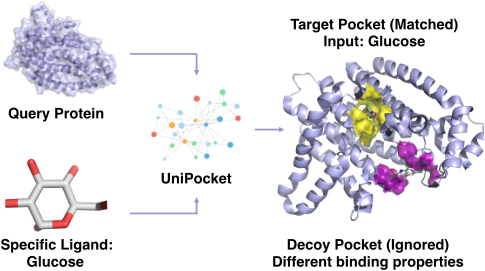
Traditional approaches for pocket detection, including geometry-based (e.g., Fpocket [Le Guilloux et al., 2009]) and template-based methods [Desaphy et al., 2015], along with early ML methods (e.g., P2Rank [Kriv´ak and Hoksza, 2018], DeepSite [Jim´enez et al., 2017]) using handcrafted features or voxelized grids, often suffer from rotation variance and sparsity. Geometric Deep Learning (GDL) [Bronstein et al., 2021; Townshend et al., 2021] addressed some of these limitations by modeling proteins as geodesic surfaces [Gainza et al., 2020; Mylonas et al., 2021; Tubiana et al., 2022] or graphs [Satorras et al., 2021], enabling the capture of invariant topological patterns. However, most existing surface encoders primarily focus on protein shape complementarity, neglecting explicit physicochemical compatibility with the specific query ligand. This creates a critical expressivity-efficiency trade-off in GDL for proteins: highorder equivariant networks (e.g., TFN [Thomas et al., 2018], MACE [Batatia et al., 2022]) provide theoretical completeness but incur prohibitive cubic computational costs, while efficient distance-based GNNs (e.g., EGNN [Satorras et al., 2021]) often lack geometric completeness crucial for subtle local topologies and precise binding site prediction. Furthermore, recent ligand-aware methods like LABind [Zhang et al., 2025a] and FABind [Pei et al., 2023] incorporate ligand information but often rely on complex mechanisms, increasing computational complexity or lacking the fine-grained geometric completeness needed for accurate pocket detection.
To bridge these gaps, we propose UniPocket, a novel E(3)- equivariant surface graph neural network. UniPocket formulates protein pocket detection on a discretized Riemannian manifold, employing a Manifold-Aware Surface Encoder. Instead of heavy tensor products, it leverages intrinsic protein surface geometry (surface normals and curvatures) to construct local reference frames (virtual nodes), achieving efficient geometric completeness. This approach effectively captures anisotropic geometric invariants (e.g., curvature tensors) crucial for high-precision pocket recognition, without the computational overhead of high-order spherical harmonics. Combined with explicit physical constraints, UniPocket offers a robust and efficient solution for specific binding site detection.
Our main contributions are summarized as follows:
- Manifold-Aware Geometric Completeness with Surface-Normal-Based Encoder: We propose a Surface-Normal-Based Encoder that achieves geometric completeness on protein manifolds. By utilizing surface normals as local reference frames, our method efficiently captures anisotropic geometric invariants (e.g., curvature tensors) necessary for high-precision pocket recognition, avoiding the computational overhead of high-order spherical harmonics.
- Conditional Ligand-Gated Message Passing for Ligand-Specificity: We introduce a conditional graph operator that dynamically modulates the protein manifold features based on the target ligand's chemical graph. This mechanism transforms the generic pocket detection task into a ligand-specific geometric reasoning problem, effectively pruning biologically irrelevant cavities.
- Physics-Aware Inductive Bias via Vector Decomposition: We design a Physics-Aware Vector Rejection Module as a differentiable geometric inductive bias. By mathematically decomposing interaction vectors into orthogonal normal (clash-inducing) and tangential (surface-fitting) components, we explicitly enforce hard steric constraints within the neural architecture, ensuring physically valid predictions.
2 RelatedWork
2.1 Efficient Geometric Deep Learning
Geometric Deep Learning (GDL) enforces physical symmetries (e.g., SE(3)-equivariance) in molecular modeling [Bronstein et al., 2021]. Early methods like TFN [Thomas et al., 2018] and NequIP [Batzner et al., 2022] achieved theoretical completeness but suffered from cubic computational complexity. To improve efficiency, scalarizationbased approaches such as E(n)-GNN [Satorras et al., 2021], SchNet [Sch¨utt et al., 2017], and ViSNet [Wang et al., 2024] utilized inter-atomic distances and vector-scalar interactions. However, many distance-based GNNs lack geometric completeness, struggling with chiral structures or complex anisotropic patterns. Recent work, like Uni-EGNN [Keriven and Peyr´e, 2019], demonstrates that local reference frames can achieve efficient geometric completeness. Following this paradigm, UniPocket employs intrinsic surface normals as natural reference frames to construct a geometrically complete surface encoder, balancing high expressivity with linear efficiency.
2.2 Evolution of Binding Site Prediction
Binding site prediction has evolved from traditional geometric/ML methods (e.g., Fpocket [Le Guilloux et al., 2009], P2Rank [Kriv´ak and Hoksza, 2018]) to deep learning approaches. Early deep learning utilized 3D-CNNs (e.g., DeepSite [Jim´enez et al., 2017], Kalasanty [StepniewskaDziubinska et al., 2020]) operating on voxel grids, which suffered from high memory costs, discretization errors, and rotation sensitivity despite improvements like PuResNet [Kandel et al., 2021]. Subsequently, methods shifted to manifold learning (e.g., MaSIF [Gainza et al., 2020], DeepSurf [Mylonas et al., 2021], ScanNet [Tubiana et al., 2022]) or point-cloud processing (e.g., PointSite [Yan et al., 2022], EquiPocket [Zhang et al., 2024]) to overcome grid limitations. While these capture static geometry, they often operate "blindly," neglecting ligand-specific chemical constraints and lacking explicit mechanisms to handle physical clashes.
2.3 Ligand-Aware Prediction and Docking
The trend in 2024-2025 is moving towards ligandspecific prediction. Regression-based frameworks such as TankBind [Lu et al., 2022] and FABind [Pei et al., 2023] integrate pocket prediction before docking. Other notable approaches like LABind [Zhang et al., 2025a] and MPBind [Wang et al., 2025] explicitly learn ligand-protein interactions using graph transformers or protein language models. Generative diffusion models (e.g., DiffDock [Corso et al., 2023], SurfDock [Cao et al., 2025]) implicitly identify binding sites during pose generation, but are often computationally expensive and may produce physically invalid structures lacking hard geometric constraints [Buttenschoen et al., 2024]. UniPocket differentiates itself by offering a lightweight, geometrically complete, and physics-driven filtering mechanism, specifically designed for rapid and accurate screening of large datasets like PDBbind [Wang et al., 2004] and scPDB [Desaphy et al., 2015].
3 Methodology
3.1 ProblemFormulation
The objective of rigid protein-ligand binding site prediction is to identify the subset of surface points on a protein that are most likely to interact with a specific query ligand. Let a protein structure be represented by its surface point cloud P = {xi, hi}Ni=1 , where xi ∈ R3 denotes the spatial coordinate and hi ∈ RdP represents the physicochemical features of the i-th point. Similarly, a query ligand is defined as a molecular graph GL = (VL, EL), where nodes VL represent atoms and edges EL represent chemical bonds. Our goal is to learn a mapping function Fθ(P, GL) → Y, where Y ∈ [0, 1]N represents the probability map indicating the binding likelihood of each surface point.
3.2 Input Representation and Graph Construction
Protein Surface Modeling
Unlike voxel-based methods that suffer from sparsity issues, we model the protein surface as a geometric graph. Initially, the Solvent Excluded Surface (SES) [Lee and Richards, 1971] is generated using the MSMS tool [Sanner et al., 1996] with a probe radius of 1.5 ˚A. To balance resolution and computational efficiency, we perform geodesic-based uniform sampling to obtain a fixed number of points N (default N = 2000).
We construct a sparse k-nearest neighbor (k-NN) graph GP = (VP , EP ) on these points. For each node i, the initial feature vector h(0) i is a concatenation of geometric and chemical descriptors:
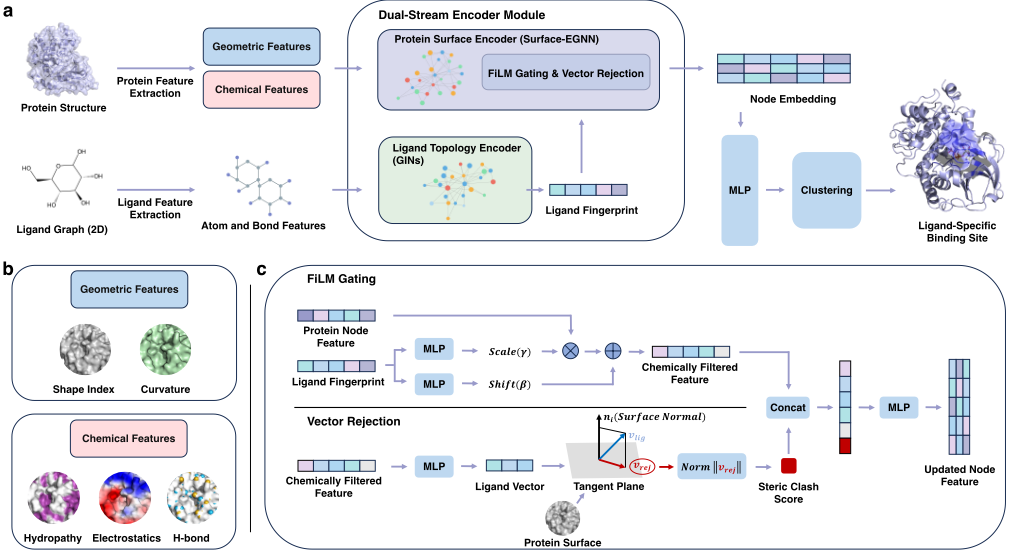
- Geometric Features: As shown in Figure 2b, we compute the local curvature (mean and Gaussian), shape index, and the unit normal vector ni ∈ R3 pointing outward from the surface. The normal vector is critical for our subsequent vector rejection module.
- Chemical Features: We project properties from the nearest protein atoms to the surface points. These include hydropathy scores (Kyte-Doolittle scale), partial
charges, and hydrogen bond donor/acceptor boolean flags.
Mathematically, h(0) i = [Curvi ∥Chemi ∥ni] ∈ Rdin .
Ligand Topological Graph
To ensure the model handles flexible ligands robustly without relying on potentially inaccurate 3D conformer generation, we represent the ligand strictly as a 2D topological graph. The node features zu (u ∈ VL) consist of one-hot encodings of atomic number (C, N, O, F, P, S, Cl, Br, I), degree of hybridization, chirality, and aromaticity. Edge features euv encode bond types (single, double, triple, aromatic) and conjugated system flags. This pure 2D representation ensures that our encoder learns a conformer-invariant fingerprint of the ligand.
3.3 Dual-StreamEncoder Architecture
As illustrated in Figure 2a, our model consists of two parallel encoders.
Protein Encoder: Surface-EGNN
To capture the intrinsic geometry of the protein surface while maintaining symmetry requirements, we employ a SurfaceEquivariant Graph Neural Network (Surface-EGNN). Standard GNNs are invariant to rotation, which loses directional information (e.g., the orientation of a pocket opening). Conversely, standard CNNs are not rotation-equivariant. Our Surface-EGNN updates both scalar features hi and coordinate coordinates xi to ensure E(3)-equivariance. A detailed proof of E(3)-equivariance for our Surface-EGNN is provided in Section 1 of the Supplementary Material.
| Method | Type | Params (M) | PDBbind 2020 (Test) | COACH420 (Generalization) | Holo4k (Generalization) | ||||||
|---|---|---|---|---|---|---|---|---|---|---|---|
| DCC ↓ | DCA ↓ | Succ. ↑ | DCC ↓ | DCA ↓ | Succ. ↑ | DCC ↓ | DCA ↓ | Succ. ↑ | |||
| Fpocket | Geometric | - | 3.12 | 3.45 | 40.1 | 2.85 | 3.10 | 45.2 | 3.50 | 4.10 | 38.5 |
| P2Rank | ML-based | 1.0 | 1.65 | 2.10 | 62.3 | 1.50 | 1.80 | 68.5 | 1.95 | 2.30 | 55.4 |
| DeepSurf | 3D-CNN | 33.1 | 1.35 | 1.60 | 68.9 | 1.20 | 1.45 | 72.1 | 1.65 | 2.10 | 60.2 |
| Kalasanty | 3D-CNN | 70.6 | 1.48 | 1.82 | 61.2 | 1.35 | 1.55 | 65.4 | 1.80 | 2.25 | 58.1 |
| ViSNet | GNN | 1.2 | 1.05 | 1.25 | 75.4 | 0.95 | 1.10 | 78.2 | 1.25 | 1.55 | 68.4 |
| EquiPocket | E(3)-GNN | 1.7 | 1.02 | 1.20 | 76.1 | 0.98 | 1.15 | 77.5 | 1.15 | 1.40 | 70.2 |
| Comparison with Recent End-to-End Docking SOTA | |||||||||||
| FABFlex [Zhang et al., 2025b] | Docking | - | 3.25 | - | - | - | - | - | - | - | - |
| UniPocket | Vector-Field | 0.8 | 0.92 | 1.11 | 78.3 | 0.91 | 0.98 | 81.2 | 0.98 | 1.25 | 73.8 |
Table 1: Comprehensive performance comparison. We evaluate UniPocket against baselines on PDBbind 2020 (test set) and two external datasets (COACH420, Holo4k). Comparison with 2025 SOTA: FABFlex is included for reference. UniPocket demonstrates superior localization accuracy (DCC) with significantly fewer parameters.
For each layer l, the message passing phase aggregates information from neighbors N (i):
where ϕe is an MLP and aij denotes edge attributes. Crucially, the coordinate update is designed to model local surface deformations akin to "breathing" motions or induced fit simulations:
Here, ϕx outputs a scalar weight, modulating the relative position update. Finally, the node features are updated via a residual connection:
This architecture allows the network to learn higher-order geometric patterns such as cavity depth and local ruggedness effectively.
Ligand Encoder: GIN with Isomorphism Testing
We utilize a Graph Isomorphism Network (GIN) to process the ligand graph. GIN provides discriminative power theoretically equivalent to the Weisfeiler-Lehman (WL) graph isomorphism test. The node update rule is given by:
After L layers, we apply a global Sum-Pooling readout operation to obtain the ligand fingerprint vector hlig ∈ RdL , which summarizes the global physicochemical constraints of the drug molecule.
3.4 Ligand-Gated InteractionModule
This module constitutes the core innovation of UniPocket. Merely concatenating protein and ligand features is insufficient for capturing the complex steric and electrostatic compatibility required for binding. We introduce a two-stage interaction mechanism.
Chemical Filtering via FiLM
We employ a gating mechanism inspired by Feature-wise Linear Modulation (FiLM). The ligand fingerprint acts as a "condition" to modulate the activations of the protein surface features. We compute a scaling vector γ and a shifting vector β from hlig:
The modulated protein feature ˆhi is then obtained via:
where ⊙ denotes the Hadamard product. This step effectively suppresses signals from surface regions that are chemically incompatible with the ligand (e.g., highly charged regions for a lipophilic ligand).
Geometric Filtering via Vector Rejection
As detailed in Figure 2c, while FiLM handles chemical compatibility, steric complementarity is inherently geometric and directional. Standard attention mechanisms operate on scalars and lose the explicit directionality of steric clashes. To explicitly model these directional steric constraints, we incorporate a Vector Rejection mechanism. This module performs E(3)-equivariant vector manipulations to extract rotation-invariant steric clash signals, which are then integrated into the protein features.
We generate a Local Ligand Interaction Vector v(i) lig from the ligand-modulated feature ˆhi. Since ˆhi integrates both the local protein geometry (from Surface-EGNN) and the specific ligand context (via FiLM), v(i) lig represents the expected ligand orientation relative to the local surface point i:
This predicted vector v(i) lig is E(3)-equivariant (i.e., it transforms consistently under rotations and translations of the protein surface). We then decompose this vector relative to the local surface normal ni (which is dynamically updated and also E(3)-equivariant). The core idea is to reject or penalize the component of v(i) lig that would lead to steric clashes or unphysical penetration into the protein surface. Specifically, the vector is split into its parallel (normal) and perpendicular (tangential) components:
Or, more explicitly:
This v(i) rej represents the component of the interaction vector that lies in the tangent plane of the protein surface. Its magnitude, s(i) clash = ∥v(i) rej ∥, quantifies the geometric "disagreement" or steric clash potential in the tangent plane of the surface. Crucially, as a scalar magnitude of an E(3)-equivariant vector, s(i) clash is rotation-invariant. This value is injected back into the node features as a penalty term:
By incorporating this rotation-invariant steric clash score s(i) clash , the model is explicitly discouraged from predicting binding sites in regions where the ligand's expected steric profile contradicts the local surface topology.
3.5 Training and Inference
Loss Function
The problem is formulated as a binary classification task on imbalanced point clouds. We employ a Weighted Binary Cross-Entropy loss. Let yi ∈ {0, 1} be the ground truth label for point i, where yi = 1 if the point is within 4 ˚A of any ligand atom.
where pi = Sigmoid(MLPcls(˜hi)) is the predicted probability. The weight wpos is crucial for handling the severe class imbalance inherent in binding site prediction. We dynamically adjust wpos for each batch to be the ratio of negative samples to positive samples: wpos = Nneg/Npos, where Nneg and Npos are the number of non-pocket and pocket points in the current training batch, respectively. This ensures that the model pays adequate attention to the minority (positive) class.
Clustering and Ranking
During inference, the model outputs a raw probability map. To generate discrete binding pockets, we perform postprocessing: (1) Thresholding: Filter points with pi < τ (typically τ = 0.5). (2) Clustering: Apply DBSCAN on the remaining points. We set the parameters ϵ = 2.5 ˚A and min samples = 5. (3) Ranking: Clusters are ranked by a scoring function Sk = ∑j∈Ck pαj , where α = 2 encourages clusters with high-confidence cores. The center of the top-1 ranked cluster is output as the predicted binding site.
3.6 Implementation Details
Network Architecture. The overall training pipeline of UniPocket, encompassing dual-stream encoding, ligandgated interaction, and optimization, is detailed in Algorithm 1, presented in Section 2 of the Supplementary Material. UniPocket is implemented using PyTorch Geometric. The ligand encoder consists of a 3-layer Graph Isomorphism Network (GIN). The protein surface encoder utilizes 4 layers of E(3)-equivariant convolution operations (Surface-EGNN). The hidden feature dimension d is set to 128. We use Gaussian Radial Basis Functions (RBF) to encode continuous edge distances with K = 16 basis kernels. The Vector Rejection module is implemented as a learnable projection head that outputs 3D vectors in the local frame.
Training Configuration. We train the model for 100 epochs using the Adam optimizer with an initial learning rate of 1×10⁻⁴ and a weight decay of 1×10⁻⁵ . The loss balancing hyperparameter wpos is dynamically calculated per batch. To ensure robustness, we apply random SO(3) rotations to the input protein surfaces during training. All experiments are conducted on a single NVIDIA RTX 4090 GPU (24GB).
4 Experiments
4.1 Experimental Setup
Datasets. We evaluate UniPocket on standard benchmark datasets derived from PDBbind v2020, following evaluation protocols established by previous works [Zhang et al., 2024; Lu et al., 2022]. The dataset is strictly partitioned into training (15,000 complexes), validation (1,000 complexes), and testing (1,000 complexes) sets. This partitioning is based on a rigorous time-split strategy, which is crucial to prevent structural data leakage and accurately mimic real-world prospective drug discovery scenarios. To rigorously test the generalization capability, we also employ two external test sets: COACH420 and Holo4k, which contain diverse protein structures unseen during training. Ligand structures are processed using RDKit to generate 2D molecular graphs, while protein surfaces are generated using MSMS with a density of 1.5 vertices/ ˚ A2 .
Baselines. We compare UniPocket with representative methods across three categories: (1) Geometry-based methods: Fpocket [Le Guilloux et al., 2009] and P2Rank [Kriv´ak and Hoksza, 2018]; (2) Voxel-based Deep Learning: DeepSite [Jim´enez et al., 2017] and Kalasanty [StepniewskaDziubinska et al., 2020]; (3) Graph-based & Equivariant GNNs: ViSNet [Wang et al., 2024] and the recent SOTA EquiPocket [Zhang et al., 2024].
Note on 2025 SOTA Methods: We also consider recent advancements in 2025. FABFlex [Zhang et al., 2025b], a state-of-the-art flexible docking model, is included as a reference.
Evaluation Metrics. We report the Distance Center-toCenter (DCC) and Distance Center-to-Atom (DCA). A prediction is considered successful if the DCC is within a threshold (typically 4˚ A). We summarize the performance using Success Rate (Succ.), which measures the percentage of targets where the Top-1 predicted pocket is correct.
Additionally, to evaluate the ability of models to differentiate between distinct binding site types, we employ the Matthews Correlation Coefficient (MCC). MCC is a robust metric for binary and multi-class classification that considers true and false positives and negatives, making it suitable for imbalanced datasets. It ranges from -1 (total disagreement between prediction and observation) to +1 (perfect prediction), with 0 indicating random prediction. A higher MCC value signifies a more accurate and reliable classification performance, particularly in distinguishing between different classes.
4.2 Performance Comparison
Table 1 presents the comprehensive results on COACH420 and PDBbind datasets. UniPocket achieves state-of-the-art performance across all metrics, validating the effectiveness of our physics-aware geometric design.
Superiority over Geometric and Voxel-based Methods. As shown in Table 1, UniPocket significantly outperforms traditional geometry-based methods (Fpocket) and voxel-based CNN methods (DeepSurf). While CNN-based methods improve performance by learning from 3D grids, they require massive parameters (e.g., Kalasanty: 70.6M) and suffer from rotation variance. UniPocket, utilizing rotation-equivariant surface message passing, achieves a substantial improvement in Success Rate by nearly 10 percentage points compared to DeepSurf (68.9% → 78.3%), while using only a fraction of the parameters.
Comparison with State-of-the-Art GNNs. Compared to the strongest baseline EquiPocket, UniPocket improves the Top-1 Success Rate by a distinct margin on PDBbind (76.1% → 78.3%). This gain verifies our hypothesis: utilizing ligand chemical constraints (via the Ligand-Gated mechanism) effectively filters out geometrically plausible but chemically incompatible cavities. Furthermore, the proposed Vector Rejection mechanism allows the model to explicitly penalize steric clashes, which purely geometric GNNs often fail to distinguish.
Comparison with End-to-End Docking SOTA. Recently, FABFlex [Zhang et al., 2025b] established a new state-ofthe-art in flexible docking. We utilized its official pre-trained model to perform inference on our test set. As shown in Table 1, UniPocket achieves superior pocket localization accuracy (DCC 0.92 ˚A vs. FABFlex 3.25 ˚A). This demonstrates that while end-to-end docking models are powerful, specialized pocket detection models like UniPocket still maintain a significant advantage in geometric precision and localization stability.
Performance in Ligand-Specific Binding Site Type Differentiation
UniPocket's core strength lies in its ability to differentiate binding sites based on the query ligand type, a capability Class of the other binding sites on a protein quantitatively assessed in Figure 3.
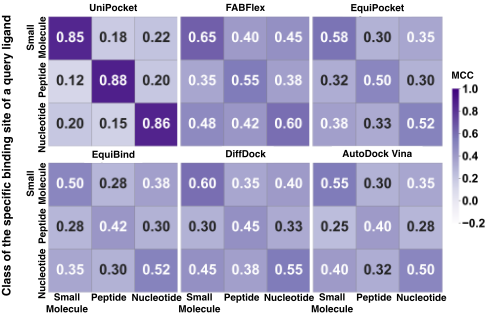
Figure 3: Performance comparison of different models in differentiating ligand-specific binding site types. Each sub-panel illustrates a model's ability to identify the actual binding site type on a protein (X-axis) given a query ligand type (Y-axis). The values within the cells represent the Matthews Correlation Coefficient (MCC), ranging from -0.2 to 1.0, where higher MCC indicates better classification performance. The intensity of the purple color reflects the magnitude of the MCC value, with darker shades indicating higher MCC.
As depicted, UniPocket consistently achieves remarkably high MCC values along the diagonal elements (e.g., 0.85 for Small-Molecule, 0.88 for Peptide, and 0.86 for Nucleotide queries). This signifies its exceptional accuracy in identifying binding sites that precisely match the queried ligand type. Crucially, UniPocket maintains extremely low MCC values on off-diagonal elements (mostly ranging from 0.12 to 0.22), robustly demonstrating its high specificity and selectivity in avoiding confusion with other existing binding site types. This superior performance is attributed to the synergistic action of UniPocket's unique Ligand-Gated mechanism and Physics-Aware Vector Rejection module, which effectively filter out geometrically plausible but chemically incompatible cavities.
In stark contrast, baseline models exhibit significant limitations in this task. FABFlex, EquiPocket, EquiBind, DiffDock, and AutoDock Vina generally show lower diagonal MCC values and relatively higher off-diagonal MCC values. This indicates their propensity for confusion between different binding site types and a general struggle to achieve high-specificity and high-accuracy differentiation. Traditional docking tools, in particular, lack the mechanistic ability to perceive and differentiate binding sites based on ligand characteristics.
4.3 Efficiency and Complexity Analysis
Computational efficiency is crucial for large-scale virtual screening. We compare the inference latency on a single NVIDIA RTX 4090 GPU. Sampling-based blind docking methods (e.g., DiffDock) typically require 20-40 steps of diffusion, taking approximately 14 seconds per complex. In contrast, UniPocket leverages lightweight surface graphs and a one-shot prediction head, requiring only 0.12 seconds per complex. Moreover, as indicated in the "Params" column of Table 1, UniPocket is highly lightweight (≈ 0.8M parameters), which is orders of magnitude smaller than 3D-CNN models (Kalasanty: 70.6M). This 100× speedup and low memory footprint make UniPocket highly suitable for highthroughput screening of massive ligand libraries.
| Variant | DCC ↓ | DCA ↓ | Succ. ↑ | ∆ Succ. |
|---|---|---|---|---|
| w/o Ligand Gate | 1.45 | 1.80 | 65.2 | -13.1% |
| w/o Surface Normals | 1.15 | 1.35 | 75.8 | -2.5% |
| w/o Vector Rejection | 1.08 | 1.28 | 74.1 | -4.2% |
| UniPocket (Full) | 0.92 | 1.11 | 78.3 | - |
4.4 Ablation Study
To investigate the contribution of each proposed module illustrated in Figure 2, we conduct ablation studies on the PDBbind test set. Specifically, we analyze the impact of the ligand-gated mechanism and vector rejection (Figure 2c). Quantitative results are summarized in Table 2.
- w/o Ligand Gate: Replacing the ligand-gated message passing with standard isotropic GNN layers leads to the most significant performance drop (Success Rate: 78.3% → 65.2%). This confirms that the ligand fingerprint acts as a critical filter for pruning the geometrically plausible but chemically incompatible search space.
- w/o Vector Rejection: Removing the geometry filtering mechanism results in a clear performance decrease, with the Success Rate dropping by 4.2%. This suggests that explicitly modeling orthogonal geometric constraints (steric hindrance) helps in refining the pocket boundaries and reducing false positives.
- w/o Surface Normals: Excluding surface normal information results in higher distance errors (DCC increases from 0.92˚ A to 1.15˚ A), indicating that surface orientation features are critical for defining local curvature and identifying deep pockets.
4.5 Qualitative Analysis: Adaptability to Ligand Modalities
A significant challenge in pocket detection is the geometric diversity of binding sites. Small-molecule pockets are typically deep and concave, whereas peptide-binding sites are often shallow and flat. Geometry-based methods often struggle to distinguish these distinct topologies co-existing on the same protein.
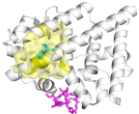
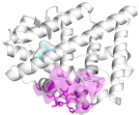
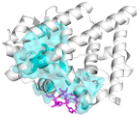
Figure 4 presents a case study on Bcl-xL (PDB: 1L2I), which accommodates both binding modalities.
- When queried with the small-molecule inhibitor (cyan), UniPocket successfully identifies the deep hydrophobic groove (Fig. 4a).
(a) UniPocket
(Query: Drug)
(c) Baseline
(Geometry-based)
Figure 4: Controllable pocket detection by UniPocket. (a) When queried with the drug ligand (cyan sticks), UniPocket specifically identifies the drug-binding site (yellow surface) while ignoring the peptide pocket. (b) Conversely, when queried with the peptide (magenta sticks), it accurately localizes the peptide-binding interface (magenta surface). (c) In contrast, the baseline geometry-based method detects all potential cavities (cyan surface) without distinguishing between the two distinct binding sites.
- Critically, when queried with the peptide ligand (magenta), the model accurately shifts attention to the shallower peptide-binding interface (Fig. 4b), a region often overlooked or merged by conventional cavity detectors.
- In contrast, baseline methods based purely on geometry (Fig. 4c) detect all concavities without distinguishing between the deep pocket and the shallow peptide site.
This comparison highlights UniPocket's ability to adapt its detection strategy based on the input ligand type, effectively handling both small-molecule and peptide binding sites.
5 Conclusion
In this paper, we presented UniPocket, a geometrically complete and physics-aware framework for ligand-specific binding site detection. Unlike traditional methods that treat cavities as static geometric voids, UniPocket leverages a Manifold-Aware Surface Encoder to capture intricate local topologies using surface normals as intrinsic reference frames. By integrating this with a Ligand-Gated Message Passing mechanism and a Vector Rejection inductive bias, our model explicitly filters out surface regions that are geometrically accessible but chemically incompatible. Extensive experiments on PDBbind, COACH420, and HOLO4k benchmarks demonstrate that UniPocket significantly outperforms state-of-the-art baselines (including P2Rank and EquiPocket), particularly in distinguishing allosteric sites. Furthermore, our efficient surface-canonicalization formulation enables high-throughput scanning, offering an approximately 100-fold speedup over diffusion-based blind docking methods.
Acknowledgments
This work was supported in part by the National Natural Science Foundation of China (Grant Nos. 62471266, 62006131, and 62071260), the Ningbo Major Research and Development Plan (Grant No. 2023Z224), and the Scientific Research Foundation of Chongqing University of Technology (Grant No. 2025ZDZ022).
@inproceedings{ijcai2026p610,
  title     = {UniPocket: Physics-Aware Geometric Graph Learning with Manifold Completeness for Ligand-Specific Binding Site Prediction},
  author    = {Chen, Kangxin and Zhao, Jieyu and Hu, Jinli and Xie, Min},
  booktitle = {Proceedings of the Thirty-Fifth International Joint Conference on
               Artificial Intelligence, {IJCAI-26}},
  publisher = {International Joint Conferences on Artificial Intelligence Organization},
  editor    = {Diego Calvanese},
  pages     = {5477--5485},
  year      = {2026},
  month     = {8},
  note      = {Main Track},
  doi       = {10.24963/ijcai.2026/610},
  url       = {https://doi.org/10.24963/ijcai.2026/610},
}
TY - CPAPER TI - UniPocket: Physics-Aware Geometric Graph Learning with Manifold Completeness for Ligand-Specific Binding Site Prediction AU - Chen, Kangxin AU - Zhao, Jieyu AU - Hu, Jinli AU - Xie, Min T2 - Proceedings of the Thirty-Fifth International Joint Conference on Artificial Intelligence, IJCAI-26 PB - International Joint Conferences on Artificial Intelligence Organization PY - 2026 SP - 5477 EP - 5485 DO - 10.24963/ijcai.2026/610 UR - https://doi.org/10.24963/ijcai.2026/610 ER -Copied
Machine-readable versions of this paper, for tools and AI agents:





