
Single-Round Clustered Federated Learning via Data Collaboration Analysis for Non-IID Data
Proceedings of the Thirty-Fifth International Joint Conference on Artificial Intelligence. Main Track. Pages 4858-4866.
https://doi.org/10.24963/ijcai.2026/541
Keywords
- Machine Learning: Clustering
- Machine Learning: Federated learning
- Machine Learning: Classification
Abstract
Federated Learning (FL) enables distributed learning across multiple clients without sharing raw data. When statistical heterogeneity across clients is severe, Clustered Federated Learning (CFL) can improve performance by grouping similar clients and training cluster-wise models. However, most CFL approaches rely on multiple communication rounds for cluster estimation and model updates, which limits their practicality under tight constraints on communication rounds. We propose Data Collaboration-based Clustered Federated Learning (DC-CFL), a single-round framework that completes both client clustering and cluster-wise learning, using only the information shared in DC analysis. DC-CFL quantifies inter-client similarity via total variation distance between label distributions, estimates clusters using hierarchical clustering, and performs cluster-wise learning via DC analysis. Experiments on multiple open datasets under representative non-IID conditions show that DC-CFL achieves accuracy comparable to multi-round baselines while requiring only one communication round. These results indicate that DC-CFL is a practical alternative for collaborative AI model development when multiple communication rounds are impractical. Our source code is publicly available at https://github.com/soutasuga/DC-CFL.
- [Blackard and Dean, 1999] Jock A. Blackard and Denis J. Dean. Comparative accuracies of artificial neural net- works and discriminant analysis in predicting forest cover types from cartographic variables. Computers and Elec- tronics in Agriculture, 24(3):131-151, 1999.
- [Bogdanova et al., 2020] Anna Bogdanova, Akie Nakai, Yukihiko Okada, Akira Imakura, and Tetsuya Sakurai. Federated learning system without model sharing through integration of dimensional reduced data representations. In Proceedings of the IJCAI 2020 International Workshop on Federated Learning for User Privacy and Data Confi- dentiality, 2020.
- [Chen and Omote, 2021] Zhaoheng Chen and Kazumasa Omote. A privacy-preserving scheme with dimensionality reduction for distributed machine learning. In Proceed- ings of the 2021 16th Asia Joint Conference on Infor- mation Security (AsiaJCIS), pages 45-50. IEEE, 2021.
- [Day and Edelsbrunner, 1984] William HE. Day and Her- bert Edelsbrunner. Efficient algorithms for agglomerative hierarchical clustering methods. Journal of Classification, 1(1):7-24, 1984.
- [Diao et al., 2024] Yiqun Diao, Qinbin Li, and Bingsheng He. Exploiting label skews in federated learning with model concatenation. In Proceedings of the AAAI Confer- ence on Artificial Intelligence, volume 38, number 10, pages 11784-11792, 2024.
- [Dry Bean, 2020] Dry Bean [Dataset]. DOI: 10.24432/C50S4B, 2020. DOI
- [Guri, 2024] Mordechai Guri. Mind The Gap: Can Air-Gaps Keep Your Private Data Secure? arXiv preprint arXiv:2409.04190, 2024.
- [He and Niyogi, 2003] Xiaofei He and Partha Niyogi. Lo- cality preserving projections. In Advances in Neural In- formation Processing Systems 16, 2003.
- [Imakura and Sakurai, 2020] Akira Imakura and Tetsuya Sa- kurai. Data collaboration analysis framework using cen- tralization of individual intermediate representations for distributed data sets. ASCE-ASME Journal of Risk and Uncertainty in Engineering Systems, Part A: Civil Engi- neering, 6(2):04020018, 2020.
- [Imakura et al., 2021a] Akira Imakura, Anna Bogdanova, Takaya Yamazoe, Kazumasa Omote, and Tetsuya Sa- kurai. Accuracy and privacy evaluations of collaborative data analysis. arXiv preprint arXiv:2101.11144, 2021
- [Imakura et al., 2021b] Akira Imakura, Hiroaki Inaba, Yukihiko Okada, and Tetsuya Sakurai. Interpretable col- laborative data analysis on distributed data. Expert Sys- tems with Applications, 177:114891, 2021.
- [Imakura et al., 2023] Akira Imakura, Masateru Kihira, Yukihiko Okada, and Tetsuya Sakurai. Another use of SMOTE for interpretable data collaboration analysis. Ex- pert Systems with Applications, 228:120385, 2023.
- [Imakura and Sakurai, 2024] Akira Imakura and Tetsuya Sa- kurai. FedDCL: a federated data collaboration learning as a hybrid-type privacy-preserving framework based on federated learning and data collaboration. arXiv preprint arXiv:2409.18356, 2024.
- [Islam et al., 2024] Md Sirajul Islam, Javaherian Simin, Fei Xu, Xu Yuan, Li Chen, and Nian-Feng Tzeng. Fedclust: Tackling data heterogeneity in federated learning through weight-driven client clustering. In Proceedings of the 53rd International Conference on Parallel Processing, pages 474-483, 2024.
- [Johnson and Lindenstrauss, 1984] William B. Johnson and Joram Lindenstrauss. Extensions of Lipschitz mappings into a Hilbert space. In Contemporary Mathematics, vol- ume 26, pages 189-206. American Mathematical Society, 1984.
- [Kairouz et al., 2021] Peter Kairouz, H Brendan McMahan, Brendan Avent, Aurélien Bellet, Mehdi Bennis, Arjun Nitin Bhagoji, et al. Advances and open problems in fed- erated learning. Foundations and Trends® in Machine Learning, 14(1-2):1-210, 2021.
- [Leng et al., 2025] Zeqi Leng, Chunxu Zhang, Guodong Long, Riting Xia, and Bo Yang. Distilling a universal ex- pert from clustered federated learning. In Proceedings of the Thirty-Fourth International Joint Conference on Arti- ficial Intelligence (IJCAI-25), pages 5571-5579, 2025. IJCAI
- [Levin et al., 2009] David A. Levin, Yuval Peres, and Eliza- beth L. Wilmer. Markov Chains and Mixing Times. American Mathematical Society, Providence, 2009.
- [Li et al., 2020] Tian Li, Anit Kumar Sahu, Manzil Zaheer, Maziar Sanjabi, Ameet Talwalkar, and Virginia Smith. Federated optimization in heterogeneous networks. In Proceedings of Machine Learning and Systems, volume 2, pages 429-450, 2020.
- [Li et al., 2021] Tian Li, Shengyuan Hu, Ahmad Beirami, and Virginia Smith. Ditto: Fair and robust federated learning through personalization. In Proceedings of the International Conference on Machine Learning, pages 6357-6368. PMLR, 2021.
- [Li et al., 2022] Qinbin Li, Yiqun Diao, Quan Chen, and Bingsheng He. Federated learning on non-IID data silos: an experimental study. In Proceedings of the 2022 IEEE 38th International Conference on Data Engineering (ICDE), pages 965-978. IEEE, 2022.
- [Liu et al., 2025] Xiang Liu, Zhenheng Tang, Xia Li, Yijun Song, Sijie Ji, Zemin Liu, Bo Han, Linshan Jiang, and Jialin Li. One-shot federated learning methods: a practical guide. In Proceedings of the Thirty-Fourth International Joint Conference on Artificial Intelligence (IJCAI-25), pages 10573-10581, 2025. IJCAI
- [Luo and Wu, 2022] Jun Luo and Shandong Wu. Adapt to adaptation: learning personalization for cross-silo feder- ated learning. In Proceedings of the Thirty-First Interna- tional Joint Conference on Artificial Intelligence (IJCAI-22), pages 2166-2173, 2022. IJCAI
- [Madeo et al., 2013] Renata Madeo, Priscilla Wagner, and Sarajane Peres. Gesture Phase Segmentation [Dataset]. DOI: 10.24432/C5Z32C, 2013. DOI
- [McMahan et al., 2017] Brendan McMahan, Eider Moore, Daniel Ramage, Seth Hampson, and Blaise Aguera y Ar- cas. Communication-efficient learning of deep networks from decentralized data. In Proceedings of the Interna- tional Conference on Artificial Intelligence and Statistics, pages 1273-1282. PMLR, 2017.
- Karl Pearson. LIII. On lines and planes of closest fit to systems of points in space. The London, Ed- inburgh, and Dublin Philosophical Magazine and Journal of Science, 2(11):559-572, 1901.
- [Sabah et al., 2024] Fahad Sabah, Yuwen Chen, Zhen Yang, Muhammad Azam, Nadeem Ahmad, and Raheem Sarwar. Model optimization techniques in personalized federated learning: a survey. Expert Systems with Applications, 243:122874, 2024.
- [Sattler et al., 2020] Felix Sattler, Klaus-Robert Müller, and Wojciech Samek. Clustered federated learning: model-ag- nostic distributed multitask optimization under privacy constraints. IEEE Transactions on Neural Networks and Learning Systems, 32(8):3710-3722, 2020.
- [Soltani et al., 2023] Behnaz Soltani, Yipeng Zhou, Venus Haghighi, and John C. S. Lui. A Survey of Federated Evaluation in Federated Learning. In Proceedings of the Thirty-Second International Joint Conference on Artifi- cial Intelligence (IJCAI-23), pages 6769-6777, 2023. IJCAI
- [Tan et al., 2022] Alysa Ziying Tan, Han Yu, Lizhen Cui, and Qiang Yang. Towards personalized federated learn- ing. IEEE Transactions on Neural Networks and Learn- ing Systems, 34(12):9587-9603, 2022.
- [Tang et al., 2024] Xiaoli Tang, Han Yu, Run Tang, Chao Ren, Anran Li, and Xiaoxiao Li. Dual calibration-based personalised federated learning. In Proceedings of the 33rd International Joint Conference on Artificial Intelli- gence (IJCAI-24), pages 4982-4990, 2024. IJCAI
- [Vanschoren et al., 2014] Joaquin Vanschoren, Jan N. Van Rijn, Bernd Bischl, and Luis Torgo. OpenML: networked science in machine learning. ACM SIGKDD Explorations Newsletter, 15(2):49-60, 2014.
- [Wang et al., 2025] Peng Wang, Shoupeng Lu, Hao Yin, Banglie Yang, Tianli Zhu, and Cheng Dai. FedCM: client clustering and migration in federated learning via gradient path similarity and update direction deviation. In Pro- ceedings of the Thirty-Fourth International Joint Confer- ence on Artificial Intelligence (IJCAI-25), pages 6343- 6351, 2025. IJCAI
- [Yamashiro et al., 2024] Hiromi Yamashiro, Kazumasa Omote, Akira Imakura, and Tetsuya Sakurai. Toward the application of differential privacy to data collaboration. IEEE Access, 12:63292-63301, 2024.
- [Zhu et al., 2021] Hangyu Zhu, Jinjin Xu, Shiqing Liu, and Yaochu Jin. Federated learning on non-IID data: a survey. Neurocomputing, 465:371-390, 2021.
References were extracted automatically from the PDF and may contain errors.
Full text extracted automatically from the PDF; figures, tables and equations may differ. The PDF is the version of record.
1 Introduction
In healthcare and finance, confidential (i.e., sensitive) data are distributed across clients, making it difficult to aggregate raw data at a single site for centralized training and analysis. Specifically, constraints related to legal compliance, information security, and organizational consensus building often prevent centralized learning that requires sharing raw data. In such settings, Federated Learning (FL) [McMahan et al., 2017] has been widely studied as a framework for integrating knowledge from multiple clients without sharing raw data.
However, non-independent and identically distributed (non-IID) conditions are common in practical deployments. When data distributions differ across clients, inconsistent updates can prevent a single global model from generalizing sufficiently, leading to degraded performance [Li et al., 2020; Zhu et al., 2021]. Therefore, maintaining the benefits of collaborative learning while adapting to non-IID data remains an important challenge [Kairouz et al., 2021].
As a promising approach to handling non-IID data, Clustered Federated Learning (CFL) has been proposed to enable collaborative learning among clients with similar data distributions [Sattler et al., 2020]. However, many CFL methods rely on multiple communication rounds for cluster estimation and model updates, which imposes an operational burden. For example, in the medical domain, confidential data may be managed on servers isolated from external networks. In such settings, standard FL, which assumes continuous clientserver communication, can face practical deployment challenges [Imakura and Sakurai, 2024]. Moreover, strongly isolated operations such as air-gap can make multi-round communication a bottleneck in both operational cost and security risk [Guri, 2024].
When communication rounds are the primary constraint, single-round training frameworks are particularly attractive. Data Collaboration (DC) analysis [Imakura and Sakurai, 2020], a non-model-sharing federated learning paradigm, is one such candidate. However, DC analysis lacks a mechanism to cluster clients under non-IID conditions and thus cannot directly support cluster-wise learning. More broadly, most clustered federated learning approaches require multiround communication for cluster estimation and training, so single-round end-to-end cluster-wise learning remains insufficiently established. This motivates a one-shot clustered federated learning framework that enables cluster-wise learning under non-IID data.
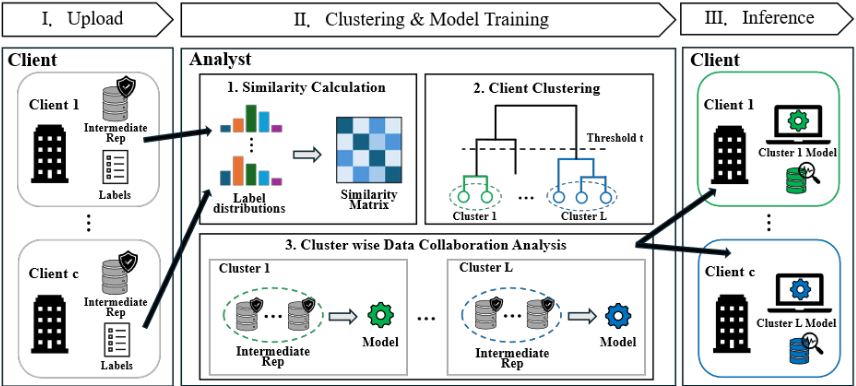
Accordingly, we propose Data Collaboration-based Clustered Federated Learning (DC-CFL), which builds on the DC analysis framework to jointly perform client clustering and model training while retaining a single communication round. Specifically, DC-CFL measures inter-client similarity based on label distributions and partitions clients via hierarchical clustering. It then performs model training within the DC analysis framework separately for each cluster, aiming to improve accuracy under non-IID conditions within a singleround communication constraint. Figure 1 overviews the DCCFL workflow. To our knowledge, DC-CFL is the first CFL framework that simultaneously achieves single-round communication and non-IID handling. It thereby offers a practical option for collaborative learning in real-world scenarios with strict communication constraints, such as healthcare and finance sectors operating under air-gapped or strongly isolated environments. Our main contributions are as follows:
- Single-round cluster-wise learning: Building on DC analysis, we develop a CFL framework that performs cluster estimation and cluster-wise model training within a single communication round.
- Empirical validation: Through experiments on benchmark datasets, we demonstrate that DC-CFL (i) attains superior accuracy to existing baselines under non-IID conditions and (ii) substantially reduces the number of communication rounds required by multi-round baselines to reach comparable accuracy.
2 Related Works
2.1 FL and Non-IID
Federated Learning (FL) is a framework in which multiple clients collaboratively train a model under the coordination of a central server without sharing raw data [McMahan et al., 2017]. Federated Averaging (FedAvg), a representative FL method, performs client-side local updates and server-side aggregation over multiple communication rounds to optimize a single global model. However, in non-IID conditions where data distributions differ across clients, performance often degrades due to inconsistent update directions (client drift). To address this issue, extensions that still assume a single global model have been proposed, such as FedProx [Li et al., 2020], which introduces a proximal term into FedAvg's local objective to suppress divergence across client updates.
Another line of research on adapting to non-IID data is Personalized Federated Learning (PFL), which aims to obtain a distinct model for each client [Tan et al., 2022]. A representative example is Ditto [Li et al., 2021], which jointly learns a shared model and client-specific models in parallel. Other approaches have also been reported, including methods that adaptively learn aggregation weights over other clients' models [Luo and Wu, 2022] and personalization techniques based on calibration mechanisms [Tang et al., 2024].
However, under severe non-IID conditions, improvements to a single global model often reach a performance ceiling, and PFL can suffer from scalability and overfitting issues due to the growing number of client-specific models and the limited local data available at each client [Sabah et al., 2024]. In such cases, a promising strategy is to group similar clients and perform learning at the cluster level.
2.2 Clustered Federated Learning Under Communication-Round Constraints
Clustered Federated Learning (CFL) is a framework that partitions similar clients into clusters and trains models at the cluster level [Sattler et al., 2020]. However, most existing CFL methods rely on multi-round communication to estimate clusters and update models, making communication rounds a dominant operational cost. For example, FedCM [Wang et al., 2025] addresses client clustering and migration based on gradient-path similarity, and DisUE [Leng et al., 2025] integrates dynamic clustering based on parameter similarity with knowledge distillation and an encryption protocol. While these approaches make the problem setting more realistic, they assume multi-round communication during training.
When the number of communication rounds is an operational constraint, one-shot FL (OFL) restricts client-server communication to a single round to reduce communication cost and operational burden [Liu et al., 2025]. However, existing OFL formulations are not specifically designed to realize end-to-end cluster-wise learning under non-IID data. Consequently, enabling CFL to complete both cluster estimation and cluster-wise model training within a single communication round remains insufficiently established under tight communication-round constraints.
To illustrate this gap, FedClust [Islam et al., 2024] is a representative CFL method that estimates clusters via hierarchical clustering without requiring a pre-specified number of clusters, and it has been reported to improve both accuracy and communication efficiency. In FedClust, clustering is performed in a single step, after which cluster-wise training proceeds via standard multi-round federated optimization. This distinction highlights the remaining gap between single-step clustering and fully single-round end-to-end CFL.
3 Preliminaries
Data Collaboration (DC) analysis [Imakura and Sakurai, 2020] is a framework for integrated analysis over distributed data without sharing raw data. In DC analysis, each client shares an intermediate representation obtained by dimensionality reduction of its raw data. DC analysis can be positioned as a federated learning approach that does not rely on model sharing [Imakura et al., 2021b]. While conventional FL exchanges model parameters over multiple rounds, DC analysis completes training by sending intermediate representations and labels only once.
In this section, we describe DC analysis for aligning clientspecific intermediate representations into a common reprethe Let clients. of number the denote ܿ sentation space. Let be data anchor the let and ℝ𝑖×, ∈ ܺ be ݅ raw data of client shared as provided are data anchor The . ℝ× ∈ cnaܺ pseudo-data [Imakura and Sakurai, 2020; Imakura et al., reduc- dimensionality arbitrary an uses ݅ 2023]. Each client tion function
to transform its raw data and the anchor data into intermediate representations:
ሺʹሻ ℝ×̃𝑖. ∈ ሻcnaܺሺ ݂ = cnãܺℝ𝑖×̃𝑖, ∈ ሻ ܺሺ ݂ = ̃ܺ rep- intermediate the , ݂ Because each client uses a different and spaces client-specific a in expressed is ̃ܺ resentation cannot be directly concatenated. To align the intermediate representations into a common representation space, we inesti- We .𝐺̃ܺ =)̃ܺ(݃ troduce a linear re-transformation mate 𝐺 ∈ ℝ̃𝑖×̂ so that the intermediate representations of ∈ ܼ the anchor data are aligned to a common representation unknowns, as ܼ ݀݊ܽ ℝ×̂ . Specifically, treating 𝐺ଵ,…, 𝐺𝑐, we consider the following least-squares problem:
It has been shown that an approximate solution can be derived via low-rank approximation based on singular value decomposition (SVD) [Imakura and Sakurai, 2020]. First, we compute a low-rank approximation of the matrix obtained by concatenating the anchor-data intermediate representations of all clients along the feature axis:
Here, Σଵ is a diagonal matrix containing the top singular of consisting matrices orthogonal are ଵܸ ݀݊ܽ ଵܷ values, and the leading left and right singular vectors, respectively. We trans- the then ;ଵܷ = ܼ define the common representation as by: given is ݅ formation matrix for client
where ሺ⋅ሻ† denotes the Moore-Penrose pseudoinverse. Asaligned is 𝐺cnãܺ , ℝ̂×̂ ∈ ܥ suming an identity matrix for applying By .݅ each for ܼ with the common representation inte- the obtain we ,̃ܺ the same transformation 𝐺 to the ̂ܺ concatenate we Finally, .𝐺̃ܺ = ̂ܺ grated representation on ,̂ܺ along the sample axis to form an integrated matrix which we can train an arbitrary supervised learner.
We discuss the privacy implications of our protocol and clarify the associated threat model and assumptions. In this dimen- the nor ܺ study, clients share neither their raw data receives analyst the Instead, . ݂ sionality-reduction functions intermediate representations together with the corresponding labels only once. By transmitting only intermediate representations and keeping the transformation functions private, the protocol avoids direct sharing of raw data, as in DC analysis [Imakura and Sakurai, 2024]. This protection is derived from the protocol design and the limited invertibility of the transformation, and it is not intended to provide formal guarantees such as differential privacy or cryptographic security. We adopt the standard honest-but-curious analyst model [Imakura et al., 2021a] and focus on deployments in which governance permits sharing intermediate representations and labels. We note that extensions of DC analysis have been proposed, such as adding noise to intermediate representations to satisfy differential privacy and combining dimensionality reduction with noise addition to improve robustness against re-identification attacks [Chen and Omote, 2021; Yamashiro et al., 2024]. Since DC-CFL uses only the same transmitted information as DC analysis and performs cluster estimation solely from the received labels, it requires no additional shared information; accordingly, its threat model and privacy assumptions are equivalent to those of DC analysis.
4 Methodology
4.1 Overview of DC-CFL
We propose Data Collaboration-based Clustered Federated Learning (DC-CFL), a single-round framework that performs client cluster estimation and cluster-wise learning by extending supervised DC analysis. The procedure consists of three stages (Algorithm 1):
- Following the DC analysis framework, each client uploads its intermediate representations and the corresponding labels for supervised learning to the analyst only once.
Algorithm 1 DC-CFL
ଵ=}ሻ𝑦,ܺ{ሺ Input: 𝑐ܺ 𝑐 , anchor data
ݐ Parameter: threshold
Output: {ℎ}=ଵ , {𝐺}=ଵ 𝑐
Dimensionality reduction (Client)
- do ܿ ͳ,…, = ݅ 1: for each client
- ሻ 𝑐ܺሺ݂ = 𝑐̃ܺ ,ሻܺሺ݂ = ̃ܺ 2: Compute
- 3: 𝑦 , 𝑐̃ܺ ,̃ܺ share
- 4: end for Similarity Calculation and clustering (Analyst)
- 5: Compute label distributions {𝑝}=ଵ 𝑐 from {𝑦}=ଵ 𝑐 .
- with ܦ 6: Build distance matrix
- ሻ. ݆ ≠ ݅ሺ 𝑝ሻ ,𝑝ሺܸ←T ܦ
- 7: Obtain clusters {𝒞}=ଵ by Hierarchical Cluster.ሻݐ ;ܦingሺ
Cluster-wise Model training (Analyst)
- do ܮ , ͳ,… = ݈ 8: for each cluster
- DC the using }∈𝒞𝑙 𝑐̃ܺ{ 9: Compute {𝐺}∈𝒞𝑙 from mapping in Sec.3.
- build and 𝒞 ∈ ݅ all for 𝐺̃ܺ = ̂ܺ 10: Compute . [𝑦]∈𝒞𝑙 = ܻ , 𝑙𝒞∈]̂ܺ[ = ̂ܺ
- .ሻ̂ܺℎሺ ≈ ܻ ݏܽ 11: Get ℎ
- 12: end for
- 13: return {ℎ}=ଵ , {𝐺}=ଵ 𝑐
- Using the received labels, the analyst constructs an inter-client distance matrix based on label distributions, performs hierarchical clustering, and determines the final partition.
- For each cluster, the analyst constructs an integrated representation within the DC analysis framework using only the clients in that cluster and trains an arbitrary downstream model in a cluster-wise manner.
Through these steps, DC-CFL aims to incorporate the benefits of clustering in non-IID conditions.
For cluster estimation in Step 2, we focus on label distribution skew, which has been reported to substantially degrade accuracy in FL [Li et al., 2022]. Accordingly, and consistent with prior work demonstrating the effectiveness of clustering based on label distributions [Diao et al., 2024; Soltani et al., 2023], we define inter-client similarity using the clients' label distributions.
4.2 TV-Based Client Clustering
let and clients of number the denote ܿ Client Similarity. Let a consider We }. 𝑦,𝑖 {𝑦,ଵ,…, = ܻ be ݅ the label set of client value a takes label each where problem classification ssalc-ܭ (empirical distribution label the define We .}ܭ{ͳ,…, 𝑦,௦ ∈ as ݅ distribution) of client
Here, 𝐼ሺ⋅ሻ denotes the indicator function. In DC-CFL, we variation total the by ܦ define the inter-client distance
(TV) distance [Levin et al., 2009] between the label distri𝑝: ݀݊ܽ butions 𝑝
The TV distance is a fundamental measure of discrepancy between two probability distributions, distinct in nature from distances over continuous-space vectors. In DC-CFL, we use the TV distance between empirical label distributions to quantify heterogeneity. This is particularly crucial in one-shot settings, where misclustered clients cannot be corrected. Therefore, we need a criterion that directly penalizes label mismatches to prevent mixing dissimilar clients. Furthermore, clustering based on label skew facilitates the alignment of client-specific representations in supervised DC analysis. Computationally, the TV distance is stable even with zero-frequency classes and requires no smoothing. Since label distributions are represented as probability vectors over a finite class set, TV is theoretically consistent as a comparison measure. For these reasons, we adopt the us- ℝ𝑐×𝑐 ∈ ܦ TV distance and construct the distance matrix ing (7). Note that this measure captures only label distribution discrepancies and does not account for feature distribution shifts or concept shifts.
Hierarchical Clustering. We partition the clients by applying agglomerative hierarchical clustering [Day and Edelsre- approach This .ܦ brunner, 1984] to the distance matrix quires only the distance matrix computed from TV distance and does not require the number of clusters to be specified in advance. It constructs a dendrogram in a single run, allowing the granularity of collaboration to be adjusted continuously possible, are criteria linkage various While .ݐ via a threshold we adopt complete linkage as a conservative choice to control within-cluster dispersion in one-shot settings, where misclustered clients cannot be corrected via additional rounds. Because complete linkage defines inter-cluster distance as the ݐ farthest-point distance, cutting the dendrogram at threshold yields clusters whose maximum pairwise distance within .ݐ each cluster (i.e., the cluster diameter) is at most
4.3 Cluster-Wise Model Training
We construct a DC-based integrated representation for each cluster and train a cluster-wise model. Let {𝒞}=ଵ denote the clusters obtained in Section 4.2. For each cluster 𝒞, we apply the DC-based integration procedure described in Section 3 to the clients in 𝒞 and obtain a cluster-specific integrated repሻሺ̂ܺ on learner supervised a train then We .ሻሺ̂ܺ resentation and its labels to obtain a cluster-wise model ℎ. Both cluster estimation and cluster-wise learning are performed on the analyst side. Since the analyst already holds all transmitted intermediate representations and labels, hyperparameters can be selected via internal validation splits, requiring no additional client communication. The analyst returns ℎ and the inference, For once. 𝒞 ∈ ݅ mapping matrix 𝐺 to each client applies and , 𝐺̃ܺ = ̂ܺ and ሻܺሺ݂ = ̃ܺ computes ݅ client .ሻ̂ܺℎሺ
5 Experiments
In this section, we evaluate the effectiveness of the proposed DC-CFL using multiple open datasets. The evaluation focuses on (i) accuracy under non-IID label distributions and (ii) the number of communication rounds required to reach accuracy comparable to DC-CFL. Each client splits its local data into training and test sets and transmits the intermediate representations of the training data and the corresponding labels to the analyst only once. The analyst constructs training and validation sets from the received representations and selects hyperparameters. Final performance is reported as the average test accuracy across clients, where each client evaluates the learned model on its local test set.
5.1 Settings
Datasets. To evaluate the effectiveness of DC-CFL under realistic data distributions, we conducted experiments using multiple open datasets. Specifically, we used the covertype dataset from Kaggle (we used the entire preprocessed training dataset in which the class frequencies are balanced) [Blackard and Dean, 1999], the Dry Bean dataset publicly available from the UCI Machine Learning Repository [Dry Bean, 2020], and the Gesture Phase Segmentation dataset (hereafter abbreviated as Gesture) [Madeo et al., 2013] obtained via OpenML [Vanschoren et al., 2014]. For each dataset, Table 1 summarizes the number of samples, the number of features, and the number of label classes.
Non-IID. We designed the statistical heterogeneity across clients as label-distribution non-IID, largely following Li et al., [2022]. Specifically, we considered the following two types:
- Class-based split (pathological non-IID, C = k): The number of classes held by each client is re{ʹ,͵}. ∈ ݇ use we section, this In .݇ stricted to
- Dirichlet split (Dir(𝛼)): For each class, the clientwise allocation proportions are generated from a Dirichlet distribution, and 𝛼 controls the degree of heterogeneity. In this section, we set 𝛼 = Ͳ.ͳ.
In our experiments, we fixed the number of participating clients to 100. This choice was made for a fair comparison, following the experimental setup of FedClust [Islam et al., 2024].
Baselines. We adopted representative FL/PFL/CFL methods that require multi-round communication as baselines. Specifically, we used FedAvg [McMahan et al., 2017] as a standard FL approach, FedProx [Li et al., 2020] as a FedAvg variant with a proximal term, Ditto [Li et al., 2021] as a representative PFL method, and FedClust [Islam et al., 2024] as a representative CFL method. In addition, to examine whether the performance gains of DC-CFL are attributable to cluster-wise learning, we also report results for DC without cluster-specific models and local-only training at each client (Local). Relatedly, one-shot FL (OFL) also targets single-round communication [Liu et al., 2025]. However, OFL studies encompass a broad range of protocol assumptions and design choices, and reported performance can be sensitive to these choices. Because our goal is to isolate and quantify the effect of clustering within the DCbased protocol studied in this work, we report representative FL/PFL/CFL methods as widely recognized reference baselines under a limited number of communication rounds and leave a systematic comparison with OFL-specific designs to future work.
| Dataset | samples | features | class |
|---|---|---|---|
| covertype | 15.12K | 54 | 7 |
| Dry Bean | 13.61K | 16 | 7 |
| Gesture | 9.87K | 32 | 5 |
Accuracy Comparison. DC-CFL completes training in a single communication round, whereas multi-round baselines require multiple rounds. To approximately match the computational budget, we align the total number of training epochs as the default setting. Specifically, following Bogdanova et al. [2020], we set the number of epochs to 50 for Local / DC / DC-CFL, and to 10 epochs × 5 rounds for FedAvg / FedProx / Ditto / FedClust. Note that DC-based methods share representations, whereas standard FL baselines communicate model updates. Therefore cross-paradigm comparisons are provided for reference under tight communication-round constraints and should not be interpreted as a fully matched-protocol comparison.
Communication-Round Comparison. To explicitly assess communication efficiency, we increase the number of rounds for multi-round baselines and measure how many rounds are required to reach the accuracy achieved by DCCFL. In this axis, we do not attempt to match total computation across methods. Instead, we fix the number of local epochs per round for multi-round baselines to 10. We then measure the number of communication rounds required to match the accuracy of DC-CFL, which completes training in a single round with 50 training epochs. We conduct the ∈ ܥ round comparison only for label-skew settings with {ʹ,͵} under the class-based split. In this split, each client's class subset is explicitly controlled, making the required rounds easier to interpret as differences in convergence behavior under heterogeneity. In contrast, the Dirichlet split depends on random draws and can exhibit substantial across-trial variance, making the required-round comparison unstable. Accordingly, we report accuracy comparisons for all settings, while limiting round-comparison results to the class-based split.
Implementation details. To ensure reproducibility, we summarize the key implementation settings below. All experiments were conducted using Python 3.10 and PyTorch 2.9 in a standard CPU environment.
- Dimensionality reduction: For the dimensionality-reComponent Principal adopted we , ݂ duction function Analysis (PCA) [Pearson, 1901], which exhibited the
| covertype | Dry Bean | Gesture | |||||||
|---|---|---|---|---|---|---|---|---|---|
| Method | C=2 | C=3 | Dir(0.1) | C=2 | C=3 | Dir(0.1) | C=2 | C=3 | Dir(0.1) |
| Local | 0.8955 | 0.7611 | 0.8515 | 0.9805 | 0.9452 | 0.9288 | 0.7033 | 0.5304 | 0.8202 |
| DC | 0.7753 | 0.7613 | 0.7743 | 0.9156 | 0.9136 | 0.9090 | 0.5171 | 0.5254 | 0.5180 |
| FedAvg | 0.4005 | 0.5048 | 0.3696 | 0.3286 | 0.5156 | 0.3036 | 0.3380 | 0.4094 | 0.2859 |
| FedProx | 0.4172 | 0.5262 | 0.4249 | 0.3352 | 0.5191 | 0.3233 | 0.3390 | 0.4379 | 0.2983 |
| Ditto | 0.8970 | 0.7575 | 0.8463 | 0.9715 | 0.9124 | 0.9106 | 0.7038 | 0.5326 | 0.8230 |
| FedClust | 0.9040 | 0.7635 | 0.8474 | 0.9722 | 0.9156 | 0.9093 | 0.7058 | 0.5339 | 0.8227 |
| DC-CFL | 0.9382 | 0.8389 | 0.8618 | 0.9861 | 0.9672 | 0.9371 | 0.7557 | 0.6162 | 0.8256 |
most stable and highest performance in our preliminary experiments compared with alternatives such as Locality Preserving Projection (LPP) [He and Niyogi, 2003] and Random Projection (RP) [Johnson and Lindenstrauss, 1984]. We set the intermediate representa.ͳ-݉= ̃݉ tion dimension to
- Anchor data: Following Imakura et al., [2023], we generated 1,000 samples.
- Dimension of the integrated representation: In the SVD applied to the concatenation matrix of the anchor-data intermediate representations, preliminary experiments indicated that using components with singular values no smaller than ͳͲ-ଶ yielded the best performance; we therefore determined the dimension of the integrated representation accordingly.
- Model: For fair comparison, we used the same twolayer MLP architecture for all methods. Specifically, the input dimension was matched to each method's input representation (raw features or the integrated representation), the hidden-layer sizes were set to either [64, 32] or [32, 16], the output dimension was set to the number of classes, and ReLU was used as the activation function.
- Hyperparameters: We used SGD for optimization with a batch size of 32. We adopted the SGD-based optimizer settings in Islam et al., [2024] as a reference and matched the learning rate and momentum settings where applicable. Specifically, we fixed the learning rate to 0.01 and the momentum to 0.5 for DC, Local, DC-CFL, Ditto, and FedClust. For FedAvg and FedProx, given their sensitivity in convergence behavior, we selected the learning rate 𝜂 ∈ {Ͳ.ͳ, Ͳ.Ͳͳ, Ͳ.ͲͲͳ} based on validation performance and set the momentum to 0.9. The FedProx proximal-term coefficient was sereg- Ditto the and Ͳ.ͲͲͳ}, Ͳ.Ͳͳ, Ͳ.ͳ, {ͳ, ∈ ߤ lected from ∈ ߣ ularization coefficient was selected from {ʹ, ͳ, Ͳ.ͳ, Ͳ.Ͳͳ}, also based on validation performance. DC- in ݐ Moreover, the clustering distance threshold CFL and FedClust was selected using validation data from the candidate set 𝒯 = {Ͳ.ͳ, Ͳ.ʹ,…, Ͳ.9}. Notably, DC-CFL does not require additional communication for
- 100% to rate participation client the set We .ݐ selecting in all communication rounds.
- Number of runs: We conducted 10 independent runs with different random seeds and report the mean results.
5.2 Results and Discussion
Accuracy
As shown in Table 2, under the default setting, DC-CFL achieves higher accuracy than the existing methods. DCCFL outperforming Local indicates that integrating information across clients can be beneficial even when raw data cannot be shared. Moreover, DC-CFL's outperformance of conventional DC analysis suggests that, under label distribution skew, clustering clients with similar label distributions and performing DC-based integration and learning per cluster can be effective. Since heterogeneity in this paper is primarily induced by label skew, clustering clients with similar label distributions is expected to reduce discrepancies among client-specific representations that DC analysis needs to align. This can reduce alignment errors in constructing the integrated representation and improve downstream performance.
Single-Round Advantage
Compared with multi-round baselines, DC-CFL substantially reduces the number of communication rounds needed to reach DC-CFL's accuracy level (Table 3). FedAvg, FedProx, and Ditto do not reach this target within 𝑅 ≤ ͷͲ under our hyperparameter settings. This behavior may be attributable to their sensitivity to client drift under strong nonIID conditions (FedAvg/FedProx) and to the reliance on global updates, which can cause performance to plateau under severe heterogeneity (Ditto). By contrast, FedClust improves as the number of rounds increases and reaches a level comparable to DC-CFL in 19-33 rounds for C=2 and 15-27 rounds for C=3, depending on the dataset. Figure 2 shows an example of accuracy trajectories on covertype (C=3), illustrating that FedClust benefits from additional rounds while the other baselines fail to reach the same level within 𝑅 ≤ ͷͲ.
| covertype | Dry Bean | Gesture | ||||
|---|---|---|---|---|---|---|
| Method | C=2 | C=3 | C=2 | C=3 | C=2 | C=3 |
| FedClust | 24 | 15 | 19 | 16 | 33 | 27 |
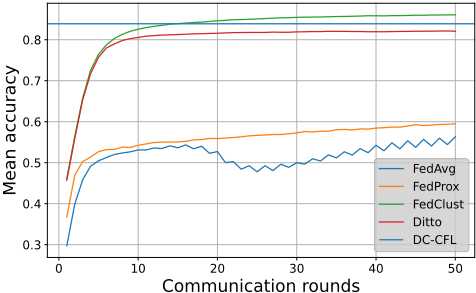
Overall, DC-CFL is advantageous when the number of communication rounds is the primary constraint, whereas multi-round CFL methods can be effective when sufficient rounds are permissible. To complement the round-based comparison, we also estimated the per-client total communication volume on the covertype setting. In DC-CFL, per-client communication is dominated by a single upload of interℝ×̃𝑖 ∈ cnãܺ and ℝ𝑖×̃𝑖 ∈ ̃ܺ mediate representations (with labels), and a single download of the mapping 𝐺 ∈ ℝ̃𝑖×̂𝑙 and the cluster-wise model ℎ, totaling approximately 0.27 MB per client. In contrast, FedClust requires 15-24 rounds (approximately 0.70-1.12 MB) to reach comparable accuracy, far exceeding the total communication volume of DC-CFL. Note that the communication volume of DC-CFL depends on key design choices: the number of intermediate the of dimension the ,ݎ anchor data samples in- cluster-wise the of dimension the and ,̃݉ representation .̂݉ tegrated representation
Sensitivity Analysis of Distance Threshold 𝒕
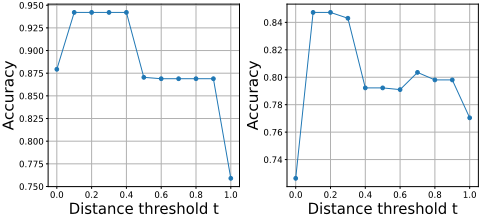
We conduct a sensitivity analysis of the clustering distance non-IID two under dataset covertype the using ݐ threshold conditions (C=2 and C=3) to evaluate its impact on DCCFL performance under different levels of data heterogenehyperparameter, sensitive a is ݐ ity. As shown in Figure 3, and its optimal value depends on the degree of heterogeneheterogene- each for ݐ ity. These results suggest that tuning ity setting, rather than using a fixed value, can systematically improve accuracy, making it an effective control parameter.
6 Conclusion
In this study, building on DC analysis, we proposed Data Collaboration-based Clustered Federated Learning (DCCFL), which completes both cluster estimation and clusterwise model training within a single communication round. Experiments on open datasets demonstrate that, under representative non-IID conditions, DC-CFL achieves accuracy comparable to that of existing methods that require multiple communication rounds. These results indicate that DC-CFL can be a practical option for collaborative AI model development even in environments where confidential data are distributed across organizations and the number of communication rounds is severely constrained.
As future work, we plan to address the following issues. First, we will investigate automatic selection of the distance a through Second, clustering. hierarchical for ݐ threshold systematic comparison with one-shot federated learning (OFL) methods, we aim to clarify the position of DC-CFL in the trade-off among accuracy, communication cost, and information disclosure risk. Third, it is necessary to extend the evaluation of the robustness and security of both cluster estimation and learning outcomes under a broader range of non-IID conditions and adversary models.
Notably, the proposed method is designed under the assumptions described in Section 3 and does not provide formal guarantees such as differential privacy. In addition, in prioritizing single-round communication, this paper assumes that sample-level label sharing required for supervised DC analysis is permissible; however, this assumption may limit the applicability of the method. In future work, we will quantitatively evaluate the privacy-accuracy trade-off, including the introduction of differential privacy to the transmitted information. Furthermore, we will explore designs that minimize the information to be shared, for example via aggregation or secure and hidden computation. In particular, since clustering in our framework can be performed using label distributions, we aim to avoid sharing sample-level labels required for supervised DC analysis. We expect these extensions to make DC-CFL both more broadly applicable and more explicit about its privacy properties.
Acknowledgments
This work was supported by JSPS KAKENHI Grant Number JP23K22166.
@inproceedings{ijcai2026p541,
  title     = {Single-Round Clustered Federated Learning via Data Collaboration Analysis for Non-IID Data},
  author    = {Sugawara, Sota and Kawamata, Yuji and Toyoda, Akihiro and Nakayama, Tomoru and Okada, Yukihiko},
  booktitle = {Proceedings of the Thirty-Fifth International Joint Conference on
               Artificial Intelligence, {IJCAI-26}},
  publisher = {International Joint Conferences on Artificial Intelligence Organization},
  editor    = {Diego Calvanese},
  pages     = {4858--4866},
  year      = {2026},
  month     = {8},
  note      = {Main Track},
  doi       = {10.24963/ijcai.2026/541},
  url       = {https://doi.org/10.24963/ijcai.2026/541},
}
TY - CPAPER TI - Single-Round Clustered Federated Learning via Data Collaboration Analysis for Non-IID Data AU - Sugawara, Sota AU - Kawamata, Yuji AU - Toyoda, Akihiro AU - Nakayama, Tomoru AU - Okada, Yukihiko T2 - Proceedings of the Thirty-Fifth International Joint Conference on Artificial Intelligence, IJCAI-26 PB - International Joint Conferences on Artificial Intelligence Organization PY - 2026 SP - 4858 EP - 4866 DO - 10.24963/ijcai.2026/541 UR - https://doi.org/10.24963/ijcai.2026/541 ER -Copied
Machine-readable versions of this paper, for tools and AI agents:





