
Causal Manifold Transport for Identifiable Causal Generation in Diffusion Models
Proceedings of the Thirty-Fifth International Joint Conference on Artificial Intelligence. Main Track. Pages 4822-4830.
https://doi.org/10.24963/ijcai.2026/537
Keywords
- Machine Learning: Geometric learning
- Machine Learning: Generative models
- Machine Learning: Causality
Abstract
Identifying meaningful latent representations within diffusion models remains a challenging problem for causal approaches. We propose Causal Manifold Transport Diffusion Model (CMT-Diff), a framework that operationalizes causal actions as geometric transformations. By adopting the perspective of backtracking counterfactuals, we formulate the generative process as a composite diffeomorphism that couples the Probability Flow ODE with a Continuous Normalizing Flow. This mapping constructs an exogenous manifold where causal factors align with coordinate variations. Within this geometry, we derive Causal Manifold Transport (CMT) to realize interventions as linear vector translations along factor-aligned directions. We establish theoretical identifiability guarantees and demonstrate that our approach facilitates controllable generation by capturing the underlying causal manifold.
- [Ahuja et al., 2022] Kartik Ahuja, Jason S Hartford, and Yoshua Bengio. Weakly supervised representation learning with sparse perturbations. Advances in Neural Information Processing Systems, 35:15516-15528, 2022.
- [Brehmer et al., 2022] Johann Brehmer, Pim De Haan, Phillip Lippe, and Taco S Cohen. Weakly supervised causal representation learning. Advances in Neural Information Processing Systems, 35:38319-38331, 2022.
- [Burgess et al., 2018] Christopher P Burgess, Irina Higgins, Arka Pal, Loic Matthey, Nick Watters, Guillaume Des- jardins, and Alexander Lerchner. Understanding disentan- gling in β-vae. arXiv preprint arXiv:1804.03599, 2018.
- [Chao et al., 2024] Patrick Chao, Patrick Blöbaum, Sapan Kirit Patel, and Shiva Kasiviswanathan. Modeling causal mechanisms with diffusion models for interventional and counterfactual queries. Transactions on Machine Learning Research, 2024.
- [Croitoru et al., 2023] Florinel-Alin Croitoru, Vlad Hondru, Radu Tudor Ionescu, and Mubarak Shah. Diffusion models in vision: A survey. IEEE Transactions on Pattern Analysis and Machine Intelligence, 45(9):10850-10869, 2023.
- [Dominguez-Olmedo et al., 2023] Ricardo Dominguez- Olmedo, Amir-Hossein Karimi, Georgios Arvanitidis, and Bernhard Schölkopf. On data manifolds entailed by structural causal models. In Proceedings of the 40th International Conference on Machine Learning, volume 202 of Proceedings of Machine Learning Research, pages 8188-8201. PMLR, 23-29 Jul 2023.
- [Eastwood and Williams, 2018] Cian Eastwood and Christo- pher KI Williams. A framework for the quantitative eval- uation of disentangled representations. In International conference on learning representations, 2018.
- [Fatemi et al., 2025] Pouria Fatemi, Ehsan Sharifian, and Mo- hammad Hossein Yassaee. A new approach to backtracking counterfactual explanations: A unified causal framework for efficient model interpretability. In Forty-second Inter- national Conference on Machine Learning, 2025.
- [Grathwohl et al., 2019] Will Grathwohl, Ricky T. Q. Chen, Jesse Bettencourt, and David Duvenaud. Scalable reversible generative models with free-form continuous dynamics. In International Conference on Learning Representations, 2019.
- [Gretton et al., 2012] Arthur Gretton, Karsten M. Borgwardt, Malte J. Rasch, Bernhard Schölkopf, and Alexander Smola. A kernel two-sample test. Journal of Machine Learning Research, 13(25):723-773, 2012.
- [Hahm et al., 2024] Jaehoon Hahm, Junho Lee, Sunghyun Kim, and Joonseok Lee. Isometric representation learning for disentangled latent space of diffusion models. In Pro- ceedings of the 41st International Conference on Machine Learning, volume 235 of Proceedings of Machine Learning Research, pages 17224-17245. PMLR, 21-27 Jul 2024.
- [Hao et al., 2024] Guang-Yuan Hao, Jiji Zhang, Biwei Huang, Hao Wang, and Kun Zhang. Natural counterfac- tuals with necessary backtracking. Advances in Neural Information Processing Systems, 37:14962-14995, 2024.
- [Heusel et al., 2017] Martin Heusel, Hubert Ramsauer, Thomas Unterthiner, Bernhard Nessler, and Sepp Hochre- iter. Gans trained by a two time-scale update rule converge to a local nash equilibrium. Advances in Neural Informa- tion Processing Systems, 30, 2017.
- [Hinton et al., 1984] Geoffrey E Hinton, James L McClel- land, and David E Rumelhart. Distributed representations. Technical report, Carnegie-Mellon University, 1984.
- [Huang et al., 2024] Yi Huang, Jiancheng Huang, Yifan Liu, Mingfu Yan, Jiaxi Lv, Jianzhuang Liu, Wei Xiong, He Zhang, Shifeng Chen, and Liangliang Cao. Diffu- sion model-based image editing: A survey. arXiv preprint arXiv:2402.17525, 2024.
- [Karras et al., 2022] Tero Karras, Miika Aittala, Timo Aila, and Samuli Laine. Elucidating the design space of diffusion- based generative models. Advances in Neural Information Processing Systems, 35:26565-26577, 2022.
- [Khemakhem et al., 2020] Ilyes Khemakhem, Diederik Kingma, Ricardo Monti, and Aapo Hyvarinen. Variational autoencoders and nonlinear ica: A unifying framework. In International Conference on Artificial Intelligence and Statistics, pages 2207-2217. PMLR, 2020.
- [Komanduri et al., 2022] Aneesh Komanduri, Yongkai Wu, Wen Huang, Feng Chen, and Xintao Wu. Scm-vae: Learn- ing identifiable causal representations via structural knowl- edge. In 2022 IEEE International Conference on Big Data (Big Data), pages 1014-1023, 2022.
- [Komanduri et al., 2023] Aneesh Komanduri, Yongkai Wu, Feng Chen, and Xintao Wu. Learning causally disentan- gled representations via the principle of independent causal mechanisms. arXiv preprint arXiv:2306.01213, 2023. IJCAI
- [Komanduri et al., 2024] Aneesh Komanduri, Chen Zhao, Feng Chen, and Xintao Wu. Causal diffusion autoencoders: Toward counterfactual generation via diffusion probabilistic models. In Proceedings of the 27th European Conference on Artificial Intelligence, 2024.
- [Kwon et al., 2023] Mingi Kwon, Jaeseok Jeong, and Youngjung Uh. Diffusion models already have a semantic latent space. In The Eleventh International Conference on Learning Representations, 2023.
- [Lee, 2012] J. Lee. Introduction to Smooth Manifolds. Grad- uate Texts in Mathematics. Springer New York, 2012.
- [Lippe et al., 2022] Phillip Lippe, Sara Magliacane, Sindy Löwe, Yuki M Asano, Taco Cohen, and Stratis Gavves. Citris: Causal identifiability from temporal intervened se- quences. In International Conference on Machine Learning, pages 13557-13603. PMLR, 2022.
- [Lippe et al., 2023] Phillip Lippe, Sara Magliacane, Sindy Löwe, Yuki M Asano, Taco Cohen, and Efstratios Gavves. Causal representation learning for instantaneous and tem- poral effects in interactive systems. In The Eleventh Inter- national Conference on Learning Representations, 2023.
- [Locatello et al., 2020] Francesco Locatello, Ben Poole, Gun- nar Rätsch, Bernhard Schölkopf, Olivier Bachem, and Michael Tschannen. Weakly-supervised disentanglement without compromises. In International conference on ma- chine learning, pages 6348-6359. PMLR, 2020.
- [Park et al., 2023] Yong-Hyun Park, Mingi Kwon, Jaewoong Choi, Junghyo Jo, and Youngjung Uh. Understanding the latent space of diffusion models through the lens of riemannian geometry. Advances in Neural Information Processing Systems, 36:24129-24142, 2023.
- [Pearl, 2009] Judea Pearl. Causality. Cambridge University Press, Cambridge, UK, 2 edition, 2009.
- [Peters et al., 2017] Jonas Peters, Dominik Janzing, and Bern- hard Schölkopf. Elements of causal inference: foundations and learning algorithms. The MIT Press, 2017.
- [Preechakul et al., 2022] Konpat Preechakul, Nattanat Chatthee, Suttisak Wizadwongsa, and Supasorn Suwa- janakorn. Diffusion autoencoders: Toward a meaningful and decodable representation. In Proceedings of the IEEE/CVF Conference on Computer Vision and Pattern Recognition, pages 10619-10629, 2022.
- [Salimans et al., 2016] Tim Salimans, Ian Goodfellow, Woj- ciech Zaremba, Vicki Cheung, Alec Radford, and Xi Chen. Improved techniques for training gans. Advances in Neural Information Processing Systems, 29, 2016.
- [Sanchez and Tsaftaris, 2022] Pedro Sanchez and Sotirios A Tsaftaris. Diffusion causal models for counterfactual esti- mation. In Conference on Causal Learning and Reasoning, pages 647-668. PMLR, 2022.
- [Shuai et al., 2024] Xincheng Shuai, Henghui Ding, Xingjun Ma, Rongcheng Tu, Yu-Gang Jiang, and Dacheng Tao. A survey of multimodal-guided image editing with text-to- image diffusion models. arXiv preprint arXiv:2406.14555, 2024.
- [Song et al., 2021] Yang Song, Jascha Sohl-Dickstein, Diederik P Kingma, Abhishek Kumar, Stefano Ermon, and Ben Poole. Score-based generative modeling through stochastic differential equations. In International Conference on Learning Representations, 2021.
- [Von Kügelgen et al., 2023] Julius Von Kügelgen, Abdirisak Mohamed, and Sander Beckers. Backtracking counterfac- tuals. In Conference on Causal Learning and Reasoning, pages 177-196. PMLR, 2023.
- [Wang et al., 2004] Zhou Wang, Alan C Bovik, Hamid R Sheikh, and Eero P Simoncelli. Image quality assessment: from error visibility to structural similarity. IEEE Transac- tions on Image Processing, 13(4):600-612, 2004.
- [Yang et al., 2021] Mengyue Yang, Furui Liu, Zhitang Chen, Xinwei Shen, Jianye Hao, and Jun Wang. Causalvae: Disen- tangled representation learning via neural structural causal models. In Proceedings of the IEEE/CVF Conference on Computer Vision and Pattern Recognition (CVPR), pages 9593-9602, June 2021.
- [Yang et al., 2023] Ling Yang, Zhilong Zhang, Yang Song, Shenda Hong, Runsheng Xu, Yue Zhao, Wentao Zhang, Bin Cui, and Ming-Hsuan Yang. Diffusion models: A comprehensive survey of methods and applications. ACM Computing Surveys, 56(4):1-39, 2023.
- [Zhang et al., 2018] Richard Zhang, Phillip Isola, Alexei A Efros, Eli Shechtman, and Oliver Wang. The unreasonable effectiveness of deep features as a perceptual metric. In Proceedings of the IEEE conference on computer vision and pattern recognition, pages 586-595, 2018.
- [Zhang et al., 2023] Jiaqi Zhang, Kristjan Greenewald, Chan- dler Squires, Akash Srivastava, Karthikeyan Shanmugam, and Caroline Uhler. Identifiability guarantees for causal dis- entanglement from soft interventions. Advances in Neural Information Processing Systems, 36:50254-50292, 2023.
- [Zhou et al., 2024] Zeyu Zhou, Ruqi Bai, Sean Kulinski, Mu- rat Kocaoglu, and David I. Inouye. Towards characterizing domain counterfactuals for invertible latent causal mod- els. In The Twelfth International Conference on Learning Representations, 2024.
References were extracted automatically from the PDF and may contain errors.
Full text extracted automatically from the PDF; figures, tables and equations may differ. The PDF is the version of record.
1 Introduction
Diffusion models have emerged as the dominant paradigm in modern generative modeling [Song et al., 2021; Yang et al., 2023]. Despite their success in image generation [Yang et al., 2023; Croitoru et al., 2023] and editing [Huang et al., 2024; Shuai et al., 2024], interpreting them through a causal lens remains an open challenge. The primary obstacle is the unstructured nature of their latent spaces. While some studies identify semantic directions [Park et al., 2023; Kwon et al., 2023; Hahm et al., 2024], these do not constitute causal interventions. Unlike Structural Causal Models (SCMs) defined by explicit variables and equations [Pearl, 2009], diffusion latents are high-dimensional and entangled. Consequently, standard diffusion models lack explicit causal variables, rendering intervention operations ill-defined.
While recent works integrate causality into diffusion models [Sanchez and Tsaftaris, 2022; Komanduri et al., 2024; Chao et al., 2024], they primarily rely on external priors or guidance classifiers. Consequently, causal action is not defined and learned within the diffusion model's own latent geometry, limiting mechanism-consistent control. To address this, we posit that a rigorous definition of causal action is required within the latent space itself. However, defining such an action is non-trivial and necessitates a formal methodology to operationalize interventions on the learned manifold.
∗Corresponding author
To operationalize interventions on the causal manifold, we distinguish between intervention paradigms. While structural interventions necessitate modifying the mechanism itself, backtracking counterfactuals [Von K¨ugelgen et al., 2023] attribute counterfactual outcomes to variations in exogenous variables under an invariant mechanism. We adopt this formulation as it theoretically validates performing interventions within a fixed generative model. By framing counterfactuals as changes in exogenous inputs rather than structural rules, this perspective justifies treating causal actions directly as latent variable manipulations.
In this work, we propose CMT-Diff (Causal Manifold Transport Diffusion Model), a framework that operationalizes causal interventions as geometric transport operations. To establish a structured causal geometry in the unstructured latent space, we couple the Probability Flow ODE (PF-ODE) [Song et al., 2021] with a Continuous Normalizing Flow (CNF) [Grathwohl et al., 2019]. This invertible mapping serves to reparameterize the unstructured diffusion latent space into a structured exogenous manifold, explicitly modeled to align coordinate variations with distinct causal factors. Within this geometry, we introduce Causal Manifold Transport (CMT). By leveraging intervention-paired observations, we identify factor-specific vector directions in the exogenous space and realize interventions as linear translations. This formulation enables intuitive and identifiable control over the generative process by manipulating latent coordinates along learned causal directions.
Contributions. We formulate a geometric framework that embeds causal structure directly into the diffusion latent space. By coupling the PF-ODE with a CNF, we construct an invertible reparameterization that induces an exogenous coordinate system explicitly aligned with causal variations. Based on this construction, we derive CMT, a methodology that operationalizes abstract causal interventions as precise vector translations within the exogenous manifold. We establish theoretical guarantees grounded in latent causal model theory, proving that the learned exogenous representation is identifiable up to diffeomorphism under atomic interventions. Finally, we empirically validate that our geometric formulation accurately captures the underlying causal topology, enabling controlled generation.
2 Background
Structural Causal Model (SCM). Pearl's Causal Hierarchy [Pearl, 2009] categorizes causal reasoning into three levels (i.e., observation, intervention, and counterfactuals) offering a systematic method to analyze variable dependencies, identify causal effects, and infer hypothetical scenarios. Building on this hierarchical framework, SCM [Peters et al., 2017] was introduced as a formal method to represent and analyze causal relationships among variables. An SCM C = (S, Pϵ) over a set z of d random variables z1, ..., zd consists of (1) a set S of assignments (the structural equations), S = {zi := fi (PAi, ϵi)}, i = 1, ..., d where fi is a deterministic function computing each variable zi from its causal parents PAi ⊆ {z1, ..., zd}\{zi} and an exogenous noise variable ϵi; (2) a joint distribution Pϵ(ϵ1, ..., ϵd) over the exogenous noise variables, which we require to be jointly independent. In the context of SCMs, two key assumptions underpin our work:
Assumption 1 (Acyclicity). The causal structure represented by the induced graph G forms a Directed Acyclic Graph (DAG), preventing circular causality.
Assumption 2 (Causal Sufficiency). There are no hidden confounders in the model, ensuring the joint independence of the exogenous variables ϵi: Pϵ(ϵ1, . . . , ϵd) = Pϵ1 (ϵ1)×· · ·× Pϵd (ϵd).
Assumptions 1 and 2 establish a unique mapping from exogenous variables ϵ to endogenous variables z through a reduced-form function f(·). The induced distribution Pz is defined as the pushforward of Pϵ through f(·); that is, if ϵ ∼ Pϵ, then z = f(ϵ) ∼ Pz. See Appendix for details of the reduced-form function characteristic.
Backtracking Counterfactuals. Unlike standard interventional counterfactuals that modify the structural mechanism via the do-operator (i.e., f → f do ), backtracking counterfactuals preserve the generative mechanism f as invariant. Instead, they attribute counterfactual outcomes to perturbations in the exogenous variables (ϵobs → ˜ϵ). The counterfactual is thus realized by propagating the modified noise through the fixed model:
This formulation ensures that interventions respect the learned regularities of the pre-trained model.
3 ProblemFormulation
Setup. Let X denote the observation space and Z be the latent space associated with a diffusion model. We employ the PF-ODE as a deterministic generator g : Z → X and keep its parameters fixed throughout. To endow the unstructured diffusion latent space with an exogenous coordinate system, we introduce a learnable, invertible reparameterization f : E → Z (implemented as a CNF). We thus define the composite generative map as:
Intuitively, E serves as an exogenous chart where abstract causal factors are aligned with simple coordinate movements, allowing for geometric manipulation.
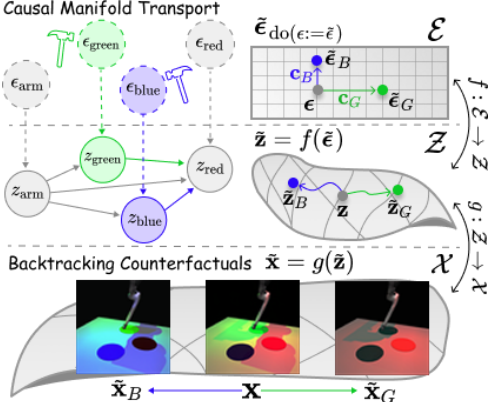
Example (Backtracking Counterfactual). We assume access to a dataset of intervention-paired observations D = {(x, ¯x, I)}, where x is a factual sample, ¯x is the corresponding post-intervention outcome, and I ∈ {0, 1}N is an indicator vector denoting which of the N factors is intervened (in the atomic setting). Given a factual observation x, we first infer its endogenous and exogenous coordinates via the inverse mappings:
As illustrated in Figure 1, a backtracking counterfactual is produced by applying a parameterized transport operator δη(·) to the exogenous code ϵ and decoding the result through the composite mechanism h:
where i = argmaxk Ik identifies the target factor, γ ∈ R controls the intervention magnitude, and η denotes the learnable parameters defining the causal basis {ck}Nk=1 .
Goal. Our objective is to jointly learn (i) the invertible exogenous chart f(·) and (ii) the set of factor-aligned directions {ci}Ni=1 in E. The learning criterion is that for each paired sample (x, ¯x, I), the transported reconstruction ˜x must accurately match the ground-truth counterfactual ¯x while preserving nontarget attributes. The remainder of this paper details the construction of these directions intrinsic to the diffusion framework and the training procedure using intervention-paired data.
4 Causal Manifold Transport DiffusionModels
4.1 Elucidating the Diffusion via a Causal Lens
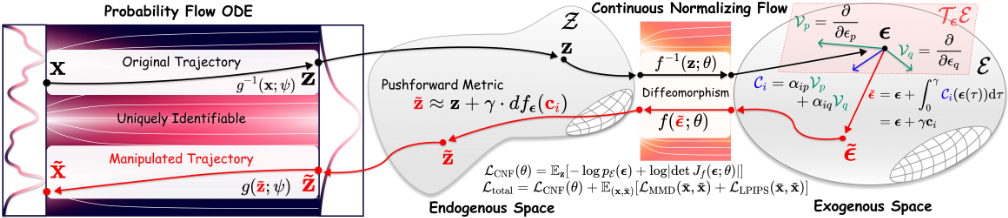
Endogenous and Exogenous Spaces. In this study, we define the latent space of the PF-ODE g : Z → X as the endogenous space Z. Although Z encodes causal information, the latent space in diffusion models is not inherently disentangled, making it challenging to identify the directional relationships between causal factors. To address this and extract independent exogenous variables, we introduce an invertible CNF f : E → Z that reparameterizes the diffusion latent space. Its inverse f -1 : Z → E maps an endogenous latent z to exogenous coordinates ϵ, i.e., ϵ = f -1 (z). By constructing the CNF as a diffeomorphic map [Grathwohl et al., 2019], Z and E share the same topological structure.
SmoothManifold and Diffeomorphism. To formalize the properties of Z and E, we present the following Observation 1 and Theorem 1 from [Dominguez-Olmedo et al., 2023]:
Observation 1. Under causal sufficiency, if each marginal distribution Pϵi has a di-dimensional smooth manifold support, the exogenous manifold E forms a smooth manifold of dimension d = ∑i di.
Theorem 1. For an acyclic SCM with the exogenous manifold E and the endogenous manifold Z, if the following conditions hold: (1) E is a smooth manifold; (2) fi(·) is differentiable with ∂ϵi fi(ϵi) ̸= 0 and is injective with respect to ϵi; then Z is a smooth manifold and the mapping f : E → Z is a diffeomorphism.
Under Assumption 2, E is a smooth manifold, characterized by its locally Euclidean structure and differentiable properties (Observation 1). The CNF f(·), satisfying the second condition of Theorem 1, ensures that both Z and E are smooth manifolds and that f : E → Z is a diffeomorphism. This diffeomorphism preserves the topological and differential structures between Z and E, thereby conserving local geometric properties under the mapping fθ(·). Thus, geometric transports in E induce well-defined, causally consistent transformations in Z.
4.2 The Causal Manifold Transport
Defining Transformations viaVector Fields. Avector field V on a manifold E is a smooth mapping assigning each point ϵ ∈ E a tangent vector V(ϵ) ∈ TϵE, representing the directional adjustment at that point. In our context, we aim to define vector fields that encode interventions on specific causal factors. We first invoke Theorem 2 (adapted from [Lee, 2012]) to establish the existence of a coordinate system aligned with such fields:
Theorem 2. Let E be a d-dimensional smooth manifold. Consider a set of linearly independent vector fields {V1, . . . , Vd} on an open subset U ⊂ E that commute (i.e., their Lie bracket vanishes). Then, for any ϵ ∈ U, there exists a smooth coordinate chart centered at ϵ such that ∂ ∂ϵi = Vi for all i = 1, . . . , d.
While Observation 1 suggests that the exogenous manifold E admits local Euclidean approximations, our architecture enforces a stronger geometric condition. By construction, the CNF establishes a global diffeomorphism between E and the latent space Rd . This topological equivalence allows us to utilize a global coordinate system where the standard basis {ej}dj=1 constitutes a valid frame for the tangent space everywhere. Consequently, a geometric transport along a basis vector creates a globally consistent linear trajectory, formalized as:
where γ denotes the transport magnitude.
Establishing a Causal Basis for Transport. The standard basis transformation in Eq. (5) manipulates latent dimensions but does not necessarily align with underlying causal factors. To address this, we postulate that N causal factors are encoded within ϵ ∈ Rd (N ≤ d) and construct a dedicated Causal Vector Field. Inspired by distributed representations [Hinton et al., 1984], we employ Proposition 1 to define this field:
Proposition 1 (Causal Vector Fields). Based on Theorem 2, we define a set of new vector fields {C1, . . . , CM} on E. Each causal vector field Ci is constructed as a linear combination of the standard coordinate fields {Vj}dj=1 :
where αij ∈ R are learnable scalar coefficients. If linearly independent, these fields span anM-dimensional causal subspace of TE .
Corollary 1 (Causal Basis). The constant vector fields Ci defined in Proposition 1 correspond uniquely to constant vectors ci ∈ Rd , defined as ci = ∑dj=1 αijej. If N = M, the set {c1, . . . , cN} forms the Causal Basis for the latent space.
By establishing these fields, we define CMT as the integration along the causal vector field Ci. Specifically, for a target factor i, the intervention is formalized as:
While Eq. (7) simplifies to a linear translation due to the global Euclidean structure of E, its validity is rooted in the factoraligned direction ci. The CNF maps the entangled endogenous space Z to this disentangled manifold E, ensuring that linear transports along ci correspond to meaningful, mechanismpreserving interventions. See Appendix for proofs of Proposition 1 and Corollary 1.
Pushforward Operation. CMT is characterized by integrating a causal vector field on the exogenous manifold E. We investigate how this vector field propagates through the composite generative mapping h = g ◦ f, where f : E → Z denotes the CNF and g : Z → X is the PF-ODE. For a given point ϵ ∈ E, a causal basis vector c ∈ TϵE-derived from {C1, . . . , CM}-is first mapped to the tangent space Tf(ϵ)Z via the pushforward operator dfϵ. Here, dfϵ(c) represents the induced transport direction in the endogenous space Z. Letting z = f(ϵ), this vector is subsequently pushed forward to the tangent space Tg(z)X of the observation space X via dgz. Consequently, the term dgz(dfϵ(c)) captures the infinitesimal effect of the initial causal basis vector c after successive transformations through the CNF and PF-ODE. By the chain rule, we have
which explicitly shows how the transport vector field is pushed forward from E to Z, and ultimately to X . Figure 2 illustrates the overall pipeline of our causality-integrated diffusion framework, CMT-Diff.
4.3 Identifiability Analysis
We ground our theoretical validity in the Latent Causal Model (LCM) framework [Brehmer et al., 2022]. We first recall the standard definition of LCMs and their identifiability conditions under hard interventions, and then extend this guarantee to our soft intervention setting.
Definition 1 (Latent Causal Models). An LCM is a tuple Q = (C, X , g, I, pI), comprising an acyclic SCM C over latent variables Z, an observation space X , a diffeomorphism g : Z → X, and a set of interventions I with distribution pI. Two LCMs Q,Q′ are equivalent (Q∼Q′ ) if there exists an isomorphism preserving the causal structure and interventional distributions.
Theorem 3 (Identifiability of Real-Valued LCMs [Brehmer et al., 2022]). For LCMs Q,Q′ with real-valued variables and atomic hard interventions, equivalence Q ∼ Q′ holds if and only if their weakly supervised distributions are identical: pXQ (x, ˜x) = pXQ′ (x, ˜x).
Identifiability under Causal Manifold Transport. Our framework instantiates an LCM where the mapping g is the PFODE and the latent structure is governed by a CNF f : E → Z. While Theorem 3 assumes hard interventions, our Causal Manifold Transport operates as a soft intervention on exogenous variables ϵ. We demonstrate that the identifiability guarantee extends to this relaxation under the intervention-paired setting. Specifically, we formalize the conditions under which soft geometric shifts enable the recovery of the true causal topology:
Proposition 2 (Identifiability under Atomic Soft Exogenous Shifts). Let Q,Q′ be LCMs with diffeomorphic observation maps. Assume intervention-paired data (x, ˜x, I) generated by atomic soft shifts ˜ϵ = ϵ + γci. If Q and Q′ induce identical distributions p(x, ˜x, I), then their latent representations are equivalent up to a diffeomorphism that preserves the intervention structure.
Proposition 3 (Counterfactual Uniqueness via Identifiable Transport). Consider two equivalent LCMs Q and Q′ that are identifiable up to an intervention-preserving diffeomorphism (as established in Proposition 2). Under the strict determinism and bijectivity of the generative mechanism h = g ◦ f, equivalence in the latent causal representation implies equivalence in counterfactual generation. Specifically, for any observation x and intervention target I, the generated counterfactual is invariant to the specific choice of the identified model: ˜xQ = ˜xQ′ .
Collectively, Propositions 2 and 3 establish that under the assumptions of deterministic and bijective h and interventionpreserving equivalence, recovering the causal transport topology in E is sufficient to make the induced counterfactual mapping in X unique within the identifiable equivalence class. See Appendix for proofs of Propositions 2 and 3.
4.4 Training Procedure
Overall Framework. Initially, we extract the endogenous variable z from the observation x by inverting the PF-ODE. Leveraging the deterministic nature of the PF-ODE, we define the extraction dynamics as:
The endogenous variable z = g-1 (x; ψ) is obtained by integrating Eq. (9) forward from t = 0 to t = T using a standard discretization scheme over time steps {t0, . . . , tn}. To ensure consistency, the parameters ψ are frozen during this process. We parameterize the CNF as an ODE du(τ)/dτ = vθ(u(τ), τ), which induces an invertible map f : E → Z by integrating from τ0 to τ1 with u(τ0) = ϵ and u(τ1) = z, i.e., z = f(ϵ; θ). The inverse map ϵ = f -1 (z; θ) is obtained by integrating the same ODE backward from τ1 to τ0 with terminal condition u(τ1) = z.
The manipulation function ˜ϵ = δ(ϵ, I, γ; η) maps an original point ϵ ∈ E and an intervention vector I ∈ {0, 1}N to a manipulated point ˜ϵ ∈ E. Its parameters η include a learnable logit matrix A ∈ RN×d (where N is the number of causal factors and d is the feature dimension). For each feature j, the vector A[:, j] ∈ RN contains the logits for the N causal factors' influence on that feature. Within the function δ(·; η), the process for deriving and using causal basis vectors begins by computing the matrix G ∈ RN×d . Each column G[:, j] is an N-dimensional vector (typically one-hot or soft one-hot) obtained from Gumbel-Softmax applied to the corresponding logits A[:, j] (for j = 1, . . . , d):
The i-th row of this matrix, G[i, :], consequently represents a d-dimensional vector of factor i's influence across all features after the Gumbel-Softmax selection process. The ddimensional causal basis vector ck ∈ Rd for an individual causal factor k is then defined as the k-th row of G:
This construction instantiates the coefficients in Proposition 1 as αij := Gij, i.e., Ci = ∑dj=1 GijVj. The intervention vector I determines which features are associated with specific interventions and whether an intervention is applied. If I indicates an intervention on a specific factor k (e.g., Ik = 1 and all other Ij = 0), the corresponding causal basis ck is scaled by γ (a scalar sampled from a uniform distribution) and added to ϵ to obtain ˜ϵ := ϵ + γck. Given an intervened exogenous coordinate ˜ϵ, we obtain the intervened endogenous latent by the forward CNF map,
Finally, the backtracking counterfactual ˜x is obtained by decoding the intervened latent ˜z via the PF-ODE. This process is mathematically equivalent to solving the dynamics defined in Eq. (9) backward in time from t = T to t = 0, subject to the terminal boundary condition xT = ˜z.
Training Objective. The counterfactual generation framework is optimized using a combined loss function to ensure accurate data distribution modeling and perceptual fidelity in generated counterfactuals. The primary loss component trains the CNF by maximum likelihood on the endogenous latents z = g-1 (x; ψ). Using the changeof-variables formula with base density pE(ϵ) = N(0, I) and ϵ = f -1 (z; θ), the CNF negative log-likelihood is LCNF(θ) = Ex∼pdata [-log pE(f -1 (g-1 (x; ψ); θ)) - log | det Jf -1g-1 (x; ψ); θ)|]. Equivalently, writing ϵ = f -1 (z; θ), we have
For CNFs, the log-determinant term is computed via the instantaneous change-of-variables formula along the ODE trajectory. For counterfactual image generation, the loss also incorporates Maximum Mean Discrepancy (MMD) [Gretton et al., 2012] for global distributional properties and Learned Perceptual Image Patch Similarity (LPIPS) [Zhang et al., 2018] for perceptual similarity. The overall loss function is:
where ˜x is the generated counterfactual and ¯x is the true postintervention image. Minimizing Ltotal trains the CNF to map the intervention manifold. MMD and LPIPS losses assess statistical and perceptual similarities between the generated counterfactuals and the true post-intervention images, while LCNF(θ) maximizes data likelihood for accurate distribution modeling.
Algorithm 1 Overall Training Procedure
Require: Intervention-paired dataD = {(x, ¯x, I)}, PF-ODE gψ (score net s(·; ψ)), CNF fθ, basis parameters η
- 1: Phase 1 (pretrain PF-ODE).
- 2: while not converged do
- 3: ψ ←ψ -∇ψLEDM [Karras et al., 2022]
- 4: end while
- 5: Phase 2 (train CNF&CMT):
- 6: while not converged do
- 7: z ← g-1 (x; ψ), ϵ ← f -1 (z; θ), γ ∼ p(γ)
- 8: ˜ϵ ← δ(ϵ, I, γ; η)
- 9: ˜x← g(f(˜ϵ; θ); ψ)
- 10: L←LCNF(θ) +LLPIPS(˜x, ¯x) +LMMD(˜x, ¯x)
- 11: (θ, η) ← (θ, η) -α∇(θ,η)L
- 12: end while
5 Experiments
Setup. We utilize the CausalCircuit dataset [Brehmer et al., 2022], which consists of 120K image pairs before and after interventions, split into 100K/10K/10K for training, validation, and testing. To rigorously benchmark performance, we conduct a comprehensive comparison against a wide range of state-of-the-art causal generative models. Our evaluation covers VAE-based approaches, including βVAE [Burgess et al., 2018], iVAE [Khemakhem et al., 2020], CausalVAE [Yang et al., 2021], SCM-VAE [Komanduri et al., 2022], ILCM [Brehmer et al., 2022], and ICM-VAE [Komanduri et al., 2023], as well as diffusion-based baselines such as DiffAE [Preechakul et al., 2022] and CausalDiffAE [Komanduri et al., 2024]. We report (i) representation quality using DCI [Eastwood and Williams, 2018] and (ii) generation quality using FID [Heusel et al., 2017], IS [Salimans et al., 2016], and SSIM [Wang et al., 2004]. More details regarding the experimental setup, baselines, and evaluation metrics are provided in the Appendix.
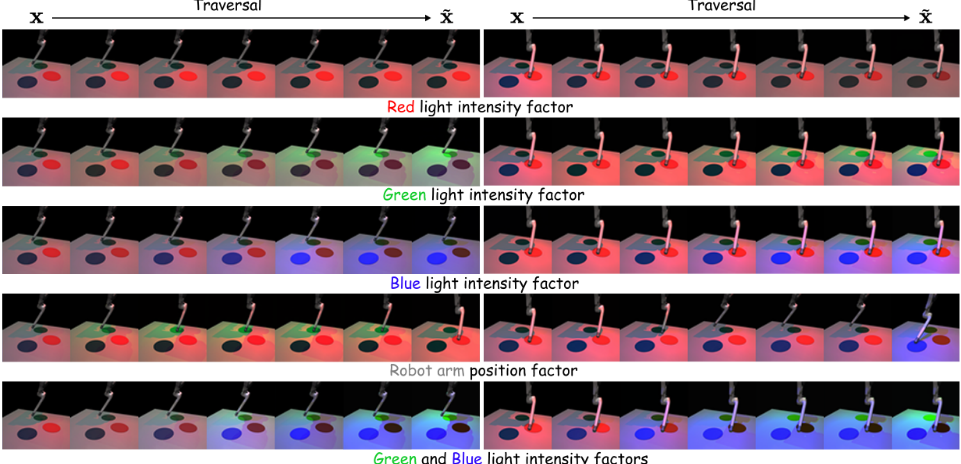
Qualitative Results. Figure 3 demonstrates the geometric realization of backtracking counterfactuals. Translating exogenous coordinates along factor-aligned directions induces consistent, monotonic variations in target attributes (e.g., light intensity, arm position) while preserving orthogonal content. This validates our premise that causal interventions can be operationalized as vector transports within the exogenous manifold. Furthermore, composite interventions (e.g., Green and Blue) exhibit additive behavior, confirming that the learned directions constitute an independent causal basis enabling compositional control.
Quantitative Results. Table 1 evaluates structural identifiability using the DCI metric, which quantifies the extent to which each latent dimension captures a single, distinct generative factor. While standard diffusion baselines (e.g., DiffAE) exhibit substantial latent entanglement, CMT-Diff attains a DCI score of 0.99, indicating strong factor alignment in the learned exogenous coordinates. This suggests that the learned transports are factor-specific and consistent with the intervention targets, supporting the use of linear translations in the exogenous manifold for controllable counterfactual generation. Although CausalDiffAE achieves similar performance, CMT-Diff learns the exogenous manifold intrinsically within the diffusion model using intervention-paired data and labels, whereas CausalDiffAE uses ground-truth exogenous variables as external guidance.
| Method | DCI (↑) |
|---|---|
| VAE-based Approaches | |
| β-VAE [Burgess et al., 2018] | 0.69 |
| iVAE [Khemakhem et al., 2020] | 0.74 |
| CausalVAE [Yang et al., 2021] | 0.88 |
| SCM-VAE [Komanduri et al., 2022] | 0.86 |
| ILCM [Brehmer et al., 2022] | 0.99 |
| ICM-VAE [Komanduri et al., 2023] | 0.98 |
| Diffusion-based Approaches | |
| DiffAE [Preechakul et al., 2022] | 0.35 |
| CausalDiffAE [Komanduri et al., 2024] | 0.99 |
| CMT-Diff (Ours) | 0.99 |
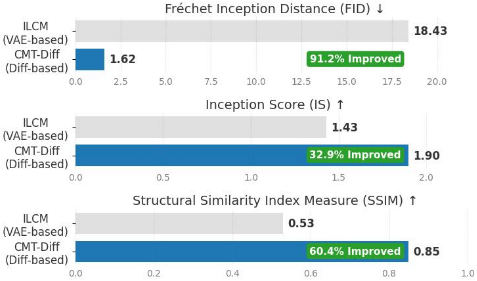
Generative Quality and Model Comparison. A critical premise of CMT-Diff is that disentanglement alone is insufficient for high-fidelity causal generation. While VAE-based baselines such as ILCM [Brehmer et al., 2022] achieve competitive factor alignment (Table 1), their reconstruction capabilities often falter in generating realistic counterfactuals. To rigorously evaluate this trade-off, we benchmark against ILCM, which operates under a comparable intervention-paired regime. We explicitly acknowledge that our method leverages auxiliary intervention target labels to define the transport direction. However, this comparison is intended to demonstrate the distinct advantage of integrating target-aware geometric transports within a diffusion backbone. As shown in Figure 4, CMT-Diff yields substantial improvements in perceptual fidelity while maintaining precise causal control.
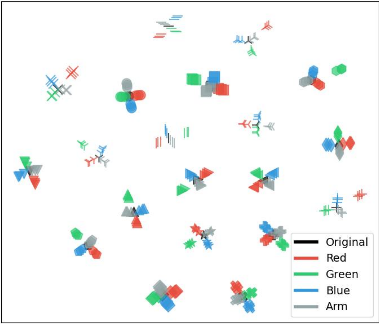
Coherence of Geometric Transport. Figure 6 visualizes the topology of the learned exogenous manifold E via t-SNE projections. We observe that interventions manifest as coherent, directionally consistent translations applied to local neighborhoods of factual samples, distinctly avoiding arbitrary discontinuities. This empirical regularity corroborates our theoretical premise that causal interventions operate as smooth, factor-specific transport maps within the latent chart.

Stability of the Causal Basis. Figure 5 probes the robustness of the learned basis construction to random initialization across 10 independent runs. Specifically, we measure how many latent dimensions are assigned to each factor by the Gumbel-Softmax based allocation and report the mean and standard deviation across runs. The allocation exhibits low variation, suggesting that the basis learning procedure is relatively stable and tends to converge to repeatable factorwise partitions of the exogenous representation in this setting. While this does not by itself establish identifiability, it provides empirical evidence that the learned transport parameterization is not overly sensitive to initialization. In practice, such repeatability is desirable because it reduces the chance that the intervention semantics change drastically across retraining.
6 RelatedWork
Backtracking Counterfactuals. In SCMs, counterfactual is typically formalized through structural interventions that modify the governing equations (e.g., via the do-operator) [Pearl, 2009]. For trained generative models, however, changing the mechanism defines a different data-generating process than the one represented by the fixed model parameters. Recent theoretical work addresses this mismatch by introducing backtracking counterfactuals, which keep the structural equations unchanged and instead explain changes through modifications of exogenous variables [Von K¨ugelgen et al., 2023]. Followup studies refine this idea by adding feasibility or naturalness constraints [Hao et al., 2024] or by framing recourse as an optimization problem [Fatemi et al., 2025]. In contrast to optimization-centric formulations or approaches that require explicit graph constraints, our work operationalizes backtracking inside diffusion models by constructing an explicit exogenous coordinate system and realizing backtracking as geometric transport along factor-aligned directions.
Causal Generative Models. Causal generative modeling has been extensively studied in VAE-based frameworks that learn identifiable latent causal variables using interventionpaired observations and related supervision signals (e.g., [Locatello et al., 2020; Brehmer et al., 2022; Ahuja et al., 2022; Lippe et al., 2022; Lippe et al., 2023; Zhang et al., 2023; Zhou et al., 2024]). These works provide identifiability guarantees and practical procedures for recovering causal factors in structured latent spaces. More recently, diffusion models have been explored for causal modeling (e.g., [Sanchez and Tsaftaris, 2022; Komanduri et al., 2024; Chao et al., 2024]), often targeting interventional or counterfactual generation by introducing additional structural information or guidance signals. A key difference is that prior diffusion-based approaches typically impose causality externally to the diffusion latent geometry, for example by assuming explicit structural priors (such as known graphs or mechanism constraints) or by constructing a causal representation with an auxiliary encoder and then conditioning or guiding a diffusion generator. In contrast, we focus on learning an intrinsic causal representation within the diffusion model from intervention-paired data with observed intervention targets, so that interventions correspond to well-defined operations in the exogenous manifold. We further provide an identifiability analysis that clarifies what aspects of this intrinsic representation are recoverable.
7 Conclusion
We proposed CMT-Diff to establish identifiable causal generation within diffusion models. By coupling a CNF with the PF-ODE, we constructed an exogenous manifold where interventions are realized as CMT. This mechanism is defined as vector translations along a learned causal basis. Our geometric formulation disentangles generative factors, enabling counterfactual control without compromising generative quality. Currently, the framework relies on intervention-paired data for manifold alignment. Future work will extend this approach to unsupervised settings, investigating whether intrinsic topological properties suffice to recover the causal basis.
Acknowledgments
This work was supported by the Institute of Information & Communications Technology Planning & Evaluation (IITP) grants funded by the Korean Government (MSIT) (No. RS2019-II190079, Artificial Intelligence Graduate School Program (Korea University); No. RS-2024-00457882, National AI Research Lab Project), and by the National Research Foundation of Korea (NRF) grant funded by the Korean Government (MSIT) (No. RS-2025-16071925).
@inproceedings{ijcai2026p537,
  title     = {Causal Manifold Transport for Identifiable Causal Generation in Diffusion Models},
  author    = {Sohn, Junghyo and Jeong, Wootaek and Song, Sujeong and Yoon, Jee Seok and Suk, Heung-Il},
  booktitle = {Proceedings of the Thirty-Fifth International Joint Conference on
               Artificial Intelligence, {IJCAI-26}},
  publisher = {International Joint Conferences on Artificial Intelligence Organization},
  editor    = {Diego Calvanese},
  pages     = {4822--4830},
  year      = {2026},
  month     = {8},
  note      = {Main Track},
  doi       = {10.24963/ijcai.2026/537},
  url       = {https://doi.org/10.24963/ijcai.2026/537},
}
TY - CPAPER TI - Causal Manifold Transport for Identifiable Causal Generation in Diffusion Models AU - Sohn, Junghyo AU - Jeong, Wootaek AU - Song, Sujeong AU - Yoon, Jee Seok AU - Suk, Heung-Il T2 - Proceedings of the Thirty-Fifth International Joint Conference on Artificial Intelligence, IJCAI-26 PB - International Joint Conferences on Artificial Intelligence Organization PY - 2026 SP - 4822 EP - 4830 DO - 10.24963/ijcai.2026/537 UR - https://doi.org/10.24963/ijcai.2026/537 ER -Copied
Machine-readable versions of this paper, for tools and AI agents:





