
Cross-Sensor Domain Generalization for Non-Contact Sleep Staging
Proceedings of the Thirty-Fifth International Joint Conference on Artificial Intelligence. Main Track. Pages 4251-4259.
https://doi.org/10.24963/ijcai.2026/473
© 2026 International Joint Conferences on Artificial Intelligence
Keywords
- Machine Learning: Classification
- Machine Learning: Applications
- Machine Learning: Representation learning
- Machine Learning: Robustness
- Machine Learning: Supervised Learning
Abstract
Sleep staging is pivotal for assessing sleep quality and clinical diagnostics. While contactless radio-frequency (RF) sensing offers an unobtrusive alternative to Polysomnography (PSG), existing methods often struggle with generalization across diverse devices and environments due to the scarcity of annotated RF data. To overcome this limitation, we propose XSensorSleep, a cross-sensor domain generalization framework. Uniquely, XSensorSleep is trained exclusively on large-scale respiratory datasets from chest and abdominal belts and is directly transferable to RF-derived respiratory signals. To bridge the domain gap, we partition the training data into multiple pseudo-domains based on data sources and sensor types, forcing the model to extract domain-invariant features from heterogeneous respiratory patterns. Furthermore, we introduce a hierarchical alignment strategy: Epoch-Level Feature Alignment (ELFA) suppresses sensor-specific morphological artifacts, while Spectral Temporal Alignment (STA) captures invariant global sleep architectures. Specifically, STA leverages the rotation-invariance of eigenvalue spectra to align whole-night transition dynamics, ensuring the model prioritizes universal physiological rhythms over device-dependent signal fluctuations. Extensive evaluations across various home and clinical RF datasets demonstrate that XSensorSleep achieves superior generalization, enabling practical, automated, and label-free non-contact sleep staging.
- [Arjovsky et al., 2019] Martin Arjovsky, Léon Bottou, Ishaan Gulrajani, and David Lopez-Paz. Invariant risk minimization. arXiv preprint arXiv:1907.02893, 2019.
- [Berry et al., 2012] Richard B Berry, Rita Brooks, Char- lene E Gamaldo, Susan M Harding, Carole Marcus, Bradley V Vaughn, et al. The aasm manual for the scor- ing of sleep and associated events. Rules, Terminology and Technical Specifications, Darien, Illinois, American Academy of Sleep Medicine, 176(2012):7, 2012.
- [Bianchi et al., 2010] Matt T Bianchi, Sydney S Cash, Joseph Mietus, Chung-Kang Peng, and Robert Thomas. Obstructive sleep apnea alters sleep stage transition dy- namics. PloS one, 5(6):e11356, 2010.
- [Blanchard et al., 2011] Gilles Blanchard, Gyemin Lee, and Clayton Scott. Generalizing from several related classifi- cation tasks to a new unlabeled sample. Advances in neu- ral information processing systems, 24, 2011.
- [Byun et al., 2019] Jong-Ho Byun, Keun Tae Kim, Hye-jin Moon, Gholam K Motamedi, and Yong Won Cho. The first night effect during polysomnography, and patients' estimates of sleep quality. Psychiatry research, 274:27- 29, 2019.
- [Carley and Farabi, 2016] David W Carley and Sarah S Farabi. Physiology of sleep. Diabetes spectrum: a pub- lication of the American Diabetes Association, 29(1):5, 2016.
- [Ding et al., 2022] Lei Ding, Baixin Chen, Yanyuan Dai, and Yun Li. A meta-analysis of the first-night effect in healthy individuals for the full age spectrum. Sleep Medicine, 89:159-165, 2022.
- [Dong et al., 2024] Shuqin Dong, Li Wen, Yuchen Li, Jingyun Lu, Zhi Zhang, Chengmei Yuan, and Changzhan Gu. Remote respiratory variables tracking with biomedi- cal radar-based iot system during sleep. IEEE Internet of Things Journal, 11(11):19937-19948, 2024.
- [Dou et al., 2019] Qi Dou, Daniel Coelho de Castro, Kon- stantinos Kamnitsas, and Ben Glocker. Domain general- ization via model-agnostic learning of semantic features. Advances in neural information processing systems, 32, 2019.
- [Duan et al., 2025] Xiang Duan, Kunpeng Li, Xuan Liu, Yang Li, Yuqing Hou, Xiaowei He, and Sheng Tang. A non-contact sleep monitoring method based on millimeter- wave radar. IEEE Transactions on Instrumentation and Measurement, 2025.
- [Ganin and Lempitsky, 2015] Yaroslav Ganin and Victor Lempitsky. Unsupervised domain adaptation by backprop- agation. In International conference on machine learning, pages 1180-1189. PMLR, 2015.
- [Gu et al., 2022] Albert Gu, Karan Goel, and Christopher Re. Efficiently modeling long sequences with structured state spaces. In International Conference on Learning Representations, 2022.
- [Hao et al., 2024] Zhanjun Hao, Yue Wang, Fenfang Li, Guozhen Ding, and Yifei Gao. Mmwave-rm: A respiration monitoring and pattern classification system based on mmwave radar. Sensors (Basel, Switzerland), 24(13):4315, 2024.
- [He et al., 2016] Kaiming He, Xiangyu Zhang, Shaoqing Ren, and Jian Sun. Deep residual learning for image recog- nition. In Proceedings of the IEEE conference on computer vision and pattern recognition, pages 770-778, 2016.
- [He et al., 2025] Hao He, Chao Li, Wolfgang Ganglberger, Kaileigh Gallagher, Rumen Hristov, Michail Ourout- zoglou, Haoqi Sun, Jimeng Sun, M Brandon Westover, and Dina Katabi. What radio waves tell us about sleep! Sleep, 48(1):zsae187, 2025.
- [Jin et al., 2020] Xin Jin, Cuiling Lan, Wenjun Zeng, and Zhibo Chen. Feature Alignment and Restoration for Do- main Generalization and Adaptation, 2020.
- [Korkalainen et al., 2019] Henri Korkalainen, Juhani Aakko, Sami Nikkonen, Samu Kainulainen, Akseli Leino, Brett Duce, Isaac O Afara, Sami Myllymaa, Juha Töyräs, and Timo Leppänen. Accurate deep learning-based sleep stag- ing in a clinical population with suspected obstructive sleep apnea. IEEE journal of biomedical and health in- formatics, 24(7):2073-2081, 2019.
- [Kwon et al., 2021] Hyun Bin Kwon, Sang Ho Choi, Dongseok Lee, Dongyeon Son, Heenam Yoon, Mi Hyun Lee, Yu Jin Lee, and Kwang Suk Park. Attention-based lstm for non-contact sleep stage classification using ir-uwb radar. IEEE Journal of Biomedical and Health Informat- ics, 25(10):3844-3853, 2021.
- [Lee et al., 2025] Hyojin Lee, You Rim Choi, Hyun Kyung Lee, Jaemin Jeong, Joopyo Hong, Hyun-Woo Shin, and Hyung-Sin Kim. Explainable vision transformer for auto- matic visual sleep staging on multimodal psg signals. npj Digital Medicine, 8(1):55, 2025.
- [Li et al., 2018] Ya Li, Xinmei Tian, Mingming Gong, Ya- jing Liu, Tongliang Liu, Kun Zhang, and Dacheng Tao. Deep domain generalization via conditional invariant ad- versarial networks. In Proceedings of the European con- ference on computer vision (ECCV), pages 624-639, 2018.
- [Li et al., 2024] Siheng Li, Beihong Jin, Fusang Zhang, Zhi Wang, Junqi Ma, Xiaoyong Ren, and Haiqin Liu. Hypnos: A contactless sleep stage monitoring system using uwb signals. Proceedings of the ACM on Interactive, Mobile, Wearable and Ubiquitous Technologies, 8(3):1-27, 2024.
- [Maaten and Hinton, 2008] Laurens van der Maaten and Ge- offrey Hinton. Visualizing data using t-sne. Journal of machine learning research, 9(Nov):2579-2605, 2008.
- [Muandet et al., 2013] Krikamol Muandet, David Balduzzi, and Bernhard Schölkopf. Domain generalization via in- variant feature representation. In International conference on machine learning, pages 10-18. PMLR, 2013.
- [Quan et al., 1997] Stuart F Quan, Barbara V Howard, Con- rad Iber, James P Kiley, F Javier Nieto, George T O'Connor, David M Rapoport, Susan Redline, John Robbins, Jonathan M Samet, et al. The sleep heart health study: design, rationale, and methods. Sleep, 20(12):1077-1085, 1997.
- [Rundo and Downey III, 2019] Jessica Vensel Rundo and Ralph Downey III. Polysomnography. Handbook of clini- cal neurology, 160:381-392, 2019.
- [Sun and Saenko, 2016] Baochen Sun and Kate Saenko. Deep coral: Correlation alignment for deep domain adap- tation. In Computer vision-ECCV 2016 workshops: Am- sterdam, the Netherlands, October 8-10 and 15-16, 2016, proceedings, part III 14, pages 443-450. Springer, 2016.
- [Tamaki et al., 2005] Masako Tamaki, Hiroshi Nittono, Mit- suo Hayashi, and Tadao Hori. Examination of the first-night effect during the sleep-onset period. Sleep, 28(2):195-202, 2005.
- [Thapa et al., 2024] Rahul Thapa, Bryan He, Magnus Ruud Kjaer, Hyatt Moore IV, Gauri Ganjoo, Emmanuel Mignot, and James Y Zou. Sleepfm: Multi-modal representation learning for sleep across ecg, eeg and respiratory signals. In AAAI 2024 Spring Symposium on Clinical Foundation Models, 2024.
- [Tzeng et al., 2014] Eric Tzeng, Judy Hoffman, Ning Zhang, Kate Saenko, and Trevor Darrell. Deep domain confu- sion: Maximizing for domain invariance. arXiv preprint arXiv:1412.3474, 2014.
- [Wang et al., 2022] Jindong Wang, Cuiling Lan, Chang Liu, Yidong Ouyang, Tao Qin, Wang Lu, Yiqiang Chen, Wen- jun Zeng, and Philip Yu. Generalizing to unseen domains: A survey on domain generalization. IEEE Transactions on Knowledge and Data Engineering, 35:1-1, 2022. IJCAI
- [Wang et al., 2024] Jiquan Wang, Sha Zhao, Haiteng Jiang, Shijian Li, Tao Li, and Gang Pan. Generalizable sleep staging via multi-level domain alignment. In Proceed- ings of the AAAI Conference on Artificial Intelligence, vol- ume 38, pages 265-273, 2024.
- [Wang et al., 2025] Wei Wang, Zhaoxi Chen, Wenyu Zhang, Zetao Wang, Xiang Zhao, Chenyang Li, Jian Guan, Shankai Yin, and Gang Li. Fusion of millimeter-wave radar and pulse oximeter data for low-burden diagnosis of obstructive sleep apnea-hypopnea syndrome. arXiv preprint arXiv:2501.15264, 2025.
- [Yu et al., 2021] Bohan Yu, Yuxiang Wang, Kai Niu, Youwei Zeng, Tao Gu, Leye Wang, Cuntai Guan, and Daqing Zhang. Wifi-sleep: Sleep stage monitoring using com- modity wi-fi devices. IEEE internet of things journal, 8(18):13900-13913, 2021.
- [Yue et al., 2018] Shichao Yue, Hao He, Hao Wang, Hariha- ran Rahul, and Dina Katabi. Extracting multi-person respi- ration from entangled rf signals. Proceedings of the ACM on Interactive, Mobile, Wearable and Ubiquitous Tech- nologies, 2(2):1-22, 2018.
- [Zhai et al., 2022] Qian Zhai, Tingyu Tang, Xiaoling Lu, Xi- aoxi Zhou, Chunguang Li, Jingang Yi, and Tao Liu. Ma- chine learning-enabled noncontact sleep structure predic- tion. Advanced Intelligent Systems, 4(5):2100227, 2022.
- [Zhang et al., 2018] Guo-Qiang Zhang, Licong Cui, Remo Mueller, Shiqiang Tao, Matthew Kim, Michael Rueschman, Sara Mariani, Daniel Mobley, and Susan Redline. The national sleep research resource: towards a sleep data commons. Journal of the American Medical Informatics Association, 25(10):1351-1358, 2018.
- [Zhang et al., 2019] Feng Zhang, Chenshu Wu, Beibei Wang, Min Wu, Daniel Bugos, Hangfang Zhang, and KJ Ray Liu. Smars: Sleep monitoring via ambient ra- dio signals. IEEE Transactions on Mobile Computing, 20(1):217-231, 2019.
- [Zhang et al., 2020] Dongheng Zhang, Yang Hu, and Yan Chen. Mtrack: Tracking multiperson moving trajectories and vital signs with radio signals. IEEE Internet of Things Journal, 8(5):3904-3914, 2020.
- [Zhao et al., 2017a] Mingmin Zhao, Shichao Yue, Dina Katabi, Tommi S Jaakkola, and Matt T Bianchi. Learning sleep stages from radio signals: A conditional adversar- ial architecture. In International conference on machine learning, pages 4100-4109. PMLR, 2017.
- [Zhao et al., 2017b] Mingmin Zhao, Shichao Yue, Dina Katabi, Tommi S Jaakkola, and Matt T Bianchi. Learning sleep stages from radio signals: A conditional adversarial architecture. In Proceedings of the 34th International Con- ference on Machine Learning, pages 4100-4109. PMLR, 2017.
- [Zhou et al., 2023] Kaiyang Zhou, Ziwei Liu, Yu Qiao, Tao Xiang, and Chen Change Loy. Domain generalization: A survey. IEEE Transactions on Pattern Analysis and Ma- chine Intelligence, 45(4):4396-4415, 2023.
- [Zhuang et al., 2025] Zhongxu Zhuang, Biao Xue, Qiang An, Hui Chu, Yue Zhang, Rui Chen, Jing Xu, Ning Ding, Xiaochuan Cui, E Wang, et al. Advancing sleep health eq- uity through deep learning on large-scale nocturnal respi- ratory signals. Nature Communications, 16(1):9334, 2025.
References were extracted automatically from the PDF and may contain errors.
Full text extracted automatically from the PDF; figures, tables and equations may differ. The PDF is the version of record.
1 Introduction
Accurate sleep staging is fundamental for assessing sleep quality and diagnosing sleep disorders. According to the American Academy of Sleep Medicine (AASM) standard [Berry et al., 2012], sleep is categorized into Wake, N1, N2, N3, and REM stages using 30-second epochs.
∗The corresponding author is Yan Chen
Polysomnography (PSG) remains the clinical gold standard [Rundo and Downey III, 2019], but its reliance on multiple contact-based sensors makes it intrusive in practice and susceptible to the first-night effect [Tamaki et al., 2005; Byun et al., 2019; Ding et al., 2022]. Despite recent advances in automated sleep staging [Thapa et al., 2024; Lee et al., 2025], these practical limitations continue to motivate the development of non-contact sleep monitoring approaches.
Among emerging paradigms, radio-frequency (RF) sensing has attracted increasing attention for non-contact sleep staging [Zhao et al., 2017a; Zhai et al., 2022; Wang et al., 2025; Zhang et al., 2019; Yu et al., 2021]. RF signals reflected from the human body are modulated by subtle physiological motions, with respiration providing the most informative cues for sleep staging [Li et al., 2024; Dong et al., 2024; Duan et al., 2025; Carley and Farabi, 2016]. This enables unobtrusive, long-term monitoring without body-worn sensors. However, practical adoption of RF-based sleep staging remains limited by the lack of large-scale, publicly available labeled RF datasets, which hinders robust model training and generalization.
In light of this limitation, the similarity between RFderived respiratory signals and chest and abdominal belt recordings [Yue et al., 2018; Zhang et al., 2020; Hao et al., 2024] enables the transfer of models trained on large-scale belt-based respiration datasets to RF-derived signals. However, such transfer is non-trivial due to fundamental differences in measurement characteristics across sensors. Belt sensors are tightly coupled to the body surface and provide high signal-to-noise respiratory waveforms, whereas RF sensing is highly sensitive to global body motion and environmental multi-path effects. In particular, non-respiratory movements during Wake periods can dominate RF reflections, intermittently corrupting or fragmenting respiratory signals and leading to lower and more variable signal quality than belt recordings. This results in pronounced cross-sensor distribution shifts in the absence of labeled RF data during training.
Most existing domain generalization methods promote robustness by enforcing similarity or consistency in learned representations across source domains, typically via feature alignment or invariance constraints [Zhou et al., 2023; Wang et al., 2022]. Such methods implicitly assume that target domain shifts are moderate and interpolatable from the source domains. In cross-sensor sleep staging, this assumption may be violated, as RF sensing induces large and sensorspecific transformations beyond simple distributional variations [Zhao et al., 2017b]. Consequently, strong similarity constraints can become overly restrictive [Jin et al., 2020], and cross-sensor generalization may benefit from representations that preserve stable structural properties of sleep dynamics under nuisance transformations.
In this paper, we propose XSensorSleep, a cross-sensor domain generalization framework for non-contact sleep staging that leverages stable properties of sleep dynamics under sensor-induced variability. The central idea is that although RF-based respiratory signals are subject to substantial noise and distortion at fine temporal scales, the large-scale organization of sleep, namely sleep architecture, is governed by relatively stable physiological dynamics across sensing modalities. XSensorSleep incorporates stage-aware data modeling to reflect sensing-dependent variability across wake and sleep states, and adopts a hierarchical alignment strategy to capture invariant structure at multiple temporal scales. Local alignment promotes robustness to sensor- and placement-related variations in short respiratory segments, while global spectral alignment focuses on the dominant dynamical structure of whole-night sleep sequences, emphasizing principal modes of temporal organization and reducing sensitivity to sensoramplified noise.
We collect RF-based datasets from both home and clinical environments and evaluate XSensorSleep on these datasets without using labeled RF data during training or finetuning. The framework is integrated into existing processing pipelines to perform fully automated, non-contact sleep staging.
Our contributions are threefold:
- We identify a fundamental limitation of existing sequence modeling approaches in cross-sensor sleep staging, namely that the assumption of preserved finegrained temporal correspondence across sensing modalities often does not hold in non-contact RF settings.
- We propose XSensorSleep, a cross-sensor domain generalization framework that leverages stable sleep dynamics beyond sensor-induced temporal distortions through joint modeling of local respiratory representations and global whole-night sleep structure.
- We validate the proposed framework through extensive evaluations on real-world RF datasets collected from both home and clinical environments, where no labeled RF data is used for training or fine-tuning.
2 RelatedWork
2.1 Non-contact Automatic Sleep Staging
Recent research has explored non-contact sleep staging using radio frequency signals as an alternative to traditional PSGbased approaches. By leveraging the ability of RF signals to capture subtle physiological activities during sleep, these methods aim to enable unobtrusive and automatic sleep staging.
Zhao et al. proposed a Conditional Adversarial Network (CAN) that learns sleep stage representations directly from RF signals, demonstrating improved accuracy even when labeled data is limited [Zhao et al., 2017a]. Kwon et al. introduced a framework based on impulse radio ultra-wideband (IR-UWB) radar, employing an attention-based LSTMmodel to capture long-range dependencies and salient temporal features in sleep patterns [Kwon et al., 2021]. Zhai et al. developed a method that combines a convolutional recurrent neural network (CRNN) with neural conditional random fields (CRF), effectively modeling both the temporal dynamics and transition structures of sleep stages from RF data [Zhai et al., 2022]. Li et al. designed a system using a CNN-based encoder together with a Transformer sequence model and contrastive learning, enabling accurate sleep staging from UWB signals and jointly performing sleep apnea detection as an auxiliary task [Li et al., 2024]. Most recently, He et al. proposed a deep neural architecture comprising multiple convolutional residual blocks for local feature extraction, followed by an LSTM layer and attention mechanism to model global temporal dependencies in RF-reflected signals [He et al., 2025].
Despite these advances, most existing RF-based sleep staging methods are often limited by small dataset sizes, lack of generalizability across environments and devices, and dependence on substantial labeled RF data, which motivates the need for robust, domain-generalizable approaches.
2.2 Domain Generalization
Domain generalization (DG) aims to train models to perform reliably on unseen domains [Blanchard et al., 2011; Muandet et al., 2013]. A widely adopted strategy for DG is to encourage domain-invariant feature learning by reducing the divergence between feature distributions across domains. Several classic methods have been developed to minimize feature distribution discrepancies across domains, such as maximum mean discrepancy (MMD) [Tzeng et al., 2014], second-order correlation alignment (CORAL) [Sun and Saenko, 2016], and similarity metric-based approaches [Dou et al., 2019].In addition, adversarial frameworks, such as domain adversarial neural networks (DANN) [Li et al., 2018], have become standard techniques in domain generalization research.
In sleep staging, recent efforts like SleepDG [Wang et al., 2024] employ multi-level alignment to bridge gaps between heterogeneous PSG datasets. However, while SleepDG focuses on intra-modality shifts, XSensorSleep addresses the more challenging cross-sensor scenario where physical measurement mechanisms differ fundamentally (e.g., from belts to non-contact RF).
Unlike SleepDG's reliance on noise-sensitive point-topoint alignment, we propose Spectral Temporal Alignment (STA). Recognizing that sleep architecture dynamics remain physiologically invariant despite varying signal morphologies, STA aligns the eigenvalue spectra of temporal correlation matrices. This spectral approach captures the universal rhythm of sleep transitions, enabling robust zero-shot generalization to unseen sensing modalities by focusing on intrinsic dynamical complexity rather than device-dependent fluctuations.
3 Method
3.1 ProblemFormulation
In this work, we study contactless sleep staging under a cross-sensor domain generalization setting, where models are trained on contact-based respiratory signals (e.g., chest and abdominal belts) and evaluated on RF-based respiratory measurements, which serve as the target domain. This setting is challenging due to substantial domain shifts in signal morphology and temporal structure induced by differences in sensing mechanisms.
We consider M labeled source domains. Each source domain m is associated with a joint distribution pm(x, y) and a labeled dataset Dm = {(xmn , ym n )}Nm n=1 . The RF-based target domain follows an unknown distribution ptarget(x, y) that differs from all source distributions pm(x, y).
Each sample (xmn , ym n ) from the m-th domain represents a whole-night respiratory recording annotated with sleep stage labels from the set Y = {1, . . . , C}, corresponding to Wake, Light (N1+N2), Deep (N3), and REM. Specifically,
where each respiratory epoch xmn,ℓ ∈ Rd is associated with a label ym n,ℓ ∈ Y.
The objective is to learn a predictive function that generalizes from belt-based respiratory recordings to RF-based respiratory signals.
3.2 Framework Overview
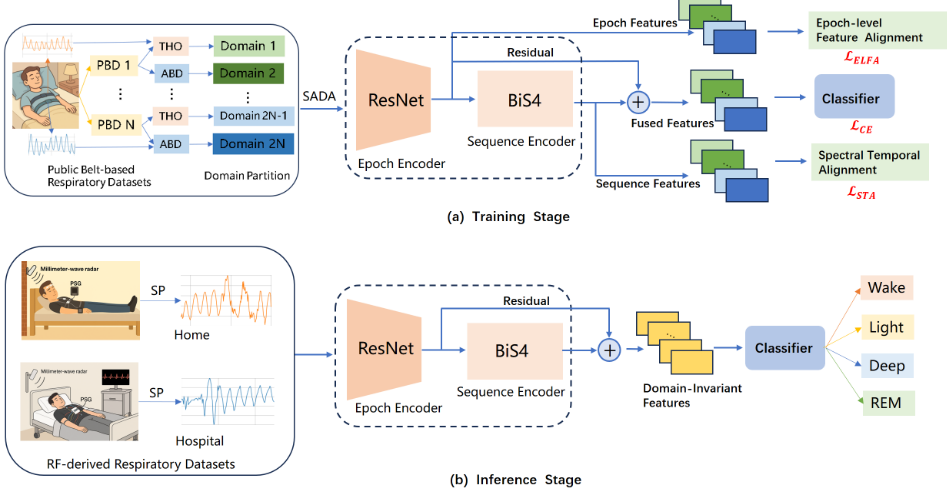
As illustrated in Fig. 1, our framework addresses the crossdomain gap between belt-based and RF-derived respiratory signals through a single-stage domain generalization approach. Labeled belt data are partitioned into multiple pseudo-domains based on dataset source, sensor type, and subject pool to expose the model to diverse respiratory patterns. To enhance generalization, we incorporate stageaware data augmentation and enforce both epoch-level feature alignment and whole-night sequence alignment, encouraging domain-invariant representations. The trained model is then directly applied to RF-derived respiratory signals for sleep stage prediction without accessing the target domain.
3.3 Model Architecture
We adopt a hierarchical architecture F = f ◦ h ◦ g to model full-night respiratory sequences, where the epoch encoder g maps each respiratory epoch to a latent representation, the sequence encoder h captures long-range temporal dependencies and sleep-stage transition dynamics across the night, and the classifier f outputs sleep stage probabilities for each epoch.
Specifically, for a whole-night respiratory sequence xmn , the epoch encoder g is applied independently to each respiratory epoch:
The resulting sequence of epoch-level embeddings Fmn = {f m n,ℓ }Lℓ=1 is then processed by the sequence encoder h to model global temporal context:
Finally, the classifier f predicts sleep stage labels for each epoch based on the temporally enhanced representations:
In our implementation, the epoch encoder g is instantiated as a ResNet34 backbone [He et al., 2016] to extract local, epoch-level representations from respiratory waveforms. The sequence encoder h is implemented using a bidirectional Structured State Space Sequence (BiS4) model [Gu et al., 2022], which captures long-range temporal dependencies by incorporating both past and future contextual information. The classifier f is realized as a lightweight multilayer perceptron that outputs sleep stage probabilities for each epoch.
3.4 Stage-Aware Data Augmentation
Directly optimizing the prediction model F via empirical risk minimization (ERM) on contact-based source domains often leads to suboptimal generalization to RF-based respiratory signals. This is primarily due to substantial sensinginduced domain shifts, where different sensing modalities exhibit stage-dependent response characteristics. In particular, while contact-based respiratory belts predominantly capture respiration-induced chest or abdominal expansion, noncontact radar systems are sensitive to all surface displacements. As a result, during the Wake stage, large-amplitude body movements can dominate radar measurements and overwhelm respiration-related micro-motions, yielding signal patterns that differ qualitatively from belt-based recordings.
Motivated by this sensing asymmetry, we propose StageAware Data Augmentation (SADA), which applies stagedependent perturbations to better reflect distinct radar sensing regimes during training. For wake epochs, an aggressive augmentation Awake introduces high-variance noise, amplitude scaling, and soft temporal masking to simulate motiondominated radar signals. For sleep epochs, a mild augmentation Asleep applies attenuated perturbations to preserve respiration-dominant morphology.
Formally, for an input respiratory epoch xmn,ℓ with label ym n,ℓ , the augmented signal ˜xmn,ℓ is defined as
where θwake and θsleep denote stage-specific augmentation parameters.
3.5 Multi-source Domain Generalization
We partition the N public belt-based datasets into 2N pseudo-domains based on dataset origin and sensor placement (chest or abdomen). To prevent subject-level information leakage, chest- and abdomen-belt signals are drawn from disjoint subject pools, and subjects appearing in multiple datasets are excluded.
Epoch-level Feature Alignment (ELFA). To reduce distributional discrepancies in local respiratory patterns across source domains, we introduce an epoch-level alignment loss. Given the sets of epoch-level features Fpn and Fqn extracted by the epoch encoder g in Eq. 2 from different source domains, we align their mean and covariance following CORAL [Sun and Saenko, 2016]:
where µ and Σ denote the corresponding mean vector and covariance matrix, and d is the feature dimensionality. By minimizing pairwise statistical discrepancies across pseudodomains, ELFA encourages the encoder to learn domaininvariant epoch-level representations that suppress sensorand dataset-specific variations in respiratory morphology.
Spectral Temporal Alignment (STA). While ELFA aligns local epoch-level representations, respiratory-based sleep staging additionally depends on long-range transition dynamics that define the global sleep architecture. However, existing sequence-level alignment methods typically assume direct temporal correspondence across domains, an assumption often violated in cross-sensor settings due to sensor-specific distortions and motion-induced shifts. We therefore propose Spectral Temporal Alignment (STA) to align dominant temporal modes of whole-night dynamics.
For a whole-night recording, given the sets of in-context features Hmn extracted by the sequence encoder in Eq. 3. We first construct a temporal correlation matrix Rmn ∈ RL×L using cosine similarity:
Then the domain-level average correlation matrix is computed as:
where Nm is the number of recordings.
Directly aligning correlation matrices via element-wise distances may impose unnecessarily strict correspondence at the level of individual temporal interactions, which is less desirable under sensor-induced distortions. Instead, STA aligns the eigenvalue spectra of ¯Rm, which summarize the dominant temporal modes of whole-night dynamics and are invariant to orthogonal transformations. The STA loss is defined as:
where λK denotes the top-K eigenvalues of corresponding correlation matrix. Aligning the leading K eigenvalues promotes agreement in large-scale temporal structure across domains, while reducing sensitivity to fine-grained variations that are susceptible to sensor-induced distortions.
3.6 Training and Inference
The total loss function during training is defined as:
where LCE is the cross-entropy loss for classification, and λ1, λ2 are balancing hyperparameters.
The model is trained exclusively on the multi-source, labeled belt-based respiratory data using the above objective. At test time, F = f ◦h◦g is directly deployed on RF-derived respiratory signals, achieving zero-shot generalization to unseen target domains.
| Dataset | Modality | Total | Used | Usage |
|---|---|---|---|---|
| Source Domain (Contact-based Sensors) | ||||
| SHHS1 | Chest/Abdo Belt | 5793 | 3083 | Train / Val. |
| SHHS2 | Chest/Abdo Belt | 2651 | 2554 | Train / Val. |
| Target Domain (RF-based Sensors) | ||||
| Home | FMCW Radar | 35 | 35 | Test |
| Hospital | FMCWRadar | 57 | 57 | Test |
4 Experiments
4.1 Datasets and Preprocessing
Datasets
We used two datasets: (1) multi-source belt-based respiratory signals from public sleep databases, and (2) a self-collected mmWave radar respiratory dataset (Table 1).
Belt-based Respiratory Datasets. We used the Sleep Heart Health Study (SHHS), including SHHS1 and SHHS2 cohorts [Zhang et al., 2018; Quan et al., 1997]. SHHS1 contains over 5,000 subjects, while SHHS2 is a subset re-collected approximately three years later. To avoid subject leakage in domain generalization experiments, overlapping subjects between cohorts were removed. Each overnight recording provides synchronized chest and abdominal belt signals annotated in 30-second epochs following AASM standards.
Radar-based Respiratory Datasets. Our target domain is a self-collected mmWave radar dataset with 92 overnight recordings from 71 subjects in hospital and home environments. Specifically, 57 recordings were collected from 57 subjects in hospital settings and 35 from 14 subjects at home. Data acquisition used 77GHZ and 60GHZ FMCW radar systems positioned obliquely at the bedside. All procedures were IRB approved.
Preprocessing
Pseudo-domain Partitioning. For both SHHS1 and SHHS2, subjects were randomly divided into two disjoint groups of comparable size, assigned to chest-belt and abdomen-belt domains, respectively. Each subject appears in only one domain, with no overlap within or across datasets. This results in four balanced pseudo-domains (SHHS1-chest, SHHS1-abdomen, SHHS2-chest, SHHS2-abdomen) with unique subjects.
Signal Processing. Radar signals were beamformed to extract respiratory waveforms by selecting points with the maximum Breath-to-Noise Ratio (BNR) . This dynamic selection enables physical adaptation to different sleeping postures (e.g., supine, side, or stomach) by focusing on the body region with the strongest respiratory modulation. All belt-based and radar-derived signals were resampled to 10Hz and bandpass filtered (0.1-2Hz) to preserve respiratory components and suppress artifacts. Each epoch was normalized using min-max scaling. Non-overlapping 30-second epochs were then concatenated to form full-night time-series inputs for the model.
4.2 Experiment Settings
XSensorSleep is implemented in PyTorch and optimized using AdamW with a cosine learning rate scheduler, an initial learning rate of 4 × 10⁻⁴ , and a weight decay of 1 × 10⁻⁴ . The model is trained for 50 epochs with a batch size of 6, a dropout rate of 0.1, and regularization coefficients λ1 = λ2 = 0.1. Each overnight respiratory recording is represented as a fixed-length sequence of 1500 epochs, corresponding to 12.5 hours of data. Shorter recordings are zero-padded with masks, while longer ones are truncated, with padded epochs excluded during temporal correlation computation.
The feature dimension is set to 512, and the number of leading eigenvalues for whole-night structure alignment is K = 20. Model performance is evaluated using Accuracy (ACC), Macro-F1 (MF1), and Cohen's Kappa (κ).
4.3 Experiment Results
Comparison with Existing Non-Contact Sleep Staging Methods Using RF Signals
We compare XSensorSleep with representative RF-based sleep staging methods spanning domain generalization, temporal modeling, and modern deep architectures, including Zhao et al. (2017) [Zhao et al., 2017a], Kwon et al. (2021) [Kwon et al., 2021], Zhai et al. (2022) [Zhai et al., 2022], He et al. (2025) [He et al., 2025], and Zhuang et al. (2025) [Zhuang et al., 2025], where the first four models were reproduced and trained on the same large-scale multisource belt datasets as XSensorSleep and evaluated on the RF-derived test sets, and the fifth method was evaluated using its publicly available pre-trained weights.
Results in Table 2 show that XSensorSleep consistently outperforms all prior RF-based methods in accuracy, macroF1, and Cohen's Kappa across both home and hospital settings, demonstrating strong generalization enabled by multisource partitioning and whole-night alignment. Performance on the hospital dataset is approximately 5 points lower than in the home setting, primarily due to increased RF noise from higher personnel movement and a greater prevalence of severe sleep apnea, consistent with prior studies [Bianchi et al., 2010; Korkalainen et al., 2019].
Comparison with Existing DG Methods
We further evaluate XSensorSleep against state-of-theart domain generalization methods, including ERM, MMD [Tzeng et al., 2014], CORAL [Sun and Saenko, 2016], DANN [Ganin and Lempitsky, 2015], IRM [Arjovsky et al., 2019], and the sleep-specific SleepDG [Wang et al., 2024]. All methods use the same backbone and are evaluated under identical experimental settings.
As shown in Table 3, our method consistently outperforms all baselines on the target domain across all metrics. The ERM baseline exhibits a notable performance drop, particularly in the Hospital environment, suggesting a pronounced modality gap between contact-based belt signals and noncontact radar measurements, where direct model transfer may be insufficient. General DG methods (e.g., CORAL and DANN) yield only marginal improvements over this baseline, possibly because sample-level distribution alignment does not fully capture the periodic morphology of respiratory signals. In contrast, XSensorSleep achieves an overall κ improvement of 0.021 over SleepDG, with the largest gain of 0.028 observed in the Hospital dataset, suggesting that STA contributes to improved robustness under clinical noise and pathological breathing conditions. Notably, XSensorSleep also exhibits the smallest performance drop from in-domain belt validation to cross-domain radar testing, indicating improved robustness to modality shift.
| Method | Home | Hospital | Overall Performance | ||||||
|---|---|---|---|---|---|---|---|---|---|
| ACC | MF1 | κ | ACC | MF1 | κ | ACC | MF1 | κ | |
| RF-Specific Baselines (Trained on Belt Data) | |||||||||
| Zhao et al. (2017) | 79.35 | 78.99 | 0.708 | 70.83 | 65.35 | 0.516 | 74.12 | 71.56 | 0.607 |
| Kwon et al. (2021) | 70.93 | 65.26 | 0.565 | 63.80 | 55.92 | 0.378 | 66.56 | 60.31 | 0.461 |
| Zhai et al. (2022) | 72.19 | 67.64 | 0.586 | 65.24 | 60.51 | 0.424 | 67.91 | 63.18 | 0.588 |
| He et al. (2025) | 76.41 | 71.56 | 0.655 | 68.84 | 64.41 | 0.496 | 71.75 | 67.23 | 0.588 |
| Large-scale Foundation Model (Zero-shot Transfer) | |||||||||
| Zhuang et al. (2025) | 80.70 | 79.49 | 0.723 | 73.21 | 67.63 | 0.568 | 76.10 | 73.12 | 0.625 |
| XSensorSleep (Ours) | 81.67 | 80.43 | 0.735 | 76.30 | 70.63 | 0.592 | 78.38 | 75.23 | 0.657 |
| Method | Home (RF) | Hospital (RF) | Overall (RF) | Validation (Belt) | Perf. Gap (∆) | ||||||||||
|---|---|---|---|---|---|---|---|---|---|---|---|---|---|---|---|
| ACC | MF1 | κ | ACC | MF1 | κ | ACC | MF1 | κ | ACC | MF1 | κ | ACC↓ | MF1↓ | κ ↓ | |
| ERM | 78.76 | 76.88 | 0.683 | 73.62 | 67.18 | 0.552 | 75.61 | 71.54 | 0.611 | 79.77 | 76.40 | 0.702 | 4.16 | 4.86 | 0.091 |
| MMD | 79.04 | 77.67 | 0.695 | 74.21 | 68.23 | 0.563 | 76.08 | 72.66 | 0.625 | 78.63 | 74.95 | 0.685 | 2.55 | 2.29 | 0.060 |
| CORAL | 79.41 | 78.07 | 0.701 | 75.15 | 69.10 | 0.573 | 76.81 | 73.81 | 0.631 | 79.46 | 75.64 | 0.696 | 2.65 | 1.83 | 0.065 |
| DANN | 80.21 | 79.02 | 0.702 | 74.29 | 68.17 | 0.571 | 76.54 | 73.33 | 0.632 | 79.45 | 75.11 | 0.692 | 2.91 | 1.78 | 0.060 |
| IRM | 80.03 | 79.23 | 0.709 | 74.75 | 68.28 | 0.559 | 76.79 | 73.56 | 0.629 | 79.50 | 75.24 | 0.694 | 2.71 | 1.68 | 0.065 |
| SleepDG | 80.56 | 79.30 | 0.713 | 74.64 | 69.07 | 0.564 | 76.93 | 74.17 | 0.636 | 80.50 | 77.20 | 0.713 | 3.57 | 3.03 | 0.077 |
| XSensorSleep | 81.67 | 80.43 | 0.735 | 76.30 | 70.63 | 0.592 | 78.38 | 75.23 | 0.657 | 80.01 | 75.77 | 0.703 | 1.63 | 0.54 | 0.046 |
| Variant | Modules | Home | Hospital | Overall Performance | ||||||||
|---|---|---|---|---|---|---|---|---|---|---|---|---|
| SADA | ELFA | STA | ACC | MF1 | κ | ACC | MF1 | κ | ACC | MF1 | κ | |
| ERM | 78.76 | 76.88 | 0.683 | 73.62 | 67.18 | 0.552 | 75.61 | 71.54 | 0.611 | |||
| (a) | ✓ | 80.02 | 78.53 | 0.710 | 75.59 | 68.39 | 0.566 | 77.31 (+1.70) | 73.11 (+1.57) | 0.637 (+0.026) | ||
| (b) | ✓ | 79.84 | 78.81 | 0.707 | 74.62 | 68.75 | 0.563 | 76.64 (+1.03) | 73.46 (+1.92) | 0.628 (+0.017) | ||
| (c) | ✓ | 80.26 | 79.42 | 0.705 | 74.86 | 68.46 | 0.570 | 76.95(+1.34) | 73.72 (+2.21) | 0.633 (+0.022) | ||
| (d) | ✓ | ✓ | 80.80 | 79.33 | 0.719 | 75.44 | 68.86 | 0.576 | 77.52 (+1.91) | 73.81 (+2.27) | 0.645 (+0.034) | |
| (e) | ✓ | ✓ | 80.94 | 79.45 | 0.723 | 76.07 | 69.45 | 0.591 | 77.97 (+2.36) | 74.63 (+3.09) | 0.651 (+0.040) | |
| (f) | ✓ | ✓ | ✓ | 81.67 | 80.43 | 0.735 | 76.30 | 70.63 | 0.592 | 78.38 (+2.77) | 75.23 (+3.69) | 0.657 (+0.046) |
4.4 Ablation Experiment
To assess the contribution of each component, we conduct ablation studies summarized in Table 4, where (f) denotes the full model and the ERMmodel serves as a lower-bound baseline.
Individual Impact of Modules. As shown in Table 4, each individual module consistently improves performance over the ERM baseline. SADA (a) introduces stage-aware perturbations that enhance robustness to varying radar signal-tonoise ratios, resulting in a 0.026 increase in overall κ. ELFA (b) performs epoch-level alignment to mitigate morphological distortions arising from the transition from mechanical pressure sensors to RF-based sensing. Notably, STA (c) independently yields a 2.21% improvement in Macro-F1, suggesting that preserving the global "physiological skeleton" provides an effective constraint for cross-modal transfer.
Synergistic Effects of Combined Modules. Combining modules leads to further performance gains, highlighting their complementary roles. The combination of SADA and ELFA (d) achieves an overall κ of 0.645, suggesting that datalevel augmentation from SADA enriches the feature space and facilitates more robust local invariant alignment by ELFA between the belt and radar domains. The SADA and STA combination (e) further improves κ to 0.651, where SADA stabilizes epoch-level representations and enables STA to more accurately capture global spectral-temporal transition dynamics across a full night without being dominated by noisy epochs.
4.5 Analysis of Stage-Aware Data Augmentation
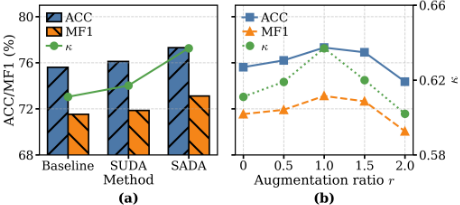
We compare our proposed SADA with two settings: (1) Baseline (no augmentation) and (2) Stage-Unaware Data Augmentation (SUDA), which applies uniform transformations across all sleep stages. As illustrated in Fig. 2(a), SADA consistently outperforms both counterparts. This confirms that tailoring augmentation to stage-specific radar motion sensitivity effectively enhances feature representation. Furthermore, Fig. 2(b) investigates the sensitivity to augmentation ratios, revealing that doubling the training data (ratio = 1.0) achieves the optimal balance between data diversity and performance.
4.6 Hyperparameter Analysis
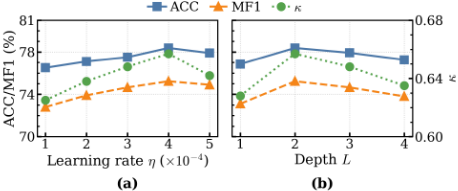
We analyze the sensitivity of XSensorSleep to the learning rate η and the number of BiS4 layers Ls4. As shown in Fig. 3(a), varying η ∈ {1 × 10⁻⁴ , 2 × 10⁻⁴ , 3 × 10⁻⁴ , 4 × 10⁻⁴ , 5 × 10⁻⁴ } reveals that performance peaks at η =
4 × 10⁻⁴ , with smaller values leading to insufficient convergence and larger ones causing training instability. Fig. 3(b) further shows that increasing Ls4 from 1 to 2 improves MF1, while performance saturates beyond Ls4 = 2 and slightly degrades at larger depths due to overfitting. We therefore set η = 4 × 10⁻⁴ and Ls4 = 2.
4.7 Feature Visualization
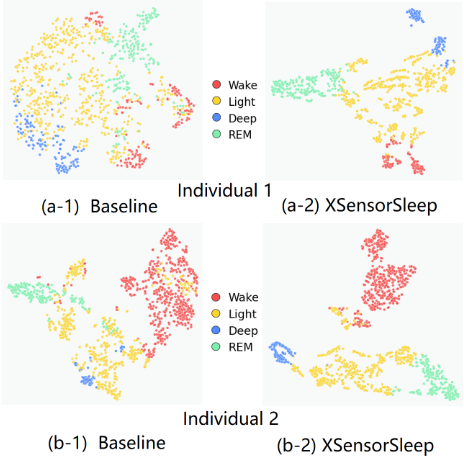
To further evaluate feature quality, we visualize intermediate fused representations using t-SNE [Maaten and Hinton, 2008] for two individuals from distinct environments: one from the Home setting and one from the Hospital setting. Fig. 4(a1) and (a-2) show the feature distributions for the Home individual under the Baseline and XSensorSleep, respectively, while Fig. 4(b-1) and (b-2) present the corresponding results for the Hospital individual. Compared to the Baseline, XSensorSleep yields more compact clusters for the same sleep stage in both environments, indicating improved feature separability and more consistent representations across domains.
5 Conclusion
We propose XSensorSleep, which formulates RF-based contactless sleep staging as a cross-sensor domain generalization problem and enables zero-shot transfer from large-scale belt-based respiratory datasets to unseen radar signals. The framework combines multi-source pseudo-domain partitioning with stage-aware data augmentation and hierarchical alignment at both the epoch and whole-night levels, explicitly addressing sensing-induced distortions and temporal mismatch across modalities. Experiments on home and hospital RF datasets show that these design choices consistently improve feature separability and cross-sensor robustness compared to existing methods.
Acknowledgments
This work was supported by Space Medical Experiment Project of CMSP under grant HYZHXMX01005.
@inproceedings{ijcai2026p473,
  title     = {Cross-Sensor Domain Generalization for Non-Contact Sleep Staging},
  author    = {Deng, Jie and Lu, Zhi and Zhou, Fang and Pu, Yu and Wu, Zhi and Wang, Beilei and Hu, Yang and Chen, Yan},
  booktitle = {Proceedings of the Thirty-Fifth International Joint Conference on
               Artificial Intelligence, {IJCAI-26}},
  publisher = {International Joint Conferences on Artificial Intelligence Organization},
  editor    = {Diego Calvanese},
  pages     = {4251--4259},
  year      = {2026},
  month     = {8},
  note      = {Main Track},
  doi       = {10.24963/ijcai.2026/473},
  url       = {https://doi.org/10.24963/ijcai.2026/473},
}
TY - CPAPER TI - Cross-Sensor Domain Generalization for Non-Contact Sleep Staging AU - Deng, Jie AU - Lu, Zhi AU - Zhou, Fang AU - Pu, Yu AU - Wu, Zhi AU - Wang, Beilei AU - Hu, Yang AU - Chen, Yan T2 - Proceedings of the Thirty-Fifth International Joint Conference on Artificial Intelligence, IJCAI-26 PB - International Joint Conferences on Artificial Intelligence Organization PY - 2026 SP - 4251 EP - 4259 DO - 10.24963/ijcai.2026/473 UR - https://doi.org/10.24963/ijcai.2026/473 ER -Copied
Machine-readable versions of this paper, for tools and AI agents:





